Most kitchen appliances are built to save you time. Far fewer are built to save you from being wrong. That distinction sounds academic until you pull a roast out of the oven, slice into it, and find it is fifteen degrees short of where you promised dinner would be. Or when you open a bag of ice in the freezer and find it has fused into a single gray glacier because nobody used it in three weeks. Or when you scrape a grill grate with a wire brush and quietly wonder whether some of those wires are now destined for a burger.
This is the gap Typhur is trying to close. Typhur kitchen appliances are designed around a single, stubborn premise: the machine should measure the outcome, not count the minutes. Instead of asking you to trust a countdown timer, a vague “air fry” button, or your own fingertip hover over a hot pan, the brand’s hardware pushes sensors, torque management and self-maintenance into places where home cooks normally compensate with guesswork, patience and paper towels.
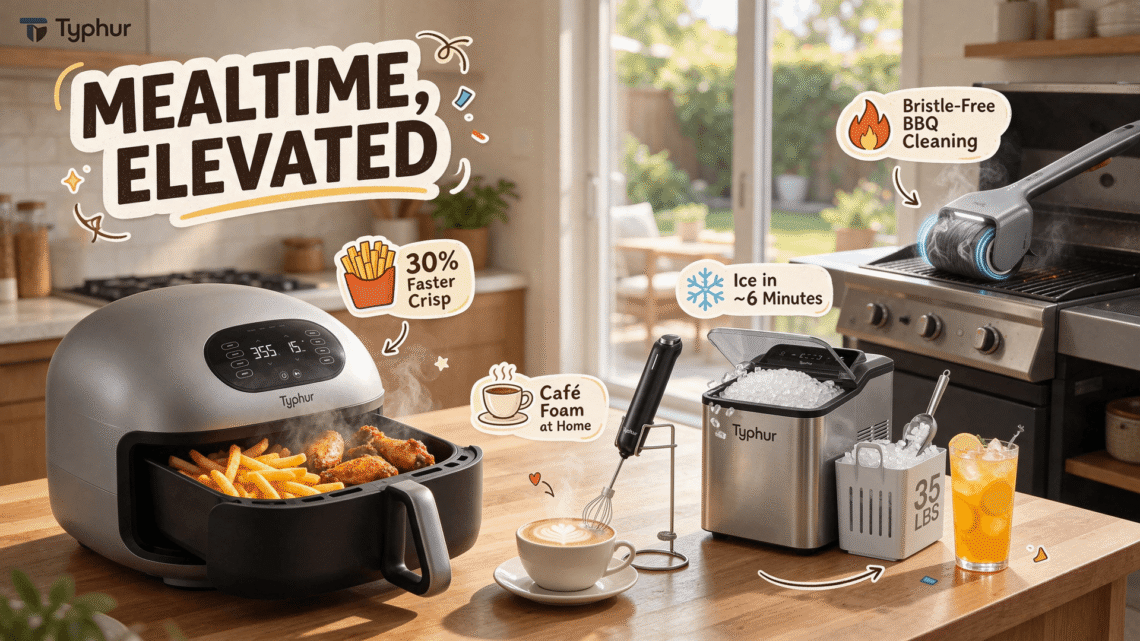
The result is a lineup that looks like a technology portfolio and behaves like a set of very disciplined coworkers. In this article we will walk through the brand’s design logic, then examine four representative machines in detail: the Dome 2 large AI smart air fryer, the InstaWhisk rechargeable milk frother, the countertop nugget ice maker, and the electric grill brush. Along the way you will find spec tables, honest fit notes, and a few calculations that change how you think about ice.
A Brand Built Around One Question: How Do You Know It Is Done?
Typhur entered a category crowded with lookalike boxes and interchangeable claim sets, and it did not lead with capacity numbers or color options. It led with instrumentation. The brand’s premium positioning is visible immediately on its storefront: dramatically lit metallic hardware, matte black surfaces, glowing readouts, and copy that talks about guided cooking and certified accuracy rather than “makes crispy fries in 12 minutes.”
That is a deliberate signal. Precision is a harder promise to make than convenience, and it is much harder to fake. A brand that stakes its identity on measurement has to actually ship measurement.
Typhur’s engineering bench is not thin. The brand sits within the broader orbit of the Joyoung group’s small-appliance manufacturing infrastructure, which gives it access to motor design, thermal engineering and sensor integration at a scale most lifestyle kitchen brands rent from third parties. That industrial depth shows up in unglamorous places: planetary gearing inside a cleaning tool, a high-pressure flush pump inside an ice maker, a ceramic coating specified as PFAS-free inside an air fryer basket.
The award record reinforces the same read. Typhur’s InstaProbe thermometer line has been recognized with both the Red Dot Award and the iF Design Award, and the brand’s Sync 8QT AI smart air fryer took a Red Dot in 2024. Its Sync Oven, a 27-quart countertop convection oven with a built-in wireless meat probe, extends the same thesis upward into a larger format: cook until the food reaches a target internal temperature, and stop there.
💬 The one-sentence version of the brand thesis: Your appliance should be able to tell the difference between “twenty minutes have passed” and “this is ready.”
Three Signals That Give the Typhur Approach Away
- Outcome sensors over elapsed-time defaults. Temperature probes, readouts and guided programs are treated as core hardware, not app garnish.
- Maintenance designed in, not bolted on. Self-cleaning cycles, washable heads and dishwasher-safe parts appear across the lineup because precision collapses when residue builds up.
- Acoustic discipline. Low decibel figures are published as specifications rather than buried in marketing adjectives, which tells you the brand considers noise a engineering problem.
Design Thesis, Side by Side
| Conventional appliance thinking | The Typhur counter-position |
|---|---|
| Add more preset buttons | Add more measurement |
| Bigger capacity is the headline | Consistent result is the headline |
| Cleaning is the user’s chore | Cleaning is a programmed cycle |
| Noise is an accepted trade-off of power | Noise is a spec to be published |
| Coatings are whatever the supplier provides | Coating chemistry gets named |
| Accessories are upsells | Attachments ship in the box |
Meet the Lineup: Four Machines, One Nervous System
Before the deep dives, here is the orientation map. Each product below attacks a different kind of household friction, and together they cover the four verbs of domestic food service: cook, pour, chill, clean.
| Machine | The friction it removes | Signature specification | Best suited to |
|---|---|---|---|
| Dome 2 large AI smart air fryer | Flipping, babysitting, greasy cavity cleanup | 15-in-1 modes, dual top-and-bottom heating, 2-hour self-clean | Families cooking full meals in one appliance |
| InstaWhisk rechargeable milk frother | Splash, dead batteries, one-trick attachments | Stepless 1,600–10,000 RPM, three detachable whisks, USB-C | Daily coffee, matcha, protein and plant milks |
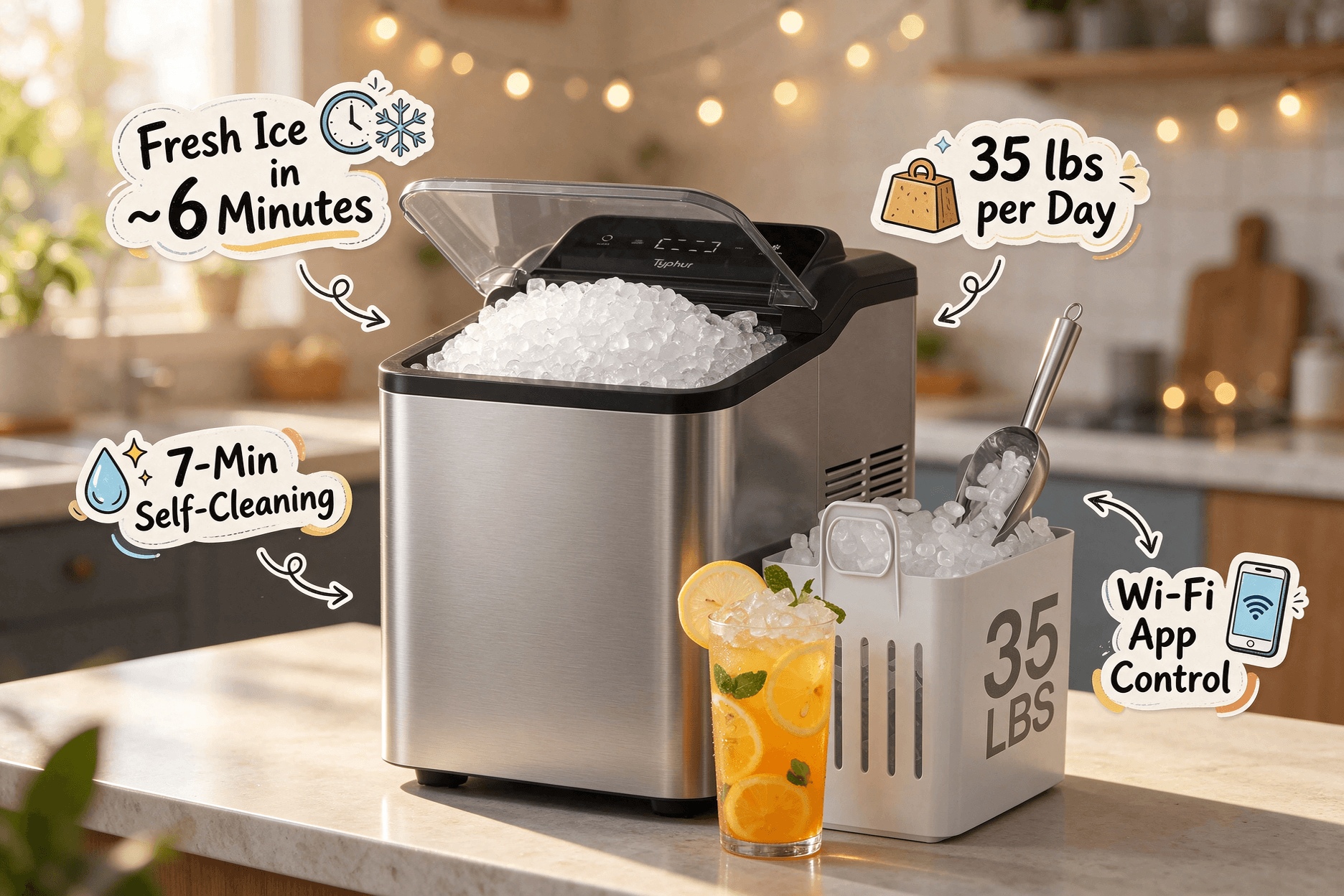
| Countertop nugget ice maker | Frozen clumps, bag storage, mystery buildup | 35 lb per 24 hours, 1.5 L tank, 7-minute self-cleaning pump | Hosts, RV owners, iced-drink households |
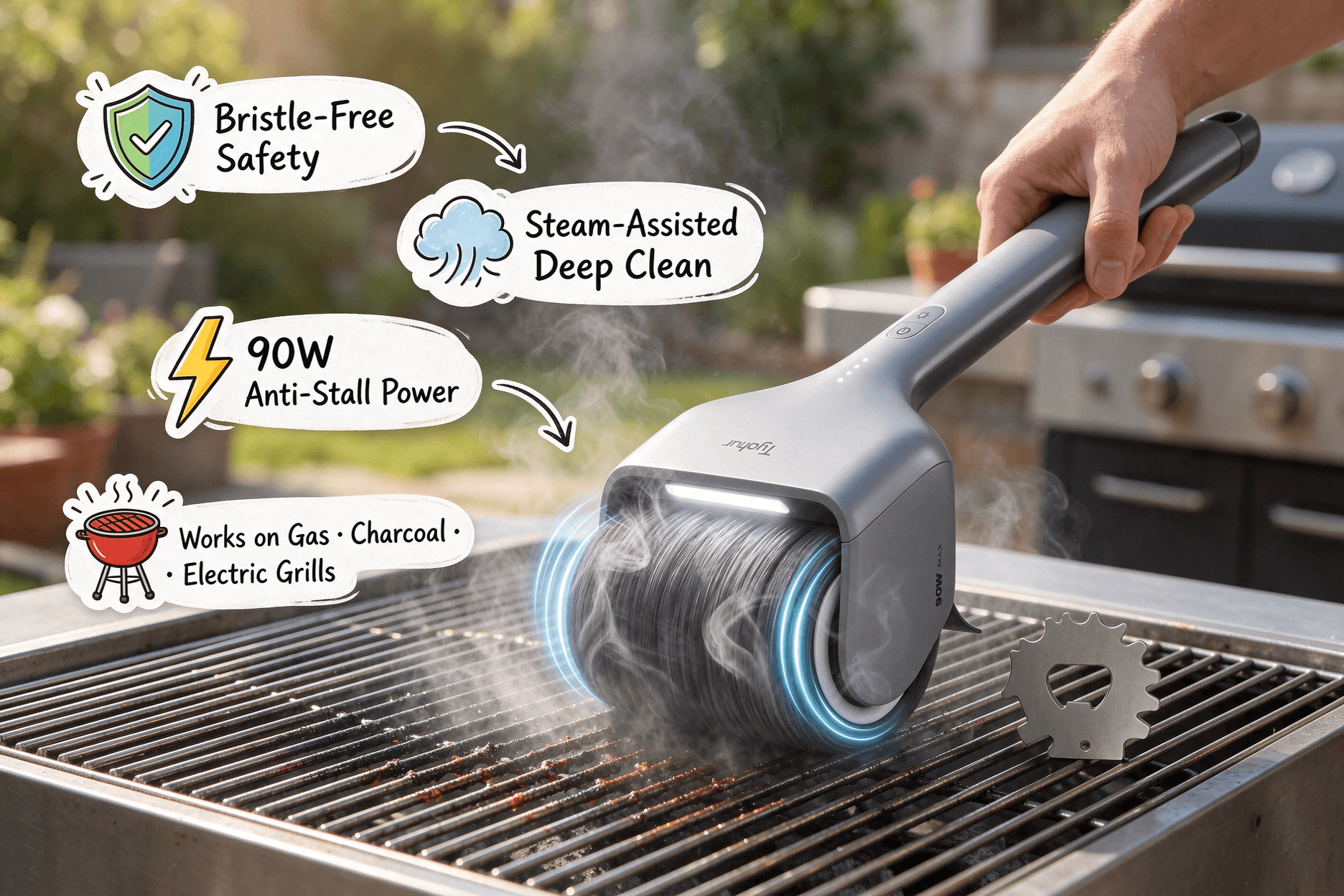
| Electric grill brush | Loose bristles, arm fatigue, burnt-on carbon | 90 W high-torque motor with anti-stall gearing, bristle-free head | Grill owners who care about food safety |
Zone One — The Cook: Typhur Dome 2 Large AI Smart Air Fryer
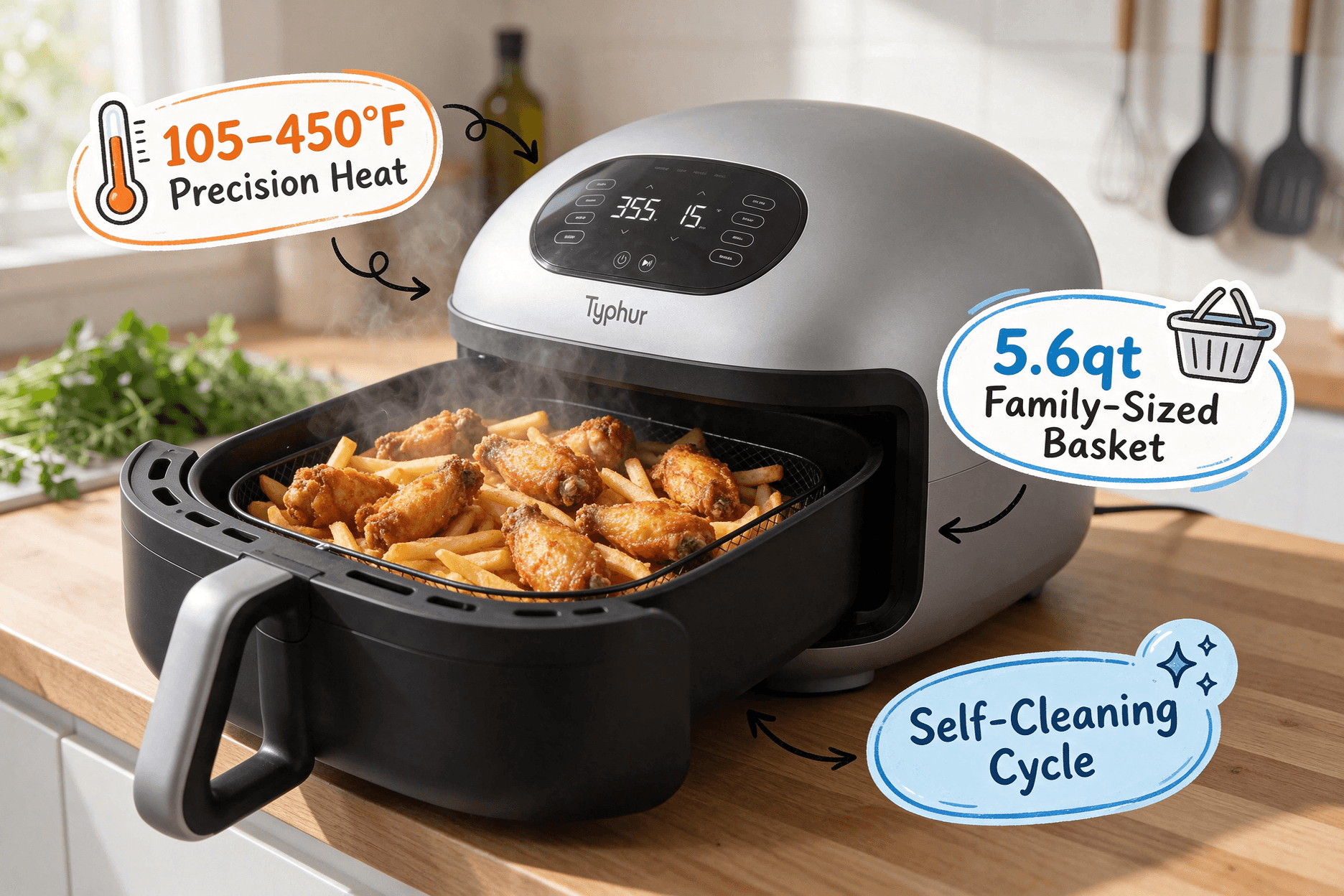
The Dome 2 is the clearest expression of the brand’s philosophy in a single object, and it is also the most physically distinctive. Its domed upper housing is not styling. It is where the second heating element lives, and that placement is the whole argument.
Why the Shape Matters Before the Software Does
A standard air fryer drives heat down from a single source into a basket. The food nearest the top browns; the food at the bottom steams unless you intervene. That intervention is the rattling drawer-pull, the tongs, the “let me just flip the wings” moment when you are otherwise occupied with a child, a phone call, or a second pan.
The Dome 2 heats from both the top and the bottom, which turns the cooking chamber into a more balanced environment. The published claim is cooking up to roughly 30 percent faster with significantly less flipping required. In practice the benefit is not speed alone; it is that the top and bottom of a load converge toward the same result instead of diverging. A tray of vegetables stops being a lesson in spatial politics.
The flat 5.6-quart basket reinforces the same point. Flat capacity is arguably more useful than tall capacity for real dinners, because it lets food lie in a single layer instead of stacking in a pyramid. Typhur illustrates it with two concrete benchmarks: a 12-inch pizza fits, and about 32 wings fit. Those are honest, visualizable numbers, and they tell you this unit is aimed at cooking for people rather than reheating for one.
Fifteen Jobs, One Countertop Slot
The 15-in-1 function set exists to solve a different problem than performance: appliance crowding. At 19.7 inches deep, 15.6 inches wide and 10.3 inches high, the Dome 2 occupies one footprint while proposing to absorb the jobs of a toaster oven, a dehydrator, a rotisserie niche, a proofing box and the oven you currently preheat for 15 minutes to reheat four chicken thighs.
Whether you use all fifteen modes is almost beside the point. The psychologically useful ones arrive in the first month:
- True convection roasting for a weeknight tray dinner, where top heat gives surface color while bottom heat cooks through.
- Reheating that respects texture. Pizza and fried rice come back crisp instead of leathery, which alone justifies the unit for households that currently use a microwave out of habit.
- Dehydration and proofing, the two functions nobody buys an air fryer for and everybody ends up using once they own one.
- Baking, because a 12-inch pizza and a small cake are both just controlled heat in a sealed chamber.
The companion app adds AI-assisted recipe generation, which fits the brand’s measurement theme: rather than handing you a static PDF, it helps translate an ingredient into a program. Treat this as a genuine convenience for the undecided dinner, not a replacement for judgment.
The Part Nobody Advertises: It Cleans Its Own Ceiling
Here is the feature that most reviewers skip and most owners eventually love. Grease and vaporized oil do not stay on the food. They rise, condense on the upper cavity surfaces, bake on cycle after cycle, and slowly turn the inside roof of your appliance into something closer to a restaurant exhaust filter than a kitchen gadget.
The Dome 2 runs a dedicated two-hour self-cleaning cycle for the top cavity, breaking down accumulated oil and residue without you disassembling anything. Consider what this actually protects: flavor neutrality. A carbonized ceiling will impart a faint burnt note to whatever you cook next, and most people misattribute that to the food. It also protects the longevity of the heating assembly and, frankly, your willingness to keep using the machine weekly instead of in motivated bursts before a dinner party.
This is the archetype of a Typhur decision. The brand treats maintenance decay as a threat to precision, so it engineers a cycle rather than a cleaning tutorial.
Quiet as an Engineering Decision
The unit is rated at 51 dB in operation. Numbers like that are easy to shrug at, so here is a reference ladder:
| Decibel reference | Approximate level |
|---|---|
| Whisper, library | 30 dB |
| Typhur Dome 2 operating | 51 dB |
| Normal conversation at arm’s length | 60 dB |
| Typical range hood on medium | 65 dB |
| Vacuum cleaner | 75 dB |
At 51 dB, the Dome 2 sits below conversation level. That matters more in open-plan homes than any spec sheet suggests, because an appliance you cannot tolerate running while people are in the room becomes an appliance you only run in preparation mode. Noise tolerance is the hidden determinant of weekly usage frequency.
The Ceramic Basket and the Coating Conversation
The basket uses a PFAS-free, non-toxic ceramic coating and is dishwasher-safe. Typhur naming the coating chemistry publicly is the meaningful part. In a category where most manufacturers describe coatings as “nonstick” and leave it there, specifying the absence of PFAS is a willingness to be held to a claim. For households with kids, or anyone who has been reading up on cookware surfaces this past decade, this single line item can decide the purchase.
A Realistic First-Week Plan
Rather than vague enthusiasm, here is a sequence that breaks the machine in usefully:
- Day one: Run the two-hour self-clean empty, then wipe the basket. You now know how the cycle behaves.
- Day two: 32 wings, no flipping. Note whether the top and bottom rows finish together.
- Day three: Reheat two pizza slices at low mode. Compare against your microwave baseline.
- Day four: A single-layer vegetable tray at higher temperature, to learn the browning ceiling.
- Day five: A 12-inch pizza, to test flat-basket geometry at maximum diameter.
- Day six: Dehydrate apple slices or herbs, to discover the low-and-slow regime.
- Day seven: Cook a full protein dinner using an app-generated program, and judge the outcome by internal temperature rather than the display countdown.
💬 You, on day two: “I forgot about these for ten minutes and they are evenly browned on both sides.” The Dome 2: “Flipping was never a recipe step. It was a symptom of one-sided heat.”
Zone Two — The Pour: InstaWhisk Rechargeable Milk Frother
At $22.09 list, the InstaWhisk is the smallest ticket in the lineup and possibly the most efficient demonstration of the brand’s instincts. It takes the cheapest, most disposable tool in the kitchen drawer and rebuilds it as a instrument.
Speed Is a Texture Dial, Not a Power Switch
Almost every budget frother on the market offers one speed, because one speed is one motor and one switch. The consequence is that users get whatever the device decides to make: stiff foam when they wanted silk, or warm milk with a lazy swirl when they wanted cold foam.
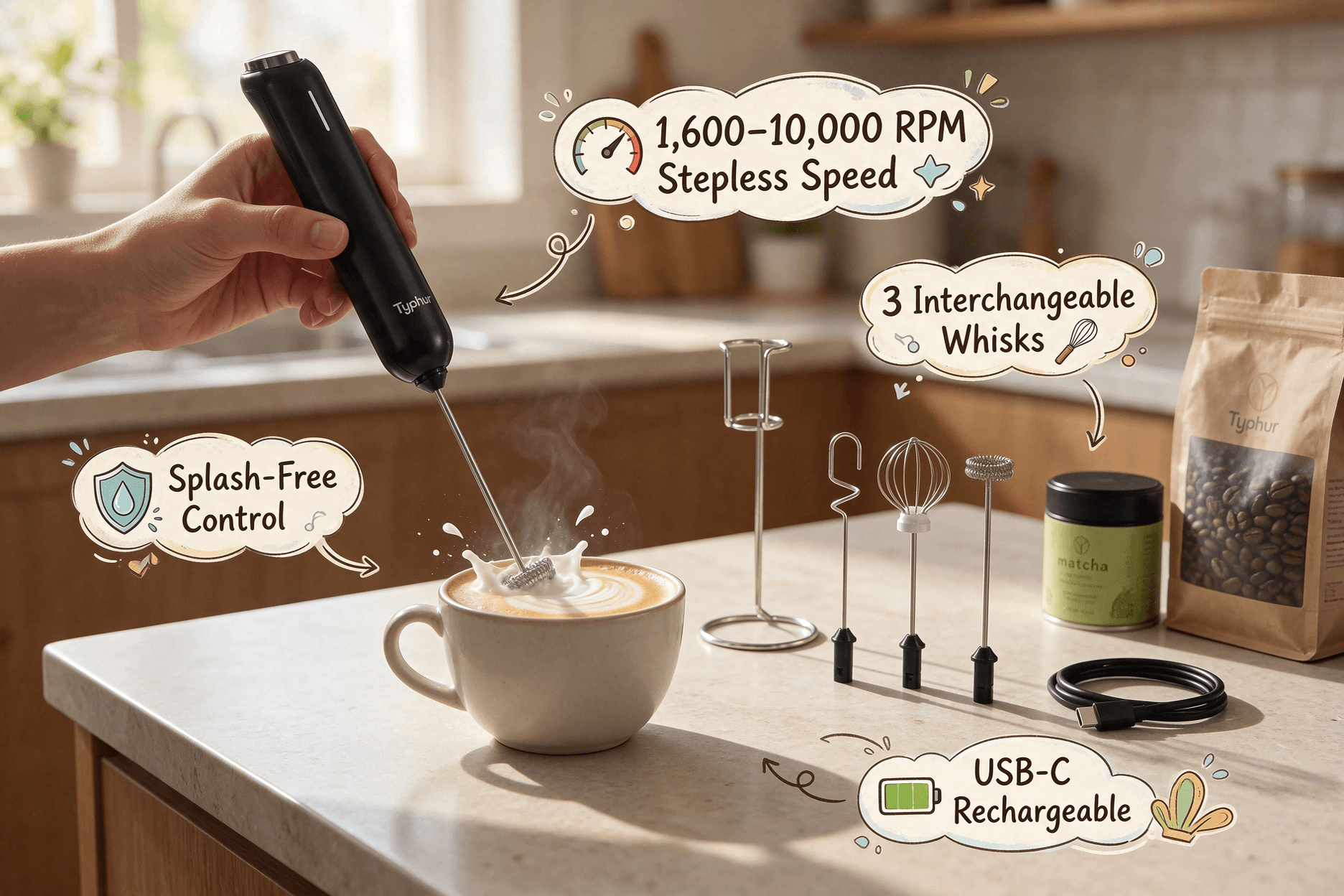
The InstaWhisk provides stepless variable control across a 1,600 to 10,000 RPM range. Stepless is the important word. There are no detents or presets forcing you into someone else’s idea of a setting; you travel continuously along the range and stop where the drink asks for. Typhur frames the endpoints concretely: the low end produces silken hot milk for a latte, the high end builds chilled froth. Between them sits cappuccino foam, matcha dispersion, cold-foam nitro texture and protein-shake de-clumping.
This is precision cooking logic applied to a $22 object, and it is why the tool belongs in a brand story about measurement rather than in a story about gadgets.
Three Heads, Three Different Drinks
The box includes three detachable whisk attachments, a metal stand and a USB-C cable. Looking at the hardware, the set covers the three genuinely distinct jobs:
- The fine coil head for aerating milk into microfoam, where small bubbles and glossy surface matter.
- The balloon-style whisk for volume and structure, useful for meringue-adjacent tasks, pancake batter and larger cup volumes.
- The spiral head for dissolving without whipping: matcha powder, collagen, creatine, cocoa, and any powder that otherwise launches itself onto your counter.
The detachable design does more than save drawer space. It means one head fouled with matcha residue does not contaminate tomorrow’s espresso foam, and washing a removable stainless steel shaft is far easier than rinsing a fixed assembly. The “double whisk” construction Typhur highlights refers to this layered attachment approach: the tool adapts to the drink instead of asking every drink to adapt to the tool.
The Battery Math That Turns It Into a Drawer Tool
The unit carries a 1500 mAh battery, charges over USB-C in about 2.5 hours, and Typhur claims it can go up to a full year on three charges. Even allowing for real-world variation, the implication is structural: this is not a device you manage. It lives in a drawer, stands upright on its metal stand by the coffee machine, and stops being a battery problem entirely.
Compare that with the AA-powered frothers of the previous decade, which reliably died on the morning you had guests. USB-C also means the charger you already own in four other drawers works here. And the body is plastic, which at this price is the correct choice rather than a compromise: a handheld immersion tool should be light, and it should not conduct heat from a 65°C pitcher of milk into your palm.
Splash Is the Real Enemy
The most quietly impressive claim is splash suppression, attributed to weight distribution and low-RPM stability. Anyone who has frothed milk near a light shirt knows the failure mode: the coil breaks the surface, the milk atomizes, and you spend more time wiping than brewing. Balance at low speed is a mechanical problem, and solving it means the low end of the RPM range becomes actually usable rather than merely available.
A Texture Reference Table
| Drink | Head | RPM zone | Target result |
|---|---|---|---|
| Latte microfoam | Fine coil | Low, roughly 1,600–3,500 | Wet-paint sheen, no visible bubbles |
| Cappuccino foam | Balloon whisk | High, 7,000–10,000 | Structured dome, holds a spoon ridge |
| Iced latte cold foam | Fine coil | High, in cold milk | Poured-over-ice cloud, drinkable in one go |
| Matcha | Spiral | Mid | Lump-free suspension, no green grit |
| Almond or oat milk | Fine coil | Mid-low, gently | Uniform texture without separation |
| Protein shake | Spiral | Mid | Complete dissolution, minimal foaming |
| Pancake batter, small batch | Balloon whisk | Mid | Aerated, streak-free mix |
⚠️ One honest note on plant milks. Oat and almond milk froth differently from dairy because their protein and fat structures differ. Baristas routinely use refrigerated, “barista edition” plant milks for stable foam. The InstaWhisk gives you the speed control to work with them properly, but no frother can fix a milk that has no foaming proteins.
Zone Three — The Cold: Typhur Countertop Nugget Ice Maker
Ice is the least glamorous thing in most kitchens and one of the most consistently mishandled. The Typhur nugget ice maker is a study in replacing an accepted annoyance with a scheduled process.
Nugget Ice Is a Texture Argument Worth Having
Hard cube ice is engineered to survive dilution, which is exactly why it is unpleasant. It chips a tooth, floats like a pebble, and refuses to absorb a drink’s flavor. Nugget, or pebble, ice is softer, chewable, and has a far greater surface-area-to-volume ratio, which means it chills aggressively and takes on the taste of whatever it is sitting in.
That last property explains the cult following. In a whiskey sour, a mint julep, an iced tea loaded with lemon, or a cheap boxed cocktail made expensive by dilution control, nugget ice does something cubes cannot. It is also the ice of choice for households with kids and for anyone who chews ice habitually, since it is gentle on enamel.
Thirty-Five Pounds a Day, in a Footprint Smaller Than a Toaster
The output rating is 35 pounds of ice per 24 hours, fed by a 1.5-liter water tank, in a chassis measuring 12.09 inches deep, 8.98 inches wide and 12.36 inches high. Those two facts together are the interesting part. A daily-output figure approaching what a family freezer’s own ice tray produces across a week, delivered from a machine narrower than a sheet of paper is tall, is a genuine achievement in compression of the freezing cycle.
Practically: you will not run out during a party, you will not run out on a heat wave, and you will not be tempted to keep a bag of ice in the freezer where it sublimates into a frost-glued brick. The unit is also marketed for RV use, which is a strong indicator of both its modest power draw and its compact geometry.
The Self-Cleaning Pump Is the Actual Innovation
Every ice maker owner eventually learns the same lesson: the machine’s enemy is not warmth, it is mineral history. Scale from hard water accumulates on the evaporator and inside the water path, quietly reducing output, then introducing cloudiness, then introducing odor. Most countertop units require you to run a vinegar soak, wait, rinse repeatedly, and reassemble, a ritual tedious enough that most people defer it until the machine protests.
This unit includes a one-touch, high-pressure self-cleaning pump that performs an automatic flush in roughly seven minutes. That converts maintenance from a project into a habit. When a cleaning cycle costs you less time than boiling a kettle, you will actually run it monthly, and the machine will hold its output and taste profile across years rather than degrading in the sixth month.
Included accessories, per the listing imagery, extend the concept outward: a dedicated storage basket marked for the 35-pound daily volume and a scoop, so the ice has somewhere to live that is not a plastic bag in a freezer drawer.
Where 50 dB Puts It in the House
Rated at 50 dB, it is quieter than the air fryer and roughly at the level of a quiet refrigerator hum. That determines placement. A 50 dB machine can live on an open kitchen counter, a bedside table in a hotel-style room, or a small RV galley without becoming a complaint. A 65 dB machine can only live in a garage.
The Ice Math, Done Honestly
Here is a calculation most buyers never run. Assume a household that goes through roughly 10 pounds of bagged ice per week in warmer months. At a typical US grocery price of about $4 to $6 per 10-pound bag, that is approximately $16 to $24 per month, or roughly $100 to $170 across a six-month season.
Now the machine: listed around $135.15 at the time of writing, against a typical price near $143.10. Electricity for a small countertop ice maker over a season is generally in the tens of dollars, not hundreds, though your rate and ambient temperature swing that figure. Water cost is negligible in practical terms.
| Path | Season cost, approximate | Trade-off |
|---|---|---|
| Bagged ice, 10 lb/week | $100–$170 | Storage clutter, freezer burn, plastic waste, run-outs |
| Countertop nugget maker | ~$135 machine + modest power | Counter space, monthly flush cycle, always on demand |
Even with conservative assumptions, the machine tends toward payback inside a season or two for an ice-heavy household, and the intangible gain is bigger than the arithmetic: never deciding you are out of ice at the moment you needed it.
- Fill the tank in the evening and wake to a full batch.
- Run the seven-minute pump flush monthly, more often in hard-water areas.
- Use filtered or low-mineral water if your tap water is scale-prone; you will extend intervals between flushes.
- Move finished ice to the storage basket rather than letting it melt in the production chamber.
Zone Four — The Cleanup: Typhur Electric Grill Brush
The grill brush is where the brand’s safety instinct is most obvious, and where a $79.99 tool replaces something that usually costs eight dollars. Understanding why requires remembering what wire-bristle brushes actually are.
The Bristle Problem Is Older Than Most Grills
Traditional grill brushes achieve scraping force by embedding stiff wire bristles into a block. Over seasons of heat cycling and impact, those bristles loosen and shed. Because the brush is used immediately before food touches the same surface, shed bristles can end up on the grate, then in dinner. Emergency departments have documented cases of ingested and aspirated wire bristles for years, and the warning has been persistent enough that the category’s future is clearly bristle-free.
Typhur’s head replaces wire bristles with stainless steel mesh wrapped around a resilient sponge. The mesh provides abrasion against carbonized residue; the sponge provides compliance so the head conforms to grate contours instead of skittering across them. Nothing is plated, glued or stapled in a configuration prone to shedding fragments into food.
Anti-Stall: Torque Is the Feature
The more interesting engineering claim is the 90 W high-torque motor with planetary gearing, marketed as anti-stall technology. Here is what that means in a hand.
Cheap electric scrubbers use small, high-RPM, low-torque motors. Press one against burnt-on residue and the motor cannot overcome the friction, so the shaft stops. Users then press harder, which stalls it further, and the tool either jams or jumps out of control. Arm fatigue, uneven cleaning, and the sense that the tool is fighting you all follow from one inadequate torque curve.
Planetary gearing trades spin for holding power. Under load, the head keeps turning instead of giving up, which means the work is done by the machine’s gearing rather than your shoulder. Consistency follows: the same pressure across the grate produces the same result across the grate. Listed at $79.99 against a typical $99.99, this is priced as a durable power tool rather than a seasonal consumable.
Steam, Not Just Scraping
The head supports a steam deep-clean technique: dampen the head, then press it against a preheated grate around 400°F. The water flashes to steam at the grate surface, loosening polymerized grease that abrasion alone would need many passes to remove. This is a real method used by pitmasters with wet balled-up foil; the product’s contribution is doing it with controlled, powered, repeatable contact instead of an arm-wrestle with a sheet of aluminum.
The Details That Reveal the Design Thinking
- IPX7 waterproof body, so the whole tool rinses under a tap instead of being wiped delicately.
- USB-C charging, matching the frother’s ecosystem and the cable already in your bag.
- Built-in LED light, because grilling ends after sunset and char is invisible in the dark.
- Detachable scraper accessory for stuck-on deposits the mesh will not shift in one pass.
- Dishwasher-safe cleaning head, which removes the most unpleasant step in grill maintenance: handling the filth you just collected.
💬 You, mid-scrape: “It is not slowing down when I push harder.” The brush: “Correct. That was always your job before this existed.”
A Safe Working Sequence
- Preheat the grate to roughly 400°F and let the surface heat evenly for a few minutes.
- Dampen the head, do not soak it dripping, then run the brush along the grate to raise steam.
- Work in short passes with moderate pressure; let the gearing do the exertion.
- Use the detachable scraper on any residue the mesh will not release.
- Let the head cool, then rinse the body under a tap or run it through the dishwasher.
- Charge over USB-C and store where the head is not crushed against tools.
How the Four Pieces Talk to Each Other
Individually these are four competent products. Together they demonstrate a coherent design language, and that coherence is the actual brand argument.
Every machine shares a set of decisions: USB-C across the ecosystem, published noise figures instead of adjectives, self-maintenance built into a cycle, replaceable or washable heads instead of whole-unit disposal, and named material chemistry instead of vague “premium finish.” Nothing in the lineup asks you to buy a proprietary charger, accept a loud motor, or perform maintenance the manufacturer did not bother to engineer.
A Saturday, Mapped Across the Lineup
| Time | Task | Machine doing the work |
|---|---|---|
| 09:30 | Batch coffee, cold foam on two iced lattes | InstaWhisk, fine coil at high RPM |
| 11:00 | Fill the ice tank, start the production cycle | Nugget ice maker |
| 12:30 | Marinate wings, start the 15-in-1 program | Dome 2 |
| 14:00 | Preheat and steam-clean the grill before guests arrive | Electric grill brush |
| 15:00 | Roast vegetables in a single layer, no flipping | Dome 2 |
| 16:30 | Ice drinks, nugget ice in the basket | Nugget ice maker |
| 18:00 | Matcha for after dinner | InstaWhisk, spiral head at mid RPM |
| 19:30 | Run the Dome 2 top-cavity self-clean while you relax | Dome 2, two-hour cycle |
Notice what is missing from that schedule: babysitting, deferring cleanup, driving for ice, and worrying about whether a wire ended up in somebody’s lunch. That absence is the product.
Buying With Your Eyes Open: Honest Fit Notes
A promotional article that admits nothing is worth less than one that does. So here is where the lineup asks for scrutiny.
Where These Are Overkill, and That Is Fine
- The Dome 2 is physically large. At 19.7 by 15.6 by 10.3 inches, it needs a real counter zone or a planned cabinet home. A household of one cooking for one may find a compact unit more proportionate.
- The ice maker earns its place only in ice-heavy households. If your freezer already handles a tray adequately and you rarely serve drinks, the counter space is a poor trade.
- The grill brush is a premium tool in a consumable category. It makes complete sense for frequent grillers. Occasional summer users may still hesitate at the price gap versus a disposable wire brush, even knowing the bristle risk.
- The frother has no heating element. It textures milk; it does not steam it. Espresso drinkers still heat first, which is normal for a handheld wand at this price.
What to Check Before You Commit
- Measure your counter depth, not just width. Deep appliances collide with backsplashes and toe-kicks.
- Know your water hardness before buying an ice maker; it sets your realistic flush interval.
- Count your outlets. USB-C charging docks can live in a drawer between uses, which is preferable to occupying a wall socket.
- Read the warranty and replacement-part terms for consumable heads on the grill brush and whisks.
- Treat published dB and output figures as laboratory conditions. Real kitchens are hotter, louder and more crowded than test setups.
On Pricing and Claims
All prices quoted here were current on the listings at the time of writing and will move with promotions and season. Likewise, figures such as 35 pounds per 24 hours, 51 dB and 30-percent-faster cooking are manufacturer-published benchmarks measured under controlled conditions. They are useful for comparing this lineup against the category, and they are not promises about your specific Tuesday evening.
Field Notes: Six Principles the Lineup Encodes
Beyond specs, Typhur’s catalog reads like a position paper on what consumer hardware owes the people using it.
- Measure the result, not the duration. Time is a proxy. Temperature, texture and completion are the actual targets.
- Design the cleaning, not just the use. Every appliance degrades through neglect, and neglect is a design failure, not a user failure.
- Publish the uncomfortable numbers. Decibels, watts, RPM ranges and coating chemistry are all things a brand can hide. Naming them is a commitment.
- Name the material you put near food. If a surface touches your family’s meals, its composition belongs in the description.
- Make accessories removable before you make them clever. Washable, replaceable parts outlive clever integrated ones.
- One charging standard across the whole house. USB-C is a respect signal: it says the brand is not building lock-in.
💬 The reason this matters beyond one kitchen: Most small appliances compete on being cheaper. Typhur competes on being more trustworthy, and trust is built from specifications nobody would bother to fabricate.
Frequently Asked Questions
Is Typhur a good brand for serious home cooks?
The lineup is built for people who care about repeatability rather than novelty. Outcome measurement, published noise ratings, self-maintenance cycles and named material chemistry all point at users who have been burned, literally and figuratively, by appliances that performed well in reviews and poorly in real kitchens. The award recognition on the thermometer and air fryer lines supports the same read from an independent design perspective.
Is the Dome 2 air fryer loud during operation?
At a published 51 dB it sits below normal conversation level, roughly comparable to a quiet room hum. It should not interrupt talking in an open-plan kitchen, though any fan-driven appliance remains audible in a completely silent room.
Can a handheld frother really make cappuccino foam?
Yes, with the right head and enough RPM. Stiff foam needs a high-speed balloon-style whisk and cold or heated milk with adequate protein content. The limitation is usually the milk, not the tool. Stepless control up to 10,000 RPM is what separates a frother that can genuinely build structure from one that merely agitates.
Do countertop nugget ice makers use much electricity?
They draw comparable power to a small appliance and run in cycles rather than continuously. Cost depends on your rate, ambient temperature and how often you request ice. For a household that otherwise buys bagged ice weekly, the machine’s energy cost typically stays well below what the bags would have cost across the same period.
Are bristle-free grill cleaners effective on heavy buildup?
Effectiveness comes from torque and abrasion rather than from wire stiffness. A 90 W motor with planetary gearing maintains drive under pressure, and the steam technique on a 400°F grate loosens polymerized grease before abrasion even starts. The one adjustment is psychological: you will use less downward force than you learned with a manual wire brush, because the gearing is doing the pushing.
Which Typhur product should a first-time buyer start with?
Start with the appliance that replaces the frustration you complain about most often. If that is burnt, uneven or babysat cooking, the Dome 2 is the anchor purchase and the one that changes how dinners get made. If it is ice scarcity or the cost of bags, the nugget maker delivers visible daily value. If it is morning coffee, the InstaWhisk is the lowest-risk entry point in the entire lineup, both in price and in the fact that it never occupies counter space when not in use.
Final Word
The home kitchen spent the last two decades getting smarter in ways that were mostly about connectivity: an app, a screen, a voice assistant bolted onto an otherwise conventional heating box. Typhur’s approach is less showy and more useful. Its Typhur kitchen appliances put the intelligence into the mechanics, into where the second heating element sits, how a motor behaves under load, what a coating is made of, how long a cleaning cycle takes, and whether a device can go a year between charges.
Four products, four verbs: cook, pour, chill, clean. None of them is revolutionary in isolation, and all of them refuse to accept the small resignations that most of us have quietly made about our kitchens. The timer stops being the authority. The frother stops being one trick. The ice stops being a shortage. The grill brush stops being a risk.
That is a brand worth paying attention to, because the promise is not that your cooking will become dramatic. It is that it will stop going wrong in the specific, unglamorous ways that ruin an evening. Precision, in the end, is not about perfection. It is about never having to wonder.