
There is a particular kind of defeat that every dog owner learns by heart. It is the 2 a.m. itch. It is the cat who suddenly dislikes being touched along the lower back. It is the walk that turns into a surveillance mission, because somewhere in the tall grass by the trailhead, something was waiting. PetArmor is a brand built for exactly that moment—not for the drama of it, but for the boring, repeatable, monthly discipline of winning it.
The premise is disarmingly simple. The parasites that bother our pets are not mysterious, and the tools that stop them are not exotic. What is hard is consistency, correct dosing, and a price that a household can actually sustain for twelve consecutive months. That is the gap PetArmor occupies: professional-grade active ingredients, sold over the counter, packaged by weight band and species, designed to be applied on the kitchen floor by an ordinary person on an ordinary Tuesday.
This is not an advertisement for a bottle. It is an introduction to a system—what the brand stands for, how its four main formats fit together, and how to build a year-round routine that holds when the season turns.
Fleas Do Not Start on the Dog. They Start in the Calendar.
Before any product makes sense, the enemy needs to be understood correctly, because most owners lose this fight in the framing rather than in the application.
The instinct is to treat pets reactively: fleas appear, a treatment is bought, fleas vanish, the treatment stops. Meanwhile the actual infestation was never primarily on the animal. Adult fleas on a pet represent a small fraction of the total population; the rest are eggs, larvae and pupae sitting in the carpet fibers, the seams of the couch, the pet bed, the crack under the rug. A flea lays eggs continuously, those eggs hatch into larvae that feed in the dark, and the pupae hide inside protective cocoons that sit dormant until vibration and warmth tell them a host has arrived.
That last detail is the one that ruins plans. The cocoon does not care about the season. It cares about a signal. This is why a house can look clean all winter and then erupt in March, three days after the first warm afternoon when somebody opens a window and a dog rolls on the rug.
Four consequences follow, and they define everything PetArmor sells:
- Treating only the visible pet is treating the symptom. The environment has to be addressed too, or the same couch reinfests the same dog on a loop.
- A break in coverage is not neutral. It is a window. Thirty-one days between doses is not a minor lapse; it is enough time for a generation to develop.
- Seasonal thinking fails in temperate climates. In a Florida apartment or a heated Ohio garage, the calendar in the pest’s favor never fully flips.
- Speed matters differently in two scenarios. Routine prevention wants long, slow, steady release. A dog already biting itself wants something that works before anyone loses sleep.
A serious flea and tick prevention brand does not sell one product. It sells answers to those two different scenarios, plus the house, plus the long clock. That is precisely the shape of the PetArmor lineup.
What PetArmor Is—and, Just as Important, What It Is Not
PetArmor is an over-the-counter pet parasiticide brand whose whole identity rests on one proposition: the chemistry used in prescription flea and tick control is not itself expensive, and access to it should not be. The active ingredients in its flagship topical are the same molecules veterinary clinics hand out in glossy boxes. The tagline on the brand’s own storefront—you are your pet’s armor—says something subtler than “buy our product.” It places the owner, not the bottle, in the defensive role. The product is the equipment. You are the armor.
The store’s supporting language is equally plainspoken: pets are family, simple pet care should be easy, and owners should be able to treat their animals at home with confidence. That is a deliberate posture. It assumes the customer is capable, informed enough to be taught, and unwilling to pay a premium for branding.
Three clarifications keep the introduction honest:
- It is not a prescription brand. Nothing here requires a veterinary visit to purchase, which is exactly the point—and also a limit, addressed further down.
- It is not a single product with variations. It is a small toolkit of formats with genuinely different mechanisms, speeds and durations. Using one badly substitutes for none of the others.
- It is not a “natural” or repellent-only brand. The core of the range is chemical parasiticide. Anyone seeking essential-oil-based approaches is shopping a different shelf.
Callout — the one-sentence version PetArmor makes vet-quality flea, tick and chewing lice treatment for dogs and cats without a prescription, sized by weight band, in four formats: a monthly spot-on, a long-wearing collar, a fast-acting oral tablet for active infestations, and sprays and foggers for the house itself. Retail on the brand’s Amazon storefront runs roughly from the low teens to about forty dollars depending on format and pack size.
The brand’s real innovation is therefore not molecular. It is logistical: making professional protection cheap enough, clear enough and available enough that a household will actually keep it up all year. In parasite control, adherence beats elegance. A perfect protocol applied three times a year loses to a good protocol applied twelve times.
The Four Formats, and Why One of Them Is Not Enough
The monthly spot-on: the backbone of the system
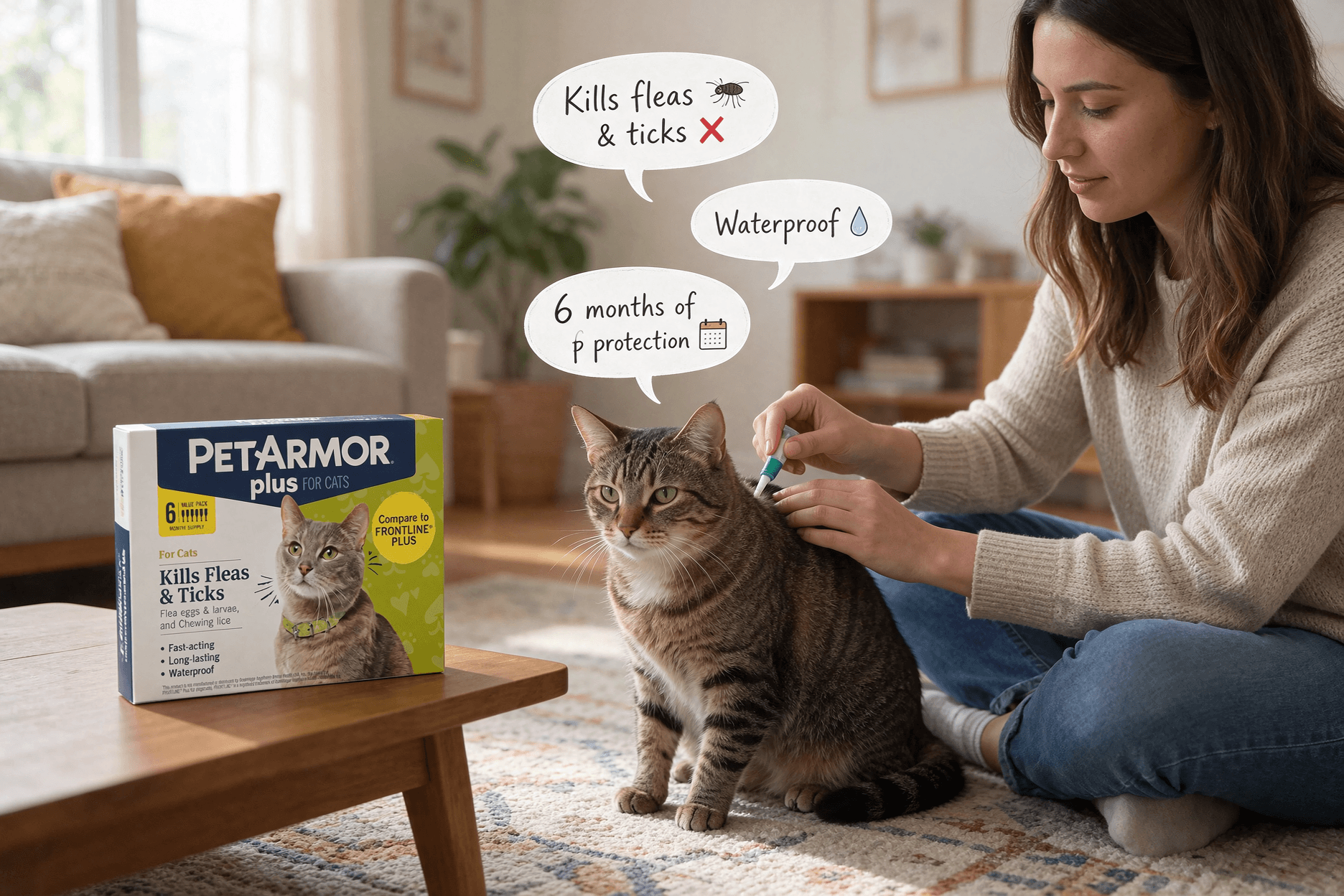
PetArmor Plus for dogs and PetArmor Plus for cats are the flagship treatments—topical solutions applied to a patch of skin at the base of the neck, where the animal cannot lick it off. The formulation pairs two actives with two jobs. One kills the adults that are already on the animal: fleas, ticks and chewing lice. The second is an insect growth regulator that interrupts reproduction, destroying flea eggs and larvae so the infestation cannot recruit the next generation. Breaking the flea life cycle is the difference between knocking numbers down and driving them toward zero.
Practical characteristics that matter more than the marketing:
- Coverage is monthly, so the calendar is the dosing schedule.
- The treatment is water-resistant once dried, which means beach weekends and rainy walks do not automatically reset the clock—but heavy, repeated bathing can.
- Weight bands are real, not decorative. The small-dog formulation is rated for a specific range beginning around five pounds, and stepping up or down between bands changes the amount of active ingredient delivered.
- Cat and dog versions are separate products for a reason that deserves its own section.
The collar: the long clock
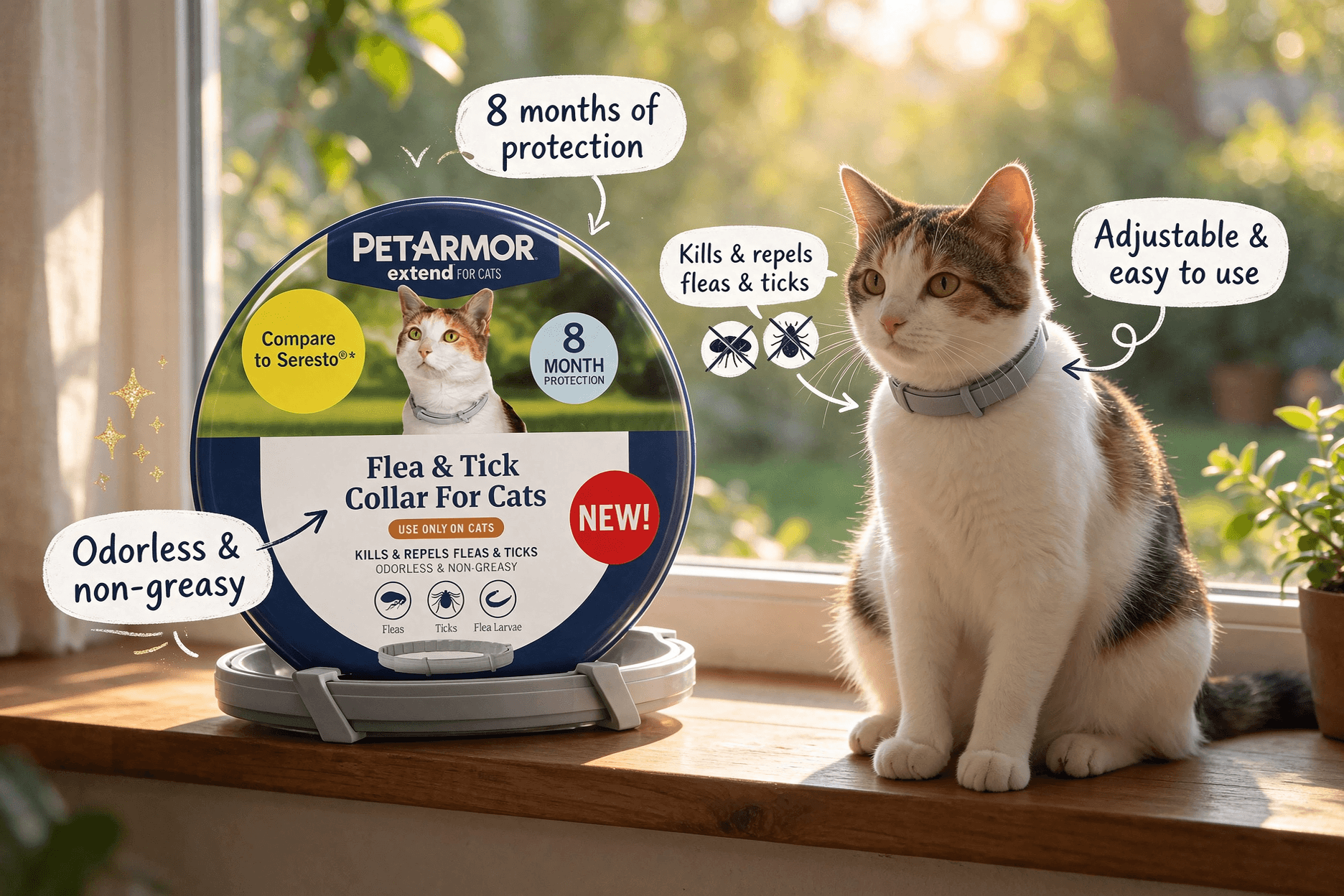
Where a spot-on asks an owner to remember, a flea and tick collar asks only to be fitted once and then left alone. PetArmor’s collars release actives slowly through the coat over an extended window—pack sizes on the storefront run to six-month supplies, and the range includes extended-duration protection rated for many months of continuous coverage.
A collar is the right answer for specific people: the owner who travels, the household with a dog who hates bottles, the multi-pet home where remembering fourteen applications a year is unrealistic. It is the wrong answer as a sole defense during an active infestation, because slow release is exactly that—slow.
The oral tablet: the ninety-minute conscience
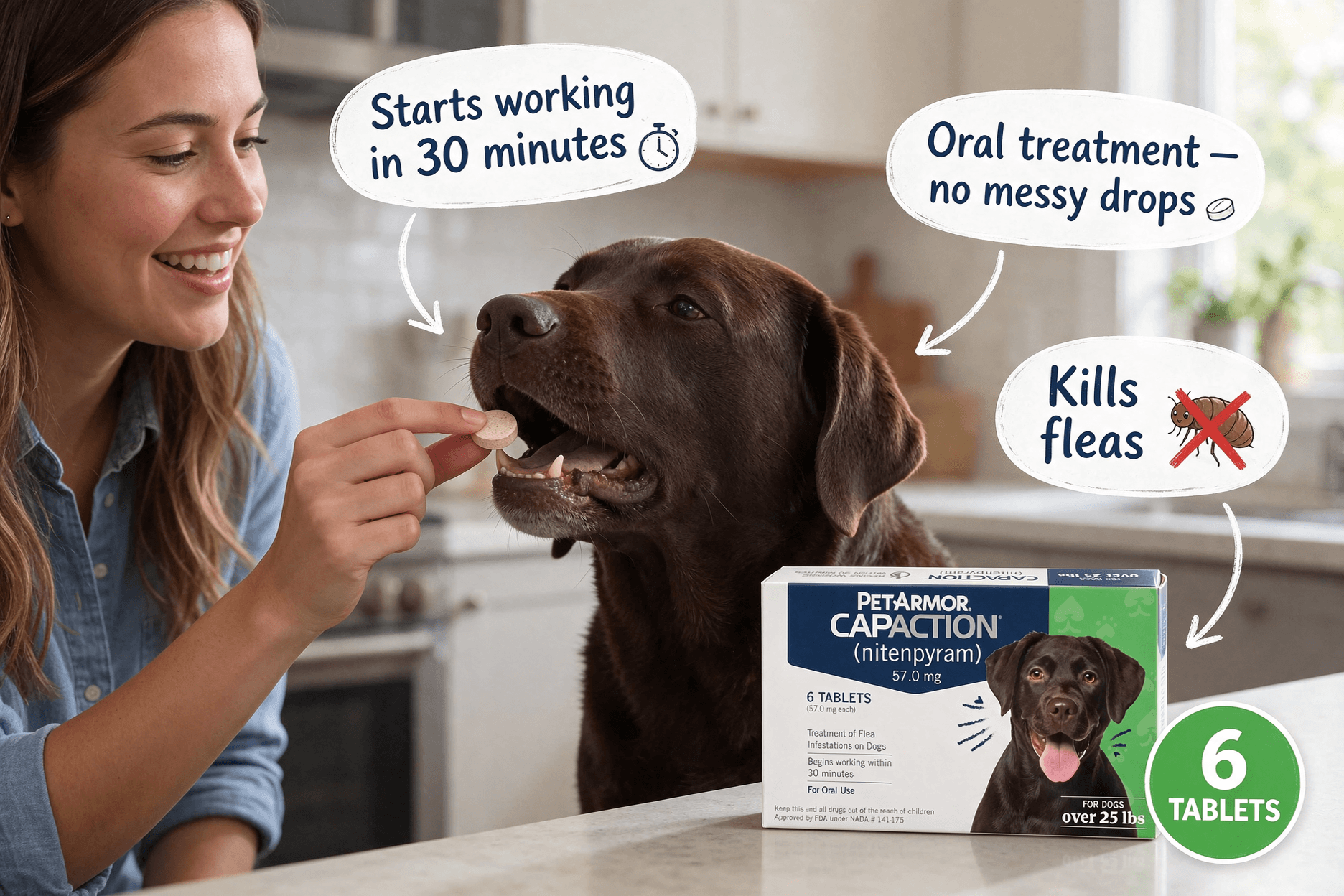
CapAction is the odd one out and the most useful thing in the drawer when things are already bad. It is a flavored tablet given by mouth, containing an active that works systemically in the bloodstream rather than on the skin, and it begins killing adult fleas within roughly thirty minutes of ingestion.
Its role needs to be understood precisely, because misunderstanding it causes complaints:
- It is a rescue tool, not prevention. It clears the adults on the animal right now.
- It does not persist for a month, and it does not address eggs, larvae or the couch.
- It is available for both dogs and cats, which makes it uniquely useful when one anxious animal needs immediate relief while the long-acting protocol catches up.
The house: sprays and foggers
Environmental control closes the loop. Home and yard products target carpets, upholstery, pet beds and crates—the reservoir stages of the life cycle that pet-directed treatments never reach. Used alone they achieve little, because the animal keeps repopulating them. Used alongside a monthly topical during an active infestation, they are what turns a recurring problem into a solved one.
| Format | Speed to effect | Duration per use | Kills adults | Hits eggs & larvae | Treats the house | Best for |
|---|---|---|---|---|---|---|
| Spot-on (PetArmor Plus) | Hours | ~30 days | Yes | Yes | No | Default year-round backbone |
| Collar | Days | Many months | Yes | Varies by formula | No | Forgetful schedules, water exposure |
| Oral tablet (CapAction) | ~30 minutes | Same day | Yes | No | No | Active infestation, urgent itch |
| Home spray / fogger | Days to weeks | One-time per treatment | Some | Yes | Yes | Carpets, furniture, reinfestation cycles |
Reading the Label Like a Pharmacist, Not Like a Shopper
Most product dissatisfaction in this category is not a chemistry failure. It is a dosing or expectation failure, and both are legible on the package before anyone buys.
Five habits separate owners who get results from owners who leave frustrated reviews:
- Match the species first, the weight second. Dog and cat formulas are not interchangeable. This is the single most consequential rule in the whole post. Certain actives and concentrations tolerated by a dog can seriously harm a cat, and a cat’s grooming behavior means anything applied to a cat’s skin must be a cat-designed product. Buy “for cats” for cats. Never split a dog tube to cover a cat.
- Weigh the animal, do not estimate the animal. “He looks like a 30-pound dog” is how weight bands get misapplied. A dog on a good protocol for eight months can be a dog under-dosed for eight months. A bathroom scale, minus your own weight, takes ninety seconds.
- Check the age floor. Puppy and kitten ages are printed for a reason, and young animals are not small adults.
- Know what the product promises before it is opened. A tablet that kills adult fleas in thirty minutes does not promise a month of egg control. A collar rated for months of protection does not promise same-day relief. Every complaint I have seen in this category traces back to a promise the label never made.
- Treat the whole household, or treat nothing effectively. One protected animal in a three-animal house is a partially defended perimeter. The unprotected ones become internal reservoirs.
Conversational — the question that comes up in every group chat “My dog got wet the day after I applied the spot-on. Did I waste it?” Almost certainly not. Once the application site has dried, the formulation is water-resistant, and normal rain, a pond, or a bath after that point does not strip the protection. What does degrade it is repeated, aggressive bathing with detergent in the days immediately before and after application. If the animal needs medicated baths on a schedule, that conversation belongs with the veterinarian, and the timing belongs on the calendar.
The Application Ritual: Twelve Minutes, Once a Month
The spot-on is where most people feel least confident, and it is the format with the highest leverage. Here is a sequence that works on dogs who squirm and cats who object.
- Choose the moment. Low light, after a walk, when the animal is already tired. Do not apply immediately before or after bathing.
- Prepare the surface. Paper towel on the floor, applicator uncapped within arm’s reach. Do not hold a tube and chase a cat simultaneously.
- Part the coat to skin, not fur. The product must reach skin. At the base of the neck, between the shoulder blades, the coat is thick and the tip of the applicator needs to press through.
- Apply in the spots the label specifies, in the volume the label specifies. Splitting a dose across the defined regions is part of the design, not an option.
- Keep animals apart until dry—relevant in multi-pet homes where one animal will groom another’s freshly treated patch.
- Wash your hands. Log the date. A phone calendar entry titled “flea + tick, monthly” is worth more than any product choice, because it converts intention into an event that fires.
Two more habits worth adopting: dispose of the applicator the same minute it is empty, and store unused doses somewhere a curious animal cannot investigate. Neither is glamorous. Both prevent the sort of incident that turns a prevention routine into an emergency visit.
The Price Question, Answered Without Apology
The elephant in the room: why is this cheaper than the prescription equivalent, and should that be suspicious?
The honest answer is that the molecules are old, the patents are long expired, and manufacturing capacity is not scarce. What is expensive in the veterinary channel is not the chemistry—it is the consultation, the packaging, the clinic margin, and the brand equity built over decades of advertising. An over-the-counter parasiticide using the same active ingredients skips most of that cost stack.
What that reasoning does not license is sloppiness. Lower price means the label, the weight bands and the storage rules matter more, not less, because nobody is standing between the product and the pet with a dosage chart. The value is only realized by an owner who reads the band, matches the species, applies on schedule and treats the environment when needed.
Consider what the arithmetic buys. If a year of protection costs a few hundred dollars spread across twelve months, that is less than a single unplanned visit for flea allergy dermatitis, and dramatically less than treating tick-borne illness, which is the outcome the tick portion of the label exists to prevent. Prevention is not cheap because it is thin. It is cheap because it is manufactured at scale—and it is cheap relative to the alternative.
A Twelve-Month Protocol That Does Not Require Perfect Memory
Rather than describing products, it helps to describe a year. The following is a template; local tick pressure, climate and household composition shift the details.
| Period | Focus | Move |
|---|---|---|
| Late winter | Resume before the threat | Restart monthly spot-on on every pet; check expiration dates on stored doses |
| Spring | Environment catch-up | First full application plus home treatment for carpets and beds if last season ended poorly |
| Early summer | Peak vigilance | Monthly on time; inspect coat after each hike, especially belly, ears, armpits |
| Midsummer | Water exposure | Continue as normal—water resistance holds; avoid repeated bathing |
| Late summer | Larvae in the house | Second environmental pass; watch for itch returning indoors |
| Autumn | Tick season tail | Do not stop early; the most common failure is November optimism |
| Early winter | Decision point | Continue year-round if the climate is mild or pets go outdoors; collars suit this stretch |
| Deep winter | Maintenance | One monthly dose, one inventory check, one scale reading |
The single most valuable row is autumn. Owners stop in November, larvae survive, and April starts again from scratch. Year-round flea and tick prevention is not a sales pitch from the industry; it is the observation that dormant pupae do not read calendars.
Multi-Pet Households: Where the Math Gets Friendly
Here is where an affordable brand earns its keep, because cost scales with heads, not with hope.
- Inventory by head, not by box. Three animals on monthly topicals means thirty-six applications a year. Buying six-month supplies rather than three-packs cuts reorder friction and usually the per-dose cost.
- Species-specific stock, physically separated. Two similar-looking boxes, one for dogs and one for cats, stored in the same basket, is an accident waiting for a dark hallway. Keep cat products in a different room.
- One calendar entry, not three. A single recurring reminder labeled “all pets, parasite month” with a checklist beats three separate notifications that fire on different days.
- New arrivals get treated into the schedule, not after it. Bringing home a foster, a puppy or a rescued adult is the classic moment an unprotected animal imports a problem into a protected household.
There is a quiet emotional dimension here too. Multi-pet owners often describe guilt about the cost of care—the vet bills, the food, the insurance that is barely affordable. A brand positioned around accessible, vet-quality protection exists for that person specifically: the one who would otherwise quietly skip a month because the clinic quote stung.
When PetArmor Is Not the Answer
Any introduction that does not describe its own limits is not an introduction; it is a brochure.
Talk to a veterinarian rather than relying on over-the-counter prevention when:
- The pet is on medication for another condition, or has a history of sensitivity, seizures, or skin disease.
- The animal is very young, very old, under the lowest published weight band, or a breeding or nursing dam.
- Flea allergy dermatitis is suspected—where a few bites trigger intense inflammation and the protocol becomes medical.
- Ticks are attaching despite correct use, which suggests either an application error, a species mismatch, or a local population under pressure from a specific life stage.
- The household includes humans with skin complaints after pet contact, which raises mites or other diagnoses outside this shelf entirely.
- A regional disease risk is in play. Tick-borne illness prevention involves more than exterminating the tick, and that conversation belongs in an exam room.
None of this weakens the brand’s case. It defines the lane. PetArmor is designed for the ordinary, sustainable, twelve-month defense of a healthy household pet—and it is designed to do that job extremely well.
Six Things Owners Ask, Answered Quickly
- “Can I cut the dose in half for a small dog?” No. Weight bands exist so the delivered amount is correct. Under-dosing is the most common silent failure in this category.
- “I have a cat and a dog. Can one box cover both?” Two boxes, two species. This is the rule with real consequences.
- “How soon after application can I pet my animal?” After the application site is fully dry. Touching the animal generally is fine; not washing hands first is not.
- “Do I still need to check for ticks if the product kills them?” Yes. Killing and repelling are different claims, and a tick attached for hours can transmit disease before it dies. Post-walk coat checks take two minutes and remain the cheapest diagnostic available.
- “The collar seems to have a smell. Is that normal?” New parasiticide collars commonly carry a noticeable odor that fades within days. Persistent strong smell combined with lethargy or skin irritation is a reason to remove it and ask questions.
- “My indoor cat—does that cat really need this?” Indoor cats get fleas from the couch, from shoes, from the dog who lives with them, and from the neighbor’s cat through a window. Indoor flea and tick treatment for cats is not paranoia; it is the recognition that a carpet is a perfectly good habitat.
The Armor Is a Habit, Not a Bottle
Return to the tagline, because it is the best thing the brand says. You are your pet’s armor. Not the tube. Not the collar. Not the tablet in the drawer.
The chemistry in this category has been solved for a long time. The unsolved variable has always been the human being: the one who forgets the thirty-first day, who estimates the weight, who assumes a January lapse is harmless, who uses the dog’s product on the cat because both boxes are orange-ish and it is late. Every infestation story that ends in frustration is a story about that variable.
So the practical introduction to PetArmor is not a list of SKUs. It is a behavioral instruction, and it fits in four lines:
- Pick the format that matches your memory, your pets and your season.
- Buy by species and by verified weight, and buy enough for a full cycle at once.
- Put the date in a calendar that beeps at you.
- Treat the house when the house is part of the problem.
Do that for twelve months with an affordable, professional-grade product, and the outcome is not dramatic. It is simply the absence of drama: no 2 a.m. itching, no March eruption, no second trip to the clinic. The walk by the tall grass stays a walk. The couch stays a couch. Your pet never learns what the season was trying to do to them.
That is the whole promise, and it is a good one.