There Is a Worker Amazon Never Named in a Category
Most equipment catalogs sort people into two boxes. There is the home cook, who wants a compact appliance that disappears into a cabinet. And there is the commercial kitchen, which buys on a procurement form and expects a service contract. Between them sits a large, overlooked group: the person who processes eighty pounds of venison in November, the farmer’s-market vendor who portions brisket on Saturday morning, the hunter who makes jerky for a year’s worth of gifts, the caterer running a two-person operation out of a rented commissary, the homesteader who grinds a side of pork and never sees a meat locker.
Paladin Equipment has built its catalog around exactly this person, and the phrase on its storefront banner says as much: commercial food processing equipment for the everyday professional. That wording is doing real work. It refuses “hobbyist.” It refuses “industrial.” It claims a middle band that most manufacturers treat as too small to design for and too demanding to sell appliance-grade tooling to.
Understanding that single sentence is the fastest way to understand the brand. Everything else — the cast aluminum, the anodized housings, the interchangeable blade sets, the foot pedal sitting quietly in the accessories rack — follows from a decision about who the customer is.
Where the Shelf Goes Quiet
To see why the positioning matters, look at what actually happens when someone outgrows countertop gear.
The failure mode is almost never a broken machine. It is a machine that works, but at the wrong scale. A countertop grinder stalls on a cold chunk of chuck. A knife-sliced batch of jerky comes out at eleven different thicknesses, and the smoker compensates by over-drying the thin strips while the thick ones stay unsafe in the middle. A slicing job meant to take twenty minutes takes an hour, and the operator’s shoulders begin to talk back.
The three ways under-scale equipment fails a working kitchen
- Throughput — the tool can do the job, but only at a pace the workload doesn’t allow.
- Consistency — output varies by hand, and variance compounds into waste.
- Body load — repetition at scale turns a manual task into an injury risk.
Every one of those is a scaling problem, not a capability problem. Which explains why the fix is rarely “a better knife.” It is a bench, a blade, and a control that frees both hands.
That is the gap Paladin’s lineup is arranged to close, and it is unusually coherent for a brand sold primarily through a marketplace storefront rather than a dealer network.
Paladin Equipment, Described Plainly
Strip away the marketing vocabulary and the brand reduces to a category architecture. The storefront is organized under three headings: grinders, slicers, accessories. Within that frame, the visible catalog runs through commercial grinders in multiple sizes, deli-style electric slicers, manual tenderizers and jerky cutters, meat mixers with paddle bowls, and a spread of supporting hardware — blade sets, plates, tubes, clamps, and foot switches.
A few characteristics emerge once you read across the range rather than down a single listing.
Materials lean structural, not cosmetic. The tenderizer is cast aluminum and cast iron with stainless rollers. The slicer is anodized aluminum with a carbon steel blade. Nothing on the line is pretending to be a decorative countertop object. These are the alloys used when a housing has to absorb torque and resist corrosion, not when it has to photograph nicely next to a kettle.
Accessories are treated as first-class products. This is the detail that most separates a serious equipment brand from a repackaged one. Paladin sells the blade set, the pedal, the clamp, the tube. A brand that only sells hero machines does not expect anyone to keep them running for years. A brand that stocks the wear items is designing for repeat labor.
Manual and electric coexist deliberately. The catalog does not treat electricity as the upgrade path. There is a manual, bench-clamped tenderizer sitting on the same shelf as a 350-watt powered slicer, and both are presented without apology. That is an unusual honesty for a category where sellers usually push the higher-priced SKU.
The buyer is assumed to be competent. Read the specification depth: feed-port dimensions, blade pair counts, amp ratings, thickness ranges in millimetres. These listings assume someone who can convert a number into a decision. Nobody has to explain what 15 mm means, because the audience already knows.
The Design Language: Grey Metal, Red Wordmark, No Noise
The visual identity reinforces the same claim. Black and deep red on white, a compact wordmark, product photography shot flat against a blank background so the machined surfaces carry the image. There is no lifestyle staging invented to make a foot switch look aspirational. The restraint is the message: this is a tool catalog, and the tools are the point.
┌──────────────────────────────────────────────┐
│  PALADIN EQUIPMENT — WHAT THE LINE REPEATS   │
├──────────────────────────────────────────────┤
│  Cast / anodized metal housings              │
│  Stainless or carbon steel cutting work      │
│  Interchangeable blade & plate sets          │
│  Bench-mountable or stable-footprint bodies  │
│  Published specs, in real units              │
│  Accessory ecosystem sold separately         │
└──────────────────────────────────────────────┘
Six recurring decisions, and together they define a brand far more precisely than any slogan could.
Three Points of Contact With the Meat
Rather than treating three products as three independent purchases, it is more useful to see them as three places where an operator touches the work.
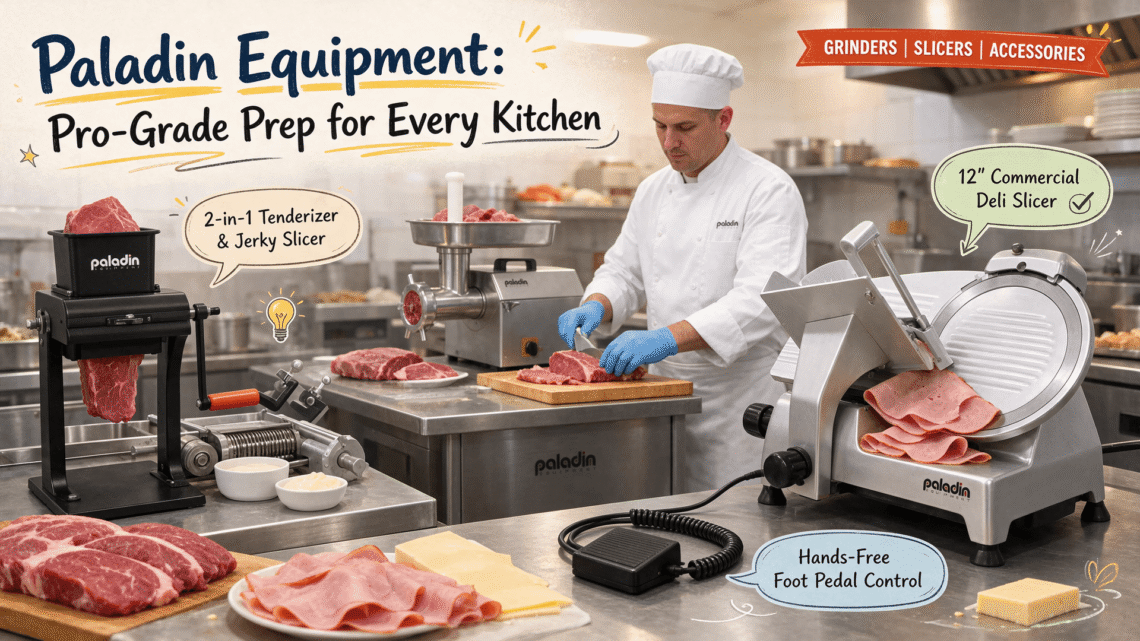
The 2-in-1 Manual Meat Tenderizer & Beef Jerky Slicer is the prep point — where a primal becomes uniform, workable stock. The 12″ Commercial Meat Slicer is the precision point — where volume and repeatability matter more than muscle. The Foot Pedal Switch is the control point — where the machine’s on/off decision moves off the hands and onto the floor.
Run as one bench, they cover the majority of small-scale processing labor: tenderize, portion, slice, grind, repeat. Below, each on its own terms.
1. The 2-in-1 Manual Tenderizer & Jerky Slicer: Two Machines, One Clamp
What it physically is
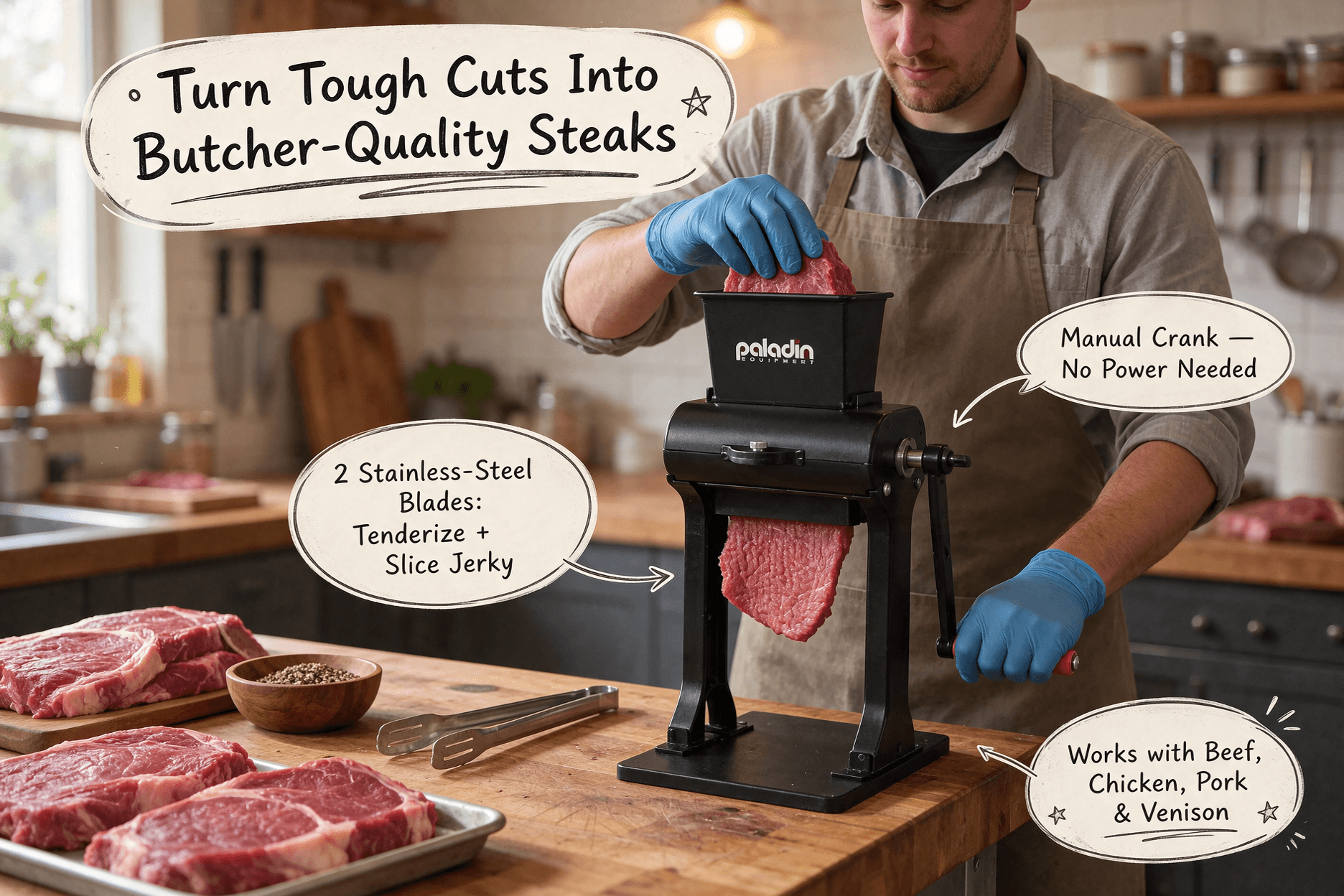
The unit is a hand-cranked, bench-mounted roller machine weighing 11 pounds and occupying 13″ L × 9.5″ W × 17.3″ H. Its body combines cast aluminum and cast iron with stainless steel rolling cutters. The feed opening measures 5.8″ × 2″, and it accepts cuts up to 4″ wide and 0.8″ thick.
The 2-in-1 claim rests on two interchangeable blade sets:
| Blade set | Configuration | Job |
|---|---|---|
| Tenderizing rollers | 16 pairs of stainless blades | Perforates and breaks connective tissue through the full thickness of a cut |
| Jerky cutter rollers | 31 stainless slicing blades | Slits a slab into uniform strips in a single pass |
Included in the box: the tenderizer body, both blade sets, two C-clamps for mounting, and a pair of tongs.
Why the numbers matter more than the feature list
The tenderizer category is flooded with small handheld blades and lightweight tabletop rollers that stall on anything cold. Two figures on this machine separate it from that pack.
The 4-inch width ceiling means a full sub-primal strip can go through sideways without pre-trimming. You are not standing at a cutting board narrowing stock before you can feed the machine — which is precisely where the time savings disappear on cheaper units.
The 0.8-inch thickness allowance means genuinely thick steaks, cube-rolls and roast-grade cuts are in scope. Thin-only machines handle breakfast portions and nothing else.
The 16-pair tenderizing configuration is the detail worth pausing on. Tenderizing works by creating thousands of small channels through the muscle, and paired rollers cut from both faces simultaneously. A single-face design leaves the far side structurally intact, which is why a cheaply tenderized steak often turns out tender at the edges and chewy through the center.
Thirty-one jerky blades is where the second function earns its place. Hand-cutting a shoulder roast into even strips is roughly ninety minutes of careful knife work, and the result is still inconsistent. Run the same cut through a 31-blade roller and it emerges as uniform strips in one crank pass. Uniform strips dry at the same rate. That is not a texture preference — even drying is what keeps a batch consistently safe and consistently chewy rather than leathery in some pieces and crumbly in others.
Where it belongs in a working routine
💬 “But I already own a knife.”
Sure — and a knife is fine for two steaks. The roller earns its clamp at twenty. The real product isn’t tenderness, it’s predictability. Once every strip is the same thickness, your smoker schedule stops being guesswork, and your cooking time stops varying by cut. That is a commercial property in a manual, $-range machine.
Practical applications across the lineup’s audience:
- Hunters and processors — tenderizing lean, worked-on venison and elk shoulder; breaking down hams and roasts before curing
- Jerky makers — consistent strip width across a full batch, without knife fatigue
- Meal-prep operators — flattening portion cuts for even searing and faster cook cycles
- Small food businesses — prepping marinated or pounded cuts ahead of a market day
- Home cooks on economy cuts — turning a chuck or round into something that eats like a premium cut
The honest trade-offs
It is manual, so a very large batch is a workout — the crank does the cutting, but your arm supplies the torque. It clamps to a surface, so it wants a sturdy bench or table rather than a thin laminate counter. And the blade sets swap, which means storage for the idle set. None of these are dealbreakers, but they are the reasons the machine suits a defined prep station better than a shared kitchen in constant use.
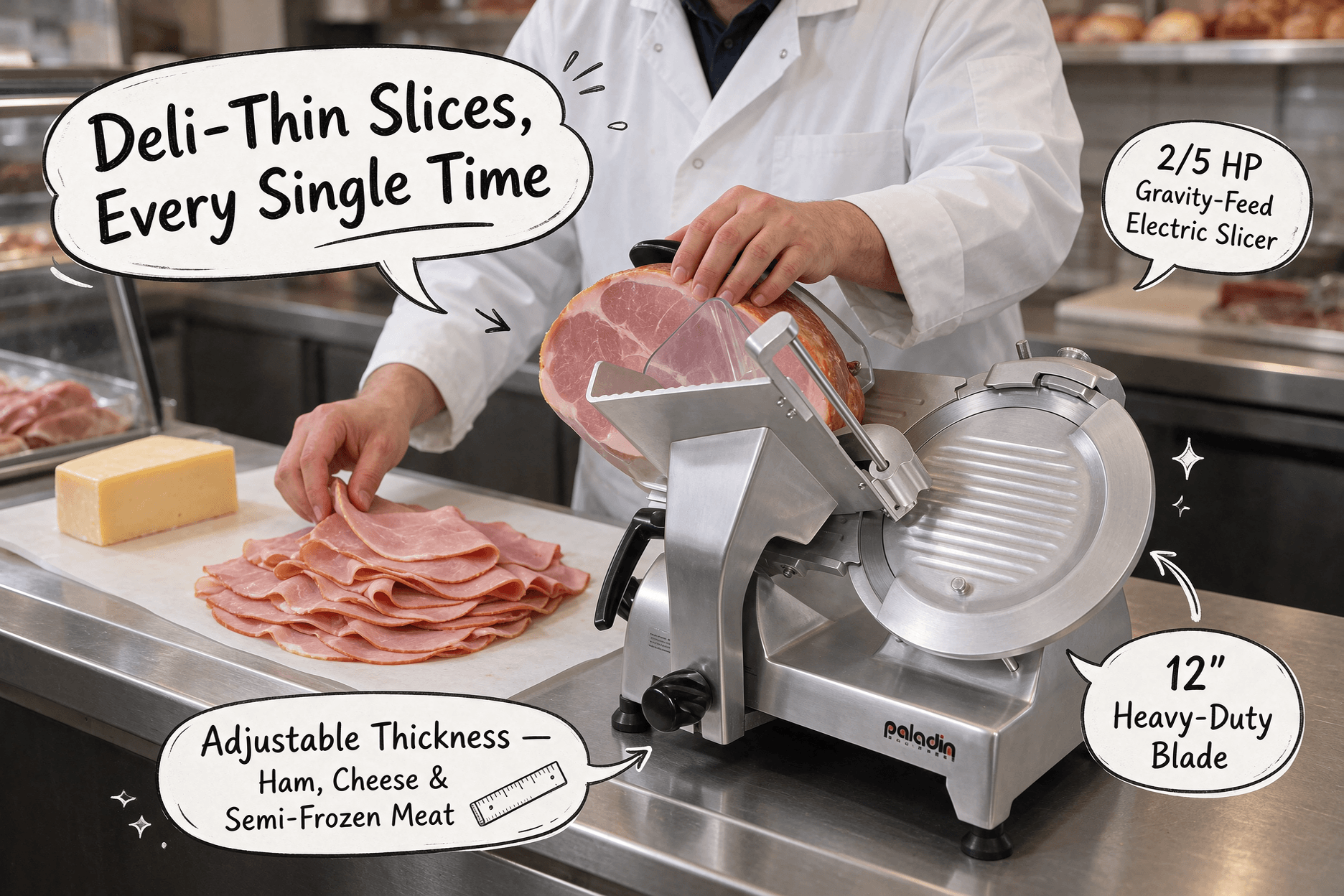
2. The 12″ Commercial Meat Slicer: Where the Brand Shows Its Hand
The specification, read properly
This is the machine that most clearly signals Paladin is not selling a home appliance with a deli photograph.
| Component | Specification | What it changes in practice |
|---|---|---|
| Motor | 350 W (½ HP), air-cooled, copper windings | Sustained duty without thermal cutout mid-batch |
| Blade | 12-inch Italian carbon steel | Larger diameter than countertop units; carbon steel takes a sharper, finer edge than stainless |
| Thickness range | 0 – 15 mm, adjustable dial | Shaves to near-translucent, up to a full thick steak cut |
| Housing | Anodized aluminum | Corrosion resistance and scratch tolerance; not a painted finish that chips to bare metal |
| Safety | Fixed blade guard, food pusher, non-slip rubber feet | Guard cannot be misplaced; feet hold position under carriage pressure |
| Cleaning | Detachable blade, guard, pusher and carriage | Reach the actual food-contact surfaces instead of wiping around them |
Air cooling is the underrated line item
Most buyers read wattage and stop. The air-cooled designation is the more useful clue. A slicer running a batch of turkey breast or a frozen ribeye generates sustained load, and a motor without adequate cooling slows, heats, and eventually trips — mid-slice, with your hand on the carriage. Copper windings run cooler and more efficiently than the alternatives used at the low end of the category. Together, those two details are why this is described as commercial rather than heavy-duty home.
The 12-inch blade, and why diameter is a productivity number
Blade diameter determines the maximum height of a product the machine can accept in one pass. A 12-inch blade lets a full-size roast, a whole ham cross-section, or a block of cheese go through without quartering it first. Smaller countertop blades force you to pre-cut, and pre-cutting is where a slicing job doubles in duration.
The Italian carbon steel construction is the other half of the slicing-quality story. Carbon steel is harder than stainless and holds a keener edge, which is why deli blades are traditionally made from it. The trade is that it demands drying after washing. That maintenance requirement is not a flaw — it is the price of an edge that produces true 0 mm shaves.
Reading the 0–15 mm dial as a work range
0 – 1 mm    →  prosciutto, smoked fish, shaved truffle, paper-thin roast beef
1 – 3 mm    →  sandwich deli meat, carpaccio, thin-cut bacon
3 – 6 mm    →  breakfast steak, cheese slices, cutlet portions
6 – 12 mm   →  burger patties from a stacked cut, thick pork medallions
12 – 15 mm  →  steak portions, dense loaves, block cheese for cubes
A dial that tops out around 8 mm turns the machine into a sandwich shop. One that reaches 15 mm makes it a general portioning tool, and that breadth is the difference between one machine serving a whole operation and needing a second device for the heavier work.
Beyond meat — the produce case that surprises people
The listing frames this as a deli and food slicer, and the food part is genuine. Onions, tomatoes, cucumbers, potatoes for gratin, fennel, cabbage — a rotating blade with a stable carriage produces vegetable cuts that a knife cannot match for regularity. For anyone running a service where slaw, salad or potato dishes are plated at volume, the slicer quietly becomes a produce machine as well.
Cleaning, stated as a uptime issue
Detachability is easy to skim past and expensive to underestimate. In a slicer, the residue accumulates under the carriage track, behind the blade guard mount, and on the blade well. A machine that will not come apart gets wiped, not cleaned, and within months the slices begin to smear rather than cut. Being able to remove the blade, guard, pusher and carriage is what keeps day forty tasting like day one.
3. The Foot Pedal Switch: The Small Item That Changes the Ergonomics
Specification
| Attribute | Detail |
|---|---|
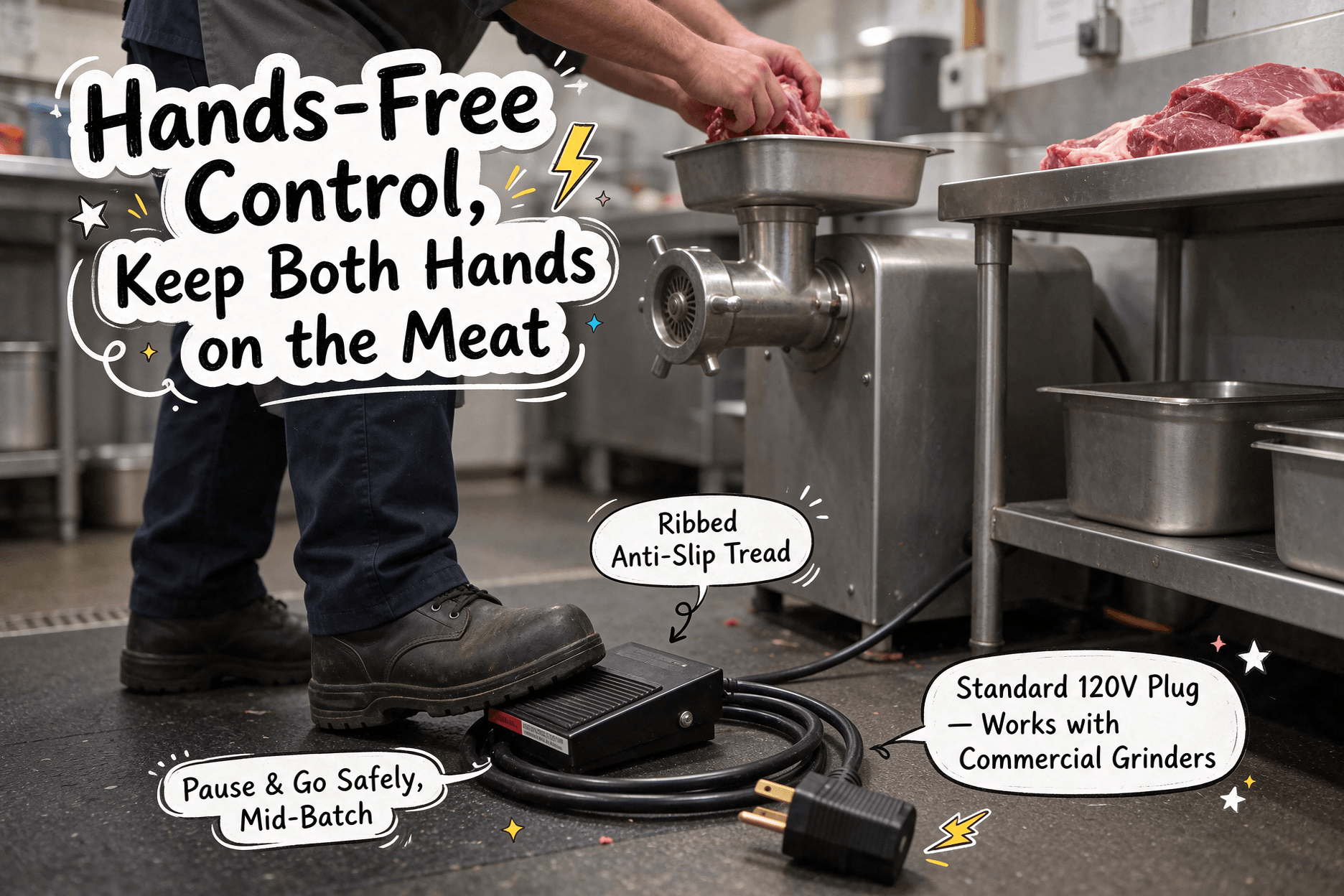
| Function | Hands-free on/off control for electric grinders and mixers |
| Electrical rating | 110 V, up to 15 amps |
| Cable | 8 feet |
| Connection | Piggyback plug — the switch plugs in line, and the machine plugs into the switch |
| Documented compatibility | Paladin Equipment #22 and #32 commercial meat grinders |
Why this belongs in the same conversation as the blades
A grinder is dangerous at exactly the moment the operator’s attention is elsewhere — pushing stock into the hopper, working the stomper, managing casing on the stuffing tube. Any control that requires a hand leaves a hand unavailable.
The pedal moves that decision to the floor. Both hands stay on the product. Starting and stopping becomes a reflex rather than a reach, which matters during the frequent stop-start rhythm of grinding: a chunk, a push, a jam, a pause. On a machine whose switch is on the body, every one of those pauses costs a hand off the hopper.
The 15-amp rating is the number to check first
Commercial grinders draw real current, particularly under load with cold fat. A 15-amp rating covers the Paladin #22 and #32 units and most machines in that class. Underspecifying here is the single common mistake in the category — a light-duty switching device on a heavy grinder will heat and fail, sometimes spectacularly. Confirm your machine’s draw before assuming any pedal will do.
Eight feet and the piggyback design
Eight feet gives enough slack to route from a wall outlet to a grinder positioned where the work actually happens, rather than where the socket is. The piggyback plug means the switch sits in-line between wall and machine — no rewiring, no enclosure work, no modification to the grinder. It is a genuine plug-and-play accessory, which is exactly what an add-on should be.
💬 “Is a pedal really worth a separate purchase?”
Ask anyone who has ground four hundred pounds in a season. The answer is not convenience — it is that the hands stay where they belong. On a long session, the reduction in reaching, twisting and mid-cycle repositioning is the difference between finishing comfortably and finishing stiff.
Running All Three as One Bench
The strongest argument for a single-brand lineup appears when the three items are used in sequence rather than isolation.
   PRIMAL CUT
       │
       ▼
┌─────────────────────┐
│ 2-IN-1 TENDERIZER   │  ── portion, tenderize, cut jerky strips
│ (bench-clamped)     │     on a manual station
└──────────┬──────────┘
           ▼
┌─────────────────────┐
│ 12" DELI SLICER     │  ── uniform slices, cheese, produce,
│ (350 W, 0–15 mm)    │     portion steaks at volume
└──────────┬──────────┘
           ▼
┌─────────────────────┐
│ GRINDER + PEDAL     │  ── hands-free control while feeding
│ SWITCH (15 A)       │     the hopper and working casing
└─────────────────────┘
           ▼
   PACKAGED / SMOKED / COOKED
A processor running this chain moves from a whole primal to jerky strips, sandwich slices, and sausage in one continuous session, without switching between brands whose blades, mounts and connectors were never designed to sit beside each other. Blade spares, clamp hardware and the pedal all come from the same catalog. That is a procurement simplification that saves real time when something wears out mid-job.
A Short Decision Framework
Rather than a verdict, here is how to map the lineup to a workload.
Buy the 2-in-1 tenderizer first if:
- You process game and the cuts are lean, thick and irregular
- Jerky is a recurring batch product, not an experiment
- You want commercial prep results with no electrical draw and minimal footprint
Buy the 12″ slicer first if:
- Volume and slice consistency define your output
- You cut frozen or partially frozen product, or full-height roasts
- Vegetables and cheese enter the workload, not only meat
Buy the foot pedal switch first if:
- You already own a Paladin #22 or #32 grinder
- Your sessions are long and stop-start
- Safety and hand availability are the constraint, not machine power
Buy all three if processing is seasonal but heavy — a hunting household, a market vendor, a two-person catering operation. The bench pays for itself in the first large job.
Maintenance: Keeping a Working Blade Honest
Commercial-grade tooling only performs commercially if it is cared for on a schedule. The habits below cost minutes and protect hours of output.
| Item | After every use | Weekly / periodic |
|---|---|---|
| 12″ slicer | Detach blade, guard, pusher, carriage; wash, rinse, dry the carbon steel blade completely | Light oil film on the carbon blade; check carriage tension and rubber feet |
| 2-in-1 tenderizer | Remove both blade sets, clear tissue and fat from roller wells, rinse, dry, refit | Inspect C-clamp pads and crank for play; wipe castings with food-safe oil |
| Foot pedal | Wipe the tread surface; keep dry | Inspect the 8-ft cable for cuts and the piggyback connection for looseness |
Two rules cover most of the risk in the category. Carbon steel rusts if left wet — drying is not optional. And a pedal rated below your machine’s draw is a failure waiting for a busy day — match the amp rating before you trust the switch.
What Paladin Equipment Is Really Claiming
Brands usually position on price or on prestige. Paladin has positioned on identity, and it is the more interesting move. The claim on that storefront banner is that professional-grade processing is not exclusively for people with a license, a walk-in cooler and a supplier account. It is for the person with a freezer full of venison, a smoker in the backyard and a job that has to be finished by Sunday.
The 2-in-1 tenderizer brings commercial prep geometry to a hand-cranked bench station. The 12-inch slicer brings deli tolerances — a genuine 0-to-15 mm range, an air-cooled copper motor, an anodized housing — to buyers who were previously told their options were a knife or a three-thousand-dollar machine. And the foot pedal switch treats operator safety as an accessory worth engineering rather than an afterthought.
None of it is dressed up. The photography is flat, the specifications are stated in real units, and the wear parts are sold on their own pages. That is what a catalog looks like when it is written for someone who intends to work.
⚙️ Field Notes: Five Things to Know Before You Buy
- Check your bench before you check the price. The tenderizer clamps to a surface; a lightweight counter will flex under cranking load.
- Blade diameter is a height limit. A 12-inch slicer accepts taller product in one pass — that is the throughput number, not a vanity spec.
- Match the pedal to the amp draw. 15 A at 110 V covers Paladin #22 and #32 grinders and similar-class machines; verify yours.
- Carbon steel needs drying. The sharper edge is worth it, but it is a two-minute habit after every wash.
- Order the spare blade set with the machine. Interchangeable sets are the feature; running one without a spare is how a batch stops mid-job.
Processing at commercial scale no longer requires a commercial kitchen. It requires equipment rated for the workload, published specifications you can actually verify, and an accessory line that keeps the machines running long after the first batch. That is the whole argument Paladin Equipment is making — and it is aimed squarely at the people who have been doing this work without a catalog of their own.