
There is a particular kind of car audio buyer who has stopped falling for glossy cone photos. They have owned a subwoofer that cooked after twenty minutes of highway driving. They have chased a rattle into the headliner and found, at the end of the afternoon, that the problem was a $3 ground lug. This reader does not want hype. They want a brand that understands the whole chain — signal in, electrons moved, sound out. That is, in a nutshell, what DS18 car audio has spent more than a decade earning a reputation for.
DS18 opened its doors in Miami, Florida, in 2013, in a region where the audio scene runs hot and unforgiving. South Florida winters are 80°F and humid. Cars there live outdoors, windows down, bass walking across parking lots. Boats come home wet. UTVs come back coated in red clay. A manufacturer that grows up in that environment does not get the luxury of building for showroom conditions; it builds for abuse, or it stops existing. Something forged in that climate tends to carry the fingerprint of it, and DS18 does.
The company’s stated motto — “We like it LOUD!” — sounds like a slogan a marketing intern invented. In practice it is closer to an engineering brief. Loudness that survives is not about peak numbers on a box; it is about thermal management, excursion control, and the discipline to publish a spec you can actually hit with real amplifiers and real wiring. DS18 designs and engineers in the USA, and its catalog now stretches past a thousand items: amplifiers, subwoofers, component sets, coaxials, tweeters, marine pods, powersports towers, wiring kits, line output converters, fuses, and installation hardware.
Callout — read this twice: Most audio brands are famous for one product category and quietly buy the rest from an OEM. DS18 is unusual in that its accessories division is as developed as its speaker division. That is not a cosmetic detail. It is the reason a DS18 install tends to behave predictably — the wire was tested against the amp that was tested against the speaker.
The Thing Miami Taught Them: Headroom Is a Moral Position
Walk through any serious South Florida install shop and you hear the same argument, repeated for twenty years: what happens at minute thirty, not minute one. A system that sounds enormous for the first three songs of a playlist and then compresses, drifts, or smells hot has not impressed anyone. It has merely delayed the disappointment.
That instinct shows up in DS18 hardware in ways a spec sheet only partly captures.
- Voice coil size over cone drama. Big coils move more heat into the structure instead of trapping it in the windings. The brand’s hero subwoofers run oversized copper and aluminum voice coils — 3-inch on the top 15s — because sustained output is a cooling problem before it is a magnet problem.
- Basket rigidity decides excursion honesty. A flimsy frame lets the cone travel sideways, and the listener hears that as mush. Sandblasted cast aluminum baskets appear throughout the performance tiers so the motor gap stays centered when the cone is working hard.
- Materials chosen for weight and stiffness. Carbon fiber cones and dust caps in the flagship line are not decoration; low mass with high rigidity means faster starts, faster stops, and cleaner transients.
- Honest ratings, printed in full. RMS, max, impedance, sensitivity, and frequency response appear on nearly every listing. The brand expects you to match it, not marvel at it.
And then there is the less glamorous half of the philosophy: a system is only as loud as its weakest conductor. You can buy the loudest subwoofer on the shelf and lose half of it to a thin power cable and an undersized fuse. DS18 clearly treats that as its own problem to solve, which is why its catalog includes the 4-gauge kits, the 12-gauge speaker wire, the hi/lo converters, and the ANL holders that most speaker brands leave to the aftermarket’s bargain bin.
Speech bubble — from the install bay: “People spend twelve hundred dollars on a sub and forty on wire. Then they tell me the brand lied. The brand didn’t lie. The voltage drop told the truth first.”
Mapping the Catalog Before You Map Your Build
A useful way to read DS18 is by job, not by price tier. The catalog is broad, but the roles inside it are distinct.
| Role in the system | What DS18 offers | Typical buyer question it answers |
|---|---|---|
| Low-frequency foundation | Black Diamond subwoofer series, plus lower-excursion pro models | “Will it hold up at minute thirty?” |
| Midrange and treble clarity | PRO component sets, midrange drivers, bullet and dome tweeters | “Why does my vocal sound buried?” |
| Power conversion | Multi-channel and monoblock amplifiers | “Do I have enough current, honestly?” |
| Signal adaptation | Hi/lo converters, line output converters, speaker emulators | “Can I keep my factory radio?” |
| Current delivery | Amplifier wiring kits, speaker wire, distribution blocks | “Why is my amp turning off at high volume?” |
| Protection | ANL and mini-ANL holders, splices, terminals | “How do I not burn the truck down?” |
| Open-air vehicles | Marine pods, UTV/Jeep tower systems, Bluetooth receivers | “Will it survive rain, spray and sun?” |
Six of those rows are what this post focuses on, because together they describe a complete working logic rather than a highlight reel.
Six Products, Six Jobs, One Chain
Below is a concise walk-through of six representative items. Rather than treating each as an isolated SKU, it helps to notice where each sits in the signal chain — because that is exactly how the brand seems to design them.
1. DS18 PRO-X6.4BMPK Mid & High Package — Two 6.5″ Midranges, Two 1″ Tweeters, Crossover Included
This is the set you buy when the doors are doing the best work of their lives and the dash speakers have given up on intelligibility. It bundles two PRO-X6.4BM 6.5-inch midrange drivers with two PRO-TW220 1-inch super bullet tweeters, and the tweeters carry a built-in capacitor filter that acts as the crossover. No external crossover network to mount, no confusing tap selection.
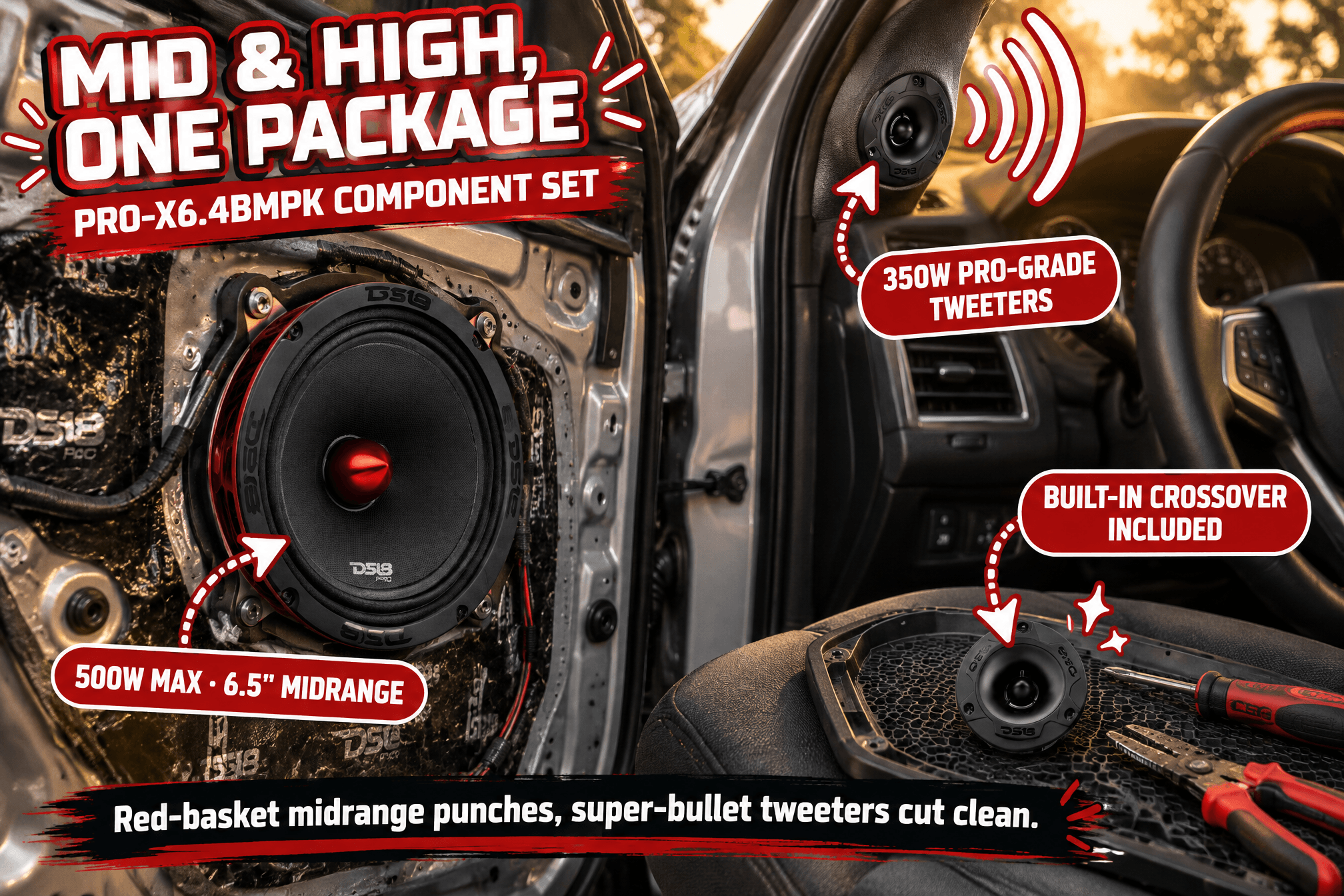
- Midrange: 500W max / 250W RMS, 4 ohm, with an aluminum bullet phase resonator built into the cone center
- Tweeter: 350W max / 225W RMS, 4 ohm, ferrite magnet structure, capacitor-filtered
- Form factor: the 1-inch pods are small enough to fit kick panels, A-pillars, dash pods or factory tweeter locations
The bullet resonator is worth pausing on. Its function is to break up the cone’s center lumpiness — the region where a paper or poly cone tends to store and re-release energy — so midrange voices come through cleaner instead of slightly “honky.” Pair that with a genuinely power-hungry tweeter (225W RMS is far beyond what most dome tweeters are asked to survive) and the package makes sense in the context it was designed for: an amplified system with a subwoofer handling everything below roughly 150–200 Hz, leaving these drivers free to work hard in the range where humans are most sensitive.
Best fit: door or kick-panel midrange upgrades in a system with a dedicated sub, especially where high volume is the goal rather than critical-listening subtlety.
2. DS18 AK4 Complete 4 Gauge CCA Amplifier Installation Kit — Everything One Amplifier Needs
Rated for up to 1200 watts to a single amplifier, the AK4 is the definition of a “don’t make me shop around” box. It uses copper-clad aluminum conductors, which are lighter and markedly more flexible than pure copper of the same gauge — a real advantage when the cable has to disappear under a carpet, around a seat rail and through a firewall.
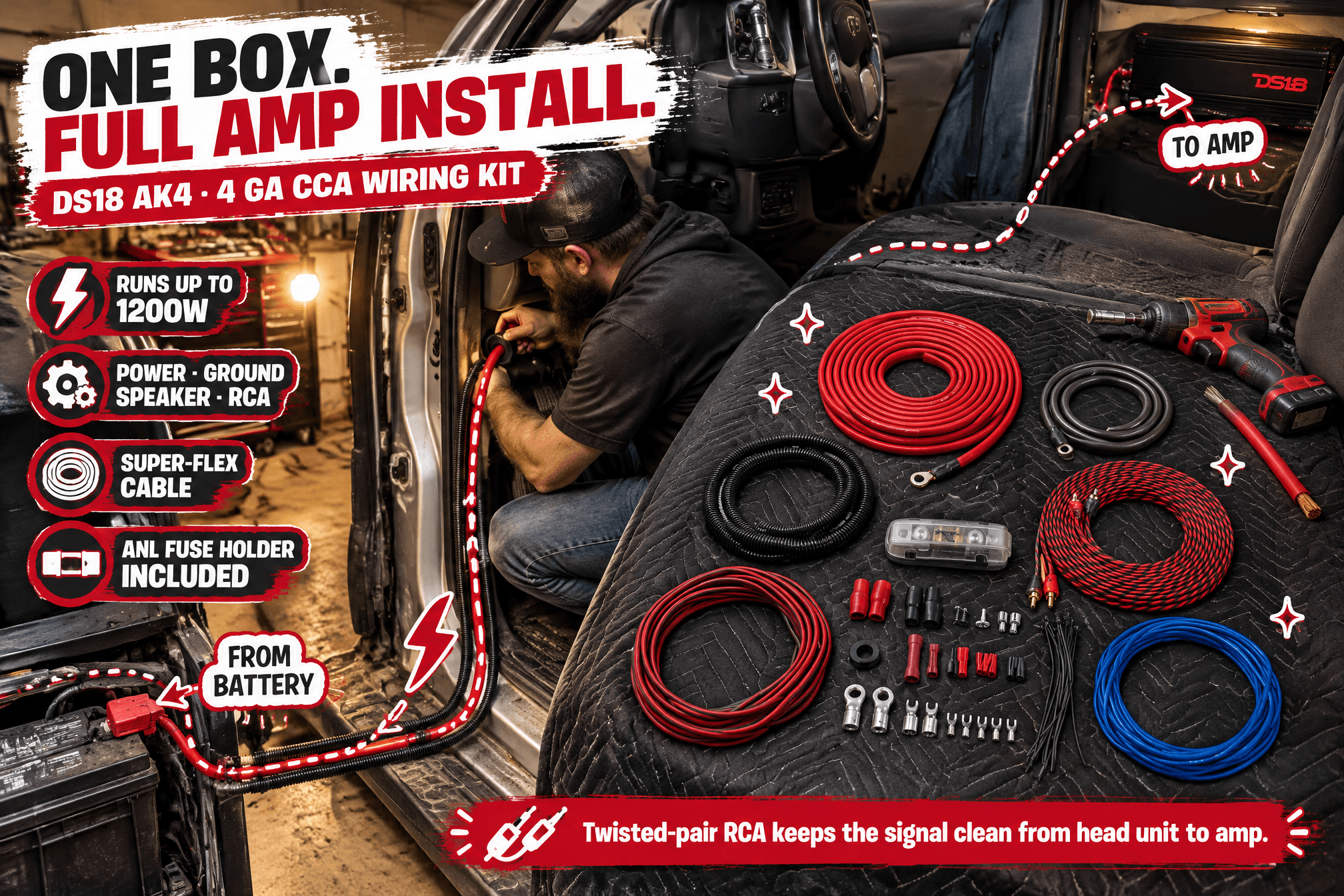
Contents, as listed:
- 17 ft of 4-gauge red power cable and 3 ft of 4-gauge black ground cable
- Mini ANL fuse holder with a high-capacity ANL fuse already supplied
- 17 ft 2-channel shielded, twisted-pair RCA cable
- 17 ft of 16-gauge speaker wire and 17 ft of 18-gauge remote turn-on wire
- 3 ft of 4 AWG split loom tubing for a clean engine-bay run
- Hardware pack: 2 ring terminals, 2 spade terminals, 5 small spade terminals, 1 rubber grommet, 10 cable ties
The thoughtful part is the completeness. Beginners usually forget three things — remote turn-on, the grommet, and the ground — and each omission produces a symptom that looks like an amplifier defect. The kit preempts all three. The shielded twisted RCA matters too: it rejects the alternator whine that cheap parallel-conductor RCA cables invite in.
One honest caveat that every installer already knows: CCA at 4-gauge is electrically closer to a 6-gauge pure copper conductor. For a single amp in the 1000–1200W max class this is a reasonable, well-tested trade for flexibility and cost. Extreme current draws deserve a step up in gauge.
Best fit: first serious amplifier install, single-amp subwoofer builds, and anyone replacing a thrift-store kit that has been in the vehicle since 2016.
3. DS18 SW-12GA-100RB Ultra Flex Speaker Wire — 12 Gauge, 100 Feet, Red and Black
A 100-foot spool of 12-gauge stranded CCA wire with a two-color red/black jacket so polarity is obvious at both ends, and a larger insulated jacket rated for higher thermal capacity. The strand construction is listed as true-spec, and the flexibility is the headline: it bends into door-harness loops and tight kick panels without springing back at you.
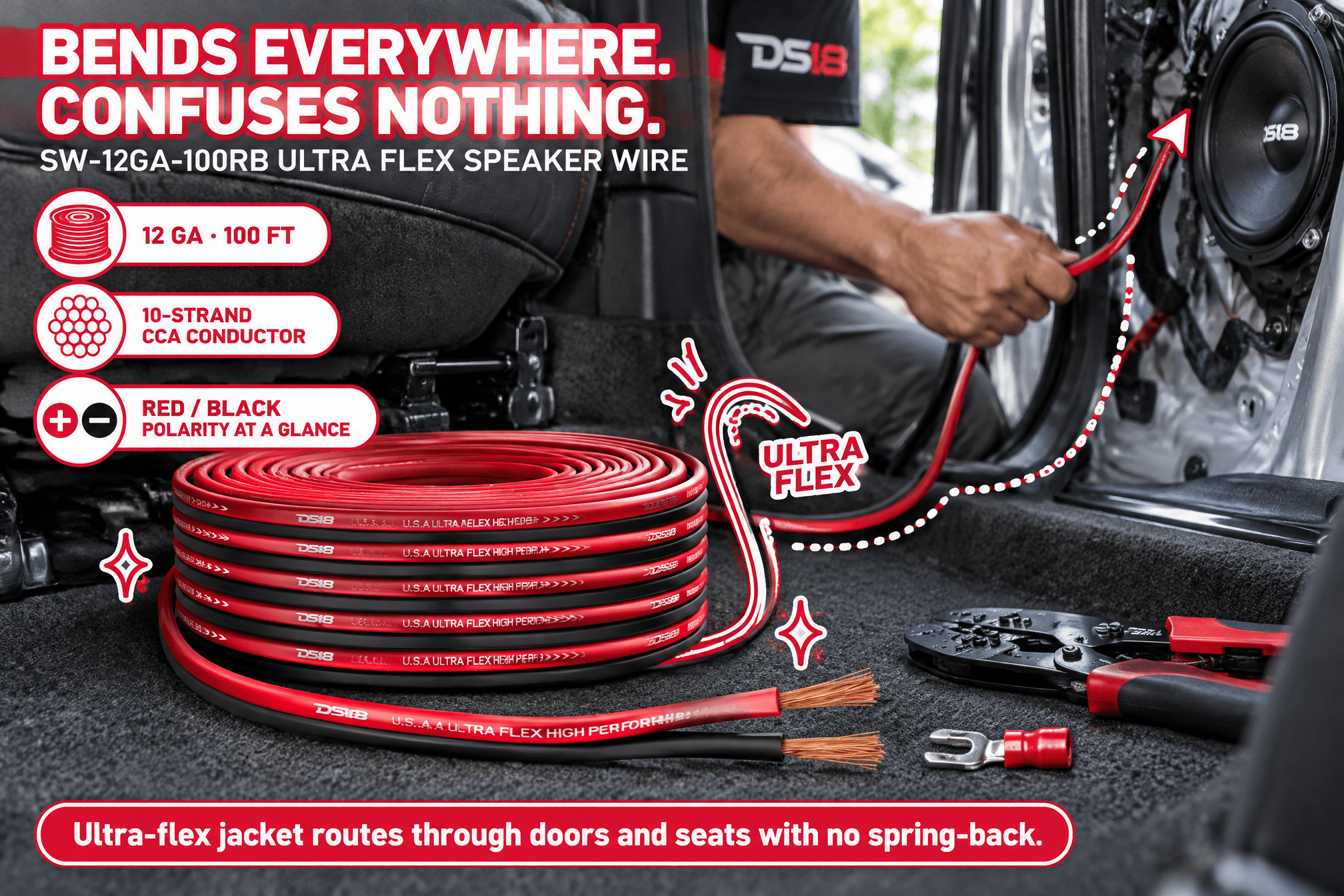
Why a brand makes its own wire becomes obvious here. Speaker wire is where installs quietly degrade. A stiff cable that fights the installer gets kinked, gets under-torqued at the terminal, gets pinched behind a trim panel. The 12-gauge conductor handles the practical loads of component midranges and coaxials across a full vehicle length, while the thicker jacket gives it more tolerance for the heat generated inside a sealed door cavity on an August day.
Practical notes:
- 100 feet covers a four-door sedan’s full speaker runs with margin, or two long amp-to-speaker legs in a truck.
- Cut with slack, dress with the supplied ties, and never staple a jacket flat against a metal edge.
- Keep it away from the power cable; run signal and current on opposite sides of the vehicle where you can.
Best fit: replacing factory paper-ribbon speaker wire in older vehicles, and any build where speaker runs exceed ten feet per side.
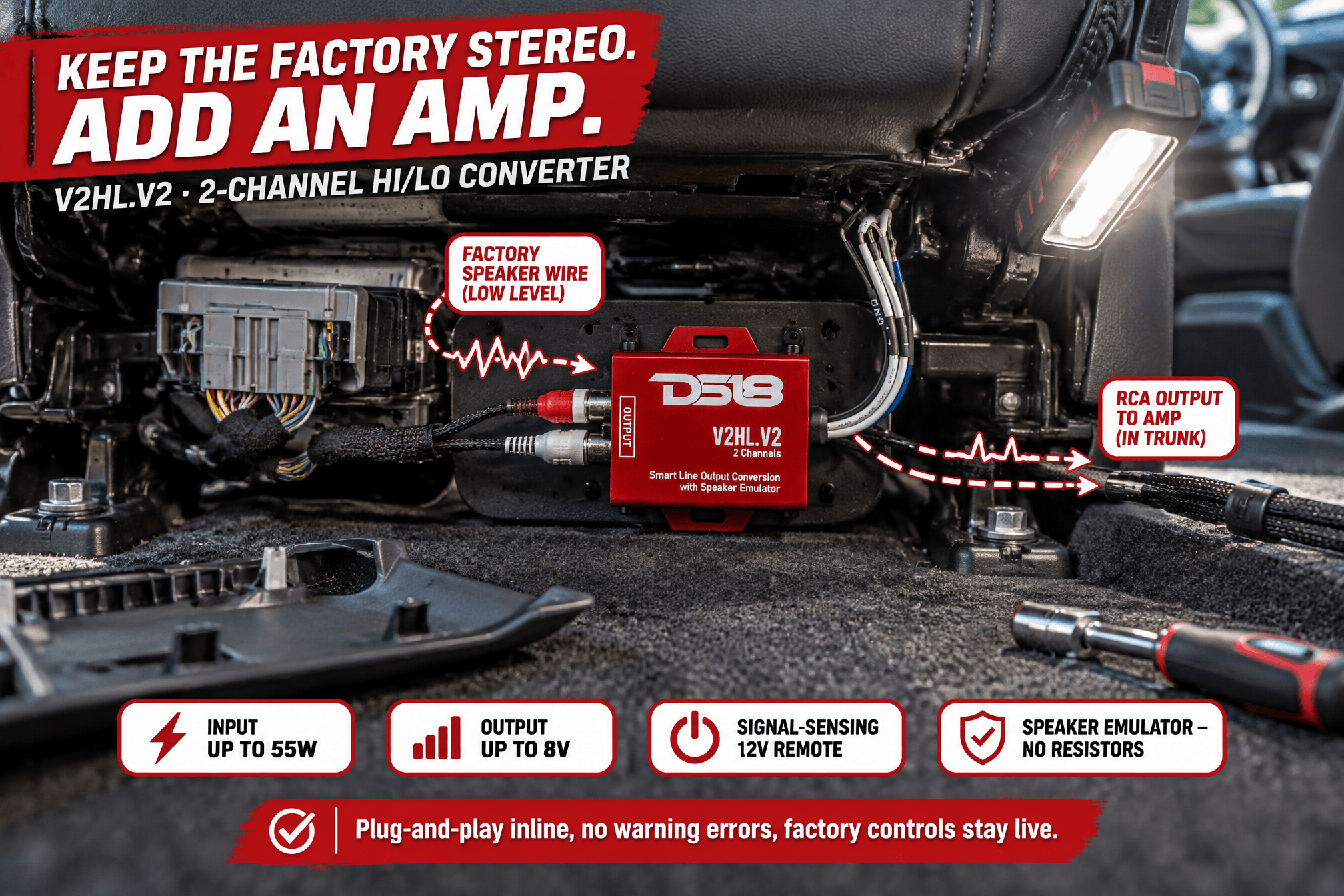
4. DS18 V2HL.V2 Hi/Lo Converter with Speaker Emulator — The Small Red Box That Saves a Factory Radio
Two channels. High-level speaker input in, dual RCA out, handling up to 55 watts of input, presenting a 20 kΩ input impedance, delivering up to 8 volts of line-level output, across a 10 Hz – 30 kHz frequency response. It senses signal and switches on automatically, and it generates its own 12V remote output to wake the amplifier.
The genuinely important feature is the built-in speaker emulator. Modern OEM amplifiers use load detection: pull the speakers off their outputs and connect a bare line input, and the car notices. Radios shut down, warning messages appear, steering-wheel controls stop responding, sometimes climate or backup-camera audio drops. Traditional solutions were external load resistors — hot bricks that get dangerously warm near upholstery. The V2HL.V2 presents the correct simulated load internally, so the factory amp believes the speakers are still there, and every OEM feature keeps working.
Where it earns its place:
- Trucks and SUVs with a factory amplified system and no pre-outputs
- European vehicles where removing the head unit triggers fault codes
- Any Jeep, Tacoma or Wrangler build where the owner wants to keep the stock radio and factory tuning
- Marine and powersports installs where the OEM control module must stay satisfied
Eight volts of output is a meaningful number, too. Many cheap converters top out around 4–5V, forcing the amplifier input gain to near maximum — which raises the noise floor. Double that headroom and the amp’s gain stays comfortable and quiet.
Best fit: adding an external amplifier or subwoofer to a modern factory system without touching the radio.
5. DS18 MP4TP.4A 4″ 600W Bluetooth Marine Tower Speakers with Amplifier and Remote
Four 4-inch injection-molded polypropylene tower pods, an MP.4A four-channel digital amplifier rated 4 × 40W RMS / 4 × 120W max at 4 ohms, and a BTRC-R Bluetooth 5.0 receiver with a wireless remote — a complete open-air system in one carton, with a 600W peak system figure.
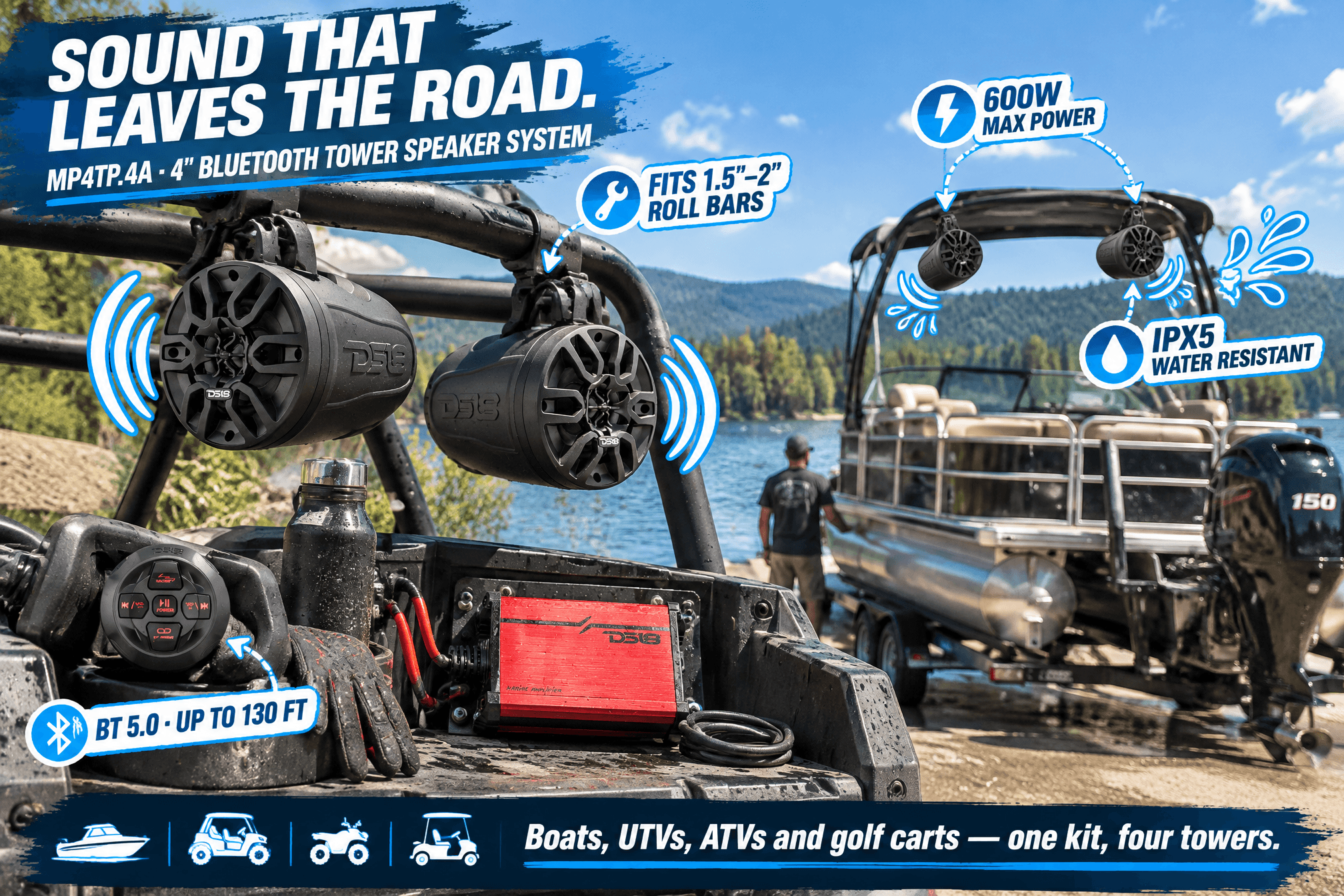
The pods carry an IPX5 water-resistance rating and UV-stable exterior materials, and mount with a tube clamp sized for 1.5″–2″ round roll bars. That clamp range matters more than any wattage number: it fits the common UTV and Jeep cage without adapters, which is where most tower-speaker projects stall in the driveway. The Bluetooth remote is rated for over 130 feet of range with A2DP streaming and illuminated controls — useful when the driver is at the tailgate and the phone is in a dry bag.
Note what the specification does not claim: no RGB lighting. That is a deliberate kind of honesty. Lighting adds cost, an extra power draw and a failure point; a rider who wants illumination can add it, and this set stays focused on surviving spray, dust and sun.
Design reality for open-air audio: there is no enclosed cabin, so bass pressure cannot build. Small-diameter drivers in pods, driven hard, with the amp close to the speakers so the wire runs stay short — that is the correct physics, and this package follows it. Polypropylene cones tolerate temperature swings and moisture without the warping that paper cones suffer on a boat.
Best fit: UTV, ATV, Jeep, boat and pontoon installs where a self-contained, wireless-controlled, weather-capable system beats a component-by-project approach.
6. DS18 FHSANL200A Square ANL Fuse Holder with 200A Fuse
A 200-ampere mini ANL fuse seated in a holder with nickel-plated aluminum and copper internal contacts, a heat-resistant plastic housing, and a clear protective cover, with through-hole mounting sized for 0-gauge or 4-gauge square connections.
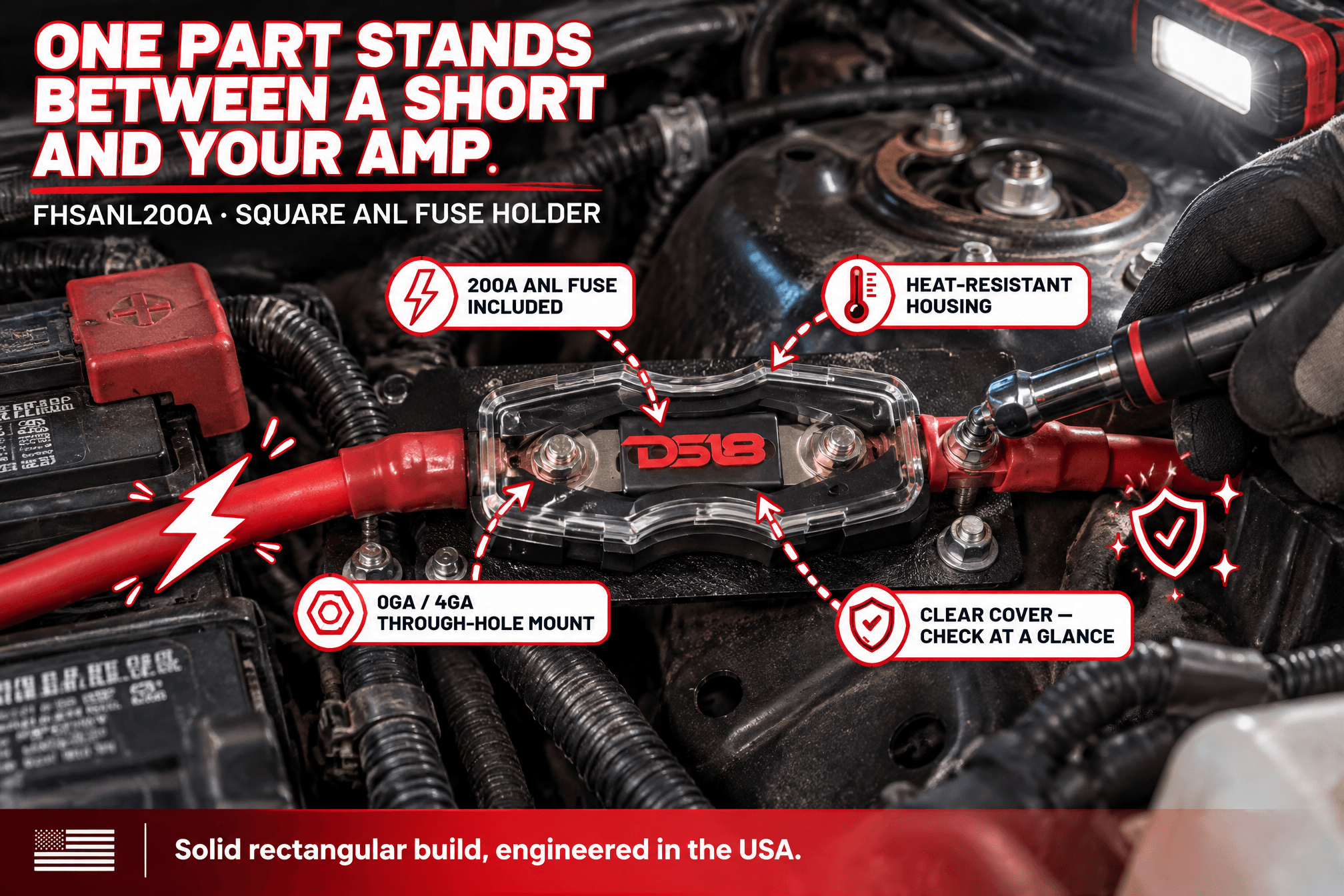
This is the smallest, most under-appreciated item on the list, and the one that most directly protects the owner’s investment — and the vehicle. The fuse sits on the power cable within roughly 18 inches of the battery positive terminal. If the amplifier shorts, or the power cable chafes through a frame rail, the fuse opens before the cable becomes a welding torch. Skip it, or undersize it, and the system still plays — until the day it doesn’t.
Sizing guidance in plain terms:
- Match the fuse amperage to the cable’s ampacity and the amp’s real draw, not to the largest number on the box.
- 200A suits heavy single-amp and dual-amp distributions running 4-gauge or 0-gauge.
- Inspect the clear cover periodically; a discolored fuse window means the element has been stressed.
- Never replace a blown ANL with a blade fuse or a taller fuse that will not close the lid.
Best fit: any install drawing more than a couple hundred amps, and every kit that ships with a holder you would rather trust to the same brand as the rest of the chain.
Two Installers, One Workbench
Marco: You ever count how many “dead amps” are actually dead wires?
Dee: More than dead amps. Last week, 4-gauge kit from a garage sale, voltage drop at idle was nearly two volts. Amp kept protecting. Customer thought it was junk.
Marco: And the fix?
Dee: Clean ground under the seat rail, ring terminal cranked down proper, fuse the right size near the battery. Same amp. Never complained again.
Marco: That’s why I don’t laugh at the boring parts.
Dee: The boring parts are the system. Speakers are just the loud part of it.
It is a fair summary of how DS18 approaches its own catalog. The tweeter and the fuse holder come from the same company because the same company knows which one fails more often.
Ordering the Six: A Chain, Not a Shopping List
Buy them in signal order and the build stops being a pile of parts.
- Adapt the signal. V2HL.V2 converts the factory speaker-level output into clean, 8V-capable RCA and generates the remote turn-on.
- Protect the current. FHSANL200A goes on the power line at the battery, before anything else is routed.
- Deliver the power. AK4 lays down the 4-gauge run, the ground, the remote lead and the RCA.
- Reach the speakers. SW-12GA-100RB carries amp output to each door with real strand count instead of foil.
- Produce the sound. PRO-X6.4BMPK handles mids and highs while the sub covers the bottom.
- Take it outside. MP4TP.4A is a parallel, self-contained branch for the open-air vehicle.
Callout — the one-sentence version: A converter shapes the signal, a fuse protects it, a kit delivers it, a wire distributes it, and speakers finally convert it — and DS18 sells all five roles as one design problem.
Three Realistic Builds, Three Different Baskets
The daily driver that finally makes sense. Factory radio stays. V2HL.V2 into a two-channel amp on the AK4, fuse at the battery, PRO-X6.4BMPK in the doors, SW-12GA-100RB for the runs. Result: vocals forward, no warning messages, no rattles from overloaded small cones. Roughly an afternoon of patient work and a weekend of daily payoff.
The bass-first truck. Keep the door mids, add a Black Diamond sub on a monoblock, use the AK4’s 4-gauge for the main leg and step up to 0-gauge distribution with the FHSANL200A if the current demand climbs. The 200A holder is exactly the component people skip and then regret.
The two-vehicle household. One full car build plus an MP4TP.4A on the UTV or boat, sharing the 12-gauge spool across both projects. The Bluetooth receiver means the open-air vehicle needs no head unit at all — a phone on the dash and 130 feet of range is the whole source stack.
Before You Add to Cart: A Short Checklist
- Impedance math first. Most of these drivers are 4 ohm. Confirm what your amplifier likes at that load before assuming power figures.
- RMS is the number you plan around. Max ratings describe survivability, not a target you should drive to.
- Gauge for the run, not the box. Measure the actual cable path length before choosing 4-gauge versus 0-gauge, and remember CCA equivalence.
- Keep the factory features you love. If the vehicle has a complex OEM amp, a converter with a speaker emulator is not an optional nicety.
- Weather rating honesty. IPX5 handles spray and washdown; it is not a submerged-rating claim, so mount pods where they drain.
- Fuse within 18 inches of the battery. Non-negotiable, and the cheapest insurance in the entire catalog.
Living With It: Longevity Details Worth Knowing
High-output audio is a thermal profession. Dust caps, vented pole pieces and thick baskets exist to move heat out of the magnetic gap, so the single best thing an owner can do is not seal the equipment into a hot, airless cavity. Give the amplifier a path to sheet metal. Leave the subwoofer enclosure port unobstructed. Route cables away from exhaust heat shields rather than under them.
Corrosion is the second killer, and it is a Miami-native problem. Dielectric grease on every spade and ring terminal. Anti-oxidant on anything marine. Zip-tie the RCA away from the power leg. On a boat, rinse the pod housings with fresh water and let the clamp hardware breathe — stainless fasteners still corrode when left wet and salty for months.
Third: torqued connections beat clever ones. A properly crimped, snugly torqued lug outperforms a soldered twist with a cold joint, every time an amp is asked for current.
Questions People Actually Ask About DS18
Is DS18 a budget brand or a performance brand? It occupies the rare middle: performance-oriented engineering priced so that an enthusiast can build a complete system without financing it. The catalog depth — including accessories most brands outsource — is what pushes it past “budget with good marketing.”
Do the accessories really need to match the speakers? No law requires it. But a fuse holder, a wire gauge and an amplifier’s current demand are a single electrical conversation, and buying them from one engineer removes a variable that frequently causes symptoms mistaken for defects.
Can I add a subwoofer to my factory radio without losing features? That is precisely the situation the V2HL.V2 was designed for, because its speaker emulator keeps the OEM amp’s load detection satisfied while producing up to 8V of line output and a 12V remote signal.
Are the marine towers suitable in saltwater? They are IPX5-rated and UV-stable for spray, washdown and sun. Salt immersion is a different exposure class; rinse them, and treat the clamp hardware as a maintenance item.
What wattage should I trust — RMS or max? Plan around RMS. Max figures indicate thermal and mechanical survival, which is valuable information, just not the number you set gain with.
The Point Nobody Makes Loud Enough
Enthusiast culture rewards the visible. The subwoofer gets the photo, the tweeter gets the argument, the amplifier gets the spec-sheet screenshot. The wire gets hidden under the carpet and forgotten along with the fuse holder, the grommet and the little converter module behind the dash — the unglamorous parts that decide whether the visible ones ever perform.
A brand that grew up in Miami’s outdoor, humid, boat-and-UTV economy learned that lesson the hard way, then wrote it into a catalog of over a thousand items. That is the real story of DS18: not that they like it loud, but that they understand what loud actually costs — in thermal design, in conductor gauge, in load emulation, in a $12 fuse placed 18 inches from a battery terminal.
So the next time someone asks why their system “isn’t as loud as the reviews said,” the honest answer rarely involves the woofer. It involves everything they didn’t think was worth discussing. Build the whole chain, in order, and the loud part takes care of itself.
Turn it up — but build it right first. That is the invitation DS18 has been extending since 2013, and it is a considerably better one than a peak-wattage number ever was.