Winter exploration and cold-weather self-reliance have historically forced outdoor enthusiasts, mobile professionals, and recreational vehicle owners into an uncomfortable compromise. For decades, staying warm beyond the reach of the municipal power grid meant choosing between moisture-heavy propane combustion, power-hungry electric resistance coils that drain lithium battery banks in hours, or bulky wood-burning stoves that demand constant tending throughout the night. None of these legacy methods truly solved the core engineering challenge of mobile climate control: delivering rapid, dry, fuel-efficient, and autonomously regulated heat in a compact footprint that survives harsh outdoor environments.
Hcalory emerged in 2017 to dismantle this compromise altogether. Operating under the engineering ethos of delivering heat that never stands down, the brand has systematically transformed industrial-grade diesel air heating technology into refined, user-centric thermal ecosystems. Rather than treating portable heaters as crude utilitarian hardware, Hcalory approaches off-grid climate control as an integrated discipline combining thermodynamic efficiency, smart wireless telemetry, acoustic dampening, and ruggedized industrial design. Whether deployed beside an expedition rooftop tent at high altitude, integrated beneath the passenger seat of a converted campervan, or stationed inside an uninsulated winter workshop, Hcalory heating systems provide dependable thermal stability when ambient temperatures plunge well below freezing.
This comprehensive guide examines the engineering architecture, smart control ecosystems, fuel economics, and model-by-model capabilities that distinguish Hcalory in the modern portable heating landscape. By looking closely at verified thermal benchmarks, fuel consumption curves, and real-world deployment configurations, you will gain a clear blueprint for selecting and operating the ideal diesel heating platform for year-round off-grid comfort.
🧭 Key Brand Snapshot: The Hcalory Standard
- 🔥 Core Philosophy: Heat That Never Stands Down — built for uninterrupted sub-zero performance.
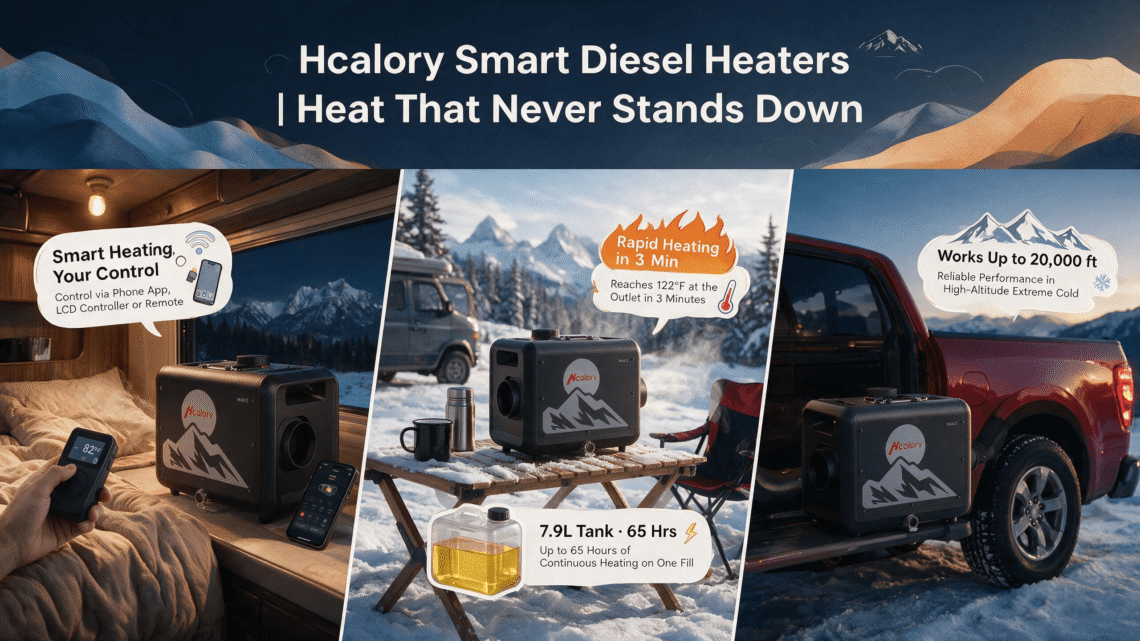
- ⚡ Thermal Velocity: Reaches 122°F (50°C) at the primary air outlet in just 3 minutes.
- ⛽ Extended Endurance: Up to 65 hours of continuous runtime on a single 7.9-liter diesel fill.
- 📱 Intelligent Command: Remote Control 2.0 pairing long-range physical remotes, Bluetooth app control, and integrated LCD panels.
- 🏔️ Environmental Resilience: IPX4 weather resistance, automatic barometric altitude compensation, and low-decibel acoustic engineering.
The Engineering Philosophy Behind Hcalory Thermal Systems
At the heart of every Hcalory unit lies a fundamental distinction between radiant space heating and forced-air diesel heat exchange. Traditional portable propane heaters rely on open catalytic or infrared combustion inside the living space, a process that inevitably releases significant water vapor and carbon dioxide directly into the enclosed air volume. Over the course of an eight-hour night in a camper or tent, propane combustion coats windows, bedding, and electronic gear in damp condensation while requiring substantial ventilation that lets cold air right back inside.
Hcalory eliminates this moisture and air-quality penalty through a sealed, dual-chamber thermodynamic architecture. Ambient air drawn into the combustion chamber is mixed with precisely metered atomized diesel fuel and ignited via a high-density ceramic glow plug. The resulting exhaust gases travel through a hermetically sealed internal labyrinth before exiting entirely outside the living space through a dedicated stainless steel exhaust pipe. Simultaneously, a separate clean-air impeller draws fresh air across the exterior cooling fins of the cast-aluminum heat exchanger, rapidly transferring thermal energy into the cabin ducting without any cross-contamination between combustion byproducts and breathable air.
This dual-path design yields bone-dry, high-velocity warmth that actively dehumidifies damp interiors. Wet ski gear, snow-covered boots, and chilled cabin upholstery dry out rapidly while occupants breathe clean, oxygen-rich air. Furthermore, because diesel fuel boasts an exceptionally high volumetric energy density—roughly 35 to 38 megajoules per liter—a compact fuel reservoir stores an extraordinary amount of usable thermal energy compared to pressurized gas cylinders or electrochemical batteries.
💬 Field Perspective: The Dry Heat Advantage “Switching from portable propane cylinders to an Hcalory diesel system completely changed how we camp in January. Instead of waking up at 3:00 AM scraping frozen condensation off the inside of our camper windows, the cabin stays bone-dry, our sleeping bags stay lofted, and the thermostat holds a steady 68 degrees until sunrise.” — Overland Expedition Builder & Four-Season Camper
Beyond basic heat exchange, Hcalory invests heavily in structural durability. Outdoor heating gear is routinely subjected to corrugated gravel roads, freezing sleet, accidental impacts in cargo beds, and rapid thermal cycling. By housing its combustion chambers, fuel lines, and microprocessor controllers inside reinforced, weather-resistant enclosures—such as the signature toolbox chassis and elevated aluminum-framed platforms—Hcalory ensures that sensitive internal components remain aligned and protected across thousands of miles of off-pavement travel.
Three-Minute Thermal Ignition and Combustion Architecture
When stepping into a frost-covered vehicle cabin or returning to a basecamp shelter after hours in freezing wind, slow heat buildup is more than an inconvenience—it is a genuine barrier to recovery and comfort. Many conventional portable heaters suffer from sluggish startup cycles, taking ten to fifteen minutes just to warm their internal casting before delivering lukewarm airflow from the duct.
Hcalory engineers resolved this thermal lag by optimizing both the ignition sequence and the internal geometry of the heat exchanger. Upon activation, the system initiates a high-efficiency pre-heat protocol while ramping up fuel atomization and primary airflow in synchronized stages. The result is an industry-leading thermal ramp-up: Hcalory heaters reach 122°F at the air outlet in just 3 minutes.
Aluminum Heat Exchanger Metallurgy and Airflow Dynamics
Achieving a 122°F outlet temperature within 180 seconds requires rapid thermal conductivity paired with maximized surface-area contact. Hcalory utilizes high-purity, thickened die-cast aluminum for its core heat exchanger body. Aluminum offers an exceptional strength-to-weight ratio alongside thermal conductivity values far superior to standard cast iron or stamped steel alloys. In upgraded platforms within the lineup, the refined aluminum body geometry increases overall thermal transfer efficiency by up to 28 percent compared to legacy heater castings.
Inside the housing, precision-molded longitudinal fins create turbulent airflow pathways that strip heat from the chamber walls with minimal aerodynamic backpressure. Because the hot air is pushed out swiftly and evenly, the heater avoids localized internal hotspots that degrade metal castings over time, channeling that energy directly into your living environment instead.
| Elapsed Time From Ignition | Hcalory Outlet Temperature Benchmark | Conventional Generic Heater Average | Real-World Cabin Impact |
|---|---|---|---|
| 0 Minutes (Cold Start) | 32°F (0°C) | 32°F (0°C) | Ambient freezing conditions inside cabin or tent |
| 1 Minute | ~54°F (12°C) | ~38°F (3°C) | Ceramic glow plug stabilizes flame; initial warm draft begins |
| 2 Minutes | ~88°F (31°C) | ~52°F (11°C) | Aluminum heat exchanger saturates; cold chill breaks rapidly |
| 3 Minutes | 122°F (50°C) | ~68°F (20°C) | Full high-velocity thermal output achieved at the air duct |
| 10 Minutes | 122°F+ Stabilized | ~92°F (33°C) | Whole-cabin ambient temperature rises into comfort zone |
| 15 Minutes | Smart Thermostat Modulation | ~104°F (40°C) | Target room temperature reached; system downshifts to save fuel |
Automated Carbon Cleaning and Combustion Longevity
One of the most common maintenance challenges across all diesel-burning appliances is carbon soot accumulation—known colloquially as “coking”—inside the combustion chamber and around the glow plug screen. Incomplete combustion caused by low-quality fuel, prolonged idling at minimum output, or unadjusted high-altitude operation can gradually restrict airflow and reduce heating performance.
To combat this issue proactively, Hcalory integrates an advanced One-Tap Carbon Clean system into flagship platforms like the Toolbox MAX 2, alongside optimized air-to-fuel calibration across the entire catalog. By running a high-temperature, oxygen-enriched purge cycle, the unit oxidizes and clears residual carbon deposits from the burner mesh without requiring manual disassembly or specialized mechanical tools. This self-cleaning capability preserves that rapid three-minute ignition benchmark season after season.
Command Architecture with Remote Control 2.0 and Smart Thermostats
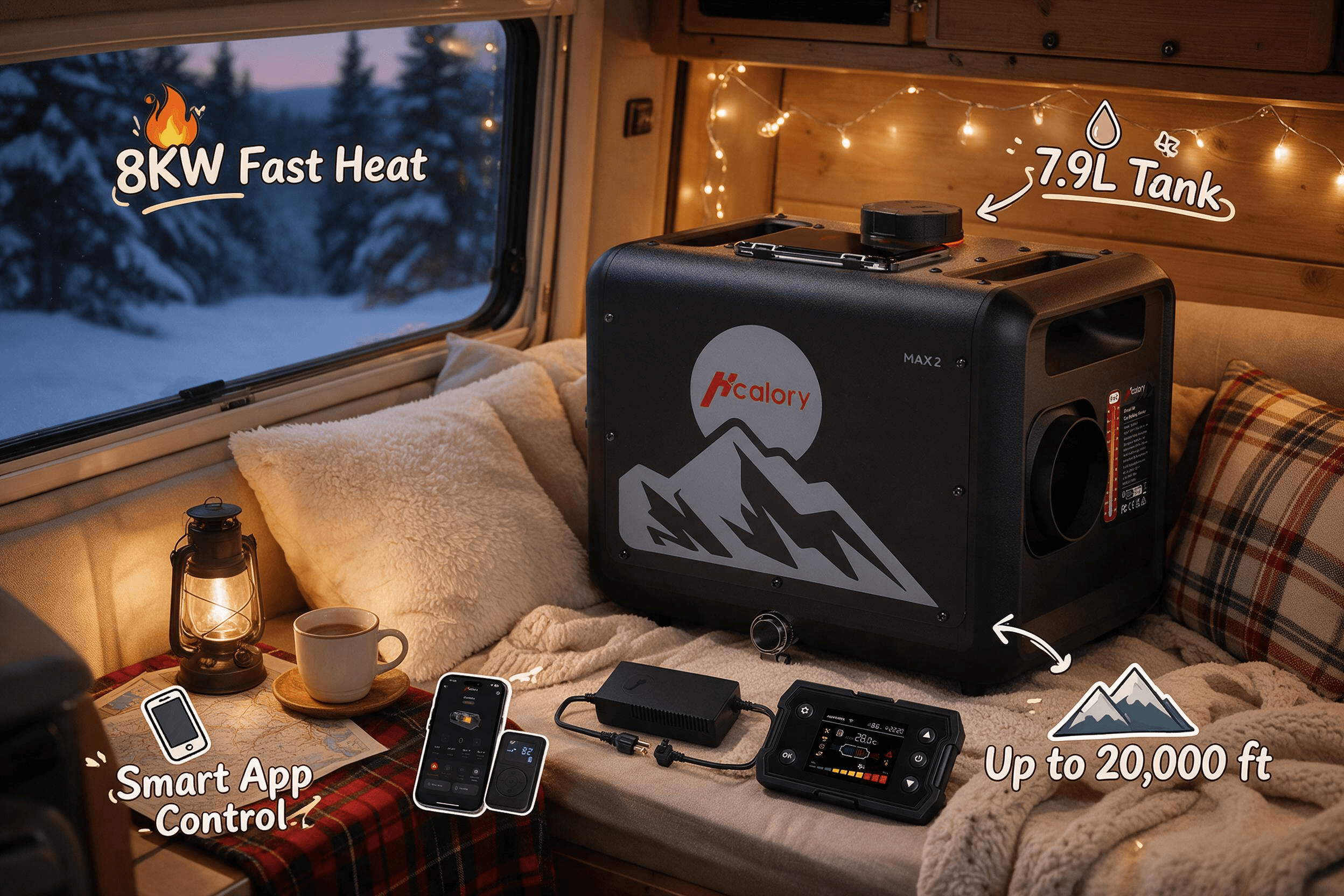
Powerful thermal output means very little if managing that heat requires climbing out of a warm sleeping bag into sub-zero air at midnight to adjust a manual dial. Hcalory bridges the gap between raw heating power and everyday livability through its Smart Heat, Your Control ecosystem, anchored by Remote Control 2.0 and an intelligent closed-loop thermostat.
Traditional first-generation diesel heater remotes were rudimentary one-way key fobs with basic “on/off” buttons and no visual feedback. If the heater was mounted outside an RV, inside a truck bed box, or outside a canvas tent, the user had no way of knowing the current cabin temperature, fuel pump status, or operating level without walking outside to inspect the main chassis.
Remote Control 2.0 transforms the user interface into a responsive, multi-node command center:
- 📟 Bidirectional Remote Feedback: The dedicated Remote Control 2.0 unit allows you to monitor real-time operational metrics, adjust heating stages, and set target temperatures from the comfort of your bed or driver’s seat at distances up to 32 feet (10 meters) and beyond.
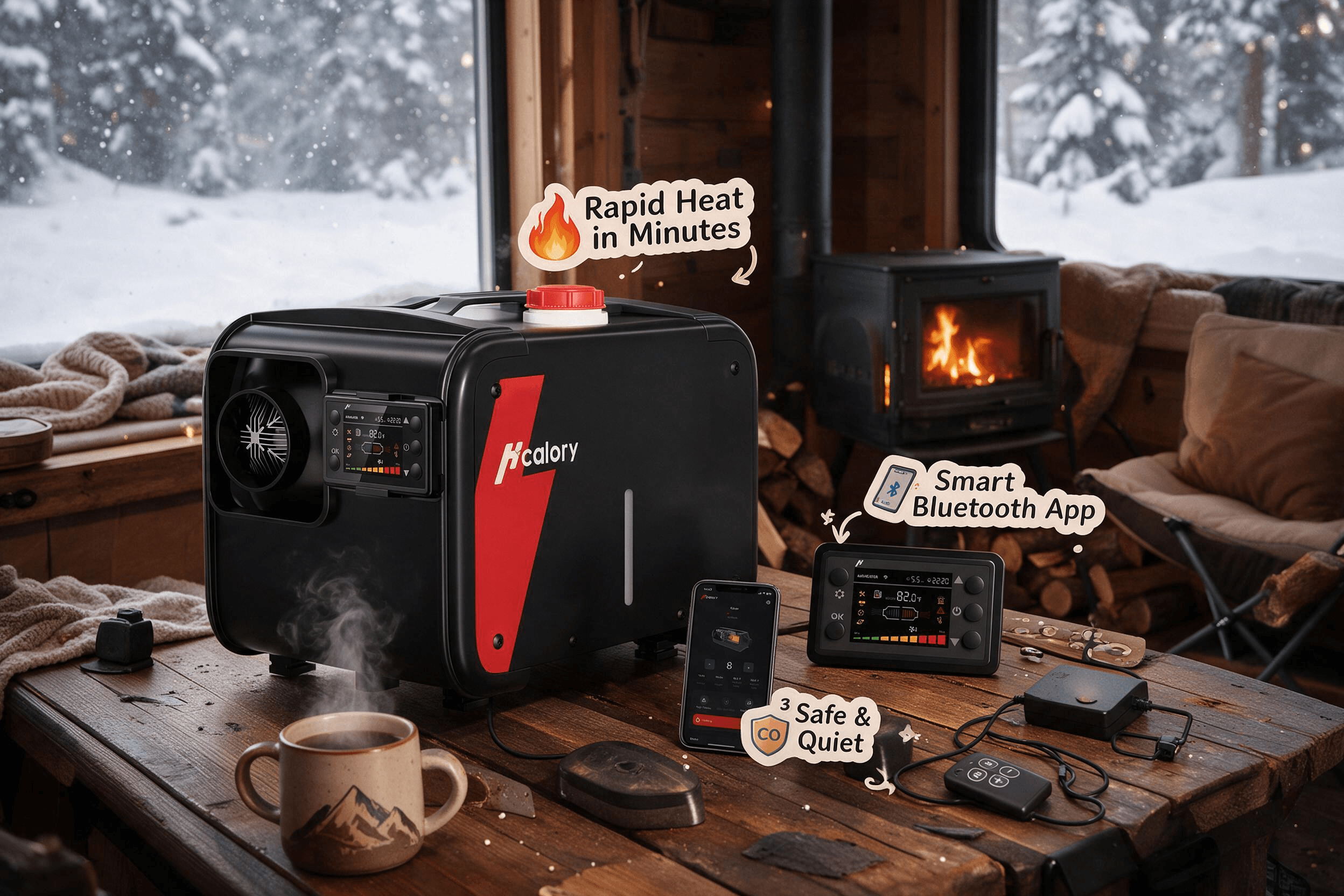
- 📲 Bluetooth Smartphone Integration: Through the dedicated Hcalory mobile application, smartphones become full-featured thermal dashboards. Users can switch between power levels and temperature targets, program automated startup timers before waking up, and inspect diagnostic readouts effortlessly.
- 🖥️ On-Board High-Contrast LCD Panel: Mounted directly on the chassis for immediate local control, the weather-sealed LCD interface provides crisp visual telemetry during setup, refueling, and diagnostic checks.
💬 Morning Routine Scenario: Zero-Chill Wakeups “When my alarm goes off at 6:30 AM in the mountains, I don’t touch the floor. I grab the Remote Control 2.0 sitting on my nightstand, tap the ignition button while the Toolbox MAX 2 sits outside in the snow, and stay under the covers for ten minutes. By the time I step out of bed, the cabin is already toasty and the frost on the windshield is melting.” — Full-Time Vanlifer & Winter Photographer
Closed-Loop Thermal Regulation vs. Constant-Output Waste
A standout innovation featured prominently across the Hcalory lineup is the Smart Thermostat architecture. Basic portable heaters operate exclusively in fixed-hertz manual mode, pumping fuel at a static rate regardless of how warm the room becomes. In a compact campervan or insulated ice shanty, fixed output quickly turns the space into an uncomfortable sauna, forcing users to manually cycle the heater on and off or crack windows open—wasting precious diesel fuel in the process.
Hcalory’s Smart Thermostat continuously monitors ambient temperature curves and compares them against your precise user-defined setpoint. As the interior approaches the target temperature, the microprocessor smoothly modulates fuel metering and fan RPM downward, transitioning from rapid warm-up into a gentle, low-consumption maintenance cruise. If a sudden gust of wind or a drop in outside temperature cools the cabin, the system ramps output back up automatically, maintaining a flat, comfortable thermal line with minimal temperature swing.
[Cold Cabin Detected] ➔ 🔥 Level 10 Rapid Boost (122°F Outlet in 3 Min)
         │
         ▼
[Approaching Target Temp] ➔ ⚙️ Smart Thermostat Modulates Pump & Fan Downward
         │
         ▼
[Target Temp Reached] ➔ 🌙 Level 1 Whisper Cruise (0.12 L/h Ultra-Low Burn)
         │
         ▼
[Ambient Drop Sensed] ➔ 🔄 Seamless Proportional Ramp-Up (Zero Manual Input)
Fuel Economics of the 7.9-Liter Tank Across Three Operating Modes
For overland travelers, remote cabin owners, and emergency preparedness planners, runtime autonomy is the ultimate metric of reliability. Refueling a heater in the middle of a howling blizzard using a frozen jerrycan is both hazardous and messy. Moreover, carrying excessive auxiliary fuel cans consumes valuable payload capacity and storage space.
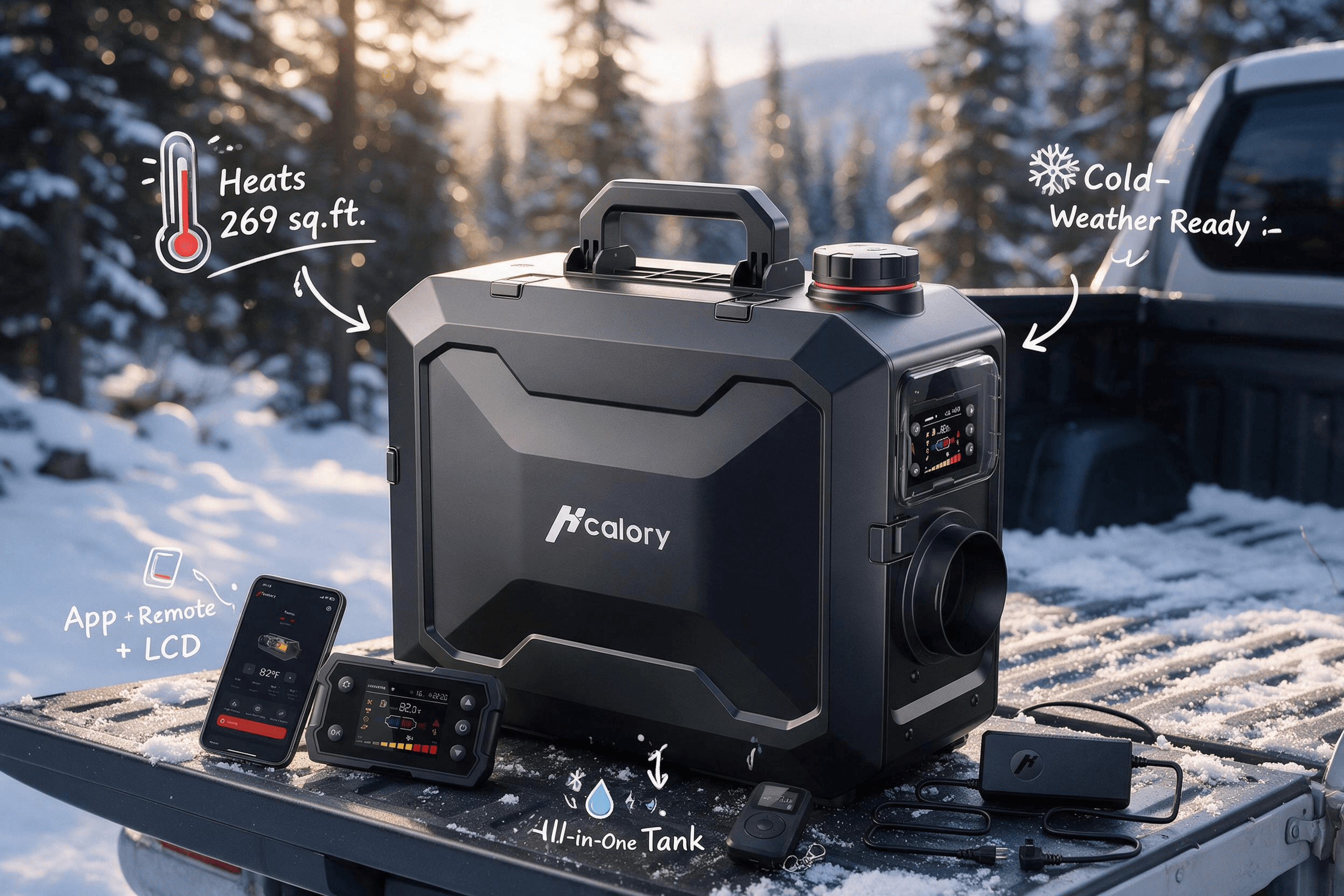
Hcalory addresses fuel autonomy head-on with its high-capacity 7.9-Liter (2.08-Gallon) Diesel Tank featured on flagship all-in-one systems like the Toolbox MAX 2, paired with precision electronic fuel injection pumps across every model. Embodying the design principle of “One Fill, Three Ways to Live,” this 7.9-liter reservoir adapts dynamically to three distinct real-world operational profiles, stretching a single tank of diesel up to an astonishing 65 hours of continuous operation.
Deep Slumber Mode: 65 Hours at Level 1
When an insulated RV, truck camper, or bedroom has already been brought up to temperature—or when camping during crisp autumn and spring nights—the heater requires only a fraction of its peak capacity to offset conductive heat loss through the walls. Operating at Level 1, the precision metering pump consumes a microscopic 0.12 liters of diesel per hour. At this burn rate, a single 7.9-liter fill delivers 65 hours of uninterrupted warmth. That equates to nearly eight full eight-hour nights of deep slumber with zero refuels, zero midnight interruptions, and whisper-quiet background operation.
Weekend-Long Vitality: 38 Hours at Level 6
During typical winter camping weekends where daytime highs hover around freezing and nighttime lows dip into the teens, a balanced mid-range output keeps larger spaces—such as family wall tents, mid-sized travel trailers, or mobile command vehicles—consistently comfortable around the clock. At Level 6, the system consumes 0.21 liters per hour, yielding 38 hours of continuous runtime on one tank. You can arrive at a remote trailhead on Friday evening, turn the heater on, and keep your living quarters warm all the way through Sunday afternoon without ever reaching for a fuel funnel.
Storm-Proof Output: 22 Hours at Level 10
When polar vortex winds, heavy mountain blizzards, or uninsulated workspaces demand uncompromising thermal power, Level 10 unleashes the full 8KW heating potential of the combustion chamber. Consuming 0.36 liters per hour, the 7.9-liter tank STILL provides a full 22 hours of continuous, full-tilt output. Even under the harshest winter conditions imaginable, users enjoy nearly an entire day and night of maximum heat before needing to top off the reservoir.
| Operating Profile | Power Setting | Hourly Fuel Burn Rate | Total Runtime (7.9L Tank) | Ideal Application Scenario |
|---|---|---|---|---|
| 🌙 Deep Slumber Mode | Level 1 | 0.12 L/h (0.032 gal/h) | Up to 65 Hours | Overnight cabin maintenance, insulated vans, multi-night trips with zero refuels |
| ⛺ Balanced Comfort Mode | Level 6 | 0.21 L/h (0.055 gal/h) | Up to 38 Hours | Full weekend winter camping, rooftop tents, medium RVs, steady daytime/nighttime use |
| 🌨️ Full-Tilt Storm Mode | Level 10 | 0.36 L/h (0.095 gal/h) | Up to 22 Hours | Extreme sub-zero blizzards, rapid warming of large uninsulated garages, ice shelters |
💡 Practical Fuel Economics Insight At an average retail diesel price of $3.80 per gallon (~$1.00 per liter), filling a 7.9-liter Hcalory tank costs roughly $7.90. In Level 1 maintenance mode, that translates to an operating cost of approximately $0.12 per hour—making Hcalory exponentially more economical than disposable 1-pound propane cylinders, which often cost $5.00 to $6.00 each and last only 3 to 5 hours in a portable radiant heater.
Acoustic Engineering and High-Altitude Atmospheric Adaptation
Two engineering hurdles have historically plagued conventional portable diesel heaters: rhythmic mechanical noise from the fuel metering pump and combustion failure at high mountain elevations. Hcalory has systematically re-engineered both subsystems to ensure serene nights and boundless geographic freedom.
Whisper-Quiet Fuel Metering and Vibration Isolation
Anyone who has slept beside an older, unrefined diesel heater knows the unmistakable “tick-tick-tick” sound of a standard solenoid plunger pump pulsing fuel into the burner, accompanied by the high-pitched whine of an unbalanced blower fan. In the dead silence of a snowy forest, even minor mechanical vibrations reverberate through vehicle floorboards and tent poles.
Hcalory resolves acoustic intrusion through a multi-layered Low Noise engineering package:
- 🔇 Integrated Oil Filter Silent Pump: By redesigning internal fluid damping pathways and combining fuel filtration with cushioned solenoid actuation, Hcalory drastically reduces the sharp metallic clicking associated with legacy metering pumps.
- 🛠️ Elastomeric Chassis Mounts: Critical vibrating components are suspended within shock-absorbing rubber isolators, preventing structure-borne resonance from transferring into the outer shell or vehicle frame.
- 🌀 Precision-Balanced Impellers & Exhaust Silencing: High-tolerance fan blades eliminate aerodynamic hum, while baffled exhaust mufflers and air intake silencers smooth out external airflow turbulence.
The result is a gentle, unobtrusive white-noise airflow that fades into the background, allowing light sleepers to rest undisturbed whether the unit is stationed inside a cabin or ducted in from outside.
Barometric Compensation for Alpine Overlanding
As elevation increases, atmospheric pressure drops and the concentration of oxygen molecules per cubic foot of air decreases. Standard diesel heaters calibrated solely for sea-level air density quickly run into trouble above 5,000 feet (1,500 meters): because the fuel pump continues injecting the same volume of diesel into thin, oxygen-starved air, the air-to-fuel mixture becomes overly rich. This triggers thick black exhaust smoke, rapid carbon fouling, flameouts, and error codes right when mountain temperatures are at their coldest.
Hcalory integrates intelligent High-Altitude Mode barometric compensation into its electronic control units. By sensing ambient air pressure changes and dynamically adjusting the ratio of blower fan speed to fuel pump frequency, Hcalory heaters maintain stoichiometric combustion efficiency across high mountain passes, alpine ski resort parking lots, and elevated backcountry plateaus.
Complete Lineup Breakdown of Hcalory Portable and Modular Heaters
Because no two off-grid setups are identical, a single heater form factor cannot serve every user equally. An ice angler pulling a sled across a frozen lake has vastly different portability needs than a commercial box-truck upfitter installing a permanent under-bunk heating system. Hcalory has structured its Amazon storefront around four distinct, purpose-built hardware platforms—allowing buyers to match chassis geometry, tank capacity, and mounting style to their exact mission profile.
Hcalory Toolbox MAX 2 All-in-One Smart Heater
Positioned as the flagship All-in-One Smart Heat powerhouse, the Toolbox MAX 2 is engineered for users who demand maximum fuel endurance, rugged outdoor weatherproofing, and zero-installation portability in a single self-contained enclosure.
- 🧰 Chassis & Weatherproofing: Built inside a heavy-duty, impact-resistant black polymer toolbox casing adorned with Hcalory’s signature alpine mountain graphics, the Toolbox MAX 2 carries an IPX4 all-weather protection rating. It can sit directly outside a tent, camper, or vehicle in falling snow or rain while piping clean, heated air indoors through its insulated flexible ducting.
- ⛽ Unrivaled Built-In Autonomy: Housing the massive 7.9-liter internal diesel tank, it delivers the full 22-to-65-hour runtime spectrum without any external fuel jerrycans or exposed fuel lines.
- 🧼 Smart Maintenance & Control: Equipped with Remote Control 2.0, Bluetooth mobile app connectivity, the One-Tap Carbon Clean self-maintenance system, and an integrated storage compartment protocol that keeps accessories organized during transit.
- 🎯 Best For: Basecamp overlanders, rooftop tent campers, off-grid cabin owners, and RV travelers who prefer placing the heater unit outside their sleeping quarters for maximum interior space and total peace of mind.
Hcalory Toolbox 2 and Toolbox 3 Portable Shield Series
For adventurers who prioritize grab-and-go ergonomics, compact vehicle packing, and rapid deployment across multiple locations, the Toolbox 2 (and its latest storefront evolution, the Toolbox 3 Shield On-The-Go) refines the suitcase-style concept into an ultra-agile mobile heating shield.
- 🧳 Ergonomic Suitcase Portability: Featuring a reinforced top carry handle, heavy-duty latches, and a streamlined vertical profile, the Toolbox series carries like a professional mechanic’s tool case. Moving the unit from the back of an SUV to an ice fishing shelter, and then into a backyard workshop on Monday morning, takes less than two minutes.
- 🔋 Dual-Voltage Power Flexibility: Engineered to run effortlessly off 12V/24V DC vehicle batteries and portable power stations in the field, while supporting AC household wall outlets via an adapter for garage, basement, or workshop heating.
- 🤫 6-Liter Endurance & Quiet Pump Architecture: Balancing total loaded weight against runtime, the 6-liter internal fuel tank provides up to 50 hours of low-setting heat while keeping the fully fueled unit light enough for easy one-handed lifting.
- 🎯 Best For: Weekend campers, ice fishermen, tailgaters, mobile mechanics, and multi-use homeowners who move their heater frequently between vehicles, tents, and indoor workspaces.
Hcalory HBH-2S and HBH-3S Elevated Endurance Platform
The HBH-2S (alongside the next-generation HBH-3S Silent Endurance Platform) takes a distinctly industrial, metallic approach to portable all-in-one heating, designed for users who value structural rigidity, compact stowing, and elevated ground clearance.
- 🏗️ Elevated Four-Legged Stance & Foldable Handle: Unlike flush-bottom boxes, the HBH series stands on four sturdy corner legs that elevate the chassis above slush, mud, and uneven ground, while providing immediate clearance for bottom-exit exhaust and intake routing. A heavy-gauge foldable stainless steel handle folds completely flat against the top deck when stowed inside tight RV pass-through compartments.
- 🔥 Upgraded Aluminum Thermal Core: Utilizing an enhanced aluminum heat-exchange body with a 5-liter integrated fuel tank, this platform maximizes heat transfer efficiency (up to a 28% thermal boost) within a remarkably compact metallic footprint.
- 🔇 Silent Endurance Engineering: Built from the ground up around acoustic dampening and continuous duty cycles, making it a favorite for inside-the-vestibule or awning-covered deployments.
- 🎯 Best For: Truck bed campers, compact teardrop trailers, awning setups, and gear-conscious travelers who need a flat-stacking, metal-armored heater with built-in ground clearance for exhaust routing.
Hcalory UNIT 2 Compact Split-System Architecture
While all-in-one toolbox heaters excel at portable, plug-and-play deployments, permanent vehicle conversions and tight architectural spaces often call for a modular approach. The Hcalory UNIT 2 is a classic, compact split-style diesel heater engineered specifically for custom, permanent, or semi-permanent installations.
- 🔧 Ultra-Compact Core Footprint: By separating the heating core from the fuel reservoir, the sleek black UNIT 2 heater body can be tucked into spaces where no all-in-one box could ever fit—such as inside a Sprinter or Transit passenger seat pedestal, beneath a sleeper-cab bunk, inside a boat hull locker, or inside a false floor cabinet.
- 🛢️ Massive 15-Liter External Tank Capability: Paired with an external 15-liter fuel tank (or tapped directly into a diesel vehicle’s auxiliary fuel pickup), the UNIT 2 can operate continuously for up to 4 full days without refueling.
- 🚐 Clean OEM-Style Integration: Once mounted through the vehicle floor plate, all exhaust, combustion intake, and fuel metering occur cleanly beneath the chassis, leaving only warm air vents and the sleek LCD / Remote Control 2.0 interface visible inside the living space.
- 🎯 Best For: DIY campervan builders, Class B/C motorhomes, commercial semi-truck sleepers, marine cabin cruisers, and permanent tiny-home installations.
| Feature / Specification | Toolbox MAX 2 | Toolbox 2 / Toolbox 3 | HBH-2S / HBH-3S | UNIT 2 |
|---|---|---|---|---|
| Form Factor | Rugged All-in-One Toolbox | Compact Portable Suitcase | Elevated Metal Frame All-in-One | Compact Modular Split Unit |
| Primary Tagline | All-in-One Smart Heat | Compact & Rugged / Shield On-The-Go | Foldable Handle / Silent Endurance | Compact & Easy to Install |
| Heating Output | 8KW Max Class | 8KW Max Class | 8KW Max Class | 8KW Max Class |
| Fuel Tank Capacity | 7.9 Liters (Internal) | 6.0 Liters (Internal) | 5.0 Liters (Internal) | 15.0 Liters (External Tank) |
| Max Runtime Per Fill | Up to 65 Hours | Up to 50 Hours | Up to 42 Hours | Up to 96 Hours (4 Days) |
| 3-Min Outlet Temp | 122°F (50°C) Rapid Heat | 122°F (50°C) Rapid Heat | 122°F (50°C) Rapid Heat | 122°F (50°C) Rapid Heat |
| Control Ecosystem | Remote 2.0 + Bluetooth App + LCD | Remote + Bluetooth App + LCD | Remote + Bluetooth App + LCD | Remote + Bluetooth App + LCD |
| Standout Hardware Trait | IPX4 Weatherproof + One-Tap Carbon Clean | Ergonomic Carry Case + Dual Voltage | 4-Leg Clearance + Foldable Steel Handle | Fits Under Seats & Tight Compartments |
Application Blueprints for RVs, Rooftop Tents, Workspaces, and Ice Shelters
Selecting the right Hcalory heater is only half the equation; deploying it with smart airflow routing and power management unlocks its full thermodynamic potential. Below are four proven field blueprints tailored to the most common cold-weather environments.
Overland Rooftop Tents and Canvas Basecamps
Canvas wall tents and hardshell rooftop tents have high rates of conductive heat loss due to thin fabric walls and wind exposure. For these setups, the Toolbox MAX 2 or Toolbox 2 / 3 stationed outside on the ground—or mounted on a vehicle tire table or roof rack—is the gold standard.
- ⛺ Ducting Strategy: Route the flexible warm-air outlet hose up into the tent through a zippered heater port, keeping bends as gradual as possible to maintain high airflow velocity.
- 🔄 Recirculation Tip: In extreme sub-zero cold (below 10°F / -12°C), if your setup allows you to route the clean-air intake duct back into the tent as well, the heater will re-heat already-warmed 60°F cabin air rather than struggling to heat -10°F outside air from scratch. Always ensure the small combustion air intake and exhaust pipe remain 100% outdoors and well clear of the clean-air intake.
Campervans, Travel Trailers, and Skoolies
Recreational vehicles suffer from cold thermal bridging through metal body panels, wheel wells, and large glass windshields. Built-in RV furnace systems running on liquid propane are notoriously loud and consume massive battery amperage and propane reserves.
- 🚐 Permanent vs. Portable Deployment: Vanlifers with dedicated under-seat space can hard-mount the UNIT 2 directly through the floor pan for a zero-clutter permanent solution. Conversely, seasonal RV owners who do not want to drill permanent holes through their trailer floor can set the Toolbox MAX 2 or HBH-2S / 3S outside beneath the RV skirt and run the warm-air duct through a custom foam window insert.
- 🌡️ Thermostat Placement: Position the Remote Control 2.0 or temperature sensing node at bed height away from the direct blast of the hot air duct so the Smart Thermostat reads true ambient living temperature.
Off-Grid Garages, Workshops, and Job Sites
Working with cold metal tools in an unheated garage, barn, or construction site saps manual dexterity and ruins paint, epoxy, and battery performance. Because Hcalory models support AC-to-DC power conversion alongside 12V/24V battery operation, they serve as formidable shop heaters during the workweek before heading out to camp on Friday.
- 🛠️ Zoned Task Heating: Point the directional air louver directly toward your workbench or vehicle engine bay. Because the air outlet reaches 122°F in 3 minutes, you get immediate spot warmth without waiting two hours to heat unused ceiling rafters.
- 🛡️ Exhaust Routing in Enclosed Structures: When operating any diesel heater inside a garage or shed, always extend and route the stainless steel exhaust pipe completely outside through a wall port or under-door pass-through sleeve so combustion gases vent safely into the open atmosphere.
Ice Fishing Shelters and Winter Hunting Blinds
Out on frozen lakes, wind-chill temperatures routinely drop to -20°F (-29°C), and traditional propane heaters turn the inside of insulated pop-up shanties into dripping, slippery ice rinks while fogging up sonar screens and eyeglasses.
- 🎣 Dry Electronics & Ice-Free Holes: The dry forced-air output of an HBH-2S / 3S or Toolbox 2 / 3 keeps the shanty floor dry, prevents fishing holes from skimming over with ice, and eliminates condensation on fish-finder displays.
- 🔋 Power Station Pairing: After the initial 2-to-3-minute glow-plug ignition phase (which briefly draws 8 to 12 amps at 12V), an Hcalory heater running in low-to-medium cruise mode draws only 15 to 40 watts of continuous electrical power. A compact 500Wh portable lithium power station (LiFePO4) can easily run the heater for an entire weekend on the ice.
Safety Protocols, Preventive Maintenance, and Seasonal Storage
While Hcalory engineers multiple layers of automated electronic protection—including overheat shutoff sensors, flameout detection, voltage drop protection, and short-circuit safeguards—adhering to disciplined operational habits guarantees safe, trouble-free performance for years.
⚠️ Essential Off-Grid Safety & Operating Checklist
- 🛡️ Never Interrupt Main Power During Shutdown: When you turn an Hcalory heater off via the LCD panel, app, or Remote Control 2.0, the fuel pump stops immediately, but the cooling fan continues running for 3 to 5 minutes to dissipate residual heat from the aluminum chamber. Never unplug the 12V battery or AC power cord before this cooling cycle finishes, or trapped heat can damage internal sensors.
- 🚨 Always Use a Carbon Monoxide Detector: Even though Hcalory uses a sealed heat exchanger that vents exhaust outdoors, every enclosed sleeping space (tent, RV, cabin, or boat) should be equipped with a working, battery-operated CO alarm as a redundant safety precaution.
- 💨 Keep Exhaust Clear of Snowdrifts and Combustibles: Ensure the external stainless steel exhaust pipe slopes slightly downward to prevent moisture pooling, stays clear of dry grass or tent guy-lines, and remains above accumulating snowbanks during overnight storms.
- 🔌 Provide Stable 12V Startup Current: During the first 180 seconds of ignition, the ceramic glow plug requires a solid 10A–15A current draw at 12V. Avoid using thin, undersized cigarette-lighter extension cords that cause voltage sag; connect directly to robust battery terminals, regulated high-amperage 12V sockets, or dedicated AC-DC power bricks.
Preventive Maintenance and Spring Storage Blueprint
Keeping an Hcalory diesel heater in peak condition requires remarkably little mechanical intervention if you follow three simple seasonal practices:
- ⛽ Use Clean, Winterized Ultra-Low Sulfur Diesel (ULSD): In temperatures below 15°F (-9°C), untreated summer-blend diesel can experience paraffin wax gelling, which restricts flow through the narrow fuel filter and silent metering pump. Always fill up with winter-blended pump diesel or add a few drops of standard anti-gel diesel conditioner during deep freezes.
- 🔥 Run a Monthly High-Output Purge: If you primarily operate your heater at Level 1 (0.12L/h) for overnight sleeping, run the unit at Level 10 for 15 to 20 minutes once every few weeks—or activate the One-Tap Carbon Clean feature on the Toolbox MAX 2—to burn off any minor soot accumulation and keep the combustion screen pristine.
- 📦 End-of-Season Fuel Drain and Dry Storage: Before storing your heater for the warm summer months, drain old diesel from the tank so fuel does not oxidize or gum up the metering pump over six months of inactivity. Run the heater briefly until the fuel line empties and shuts down cleanly, cap the air intake and exhaust ports to keep dust and insects out, and store the unit in a dry area.
Elevating Cold-Weather Freedom with Hcalory
Winter no longer has to dictate when your camping season ends, where your campervan can travel, or how comfortably you can work in an off-grid space. By uniting rapid 3-minute heating to 122°F, up to 65 hours of single-tank autonomy, whisper-quiet pump acoustics, and the effortless convenience of Remote Control 2.0 and Smart Thermostat modulation, Hcalory has established a new benchmark for portable thermal engineering.
Whether your adventures call for the weatherproof, long-range stamina of the Toolbox MAX 2, the grab-and-go versatility of the Toolbox 2 and Toolbox 3, the elevated metallic resilience of the HBH-2S and HBH-3S, or the seamless under-seat integration of the UNIT 2, Hcalory delivers dependable, bone-dry warmth built for the toughest conditions on earth—proving in every sub-zero gale that true engineering produces heat that never stands down.