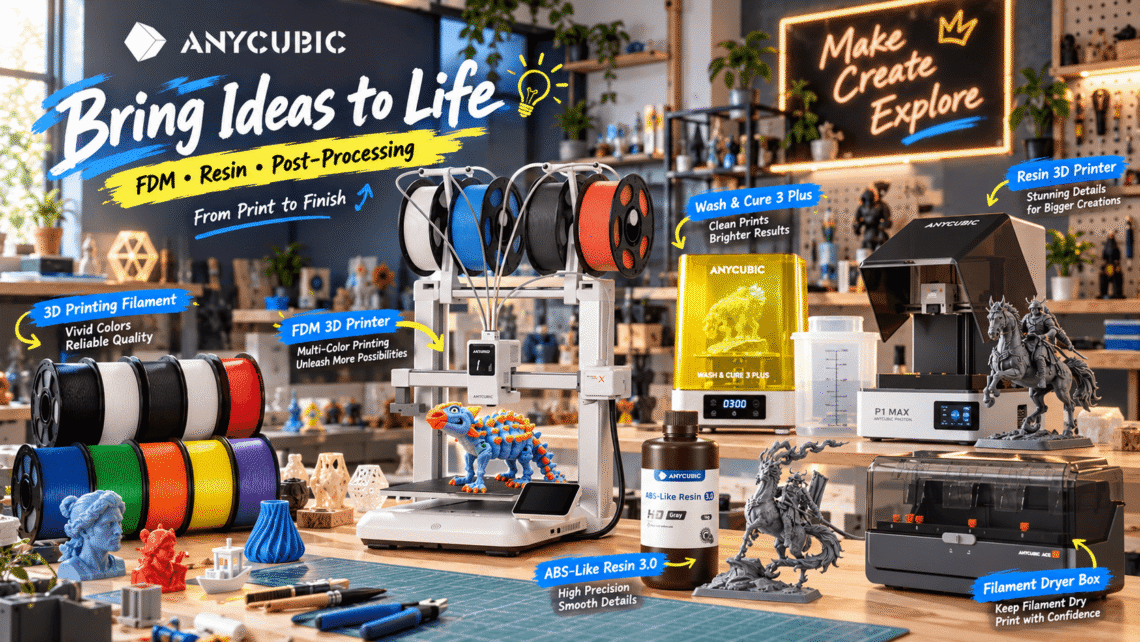
In the span of just over a decade, desktop 3D printing has evolved from an expensive curiosity reserved for industrial engineers and dedicated makers into something far more accessible. Today, hobbyists, educators, small-business owners, and curious beginners are setting up printers on kitchen tables, in classroom corners, and inside garage workshops. Among the companies that helped accelerate this shift, ANYCUBIC stands out not because it shouted the loudest, but because it consistently delivered machines that balanced capability with affordability. The brand has become a fixture in the desktop fabrication conversation, and its growing ecosystem of printers, resins, filaments, and accessories tells a larger story about where additive manufacturing is headed next.
This article takes a closer look at ANYCUBIC as a brand, exploring its philosophy, its product approach, the communities it serves, and the reasons it continues to matter in a crowded market. Rather than simply listing specifications, the goal here is to understand what ANYCUBIC represents for people who want to turn digital ideas into physical objects without navigating a steep learning curve or draining their savings account.
From Shenzhen to Workbenches Around the World
ANYCUBIC was founded in Shenzhen, a city that has earned its reputation as the global capital of hardware innovation. The company emerged during a period when consumer-grade 3D printing was still figuring itself out. Early desktop machines were often finicky, expensive, and intimidating to newcomers. Wires sprawled across open frames, calibration required engineering patience, and a successful first print felt more like luck than inevitability. ANYCUBIC entered this environment with a clear premise: reliable 3D printing did not have to be a luxury experience.
The brand’s growth mirrors the broader maturation of the consumer 3D printing industry. Where early adopters once tolerated inconsistent extrusion and mysterious bed-adhesion failures, today’s users expect intuitive interfaces, auto-leveling, and prints that survive shipping. ANYCUBIC responded to these rising expectations by refining its hardware designs, expanding its material offerings, and building a global support network. What began as a challenger brand has become a trusted name for people who want to explore digital fabrication without treating every project like a troubleshooting exercise.
The company’s headquarters in Shenzhen gives it a distinctive advantage. Proximity to component manufacturers, rapid prototyping facilities, and a deep pool of engineering talent allows ANYCUBIC to iterate quickly. When a new display technology, extruder design, or motion system becomes viable, the company can test and integrate it faster than many competitors. This manufacturing agility does not always make headlines, but it shows up in the final product as faster print speeds, quieter operation, and more consistent output.
A Brand Built on the Idea of Accessible Precision
If there is a single idea that runs through ANYCUBIC’s product development, it is the belief that precision should not be proprietary. High-resolution 3D printing was once the domain of professional services and industrial systems costing tens of thousands of dollars. ANYCUBIC helped change that perception by bringing resin-based printing and refined filament systems into price ranges that students, artists, and independent designers could actually consider.
This commitment to accessibility does not mean the brand treats its products as toys. On the contrary, ANYCUBIC machines are often used for functional prototyping, jewelry casting, miniatures, architectural models, dental applications, and educational demonstrations. The difference lies in how the company packages that capability. Features that once required manual configuration and constant supervision are increasingly automated. Touchscreen interfaces replace cryptic knob-and-button menus. Modular components make maintenance less intimidating. The result is a line of printers that feel approachable on day one but still offer enough depth to satisfy users as their skills grow.
The brand’s positioning also reflects an understanding of how people actually use 3D printers. Many owners do not run their machines forty hours a week in a production environment. They print on weekends, between classes, or during bursts of creative energy. ANYCUBIC designs with these intermittent users in mind, emphasizing quick setup, stable idle behavior, and forgiving maintenance schedules. A printer that works reliably after sitting unused for two weeks is, in many homes, more valuable than a printer optimized for continuous industrial output.
Understanding the Two Worlds of ANYCUBIC Printing
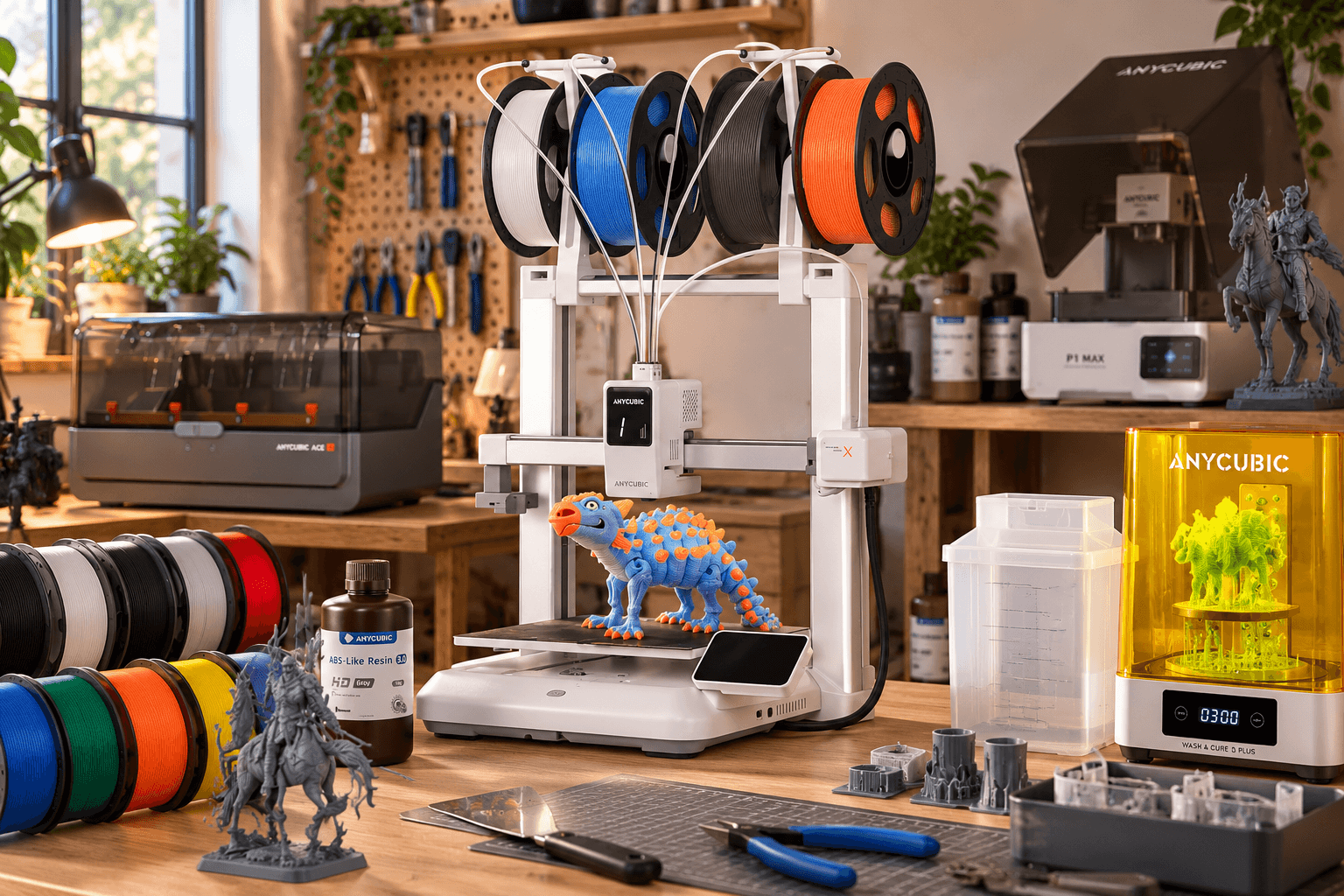
ANYCUBIC’s product lineup essentially splits into two major categories, each serving different creative and practical needs. Understanding this division is essential for anyone considering the brand, because the right choice depends entirely on what you want to make.
Filament-Based Printing for Functional Creation
On one side, ANYCUBIC offers fused deposition modeling printers, commonly known as FDM or filament printers. These machines build objects by heating thermoplastic filament and depositing it layer by layer. FDM printing is the technology most people picture when they imagine a 3D printer in action: a nozzle moving back and forth, gradually stacking a physical object from a digital file.
ANYCUBIC’s FDM machines are designed around versatility and structural strength. They excel at producing functional parts, mechanical prototypes, cosplay props, household fixtures, brackets, enclosures, and anything else where durability matters more than microscopic surface detail. The technology works with a wide range of materials, including standard plastics like PLA and PETG, more demanding filaments like ABS and nylon, and specialty blends containing carbon fiber, wood, or metal powders.
What distinguishes ANYCUBIC’s approach to FDM printing is the attention given to the full workflow, not just the printing itself. Bed adhesion, nozzle clogging, and warping are common frustrations for FDM users, and the company has steadily introduced features aimed at reducing these pain points. Heated beds, flexible build plates, direct-drive extruders, and automatic bed leveling have become standard expectations in the industry, and ANYCUBIC has worked to implement them in ways that remain affordable. The result is a printing experience that lets users focus on design rather than constant mechanical babysitting.
Resin Printing for Detail and Surface Quality
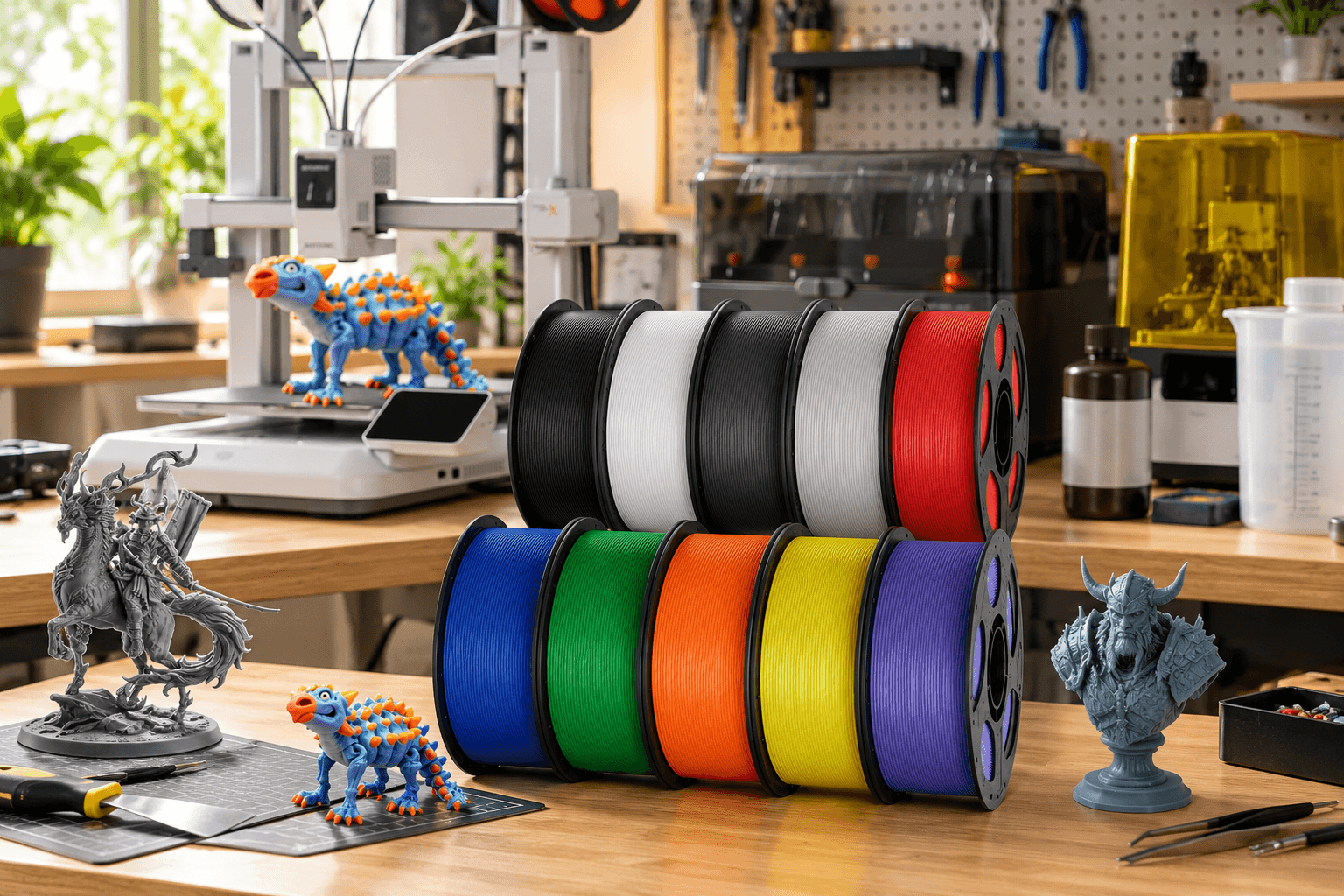
On the other side, ANYCUBIC has made a significant name for itself in resin-based printing, specifically the masked stereolithography approach often referred to as MSLA or LCD resin printing. These printers use a liquid photopolymer resin that hardens when exposed to light projected through an LCD screen. The technology produces dramatically finer detail than typical FDM printing, with layer lines so small they often disappear entirely after light post-processing.
Resin printing is ideal for applications where surface quality and fine features matter most. Miniature figurines, highly detailed props, jewelry masters, dental models, and intricate art pieces all benefit from the precision that resin systems can deliver. ANYCUBIC’s resin printers have become especially popular among tabletop gamers, miniature painters, jewelry designers, and dental technicians who need smooth surfaces and crisp edges.
The trade-off with resin printing is that it involves more post-processing than FDM. Prints must be washed to remove excess uncured resin and then cured under UV light to reach full mechanical strength. Resin also requires more careful handling and ventilation than filament. ANYCUBIC has addressed this by offering not just printers but also wash-and-cure stations that automate much of the cleanup. By selling these complementary tools, the brand makes resin printing feel less like a chemistry experiment and more like a complete creative system.
Designing for Real People, Not Just Specifications
It is easy to get lost in specifications when evaluating 3D printers. Build volume, layer height, print speed, and resolution numbers all matter, but they only tell part of the story. ANYCUBIC has generally understood that the user experience surrounding the print matters almost as much as the print itself.
Setup is one area where this philosophy is most visible. A printer that arrives in a box full of mysterious cables and undocumented calibration rituals can scare away beginners before they ever produce their first object. ANYCUBIC has moved toward more assembled, plug-and-play designs that reduce the time between unboxing and first successful print. For many users, this matters more than marginal improvements in speed.
Maintenance is another crucial factor. All 3D printers require occasional care, whether it is cleaning a nozzle, replacing a worn sheet, or leveling a build platform. ANYCUBIC designs its machines with modular parts and accessible layouts, so users do not need specialized training to perform common repairs. This design sensibility extends the useful life of each printer and reduces the total cost of ownership over time.
The company’s interface choices also reflect a desire to lower barriers. Touchscreen controls with clear icons and straightforward menus replace the cryptic displays that once dominated budget printers. Firmware updates, when needed, are distributed in ways that do not require users to become amateur software engineers. These details may seem minor, but they accumulate into a user experience that respects the user’s time.
Who Actually Uses ANYCUBIC Printers?
The answer to this question is broader than it might first appear. ANYCUBIC’s product range is wide enough to attract several distinct user communities, each with its own priorities and creative goals.
Hobbyists and makers represent one of the largest groups. These are people who print for the joy of making things, whether that means custom brackets for a home project, decorative objects, articulated figures, or replacement parts for appliances. They value reliability and material variety because their projects change from week to week. They also appreciate communities where they can share settings, troubleshoot problems, and show off finished prints.
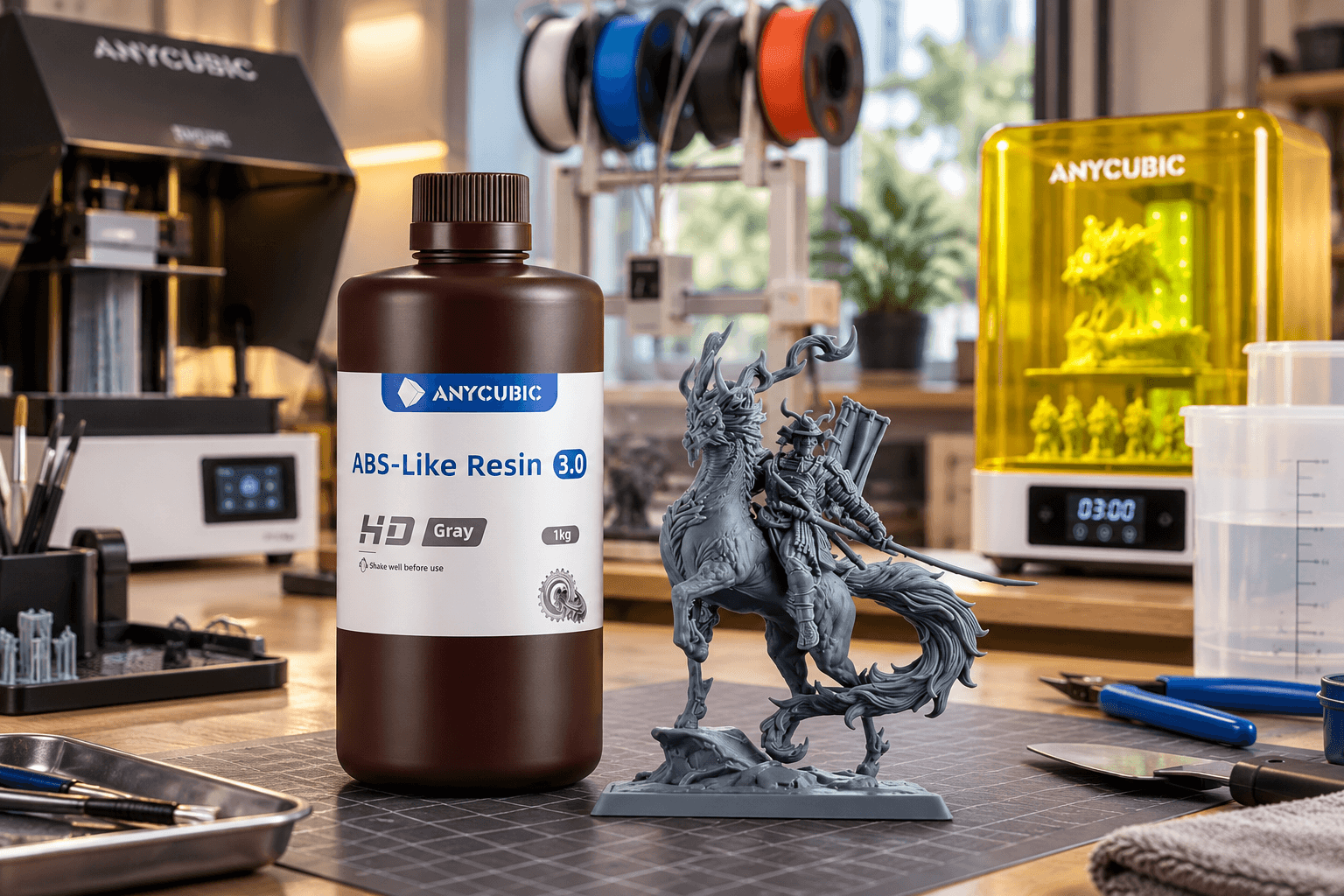
Tabletop gamers and miniature painters form another significant community. For these users, detail is everything. A miniature that looks blocky or pitted under a magnifying glass will not make it to the painting table. ANYCUBIC’s resin printers have found a loyal following here because they can reproduce tiny facial features, fabric folds, weapon details, and architectural textures with impressive fidelity.
Educators and students use ANYCUBIC machines to teach design thinking, engineering principles, and digital manufacturing skills. Schools and universities appreciate the relatively low cost of entry, which allows them to equip classrooms with multiple machines rather than a single shared printer. Students can learn by doing, iterating designs quickly, and experiencing the full cycle from digital model to physical object.
Jewelry designers and dental technicians use resin printers for professional applications that demand fine detail and smooth surfaces. While these users may eventually move on to more specialized systems, ANYCUBIC machines often serve as an accessible entry point or as a reliable backup for smaller production runs.
Small-business owners and product developers use FDM machines for functional prototyping. Being able to print a physical version of a design in hours rather than waiting days for an outsourced prototype can dramatically accelerate product development. ANYCUBIC’s larger build volumes and support for engineering materials make these workflows practical on a desktop budget.
The Ecosystem Beyond the Printer
A 3D printer is not really a standalone device in practice. It sits within a larger ecosystem of materials, software, post-processing tools, and community knowledge. ANYCUBIC has invested in building out this ecosystem so that users do not have to cobble together incompatible parts from different vendors.
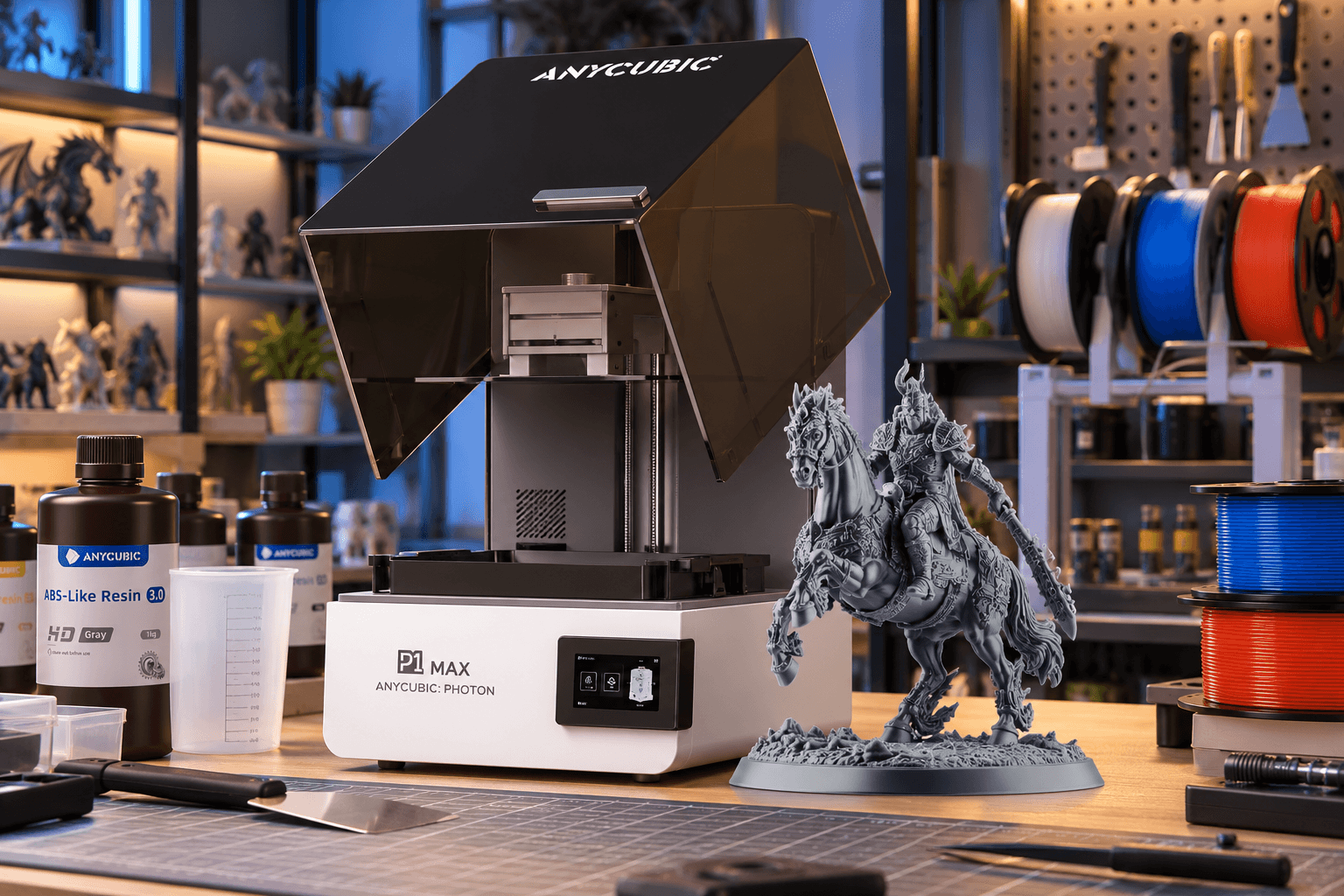
Materials are the most obvious example. Filament printers need filament, and resin printers need resin. ANYCUBIC offers its own branded materials formulated to work well with its machines, including standard resins, water-washable resins that simplify cleanup, tough resins for functional parts, and specialty resins with specific mechanical or aesthetic properties. For filament users, the company provides options in common materials like PLA, PETG, and ABS. Having reliable first-party materials reduces the guesswork involved in dialing in print settings.
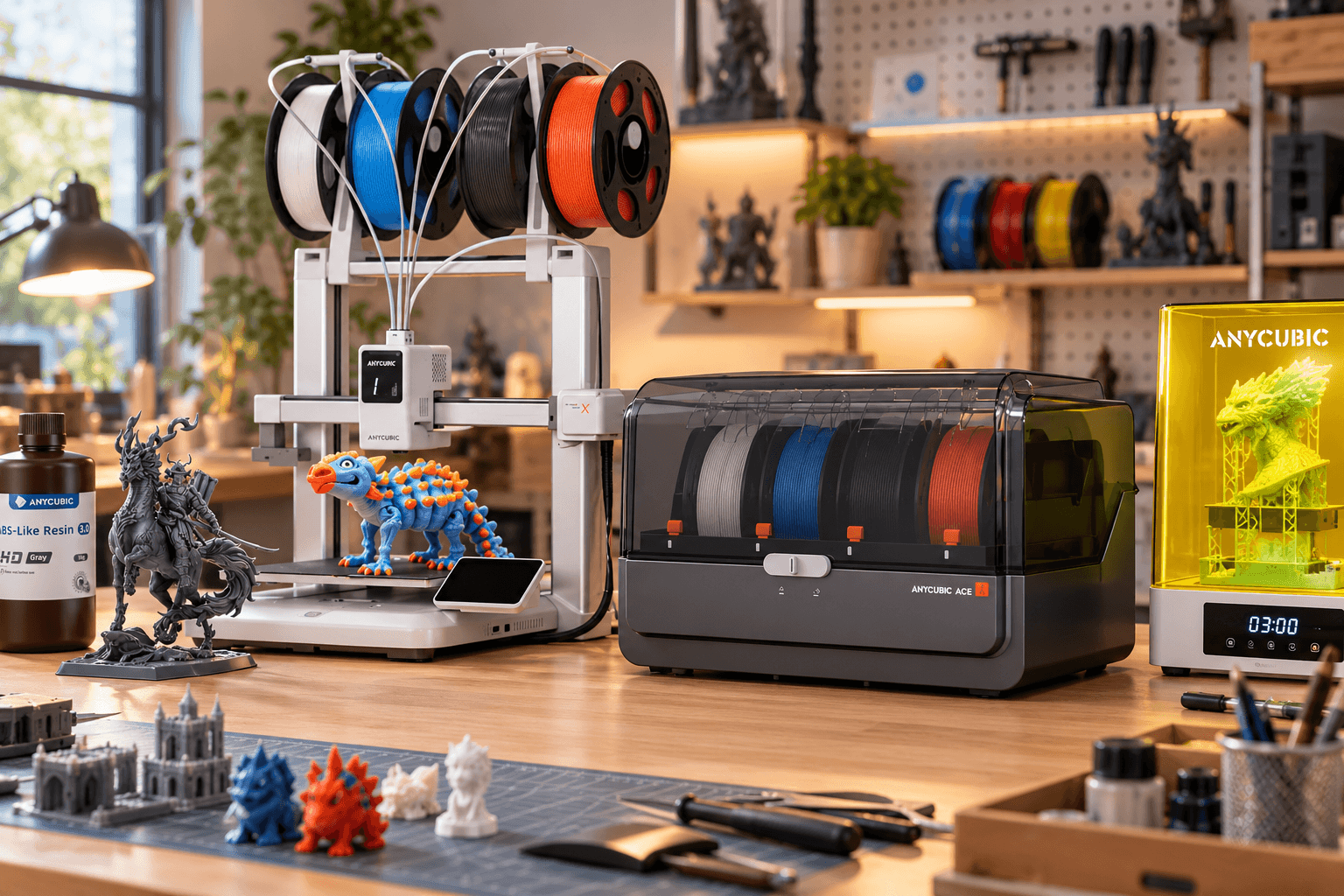
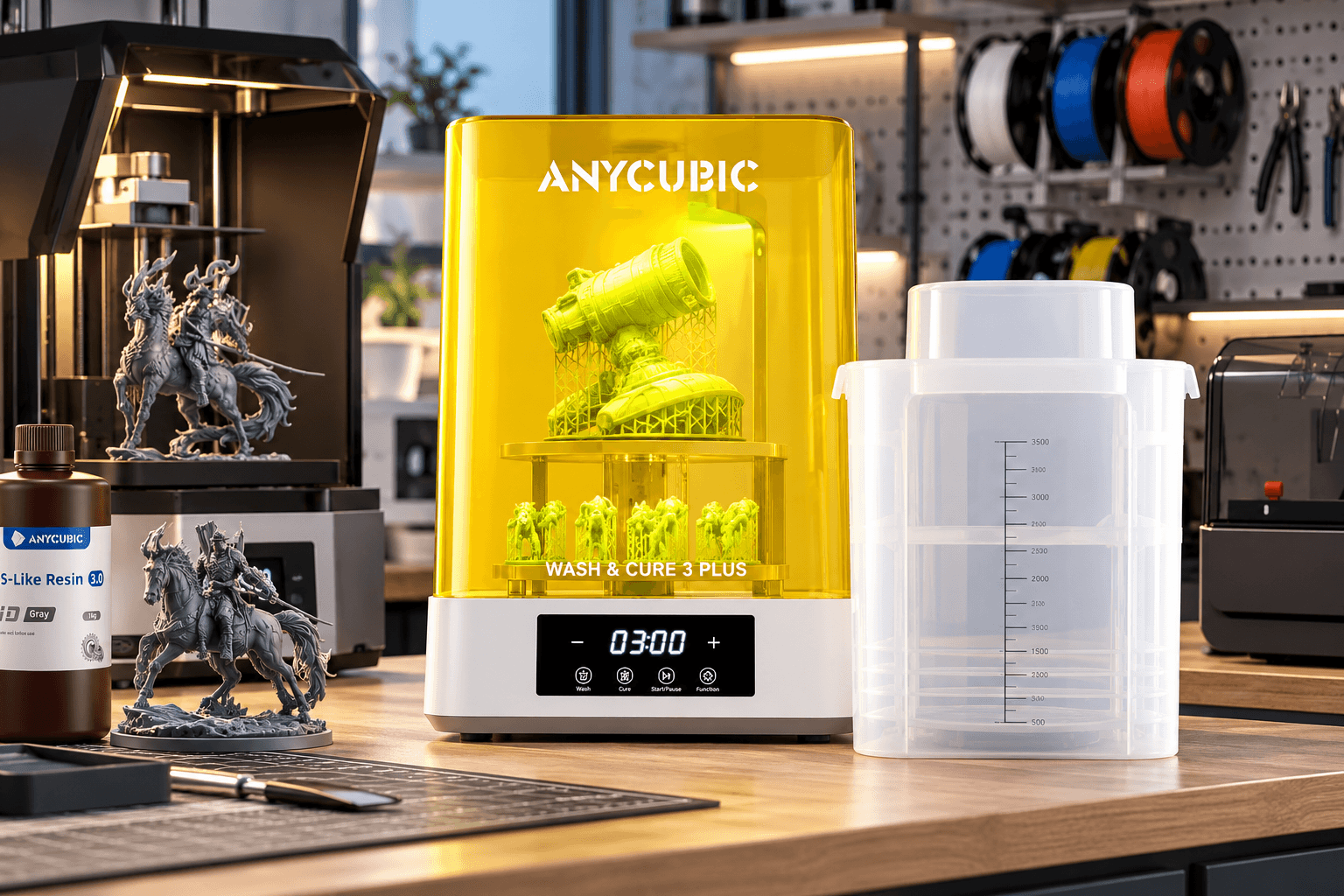
Post-processing equipment completes the workflow. Wash-and-cure stations for resin printing remove the need for users to improvise cleanup solutions using household containers and UV nail lamps. These stations streamline one of the most tedious parts of resin printing and produce more consistent results. For FDM users, accessories like flexible build plates and enclosure options help expand the range of printable materials and improve print reliability.
Software compatibility is another piece of the puzzle. ANYCUBIC printers generally work with popular open-source slicing software, giving users flexibility while also providing manufacturer-recommended profiles. This openness is important because it means users are not locked into proprietary software that might limit their options or become unsupported over time.
Community support rounds out the ecosystem. ANYCUBIC maintains official support channels, documentation, and firmware resources, but much of the brand’s practical knowledge lives in user communities. Forums, social media groups, and video tutorials created by ANYCUBIC owners form an informal support network that helps newcomers overcome early obstacles. The company’s popularity means that for most common issues, someone has already documented a solution.
Quality, Affordability, and the Myth of Compromise
There is a persistent assumption in consumer technology that lower prices must mean lower quality. ANYCUBIC has spent years challenging that assumption in the 3D printing space. The company’s business model relies on efficient manufacturing, direct distribution, and focused engineering rather than on cutting corners that users would notice.
This does not mean ANYCUBIC printers are flawless. No desktop 3D printer is. Users still encounter failed prints, calibration challenges, and occasional component failures. What matters is the ratio of capability to cost, and ANYCUBIC generally scores well by that measure. A user who spends a moderate amount on an ANYCUBIC machine typically receives a printer capable of producing professional-looking models, functional prototypes, and detailed artistic pieces.
The company’s pricing strategy has also had a democratizing effect on the broader market. By consistently offering capable machines at lower price points, ANYCUBIC has forced competitors to improve their own value propositions. This competition benefits consumers across the industry, raising baseline expectations for what an affordable 3D printer should include.
At the same time, ANYCUBIC has not abandoned users who want more advanced features. Its product range includes options with larger build volumes, faster print speeds, higher-resolution screens, and more robust construction. This tiered approach means that a beginner can start with an entry-level machine and later upgrade within the same brand family without having to relearn everything.
Innovation at the Pace of Practicality
Innovation in 3D printing can take many forms. Some companies chase headline-grabbing specifications or experimental technologies. ANYCUBIC tends to focus on practical improvements that make a noticeable difference in daily use. Faster exposure times for resin printers, more stable motion systems for FDM machines, better build surfaces, and quieter operation are the kinds of refinements that may not generate viral press releases but do make owners happier.
The company has also shown responsiveness to user feedback. Features that the community requests, such as larger resin vats, more accessible maintenance panels, or improved ventilation, have gradually appeared in newer models. This iterative approach reflects a mature understanding of product development: the best printer is not necessarily the one with the most exotic technology, but the one that removes the most friction from the user’s workflow.
Looking at ANYCUBIC’s trajectory, it is clear that the brand views 3D printing as a long-term consumer technology rather than a fleeting trend. The investments in materials, accessories, support infrastructure, and global distribution suggest a company preparing for a future where desktop fabrication becomes as normal as owning a laser printer or a sewing machine.
The Environmental and Social Dimensions of Desktop Fabrication
As 3D printing becomes more common, questions about materials, waste, and sustainability become more important. ANYCUBIC operates within this larger conversation, even if no single company can solve every environmental challenge associated with plastics and resin chemistry.
Filament printing, when used thoughtfully, can reduce waste by enabling localized manufacturing and repair. Instead of ordering an entire replacement part or product from overseas, a user can print only the component that broke. This repair culture aligns with broader movements toward sustainability and right-to-repair. ANYCUBIC’s support for a wide range of filaments, including biodegradable PLA and recycled materials, gives users options for reducing their environmental impact.
Resin printing presents different challenges because photopolymer resins require careful handling and disposal. ANYCUBIC has responded in part by offering water-washable resins that reduce the need for harsh cleaning chemicals. The company also provides guidance on proper resin disposal and safety practices. These steps do not eliminate the environmental considerations of resin printing, but they do help users make more responsible choices.
Socially, the spread of affordable 3D printing has implications for education, entrepreneurship, and creative expression. Students who might never have encountered manufacturing equipment can now design and produce physical objects. Small businesses can prototype products without massive upfront investment. Artists can explore forms that would be difficult or impossible to create by hand. ANYCUBIC’s role in this ecosystem is to provide the tools that make these activities possible.
What to Consider Before Buying an ANYCUBIC Printer
Choosing a 3D printer is a personal decision that depends on goals, budget, workspace, and patience. ANYCUBIC offers enough variety that most buyers can find something suitable, but a little forethought helps ensure satisfaction.
First, consider what you want to print. If your interests lean toward functional parts, mechanical prototypes, cosplay armor, or large objects, an FDM printer is probably the better starting point. If you care most about fine detail, smooth surfaces, and small intricate objects, a resin printer will likely serve you better. Some users eventually own both, but most beginners should start with one technology and master it.
Second, think about your workspace. Resin printers need good ventilation and a cleanup area. FDM printers are generally less messy but can be noisy and benefit from stable temperatures for certain materials. Make sure you have adequate space for the machine, materials, and post-processing.
Third, be realistic about the learning curve. ANYCUBIC printers are designed to be accessible, but 3D printing still involves learning about supports, orientation, slicer settings, and material behavior. The first few prints may require troubleshooting. Patience and a willingness to learn are more valuable than any single feature.
Fourth, consider the total cost of ownership. The printer itself is only part of the expense. Filament or resin, replacement build surfaces, cleaning supplies, and occasional spare parts add up over time. ANYCUBIC’s relatively affordable materials and widely available replacement parts help keep these ongoing costs manageable.
The Future of ANYCUBIC and Desktop Fabrication
The 3D printing industry is still evolving rapidly. New materials, faster printing technologies, AI-assisted slicing, and improved user interfaces are all reshaping what desktop fabrication can do. ANYCUBIC is positioned to participate in this evolution because of its manufacturing strengths, global reach, and focus on the consumer market.
One likely direction is continued speed improvements. Users increasingly expect prints to finish in hours rather than days. Technologies that allow faster resin exposure or faster filament deposition without sacrificing quality will become standard. ANYCUBIC’s history of adopting practical improvements suggests it will integrate these advances as they mature.
Another direction is smarter software. The gap between a 3D model and a successful print involves many decisions about orientation, supports, infill, and material settings. Software that can automate more of these decisions will make 3D printing accessible to an even wider audience. ANYCUBIC’s openness to popular slicing software puts it in a good position to benefit from these improvements.
Sustainability will also continue to matter. As users become more environmentally conscious, demand for recyclable filaments, bio-based resins, and energy-efficient printers will grow. ANYCUBIC’s material lineup and design choices will likely evolve in response to these preferences.
Finally, the community around ANYCUBIC will continue to be one of its greatest assets. A large, active user base creates a feedback loop that drives product improvement, produces educational content, and helps newcomers find their footing. Brands that nurture this community tend to thrive in creative technology markets.
Conclusion: The Significance of ANYCUBIC
ANYCUBIC represents something important in the history of desktop 3D printing: the moment when a powerful technology stopped being an exclusive tool and started becoming an everyday creative instrument. The company has not tried to be everything to everyone. Instead, it has focused on making reliable, capable 3D printers available at prices that open the door to hobbyists, students, artists, and entrepreneurs.
The brand’s strength lies not in any single revolutionary product, but in a sustained commitment to accessibility, practical innovation, and user-centered design. Whether you are printing your first benchy, prototyping a product, or casting jewelry masters, ANYCUBIC offers a pathway into the world of digital fabrication that respects both your ambitions and your budget.
In a market full of promises about the future of making, ANYCUBIC has built its reputation by delivering useful tools for the present. That may not sound as dramatic as a technological breakthrough, but for the millions of people who have turned digital ideas into physical reality with an ANYCUBIC printer, it matters quite a lot. The brand has helped prove that the future of making is not something that happens only in factories or research labs. It can happen on a desk, in a classroom, or in a small workshop, one layer at a time.