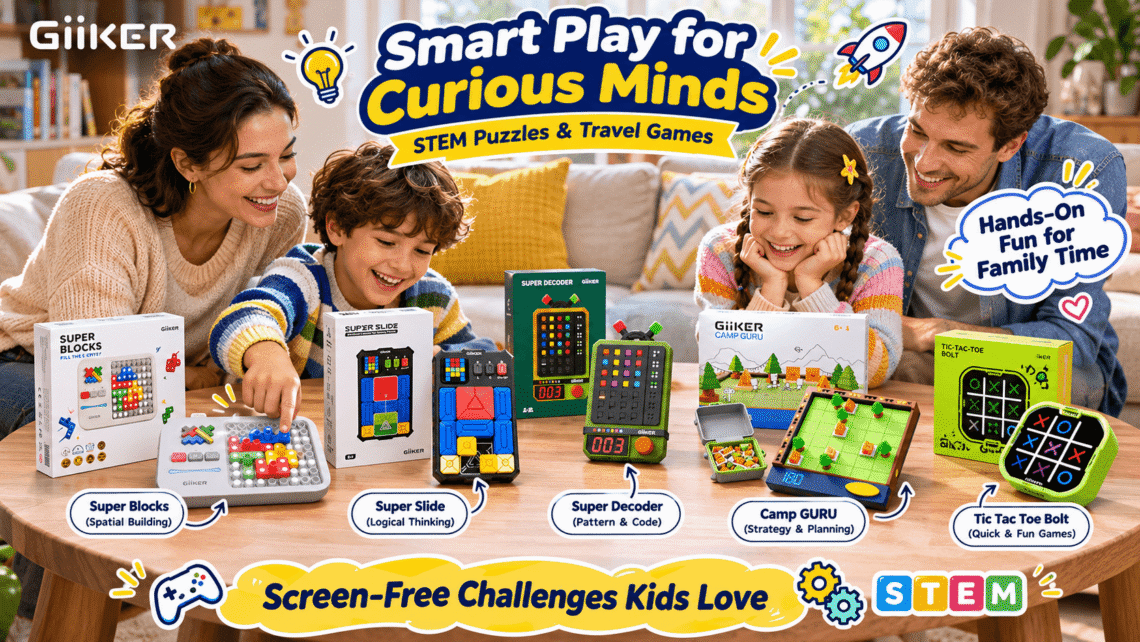
If you have ever watched a child abandon a tablet mid-level and reach for something that actually fits in their hands, you already understand why GiiKER has quietly become one of the most talked-about names in family gaming. This is the story of a brand that took the puzzle games your parents grew up with — sliding tiles, code books, tic-tac-toe boxes — and rebuilt them around sensors, light boards, and adaptive difficulty systems that practically learn alongside the player.
This article walks through who GiiKER really is, why its products keep landing on gift guides and award lists, and which five handheld smart puzzles deserve a spot in your next family game night.
The Short Version: What Is GiiKER, Anyway?
GiiKER — a name spun from “geek” — is a smart-toys company that blends traditional play with connected technology. Founded as a small team back in 2012, the company spent its early years chasing a surprisingly specific problem: how do you make a physical puzzle that knows when you’ve solved it?
Their first breakthrough came with the GiCUBE in 2014, followed by the SUPERCUBE i3 in 2018, billed as the world’s first smart cube. That device earned spots on Forbes’ best tech toy lists and in the MoMA Design Store, and it opened doors in more than 100 countries. Over time, the product line expanded far beyond cubes into a roster of standalone handheld puzzle consoles: Super Slide, Super Blocks, Super Decoder, Camp GURU, and Tic Tac Toe Bolt, among others.
The throughline is simple. Every GiiKER device is:
- Screen-free by design — no LCD, no apps required to play (the app layer is optional).
- Sensor-driven — the board itself detects pieces, moves, and patterns in real time.
- Level-based — hundreds to thousands of built-in challenges with graduated difficulty.
- Travel-ready — pocket-sized, battery-powered, and built from durable ABS plastic.
In other words, GiiKER makes “smart” toys that are still toys first.
Why the Brand Hit a Nerve (And Why Now)
Walk through any airport terminal, restaurant wait area, or pediatrician lobby, and the same scene repeats: a child hunched over a glowing rectangle while adults quietly wonder whether that is the only way to keep them occupied.
GiiKER arrived at exactly the right cultural moment. Parents and educators were already asking for screen-free STEM toys, educational travel games, and quiet independent-play options — but most offerings were either too babyish (cardboard puzzles with twenty pieces) or too open-ended (robot kits requiring constant adult intervention).
GiiKER’s sweet spot sits between those extremes:
- A puzzle console children can operate alone because the device itself gives feedback.
- Difficulty that ramps automatically, so a six-year-old doesn’t get bored at level one or defeated at level fifty.
- Hardware sturdy enough to survive a backpack, a carry-on, or a cousin’s sleepover.
That trifecta is why reviewers describe GiiKER products as “addictive” in the same way a good smartphone game is addictive — except the player’s eyes aren’t straining against blue light, and their hands are doing real, fine-motor work.
The Five Products Worth Knowing
Below is a concise tour of the five products the brand is best known for right now. Each section explains what the toy is, who it suits, and where it fits in a family’s rotation.
1. GiiKER Super Blocks: Pattern Matching, 1,000+ Challenges
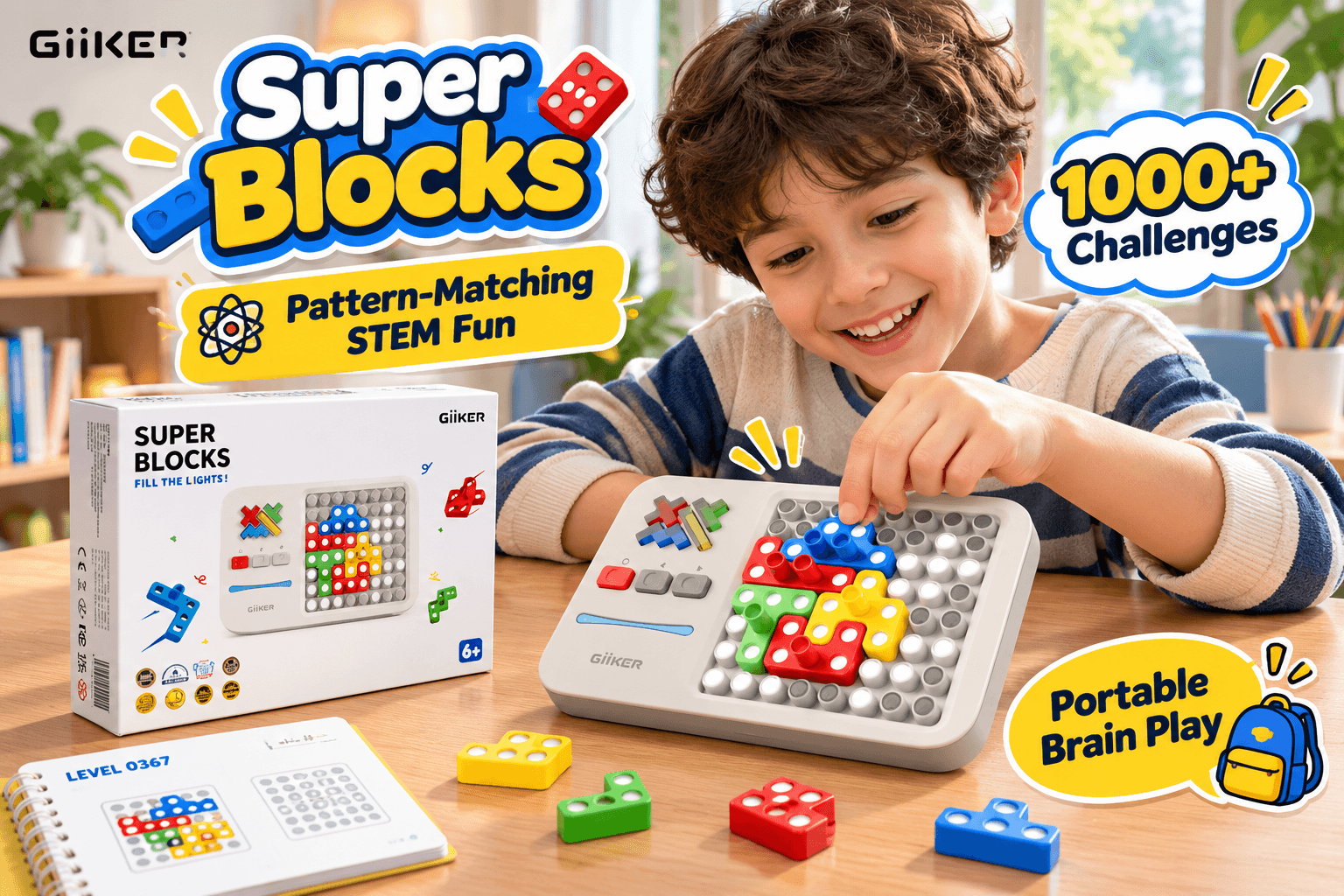
Imagine an 8×8 board made of glowing tiles, plus sixteen shapes of colored plastic blocks. The board lights up a specific pattern, and your job is to cover those lit squares — and only those squares — using the fewest, or the exact, combination of pieces. That is Super Blocks in a sentence.
What makes it interesting:
- It’s essentially a light-up polyomino puzzle, in the spirit of classic block-placement games, except the challenge book is built into the machine.
- Over 1,000 progressive challenges range from “cover this small cluster of lights” introductions to dense, expert-level tiling problems.
- A Learn Mode shows animated hints when a player is stuck, which keeps frustration low and curiosity high.
- The tactile weight of the blocks against the grid is satisfying in a way digital versions rarely are.
Best for: Kids ages 6+, spatial-reasoning fans, and anyone who liked Tetris or tangrams as a child but wishes those games had a built-in coach.
🗨️ “The first thing my daughter said when she beat a level wasn’t ‘next level?’ — it was ‘I told you I could do it.'”
— A parent’s reaction, paraphrased from product community threads
2. GiiKER Super Slide: The Classic Sliding Puzzle, Upgraded
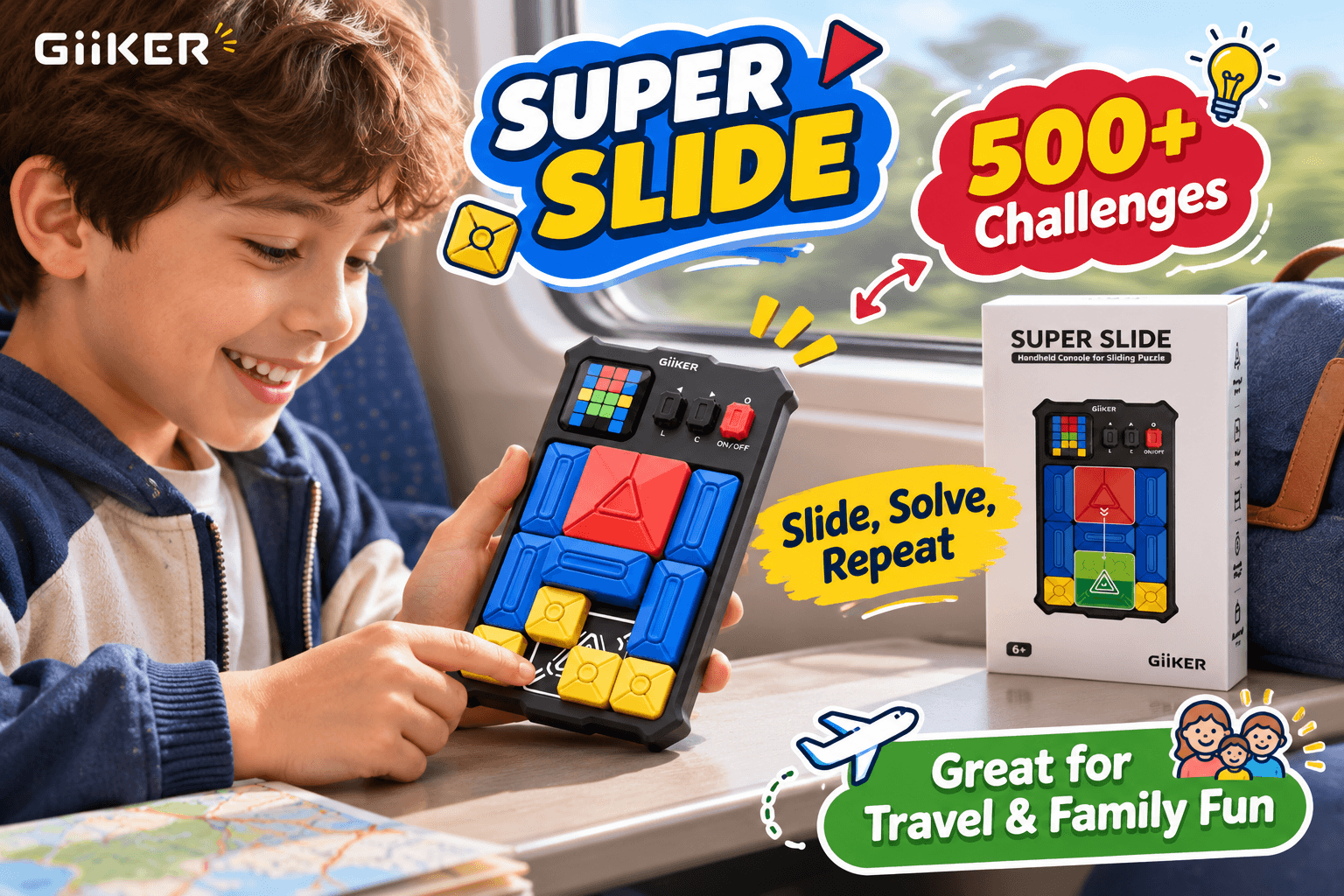
The sliding tile puzzle — the one with the red block you need to maneuver around obstacles to a target — is a hundred years old. GiiKER’s Super Slide takes that core, replaces the paper challenge cards with an LED screen, and adds 500+ levels of preloaded puzzles.
How it plays:
- The screen displays the starting layout; you slide the red square toward the bottom-center detection zone.
- Obstacles vary in size — 2×2 blocks, horizontal bars, vertical bars — exactly like the classic rush-hour-style traffic puzzles.
- Move counting and timer-style feedback encourage improvement without a stressful clock.
- Levels are grouped in stages, so progress feels like climbing rather than wandering.
Why families love it: Super Slide is the most “educational but invisible” toy in the lineup. Kids are planning sequences, testing hypotheses, and backtracking when a move traps them — all while thinking they’re just playing a game on a flight.
Best for: Ages 6+, commutes, car rides, and kids who enjoy planning their way out of a jam.
3. GiiKER Super Decoder: Crack the Code, 600 Levels
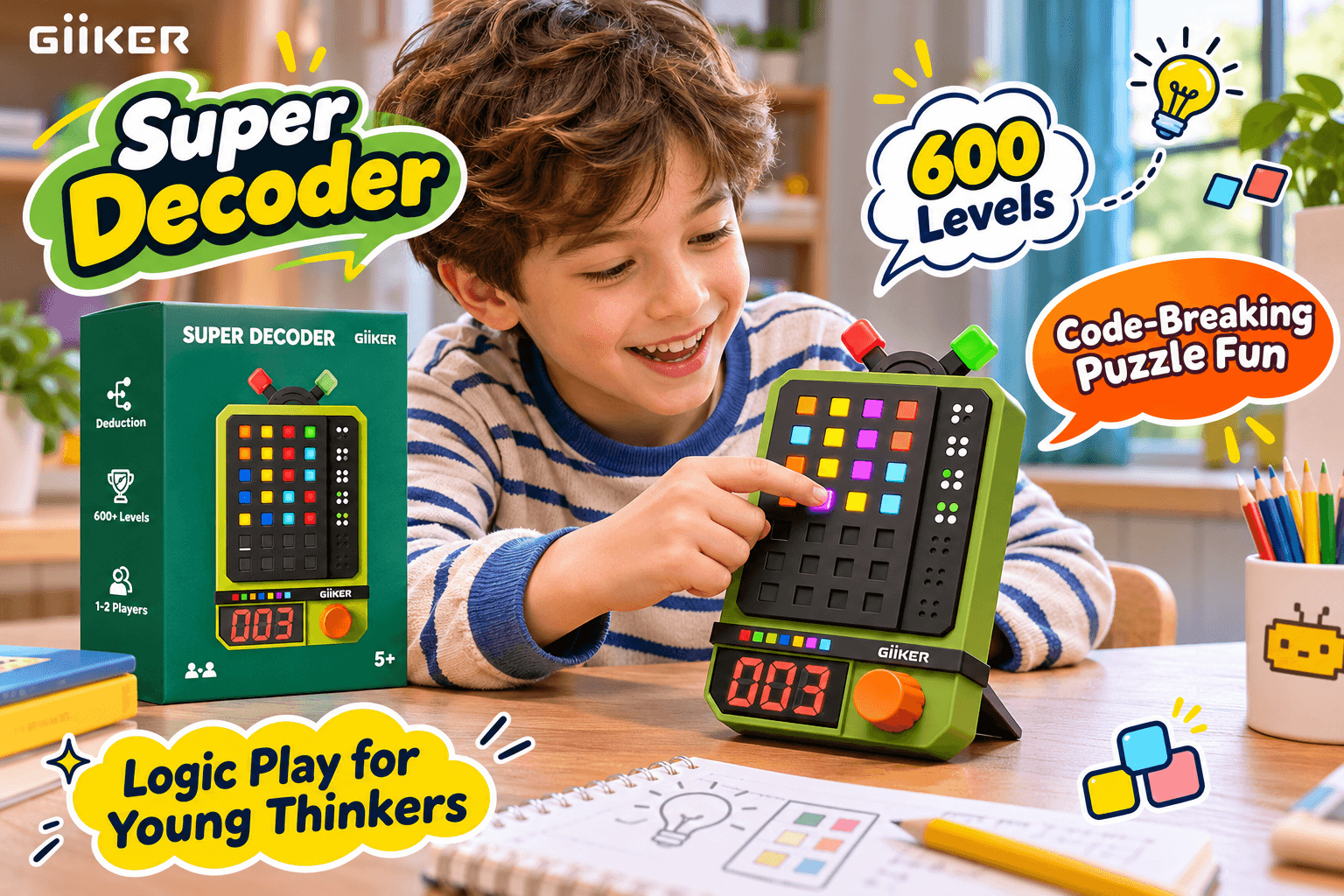
Super Decoder is the lineup’s mystery game. It’s an electronic code-breaking puzzle console inspired by classic “guess the secret sequence” board games — except there’s no human opponent holding the code. The machine generates it, and gives you feedback after each attempt.
Highlights:
- 600 built-in levels across difficulty tiers, from beginner sequences to long, multi-clue master codes.
- You input guesses with colored buttons; the console tells you how close you are.
- The interface deliberately teaches deductive reasoning — forming a hypothesis, testing it, refining it.
- The form factor is a compact handheld console, so it works in solo play sessions.
Where it shines: Super Decoder is the natural bridge between pure puzzle games and logic exercises. Kids who love “whodunnit” books or escape rooms tend to gravitate here. It also makes a surprisingly good co-pilot activity: a parent and child huddle over one console, arguing about which color to try next.
Best for: Ages 5+, budding detectives, and long-haul flights where you want quiet concentration, not another music video.
4. GiiKER Camp GURU: The 6×6 Logic Puzzle
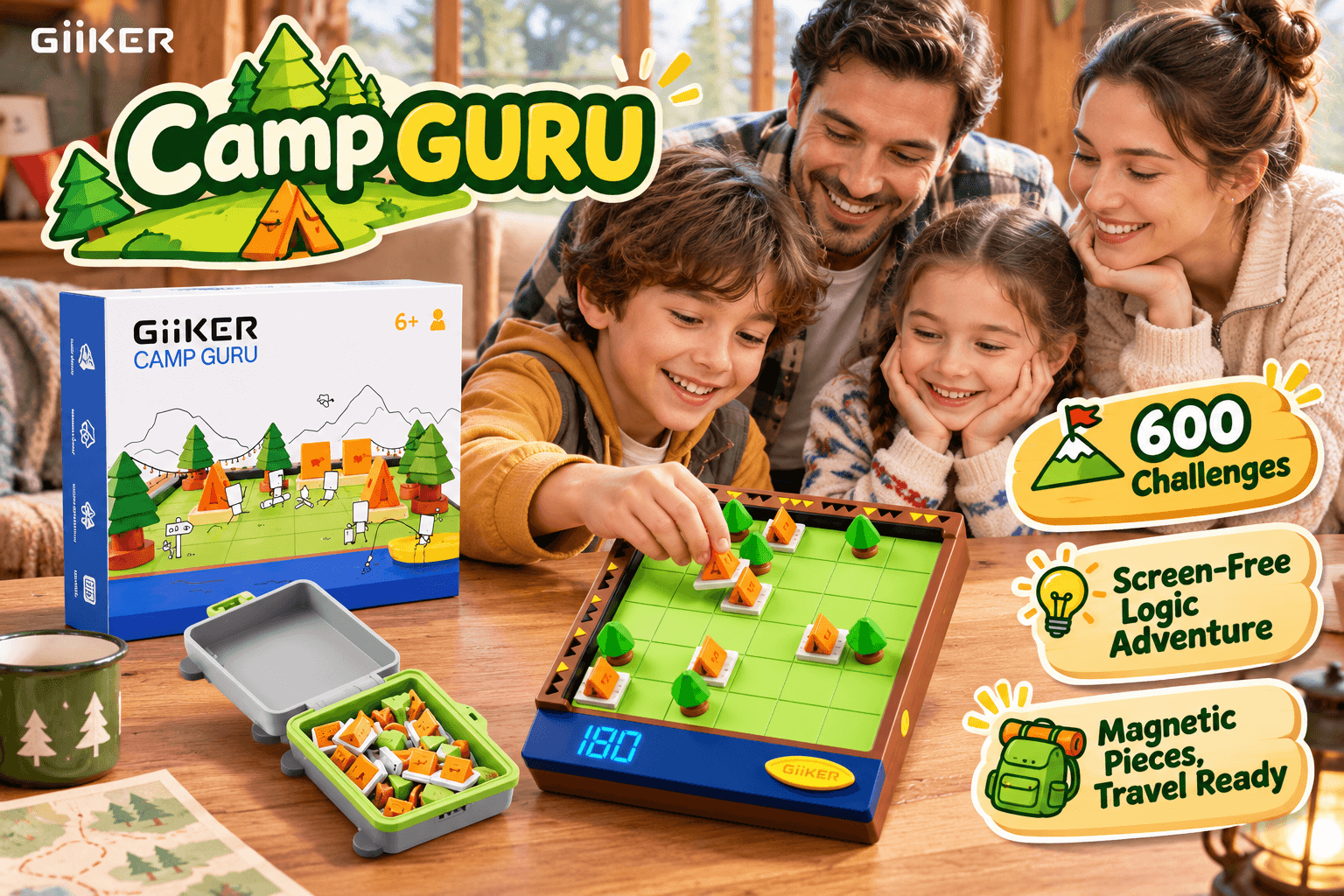
Camp GURU is GiiKER’s answer to grid-based logic puzzles — think of a gentle, cartoon-camping version of a number puzzle, but themed around tents, trees, and campsites. The goal: place the campsite pieces so that every row, column, and region follows the rules displayed on the board.
What stands out:
- 600 challenges on a 6×6 grid, sized so the game feels approachable without being trivial.
- The camping theme (tents under trees, marshmallow-colored pieces) softens the math-like structure for younger players.
- Real-time validation means the console lights up when a placement breaks the rules, teaching constraint thinking without frustration.
- It’s arguably the most “school-like” of the five in the best sense: it mirrors the logic-grid work children encounter in upper elementary math.
Best for: Ages 6+, children who finished Super Slide and want a new challenge type, and homeschool parents looking for screen-free critical-thinking material.
5. GiiKER Tic Tac Toe Bolt: Four Games in One
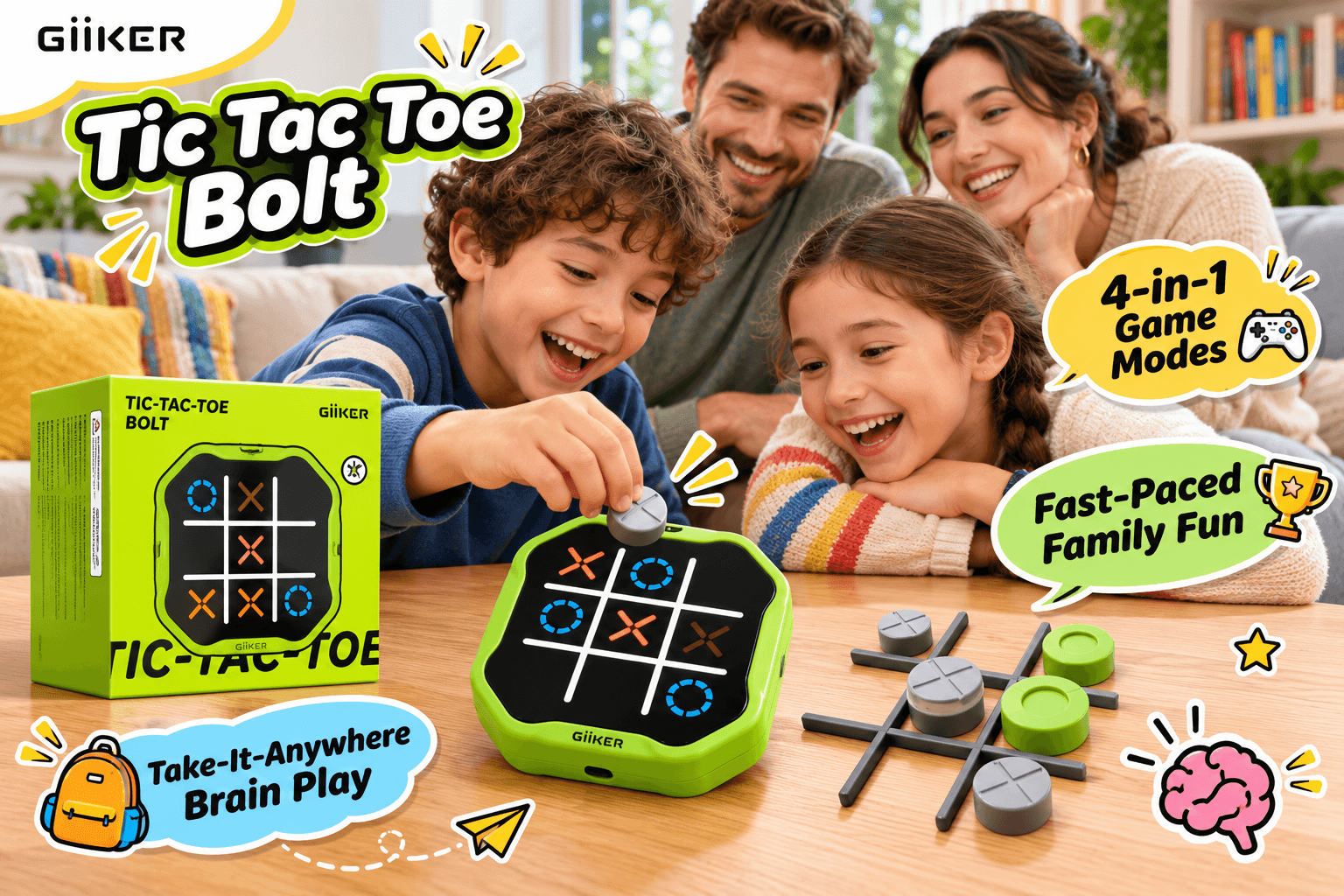
Where the other four are single-mechanic puzzle consoles, Tic Tac Toe Bolt is the party-friendly member of the family. It crams multiple game modes into one small device centered around the three-in-a-row idea.
What’s inside:
- Infinite tic-tac-toe variants on a compact board — the classic game, plus expanded rule sets that keep the childhood stalwart from being predictable.
- Play against the AI in solo mode, or 1v1 battle against a sibling or friend.
- The electronic board lights up and announces turns, so no one argues over who started.
- The 4-in-1 packaging means the same unit rotates through different mini-games depending on the mood.
Where it fits: Tic Tac Toe Bolt is the easiest entry point for families new to GiiKER. It’s also the one most likely to end up in a living room, passed back and forth, rather than tucked into a travel bag.
Best for: Ages 6+, siblings who share devices, and family game nights that need a fast, low-stakes round between heavier board games.
Side-by-Side: Which GiiKER Toy Matches Which Mood?
If you’re choosing just one (or deciding where to start), this table cuts through the marketing copy.
| Product | Core Skill Trained | Challenge Count | Best Play Length | Ideal For |
|---|---|---|---|---|
| Super Blocks | Spatial reasoning, pattern matching | 1,000+ | 10–25 min sessions | Visual thinkers, ages 6+ |
| Super Slide | Planning, sequence logic | 500+ | 10–20 min sessions | Commuters, ages 6+ |
| Super Decoder | Deductive reasoning, hypothesis testing | 600 | 15–30 min sessions | Mystery lovers, ages 5+ |
| Camp GURU | Constraint logic, grid reasoning | 600 | 15–30 min sessions | Students, ages 6+ |
| Tic Tac Toe Bolt | Strategy, fast decision-making | Multiple modes | 5–15 min rounds | Families, ages 6+ |
🗨️ Quick callout: none of these require a smartphone to play. The companion apps exist for tracking progress and unlocking extra content, but the devices work standalone right out of the box.
How the Brand Actually Builds Its Toys
A fair question: what separates GiiKER from the flood of “smart” gadgets on the shelf? Based on the brand’s own materials and product reviews, a few consistent engineering choices stand out.
Sensors over screens. Rather than bolting an LCD onto a plastic toy, GiiKER designs boards where the surface itself knows what’s happening — piece placement, slide direction, button sequences. This keeps the device cheap to run on simple batteries and avoids the “mini tablet” feel that parents are trying to escape.
Built-in content instead of cartridges. Each console preloads hundreds of levels. There’s nothing to download, no account to set up, no Wi-Fi required. It’s a deliberate choice toward longevity: a five-year-old’s device in 2025 still works exactly the same in 2028.
Materials and safety. The toys are molded from high-quality, non-toxic ABS plastic — the same material used in durable kitchen tools and travel cases. Edges are rounded, pieces are sized for small hands, and the lineup intentionally avoids tiny swallowable parts.
Awards as validation. The brand’s smart-cube lineage earned recognition from Forbes’ tech-toy coverage and shelf space in the MoMA Design Store — endorsements that matter when you’re spending real money on a gift for a kid you like.
A Day in the Life: How Families Actually Use These Toys
It’s one thing to list features. It’s another to picture how a product behaves in a real household.
The airport scenario. Family of four, delayed flight, two children under ten. Super Slide gets pulled out first — it’s quiet, one-handed at the gate, and the level structure naturally absorbs twenty-minute windows of waiting. By the time boarding is called, one child has cleared an entire stage.
The restaurant wait. Super Decoder comes out folded between two kids at the table. They don’t speak much. They just pass the console back and forth between guesses. The waiter returns with drinks before anyone asks for the kids’ menu tablet.
The car ride at dusk. Camp GURU, because the lighting changes and this device doesn’t need glare-free screen conditions. A parent in the front seat hears, “I figured out the whole row!” from the back.
The rainy Saturday. Tic Tac Toe Bolt runs on the coffee table for an hour, rotating between AI solo rounds and sibling matches. It’s the only GiiKER product that reliably invites adults in — because three-in-a-row is universal, and losing to a seven-year-old on an electronic board is somehow funnier than losing to them on paper.
🗨️ “They’re not ‘educational’ in the homework way. They’re educational in the way that asking ‘what happened here, and what do I try next?’ is educational.”
— A recurring sentiment in parent reviews
Creative Inspiration: Five Gift-Giving Angles
Because these products hit a surprisingly wide range of occasions, here are some non-obvious ways to give them.
- The “no more screens in the car” gift. Bundle Super Slide and Super Decoder into a reusable travel pouch with a printed card: “200,000 miles of family road trips start here.”
- The “big-kid graduation” gift. Move-up from toddler toys to Camp GURU — it signals “you’re old enough for logic puzzles now” without buying anything babyish.
- The classroom reward chest. Teachers and therapists report these consoles work well as quiet independent-work stations because the self-checking board removes the need for an adult referee.
- The “grandma and grandpa” gift. Grandparents who want something better than another stuffed animal consistently land on Tic Tac Toe Bolt, because they can play it on a visit.
- The sibling-share set. One puzzle console (Super Blocks or Camp GURU) plus Tic Tac Toe Bolt covers both solo and social play in two devices.
Who Is GiiKER For — and Who Isn’t?
A few honest limitations, since any brand overview should include them.
Great fit for:
- Families trying to reduce passive screen time without replacing it with unstructured boredom.
- Kids aged roughly 5–12 who already enjoy puzzles, brain teasers, or strategy games.
- Frequent travelers looking for compact, battery-powered engagement.
- Parents who want toys that grow with the child — the level curves handle age progression.
Less of a fit for:
- Children under 5, since the mechanics and reading-free rules still favor slightly older hands.
- Families who want multiplayer digital experiences with online play — GiiKER’s devices are offline-first by design.
- Buyers expecting app-style content updates; the experience is mostly the preloaded library.
None of these are flaws — they’re alignment checks. If your household’s needs sit in the “less of a fit” column, another product category will serve you better.
The Bottom Line
GiiKER occupies a rare spot in the toy market: it’s a brand with genuine technology credibility, award-winning design roots, and a product lineup that refuses to treat “smart” as a synonym for “touchscreen.” The five consoles profiled here — Super Blocks, Super Slide, Super Decoder, Camp GURU, and Tic Tac Toe Bolt — cover the major ways children actually think: tiling, planning, deducing, constraining, and competing.
For parents who want playtime that quietly builds focus, spatial sense, and patience — without another subscription, another app, or another glowing rectangle — GiiKER’s lineup is one of the more thoughtful places to start. Pick the mechanic your child gravitates toward, hand them the console, and let the built-in levels do the teaching.
The hardest part, based on the reviews, is prying it out of their hands when dinner is ready.