(And why a growing number of cat parents now treat their litter like a daily health checkup)
Most people never think of the litter box as smart technology. That is precisely the gap PrettyLitter was built to exploit. Launched as a direct-to-consumer subscription brand, PrettyLitter reimagined what cat litter could be: a lightweight, odor-locking crystal medium that also changes color to flag potential urinary problems in your cat. In an industry long dominated by heavy clumping clay, dusty scooping routines, and “just tolerate it” attitudes, PrettyLitter chose a completely different philosophy—make the smallest, most unglamorous corner of your home quietly do veterinary-adjacent surveillance work while you go about your day.
This article focuses on the brand itself: who built it, what it stands for, how it designs its product lineup, and what cat parents can actually expect from the PrettyLitter experience.
1. How PrettyLitter Started: A Brand Born From “What If?”
Every brand has an origin story, and PrettyLitter’s is the kind that sounds obvious only in hindsight. The company was founded by Daniel Rotman, who remains the face of the brand as its CEO. The core insight was simple but under-exploited: cats are masters of hiding illness. In the wild, showing weakness gets you targeted by predators. In your living room, that instinct means urinary tract infections, kidney issues, and dehydration often hide behind the same purring, normal-behaving cat you see every day.
The team’s answer was not a smart feeder or a wearable collar. It was the one thing every cat parent touches every single day—the litter box. If the litter itself could quietly report on urine acidity, alkalinity, and the visible presence of blood, then owners would get an early warning signal without needing a veterinary degree or a monthly blood panel.
That single reframe defines the brand’s identity to this day:
- Preventive, not reactive. PrettyLitter sells detection, not just cleanup.
- Observational, not diagnostic. The crystals flag abnormalities; a vet confirms them.
- Subscription-first. The brand was built around recurring monthly delivery, so you never run out.
- Science-forward marketing. The brand openly emphasizes its veterinarian-in-chief guidance and its proprietary color-changing formula.
💬 Founder voice (as imagined in brand workshops):
“Your cat can’t tell you something is wrong. So we made the litter tell you instead.”
It is that sentence, more than any product spec, that becomes the emotional hook of the PrettyLitter brand.
2. What PrettyLitter Actually Is: A Material Story
Before we get to the product catalog, it helps to understand what PrettyLitter is made of, because the material choice is central to the brand’s message.
PrettyLitter uses amorphous silica gel—the same family of desiccant material you find in pill bottles and shoe boxes, purified and processed into lightweight crystals. Two technical points matter to the brand’s positioning:
- Amorphous ≠ crystalline silica. This distinction is important because crystalline silica dust is linked to long-term respiratory concerns in occupational settings. PrettyLitter repeatedly emphasizes that its material is non-crystalline, non-toxic, and inert.
- Microscopic pores = absorption and odor control. The crystals absorb urine through millions of micropores, lock moisture in, let the water evaporate, and trap odor-causing compounds inside. The box stays dry to the touch and ammonia stays low for up to roughly 30 days.
The result is a very different experience from traditional clay:
| Experience dimension | Typical clay litter | PrettyLitter |
|---|---|---|
| Weight per monthly bag | Heavy (15–30 lb) | Light (6–10 lb) |
| Scooping frequency | Daily clump removal | Solids only; liquids evaporate |
| Full-box change | Every 1–2 weeks | Every ~30 days |
| Odor approach | Masking or clump sealing | Absorption + evaporation |
| Health monitoring | None | Color-change indicators |
| Dust level | Often high | Marketed as low dust |
That table is the shortest possible explanation of why the brand exists. It is not “better clay.” It is a different physics.
3. The Color-Change System: The Brand’s Signature Feature
If PrettyLitter had a logo-level product feature, it would be the color-changing crystals. This is the element that makes the brand instantly recognizable in the crowded cat litter aisle—and the one that generates the most questions.
Here is the practical logic:
- Yellow/normal urine in healthy range — no action needed.
- Blue or dark green — potentially too acidic; can flag issues like struvite crystals.
- Orange or red — potentially too alkaline; can flag issues like urinary tract infections.
- Red tinge — may indicate the visible presence of blood in the urine.
A small brand honesty note, which PrettyLitter itself is careful to include: these indicators do not diagnose disease. They are an early-warning layer. A color change is a reason to call your vet, not a reason to self-treat.
🐱 A dialogue in a typical PrettyLitter household:
Owner: “Hmm… the crystals near the corner turned orange overnight.”
Cat: (blinks slowly, looking perfectly fine)
Owner: “Sure. You look fine. We’re still going to the vet on Thursday.”
This exchange—owners learning to read the box instead of just scooping it—is the cultural behavior the brand wants to create.
4. The Product Lineup: Brief, But Worth Mapping
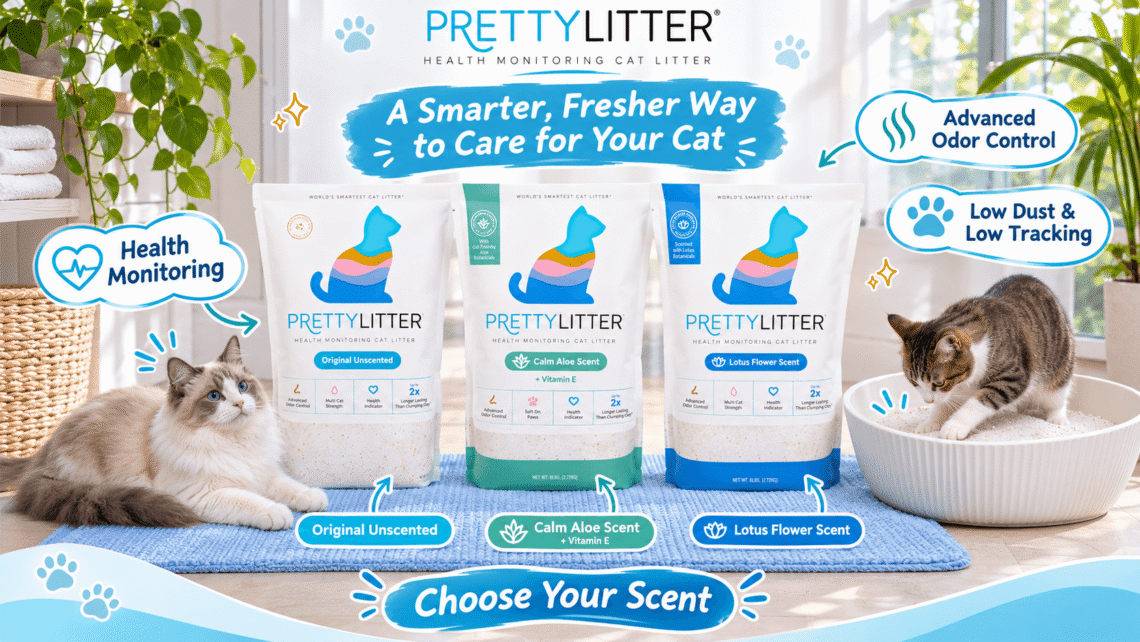
PrettyLitter’s catalog is deliberately narrow. The brand is not trying to sell you a hundred cat accessories. It wants to own the litter category inside your home. Here is the current lineup in compact form (pricing reflects standard subscription-era retail; exact figures fluctuate by channel and promotion):
| Product | Format | Scent | Typical weight | Typical price point | Best for |
|---|---|---|---|---|---|
| Original PrettyLitter | Non-clumping crystals | Unscented | ~6 lb | ~$24 | First-time subscribers, scent-sensitive cats |
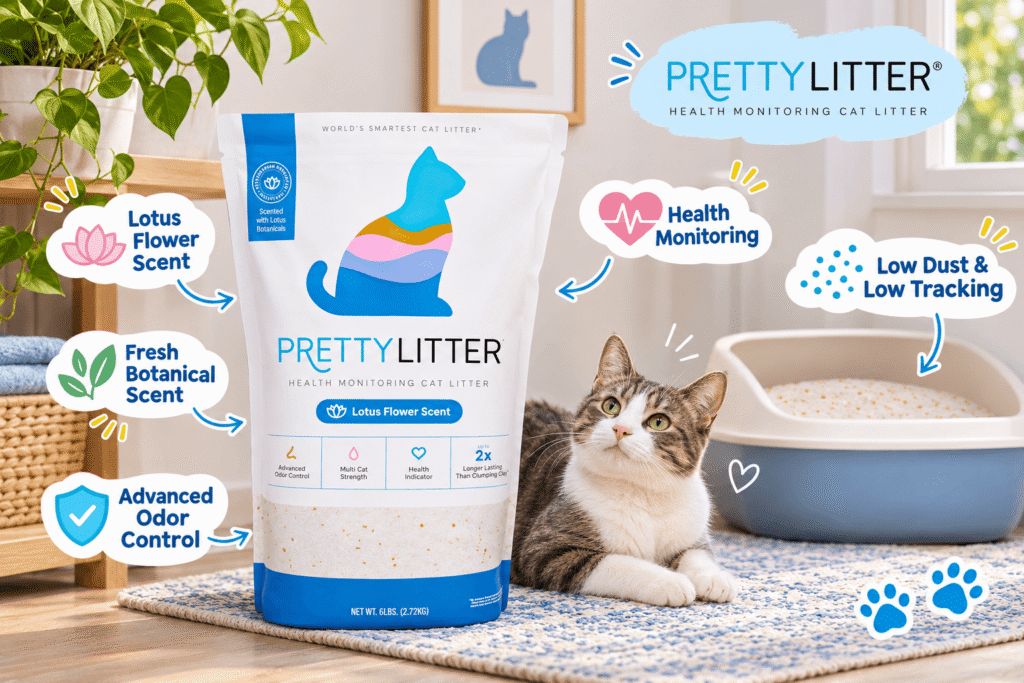
| Lotus Flower | Non-clumping crystals | Light floral | ~6 lb | ~$24 | Owners who want mild fragrance without perfumed chemicals |
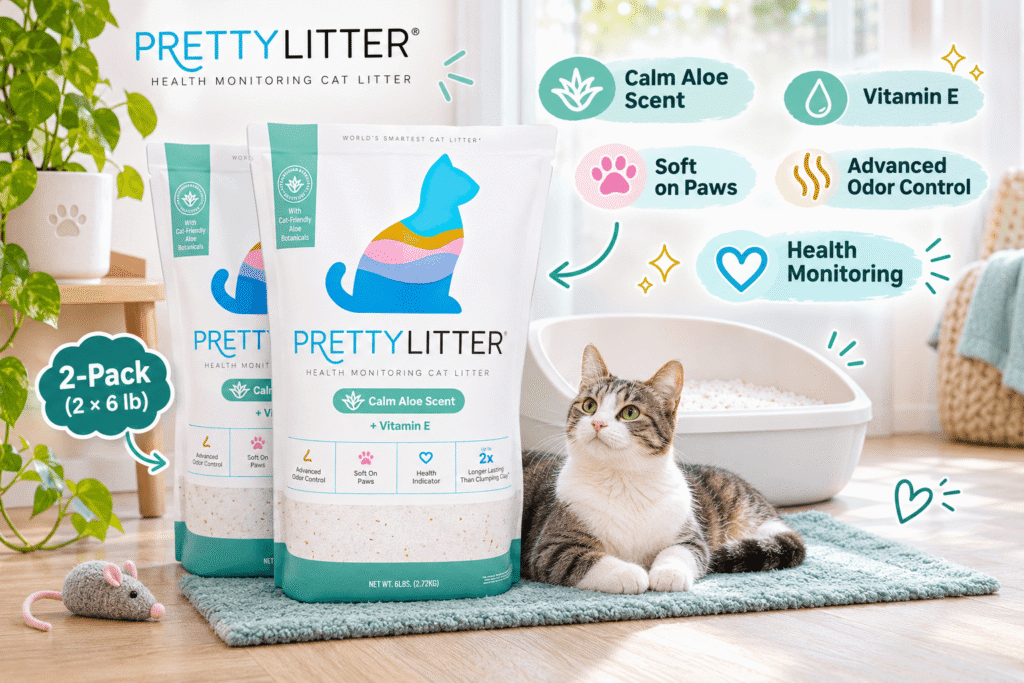
| Calm Aloe | Non-clumping crystals | Aloe botanical | ~6 lb | ~$24 | Owners who prefer softer, greener scents |
| Clumping PrettyLitter | Clumping, low-dust | Unscented | ~10 lb | ~$29.99 | Owners who want health monitoring and the familiar clumping routine |
A few strategic observations about this lineup:
- Three non-clumping scents, one clumping option. The brand’s heart remains the crystal formula; the clumping version exists as a “bridge” for customers who refuse to abandon clumping behavior.
- Shared health-monitoring core. Every variety includes the proprietary color-change indicator. The differences are scent and texture preferences, not the core promise.
- Consistent price architecture. The non-clumping SKUs share one price, making scent choice low-friction.
- Multi-channel availability. Beyond the direct subscription, PrettyLitter products also show up in major retail and Amazon storefront formats, which is a sign of a brand that has moved past pure DTC into omnichannel maturity.
5. Subscription by Design: The Business Model Is Part of the Brand
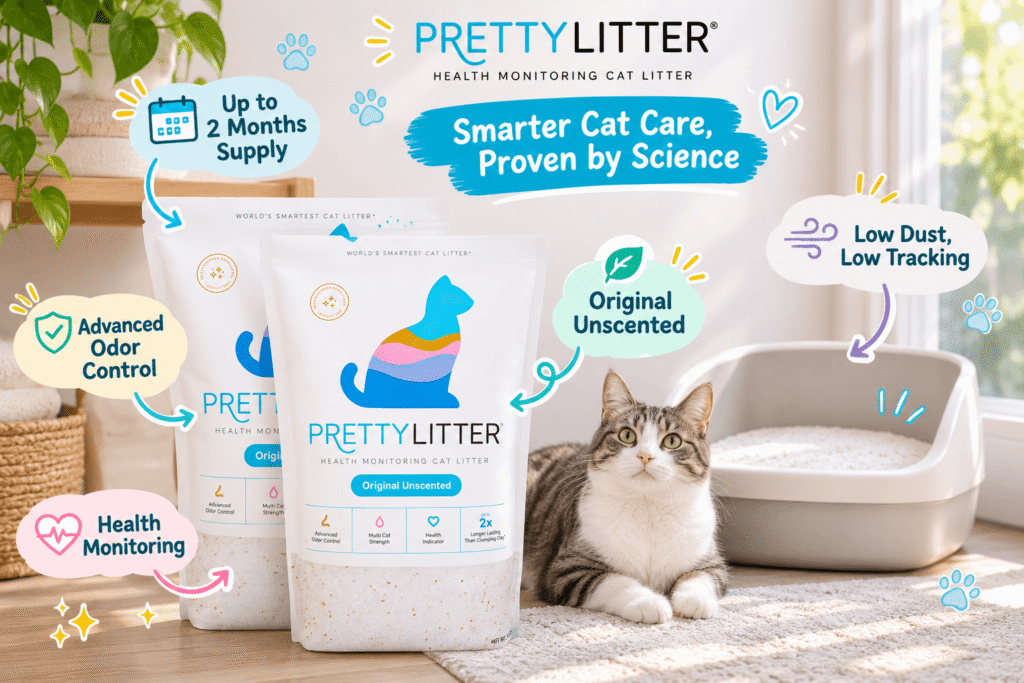
PrettyLitter’s commercial model is itself a brand statement. The company was built around monthly recurring delivery: one 6 lb bag per cat per month, auto-shipped, cancellable online.
Why does the business model deserve its own section in a brand profile? Because it answers a question most cat parents never articulate: Why do I keep buying the same litter, running out at random, and hauling heavy bags home?
The subscription model silently fixes three frictions:
- The “running out” crisis. You are never scraping the bottom of the box with no replacement.
- The heavy-bag problem. A 6 lb crystal bag replaces a roughly 30-day cycle; no more hefting 20+ lb clay containers.
- The habit loop. Because delivery is automatic, the health-monitoring habit also becomes automatic. You glance at the box as part of the monthly rhythm.
💬 A typical support-chat moment (brand-style, as seen in community forums):
Customer: “Do I really need the subscription? Can I just buy one bag?”
Brand: “You can try a single bag. Most people switch to subscription because the savings and the auto-delivery beat remembering. You can pause or cancel anytime.”
That tone—low-pressure, subscription-first but not subscription-only—is consistent with how the brand talks to customers across channels.
6. Brand Voice and Identity: Fresh, Cheerful, Science-Curious
Visually, from the brand’s public storefront and marketing materials, PrettyLitter presents a distinctive identity:
- Color palette: sky blues, aqua, teal accents, occasional soft pink, clean white backgrounds. The aesthetic reads as “hygiene product meets wellness brand,” not gritty pet-industry brown.
- Logo system: a stylized abstract cat silhouette embedded in a rainbow-like arc, which signals brightness and modernity.
- Tagline territory: “A fresh approach to cat litter,” “Smarter cat care, proven by science,” “The world’s smartest cat litter.”
- Content themes: health awareness, freshness, convenience, and the emotional bond between owners and cats.
The brand voice is deliberately upbeat but technical: it uses phrases like “proven by science” and “monitor like never before,” but wraps them in soft, pet-friendly imagery. It avoids two extremes common in pet marketing:
- It does not lean into fear (“cat kidney failure is silent—buy now!”).
- It does not lean into pure cuteness (“kitty wittle poops”).
Instead, it sits in a third lane: responsible, modern, slightly tech-minded cat parent. That is the identity the brand has carefully built.
7. Who PrettyLitter Is For (And Who It Isn’t)
A strong brand knows its customer. PrettyLitter’s ideal buyer tends to match this checklist:
✅ You worry silently that your cat “isn’t telling you something.”
✅ You are comfortable shopping subscriptions (hello Dollar Shave Club-era behavior).
✅ You dislike hauling heavy litter bags.
✅ You want low dust and light odor management.
✅ You appreciate a monthly “checkup” layer on top of your regular vet visits.
And honestly, PrettyLitter may not be the right fit if:
❌ Your cat is a confirmed clumping-litter purist who refuses to walk on crystals.
❌ You are looking for a heavily perfumed, “forest breeze” style odor mask.
❌ You expect the litter to diagnose disease on its own (it won’t—and it says so).
❌ You want a natural clay or recycled-paper product (that is a different category).
This kind of honest fit analysis is itself a brand signal: PrettyLitter behaves like a mature brand that would rather convert the right customer than pressure-convert everyone.
8. The Broader Category Shift: Why PrettyLitter Matters Beyond One Product
Stepping back, PrettyLitter represents a larger industry movement worth naming: the “healthification” of routine pet consumables.
For decades, cat litter was a commodity. Then came the smart feeder trend, the GPS collar trend, and the at-home pet test trend. PrettyLitter’s bet is that the highest-leverage health sensor is not a gadget—it is the material you already place under your cat every day.
That bet has consequences for the wider market:
- Competitors now copy the subscription-plus-monitoring format.
- Retailers give crystal litters better shelf placement.
- Veterinary clinics increasingly mention pH monitoring in urinary prevention talks.
- Cat parents now ask “what does this litter tell me?” instead of “how hard does it clump?”
PrettyLitter, more than any single product, normalized that question.
9. FAQs Around the Brand (The Questions That Actually Come Up)
Is PrettyLitter safe around kittens?
The brand markets its amorphous silica as non-toxic and pet-safe for household use; as with any litter, owners should still watch kittens that nibble or eat crystals.
Do I still scoop?
Yes—solids still need scooping. The difference is that urine absorbs and evaporates, so you no longer scoop wet clumps daily.
How often do I change the whole box?
The brand’s guidance is roughly monthly, with one 6 lb bag covering one cat for about 30 days.
What if the color changes?
It is an early warning signal. Document what you saw and schedule a vet visit; do not treat symptoms yourself.
Can I pause or cancel the subscription?
Yes—subscription management is self-serve, which is a core part of the brand’s customer promise.
10. Final Take: A Brand That Made the Litter Box Intelligent
PrettyLitter’s real achievement is not a new texture or a new scent. It is a reframe: the litter box, long treated as an embarrassing chore, becomes a quiet daily health ritual. The brand paired that reframe with a genuinely different material (amorphous silica gel), a subscription business model that removes friction, a clean and wellness-adjacent visual identity, and a carefully narrow product line that never strays far from the core promise.
For cat parents who have ever stared at their seemingly fine cat and wondered, “Are you actually okay?”—PrettyLitter offers a small, practical, color-coded answer. It will never replace a veterinarian. It will never solve every feline health mystery. But as a brand, it has done something rare: it took the most boring object in pet ownership and made it meaningful.
And honestly? That is a pretty good reason to remember the name.