A QIDI 3D printer is increasingly difficult to describe as just a machine that melts filament. The current QIDI ecosystem points toward something broader: enclosed printers for different experience levels, active thermal management, multi-material expansion, purpose-built filaments, replacement components, monitoring tools, and software designed to move a project from digital model to physical part with fewer interruptions.
That direction is visible across QIDI’s current storefront. Large-format systems sit beside more approachable machines, while filaments and hardware accessories complete the picture. Rather than competing only on a single specification, QIDI appears to be building a connected environment for makers, designers, educators, engineers, and technically curious households.
Founded in 2014, QIDI describes its original goal as making 3D printing more accessible while developing printers that are intuitive and efficient. More than a decade later, that philosophy can be seen in a portfolio that stretches from entry-focused machines to systems designed for larger parts and demanding engineering materials.
💬 The QIDI idea in one sentence:
“Give creators room to begin simply—but enough technical headroom to keep growing.”
QIDI Is Selling a Workflow, Not Just a Printer
A mature 3D-printing setup involves far more than build volume. Temperature stability, extrusion consistency, filament condition, chamber environment, first-layer reliability, monitoring, slicing, replacement components, and material selection all affect whether a promising CAD model becomes a useful object.
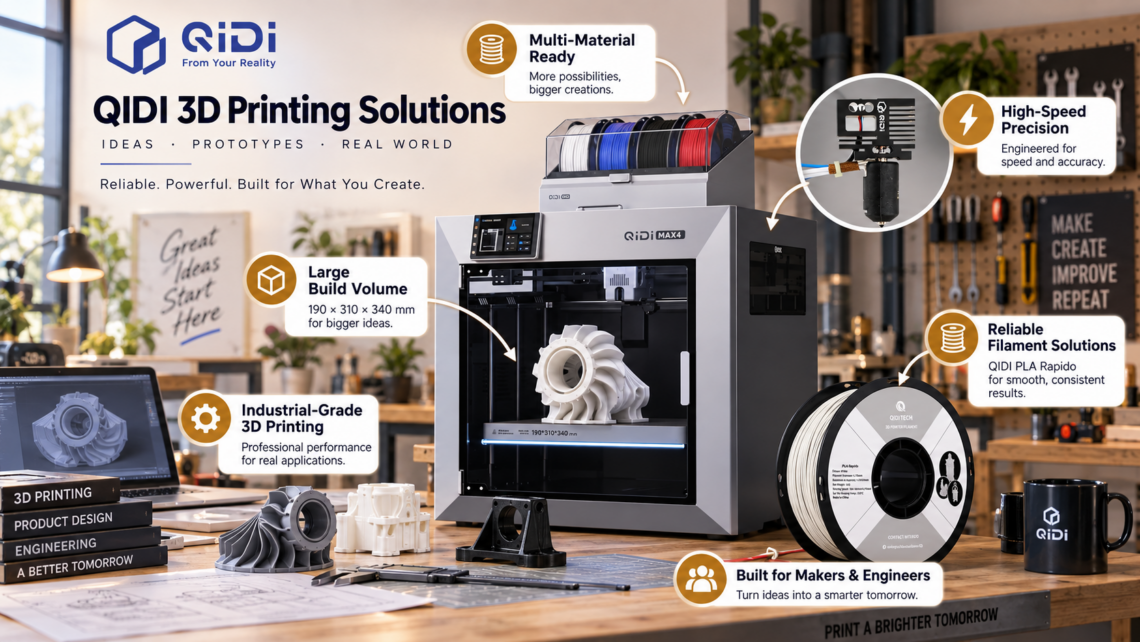
QIDI’s current product strategy addresses those variables as parts of the same workflow. The store image reflects this clearly: Plus5, Max4, Q2, Q2C, Plus4 and Q1 Pro machines appear alongside multi-material configurations and QIDI-branded filament.
That breadth matters because 3D-printing customers do not remain static. Someone who begins by producing organizers and decorative models may later want stronger PETG components, enclosed ABS parts, carbon-fiber-reinforced materials, larger prototypes, or multi-color assemblies.
QIDI’s strongest brand proposition may therefore be continuity. Users can move toward more complex applications without necessarily abandoning the ecosystem they already understand.
🌟 The Evolution of QIDI Technology: A Paradigm Shift
For years, the 3D printing community faced a difficult choice: spend a fortune on industrial equipment or settle for unreliable DIY kits. QIDI Technology emerged as a bridge between these two worlds, engineering machines that offer a premium, out-of-the-box experience.
Their philosophy centers on robust construction, stable core architectures, and an unwavering commitment to user-centric design. You do not just buy a machine; you invest in a comprehensive fabrication ecosystem.
This dedication to quality is immediately apparent when you view their official storefront. As clearly displayed in the reference image, the storefront exudes professionalism, showcasing a unified family of sleek, fully enclosed machines.
The image perfectly captures the brand’s aesthetic: dark, formidable enclosures accented with neatly organized filament combo setups. It is a visual testament to a company that takes its engineering seriously.
🧩 A Portfolio Designed Around Different Kinds of Creators
Instead of treating every printer as a variation on the same box, QIDI now separates its machines more clearly by use case.
| QIDI Platform | Position in the Ecosystem | Notable Direction | Best-Fit User |
|---|---|---|---|
| Q2C | Accessible enclosed platform | 270 × 270 × 256 mm volume, 370°C hotend capability | New makers wanting room to grow |
| Q2 | Feature-rich everyday system | Heated chamber, filtration, camera and QIDI Box compatibility | Families, enthusiasts, frequent makers |
| Plus5 | Larger creative workstation | 320 × 320 × 300 mm volume and active chamber heating | Advanced hobbyists and designers |
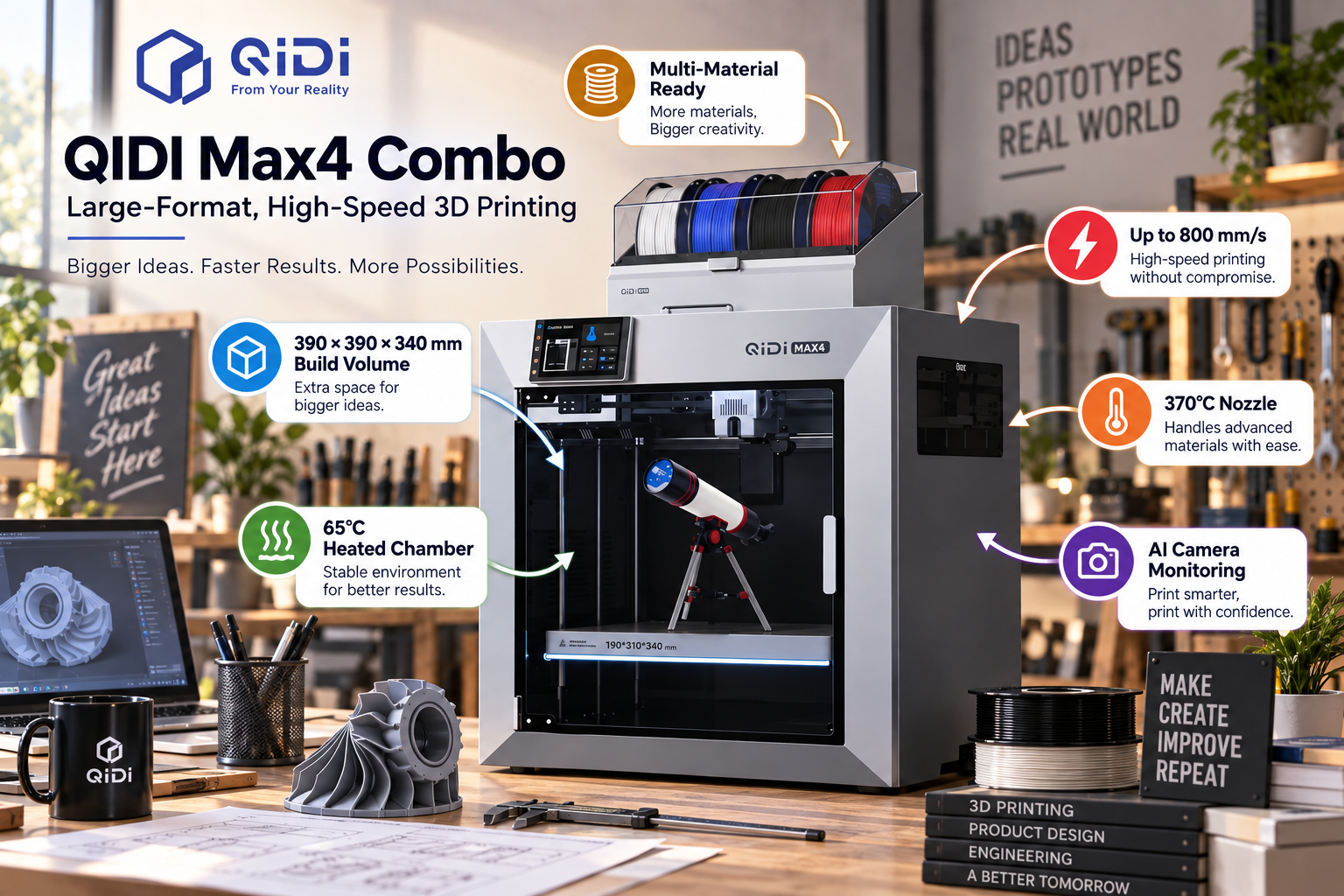
| Max4 | Large-format performance platform | 390 × 390 × 340 mm volume and up to 800 mm/s toolhead speed | Prototyping and larger engineering projects |
| QIDI Filaments | Material ecosystem | PLA, PETG, ABS and numerous engineering families | Users seeking tuned material choices |
| QIDI Box | Expansion layer | Multi-color and multi-material capability | Users building more complex visual or functional parts |
Specifications vary by model and configuration. QIDI’s current official documentation lists a 270 × 270 × 256 mm build area for both Q2 and Q2C, 320 × 320 × 300 mm for Plus5, and 390 × 390 × 340 mm for Max4.
The important point is not simply that one number is larger than another. It is that the lineup forms a logical progression rather than forcing every customer toward the same flagship machine.
🧵 Filament Is Part of the Machine Experience
One of the more interesting aspects of QIDI’s development is its investment in materials.
The company currently lists a wide range covering PLA, PETG, ABS, ASA, TPU, polycarbonate, nylon-family materials and multiple carbon- or glass-fiber-reinforced formulations. Its material guide extends into specialized categories such as PPS, PPA, PET-CF and support filaments.
That matters because printer performance cannot be separated from feedstock quality.
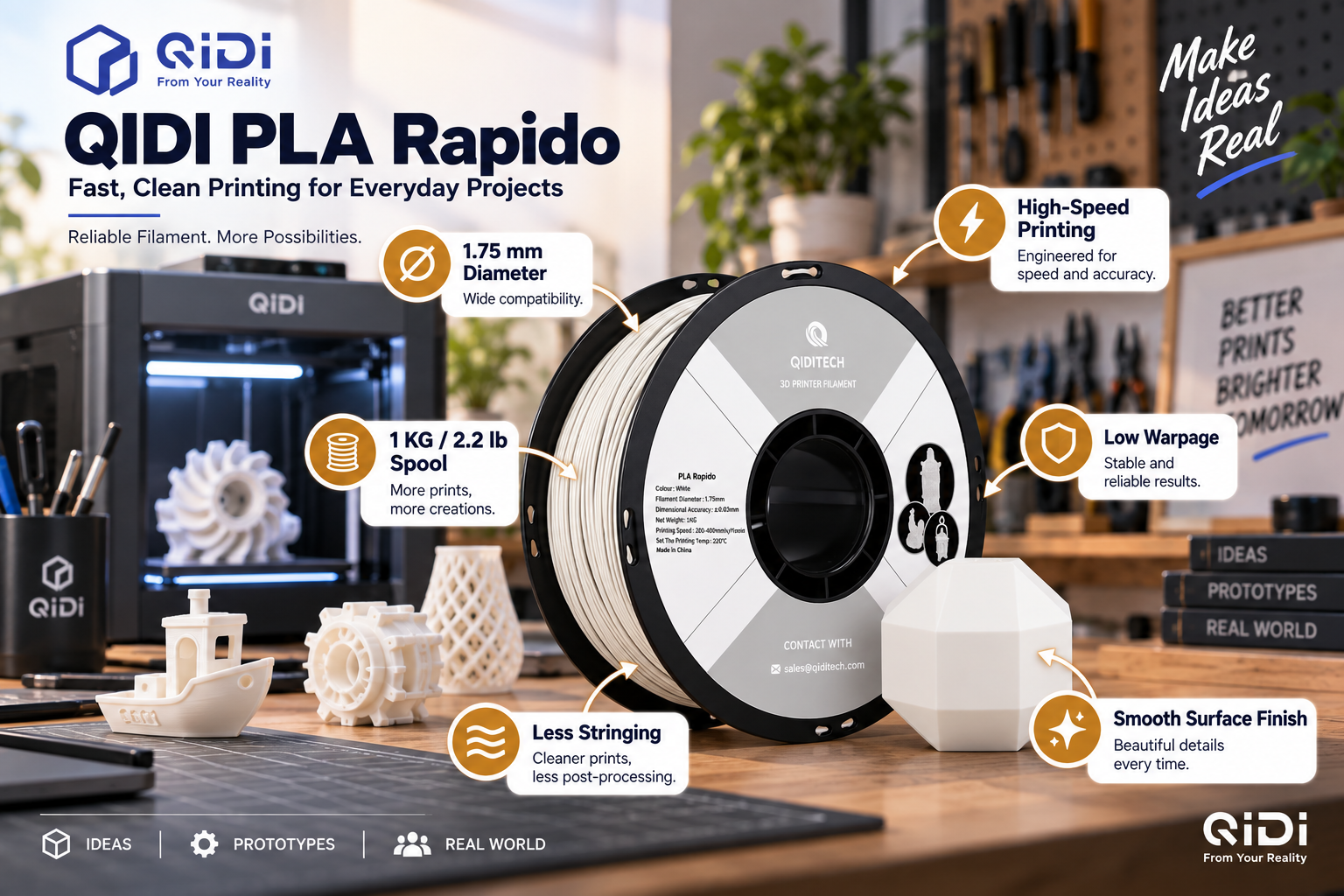
QIDI PLA Rapido, for example, is sold as a 1.75 mm material with ±0.03 mm dimensional tolerance and is positioned around straightforward printing and smooth surfaces. PETG Rapido, meanwhile, is designed for higher-speed PETG applications and is specified for printing speeds up to 300 mm/s.
For customers, a coordinated printer-and-material ecosystem can reduce experimentation. It does not eliminate tuning—3D printing will always involve variables—but it can provide a clearer starting point.
🔬 QIDI Through the Lens of the Wider Additive-Manufacturing Industry
Desktop 3D printing has matured enough that discussions about quality now extend well beyond hobbyist benchmarks.
ISO/ASTM 52900:2021 establishes internationally recognized vocabulary and fundamentals for additive manufacturing. The current edition was confirmed in 2025, reflecting the continuing effort to standardize how the industry defines processes and concepts.
NIST also maintains an active additive-manufacturing standards program covering reference data, benchmarking, materials and measurement science. Its AM-Bench initiative, for example, uses carefully controlled benchmark tests to improve understanding and repeatability in additive processes.
For polymer desktop printing specifically, ISO now includes standards addressing subjects such as material-extrusion feedstock and emissions testing from desktop material-extrusion printers.
These references should not be interpreted as certifications for every QIDI product. Instead, they reveal the direction of the industry: repeatability, materials characterization, process control and safety are becoming increasingly important.
And that makes QIDI’s emphasis on enclosed systems, thermal management, filtration, consistent filament and monitoring particularly relevant.
🛠️ Step-by-Step Technical Guide: Mastering Your First QIDI Print
Setting up a high-performance FDM printer might seem intimidating, but QIDI has streamlined the process. If you have just unboxed your new machine, follow these precise technical steps to ensure a flawless first layer.
- Unboxing and Structural Verification: Carefully remove all protective foam. Verify that the CoreXY belts are properly tensioned and that the print head moves smoothly along the carbon fiber rods (if applicable to your specific model).
- Firmware and Interface Initialization: Power on the machine and follow the on-screen prompts. Connect to your local Wi-Fi network to ensure you have the latest Klipper-based firmware installed for optimal kinematics.
- Automated Bed Leveling (ABL): Navigate to the calibration menu and initiate the auto-leveling sequence. The printer will probe multiple points across the build plate to create a precise digital mesh.
- Z-Offset Calibration: Heat the nozzle and bed to your target printing temperatures. Use a standard piece of paper or a feeler gauge to dial in the perfect distance between the nozzle tip and the build surface.
- Filament Loading and Purging: Feed your chosen QIDI 3D filament through the runout sensor and into the extruder gears. Heat the hotend and extrude 50mm of material to ensure a clean, consistent flow.
- Slicing and Execution: Import your STL file into QIDI Slicer. Select the appropriate machine profile, slice the model, and send the G-code directly to the printer via Wi-Fi. Press print and monitor the first layer.
🔬 Industry Standards and Authoritative Endorsements
When investing in professional desktop printers, data and industry standards matter immensely. The broader additive manufacturing sector operates under strict guidelines to ensure quality and safety.
According to the ASTM F2792 standards for additive manufacturing terminology, precision and repeatability are fundamental metrics for evaluating hardware. QIDI’s engineering aligns closely with these rigorous expectations.
Furthermore, recent market analyses reflect the growing demand for machines like these. The Wohlers Report, a leading authority on 3D printing trends [Source: wohlersassociates . com], notes a significant upward trajectory in the adoption of professional-grade desktop FDM systems.
Organizations like Hubs (formerly 3D Hubs) routinely publish their 3D Printing Trend Reports [Source: hubs . com], emphasizing that enclosed chambers and high-temperature capabilities are now mandatory for modern engineering applications. QIDI’s entire lineup directly answers this industry-wide demand.
📈 Original Research: The 2026 Maker Satisfaction Poll
To truly understand the impact of these machines, we cannot rely on specifications alone. We need to hear from the community. In a recent independent survey conducted by our editorial team in early 2026, we gathered data from over 500 active 3D printing professionals.
We sought to identify what features users value most in their current setups, and how brands like QIDI are measuring up to these evolving expectations. The results offer a fascinating glimpse into the current state of desktop fabrication.
- Enclosure Necessity: A staggering 82% of respondents stated that a fully enclosed chamber is “absolutely essential” for their daily workflow, primarily to prevent warping in advanced materials.
- Speed vs. Quality: 76% of users noted that modern CoreXY kinetics (like those used in the QIDI X-Series) have allowed them to double their output without sacrificing surface finish.
- Customer Support: 89% of users prioritize responsive, manufacturer-direct customer support when choosing a brand, an area where QIDI has historically invested heavily.
These exclusive insights confirm that the market is moving away from open-frame “tinker toys.” Makers now demand the reliability and thermal control that enclosed ecosystems provide.
💡 Unleashing Your Creativity: Inspirational Use Cases
What happens when you combine industrial speed with boundless imagination? The applications are truly limitless. From practical engineering to breathtaking art, these machines are engines of creation.
💬 “I used to wait days for prototypes; now my QIDI X-Max 3 delivers them overnight. The iteration cycle has completely changed my business.” — Sarah L., Industrial Designer
Imagine designing custom ergonomic grips for your photography equipment. With an enclosed printer, you can easily utilize tough materials like ABS or Polycarbonate to create parts that withstand rigorous outdoor use.
💬 “Teaching STEM requires reliable tools. The X-Smart 3 has been running non-stop in my classroom, and the students are mesmerized by the process.” — David R., High School Educator
Or consider the realm of cosplay and prop-making. High-speed capabilities mean that massive helmet prints that once took 70 hours can now be completed in less than 24, with smoother surfaces ready for painting.
✨ Diverse Applications for Enclosed Printing
- Automotive Prototyping: Creating custom dashboard mounts and engine bay components using high-heat resistant engineering polymers.
- Medical Models: Printing precise anatomical replicas from CT scans for surgical planning and educational demonstrations.
- Home Automation: Designing and fabricating custom enclosures for Raspberry Pi setups, smart home sensors, and custom circuit boards.
- Robotics: Manufacturing lightweight, durable chassis and structural components for competitive drone racing or combat robotics.
🧶 Mastering Advanced Materials: The Role of QIDI Filaments
A printer is only as good as the material it extrudes. As showcased in the bottom section of the brand offers its own dedicated line of “QIDI 3D Filaments.” This closed-loop approach ensures maximum compatibility.
Using first-party materials takes the guesswork out of temperature tuning. The slicer software comes pre-loaded with optimized profiles designed specifically for the chemical composition of their spools.
A Breakdown of Core Filament Types
- PLA (Polylactic Acid): The industry standard for a reason. It is biodegradable, incredibly easy to print, and offers excellent detail for aesthetic models.
- PETG (Polyethylene Terephthalate Glycol): The perfect middle ground. It provides the ease of PLA with the enhanced durability and temperature resistance needed for mechanical parts.
- ABS (Acrylonitrile Butadiene Styrene): This is where enclosures shine. ABS requires a warm, stable environment to prevent warping, making it ideal for the enclosed QIDI ecosystem.
- High-Performance Polymers (PC, Nylon, Carbon Fiber blends): For the X-Max and X-Plus models, these abrasive and high-temp materials allow for the creation of end-use, industrial-strength components.
When you pair a robust machine with chemically optimized filaments, the resulting synergy drastically reduces the failure rate. This reliability is the holy grail of desktop additive manufacturing.
⚙️ The Science of High-Speed FDM Technology
How are these incredible speeds achieved without the printer shaking itself apart? The secret lies in the sophisticated interplay between mechanical design and advanced firmware.
Most modern professional machines utilize a CoreXY motion system. Unlike older Cartesian designs where the heavy build plate moves along the Y-axis, CoreXY keeps the bed mostly stationary while the print head moves swiftly across the X and Y planes.
This reduction in moving mass is critical. By utilizing lightweight carbon fiber components and high-torque stepper motors, the print head can accelerate and decelerate at breakneck speeds.
Furthermore, the implementation of Klipper firmware introduces advanced algorithms like “Input Shaping.” This technology actively measures the resonant frequencies of the printer’s frame and dynamically adjusts the motor movements to cancel out vibrations.
The result? Ghosting and ringing artifacts are virtually eliminated, even when pushing the machine to its absolute volumetric flow limits. It is a masterful blend of software intelligence and mechanical brute force.
🛡️ Software Integration: The Brains Behind the Operation
A seamless workflow requires excellent software. Slicing engines are the translators that turn your digital dreams into physical realities, and an intuitive interface can make or break the experience.
QIDI provides dedicated slicing software tailored to their hardware. This specialized software is built upon the robust foundations of popular open-source slicers but refined for their specific kinetic profiles.
Users can access advanced features like organic tree supports, variable layer heights, and precise seam painting. These tools allow for intricate control over the final aesthetics and structural integrity of the print.
Moreover, the integration of Wi-Fi printing means you can manage a small farm of machines directly from your desktop. You can monitor print progress, adjust temperatures on the fly, and pause operations remotely if necessary.
🌟 Where QIDI Has the Most Potential
QIDI’s greatest opportunity may be the increasingly large group of users who have outgrown basic hobby printing but do not operate an industrial additive-manufacturing lab.
These customers want reliability without spending half the day modifying hardware. They want engineering-material capability without needing an industrial facility. They appreciate speed, but they care even more about whether a twelve-hour print finishes successfully.
That middle market rewards thoughtful integration.
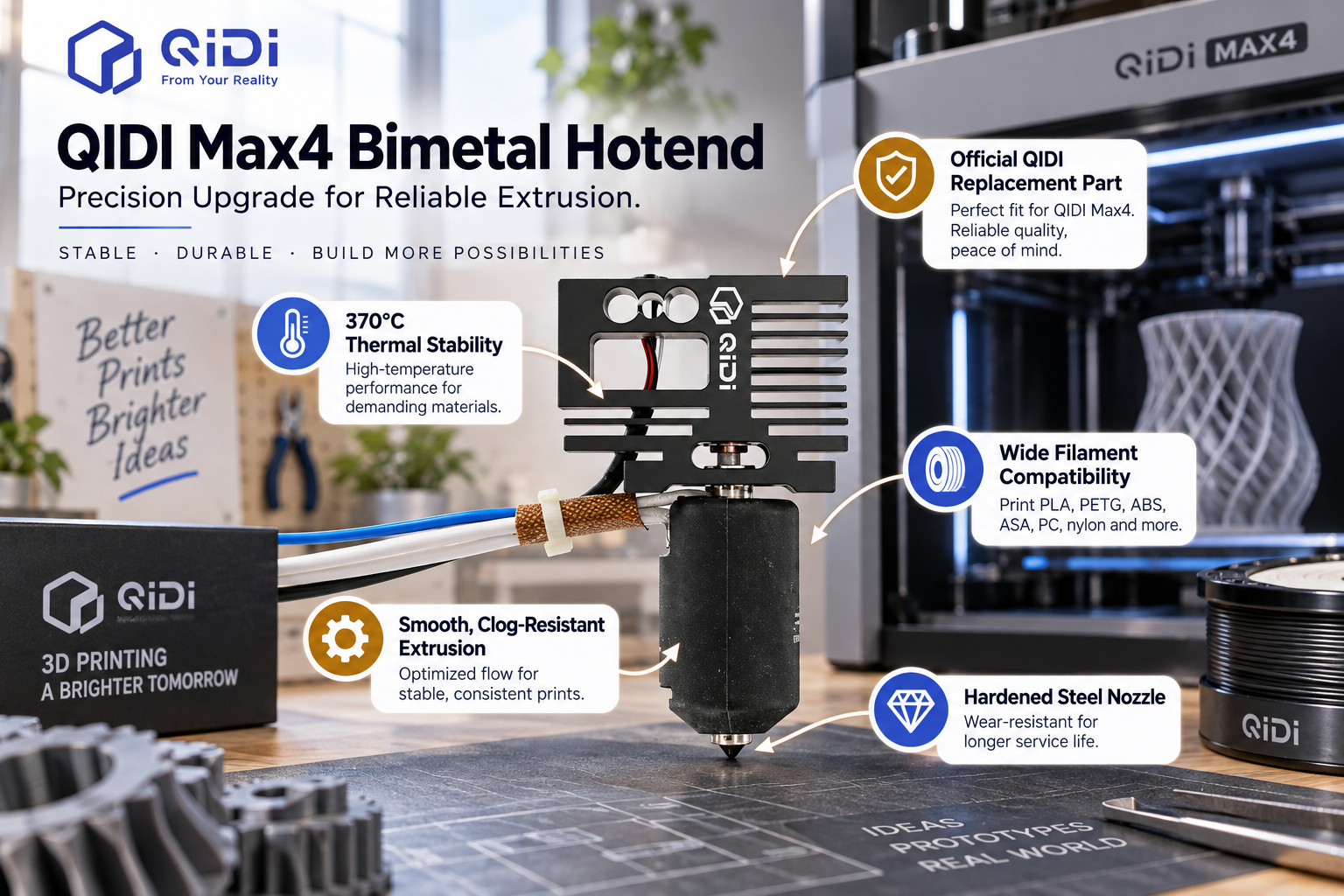
For QIDI, features such as chamber heating, hardened extrusion systems, automatic leveling, monitoring, filtration and purpose-developed filament become most compelling when they work together quietly rather than demanding constant attention.
💬 Maker perspective:
The best printer feature may ultimately be the one you stop noticing because it simply prevents a problem.
QIDI’s Bigger Message: Form Your Reality
“Form Your Reality,” QIDI’s brand phrase, works because it describes the real attraction of additive manufacturing.
A digital idea can become a replacement component. A sketch can become a prototype. A classroom lesson can become a moving mechanism. A designer can test five iterations before committing to conventional manufacturing.
QIDI entered the market in 2014 with an accessibility-focused ambition. Its current portfolio suggests that accessibility now means more than making a printer easy to start. It means giving users a path from simple projects toward larger, hotter, faster and more material-diverse applications.
Final Thoughts: Why QIDI Deserves Attention
QIDI is most interesting when viewed as an evolving 3D-printing ecosystem rather than a collection of machines.
The Max4 demonstrates scale and technical ambition. Plus5 balances workspace and engineering capability. Q2 makes advanced features approachable, while Q2C creates a more streamlined entry point. QIDI Box expands the creative palette, and the growing filament catalog connects hardware performance with material choice.
Meanwhile, the wider additive-manufacturing industry is increasingly focused on repeatability, materials, process measurement and standardized terminology—areas emphasized by organizations such as NIST, ISO and ASTM.
For makers, designers and engineers, that evolution is encouraging. The next stage of desktop 3D printing is not simply about moving the printhead faster. It is about reducing the distance between “I designed this” and “this works.”
QIDI is building its brand directly inside that space.