Let’s be honest: most ready-to-drink coffee brands fall into one of two camps. Either they taste like brown water wearing a coffee costume, or they’re so overloaded with sugar and artificial flavoring that you finish the can and feel immediately sorry for yourself.
Happy® is neither.
If you’ve browsed the canned coffee aisle at Target, Walmart, or Amazon recently, you’ve probably seen those brightly colored 11 oz cans with the lowercase “happy” logo — the ones with the cute little smiley face. Maybe you grabbed one on a whim. Maybe you’ve been seeing them everywhere and haven’t pulled the trigger yet. Either way, you’re about to find out why this brand has quietly become one of the most interesting entries in the $20 billion RTD coffee market — and why its story is about way more than just a good cup of joe.
🌱 A Brand Built by Two People Who Decided Coffee Could Do More
Happy® was co-founded by Craig Dubitsky, a CPG veteran who’s spent decades building category-redefining brands (you might remember his work with everyone from health and wellness giants to lifestyle labels that turned everyday products into cultural touchstones), alongside Robert Downey Jr. — yes, that Robert Downey Jr.
That might sound like a celebrity vanity project at first glance. It isn’t.
RDJ’s involvement goes well beyond slapping a name on a can. The actor has been open about his own long journey with mental health, recovery, and the small daily rituals — like that first morning cup — that helped him rebuild a life he wanted to be present for. When he and Dubitsky started talking about what a coffee brand could be, the conversation went straight past “what’s the flavor profile?” and landed on something more interesting: what if the cup itself became a tiny, reliable moment of goodness in someone’s day?
That’s the thesis behind Happy®: coffee as a vehicle for everyday wellbeing. Not wellness as a buzzword, not adaptogen powders or mushroom extracts making wild claims — just really good, responsibly sourced coffee that arrives in your hand when you need a small win, with a little extra support baked in for anyone who might be going through something heavier.
🧠 The Mental Health Mission That’s Actually on the Can
Here’s where Happy® does something genuinely unusual for a coffee brand.
Every single product — every can, every bag, every pod — carries the NAMI helpline number printed right on the packaging.
NAMI, the National Alliance on Mental Illness, is the largest grassroots mental health organization in the United States. Their helpline (800-950-NAMI) is staffed by trained volunteers who answer questions, provide resources, and connect people to care. Happy® decided to put that number on every product because, in their words: mental health is health.
This isn’t a marketing campaign that runs for a quarter and disappears. It’s printed on the can. It’s the first thing you see when you flip the label over. It’s a permanent part of the brand’s identity.
Some limited-edition releases go even further. Their “Little Victories” microlot coffee — a 92-point Maracaturra from Jinotega, Nicaragua — donated 100% of sales to the Mental Health Coalition. That’s not a percentage rounded up after overhead. That’s the whole thing.
💬 “I picked up a vanilla latte at the grocery store, and the NAMI number on the bottom of the can stopped me. I’d been sitting on a friend’s crisis for two weeks and didn’t know what to say. I called the number that night. They talked me through it.”
— A real customer review that now hangs in Happy®’s Instagram DMs.
That’s the kind of impact you can’t manufacture. It comes from deciding, on day one, that a coffee brand can be more than coffee.
What’s Actually in the Cup: 100% Arabica, Real Milk, No Nonsense
Let’s talk about the coffee itself, because if the product didn’t hold up, none of the mission stuff would matter.
Happy® builds everything around 100% arabica beans, sourced from smallholder farms across Colombia, Brazil, Rwanda, Nicaragua, Peru, Honduras, Mexico, and Guatemala. They work with Q-graders — the specialty coffee world’s equivalent of master sommeliers — to craft each blend, and their growers get premium pay-per-pound plus training support. It’s responsibly sourced, not greenwashed.
Here’s the ingredient short version:
- ✅ Canned lattes: real milk, real sugar, real coffee. No plant-based substitute shortcuts, no artificial sweeteners, no mystery “creamer” powders.
- ✅ Canned cold brews: black coffee. Bold, smooth, no sugar added unless the flavor says so.
- ✅ Flavored coffees: natural flavors only. No artificial anything.
- ✅ K-cup pods: Rainforest Alliance Certified.
- ✅ Kosher certification across the core line.
Compare that to some competitors’ canned lattes, which list ingredients you’d need a chemistry degree to decode. Happy® keeps it clean.
☕ The Product Lineup at a Glance
| Product Line | Format | Caffeine (per serving) | Best For |
|---|---|---|---|
| Canned Lattes (mocha, vanilla, caramel) | 11 oz can | 40–50 mg | Afternoon pick-me-up, lighter caffeine |
| Specialty Lattes (chocolatey chip, black forest cake, apple pie, Dubai chocolatey) | 11 oz can | 55–80 mg | Treat-yourself moments |
| Canned Cold Brew (original, salted caramel, Tahitian vanilla) | 11 oz can | 140–165 mg | Full morning coffee replacement |
| Multi-Serve Cold Brew | 48 oz bottle | ~140 mg per 8 oz | Home fridge refresh |
| Ground Coffee (light / medium / dark + flavored) | 12 oz bag | 95–165 mg per cup | Drip coffee routines |
| Whole Bean (same roasts + rare microlots) | 12 oz bag | 95–165 mg per cup | Espresso, pour-over, connoisseurs |
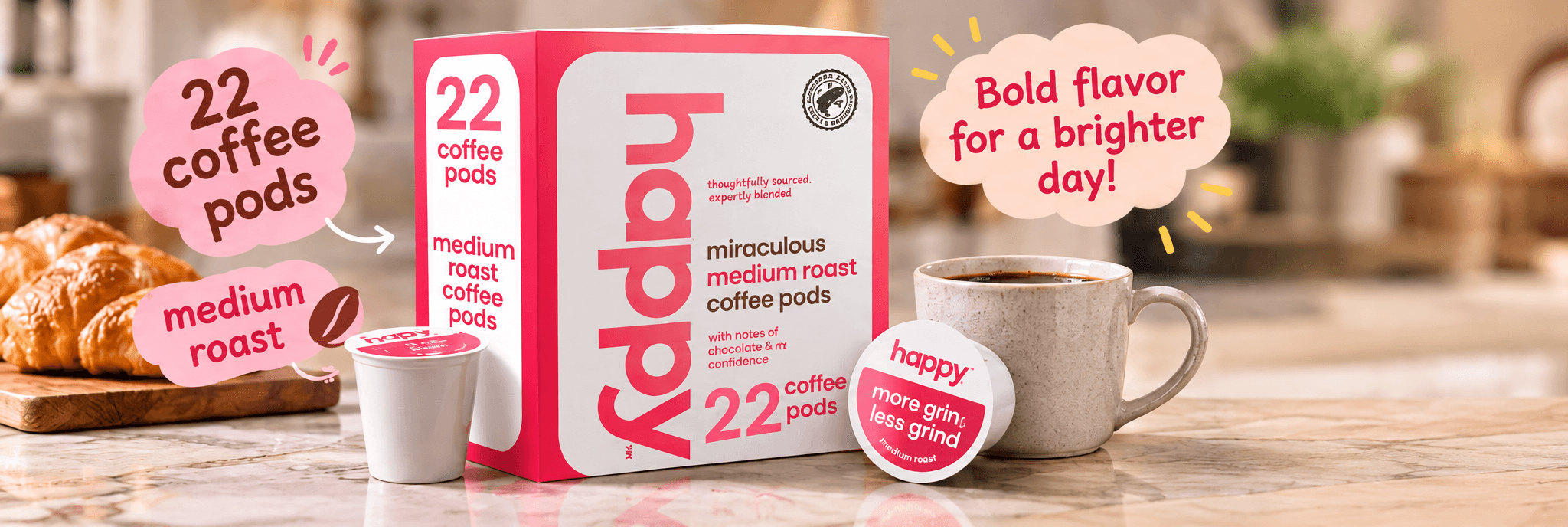
| K-Cup Compatible Pods | 22-count box | 75–150 mg per pod | Keurig households |
That’s a genuinely full range. You can build your entire coffee routine around Happy® whether you’re a pour-over purist, a Keurig convenience person, or someone who just grabs a can on the way out the door.
🎨 The Flavors: From Classic to “Wait, They Made a Cotton Candy Coffee?”
Let’s get into the fun part.
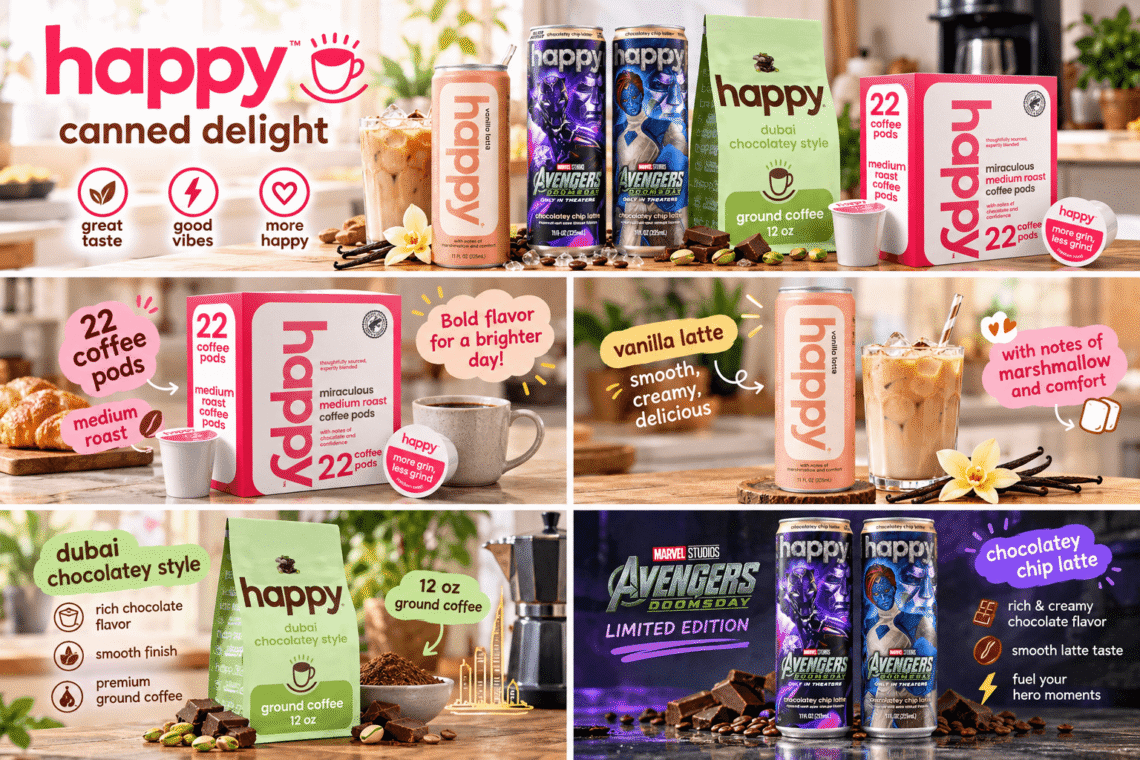
The core canned latte line is what most people encounter first: Mocha, Vanilla, and Caramel. These are the reliable everyday cans — the ones you’ll find in a 12-pack at a decent price point, the ones that taste like what you’d actually order at a café, just cold and portable.
The cold brew line leans more into the coffee purist side. Original is unsweetened black cold brew. Salted Caramel and Tahitian Vanilla add subtle sweetness without drowning the bean.
Then things get interesting.
Happy® has become known for its limited-edition flavors that feel less like a corporate R&D spreadsheet and more like someone’s very specific snack obsession made into a beverage. The current lineup includes:
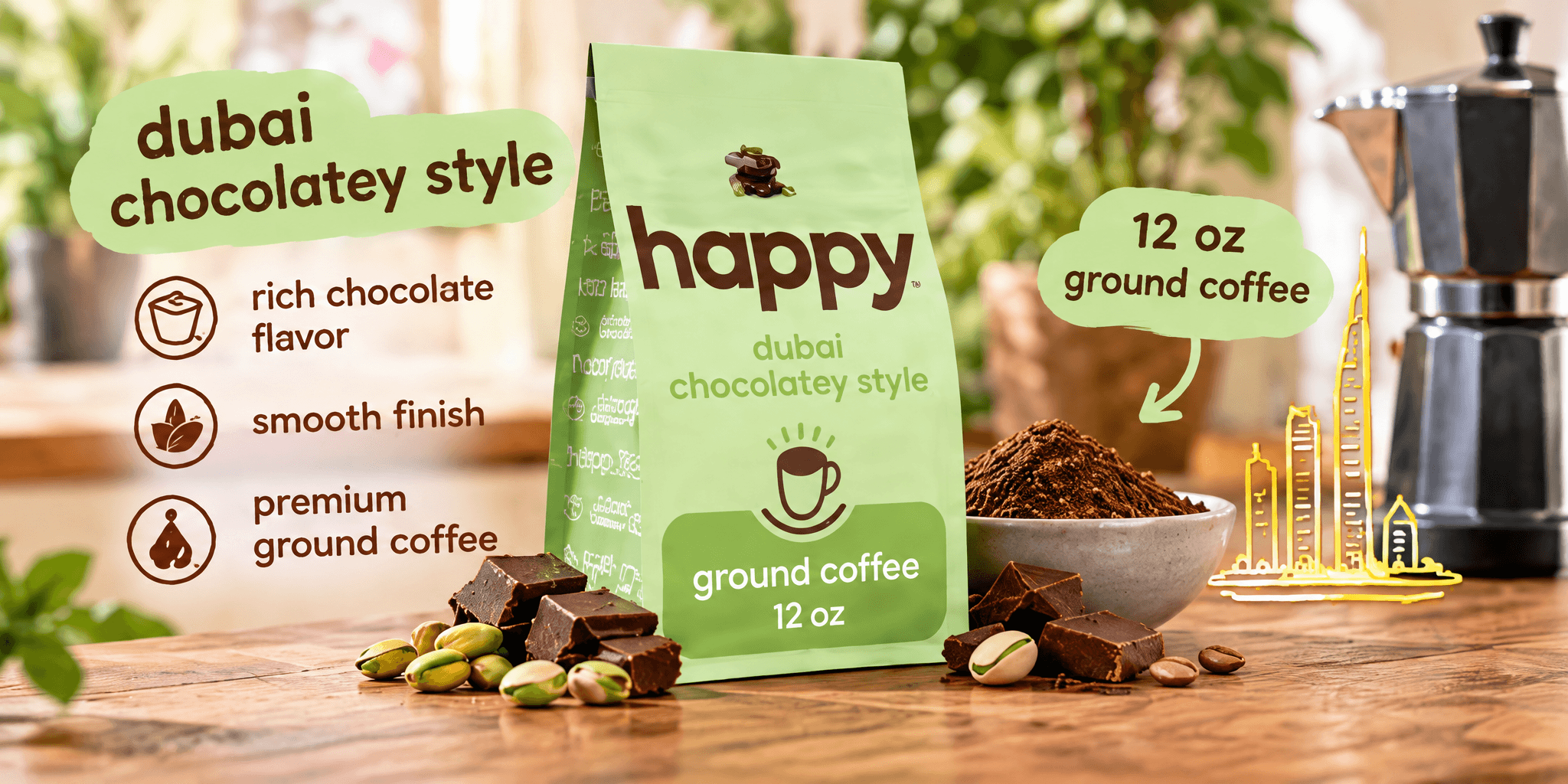
- 🍫 Dubai Chocolatey Style Latte — inspired by the viral Dubai chocolate trend (the pistachio-knafeh thing that took over your social feeds).
- 🍪 Chocolatey Chip Latte — because who hasn’t wanted a chocolate chip cookie in liquid form?
- 🍒 Black Forest Cake Latte — chocolate-cherry indulgence at about 120 calories.
- 🥧 Apple Pie Latte — autumn in a can, naturally flavored.
- 🍇 Berry Necessary Blueberry ground coffee
- 🧁 Cotton Candy flavored ground coffee — yes, really, and it’s surprisingly good.
The microlot series deserves its own paragraph. These are small-batch, rare single-origin releases like Cloud Nine (a Chiroso microlot grown 6,000 feet up in Antioquia, Colombia) and Over the Moon (a 91-point Swiss Water decaf — yes, decaf can be scored 91 points). When they’re gone, they’re usually gone.
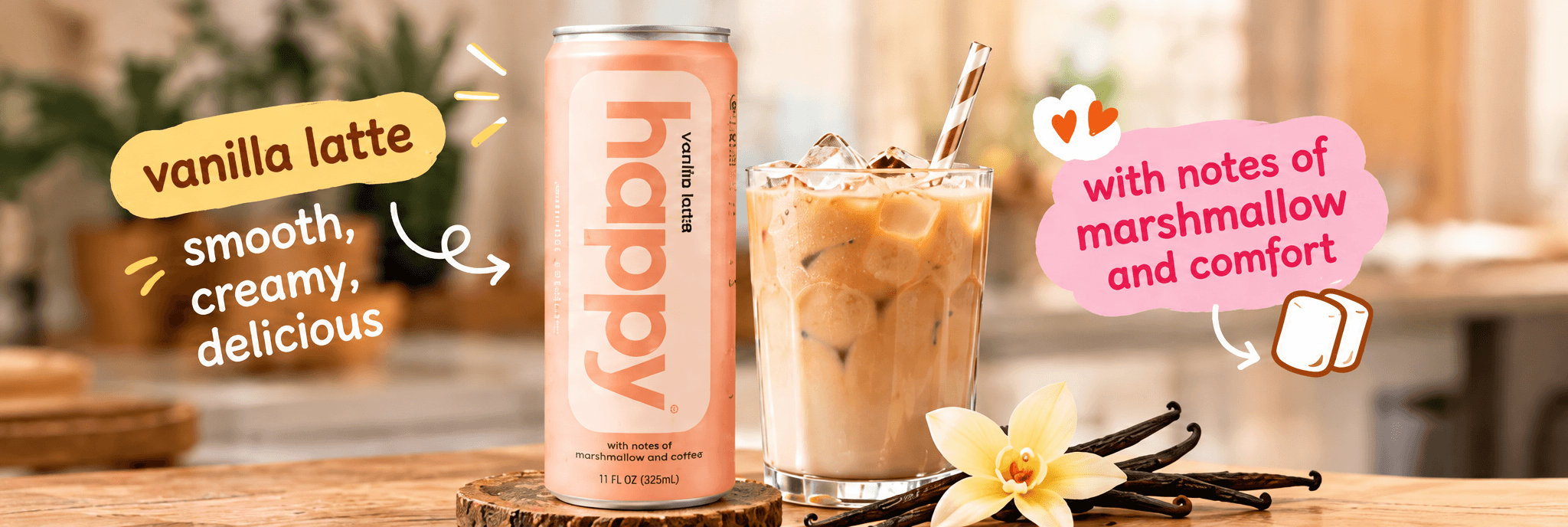
🦸 The Marvel Avengers: Doomsday Collaboration (Yes, Really)
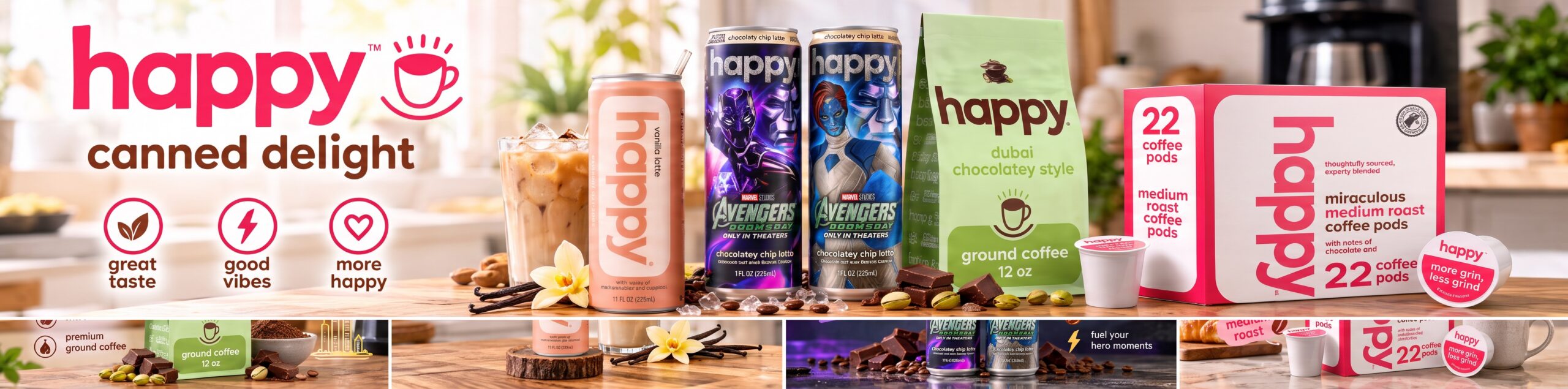
If you’ve looked at Happy®’s Amazon store recently, you’ve seen the most unexpected collaboration in canned coffee history: Happy® × Marvel Studios’ Avengers: Doomsday.
Special-edition cans featuring Black Panther, Mystique, Gambit, The Thing, Doctor Doom, Thor, Captain America, and Mister Fantastic. Chocolatey chip lattes, vanilla lattes, original cold brews, and Tahitian vanilla cold brews — all wrapped in Marvel character art.
Is it a little bit absurd? Sure. Is it also completely perfect for a brand co-founded by Tony Stark himself? Absolutely.
The campaign messaging — “Doomsday is coming. Bring coffee.” — has the kind of dry humor that only a brand with RDJ’s fingerprints on it could pull off. It’s the kind of crossover that could easily feel like a cash grab, except Happy® has always dressed up their cans in fun, seasonal, limited-edition art (see: every Halloween, holiday, and summer drop). This is just their most visible one yet.
💰 The Price Point: Actually Reasonable
Let’s talk money, because this is where a lot of “mission-driven” brands fall apart.
Happy®’s 11 oz cans typically retail for around $2.50–$3.00 each in 4-packs, with 12-packs coming in closer to $2.00–$2.65 per can depending on the retailer and current promotion. Ground coffee bags run $11.99–$15.99. K-cup 22-count boxes hover around $17.99.
Compare that to:
| Brand | 11 oz RTD Latte Avg. Price |
|---|---|
| Starbucks Doubleshot | ~$3.49 |
| La Colonne Cold Brew | ~$3.99 |
| Chameleon Cold Brew | ~$3.29 |
| Happy® Latte | ~$2.65 |
| Generic grocery store brand | ~$1.99 (but…) |
You’re paying café-adjacent quality at grocery-store-adjacent prices. And unlike the generic store brand, you know the NAMI helpline is on the can doing actual good in the world.
They also offer a subscription on happyproducts.com with 5–8% off, flexible frequency, and cancel-anytime terms. The Amazon storefront bundles 4-packs and 12-packs of the core flavors in rotation, which is the easiest entry point if you want to try before you subscribe.
🛒 Where to Actually Find Happy®
If you’re reading this and thinking “okay, where do I buy this?” — you’ve got options.
Online:
- Amazon storefront (the one you came from) — 4-packs, 12-packs, and Marvel collab bundles
- HappyProducts.com — full lineup including microlots and subscription
In-store:
- Target, Walmart, Kroger family stores (Kroger, Dillons, Fred Meyer, King Soopers, Fry’s, Ralphs)
- Albertsons, CVS, Meijer
- The 48 oz multi-serve cold brew bottles are Kroger-family exclusive
That’s a national retail footprint for a brand that’s only been operating for a few years. They’re not a DTC-only darling that vanishes when you want to reorder — they’re in the places you already shop.
☀️ A Typical Day With Happy®
Let’s paint a picture, because that’s often the fastest way to figure out if a brand fits your life.
6:47 AM. You’re standing in your kitchen. The Keurig gets a Happy® Daily Magic medium roast pod. Steam rises. You drink it at the counter while the dog stares at you for breakfast.
12:30 PM. The 3 PM slump is already flirting with you, so you grab a Happy® vanilla latte from the office fridge. 40–50 mg of caffeine — not enough to jolt you, just enough to take the edge off the post-lunch drag. Real milk, real sugar, no weird aftertaste.
7:15 PM. You make dinner. You’re not doing another full cup of coffee, so you brew an Over the Moon Swiss Water decaf — 91 points, chocolatey, smooth. Two to five milligrams of caffeine. You can drink it and still go to sleep at a reasonable hour.
Saturday morning. You grind a Cloud Nine microlot bean, pour it over. It’s fruity, it’s floral, it tastes like something you’d pay $6 for at a third-wave café. You check the bottom of the bag and remember: every bag carries the NAMI number, and some stranger somewhere might be calling it tonight.
That’s the Happy® experience. It’s not revolutionary. It’s consistent. It’s good. And occasionally, it’s doing more than it looks like on the surface.
🔍 The Small Details That Add Up
Here are the things you only notice after living with the brand for a few weeks:
- The cans are shelf-stable until opened. You can stash a 12-pack in your pantry for months. Once cracked, refrigerate and finish within 24 hours. No wasted product if you don’t drink it immediately.
- You can warm the lattes. They’re designed cold, but you can pour one into a mug and heat it up (don’t microwave the can — transfer first). Perfect for winter.
- The ground coffee bags have a one-way valve for freshness, and they tell you to use within 4 weeks of opening for peak flavor.
- The whole bean microlots are small-batch on purpose. They don’t overproduce, because the farmers don’t have that much coffee to give.
- The K-cup pods are Keurig 1.0 and 2.0 compatible, plus most other single-serve machines. No proprietary lock-in nonsense.
- The naming is genuinely fun. “Bright Side” light roast. “Daily Magic” medium. “Bold Type” dark. “Over the Moon” decaf. “Cloud Nine” microlot. “Little Victories.” These are names written by people who like language, not by a focus group.
🤔 The Honest Caveats
No brand is perfect, and you deserve the real picture.
- 📦 The Amazon storefront rotates inventory fast. If a flavor sells out, it can be a few weeks before it comes back. Limited editions especially — they’re gone when they’re gone.
- 🚫 They don’t ship internationally yet. United States only.
- 🥛 The lattes use dairy, not plant milk. If you’re lactose intolerant or vegan, the canned lattes won’t work for you — stick to the cold brews or the whole bean/ground line.
- 💸 The microlots are a splurge. They’re specialty small-batch coffees, priced accordingly.
- 🌡️ “Light roast has more caffeine” is a myth by weight. Happy® is transparent about this: light and dark roasts are essentially equal in caffeine content by weight. By volume (a scoop), light roast edges out by about 10%.
🎁 Who Is Happy® Actually For?
Let’s matchmake.
You’ll love Happy® if:
- You grab ready-to-drink coffee on your commute and are tired of the taste options
- You want a Keurig pod that doesn’t taste like paper
- You care about brands that put their values on the packaging, not just in a press release
- You’ve been meaning to try specialty coffee but don’t know where to start
- You want to support a company where 100% of some products’ sales go directly to mental health causes
You might want to skip it if:
- You need plant-based / oat / almond milk lattes (the current line is dairy-only)
- You’re chasing extremely low-carb or zero-sugar drinks (the lattes have real sugar)
- You drink 3+ cups a day and need a bulk subscription that beats café prices (Happy® is grocery-tier, not wholesale-tier)
- You’re looking for hyper-caffeinated energy drinks (the cold brew is ~165 mg, comparable to one regular cup — not a Red Bull replacement)
🌍 The Big Picture: A Coffee Brand Taking Mental Health Seriously
Here’s the thing that’s easy to miss when you’re staring at a 4-pack of mocha lattes in a grocery store cooler.
The conversation around mental health in America has shifted dramatically in the last decade. We talk about it more openly. We’re more willing to admit when we’re not okay. But there’s still a gap between “talking about it” and “knowing what to do when someone you love is struggling.”
Happy® decided to close that gap in the smallest, most literal way possible: by printing a phone number on every can, every bag, every box. Not a toll-free number for their customer service. A number for a mental health hotline staffed by people who can actually help.
They partner with NAMI on every product. They donate 100% of some limited-edition sales to the Mental Health Coalition. They use their platform (which includes a certain A-list co-founder with a sizable social reach) to keep the conversation visible.
It’s a small thing, measured against the scale of the problem. But it’s the kind of small thing that, multiplied across millions of cans sold, reaches millions of people who might never have picked up the phone otherwise.
✨ The Bottom Line
So should you buy Happy®?
If you’re reading this on Amazon, the answer is probably yes — with one caveat. Start with a 4-pack, not a 12-pack. Try the vanilla latte if you want something easy and approachable. Try the original cold brew if you drink black coffee. Try the chocolatey chip latte (ideally the Black Panther special-edition can, if you can find one) if you want the full experience.
Then check the bottom of the can. You’ll see the NAMI number. You’ll remember what this brand is actually trying to do. And you’ll probably grab a 12-pack next time.
Because really good coffee, at a fair price, from a company that’s trying — even a little bit — to leave the world better than it found it? That’s the kind of thing worth building a fridge around.
Here’s to the small wins. ☕