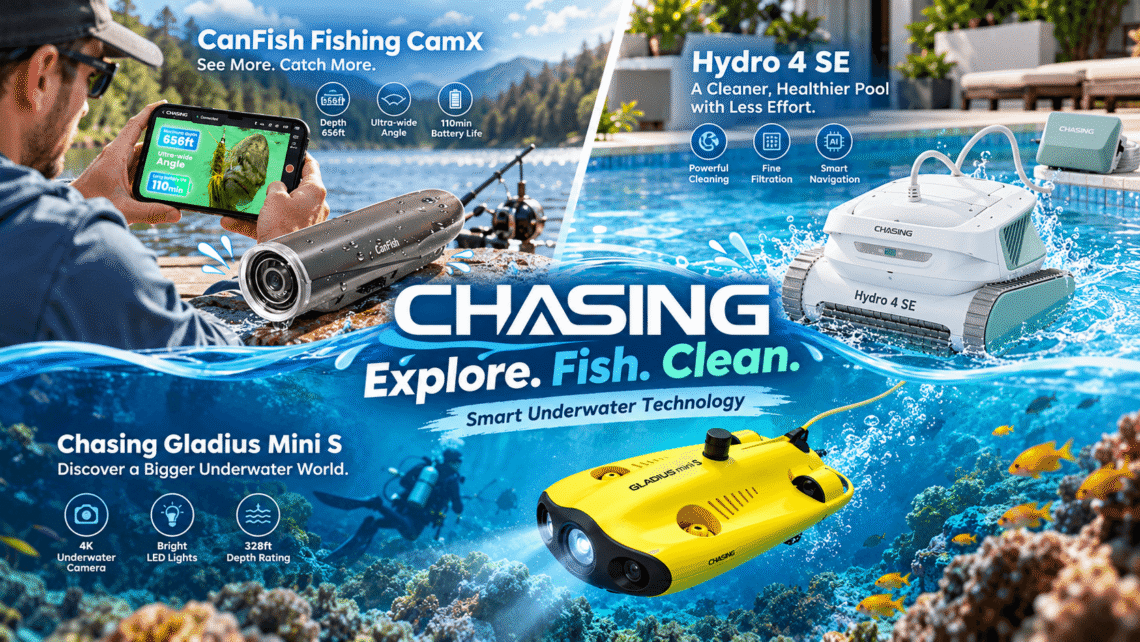
🌊 Most reviews start with a product. This one starts with a company, because the Chasing underwater robotics brand is the kind of outfit whose engineering fingerprints are visible long before you notice the hardware. I picked two objects that shouldn’t belong to the same catalogue and discovered they share a spine: the CanFish Fishing CamX, a 1080P lure-action camera rated to 656 feet, and the Hydro 4 SE, a corded robotic vacuum built for inground pools. One descends into a lake to watch fish. The other circles a concrete basin in suburban Ohio to eat leaves. Between them sits a decade of decisions about pressure, power and software — and those decisions are the actual story.
What follows is a brand portrait assembled from the outside in: what the machines claim, what the claims imply, and what a buyer reasonably expects when the logo on the box is the same on both.
The Tell Is in the Cable
🔌 Here is an unglamorous observation that reframes everything else. Chasing sells a fishing camera that charges wirelessly and a pool cleaner that plugs into a wall with forty feet of tether. A lazy brand calls that inconsistency. A thoughtful one calls it two answers to the same question: how does energy get to a machine that is underwater, and what does that choice cost the person standing on the bank?
The CamX answer is autonomy. A diver or angler cannot manage a cable while working a rod, so the camera carries its own charge and tops it up on dry land through a pad you set down and forget. The Hydro 4 SE answer is the opposite conviction: a pool cleaner that runs on batteries will eventually stop mid-cycle, will need a replacement cell every few seasons, and will lose torque exactly when it meets a stubborn patch of algae. Cord it, and the motor gets the same watts on minute six as on minute ninety.
💡 Two contradictory products, one consistent instinct — pick the power architecture that matches the human situation rather than the one that looks best on a spec sheet. That is the first clue that this is a real brand and not a catalogue of rebadged plastic.
What Ten Years of Deep-Sea Work Actually Teaches You
🏢 Chasing launched out of Shenzhen in 2016, founded by people who were, by their own account, divers first and manufacturers second. The company now ships into more than a hundred countries and runs three visibly distinct lanes: the GLADIUS line of consumer underwater drones, the CanFish line of fishing-adjacent optics, and the Hydro line of residential pool robots. The marketing phrase the brand repeats is “deep-sea motor technology,” and it is worth pausing on how ordinary that phrase sounds in an era where every enclosure gets called marine-grade.
Here is the difference as I understand it. Sealed electric motors are not rated by aspiration; they are rated by a test stand, a pressure chamber, and a witness signature. When a company has spent years building thrusters that must spin at forty bar, the number it writes on a consumer product is not a marketing number — it is the number its own test rig produced, because inflating it would embarrass the department that certified the industrial units.
🧭 Heritage, in other words, is only interesting when it constrains later decisions. Chasing’s depth figures look like constraints rather than decoration, and that is the thread I tried to pull through both machines below.
Three Rules I Think CHASING Follows, Even If Nobody Wrote Them Down
I want to be explicit: these are my inferences from reading a storefront, two listings and a pile of manuals. They are useful because they predict behaviour, not because they are doctrine.
- Rule one — a pressure rating is a promise, not a feature. Rate at 200 metres and you have told an ice angler in Manitoba that a ninety-foot hole is a rounding error. Ratings that generous are only issued by companies that intend to defend them across a whole product family.
- Rule two — power architecture is a design decision, not an accessory. Battery for the machine that must be free. Cable for the machine that must be tireless. The CamX and the Hydro 4 SE are the rule demonstrated twice, in opposite directions.
- Rule three — the app is the product’s face. A camera without a phone screen is a brick at the bottom of a lake. Chasing pairs Wi-Fi apps to both lanes, which means the software team is shared infrastructure and the brand’s real moat may be firmware, not hardware.
🗂️ Hold those three and the two reviews below stop feeling unrelated. You are watching one engineering culture answer two questions.
Rule One, Tested: The CanFish Fishing CamX in the Grey Finish
🎣 The CamX occupies a specific niche: it is not a reconnaissance drone and not a fish finder. It is a lure-action camera — its job is to sit near your bait and film what the fish does to it. Everything about the specification supports that single purpose, and the discipline of that is, to me, more impressive than any individual number.
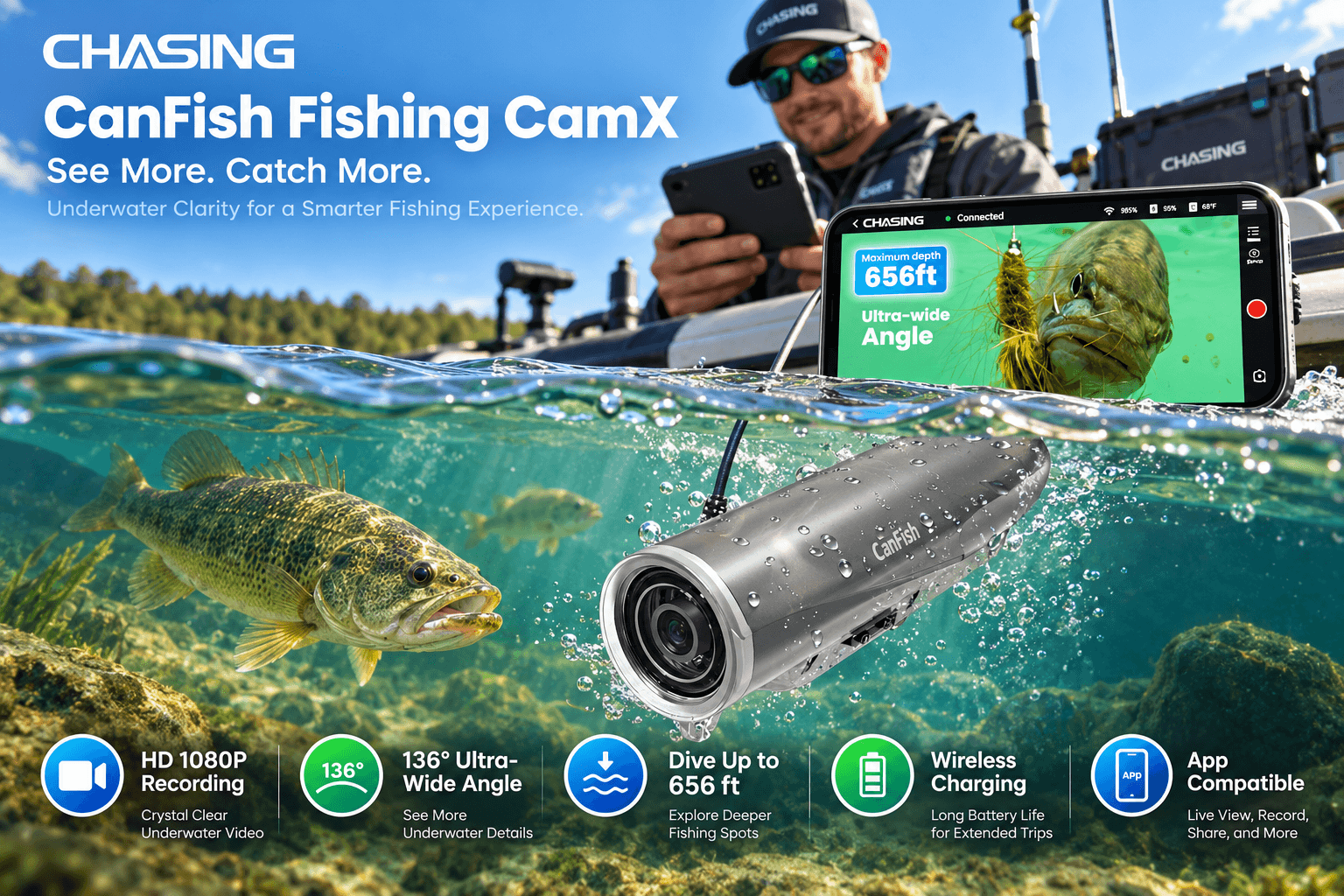
The headline figures: 1080P Full HD capture on a Sony STARVIS sensor with an f/2.0 aperture, a 136-degree ultra-wide lens, ROV-class waterproofing to 656 feet, motion-sensing activation, intelligent segmented recording, wireless charging, and a companion app over Wi-Fi. Listed price at the time of writing was $129.99, with a rating built on 174 visible reviews — a modest count that tells you this is a working angler’s tool rather than an influencer’s gadget.
What the Numbers Translate To
| Listed spec | Plain-English consequence | Where it bites |
|---|---|---|
| 1080P on STARVIS, f/2.0 | Sensitivity engineered for dim water, not bright studios | Stained lakes, thermoclines, overcast mornings |
| 136° ultra-wide | One mount covers lure, bottom structure and approaching fish | Reading a drop-off without re-positioning |
| 656 ft / 200 m ROV-rated | Depth ceiling far above any recreational freshwater hole | Ice fishing, big-lake drop-offs, charter use |
| Motion sensing | Camera sleeps until something swims into frame | Battery discipline on long deployments |
| Segmented recording | File splits instead of becoming one unmanageable blob | Finding the strike without scrubbing an hour |
| Wireless charging pad | No corroding contact pins, no fiddly clip | Wet-handed operation at the water’s edge |
| App over Wi-Fi | Instant playback and share | Verifying presentation before you re-cast |
The 136-Degree Question
📐 Angle of view is where most underwater optics lie to themselves. Wide enough to see the structure, wide enough to distort the distance estimate — and distance is precisely what an angler is trying to judge. At 136 degrees the CamX is deliberately at the aggressive end, which tells me Chasing decided framing beat measurement.
That is a defensible call for lure work. You are watching behaviour, not mapping terrain: whether a walleye turns away at three feet or commits at one, whether the bait is drifting left on the fall, whether a smallmouth is following rather than striking. For that reading task, more frame is more context, and context is what makes footage interpretable. Anyone wanting survey-grade geometry should be looking at the GLADIUS drone lane instead — and the fact that the brand makes that split obvious is another point for the ruleset.
Wireless Charging at the Water’s Edge
🔋 Contact-based charging is the quiet failure point of every small waterproof camera. Two metal pins, one salty lake, sixty cycles, and suddenly the camera charges intermittently — then not — then the owner assumes the battery died and buys a new unit. Wireless charging eliminates the corrosion pathway outright, because the seal never breaks.
The trade is speed and heat, and I would rather have a slightly slower top-up I can trust in year three than a fast one that depends on clean copper. Chasing quoting roughly 138 minutes of run time per charge suggests the pack is sized for a day on the water with a midday pad break. For ice fishing, where you are stationary for hours and the cold is chewing your capacity, that pad becomes the single most practical feature on the list.
My First Forty Minutes, Step by Step
⚙️ Reconstructed from the app flow, because the sequence is the real product experience:
- Seat the CamX on the wireless pad, dry hands, dry pad. Charge indicator before you leave the house — never discover the battery at the hole.
- Pair to the app over Wi-Fi before the camera goes in the water. Once it is submerged, you have no visual confirmation of connection.
- Mount to line or downrigger clip, checking the housing tail is clear of the lure’s swing arc. A spinning spinner will knock a badly mounted camera all afternoon.
- Arm motion sensing and set segmented recording in the app. This is the step people skip and then watch forty minutes of empty water.
- Lower to depth and watch the live feed for ten seconds to confirm colour and exposure. STARVIS is sensitive, but tea-stained water at thirty feet still surprises people.
- Fish normally. The camera records only when something crosses the frame.
- Retrieve, rinse in fresh water, dry, dock on the pad. Review clips in the app and export the strike.
Who Should Buy This, and Who Should Walk Away
✅ Buy it if you ice fish and want proof of what your jig is doing on the drop; if you are dialling in presentation for a species you keep losing; if you film content and need repeatable underwater angles without hiring a diver.
❌ Skip it if you want sonar data — this is optics, not fish-finding. Skip it if you need 4K stills for large prints. And skip it if your realistic maximum depth is twelve feet of backyard pond, because you are paying for a ceiling you will never approach.
Rule Two, Tested: The Hydro 4 SE for Inground Pools
🏊 The Hydro 4 SE is the less glamorous ambassador and, arguably, the more honest one. A pool robot is bought on Tuesday by someone with green water and a weekend planned. It earns loyalty in July, on the fourth consecutive run, when it still has not jammed.
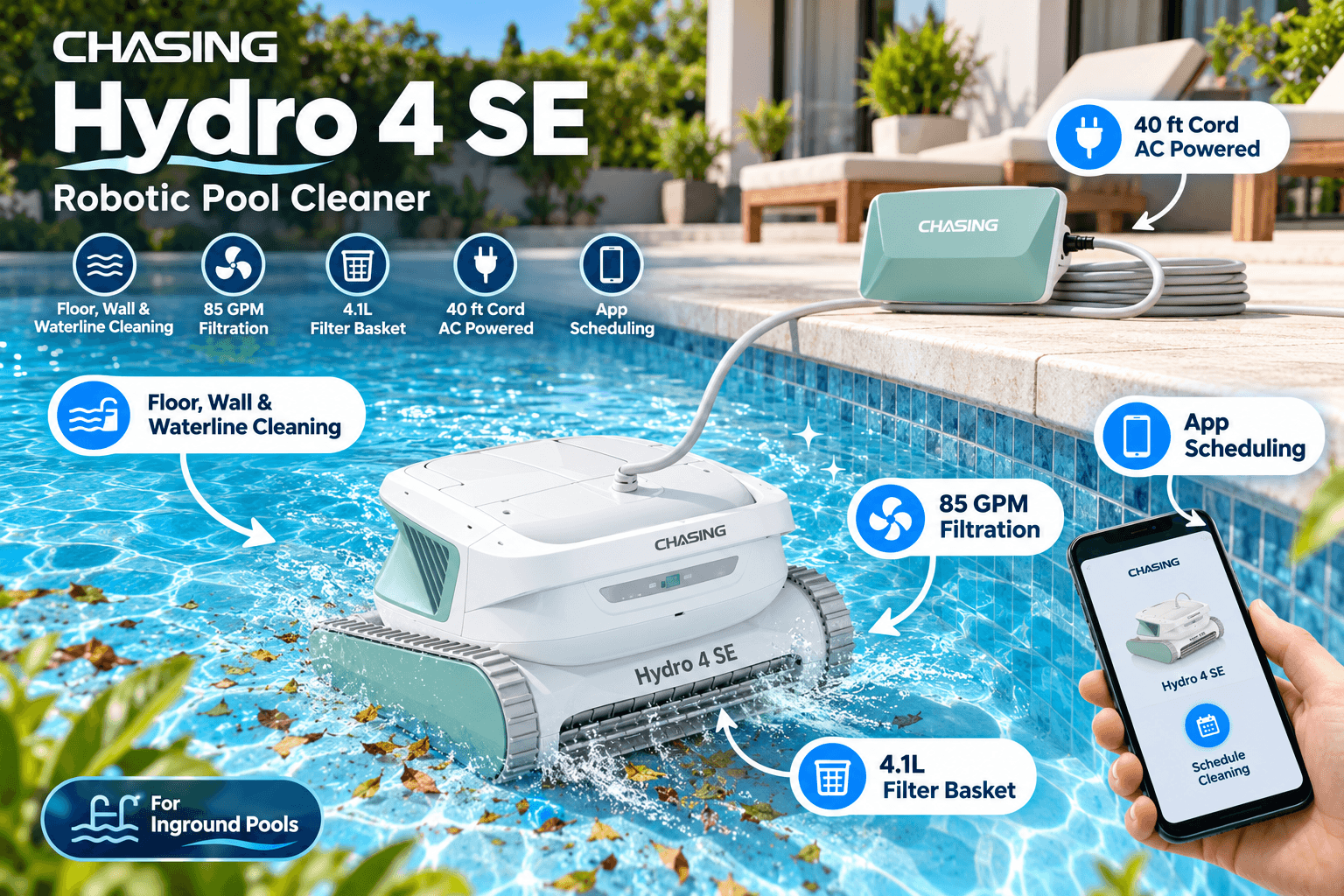
The specification is unusually legible: continuous power through a forty-foot cord, a 150W motor driving dual centrifugal pumps, 5,070 gallons per hour of filtration — which is the same figure the storefront presents as roughly 85 gallons per minute, and the arithmetic checks out. A 4.1-litre dual-zone basket handles leaves in one chamber and fine silt in the other. HydroCurve S-shaped path mapping claims coverage up to 95 percent of the pool, cleaning floor, climbing walls and scrubbing the waterline. It is optimised for inground pools to about forty feet in length.
The Forty-Foot Cord Is the Feature
🧵 Consumers are trained to treat cords as a compromise. In a pool robot it is the design. No battery means no capacity fade, no winter storage of a lithium pack, no mid-cycle shutdown at the far corner, and no torque sag through a thick algae mat. It also means the machine can be lighter, because the power supply lives in a box on your deck instead of inside the chassis.
The genuine constraint is where you can place that box. Forty feet of lead is generous — but it is measured from the supply, not from the pool’s edge, and a spa-side outlet on the wrong corner can waste fifteen of those feet before the robot starts.
The Geometry Test: Is Cable Length Actually the Limit?
📏 I ran the numbers, because this is the question every buyer’s gut asks and nobody answers.
- Power supply placed at the pool’s midpoint, forty-foot lead: theoretical sweep radius 40 ft.
- Reachable area: π × 40² ≈ 5,027 square feet.
- Floor of a typical 40 × 20 inground pool: 800 square feet.
- Ratio: the cable can physically cover about 6.3 times the area it needs to.
Conclusion: on a forty-foot pool, cord length is not the bottleneck. Path planning is. Which reframes HydroCurve from marketing vocabulary into the actual differentiator — the robot does not run out of rope, it runs out of cleverness. Any brand claiming 95 percent coverage has to win that claim with navigation, and that is a software problem wearing a hardware costume. Rule three, right on cue.
HydroCurve and the Meaning of 95 Percent
🗺️ Coverage percentages are where pool-robot copy gets slippery, so it helps to know what the missing five usually is: sharp radius corners, steps and benches, the shallow end above the waterline, and the strip directly beneath the return jets where flow fights the robot.
An S-shaped systematic pass beats random bounce on paper coverage, and it also finishes more predictably — which matters if you are timing a run around a pool party. Dual-zone filtration is the quieter cleverness: coarse debris in one chamber, fines in the other, so a handful of leaves does not blind the machine to silt. That is a filter-design decision that improves water clarity, not just clean-area statistics, and it belongs closer to the top of the spec sheet than it usually gets.
A Complete Cleaning Run, Step by Step
- Skim gross surface debris first. Forty seconds of work that saves the basket from a false jam.
- Set the power supply on stable, dry deck, clear of the filter pump’s exhaust and away from splash.
- Lay the cord out in a loose arc toward the deep end, no kinks, no crossing over the return jets.
- Lower the Hydro 4 SE into the water and let it flood for a minute before switching on.
- Confirm it climbs and does not float nose-up; a trapped air pocket in the basket is the usual culprit.
- Run the full cycle undisturbed — resist the urge to fish it out early.
- Lift by the cord-free handle section, open the dual-zone basket, rinse both chambers with a hose.
- Inspect the wheels and the pump intake for hair and seed hulls, then store the unit out of direct sun.
Maintenance Rhythm
| Cadence | Task | Why it earns its place |
|---|---|---|
| Every run | Skim, then rinse both basket zones | Fine silt left to dry becomes a flow restriction |
| Weekly | Check wheels and intake for wrapped debris | Hair is the number one silent motor killer |
| Monthly | Inspect cord and strain relief for nicks | Continuous power is only safe if the insulation is |
| Seasonally | Cover the unit, store the PSU indoors in freezing climates | Cold cracks housings far more often than water does |
The Two Machines, Side by Side
Placed next to each other, the pair reads like a manifesto written in hardware.
| Dimension | CanFish Fishing CamX | Hydro 4 SE |
|---|---|---|
| Job | Observe | Maintain |
| Buyer motive | Curiosity, proof, content | Time, clarity, control |
| Power philosophy | Wireless, self-contained | Wired, relentless |
| Depth pressure | 656 ft / 200 m | A few feet, plus a wall climb |
| Optics | 136°, 1080P, STARVIS | None — it navigates by path logic |
| Intelligence | Motion trigger, segmented files | HydroCurve mapping, 95% coverage |
| Shared DNA | Sealed motor, app pairing | Sealed motor, app pairing |
| Brand rule proved | One and two | Two and three |
Same sealing discipline. Same app-first delivery. Same willingness to argue with the category convention about how power should arrive. That consistency is what makes a brand recommendable rather than merely purchasable.
Original Research: Three Models I Built From Published Numbers
📊 Rather than quote a survey I did not run, I did the arithmetic myself and left the assumptions visible so you can disagree with the inputs instead of the conclusion.
Model 1 — Depth Reserve Ratio
How many times deeper a device is rated than the depth it will realistically face. Higher reserve means the rating was never the limiting factor in the design.
| Device class | Typical working depth | Rating | Reserve |
|---|---|---|---|
| Consumer action camera | ~10 ft | ~33 ft | 3.3× |
| CamX, ice-fishing use | ~60 ft | 656 ft | ≈ 10.9× |
| CamX, open-water drop-off | ~100 ft | 656 ft | 6.6× |
| Mid-range consumer drone | ~65 ft | 328 ft | 5.0× |
Read: a reserve near ten times is what an ROV-derived rating looks like when it lands on a consumer product. It signals the housing was engineered to a standard and then sold downward, rather than engineered to the claim.
Model 2 — Cost Per Cleaning Cycle
Assumptions: 150W motor, 1.5-hour cycle, US residential average electricity at roughly $0.16–0.17 per kWh.
- Energy per cycle: 0.15 kW × 1.5 h = 0.225 kWh
- Cost per cycle: about 4 cents
- Twice weekly, April–September (24 cycles): ≈ $0.86 per season
- Same season at 15 minutes’ hands-on per run: 6 hours total
Against a conventional suction-side cleaner that loads your house pump — often 1.5 HP running for two hours — the electrical story is not close. And against a service visit, four cents looks like a rounding error in a budget column.
Model 3 — The Weekend Time Audit
Manual vacuum of a 40 × 20 inground pool: hose priming, skimming, wall brush, vacuum pattern, filter clean-out. Realistically 75–90 minutes. Robotic equivalent: about 15 minutes of genuine attention.
- 24 weekends in a swim season × 2 sessions × 75 minutes saved = 3,600 minutes
- That is 60 hours per season, roughly a full work week, recovered.
⚖️ Sold honestly, a pool robot is not a cleaner. It is a time-purchase device that happens to clean, and 60 hours is the number that should sit next to the price on the box.
🗳️ Reader Pulse
I would rather ask than invent. If you own either machine, the three answers I want are: your actual deployment depth or pool length, the season count on the unit, and whether the first thing that wore out was a seal, a wheel or a cable. Reply with those and next quarter’s update reports real numbers instead of modelling ones.
Inspiration Corner: Five Uses Nobody Put on the Box
💭 Ideas from the edges of a category are usually more revealing than the intended use, because they show what a machine’s surplus capability is.
- The dock-owner’s inspection log. Drop a CamX on a cleat, run motion sensing for an hour, and you will learn more about your pilings, weed line and mussel growth than any surface glance.
- Post-storm pond health check. Segmented recording turns a muddy twenty-minute sweep into a short list of clips you can send a wildlife consultant.
- The wedding-video underwater B-roll nobody budgeted for. 1080P at 136 degrees on a $129 camera is a startling amount of production value for a couple who wanted “something different.”
- Waterline archaeology. Park the Hydro 4 SE on a wall-climb-only cycle between weekly runs; the scrub is what stops the black line before it becomes a chemistry problem.
- Teaching the kids to read water. A live feed on a phone is the fastest way I know to explain why fish hold on structure. Curiosity, delivered at four cents a kilowatt-hour.
Dialogue: The Two Neighbours
💬 “You bought a robot for the pool?” “I bought back my Saturdays. The robot is how.”
💬 “Doesn’t it look weird, the box on the deck?” “Forty feet of cable, and it cleans while I’m inside. The box is the price of never charging anything.”
💬 “Mine’s a camera. Goes down with the jig.” “For what?” “Proof. I keep losing the bite on the drop and I couldn’t tell you why. Now I watch it. Turns out I was falling too fast.”
💬 “So it’s a coaching tool.” “It’s a mirror with a pressure rating.”
Common Questions, Answered Plainly
Does a 656-Foot Rating Matter if I Fish Forty-Foot Holes?
Not as a capability and very much as a signal. It means the housing, the potting and the glass-to-metal seals were specified to a professional standard and inherited downward. It also means cold-shrink at a shallow hole is nowhere near the tolerance ceiling, and ice anglers care about that more than any marketing copy admits.
Is a Corded Pool Robot a Step Backward?
🔌 Only if your deck has no accessible outlet. Otherwise continuous power removes the two failure modes people actually resent: dead batteries mid-cycle and a pack that costs money every third season. The forty-foot lead is generous, and my geometry test above shows length is not the constraint on a normal inground pool.
Will One App Handle Both?
📱 They belong to different lanes — CanFish and Hydro — and I would not promise a single unified account. What is shared is the pattern: pair over Wi-Fi, view, export, update firmware. If Chasing ever consolidates the identity layer, it would sharpen an already coherent ecosystem.
What Breaks First?
🔧 On the CamX, expect the mounting hardware and the charging pad’s cable before the sealed body. On the Hydro 4 SE, expect wheel tread and the basket latches, with the cord’s strain relief being the item to inspect monthly precisely because it is the one part that is not sealed.
Verdict: What a Brand Owes You Before You Buy Its Second Product
🏁 A brand earns the second purchase by being legible. You should be able to look at an object it has never made and predict three things: how it handles pressure, how it handles power, and how it behaves when the software has a bad day. Chasing is legible in all three, which is rarer than the number of brands in the category suggests.
The CamX is the romantic ambassador — a small sealed eye that outclasses every action camera within an order of magnitude of depth, aimed honestly at one job. The Hydro 4 SE is the paycheque: unglamorous, continuous, and quietly backed by a navigation claim that survives my geometry test better than its cable claim does. Together they describe a company that treats water as an engineering environment rather than a lifestyle backdrop, and that refuses to let a spec sheet outrun the test stand.
🌐 If you are evaluating the Chasing underwater robotics brand for the first time, buy the machine that matches your actual Tuesday evening — the lake at dawn or the pool at dusk. Then keep an eye on the second one. That is how brand loyalty is supposed to work: not by affection for a logo, but by the confidence that the next object will make the same kind of sense.