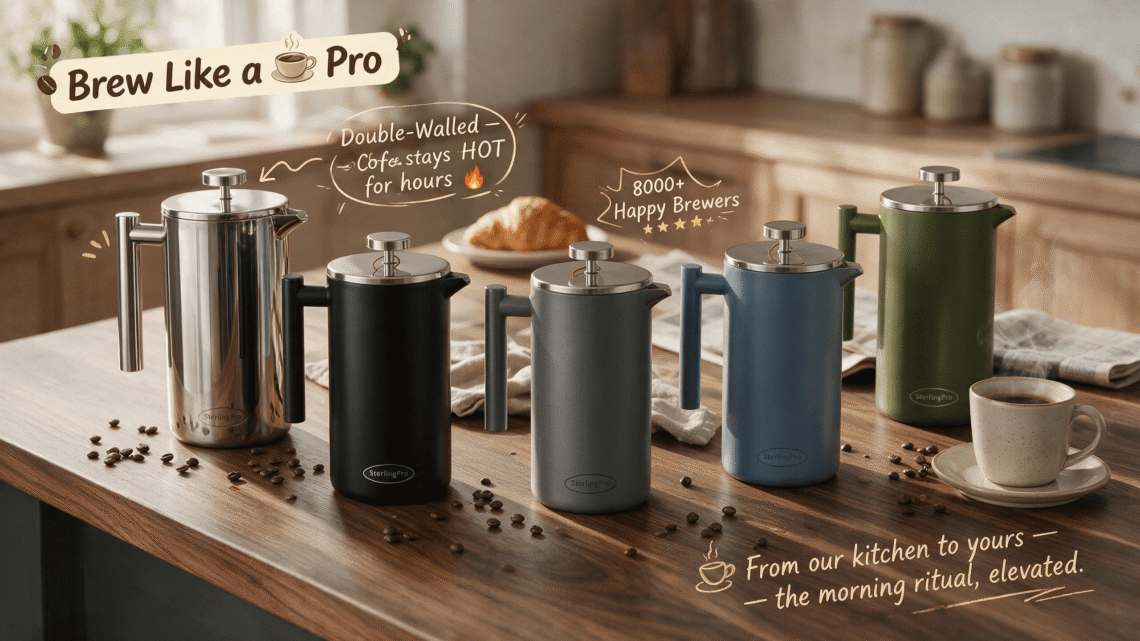
Roughly two-thirds of American adults drink coffee every day, according to the National Coffee Association’s 2025 National Coffee Data Trends, and the overwhelming majority of that volume is brewed at home rather than bought. That statistic is quietly unflattering to equipment makers. If a category’s customers are habitual, the vessel they buy on a Tuesday afternoon ought to still be functional in year four. For the immersion brewer, it generally is not. The SterlingPro stainless steel French press was engineered against exactly that failure record, and the substantive story is not the brand’s slogan but the four decisions underneath it: an 18/10 alloy body, a double-walled cavity, a two-screen filter stack, and a capacity ceiling nobody else in the category bothered to raise.
A Category Still Running on 1929 Hardware
The immersion brewer is one of the few kitchen appliances whose design has barely moved in a century. Attilio Calimari’s 1929 patent described what still sits in most cupboards: a cylindrical beaker, a lid, a rod, a mesh disc. Ninety-five years of innovation went into burr grinders, gooseneck kettles and light-roast profiling. Almost none of it went into the container that actually holds the coffee.
The consequences show up predictably. A borosilicate beaker is a thermal conductor with no protection, so brew temperature falls through the wall while the household is still pouring the first cup. The same beaker is a fracture risk near a sink drain, a dishwasher rack and any child who reaches for a handle. And the plastic lid collar that screws onto it is where the design gives up on taste: warm coffee sits against polymer for the entire steep, and polymers hold onto oils.
Three failure modes account for most abandoned presses:
- Structural — a cracked or chipped beaker, usually from thermal shock or a single collision with a sink edge.
- Thermal — a cup that has dropped below the palatable window before the second pour.
- Organoleptic — plastic and rancid-oil flavor memory in the lid assembly, plus sediment in the last inch of every mug.
None of these are bean problems. They are vessel problems, which means they are solvable with materials science rather than with a better bag of coffee. That is the opening SterlingPro took.
What SterlingPro Changed in the Vessel Itself
Reading 18/10 and 304 Correctly
The brand specifies 304-grade stainless steel, marketed as 18/10 for its nominal composition of 18 percent chromium and 10 percent nickel. Chromium is the element that matters for safety as well as for corrosion: the U.S. Food and Drug Administration treats stainless steel as generally recognized as safe for food contact where chromium content reaches at least 16 percent, a threshold 304 clears comfortably. Nickel’s contribution is different — it stabilizes the austenitic structure, improves formability during drawing and polishing, and toughens resistance to the organic acids that coffee happens to contain.
| Alloy | Nominal composition | Typical use | Relevance to coffee |
|---|---|---|---|
| 304 / 18/10 | 18% Cr, 10% Ni | Cutlery, cookware, sinks | Standard food-service choice; handles citric and chlorogenic acids well |
| 316 / 18/8 Mo | Adds ~2–3% molybdenum | Marine, surgical, highly acidic duty | Better against chloride and strong acid; unnecessary for brewing water |
| 430 | ~16–18% Cr, no nickel | Decorative, automotive trim | Cheaper, less corrosion-tolerant, not a food-longevity choice |
A useful clarification for shoppers who read spec sheets closely: the FDA does not certify raw steel grades. Compliance for a finished article rests on material test certificates, sanitary design and demonstrated non-migration under 21 CFR 175.300 for coated and finished articles. Surface finish is part of that story too — hygienic design practice generally targets a roughness average at or below 0.8 µm so the surface is cleanable and does not harbor residue. A polished interior wall is not cosmetic; it is what allows a rinse to actually work.
Double Walls Are Insulation, Not Styling
The 1.75-liter body measures approximately 10 inches tall, 7 inches across from handle to spout, and 5 inches at the base — dimensions that only a vacuum-adjacent double wall makes manageable. Two nested steel shells with a sealed gap between them do two jobs at once. They slow conductive heat loss, which the brand states keeps coffee hot up to five times longer than a comparable glass-beaker press. And they keep the outer surface cool to the touch, which converts an appliance that would otherwise scald a hand on contact into something a person can hold, carry and store without a sleeve.
The “five times” figure is a manufacturer claim, and it deserves to be read as directional rather than as a laboratory constant. Still, the physics is not in dispute: an air gap or vacuum layer between two metal shells has orders of magnitude lower thermal conductivity than a single glass wall exposed to room air. What varies is the sealed-gap quality, not the principle.
The Two-Screen Stack and the Sediment Problem
Fine grind in a single-mesh plunger will always pass some solids; the aperture is simply larger than the smallest particles. SterlingPro’s answer is a dual filter system — two stacked stainless screens with opposing load paths, so the upper screen bears compression and the lower screen bears the fines barrier. The stated outcome is a granule-free cup, and the practical outcome is that the last half-inch of the beaker stops being a mouthful of grit.
This is also the component the brand treats as consumable rather than permanent. The 1.75L ships with two bonus replacement screens, and additional multi-packs of the circular mesh screens, along with spring and lid assemblies, are stocked as spare parts. That single decision is worth more over five years of ownership than most finish upgrades.
Capacity as a Brewing Variable, Not Just a Number
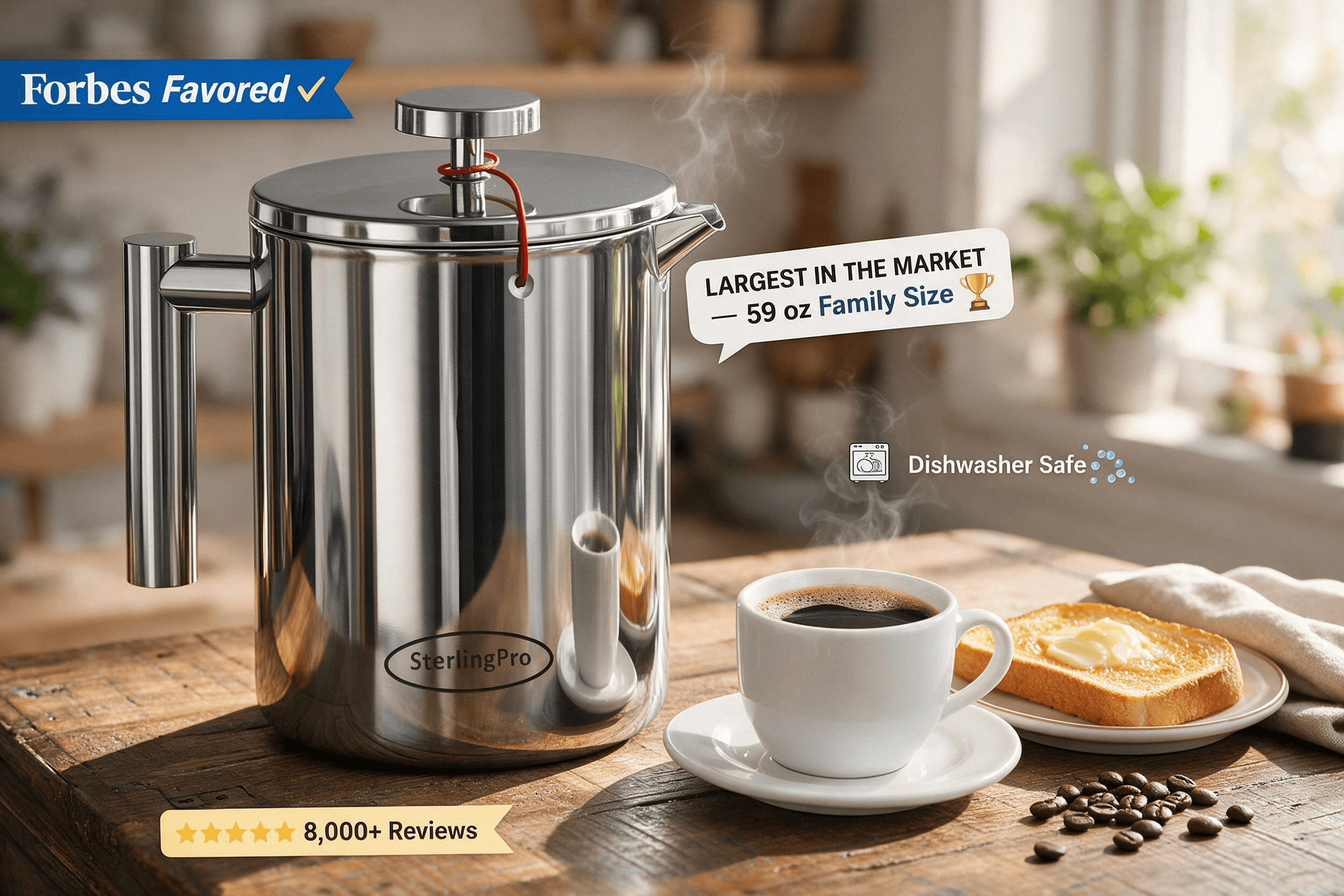
Most presses are sold in a 34-ounce (1 liter) format, which yields roughly four to six small cups and forces anyone brewing for more than two people into a second batch. The SterlingPro range runs 1L/34oz, 1.5L/51oz, 1.75L/59oz and a 2L/64oz format, with the 1.75L rated to hold up to 16 cups or 8 mugs.
| Model | Capacity | Approx. yield | Best fit |
|---|---|---|---|
| 34 oz | 1 L | 4–6 small cups | Solo drinker, RV, boat, office desk |
| 51 oz | 1.5 L | 8–10 cups | Two-person household, one full batch |
| 59 oz | 1.75 L | up to 16 cups / 8 mugs | Family of four, batch brewing, meal prep |
| 64 oz | 2 L | 16–20 cups | Small office, gatherings, weekend hosting |
The under-discussed effect of volume is thermal, not logistical. A 1.75-liter mass of water has far greater thermal inertia than a 600-milliliter one, so its rate of temperature decline per minute is lower even before insulation is considered. Combine a large thermal mass with a double-walled vessel and the brew stays inside the 195–205 °F extraction window — the range consistently cited as optimal, where sugars and oils release cleanly without dragging out harsh bitter compounds — for materially longer. Below about 195 °F, extraction turns sour and thin. Above 205 °F, it turns ashy.
There is a second-order benefit worth naming: batch consistency. Coffee drunk within the first ten minutes of a small brew and coffee drunk forty minutes later from a thermos are effectively different beverages. A single large immersion batch that holds its own temperature removes the thermos from the chain entirely, and with it the oxidation and residual-heating that make afternoon coffee taste flat.
Original Analysis: The Replacement Cycle Model
Public discussion of brewer cost is almost always about sticker price. That is the wrong denominator. The meaningful figure is objects consumed per decade of daily drinking, because a device that cannot be repaired is a consumable no matter how well it is finished.
Below is our own model, built on stated inputs rather than measured ones. Assumptions are labeled so any reader can substitute their own street prices and household facts.
Inputs used:
- NCA 2025 data: about 66 percent of U.S. adults drink coffee daily, averaging roughly three cups.
- Brand specification: 1.75L / 59oz vessel; two bonus replacement screens included; screens stocked as spare parts.
- Structural premise: a glass beaker has one failure path (fracture) with no repair path; a steel vessel has none, and its wear item (screens) is replaceable.
Three-year object count for a three-cup-per-day household:
| Ownership path | Vessels bought | Wear parts bought | Total objects | Repairable? |
|---|---|---|---|---|
| Glass beaker + plastic collar | 1–2 (fracture or chip likely by year 2–3) | 0 (screen not sold separately on most models) | 1–2 | No |
| Cheap steel press, single screen, no spares | 1 | 0 available | 1 | Rarely |
| SterlingPro 1.75L + screen multi-pack | 1 | 1 six-pack of screens | 2 | Yes |
The interesting conclusion is not that steel wins on durability — that is obvious. It is that parts availability is the actual durability specification. A press that costs more upfront but ships with two spare screens and has a six-pack of replacements in the same storefront will outlast a cheaper press whose plunger assembly is a sealed unit. Every cracked beaker represents not just the vessel but the accumulated flavor of everything that was brewed in it before it failed.
Our view, stated plainly: any immersion brewer sold without replaceable screens should be classified as a disposable appliance, whatever the packaging says.
A Repeatable Method for Large-Format Immersion Brewing
Scaling a recipe from 600 ml to 1.75 L is not multiplication. Thermal mass, surface-area-to-volume ratio and settling behavior all shift, and most people who batch-brew for the first time under-correct on grind.
- Dose by water weight, not by scoops. Use the internal brew-level markings as the volume reference, then weigh. A workable starting ratio is 60 g of coffee per liter, so the 1.75L takes about 105 g and the 1L takes about 60 g.
- Grind coarser than your small-press setting. One to two clicks coarser on a typical burr grinder. A larger mass holds temperature longer, which extends effective extraction time; a fine grind in a big batch overshoots into bitterness before the plunger ever goes down.
- Charge the vessel first. Rinse the empty steel pot with boiling water for thirty seconds and discard it. A cold 304 wall steals 4–6 °F from the brew on contact, and in a double-walled vessel that loss is slower to recover.
- Pour all water in one continuous motion. Aim for saturation of every bed, not circles. Pouring in stages in a tall 10-inch column creates channeling that a single-mesh plunger cannot correct.
- Break the crust at four minutes. Use a spoon to stir the floating top layer, then skim it off rather than leaving it to be pressed down.
- Rest for a further four to six minutes. Sediment needs time to fall out of suspension in a large volume; the two screens work far better when the solids have already done most of the settling themselves.
- Press in one slow, uninterrupted descent. Roughly twenty seconds. Resistance that suddenly spikes means the grind was too fine — stop, decant, and adjust next batch rather than forcing the plunger.
- Decant immediately into mugs. Do not leave the plunger submerged with liquid in the vessel. Immersion does not stop at the plunger; the bed keeps extracting until the coffee is separated from it.
- Rinse the screen stack under running water within the hour. Dried coffee oils on mesh are the single hardest residue to remove later.
Under the Specialty Coffee Association’s commonly cited Golden Cup parameters — roughly 18 to 22 percent extraction and a strength band near 1.2 to 1.5 percent total dissolved solids — the adjustment most batch brewers need after their first attempt is a coarser grind plus a shorter rest, not a different bean.
Caring for Metal: Cleaning, Descaling and Filter Replacement
Steel forgives a great deal, but it is not maintenance-free, and the two failure points that remain are grease film and mineral scale.
Daily:
- Plunge the screen a few times in hot water to dislodge the bed, discard grounds, and rinse both screens under running water.
- Wash the lid and plunger assembly separately; the hub where the rod meets the collar is where oils collect.
- Air-dry upside down with the lid off. Trapped moisture in a sealed steel vessel is how a metallic tang migrates into the next brew.
Weekly:
- Soak the vessel and screen stack in warm water with a mild alkaline detergent for thirty minutes.
- Use a soft brush on the interior wall; avoid abrasive pads that scratch the polished finish and create microscopic anchors for residue.
Quarterly, or monthly in hard-water areas:
- Fill to the brew line with a 1:1 white vinegar and water solution, heat to just below boiling, and hold for thirty minutes.
- Discard, then run two full cycles of clean water through the vessel with the screens seated.
- For scale specifically, citric acid at about one tablespoon per liter works faster and leaves no odor.
When to Replace Screens
Replace the mesh when any of the following appear:
- Visible deformation or a lifted crimp edge, which lets fines bypass the barrier.
- A gray-brown film that survives detergent and vinegar, indicating polymerized oil in the weave.
- Plunger resistance that has dropped noticeably, meaning the seal against the wall has loosened.
Including two bonus screens with the 1.75L is a sensible buffer: one in service, one in rotation while the first is soaking. The availability of a six-pack of replacements in the same storefront turns what would otherwise be an appliance disposal into a ninety-second swap.
What Third-Party Standards Actually Tell You About Coffee Equipment
Marketing language is easy; standards documents are not. Knowing which bodies govern which part of the cup lets a shopper evaluate a press on evidence rather than adjectives.
| Standard / authority | What it governs | Why it matters here |
|---|---|---|
| FDA GRAS opinion on stainless steel | Food-contact safety where chromium ≥ 16% | 304 / 18/10 clears the threshold; the alloy itself is not the risk |
| 21 CFR 175.300 | Coated and finished articles; no migration of harmful substances | Applies to the finished vessel, not the raw coil of steel |
| UL 1082 | Household electric coffee makers — overheating, shock, fire | Relevant to drip machines; an immersion press has no electrical failure path |
| UL 197 | Commercial electric appliances, with hospitality supplements | The benchmark for office and café equipment |
| NSF/ANSI 42 | Aesthetic effects: chlorine, taste, odor, particulates | Governs filtration media, and water is 98% of the finished cup |
| NSF/ANSI 53 | Health effects: lead, VOCs, chromium, Cryptosporidium | Also requires that the filter itself does not leach |
The UL distinction is worth pausing on. A pour-over machine or electric percolator carries thermal-fuse and heating-element risk that UL 1082 exists to constrain. A manual immersion press has no element, no thermostat and no cord. Its risk profile is mechanical, which is precisely why alloy quality, wall integrity and a cool-touch exterior are the correct places to spend engineering budget — they are the entire safety surface of the product.
The NSF lines matter for a different reason: anything that touches the water upstream of the brew. Because coffee is roughly 98 percent water, mineral content and chlorine residual do more to a cup than most roast choices do. A steel vessel that neither scales unevenly nor holds odors is, in effect, a neutral participant in that equation.
Media Validation, and What It Is Worth
SterlingPro’s storefront cites recognition from Forbes, NBC News and Fox News, and its 34oz packaging references more than 8,000 reviews. These are brand-reported figures, and they should be treated as such. But they are worth interpreting rather than dismissing.
Review volume on durable goods behaves differently than on consumables. A coffee press accumulates reviews slowly and retains them for years, so a high count on a single listing indicates sustained sales velocity across a long window, not a promotional spike. More usefully, high-volume review sets on durable products are dominated by two topics: whether the item arrived intact, and whether it survived year two. That is exactly the failure record the glass category cannot win on.
Third-party editorial mentions carry a different weight. A publication listing a press among recommended models is validating that the vessel performs in a side-by-side, which is a stronger signal than any self-described feature list. The honest caveat is that recommendation lists age quickly, and a mention should be checked for the specific model and size it referred to.
Who Should Buy Which Size — and Who Should Not
Buy the 1.75L / 59oz if:
- More than two people drink coffee in the household.
- You want one batch to cover morning and a second round without reheating.
- Your current press lives near a sink, a dishwasher door or small hands.
Buy the 1L / 34oz if:
- You drink alone or as a pair and want a single batch finished fresh.
- Space is constrained — a boat, an RV, a dorm, a small countertop.
- You want the lowest-entry option in the same steel-and-dual-screen architecture.
Consider the 2L / 64oz if:
- You brew for a small office, a weekend gathering, or a household that also iced-coffees.
Do not buy any immersion press if:
- You want paper-filter clarity. Metal mesh, however fine, will not replicate the polish of a paper cone.
- You need programmable temperature control or automatic dispensing.
- Your priority is the lightest possible packing weight for backpacking; a double-walled steel vessel is not a trail item.
That last section is unusual in brand content, and it is included deliberately. A recommendation only earns trust when it states its own boundaries.
Frequently Asked Questions
Does a stainless steel press change the flavor compared with glass? The vessel should not, if it is properly finished and cleaned. Any metallic note comes from residue or damaged passivation, not from 18/10 alloy in contact with brewed coffee.
Can the double-walled body go on a stovetop? No. It is an immersion brewer for hot water added off the heat; direct flame would void the wall integrity and defeat the insulation gap.
Is the outside genuinely cool to the touch? The stated design intent is a cool-touch exterior during normal handling. Filled to the line with near-boiling water, expect warmth that is comfortable to grip rather than cold.
How often do the screens need replacing? With weekly deep cleaning and quarterly descaling, plan on one to two years of heavy daily use before the weave holds film or the crimp edge lifts.
Will replacement screens from the six-pack fit older models? Match the diameter to your specific size — the 1L, 1.5L and 1.75L use different screen dimensions. Confirm against the size you own.
Does bigger capacity mean a weaker cup? Only if the ratio is not scaled. Weigh coffee against water by the liter and the strength is identical; the difference is that the larger batch holds temperature far longer.
The Bottom Line on Steel
The immersion brewer’s problems were never about coffee. They were about a beaker that cracks, a wall that sheds heat, a collar that holds odors, and a mesh that cannot be swapped when it wears out. SterlingPro addressed all four with the same underlying logic: make the vessel out of a material that does not have a failure date, insulate it so the brew stays in the extraction window, keep plastic out of the contact chain, and sell the wear parts separately so that a tired screen is a ninety-second repair instead of a new appliance.
For a household that drinks three cups a day — the national average, per the National Coffee Association — the difference between a press that lasts eighteen months and one that lasts eight years is not a marginal upgrade. It is the difference between a recurring purchase and a solved problem.