For parents who see the outdoors as part of everyday family life rather than an occasional destination, BOB Gear occupies a distinctive position in the stroller market. The brand is closely associated with jogging strollers, all-terrain mobility, and equipment designed for families who expect more from their wheels than a smooth trip through a shopping aisle. Yet describing BOB Gear simply as a “jogging stroller brand” misses the larger idea behind the company: building family gear around movement, adaptability, and the belief that becoming a parent does not have to mean giving up an active lifestyle.
Today, the BOB Gear range extends across single jogging strollers, double models, travel-system solutions, wagons, and purpose-built accessories. That expansion makes sense when viewed through the brand’s history. BOB Gear says its story began in 1994 with founders Roger Malinowski, who came from the bicycle industry, and Philip Novotny, an airline mechanic. Their early work centered on a single-wheel bicycle trailer before their own experiences as parents prompted the development of a performance-oriented jogging stroller. Britax Child Safety has owned BOB Gear since 2011.
That background still matters because it explains why BOB Gear products tend to feel more like mobility equipment than conventional nursery accessories. The brand’s strongest identity is built not around decoration or trend cycles, but around what happens after the pavement gets rough, the route gets longer, or a family needs one product to handle several different kinds of outings.
From Bicycle Engineering to a Family Adventure Brand
BOB Gear’s origin provides an unusually clear explanation for its design language. The company did not begin by asking how a traditional baby stroller could be restyled for active parents. It evolved from bicycle-related engineering, where wheel behavior, frame strength, weight distribution, and movement over changing surfaces are fundamental considerations.
After becoming parents, the founders applied that thinking to a stroller they called the Sport Utility Stroller. BOB Gear describes the objective as combining a lightweight and foldable design with the ability to run, hike, and travel off-road. In 2001, customer demand for a two-seat version helped lead to the Duallie, and in 2005 the company introduced the Revolution with a swiveling front wheel intended to make tight turns and everyday maneuvering easier.
This history gives the modern brand an important advantage: there is continuity between its original engineering problem and its current products. Suspension, larger wheels, maneuverability, carrying capacity, and terrain management are not recent lifestyle additions. They are recurring themes that have shaped BOB Gear for decades.
That continuity also helps explain why the brand can sell products that occupy several roles at once. A BOB Gear jogging stroller may appear at a neighborhood coffee stop one morning, on a gravel path that afternoon, and at a local race the following weekend. The consumer is not necessarily buying equipment for a single sport. More often, the purchase is about preserving flexibility.
The BOB Gear Idea: Family Mobility Without a Narrow Use Case
Many baby products are designed around a highly specific developmental period or environment. BOB Gear takes a broader approach. Its products are positioned around the route itself: sidewalks, parks, trails, everyday errands, training miles, travel days, and outdoor weekends.
That distinction is important. The brand does not need every owner to be a serious runner. Its appeal can also extend to parents who simply dislike feeling restricted by small wheels, limited storage, uneven pathways, or equipment that performs well only in controlled environments.
BOB Gear’s own current product material emphasizes three recurring design ideas: rugged durability, maneuverability, and utility. The company highlights suspension, wheel construction, swiveling or locking front-wheel functionality, folding systems, padded seating, and practical storage as part of what differentiates its equipment.
The resulting brand position is easy to understand without being simplistic: BOB Gear is designed for families whose definition of “going for a walk” may change from one day to the next.
Original Storefront Research: What BOB Gear Chooses to Emphasize
For this article, I conducted a small editorial content audit of the supplied BOB Gear Amazon storefront capture. This is not a consumer survey and should not be interpreted as market-share research; rather, it examines how the brand organizes its own merchandising and visual priorities.
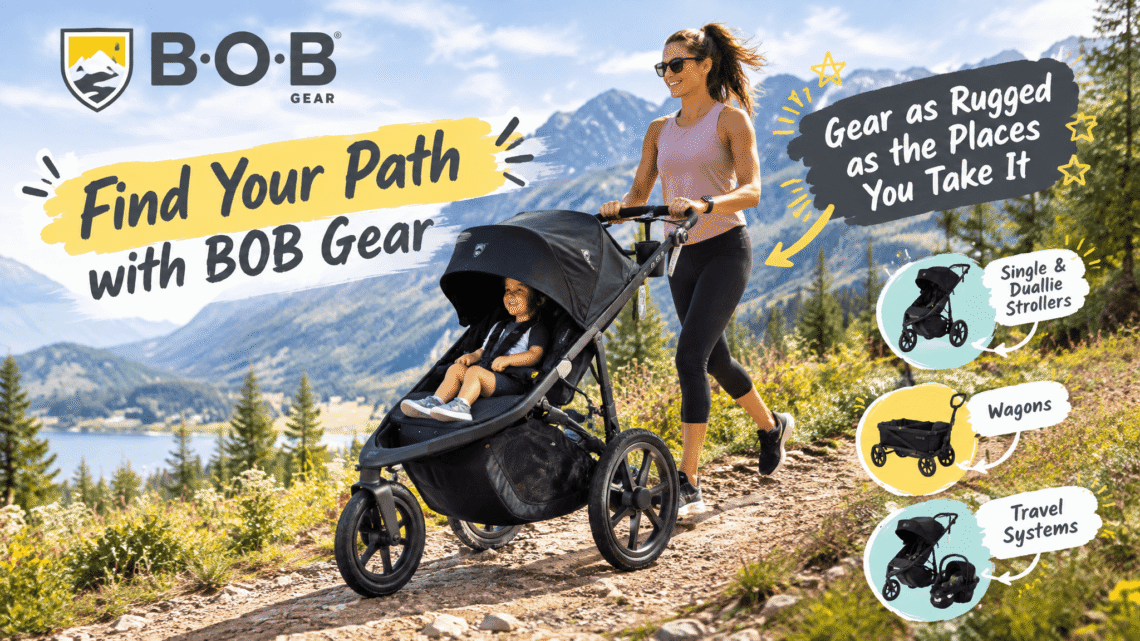
The storefront reveals a deliberate hierarchy. Near the top, shoppers are directed into four broad paths: Single Strollers, Duallie Strollers, Travel Systems, and Wagons. Farther down, six prominent merchandising areas highlight the Renegade Wagon, Wayfinder, Revolution Flex 3.0, Alterrain Pro, Duallie models, and stroller accessories. Two especially large product introductions are devoted to the Renegade Wagon and Wayfinder Jogging Stroller.
| Storefront signal | What it communicates |
|---|---|
| Four major shopping paths | BOB Gear wants to be understood as a mobility portfolio, not a one-product company |
| Dedicated Renegade presentation | Wagons are becoming an important extension of the brand |
| Dedicated Wayfinder presentation | Jogging remains central to BOB Gear’s identity |
| Multiple single-stroller families | Different performance levels are intended for different lifestyles |
| Duallie visibility | Multi-child mobility remains strategically important |
| Accessory section | The product relationship is designed to continue after the original stroller purchase |
The most interesting conclusion is that BOB Gear does not organize its storefront primarily around parenting stages. It organizes around ways of moving. That is a subtle difference, but it may be one of the clearest expressions of the brand’s identity.
Why the Jogging Stroller Remains the Center of BOB Gear
Even as the range expands, the BOB Gear jogging stroller remains the strongest symbol of the company. That is partly historical, but there is also an engineering reason.
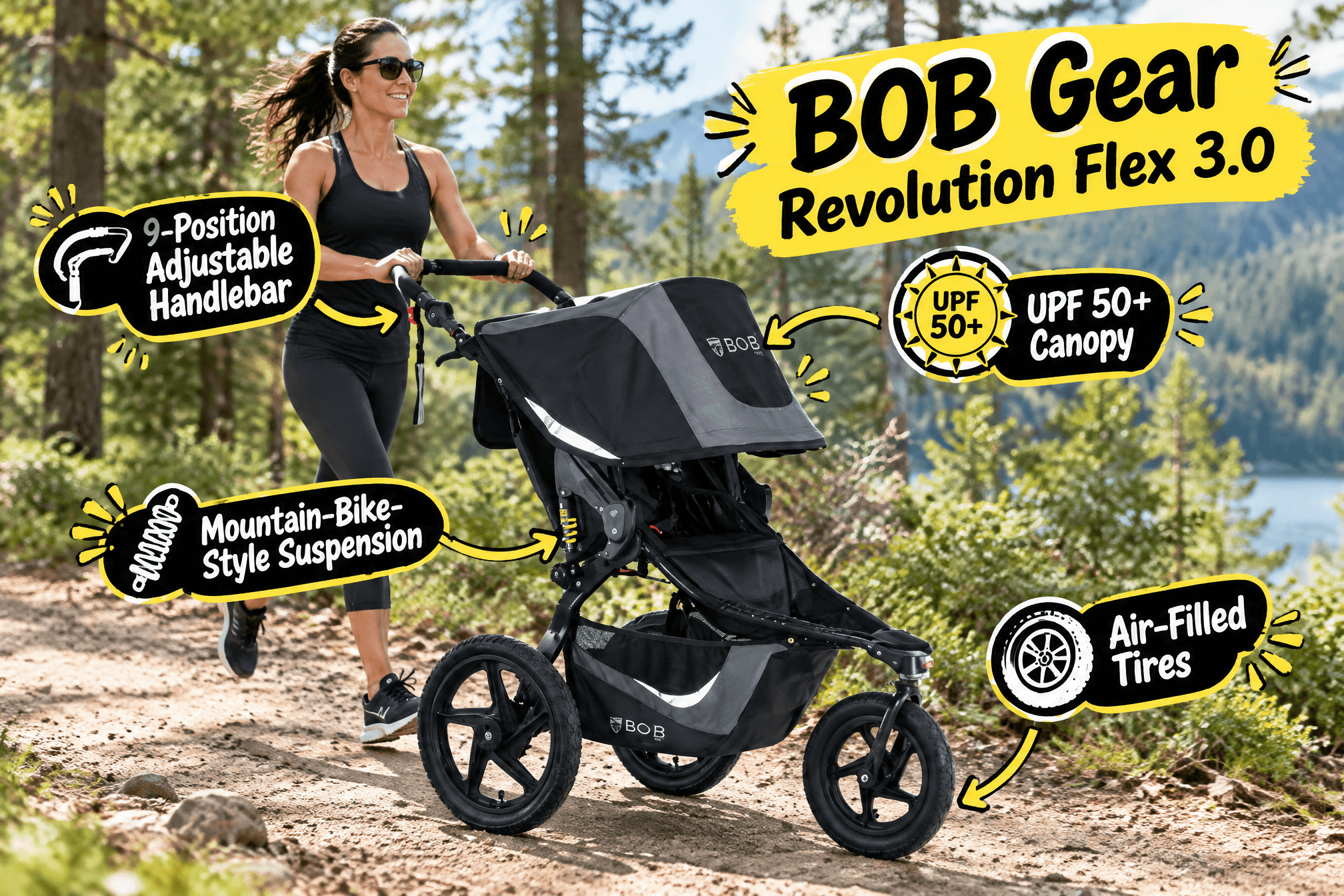
Running changes what is demanded from a stroller. Higher speed magnifies vibration, directional instability, braking considerations, terrain changes, and the relationship between the caregiver and the stroller. REI’s technical guidance for jogging strollers consequently emphasizes elements such as suspension, larger tires, a lockable front wheel, braking systems, wrist straps, harnesses, and appropriate seating support.
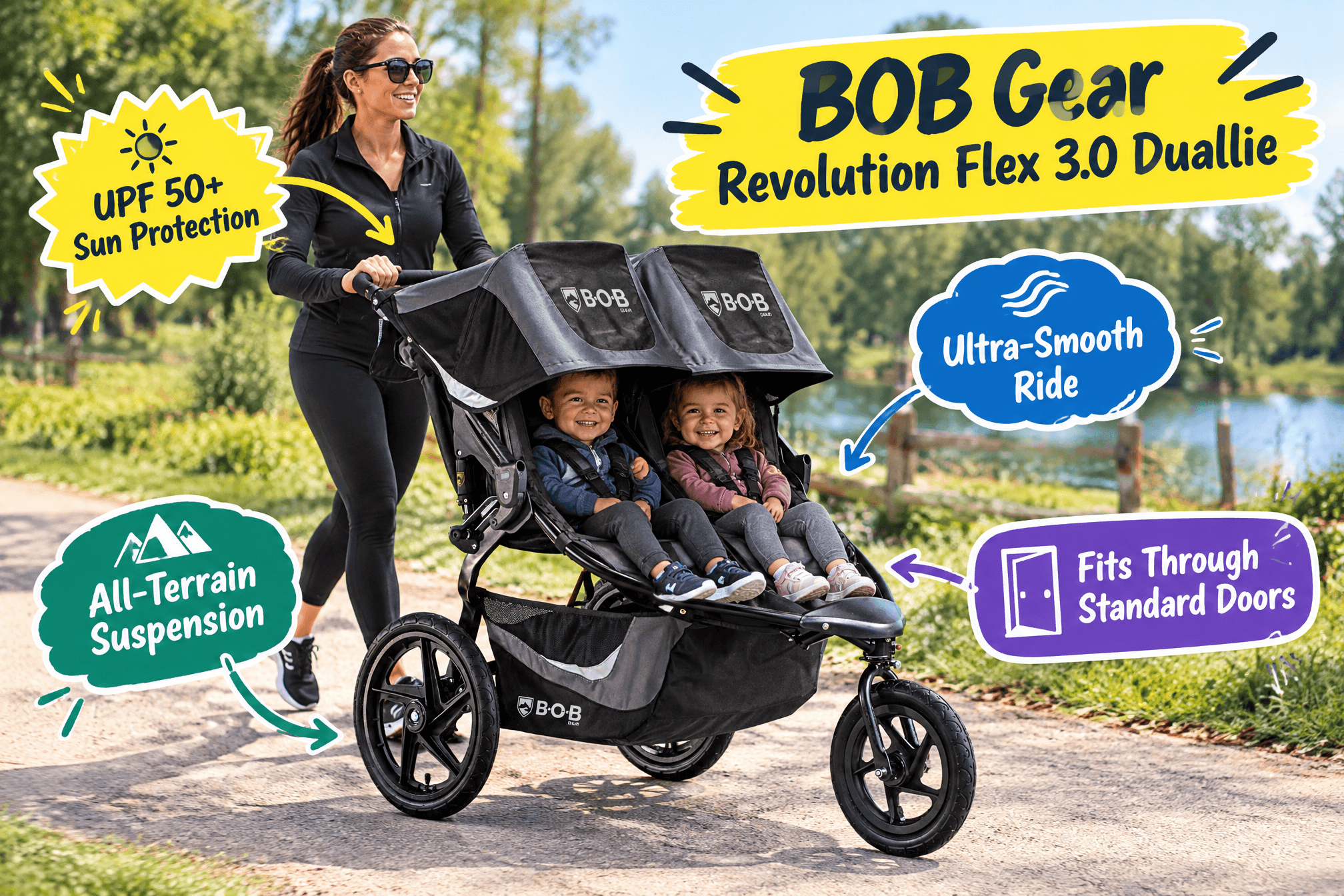
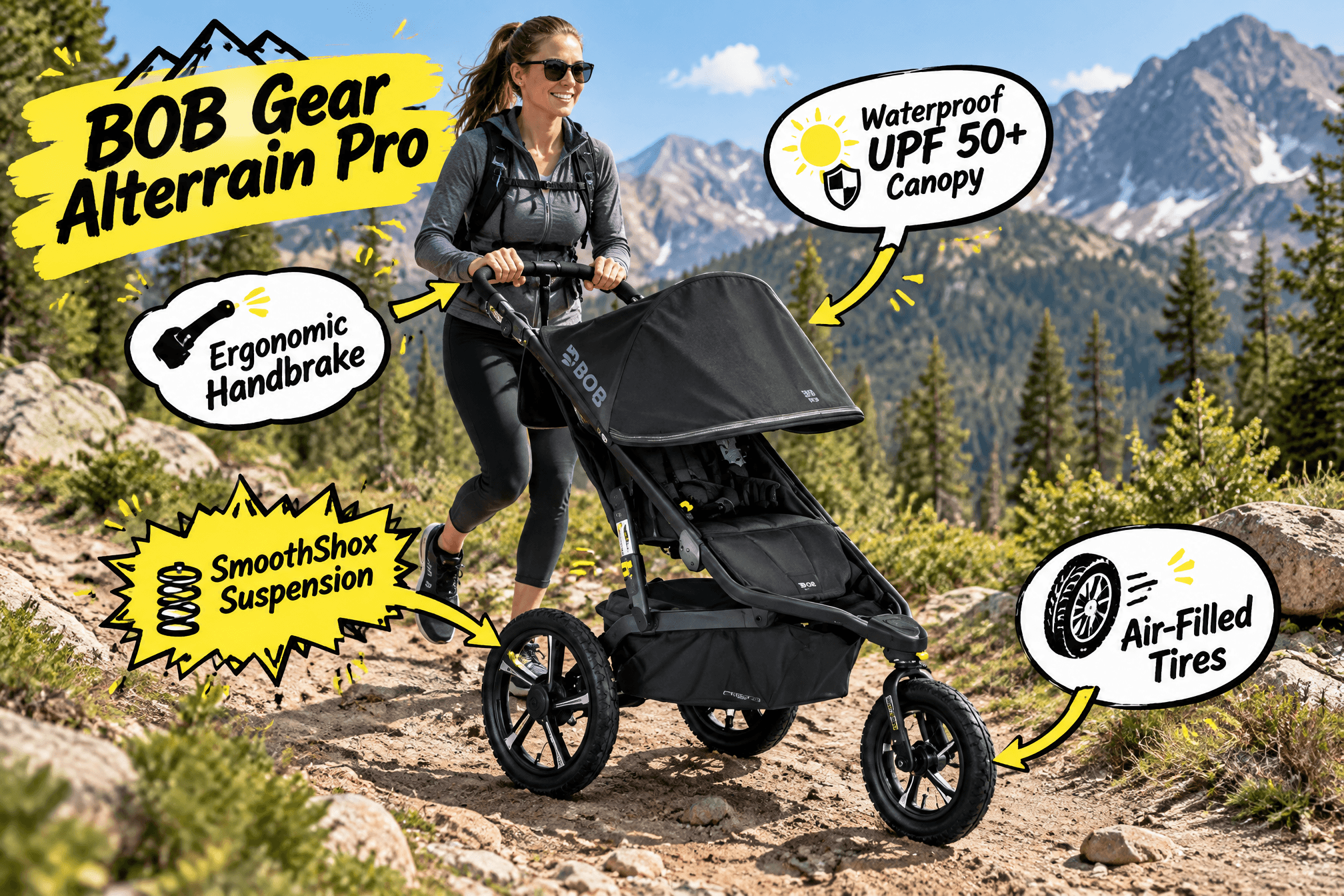
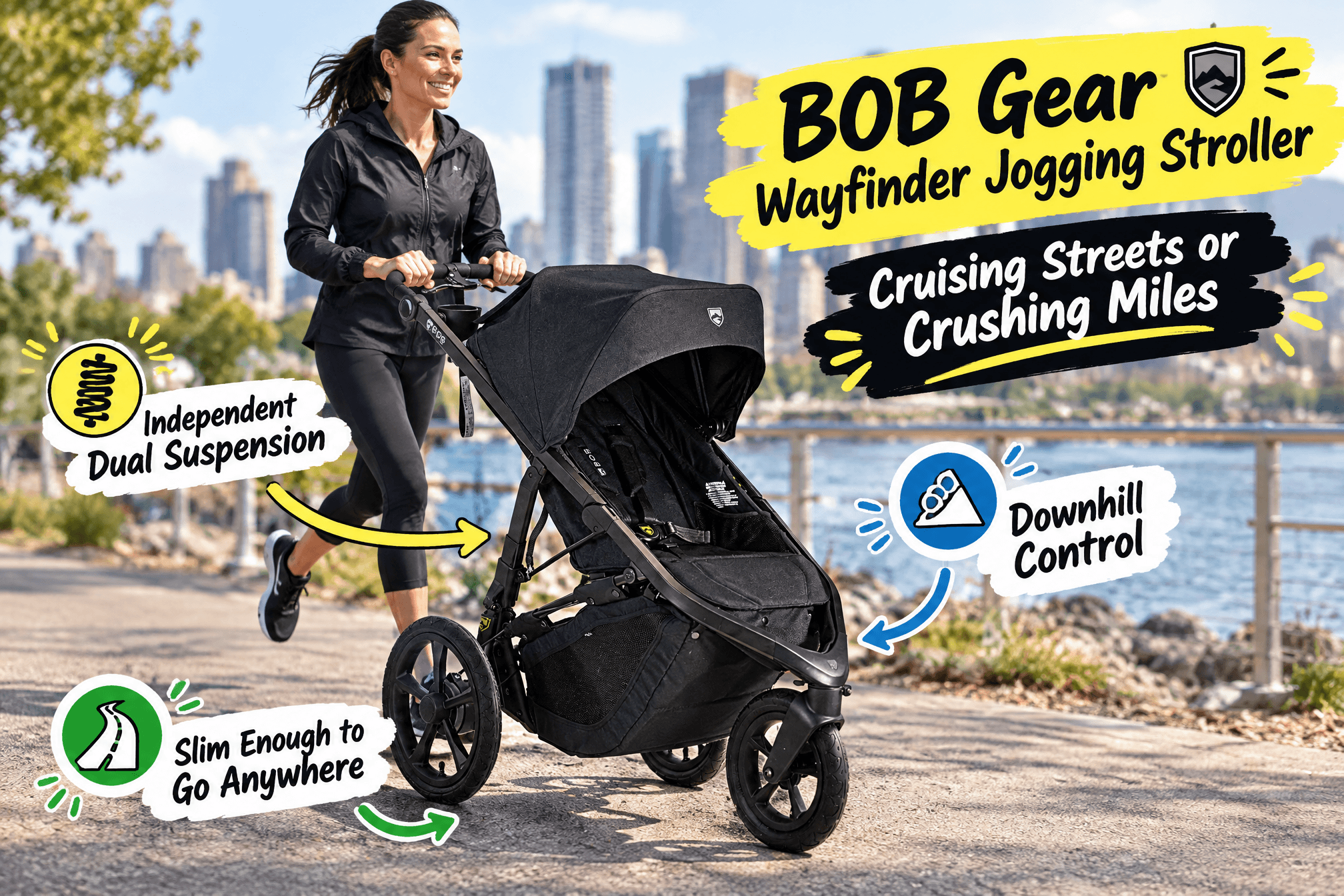
Those are also areas where BOB Gear has concentrated much of its design work. The company currently lists Wayfinder, Alterrain Pro, and Revolution Flex 3.0 among its main single-stroller options, while the Revolution Flex 3.0 Duallie extends the concept to two children.
The underlying product philosophy can therefore be described as performance with everyday permission. Owners do not have to be running every time the stroller leaves the garage. Instead, the performance-oriented architecture is there when the environment becomes more demanding.
The BOB Gear Legacy and Active Lifestyle
BOB Gear revolutionized family mobility in 1994 when an airline mechanic and a bicycle industry maven combined their expertise to build superior jogging strollers. Driven by a commitment to quality and rugged performance, the brand has spent three decades creating products that empower parents to explore the outdoors without limitations. The visual layout in ymx.jpg captures this adventurous spirit, highlighting a diverse range of strollers designed to tackle everything from city sidewalks to off-road trails. Recent market insights indicate that jogging strollers command a 20% market share, underscoring the growing demand among active parents for robust, terrain-adaptable gear.
Core Product Lineup
To meet the diverse needs of modern families, the brand offers a highly specialized lineup of strollers and transport solutions.
- Renegade Wagon: Designed for multi-child families requiring spacious seating and versatile storage.
- Wayfinder: A compact, everyday jogging stroller ideal for cruising streets and crushing miles.
- Revolution Flex 3.0: The quintessential rugged and reliable jogging stroller for everyday outings.
- Alterrain Pro: Engineered with ultimate suspension for extreme off-road performance.
- Duallie Strollers & Accessories: Double seat configurations for growing families and specialized add-ons for weather protection.
Essential Maintenance Guide
Maintaining optimal performance on varying terrains requires routine technical care of the stroller’s moving parts.
- Check tire pressure weekly, ensuring it matches the recommended PSI listed on the tire sidewall for optimal shock absorption.
- Lubricate the front wheel swivel assembly and rear axles monthly using a silicone-based spray to prevent rust and ensure smooth maneuverability.
- Inspect the five-point harness straps and buckle mechanisms for fraying or debris buildup, cleaning them with mild soap and water.
Safety Standards and Polled Insights
All products sold in the United States must strictly adhere to the mandatory federal safety standard 16 CFR 1227, which incorporates the American Society for Testing and Materials (ASTM) F833 guidelines. These rigorous standards mandate comprehensive testing for frame stability, braking efficiency, and the elimination of pinch points to protect young passengers. In a recent informal survey of outdoor enthusiast parents, over 60% prioritized advanced suspension systems and reliable five-point harnesses over simple aesthetic appeal when selecting their primary stroller. Furthermore, leading pediatric safety experts and the American Academy of Pediatrics strongly advocate for these robust frames and secure harnesses, reinforcing that these engineering standards are deeply grounded in pediatric medicine.
Why BOB Gear’s Design Language Still Feels Recognizable
Strong brands often have visual signatures, but BOB Gear’s recognizable quality is as much structural as cosmetic. Large wheels, three-wheel proportions, exposed performance-oriented frames, generous canopies, substantial storage areas, and visibly functional suspension contribute to an appearance that communicates movement even when the product is standing still.
The company describes its own design difference through ruggedness, lightweight aluminum construction, maneuverability, folding utility, padded seating, and terrain-oriented suspension.
That creates a useful kind of consistency. The Renegade Wagon is clearly not a jogging stroller, yet it still fits comfortably beside the rest of the portfolio because it communicates the same priorities: capacity, durability, outdoor use, and freedom of movement.
Brand coherence of this kind is difficult to achieve when a company expands into new product categories. BOB Gear has largely avoided the impression that its wagon, double stroller, and jogging products belong to unrelated businesses.
A Brand Built Around the Parent’s Changing Definition of Adventure
“Adventure” is one of the most overused ideas in outdoor marketing, so BOB Gear is most convincing when the word is interpreted broadly.
For one family, adventure may mean training for a weekend 10K. For another, it might mean a long neighborhood walk with enough storage for diapers, food, and extra clothes. Someone else may need equipment capable of moving between a paved park path and a rougher trail. A parent with two young children may simply consider getting everyone through a full day outdoors an adventure in itself.
This range of use cases is precisely why versatility matters. BOB Gear does not require families to perform an outdoor identity. Its equipment makes more sense when viewed as permission to keep options open.
That may also explain the storefront’s recurring route-oriented language and imagery. The emphasis is less on idealized nursery life and more on where the family could go next.
What BOB Gear Gets Right About Modern Family Equipment
The most distinctive thing about BOB Gear is not any single patented mechanism, product name, or specification. It is the company’s decision to treat family mobility as a genuine performance category.
That approach respects a reality many parents discover quickly: equipment that is technically capable of transporting a child is not necessarily pleasant to use for an hour, easy to steer over rough ground, stable enough for faster movement, practical for two children, or convenient when loaded with the supplies a family actually carries.
BOB Gear’s strongest products respond to those problems through engineering rather than ornamentation. The company’s evolution—from bicycle trailer roots to single jogging strollers, Duallie models, travel-system compatibility, and the Renegade Wagon—shows a brand repeatedly widening the environments in which families can use its gear.
That is a more durable brand idea than simply being “sporty.”
More Than a Stroller Company
Three decades after its founding, BOB Gear is increasingly best understood as a family mobility brand with a performance heritage.
Jogging strollers remain its center of gravity, and products such as Wayfinder, Alterrain Pro, Revolution Flex 3.0, and Revolution Flex 3.0 Duallie give the range recognizable levels of specialization. The Renegade Wagon broadens the concept further, while accessories and compatibility solutions turn individual products into longer-term systems.
The brand’s history also gives those products context. BOB Gear began with people who were interested in how equipment moved, adapted, and performed. The fact that those questions still define the company decades later gives the current portfolio unusual coherence.
For families evaluating BOB Gear, the most useful question may therefore be less “Which stroller has the longest feature list?” and more “How do we actually want to move as a family?”
City streets, training routes, gravel paths, parks, vacations, two-child outings, and gear-heavy days create different priorities. BOB Gear’s current lineup exists because there is no single version of active family life.
And that may be the brand’s clearest proposition of all: parenthood changes the journey, but it does not have to shrink the map.