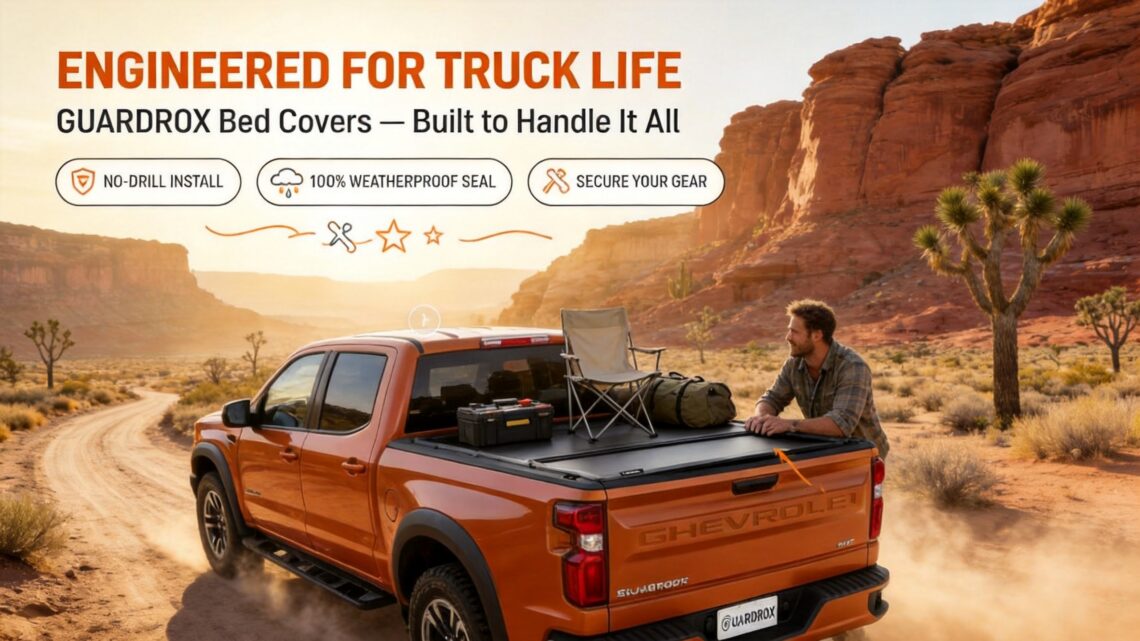
There is a strange blind spot in the way Americans talk about their trucks. Ask somebody what they love about their F-150 and you will get a monologue — the exhaust note on a cold start, the way the hood sits flat, the number stenciled on the towing package sticker in the window. Ask them about the bed, though, and the conversation dies. The bed is where the truck stops being an identity and starts being a tool. It is six feet of ribbed steel that most owners think about exactly twice a year: once when something rolls around in it, and once when it rains.
Guardrox built a brand on that blind spot. Not on the engine, not on the badge, not on the infotainment screen — on the emptiest, most overlooked cubic footage on the vehicle. The company is a US-focused truck accessories house whose catalogue is almost comically narrow: tonneau covers and bed protection. Where a typical aftermarket brand sprawls across LED light bars, mud flaps, exhaust tips, seat covers and a dozen other categories, Guardrox went the other direction and dug down. Their tagline is “Engineered for Truck Life,” which is a phrase that could mean anything, but on their listings it keeps collapsing into something very specific — the argument that the bed is the part of the truck you actually depend on, and it deserves hardware that behaves like it was designed rather than adapted.
I find that refreshing, and a little counterintuitive. Because the bed cover is one of the least glamorous products in the automotive universe, and therefore one of the hardest places to win trust. Nobody impulse-buys a tonneau cover. Every purchase is preceded by twenty minutes of forum spelunking, a worried question about water intrusion, and a silent fear of drilling holes in a vehicle that is still under finance. A brand that survives that shopping journey has to be telling the truth about at least three things: what the lid is made of, how long it takes to install, and what happens when it leaks.
The Category Trap, and How a Narrow Catalogue Dodges It
Here is the economics of it. Most accessory brands treat covers as an upsell line item — a SKU added to a catalogue that already sells ten thousand other SKUs. That model rewards sameness. You source a generic panel, you print a logo on the box, you ship it under three different names for three different bed lengths, and you move on. The brand equity lives in the light bar, not the lid.
A company that sells almost nothing else has the opposite incentive. 🔧 When the cover is the business, the differences between models stop being marketing decoration and start being engineering decisions with consequences. Fold versus roll. Hard panel versus soft vinyl. Two-thirds bed access versus all of it. Each choice trades one kind of frustration for another, and a specialist has to be honest about which frustration you are buying, because the reviews will punish them either way.
That is why Guardrox’s lineup reads like a decision tree rather than a price ladder. They are not offering “good, better, best” versions of the same object. They are offering structurally different answers to different owners, with model letters that map to real mechanisms:
- L5 — the low-profile hard tri-fold. The brand rates it around 400 lbs of distributed load, and it folds forward to give you roughly two-thirds of the bed open at once. 📦 This is the default answer for someone who wants the truck to look like it left the factory with the cover installed.
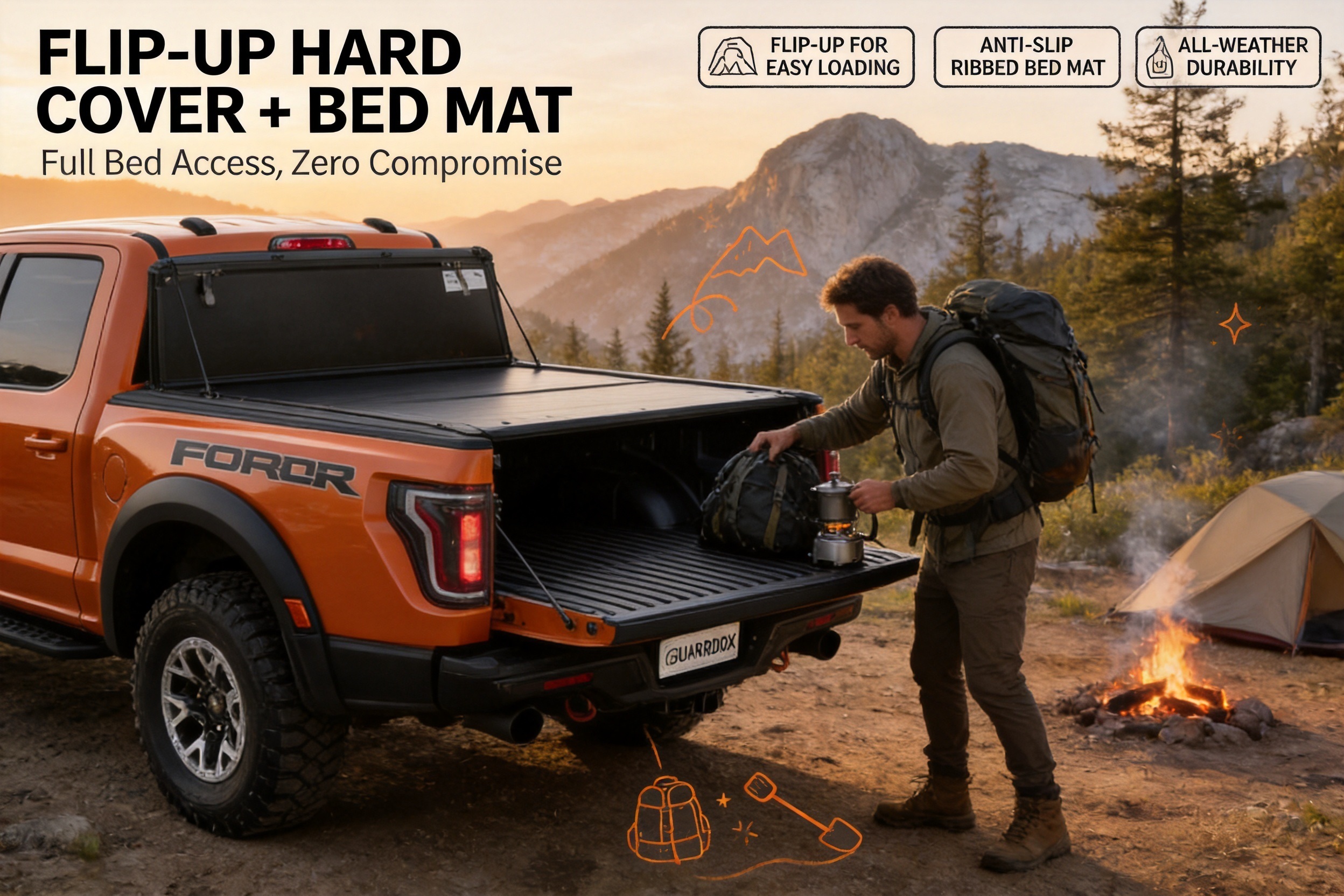
- LX5 — the flip-up hard tri-fold. Same family of materials, different hinge philosophy: the panels stack and prop upright against the cab, and the brand puts a heavier figure on it, around 600 lbs distributed. The payoff is that with the cover parked open, nothing is in the way — not a folded panel, not a strap, not a bulkhead.
- L6 — the hard quad-fold. Four segments instead of three, which buys finer granularity when you want partial access. It is the model for people who load the truck in stages rather than all at once.
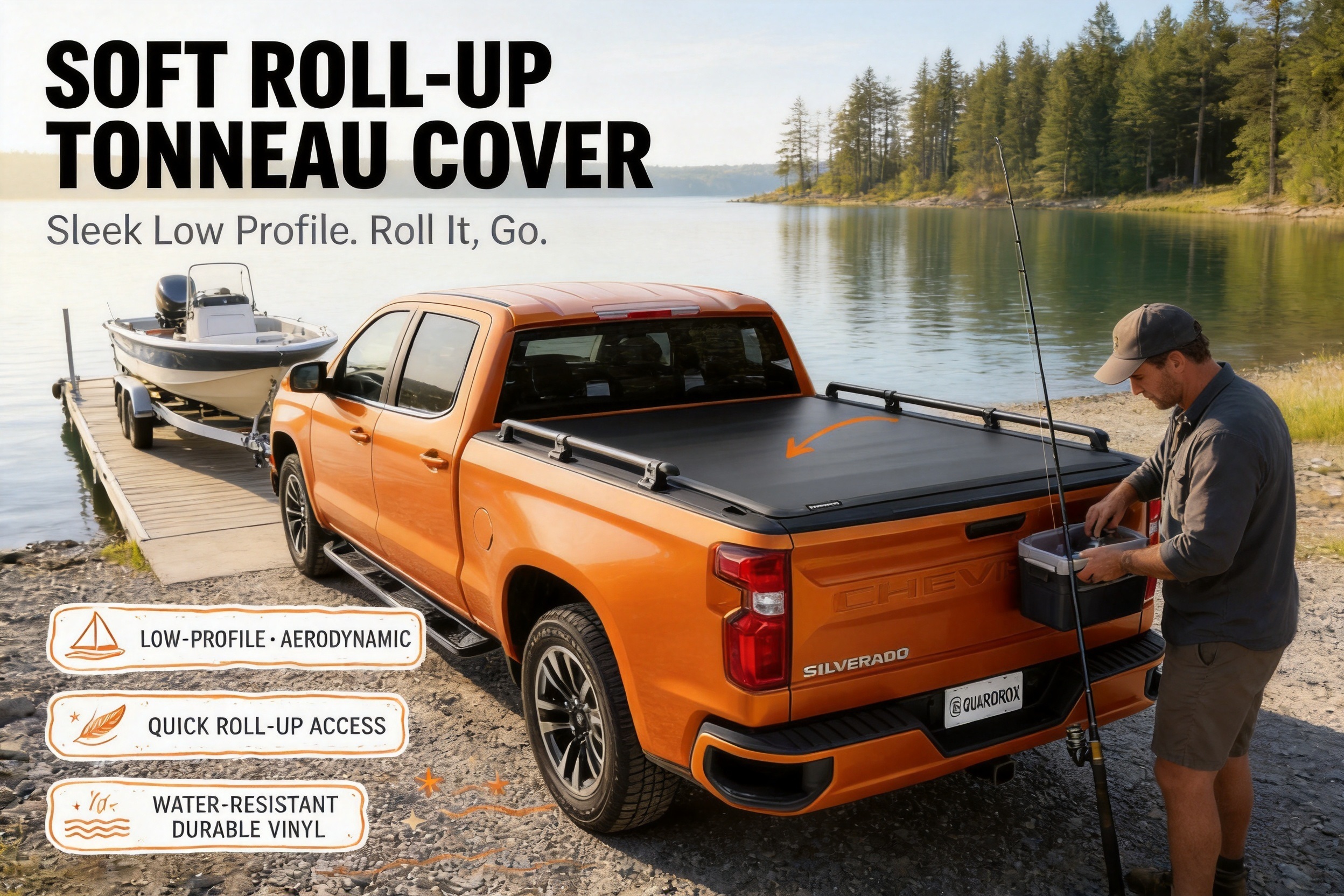
- S5 — the soft tri-fold. 24 oz marine-grade vinyl over an aluminum frame, rated near 200 lbs, and pitched as a ten-minute tool-free job. ❄️ Snow load and gear weight are where this one asks you to pay attention.
- R5 — the soft roll-up end of the range, for owners who want tension, a key, and a low monthly cost.
🔎 Field note. Load ratings are distributed ratings, which is engineer-speak for “spread the weight out.” A 600 lb figure is an invitation to stack lumber flat across the panels. It is not a promise that one corner of a granite countertop can be dropped onto one hinge point. Read the word “distributed” every time you see it, on this brand or any other.
Reading a Cover Like an Engineer, Not Like a Shopper
Walk through what the hard covers are actually made of and the brand’s tone shifts from lifestyle to materials science. Guardrox describes its hard panels as fiber-reinforced polymer — FRP — over a honeycomb core, mounted in a heavy-duty aluminum frame. That trio is worth unpacking, because each element answers a different complaint people have had about bed covers for forty years.
The fiberglass skin handles impact and UV. It is the outer shell, the thing that takes a falling branch, a rogue shopping cart, and eleven summers of desert sun. The aluminum frame handles torsion — it is what keeps a five-foot-long panel from flexing into a shallow smile when you lean on it, and it is what the hinges and clamps actually grip. And the honeycomb core in between is the quiet hero. 🐝 A honeycomb sandwich is the oldest trick in lightweight structures: almost no mass, enormous stiffness per unit of weight, and it is the reason an aircraft door can be thin as a picture frame. In a tonneau cover, that core is what lets a panel hold a person’s weight without turning into a sheet-steel drum that booms every time a breeze crosses it.
Then there is the finish. Matte black, low profile, deliberately unshowy. This is a design decision with an economic consequence hiding inside it. A cover that sits flush and dark disappears against the bed rails, which means the truck looks stock — an argument that matters enormously to anybody who cares about how the vehicle reads in a driveway, and to anybody who plans to hand it to a dealer in five years. A cover that shouts about itself is a cover that announces “there is stuff under here” and “somebody modified this.”
💬 “Does the low profile cost me cargo height?” 🗨️ A little, yes — and any honest brand will say so. Flush-mounting means the lid sits at rail level, so you lose a couple of inches of vertical swing. What you get back is the ability to drive through a standard garage, a standard carport, and a standard parking structure without a moment of dread. Most owners discover, within a month, that they will trade two inches of upward space for the elimination of that daily little flinch.
Thirty Minutes, One Tool Set, Zero Holes
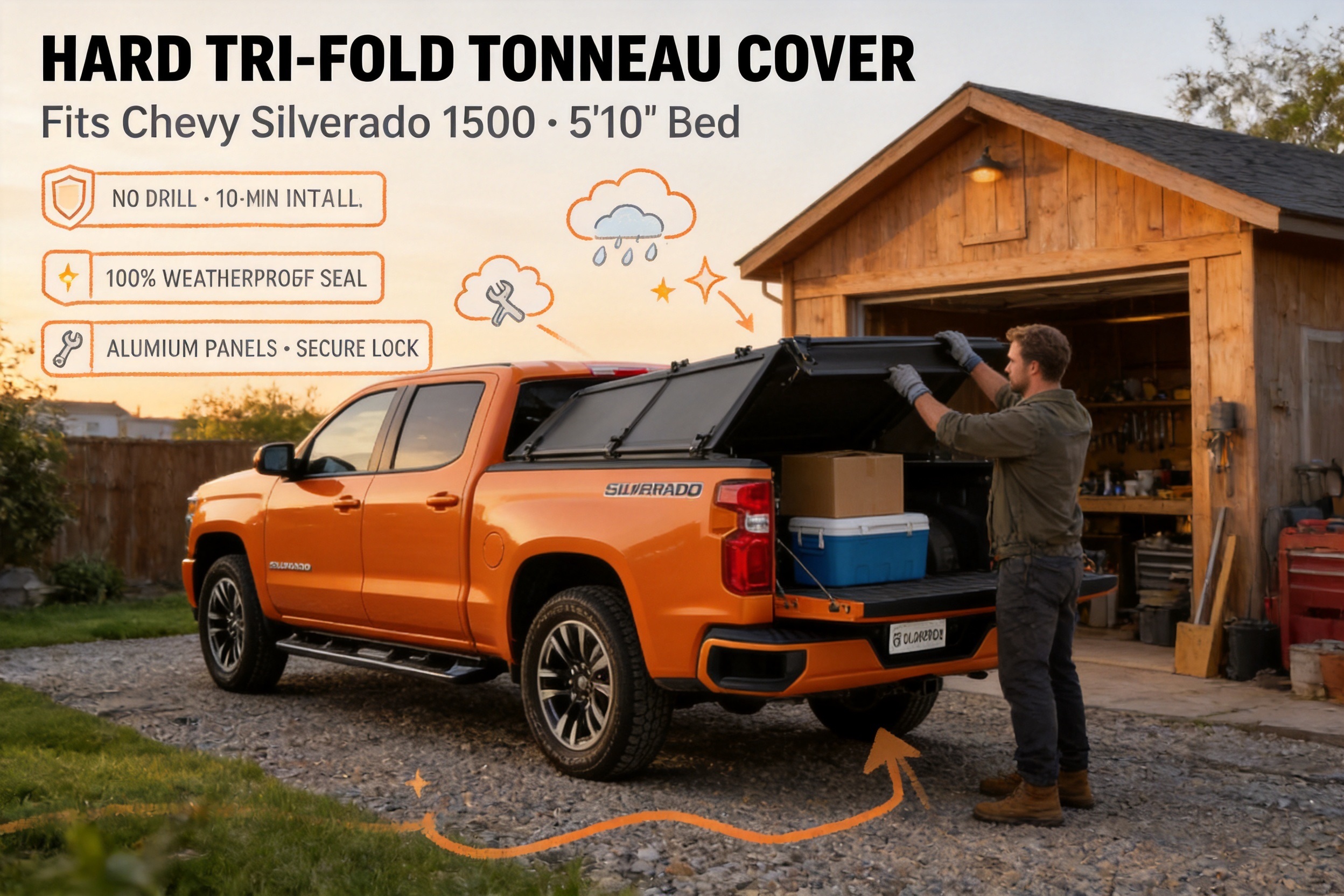
The single most repeated phrase in the Guardrox listings is the one that should be most repeated in this category: no-drill. Clamp-on installation. Everything attaches to the bed rails using hardware that grips existing surfaces, which means the truck goes home unmodified.
That is not a small psychological point. Drilling into a bed rail is where enthusiasm goes to die. It is the step that turns a Saturday-morning project into a decision with permanence, and it is the step that makes owners of financed, leased, or resale-minded vehicles quietly close the tab. A clamp-on system removes the irreversible action from the equation. ⏱️ The brand quotes under thirty minutes for the hard covers and around ten for the S5 soft tri-fold, and while those numbers assume a clean bed, a flat driveway, and somebody who reads the instructions before opening the boxes, they are in the right ballpark for the mechanism. There is no bodywork, no wiring, no trim removal, no torque sequence on a structural fastener.
The practical case for no-drill goes further than resale value, though. Beds get used. Rail clamps can be loosened, the cover can come off, and the truck can go back to being an open hauler for the one weekend a year when a dresser needs moving. A drilled cover locks you into its presence forever; a clamped cover is a guest.
⚠️ The one honest caveat. Clamp-on means the fit quality lives or dies on the bed rails themselves. Factory paint build-up, an older truck with a layer of undercoating or surface rust on the rail lip, aftermarket bed liners that change the rail profile, or a spray-in liner that has crept over the flange — all of these change how a clamp seats. If your truck has been living a hard life, the thirty-minute figure assumes you spend ten of those minutes cleaning the rail surface first. That is not a knock on the design. It is the difference between a seal and a leak, and it applies to every cover sold by every brand in the aisle.
Weather Is the Real Competitor
Here is where I want to say something that most brand copy will not, because it is more useful than a boast.
There is no such thing as a submarine. 🌧️ Any tonneau cover — this brand’s, or one costing three times as much — is a weather-resistant object, not a waterproof one, and the reason is structural rather than shameful. A cover has to seal against a surface that flexes, expand and contract across a temperature range of about 150°F, drain water it was never designed to hold out, and still open and close thousands of times without the sealant turning to chalk. Physics sets the ceiling. What separates good hardware from cheap hardware is not whether water ever appears in the bed; it is how much, how often, and where it goes.
Which is why the Guardrox specification sheet interests me more than a superlative would. Seams and edge seals on the hard covers are the part of the design that gets real attention, and the brand’s own imagery leans into it — trucks crossing rocky river sections with spray going over the panels, aerial shots of beaded water sitting on a closed matte lid in the middle of a dirt road. 💧 That is a deliberate message: this thing is meant to be driven through weather, not parked away from it.
The UV story matters just as much, and gets discussed far less. Sunlight is the slow killer in this category. It is what turns a glossy panel chalky in two seasons, what hardens a rubber seal until it stops conforming, what makes vinyl crack along a fold line where it has been bent four hundred times. An FRP skin with UV stability and marine-grade vinyl on the soft side are, in plain language, choices about how the cover looks in year four instead of year one. If you buy a cover for the appearance, the material decision is really a durability decision wearing a cosmetic disguise.
And there is a third weather argument nobody makes: theft deterrence. A locked, opaque bed converts “stuff visible in vehicle” from a probable cause into a guess. 🔒 The covers are designed to work with the tailgate lock, so the whole rear of the truck becomes one continuous question mark to anybody walking past it at 6 PM in a strip-mall parking lot.
The Soft-versus-Hard Question, Made Smaller Than It Feels
People agonize over this. It should take about ninety seconds.
The distinction is not “cheap versus expensive” — the S5 at 200 lbs and 24 oz of marine vinyl is a serious object, and a hard cover at the low end of somebody else’s catalogue can be a flimsy one. The distinction is about what you put in the bed and how often you change your mind.
| Question you actually care about | Leans hard (L5 / LX5 / L6) | Leans soft (S5 / R5) |
|---|---|---|
| Do you carry heavy or long items across the panels? | ✅ Up to ~600 lbs distributed on LX5 | ⚠️ ~200 lbs on S5, mostly light gear and snow |
| Do you want full, unobstructed bed access with the cover open? | ✅ LX5 flips upright against the cab | ❌ Folded or rolled panels always occupy space |
| Is installation speed your priority? | ️ Under 30 minutes, two people helps | ✅ Around 10 minutes, genuinely single-handed |
| Budget per square foot of coverage? | ⚠️ Higher | ✅ Lower |
| Do you run a rack system across the bed? | ✅ Hard panels tolerate point loads better | ❌ Not the right tool |
| Do you live somewhere with heavy snowfall? | ✅ Sheds it, stiffness helps | ⚠️ You will be clearing it off by hand |
Notice what the table does not say anywhere. It does not say one type is safer, or that soft covers leak more. Those are folklore. What it says is that a hard tri-fold costs you time and money and buys you rigidity plus, on the LX5, the whole bed at once. A soft cover buys you speed and price and asks you to respect the weight limit. 🧊 Pick the trade, not the reputation.
Compatibility: The Unsexy Arithmetic That Decides Everything
If there is one place where a specialist brand earns its keep, it is here. Fitment is the boring part of this category, and it is also the part that generates nearly every bad review.
A “5.5-foot bed” is not one object. It is a family of slightly different rail geometries spread across model generations, trim levels, cab configurations and production-year changeovers. The same nominal bed length on a truck built in one model year can have a tailgate gap and rail lip that differ from the year before. This is why covers are sold against tight year ranges rather than loose ones, and why Guardrox’s catalogue is cut to specific fits for the names that dominate American driveways — F-150, Silverado 1500, RAM 1500, the GMC twins, Tacoma, Tundra — in particular bed lengths across defined model-year spans.
📋 Before you order, verify these four things.
- Bed length, measured inside the bed from the bulkhead to the inside of the closed tailgate — not the sticker, not the brochure, not what your buddy’s truck has.
- Model year range, including whether your truck straddles a generation change.
- Cab type, because Crew Cab and SuperCab often share a bed length but not always the surrounding geometry.
- Anything already touching the rails: bed liner, tonneau add-ons, a headache rack, a bed step bolted to the bumper area. Clamp-on hardware wants clean, bare, factory rail.
The reason this matters more for a narrow brand than a sprawling one is simple accountability. When a light-bar company sells a cover that fits poorly, the customer blames the category and the brand loses nothing. When a cover company sells a cover that fits poorly, the customer blames the company and the brand loses its only product line. Specialisation concentrates risk, and concentrated risk tends to produce better fitment charts. 🎯
Warranty as a Sentence, Not a Whisper
Guardrox backs its hard covers with a three-year limited warranty and its soft covers with two years, alongside a 30-day return window. The design work is additionally protected by US design patents.
Those numbers are not the most important thing about the sentence. What is interesting is the asymmetry. Two years on vinyl, three on FRP and aluminum. That is a brand admitting, in its own paperwork, that the soft material has a shorter realistic life than the hard one — which is exactly right, and exactly the sort of thing a copywriter working from a hype brief would smooth over. A blanket “lifetime warranty!” on everything is a marketing gesture. A differentiated term is an engineering statement, because it means somebody had to decide how long each material should last before the company takes responsibility for it.
The 30-day window deserves equal weight, arguably more. In this category, the first thirty days are when every real problem announces itself: a rattle at 40 mph, a corner that will not seat, a drip after the first storm. A return window that covers the break-in period is worth more than a longer warranty that only pays out on catastrophic failure. 💰 And the practical reality of buying through a major marketplace is that the return process is already familiar to the buyer — no unfamiliar claims portal, no shipping a 70 lb box back to an overseas warehouse at their own cost and risk.
Five Owners, and How the Lineup Maps to Them
The cleanest way to understand a narrow catalogue is to meet the people it serves. These are composites, of course, but they are the composites that show up in every review thread.
The weeknight contractor. Loads pipe on Monday, drywall Wednesday, and a pallet of pavers when a job runs long. Wants the panels to take weight, wants the tailgate lock to matter, and wants to open the whole bed when the load is awkward. For this person, the LX5’s upright flip is not a luxury — it is the difference between wrestling a folded panel out of the way and simply loading. ⏱️ Their time is worth more than the price gap.
The weekend overlander. Rooftop tent, recovery boards, a swivel stove, two chairs, and a cooler that has personally offended them with its size. This owner is chasing two things at once: security at trailheads, and a bed that stays dry on a three-night trip. Low profile matters because a roof rack already raised the center of gravity; a tall, draggy cover on top of that is a bad deal.
The commuter with a garage. Buys the cover for the rain and the parking structure, and secondarily for the look. Sixty miles of highway a day makes the aerodynamic question real, and this is the owner who notices the wind noise change first — in either direction.
The first-truck buyer. Just traded a sedan for a used half-ton and has a strict budget plus a lot of pride. Wants protection, does not want to drill into somebody else’s previous ownership, and cannot justify $900 for a lid. This is the person the S5 exists for, and honestly it is the smartest value proposition in the range.
The resale strategist. Buying a truck they will sell in four years, and thinking about the dealer inspection. A flush, matte, no-drill cover that leaves zero permanent modification is the whole play. 🧾 Remove it before the appraisal, hand back a stock truck, keep the hardware in the garage.
The Fuel-Economy Question, Answered Honestly
Every cover listing in America eventually reaches for the aerodynamics argument, and it is worth being precise about it, because the imprecise version has taught people to disbelieve the whole category.
An open truck bed is a parachute. Air flows over the cab, hits the tailgate, and tumbles into the cavity, creating a low-pressure region that drags backward on the vehicle. Covering the bed smooths that flow, and the effect is real — it has been measured, modeled, and demonstrated enough times that no serious engineer disputes it. The honest part is the magnitude. On a modern half-ton with active grille shutters and a tuned body, the improvement from covering the bed is measured in single-digit percentages, mostly at highway speed, and it shrinks toward nothing around town. 🛣️
So here is the useful framing: do not buy a tonneau cover to pay for itself in fuel. Buy it because the load ratings, the weather sealing, the security, and the appearance are worth the money on their own — and then treat the small efficiency gain as a rebate that arrives invisibly at every fill-up. A brand that lets the durability case lead and the aero case trail is a brand telling you the truth in the order that matters.
🗨️ “Mine rattled.” 💬 The most common mechanical complaint in this entire category, across every manufacturer, traces back to two causes about nine times out of ten: clamps torqued unevenly around the perimeter, or a bed rail that still had wax, grit, or liner overspray on it. Re-seat, torque in sequence, clean the contact surface. It is a five-minute fix and it is almost never a defect.
Ten Minutes a Month, and That Is the Whole Maintenance Story
There is no service schedule here, no fluid, no filter. There is cleanliness, which happens to be the difference between a cover that seals at three years and one that seals at eight.
- 🧽 Wash the panel surface with plain car shampoo when you wash the truck. Skip the abrasive compounds and the solvent-based dressings.
- 🧵 Wipe the seals and channels with a damp cloth every month or two. Grit in a sealing channel acts like sandpaper on a mating surface.
- 🛢️ Condition the rubber once or twice a year with a water-based protectant. Not petroleum jelly, not a tire shine with solvents — a protectant meant for EPDM or natural rubber seals.
- 🔩 Re-check the clamp hardware twice a year, after winter and after summer. Metal expands, roads shake, and a slightly loose clamp becomes a rattle long before it becomes a leak.
- 🌊 Clear the drainage paths if your model has them, and never force a stiff mechanism. A cover that resists folding is telling you there is something in the hinge or the channel.
- ❄️ Do not open a frozen cover. Ice bonded to a seal will take the seal with it. Warm the truck, wait, then open.
That is it. Six habits, roughly an hour a year, in exchange for whatever is in the bed staying dry, dark, and unmoved. 🧰 Compare that to the maintenance burden of almost any other vehicle modification and the value proposition gets a little sharper.
What a Narrow Brand Signals About the Next Five Years
There is a strategic read here that goes beyond covers.
A brand that concentrates on one product family, protects the designs with patents, publishes differentiated warranty terms, and sells primarily through a major marketplace has made a coherent bet: become the trusted name in bed protection rather than a recognizable logo on a shelf of miscellaneous parts. That bet has a specific payoff profile. It caps the upside — Guardrox is never going to have a halo moment the way a brand with an exhaust line does — but it dramatically lowers the risk of being forgotten, because the customers who research this category carefully are the same customers who repurchase, and who recommend. 🔁
It also means the product line will keep getting deeper rather than wider. More mechanisms, more bed-length coverage, more model-year precision, better hinges. For an owner, that translates into something reassuring: the company’s next release will probably be a refinement of something you already own, not a distraction in a category you do not care about.
The Unglamorous Verdict
Trucks are one of the last American products where the culture is loud and the usage is practical. People will spend extraordinary amounts of money on the front of a half-ton and then throw a tarp over the back of it. 🛻
Guardrox is a brand that looked at that imbalance and built a business on the neglected side of it. Narrow catalogue, honest materials, no-drill installation, differentiated warranty terms, and a set of model letters — L5, LX5, L6, S5, R5 — that correspond to genuine mechanical trade-offs instead of marketing tiers. It is not exciting. It is not supposed to be. The best version of this product is the one you stop noticing after the second week, because it opens when you want it to, stays shut when you do not, keeps the rain out of the toolbox, and makes the truck look like the truck.
Somebody has to engineer the six feet nobody thinks about. 🧭 Judging by how deliberately the lineup is drawn, Guardrox has decided to be that somebody — and in a category full of afterthoughts, deciding to care about the boring part is, quietly, the whole differentiator.