Most writing about kitchens gravitates toward the loud objects: the range that can boil a pot of pasta in ninety seconds, the stand mixer with a planetary head and a colourway, the knife block that looks like a small sculpture garden. None of those things get touched very often by most of us. The mixer lives under a cabinet. The fancy knife comes out on Sundays.
The objects that actually accumulate wear are far less photogenic. A board the knife lands on forty times a night. A drawer the spoons fall into. A patch of counter where the fruit sits and quietly bruises. These are the pieces that decide whether a kitchen feels cooperative or adversarial, and they are almost never the ones a design conversation starts with.
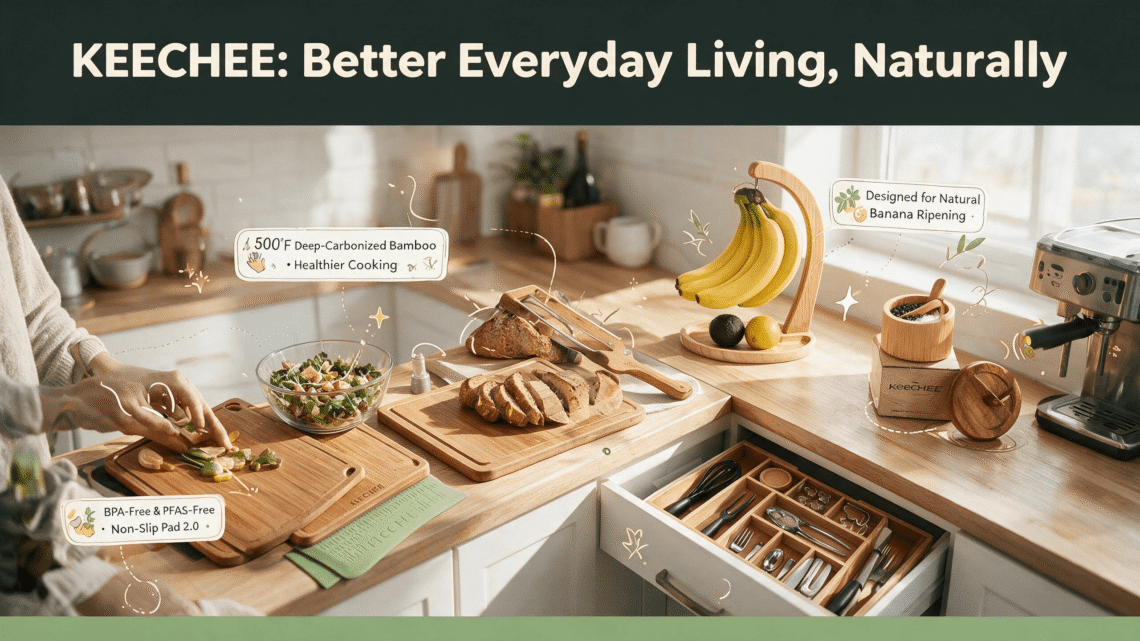
Keechee starts there. The brand, which runs its storefront on Amazon.com and carries the tagline “ONE OF NATURE,” has assembled a catalogue that is unusually narrow for a kitchen label: prep surfaces, storage vessels, serving boards, and the small mechanical fixes that make both of those jobs less hazardous. Almost all of it is bamboo, a large share of it is bamboo that has been heat-treated at 500°F, and the whole line hangs together under a promise the brand phrases as “better everyday living, naturally.”
What follows is a close read of that line, product by product, and an attempt to articulate what a company is really saying when it decides to build nearly everything out of one fast-growing grass.
What a Brand Built Around a Single Material Is Actually Claiming
Choosing a material is not a cosmetic decision in the kitchen. Wood, plastic, stainless steel, and bamboo each behave differently under a knife edge, under running water, inside a dishwasher, and after three years of being the thing nobody washes promptly. A brand that commits to one of them is committing to a set of trade-offs, and it is worth naming those trade-offs before looking at any individual product.
A tagline that points at the tree, not the mood
Plenty of housewares companies use nature as atmosphere: green photography, leaf motifs, words like “pure” and “wholesome” doing abstract work. Keechee’s phrasing is more literal, and the difference matters. “One of nature” positions the products as pieces of a biological material that have been shaped rather than synthesized, and the brand’s supporting language follows that thread: “we gently design, natural materials,” “natural. beautiful life, without the compromise.”
That framing does real commercial work, because it converts an aesthetic preference into a durability argument. The customer who picks bamboo over plastic usually has two motives in mind, and only one of them is environmental. The other is the suspicion that a plastic board, scored deep by a year of chopping, is no longer a surface she wants to put food on. Bamboo answers both instincts at once.
Heat treatment as the founding decision
The most technically consequential thing in Keechee’s catalogue is a number: 500°F. The brand’s flagship boards and its drawer organizer are made from carbonized bamboo, which means the material has been subjected to high-heat steam treatment before it is pressed into service. This is not a finishing step applied after the fact; it changes the substrate.
Carbonization does three things that a kitchen buyer can actually feel. It drives moisture and sugars out of the fiber, which reduces the swelling and shrinking that causes a plain bamboo board to cup over time. It hardens the surface, so the board resists the deep scoring that a heavy chef’s knife would otherwise carve into it. And it darkens the color to that warm, toasted brown the brand uses as a visual signature, which means the finish is a byproduct of the treatment rather than a stain painted on afterward.
The brand extends the argument to maintenance as well, listing its carbonized boards as dishwasher-safe. That is a meaningful claim in a category where the standard advice has always been the opposite: hand-wash immediately, dry on end, never let it sit wet. Whatever material science is doing behind it, the practical effect is that the object stops demanding ritual.
Subtraction as a house style
Look at the six products discussed below and a pattern emerges: none of them have more parts than the job requires. No app, no charging port, no proprietary refill, no assembly requiring a tool. The banana holder goes together by hand in seconds. The bread knife adjusts by sliding one guide along one slotted spine. The non-slip mat is, quite literally, a rectangle.
This restraint is easy to mistake for plainness. It is closer to a design position. Every component a manufacturer removes is a component that can crack, loosen, warp, or need replacing, and in low-cost kitchen goods the failure mode is almost always a small plastic hinge or a glued joint rather than the main body. By designing toward fewer interfaces, Keechee is buying longevity, which is also what its “designed to last for years” language on the cutting board line is pointing at.
The Anchor Piece: Keechee Bamboo Cutting Board
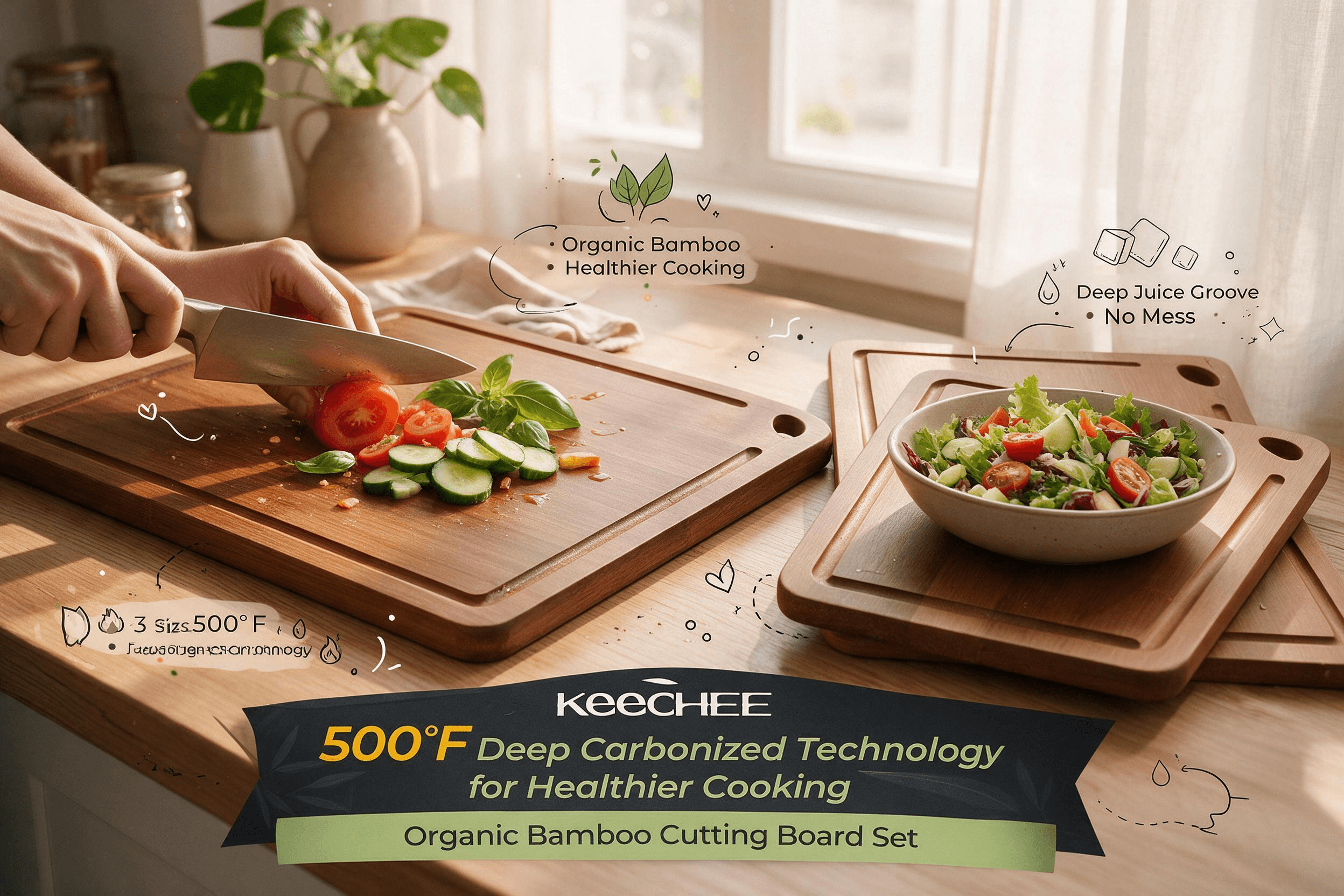
Every brand has a product that pays for the rest of the catalogue, and for Keechee it is the carbonized bamboo cutting board. The line is offered in three footprints, 15 by 10 inches, 12 by 8, and 9 by 6, and the boards are built from cross-laminated bamboo strips rather than a single laminated plank.
Why lamination matters more than it sounds
Bamboo is not wood in the structural sense; it is a grass, and its fibers run long and straight. Taken raw and flat, a bamboo panel will move with humidity along that grain. Cross-laminating, stacking strips with alternating orientation and pressing them into a single board, cancels most of that directional movement. The result is a panel that stays flat on a counter instead of bowing into a rocking disc, which is the single most common complaint about inexpensive boards.
The practical consequence shows up during use. A board that lifts at the corners has no stable relationship to the counter, so the knife’s landing point shifts under the hand holding the food. A laminated board that lies dead flat lets the cook put pressure where she intends it. Combined with 500°F carbonization, the material ends up doing double duty: the lamination handles geometry, the heat treatment handles hardness and moisture.
Grooves, handles, and the arithmetic of a busy counter
Two features on the Keechee boards are small enough to overlook in a product photo and important enough to change daily behaviour.
The first is the juice groove, routed as a continuous channel near the perimeter. Its job is unglamorous: when a roast comes off the oven and gets set down to rest, the liquid runs outward until it hits the channel and stops there instead of reaching the board’s edge and continuing onto the counter. On the larger 15 by 10 board the groove buys real containment; a chicken carcass releases more than people expect. The boards are reversible, so the grooved face handles wet jobs and the flat face handles dry prep, which effectively doubles the usefulness of one object.
The second is the cutout corner handle. This sounds like a serving affectation until it is used for its mundane purpose, which is moving a loaded board one-handed. Carrying a 12 by 8 board with four chopped onions on it requires either two hands and a negotiation, or a pinch grip on the edge that tilts the load. A thumb hole solves it. The same cutout doubles as a hanging point, which matters in kitchens where drawer space is already committed.
From prep surface to serving piece
The brand’s charcuterie positioning is not marketing drift; it follows from the material. Carbonized bamboo at that warm toasted tone reads as finished tableware rather than kitchen equipment, so the board that held raw chicken thighs at 5 p.m. — after a wash — is the board that holds cheese at 7. Keechee leans into this with a larger format in the same family, marketed with the blunt logic of “more cheese room, more guest-pleasing presence.”
There is a quieter argument for bamboo on the knife-front, too. Compared with glass, stone, or hardwood, bamboo is somewhat forgiving to a blade edge, and its surface tension means a knife bites rather than skates. Cooks who care about their knives have long preferred softer boards for exactly this reason, and a material that is both gentle on steel and resistant to its own deep scoring is a genuinely useful combination.
As a gift, the board occupies a rare position: it is something nearly every household needs replacing, it is rarely the thing someone buys for themselves, and it is universally understood in size and function without explanation. That is the profile of a reliable present.
The Bread Knife That Decides Slice Thickness For You
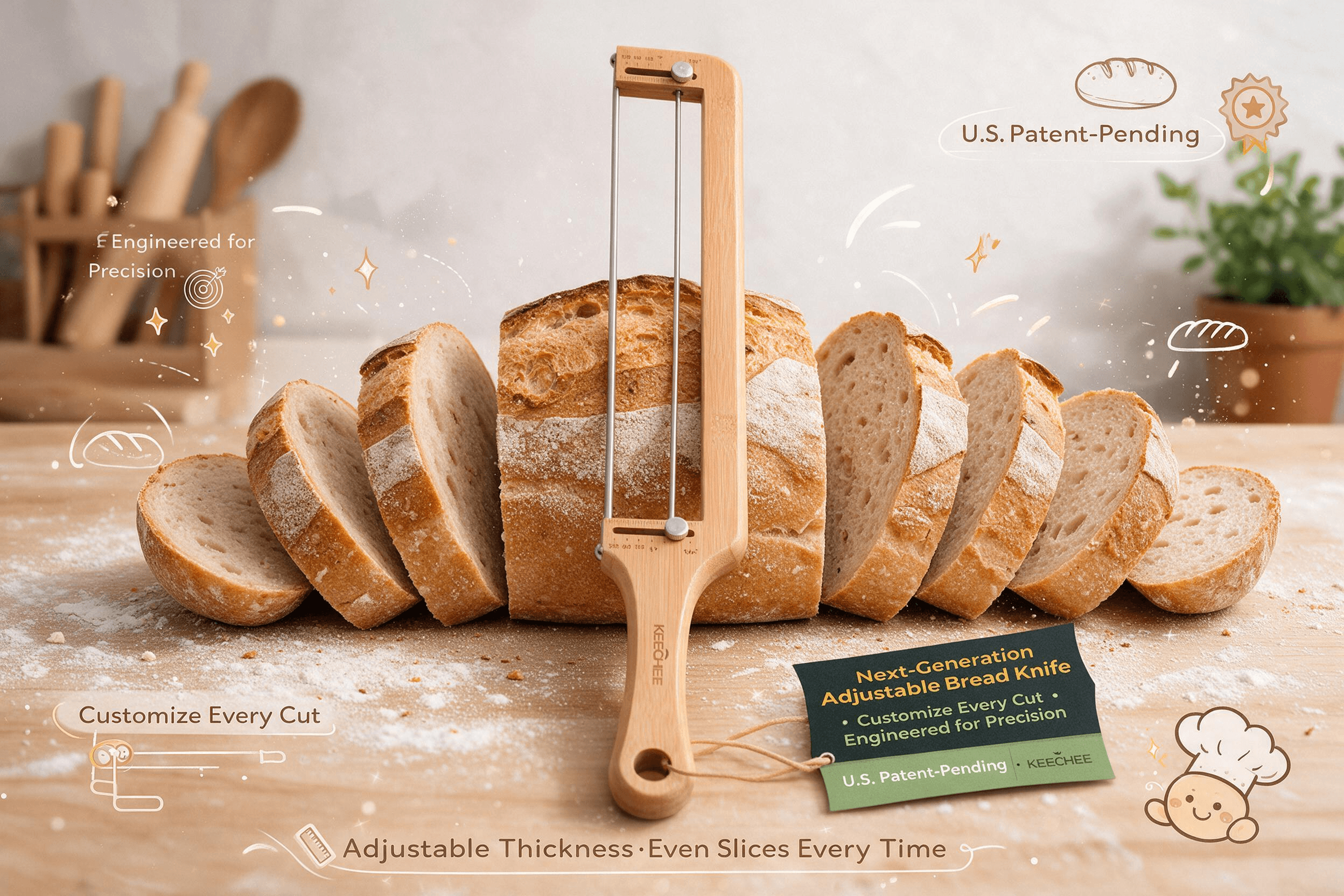
Keechee’s adjustable bread knife, presented in the brand’s accessories range under the “bread pilot” framing, is the most mechanically interesting object in the line-up. It is built from a bamboo frame carrying a serrated stainless steel blade, weighs 0.35 pounds, and sets slice thickness with a sliding guide adjustable anywhere from a quarter-inch to two inches.
The problem it is actually solving
Cutting a sourdough boule evenly is harder than it looks, and the difficulty is not the crust. A serrated knife handles a burnt, blistered crust easily; the teeth do the work. The difficulty is consistency. The first three slices come out at whatever thickness the hand happens to hold, the middle of the loaf drifts, and by the end the slices are uneven enough that they stack badly on a plate. Anyone who has served homemade bread to guests knows the anticlimax.
A thickness guide converts that judgement into a setting. Slide the guide to one inch, and the loaf presents the same geometry to the blade every time; the hand stops measuring and starts repeating. The ¼-to-2-inch range covers the realistic spread of use: thin slices for a cheese board, a proper inch for a sandwich, something closer to two for a thick grilled slice or a French-toast cut.
Why the frame is bamboo and not plastic
The bamboo frame is a deliberate continuity choice, but it also has functional justification. Bread slicing is a high-contact activity — the frame rides against the loaf’s flank on every stroke — and a rigid, low-mass material keeps the tool at 0.35 pounds, light enough that the blade does the cutting rather than the user muscling the whole assembly downward.
The guide mechanism is a slotted spine rather than a separate clamp, meaning there is one moving interface and no small part to lose. This is the subtraction principle from earlier, applied to a tool that competitors commonly build out of several moulded plastic pieces that snap after a season of twisting.
Ambidexterity as an afterthought that isn’t
The handle configuration can be switched for left-handed use, which sounds like a footnote until you consider how rarely it is offered. Most bread-slicing guides are engineered assuming a right-handed downward stroke, which forces left-handed users to rotate the loaf instead of the tool. A switchable frame moves the accommodation to the object where it belongs.
For a household where more than one person bakes, or for a gift whose recipient’s handedness is unknown, that flexibility removes a real purchase risk.
The Banana Stand: An Object That Fixes a Problem Nobody Names
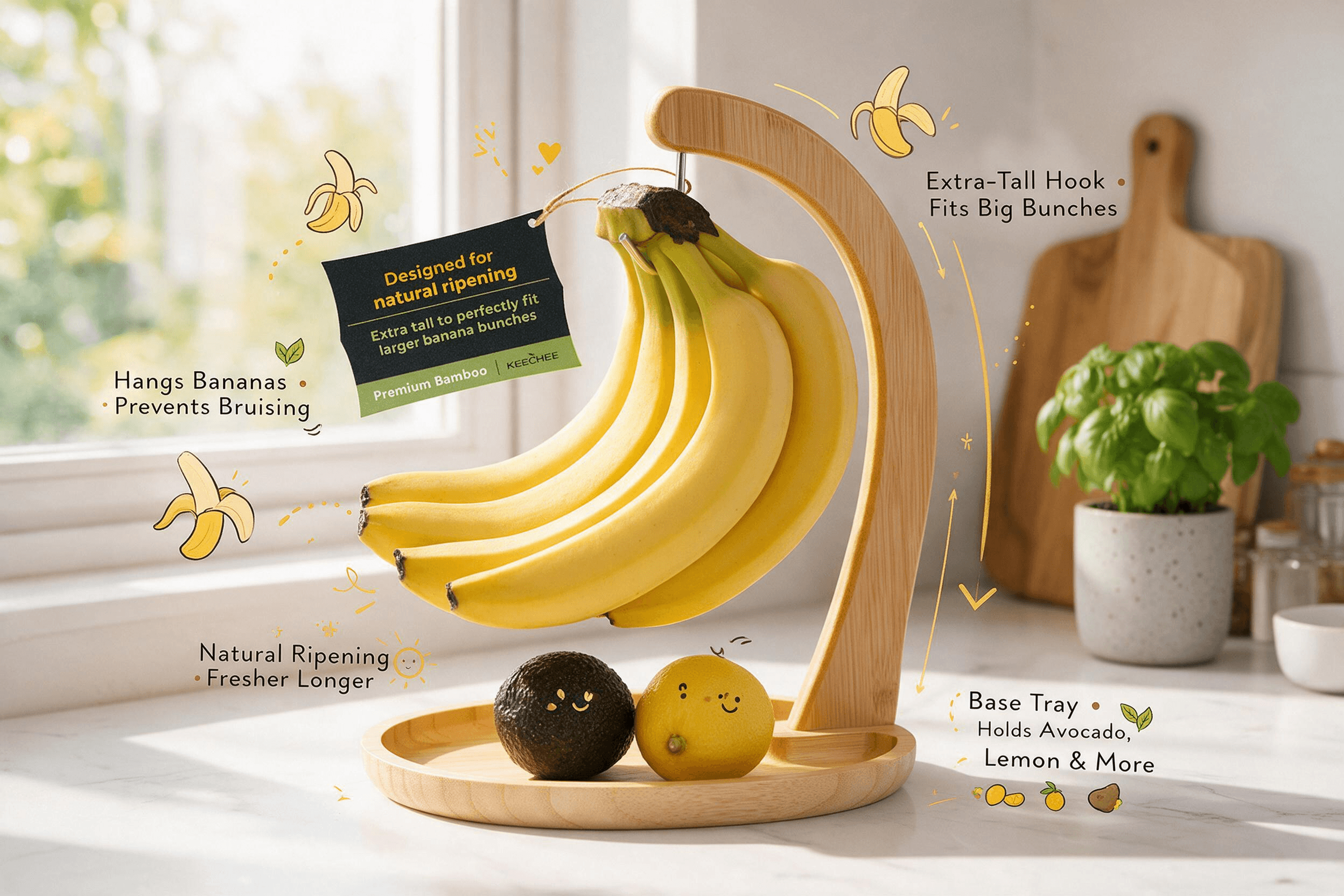
Countertop fruit storage is one of those categories where the default solution is so entrenched that its flaws stop being visible. Bananas go in a bowl. In a bowl, the bunch rests on its own lowest fingers, pressure builds at contact points, bruising starts underneath, and ripening accelerates unevenly, so the fruit at the bottom of the pile is brown two days before the fruit at the top is ready.
Keechee’s bamboo banana holder addresses this with a suspended hook and, unusually, a tray. The stand stands 12.9 inches tall, and the shallow base tray catches small fruit that would otherwise roam the counter.
Height as the whole specification
The 12.9-inch figure is not decoration. A short holder fails at the exact moment it earns its keep: a full, heavy supermarket bunch grows long as it ripens, and if the tip of the lowest finger touches the base or the counter, the bruising problem returns in miniature. Extra height gives the bunch room to hang clear even at full spread, and Keechee markets the dimension for precisely that reason.
Suspension changes the ripening profile as well. Without static contact patches, moisture does not pool against one side of the peel, and the localized soft spots that begin under a resting bunch never form. The brand’s own comparison imagery makes the case visually: bananas in a bowl against clean, unblemished fruit hanging from the stand.
The tray is the smarter half
The hook is the obvious idea; the tray is the thoughtful one. A countertop that hosts a banana stand has usually already displaced the lemons, the avocados, and the limes somewhere else, and the result is fruit scattered across the work surface that should be being used for prep. A shallow base tray consolidates the small daily fruit into one footprint directly beneath the bananas.
Functionally, that means a single object occupies the space of two, and the vertical arrangement suits the actual consumption pattern of most households: bananas get taken from the top of the bunch, and the small fruit gets picked out of the tray at the same spot on the counter. Assembly requires no tools and takes seconds, and the bamboo is finished smooth enough to be splinter-free, which matters for an object handled constantly and stored in the open.
Two Green Rectangles Solving a Very Common Injury
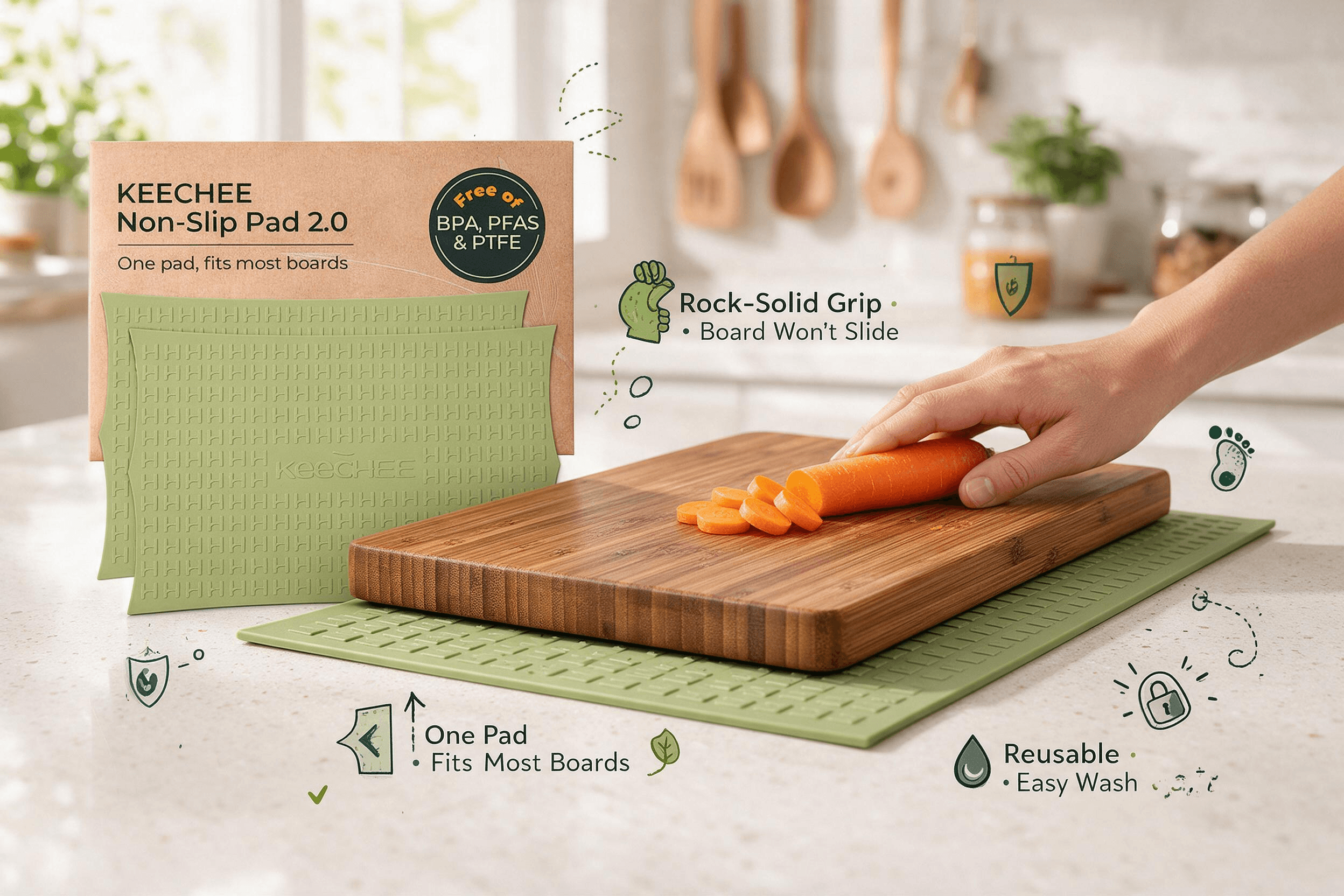
The Keechee 2-pack silicone non-slip mat is the least expensive and most consequential item in the line-up. Each mat measures 11 by 7.3 inches, is made from flexible silicone, and carries a high-density concave-and-convex texture on both faces. It goes underneath the cutting board.
How a board becomes dangerous
A slipping board is one of the more reliable ways to injure a hand in a home kitchen. The mechanism is consistent: the cook applies downward and forward pressure with the knife, friction between the board and the counter fails, the board travels, and the hand holding the food is now where the board was. Granite, quartz, marble and stainless-steel sinksides are all low-friction, and a wooden or bamboo board on a smooth stone counter is close to the worst possible pairing.
The mat intervenes on both interfaces at once. The textured underside conforms to the counter and resists shear; the textured top face grips the board’s base. Density of the texture is what does the work here — a sparse pattern of rubber nubs leaves long unsupported spans where a large board can still pivot, whereas a high-density field of raised geometry distributes the grip across the whole footprint.
The secondary benefits people don’t shop for
Two effects come free with the safety improvement. The first is counter protection: a silicone layer between a heavy board and a stone surface prevents the ring of moisture and oil that a stationary wet board leaves behind, and cushions impact noise from heavy chopping, which is not nothing in an open-plan ground floor.
The second is that it extends the working life of the board itself by keeping it from sliding off the counter edge during an aggressive cut. Keechee’s setup guidance is deliberately minimal — lay the mat down, set the board on top, no adhesive, no soaking, no trimming — and the two-pack acknowledges that most kitchens have more than one prep zone. Sold in the brand’s characteristic green, it photographs as a design object rather than a hazard accessory, which is part of why it functions as a gift.
The Drawer Is the Honest Test of a Kitchen
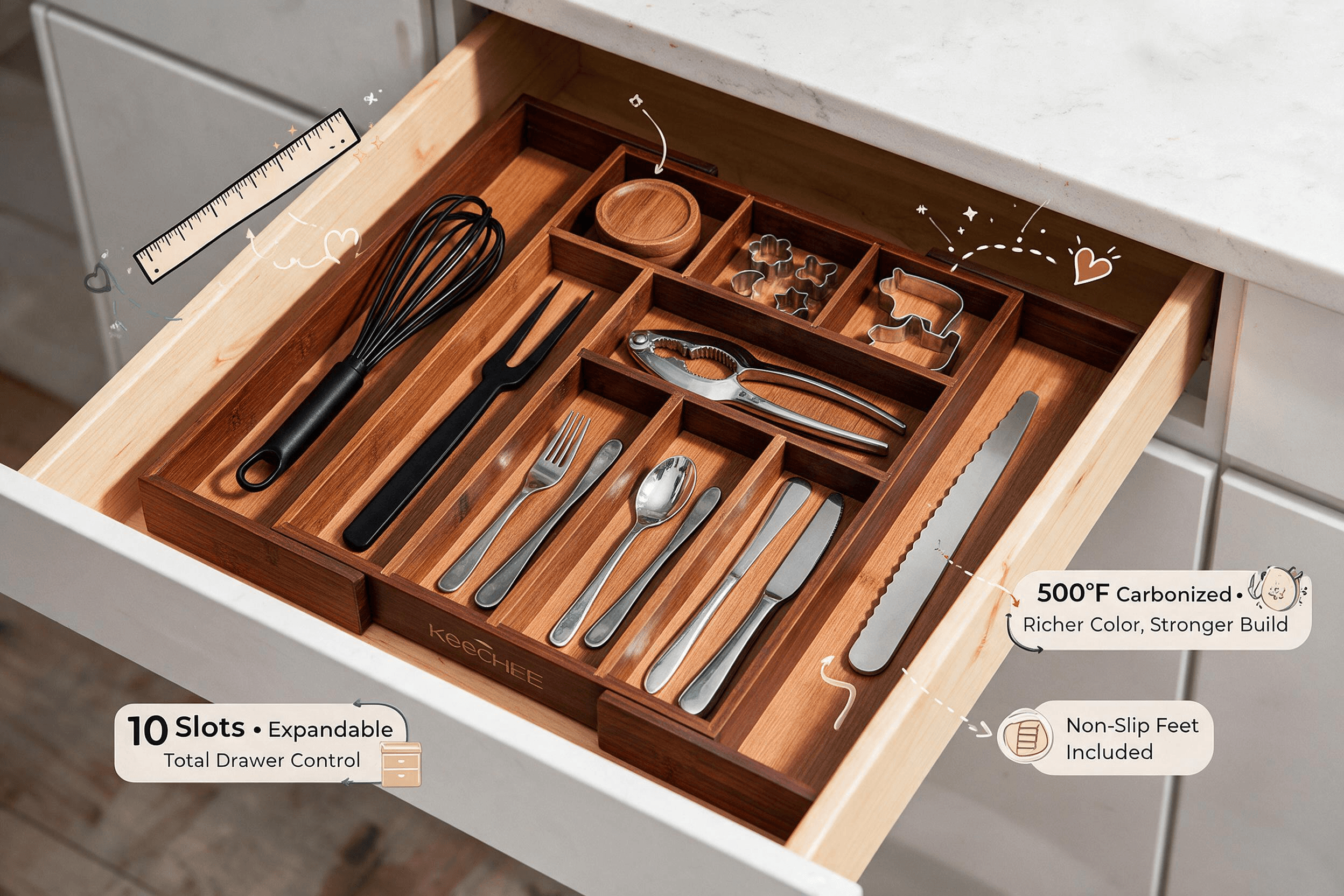
Ask people what makes a kitchen feel disordered and the answer is rarely the counters. It is the drawer that has to be opened twice — the one where the whisks lie on top of the spatulas because nothing was ever divided. Keechee’s carbonized bamboo drawer organizer is built for that specific failure.
Specifications that map to real drawers
The unit is a ten-slot design that expands from 13 to 19.6 inches in width, configured from a base of eight compartments that open out to ten. Depth is 2.2 inches, and high-grip silicone non-slip feet ship included rather than as an accessory.
Each of those numbers corresponds to a known problem. Standard drawer interiors run roughly 14 to 22 inches depending on the cabinet, which is why fixed-width organizers so often leave either a useless gap or an unusable squeeze; an expanding body covers most of the range with one SKU. The eight-to-ten adjustment lets the user choose compartment count after the fact, so the tray can be coarse for tongs and ladles or fine for teaspoons and measuring spoons.
The 2.2-inch depth is the less obvious specification and arguably the more important. Shallow organizers — the common one-inch type — force bulky items like a potato masher, a pair of kitchen shears, or a stack of measuring cups to sit proud of the drawer lip, which jams the drawer closed. Extra depth converts those items from obstacles into inventory.
Carbonized here, for the same reason as on the board
Applying 500°F bamboo inside a drawer is a moisture decision as much as a strength one. Drawers are cool, poorly ventilated, and periodically hold a spoon that was rinsed and not dried. Untreated bamboo in that environment is prone to swelling at the joints and, in bad cases, to surface spotting. Carbonized bamboo has had the sugars and free moisture driven out before it goes into service, so the compartment walls keep their dimensions and the tray does not begin to rack.
The included silicone feet address the last irritation: an organizer that slides forward every time someone drops in a heavy ladle defeats its own purpose. Anchoring it costs almost nothing in manufacturing and removes a genuine daily annoyance, which is a fair illustration of how the brand tends to identify problems — by watching the object in use rather than by adding features to a spec sheet.
Salt, Kept Within Arm’s Reach
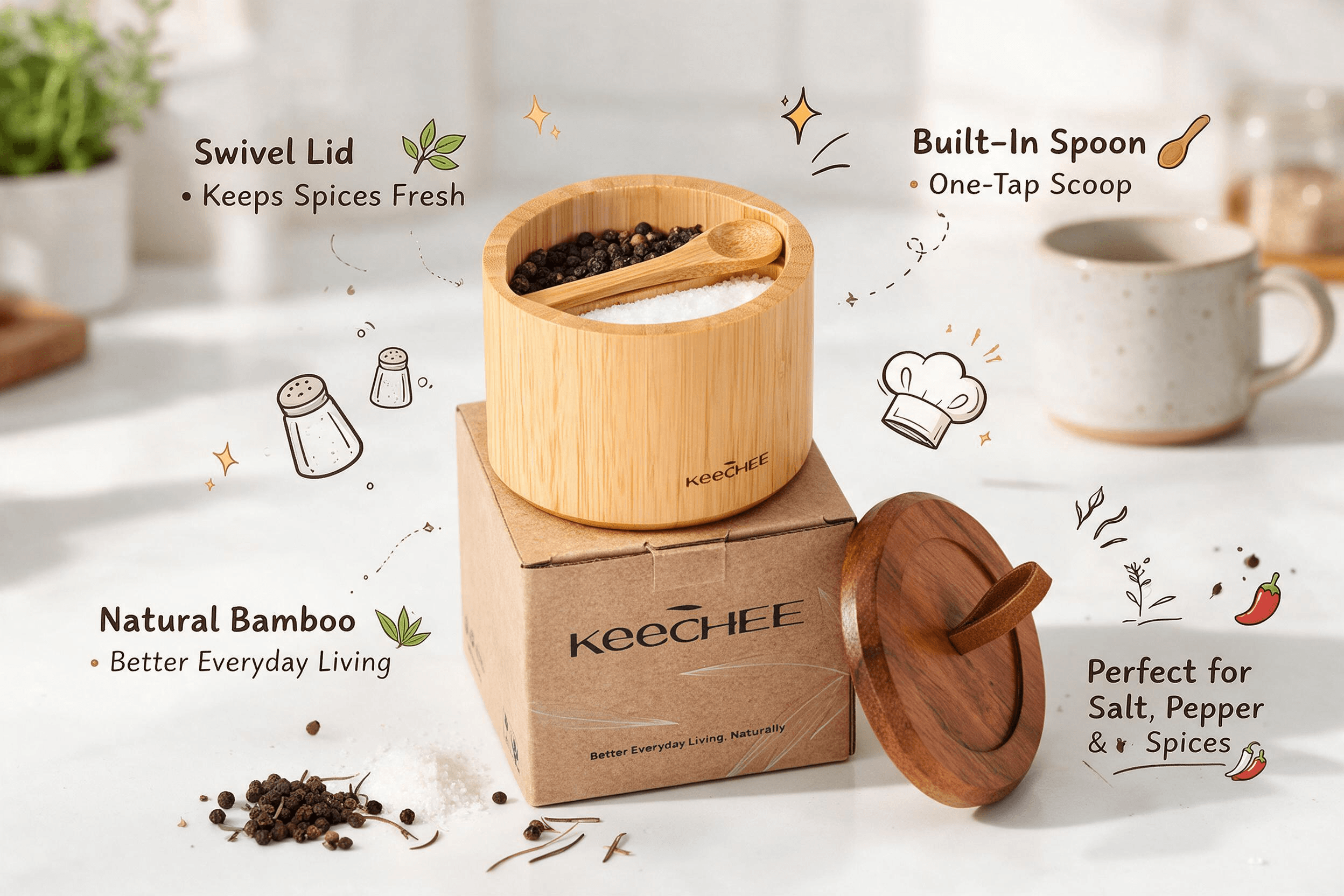
The Keechee bamboo salt cellar is the smallest object in this group and the one that most clearly signals design intent. It is a two-tone countertop seasoning container: a bamboo body paired with an acacia wood lid, dual-compartment, 7-ounce capacity, with a built-in slot that holds the included bamboo spoon and a sheet of pre-printed labels for salt, pepper, seasoning, and spices.
Why the two woods
Combining bamboo with acacia is not an arbitrary pairing for visual interest. Acacia is denser and darker, with a pronounced figure that reads as furniture-grade timber; bamboo is lighter, straighter-grained, and more dimensionally stable in a thin-walled vessel. Using acacia for the lid puts the more decorative material where the eye lands, and bamboo for the body puts the more stable material where humidity fluctuates as the container is opened and refilled.
The result is an object that looks considered rather than moulded. The mouth is 3.5 inches wide, which is generous enough to refill from a bulk bag without a funnel, and the one-piece body construction means there is no interior seam where damp salt can crust and eventually split a glued joint.
The spoon slot is the detail that matters
Open the lid, and the spoon rests in an integrated channel rather than lying in the salt. That distinction sounds trivial. In practice, a spoon buried in a salt container gets lifted out coated in crystals, taps against the rim, and deposits salt on the counter every single time — the small cumulative mess that makes people stop keeping salt close and start keeping it in a cupboard.
A slot holds the spoon above the contents, dry and available. The pre-printed labels do similar work at a lower order of difficulty: they stop the two compartments from drifting into ambiguity, which is the ordinary fate of any unlidded dual container in a shared kitchen. At 7 ounces the vessel is sized for weekly replenishment rather than bulk storage, which is the correct instinct for a container meant to sit out in the open near the stove.
Reading the Six Products as One Argument
Taken individually, these are six competent objects. Taken together, they form a coherent position, and it is worth stating that position plainly because it is what separates a brand from a catalogue.
A single material language
Bamboo appears in every product here in one of two roles: carbonized where strength and moisture resistance matter (boards, drawer organizer), natural where warmth and lightness matter (banana stand, bread knife frame, salt cellar body). Acacia appears once, as a deliberate accent. Silicone appears twice, always as an interface material — grip under a board, feet under a tray — never as the body of a product.
That allocation is consistent enough to be a signature. A customer who buys the board and later adds the organizer will find the two objects reading as a pair on the counter and in the drawer, which is not an accident of good luck but the outcome of holding a narrow palette.
Gift logic built into the range
Several products in this line carry an explicit gift framing, and the range as a whole covers an unusually wide price ladder for a single brand: a two-pack of mats at the entry point, a salt cellar or banana stand in the middle, a board set at the top. That spread is what makes the brand practical for shoppers who buy repeatedly — housewarming, wedding registry, holiday hosting, a hostess gift in November — without leaving the catalogue.
It also reflects a genuine insight about kitchen gifting. The most reliably appreciated kitchen gifts are consumable-adjacent objects the recipient needs but would not prioritize: good boards, real organizers, a place for the bananas. Nobody registers for a non-slip mat, and everybody uses one within a week of receiving it.
Longevity as an environmental argument
The sustainability case for bamboo is usually made on growth rate — grasses regenerate from the root system after harvest rather than requiring replanting, and mature far faster than hardwood. Keechee’s angle adds a second, less-discussed layer: durability as an ecological position.
Carbonization that permits dishwasher treatment, lamination that keeps a board flat, an expanding organizer that fits the drawer you own rather than the drawer a manufacturer assumed, a single moving part on a bread guide — each of these choices extends serviceable life by some margin, and every month of extra life is a month the object does not become landfill. “Without the compromise” is a claim about aesthetics and function, but the material honesty behind it is that long-lived goods are the cheap goods.
Frequently Asked Questions
What does carbonized bamboo actually mean, and is it safe around food? Carbonization is a heat treatment using high-temperature steam, around 500°F in Keechee’s specification. It darkens the material from within, reduces its moisture content, and increases hardness. No chemical colouring is involved in the process itself; the colour change is the sugar-and-fiber response to heat. Treated bamboo is used widely in food-contact kitchenware.
Are Keechee bamboo boards really dishwasher-safe? The brand lists its carbonized boards as dishwasher-safe, which is unusual for the category and reflects the reduced water absorption that heat treatment produces. As with any timber-adjacent product, the practical lifespan lengthens if the board is removed promptly and dried rather than left sitting in a wet machine, but the requirement for careful hand-washing ritual is what the treatment is designed to remove.
Which cutting board size should a household start with? The 15 by 10 inch board covers the jobs that make a small board frustrating: roasting and carving meat, prepping vegetables for a full meal, holding a charcuterie spread. The 12 by 8 is the everyday workhorse. The 9 by 6 suits garnish work, citrus, and serving single portions. A household that cooks in volume generally wants the largest as its primary surface.
Does the adjustable bread knife work on soft bread as well as crusty loaves? Yes. The serrated edge is what handles a hard crust, and it cuts soft enriched doughs such as brioche without compressing them, provided the stroke is light and the guide sets the thickness. The ¼-inch end of the range exists specifically for thin, even slices of softer breads.
Will the drawer organizer fit a nonstandard drawer? Its expanding width runs from 13 to 19.6 inches, which covers the majority of standard kitchen cabinet interiors. Shallow or unusually narrow antique drawers are the main case where it will not seat properly, and measuring the interior width before ordering is the only reliable check.
Can the non-slip mats be used under things other than cutting boards? They are specified for cutting boards, and that is where the benefit is greatest. The same principle applies to any flat-bottomed object on a slippery stone or steel surface. Items with feet, ridges, or curved bases will not make full contact with the texture, so grip will be correspondingly partial.
Where Keechee Fits
There is a version of the kitchenware market that competes on novelty: new colours every season, gadgets that solve a problem once a year, products designed to look impressive in a photograph and mediocre in the eighth month of use.
Keechee is plainly not competing in that market. Its line is small, its material palette is narrower still, and its most interesting ideas are invisible in a hero shot — the steam treatment inside a board, the depth figure on a tray, the slot that holds a spoon above the salt. That is a brand betting on the fact that these objects get judged by daily use rather than by first impression.
Whether that bet pays off is ultimately decided by customers over years, not by reviewers in a week. But the direction of the reasoning is legible from the products themselves, and it is a refreshing one in a category with a lot of noise: fewer things, made of one honest material, treated properly, designed so that the part most likely to break is the part that isn’t there.