Introduction: The Invisible Comfort We Overlook
Most homeowners notice humidity only when it becomes impossible to ignore. A musty smell rising from the basement after a rainstorm. Condensation collecting on windowsills during summer mornings. Mold creeping along the corner of a bathroom ceiling. By the time these signs appear, moisture has already settled into fabrics, drywall, and timber, quietly damaging property and degrading indoor air quality. The challenge is not simply removing water from the air; it is doing so consistently, efficiently, and without turning the home into a noisy mechanical zone.
This is where Waykar has spent more than a decade refining its craft. Founded in 2014, the company set out to solve a problem that many appliance manufacturers treat as an afterthought: how to control humidity at scale without sacrificing energy efficiency, acoustic comfort, or design restraint. What began as a focused effort in humidity-control engineering has grown into a product ecosystem that serves residential basements, commercial warehouses, crawl spaces, and the precision needs of HVAC professionals. Waykar’s portfolio is not a scattershot collection of appliances. It is a deliberately built family of tools that address moisture from every angle: prevention, extraction, drainage, and measurement.
The following article introduces the Waykar brand and examines five products that represent its range. Each product serves a different environment, yet all share a common design language: quiet operation, thoughtful automation, and a respect for the spaces they occupy. Whether you are a homeowner looking to reclaim a damp basement, a contractor managing a water-damage restoration, or a facility manager trying to protect inventory, Waykar offers a solution scaled to the task. The goal here is not to repeat marketing language, but to explain, in plain terms, why these products matter and how they fit into a broader approach to healthier indoor air.
Who Is Waykar? A Brand Built on Air Quality
Waykar describes itself as a humidity-control specialist, and that focus is worth taking seriously. In a market crowded with generalist appliance brands, Waykar has concentrated its research and manufacturing on one domain: managing the moisture that circulates through buildings. The company operates a substantial manufacturing facility and has developed patented technologies around dehumidification, drainage, and environmental sensing. That depth of focus shows up in the details: rotary compressors tuned for efficiency, probe sensors that replace mechanical floats, washable filters that reduce long-term cost, and control panels that prioritize clarity over visual noise.
The brand’s philosophy rests on a few clear commitments. First, products should be reliable enough to run continuously in harsh conditions, from crawl spaces with dirt floors to commercial basements with concrete walls. Second, energy efficiency is not a premium feature but a baseline expectation. Several Waykar dehumidifiers carry Energy Star certification, reflecting designs that remove large volumes of moisture without drawing excessive power. Third, support should extend beyond the sale. Waykar backs many of its units with multi-year warranties, return guarantees, and lifetime technical assistance, signaling confidence in product longevity.
Sustainability also appears in the company’s packaging choices and product longevity. By emphasizing washable filters, durable metal casings, and extended motor lifespans, Waykar reduces the cycle of replacement that plagues cheaper appliances. This is not greenwashing. It is a practical acknowledgment that the most sustainable appliance is the one you do not have to replace every two years.
The result is a brand that appeals to a wide range of buyers. Homeowners appreciate the quiet operation and user-friendly controls. Contractors value the pump systems, heavy-duty wheels, and high extraction rates. HVAC technicians find compatible drainage accessories and diagnostic tools. Waykar has built its reputation by serving all of these audiences without diluting its core expertise.
Why Humidity Control Deserves More Attention
Before examining specific products, it is useful to remember why humidity control matters in the first place. Relative humidity above sixty percent creates conditions where mold, dust mites, and mildew thrive. These biological irritants can aggravate allergies, trigger asthma symptoms, and produce the stale, sour odors that make basements and crawl spaces unpleasant. High humidity also accelerates the degradation of building materials. Wood swells, paint peels, metal fixtures corrode, and insulation loses effectiveness. In commercial settings, excess moisture can damage inventory, warp flooring, and create slip hazards.
Conversely, air that is too dry can cause respiratory irritation and static electricity. The ideal indoor relative humidity generally falls between forty and fifty percent, though personal preference and climate will shift that range. Achieving and maintaining that band requires more than opening a window. It requires a system that senses current conditions, removes moisture at the right rate, and drains that moisture away without constant human intervention.
This is why dehumidifiers have become essential appliances in many parts of the country. In the humid Southeast, the Midwest during summer, and coastal regions year-round, mechanical dehumidification is often the only practical way to keep indoor air healthy. In basements and crawl spaces, where ground moisture seeps through walls and floors, the need is even more pronounced. And in commercial or industrial settings, the volume of air and the cost of damage make professional-grade equipment a sound investment.
Waykar’s product line reflects these realities. The company does not treat dehumidification as a one-size-fits-all problem. Instead, it offers scaled solutions: a portable residential unit for large living spaces, a compact crawl-space workhorse, a high-capacity commercial machine, plus supporting tools like condensate pumps and moisture meters. Together, these products form a coherent approach to moisture management.
Product in Focus: Waykar 80 Pints 2025 Energy Star Dehumidifier
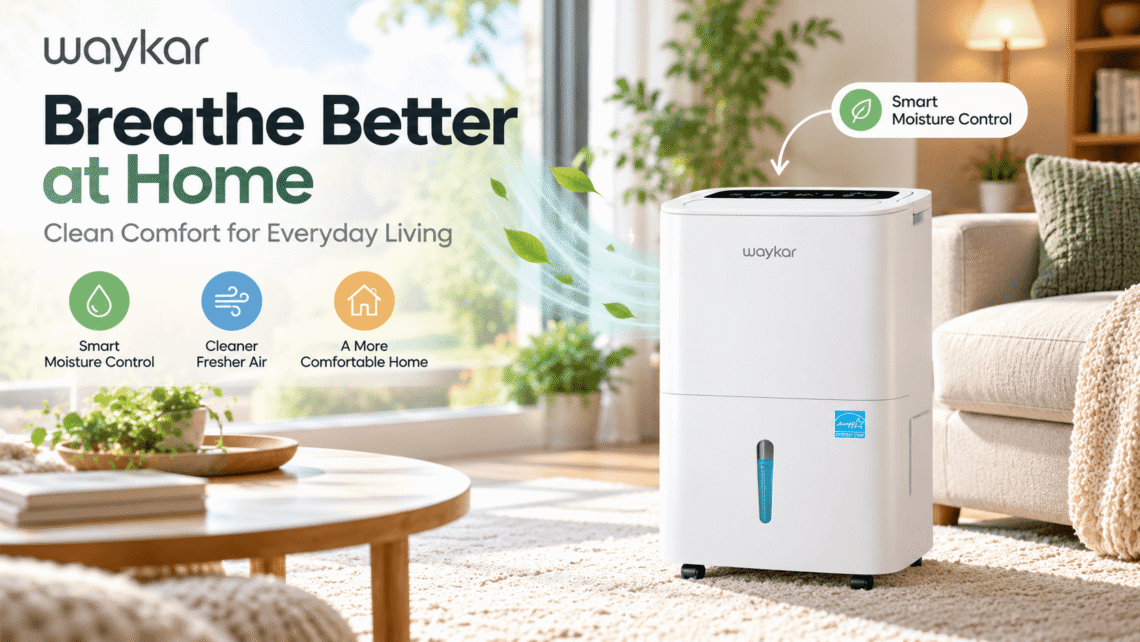
The Waykar 80 Pints 2025 Energy Star Dehumidifier is designed for homeowners who need serious moisture removal without commercial noise levels or industrial bulk. Rated to remove up to eighty pints of moisture per day and cover spaces up to five thousand square feet, it sits at the upper end of residential capacity. That makes it well suited for finished basements, large open-concept living areas, multi-room apartments, or homes where humidity problems are not isolated to one corner.
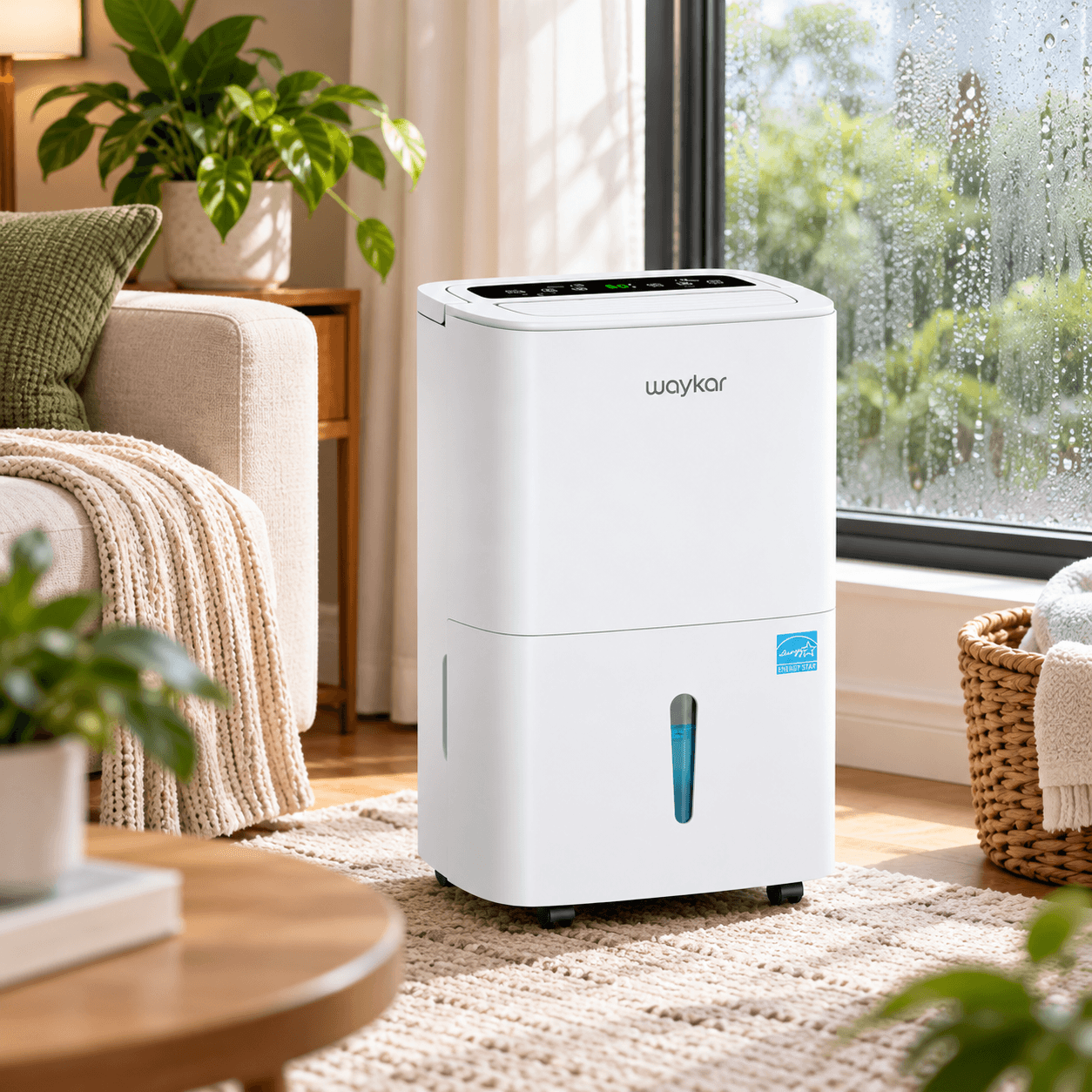
One of the first things buyers notice is the Energy Star 2025 certification. The unit draws approximately 390 watts, which is notable for a machine with this extraction capacity. Energy efficiency matters in a dehumidifier more than in many appliances because the unit may run for hours each day, especially during humid seasons. A lower power draw translates directly into lower operating costs over the life of the product, and it reduces the environmental footprint of keeping a home dry.
The humidity control range is adjustable from thirty to eighty percent, allowing users to set a target that suits their space and season. The touch panel is straightforward, and the inclusion of a twenty-four-hour timer means the unit can be scheduled to run during off-peak electricity hours or only when the space is unoccupied. Auto-restart ensures that, after a power outage, the dehumidifier resumes operation at its previous settings rather than defaulting to a generic mode. Auto-defrost protects the coils in cooler basement temperatures, extending the usable season into early spring and late fall.
Noise is another area where this model distinguishes itself. Operating between forty-two and forty-nine decibels, it is quiet enough to run in a living area without dominating the soundscape. For context, forty decibels is roughly the noise level of a quiet library, while fifty decibels is comparable to a moderate rainfall. This range makes the unit practical for bedrooms, home offices, and media rooms as well as basements.
Drainage flexibility is built in. Users can let the collected water accumulate in the internal tank, which shuts off automatically when full, or they can attach the included drain hose for continuous drainage. Continuous drainage is the preferred option for basements or vacation homes where the unit needs to operate unattended for long stretches. Auto-swing louvers distribute dry air more evenly across a large room, preventing the creation of damp pockets in distant corners.
What makes this product representative of the Waykar brand is its balance. It offers high capacity, energy efficiency, quiet operation, and smart automation in a form factor that still fits comfortably in a residential setting. It does not ask homeowners to accept industrial noise or complexity in exchange for performance.
Product in Focus: Waykar 125 Pint Crawl Space Dehumidifier with Pump
Crawl spaces are among the most neglected environments in a home. Low ceilings, poor ventilation, and direct contact with the earth make them natural reservoirs for moisture. Left unchecked, that dampness rises into living spaces, affects floorboards, invites pests, and creates the conditions for mold growth. Treating a crawl space requires a dehumidifier that is compact enough to fit in tight quarters yet durable enough to operate in gritty, humid conditions.
The Waykar 125 Pint Crawl Space Dehumidifier addresses this niche directly. With a daily extraction capacity of 125 pints and coverage up to six thousand five hundred square feet, it is substantially more powerful than typical residential units. Yet the housing is compact, allowing installation in the constrained headroom of a crawl space. The metal casing and TUV-certified construction signal that this machine is built for continuous duty rather than occasional use.
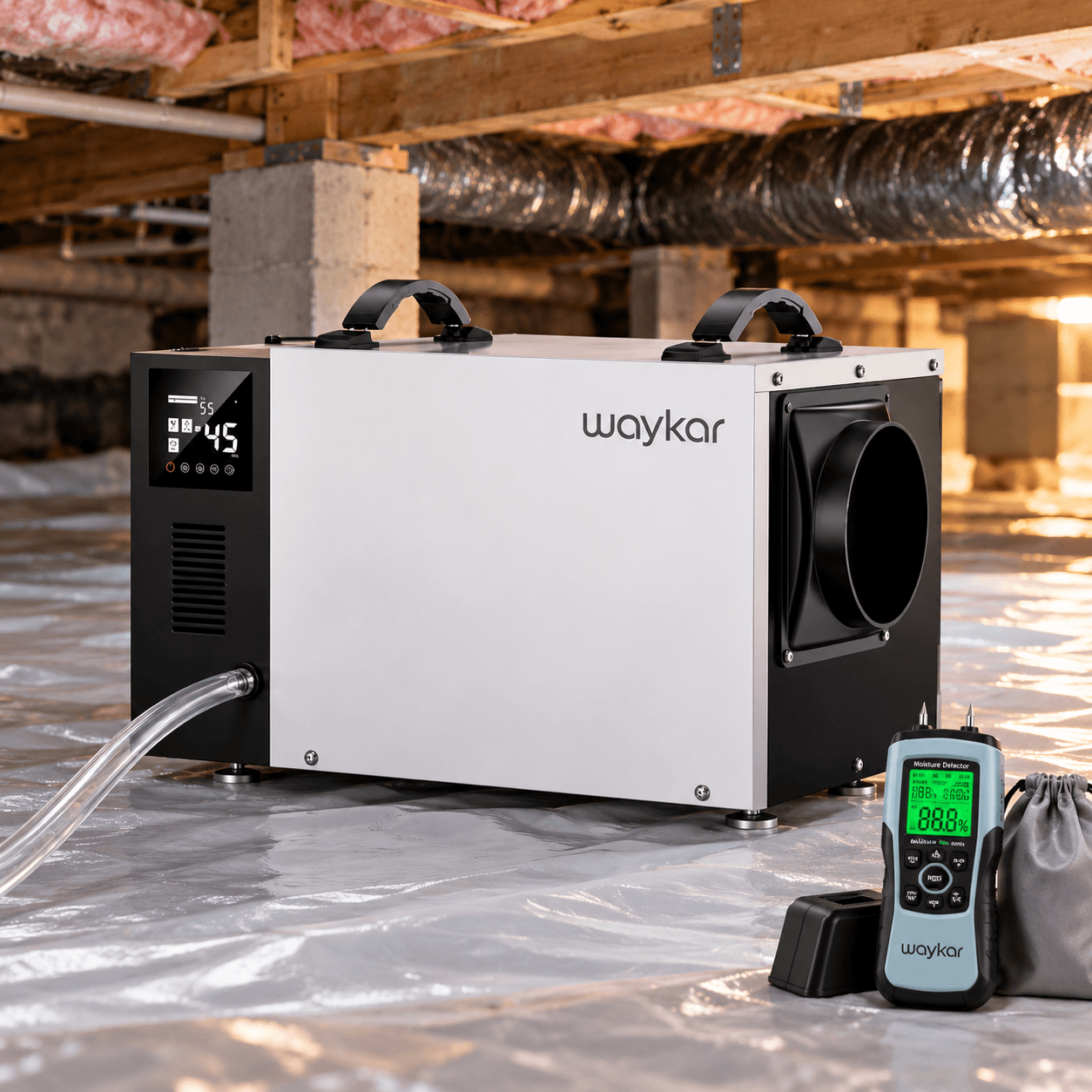
A built-in pump is the feature that transforms this unit from useful to genuinely practical. Crawl spaces rarely have floor drains, and gravity drainage is often impossible when the unit sits below the level of the home’s plumbing. The pump can lift collected water up to 16.4 feet vertically, sending it out through a drain hose to a sink, sump pit, or exterior discharge point. Dual drainage hoses are included, adding flexibility depending on the layout of the space.
The compressor is a high-efficiency rotary design, which helps keep operating costs manageable despite the large extraction capacity. Smart sensors monitor humidity and temperature, adjusting operation to match real-time conditions. Auto-defrost protects the coils during colder crawl-space nights, and overload protection guards the motor against power fluctuations. These features matter because crawl-space units are often installed and then forgotten; they need to handle variation without requiring frequent visits from the homeowner.
Waykar backs this model with a five-year warranty, which is generous in an industry where one-year warranties are common. That coverage reflects the company’s confidence in the unit’s durability and its understanding that crawl-space equipment is difficult and unpleasant to replace. For homeowners, contractors, and property managers dealing with water damage restoration or long-term moisture control, this dehumidifier offers a purpose-built solution.
Product in Focus: Waykar 155 Pints Commercial Dehumidifier with Pump
When the environment grows larger and the stakes higher, the equipment must scale accordingly. The Waykar 155 Pints Commercial Dehumidifier is built for warehouses, gyms, indoor pools, large basements, flood restoration sites, and other settings where moisture loads can overwhelm residential machines. Capable of removing 155 pints per day and covering up to eight thousand square feet, it represents the upper tier of Waykar’s portable commercial line.
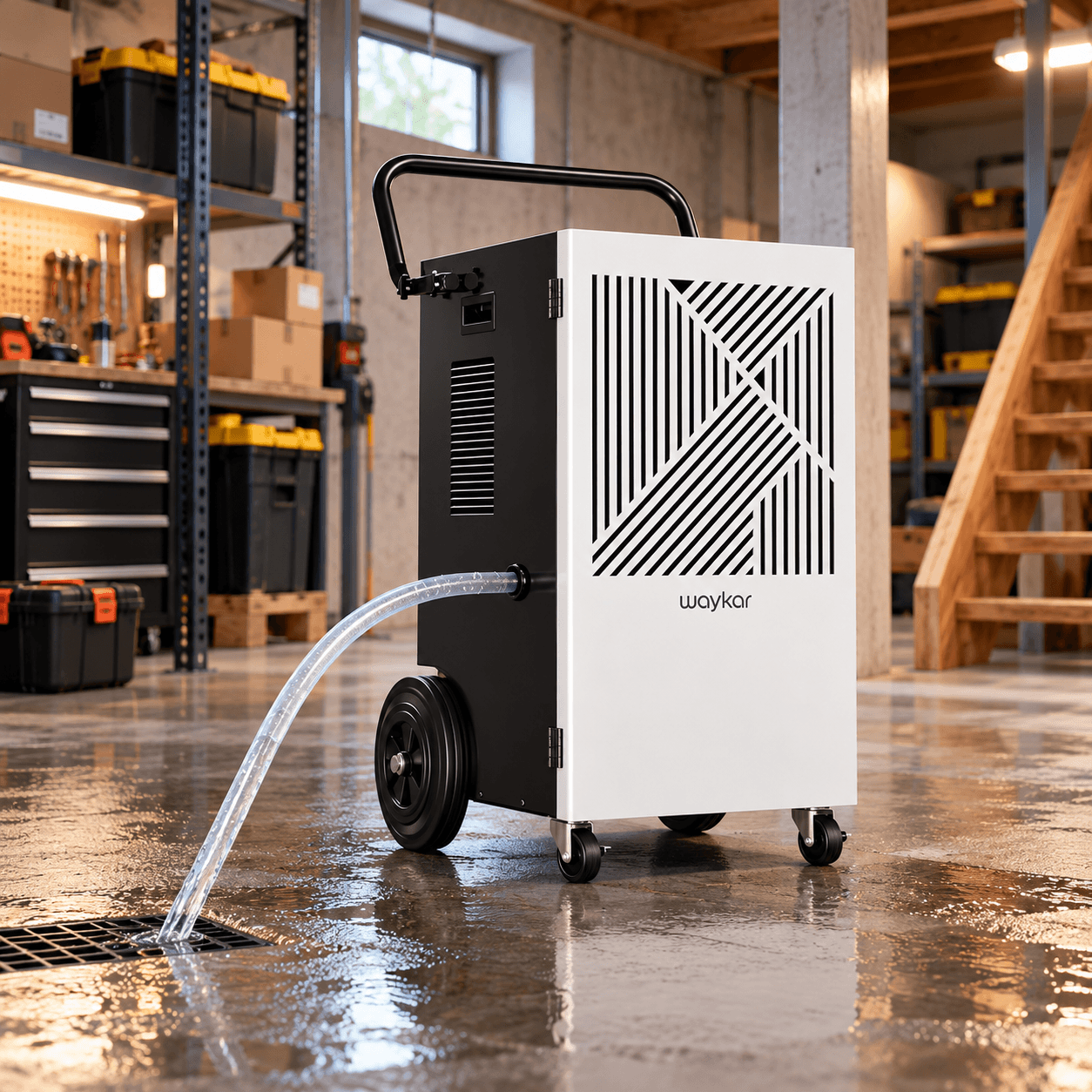
Like the crawl-space model, this unit includes a built-in pump with a 16.4-foot vertical lift, enabling drainage even when floor drains are unavailable or inconveniently located. A gravity drain option is also available for situations where the unit sits above a suitable outlet. This dual drainage design makes the dehumidifier adaptable to a wide range of commercial layouts, from open warehouse floors to multi-level buildings.
The washable filter is a small but important detail. In commercial environments, dust and particulates are common, and disposable filters can become a recurring expense. A washable filter reduces waste, lowers maintenance costs, and ensures that airflow remains strong over time. Heavy-duty wheels and a sturdy handle make it possible to move the unit between job sites or reposition it within a large facility. For restoration contractors, portability is a key advantage; one machine can be deployed to a water-damaged property today and a gymnasium tomorrow.
Smart controls include auto-defrost, auto-restart, and a twenty-four-hour timer. These are not luxury additions in a commercial setting. They are essential for unattended operation during nights, weekends, or emergency drying jobs. The five-year warranty, two-year return guarantee, and lifetime technical support provide a level of assurance that professional users expect when purchasing equipment for demanding applications.
What stands out about this product is its refusal to compromise between capacity and usability. Many commercial dehumidifiers are powerful but cumbersome, loud but effective, or durable but ugly. Waykar has tried to keep all three qualities in balance, producing a machine that performs under pressure while remaining manageable for the people who operate it.
Product in Focus: Waykar HVAC Condensate Pump
Not every moisture problem is solved by pulling water from the air. Sometimes the challenge is moving water that has already condensed. Air conditioners, high-efficiency furnaces, ice makers, and dehumidifiers all produce condensate as a byproduct of normal operation. When a floor drain is not available, that water must be lifted and transported to a remote drain or sump. The Waykar HVAC Condensate Pump performs this task with an emphasis on quiet operation and mechanical reliability.
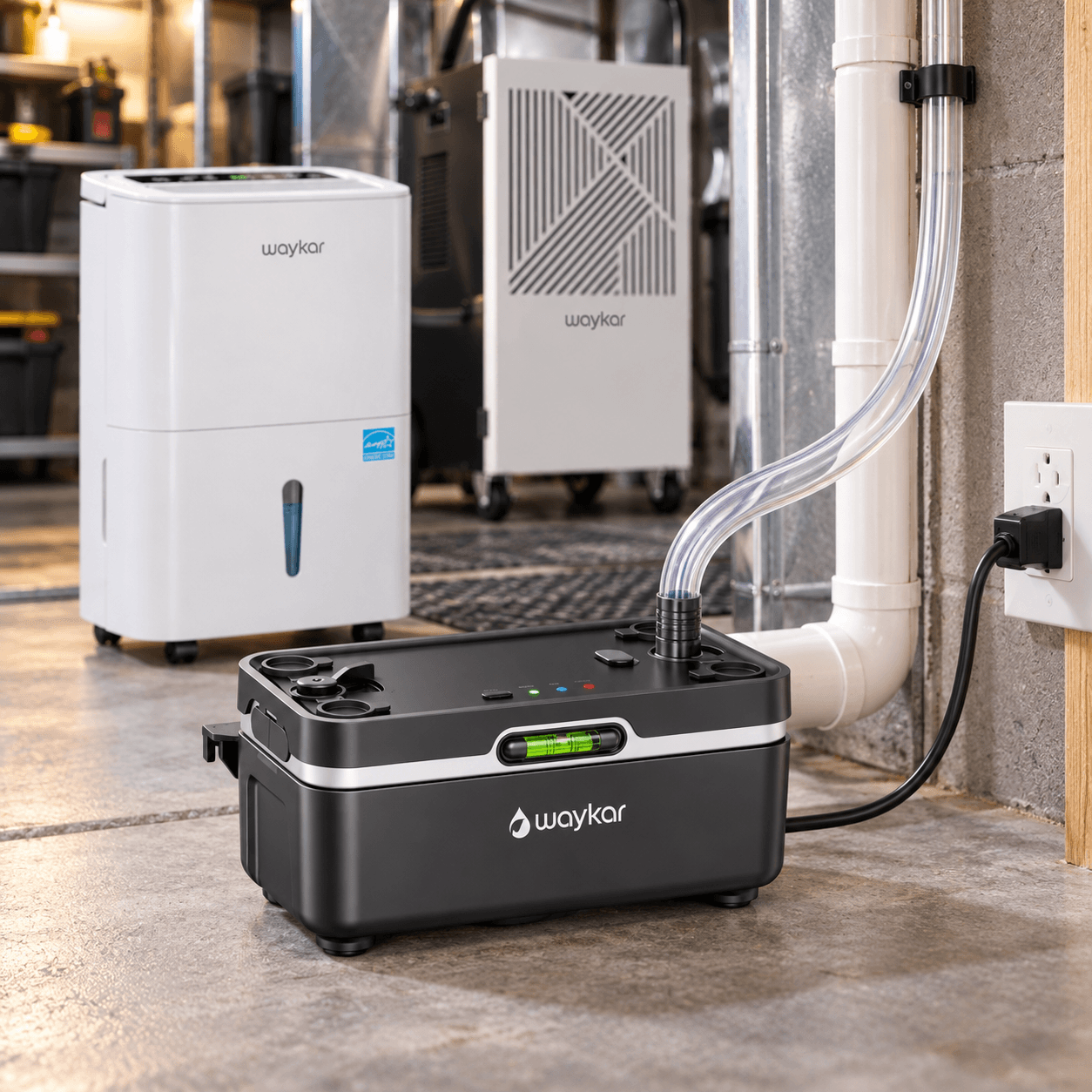
The pump operates at just twenty-five decibels, which is notably quiet for a condensate pump. That low noise level comes from a water-cooled brushless DC motor, a design choice that reduces both acoustic output and mechanical wear. The motor is rated for a thirty-thousand-hour lifespan, suggesting years of service even in continuous-duty applications. With a 1/50 horsepower motor, a flow rate of 127 gallons per hour, and a maximum lift of 24.6 feet, the pump has enough capacity for residential HVAC systems as well as many light commercial setups.
One of the more thoughtful engineering details is the probe sensor technology. Traditional condensate pumps rely on mechanical floats, which can stick, crack, or accumulate debris over time. Probe sensors eliminate the float entirely, reducing the number of moving parts that can fail. An overflow safety switch adds a layer of protection by shutting down the connected appliance if the pump cannot keep up with condensate production. A micron-level filter helps keep debris out of the pump mechanism, and a three-color status indicator provides at-a-glance feedback on operating condition.
This product illustrates Waykar’s broader strategy. The company does not only address humidity at the point of extraction; it also addresses the infrastructure that makes sustained moisture control possible. A dehumidifier can remove water from the air, but without a reliable way to drain that water, the unit becomes a maintenance burden. The condensate pump closes that loop.
Product in Focus: Waykar Pin-Type Moisture Meter
Measurement is the foundation of effective moisture control. Before choosing a dehumidifier, before declaring a water-damage job complete, and before installing hardwood flooring or drywall, it helps to know exactly how much moisture is present in the material. The Waykar Pin-Type Moisture Meter is a compact diagnostic tool designed for this purpose, offering two measurement modes for wood and building materials.
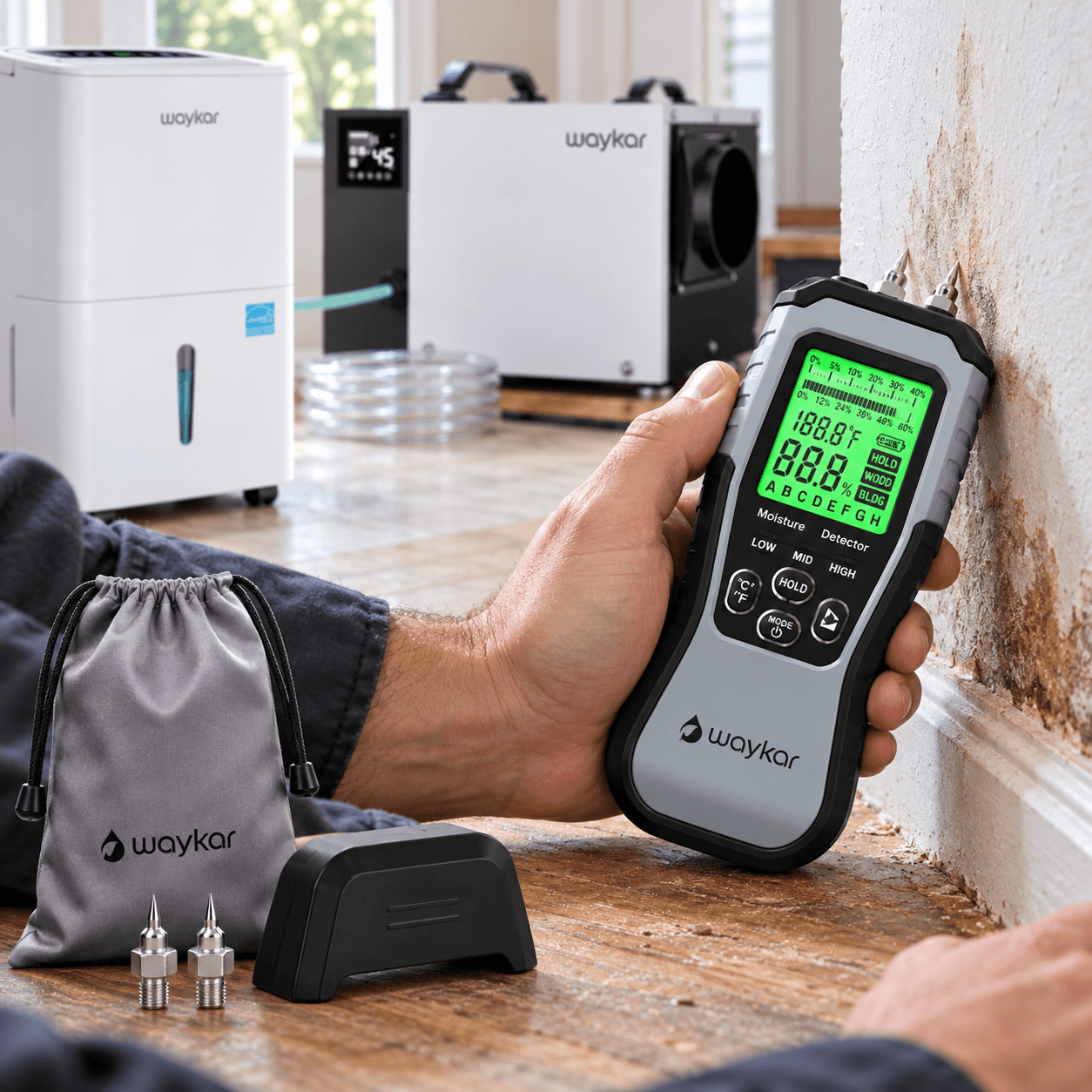
For wood, the meter measures moisture content from six to sixty percent. For building materials such as drywall, plaster, and concrete, the range is 1.5 to thirty-three percent. Accuracy is rated at plus or minus two percent with a resolution of 0.1 percent, which is sufficient for most construction, woodworking, and home-inspection tasks. Eight selectable wood groups allow users to calibrate the device for more than one hundred wood species, improving accuracy across different densities.
The interface is designed for quick interpretation. A backlit LCD display is easy to read in dim crawl spaces or corners of basements. Color-coded indicator lights, green, yellow, and red, give an immediate sense of whether a reading is low, moderate, or high. Additional features include a hold function for recording readings in awkward positions, an auto shutoff after three minutes of inactivity to preserve battery life, and a self-check feature to confirm that the device is functioning correctly. The included spare pins and carrying pouch add practical value for professionals who use the meter regularly.
This moisture meter fits naturally into the Waykar ecosystem. It is the diagnostic complement to the therapeutic dehumidifiers. Homeowners can use it to identify problem areas before buying equipment. Contractors can use it to document conditions before and after drying jobs. Woodworkers can use it to verify that lumber is ready for finishing. The meter is not the most visible product in the lineup, but it is one of the most useful for anyone who takes moisture seriously.
The Common Threads: Design, Efficiency, and Support
Across these five products, several themes emerge. The first is quiet operation. Waykar seems to treat noise as a quality-of-life issue rather than a secondary specification. Whether it is a residential dehumidifier running at forty-two decibels or a condensate pump operating at twenty-five decibels, the company prioritizes acoustic comfort. This matters because moisture-control equipment often runs continuously in occupied spaces. A loud machine discourages use, which defeats the purpose.
The second theme is automation. Auto-defrost, auto-restart, automatic pump systems, humidity sensors, and programmable timers reduce the mental load on users. These features allow the equipment to respond to changing conditions without constant adjustment. In practical terms, that means fewer trips to the basement, less anxiety about power outages, and more consistent indoor air quality.
The third theme is energy efficiency. From the Energy Star certification on the 80-pint dehumidifier to the efficient rotary compressors in the larger units, Waykar designs products that minimize power consumption relative to performance. This is environmentally responsible, but it is also economically sensible. Lower operating costs improve the total cost of ownership and make it easier to justify running the equipment as much as needed.
The fourth theme is support. Warranties of five years, return guarantees, lifetime technical assistance, and durable construction all communicate that Waykar expects its products to last. In a market where disposable appliances are common, this emphasis on longevity is refreshing. It also aligns with the brand’s sustainability claims: longer-lasting products create less waste.
Finally, there is the theme of scalability. Waykar offers a clear progression from residential to crawl-space to commercial dehumidification, plus the supporting tools that make each application work. This allows buyers to choose the right level of equipment for their specific situation rather than overbuying or underbuying.
Choosing the Right Waykar Product for Your Situation
With several models available, selecting the right unit depends on honest assessment of the space and the problem. For a typical homeowner dealing with dampness in a basement, large living area, or multiple rooms, the 80 Pints Energy Star Dehumidifier is the natural starting point. It balances capacity, efficiency, and quiet operation in a form factor that fits residential life.
For crawl spaces, the decision is clearer. The 125 Pint Crawl Space Dehumidifier is specifically engineered for low-clearance, high-humidity environments. Its compact size, built-in pump, and durable construction make it suitable for spaces where a standard portable unit would struggle or fail.
For larger commercial or industrial applications, water-damage restoration, indoor pools, or warehouses, the 155 Pints Commercial Dehumidifier provides the necessary extraction rate and coverage. Its portability also makes it attractive for contractors who need to move equipment between job sites.
The HVAC Condensate Pump is a supporting tool rather than a standalone humidity solution. It is the right choice when an air conditioner, furnace, ice maker, or dehumidifier needs to discharge condensate to a location above the unit or far from a floor drain.
The Pin-Type Moisture Meter is useful across all of these scenarios. It helps diagnose the problem before selecting equipment, verifies progress during drying, and confirms that materials are ready for finishing or installation. For professionals, it is a practical everyday tool. For homeowners, it removes guesswork from moisture management.
Conclusion: A Brand Worth Knowing
Waykar has built its identity around a single, important idea: indoor air quality is not a luxury, and moisture control is not an afterthought. The company’s product line demonstrates what happens when a manufacturer focuses deeply on one problem rather than spreading its attention across dozens of unrelated appliances. The result is equipment that is quieter, more efficient, more durable, and easier to live with than much of the competition.
The five products examined here tell that story from different angles. The 80 Pints Energy Star Dehumidifier brings professional-grade capacity into the home. The 125 Pint Crawl Space Dehumidifier solves one of the most stubborn moisture problems in residential construction. The 155 Pints Commercial Dehumidifier scales that solution for industrial and commercial spaces. The HVAC Condensate Pump handles the drainage infrastructure that makes sustained moisture control possible. And the Pin-Type Moisture Meter gives users the data they need to make informed decisions.
What unites them is a respect for the spaces they serve. Waykar does not ask users to tolerate noise, complexity, or disposable construction in exchange for dry air. Instead, the brand offers a coherent system for managing moisture at every level, from measurement to extraction to drainage. For anyone who has ever walked into a damp basement and wished for a better answer, that system is worth exploring.