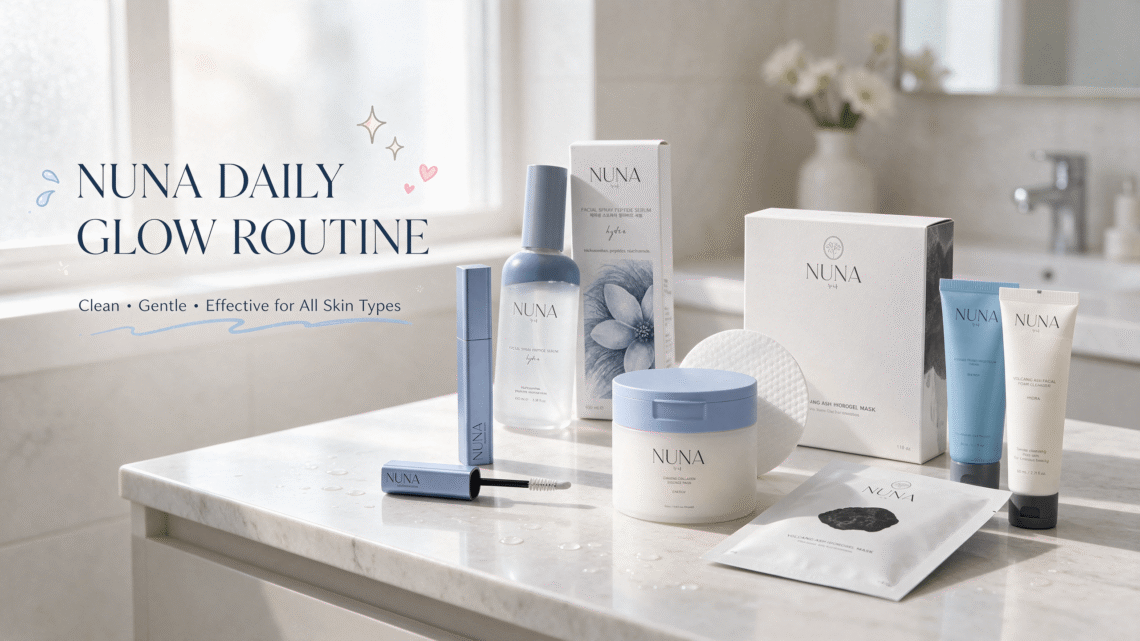
Walk past any skincare shelf long enough and a pattern shows up. One brand sells you a fragrance, another sells you a laboratory, a third sells you a ritual borrowed from a grandmother’s bathroom cabinet. NUNA Beauty Lab sells none of those three, and that is the most interesting thing about it. What it sells is a grammar — a small, repeatable set of ingredients and textures that shows up again and again across a lash serum, a mist, a cream, a jar of pads, a foam, and a hydrogel mask, until you realize you were never looking at six separate products. You were looking at one idea of hydration, expressed six different ways.
This is a close read of that idea. We will start with the brand itself — what it seems to be optimizing for, and what it has quietly decided not to do — then move through the six formulas in the order your skin would actually meet them: cleanse, flood, seal, treat, repair, and finish at the eye area. Along the way you will find scan tables, a couple of honest frictions, and three complete routines assembled from the same six shelves.
If you have been hunting for a Korean skincare routine that does not require ten steps, four of which you will abandon by week two, this is the brand worth reading carefully.
First, the brand: what NUNA Beauty Lab is actually optimizing for
Most brand stories are told backwards — a mood board first, a formula later. NUNA’s story is easier to read forwards, because it is written on the labels.
Look at where the ingredients come from. Volcanic ash from Jeju Island. Jeju sea water. Camellia japonica oil and extract. Centella asiatica, ginseng root, houttuynia, portulaca, citrus unshiu — a list that reads like a survey of the Korean peninsula’s coastline, its hot springs, and its shaded hillsides. Now look at what sits next to those on the same ingredient deck: an eight-peptide blend, niacinamide measured to a percentage, a multi-molecular hyaluronic acid matrix, ceramide NP, ectoin, hydrolyzed hyaluronic acid, a seventeen-amino-acid complex.
⌜ Lab Note ⌟ NUNA’s naming convention is telling. It does not call itself “NUNA Botanicals” or “NUNA Hanbang.” It calls itself a Lab — and then fills that lab with plants. The botanicals are the raw material; the lab is the standard they have to pass.
That juxtaposition is the whole brand in one sentence: traditional Korean botanicals are treated as candidates, not as credentials. A plant extract earns its place on a NUNA label by doing a job — buffering a wash, supporting a barrier, carrying water to a specific depth — not by having a nice story.
Three design convictions fall out of that, and you can verify all three by reading any two products side by side.
1. Hydration is a system, not a step. Water is not delivered by one molecule at one depth. It is delivered by a matrix: high-molecular hyaluronic acid sitting on the surface, lower-molecular and hydrolyzed forms moving beneath, amino acids and panthenol holding the reserve, and — critically — something on top to stop it leaving. That is why the cleanser has hyaluronic acid in it. A cleanser is a rinse-off product; putting HA in one is commercially illogical unless you are building a system rather than a hero.
2. Texture is a functional choice, and NUNA keeps choosing the doubled one. Dual-phase serum spray. Double-phase hydration cream. Hydrogel that turns transparent as it gives up its essence. A pad you can swipe in thirty seconds or leave for fifteen minutes. Nothing here is a single-mode product. The brand seems genuinely uninterested in the “one texture, one use” convention, and interested in formulas that adapt to the day you are having.
3. Comfort is a hard constraint, not a bonus. Dermatologist-tested for sensitive eyes. Prostaglandin-, paraben- and sulfate-free. Coconut-derived surfactants instead of the harsher foaming agents. Madecassoside and allantoin as standing calibers. Ectoin in the cream. The pattern is clear: before NUNA asks a formula to do something, it asks the formula not to take something.
And then there is the visual identity, which is unusually consistent for a young brand — powder blue, muted slate, generous white space, a serif wordmark under a fine line-drawn daisy, Korean characters beside Latin ones rather than underneath them. No gradients screaming “GLOW.” No gold foil. The restraint is the pitch: we would rather look like a well-run lab than a luxury house, because that is what we are claiming to be.
The ingredient grammar: five repeaters you will see on every NUNA label
Once you can read the repeaters, every new product on the shelf becomes easy to place. Here is the vocabulary.
| Repeater | Where it shows up | What it is doing in the formula |
|---|---|---|
| Jeju volcanic ash + kaolin | Foam cleanser, hydrogel mask | A mineral duo that pulls oil and congestion out of pores without mechanical scrubbing |
| Multi-weight / hydrolyzed hyaluronic acid | All six products, in some form | Layered water delivery and retention at different depths, rather than a single surface film |
| Centella asiatica → madecassoside | Lash serum, pads, cream, cleanser | The calming backbone; redness control and barrier recovery while actives work |
| Peptide complexes | Lash serum (Hexapeptide-9, Nonapeptide-1, Copper Tripeptide-1), serum spray (8-peptide blend) | Firmness, follicle and lash support, the “lab” half of the brand |
| Fermentation & marine actives | Pads (fermented ginseng, Lactobacillus ferment), cream (Jeju sea water, pearl extract), mask (Chondrus crispus / Irish moss) | Better bioavailability, plus cooling, luminosity and texture |
Notice what is absent: high-proof alcohol as a filler, essential-oil heavy fragrance architectures, and the prostaglandin analogues that dominate the lash-serum category. Absences are brand decisions too.
Six products, read as one system
Here is the whole shelf in one scan before we go deep.
| # | Product | Size | Category leader actives | Reach for it when |
|---|---|---|---|---|
| 1 | Hydra Volcanic Ash Facial Foam Cleanser | 2.7 fl oz | Volcanic ash, kaolin, 17-amino acid complex, hydrolyzed HA, centella | You want a deep-clean feel with zero tightness afterward |
| 2 | Ultra Hydrating Face Serum Spray | 3.38 fl oz | 8-peptide blend, 2% niacinamide, multi-HA, squalane + jojoba/grapeseed/sunflower | Your routine is too long, or your midday skin is too dry |
| 3 | Double Phase Hydration Cream | 2.71 fl oz (80 ml) | Multi-HA, ceramide NP, camellia japonica oil & extract, ectoin, madecassoside | Your barrier feels thin, or your serum keeps evaporating |
| 4 | Ginseng Collagen Essence Pads | 70 pads | Dual collagen, fermented ginseng root, Lactobacillus ferment, multi-HA, centella | You want treatment-grade results in 30 seconds — or a 15-minute mask |
| 5 | Volcanic Ash Hydrogel Face Masks | Pack of 7 | Jeju volcanic ash, triple HA, ceramide NP, allantoin, panthenol, Irish moss hydrogel | An event is coming, or a whole week needs catching up |
| 6 | Eyelash Growth Support Serum | 6 ml (6-month supply) | Biotin, panthenol, 3-peptide complex, four Korean botanical extracts | Lashes look sparse and you want a prostaglandin-free path |
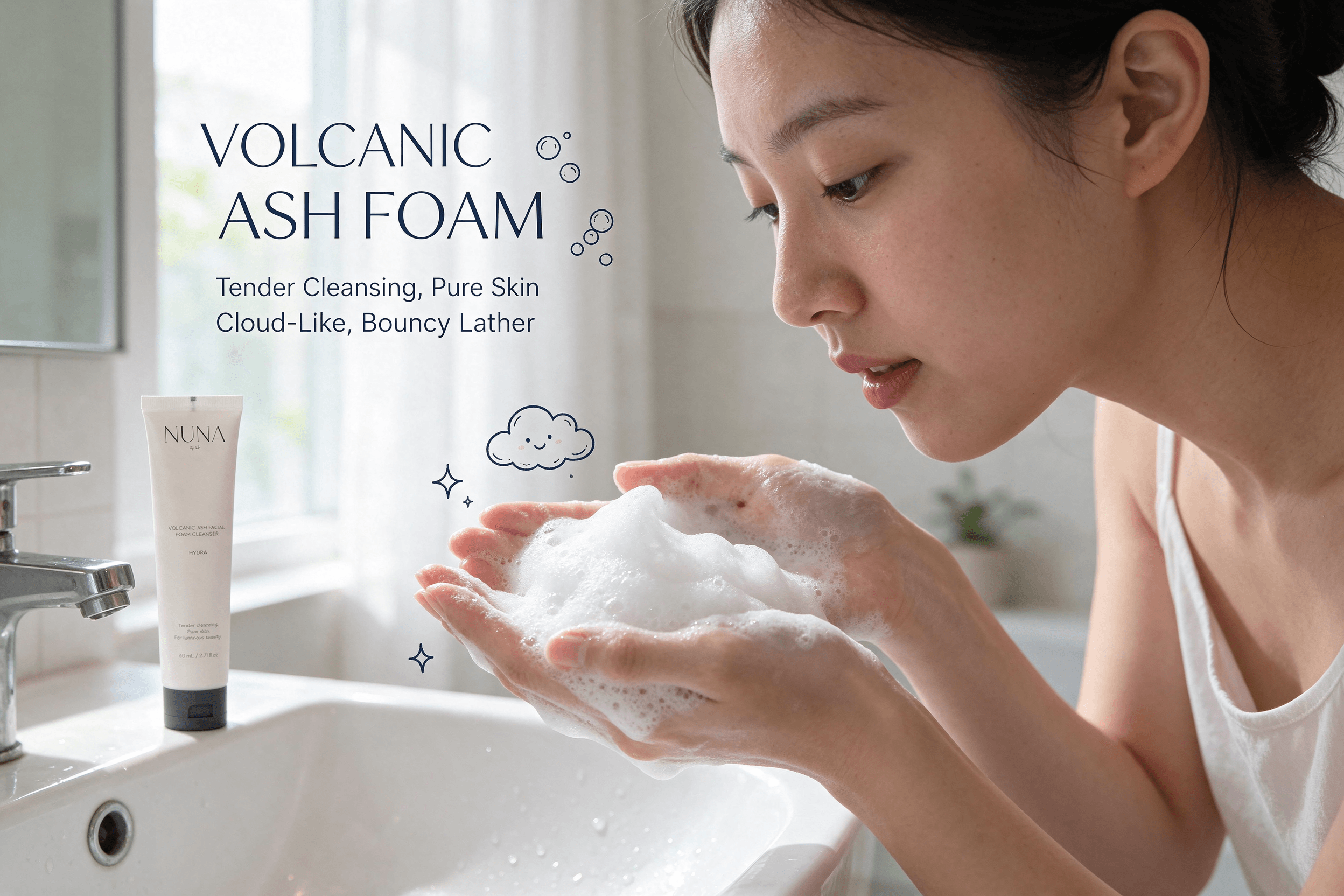
1. The cleanser everyone under-buys: Hydra Volcanic Ash Facial Foam Cleanser
There is a specific kind of customer who spends generously on serums and grabs whatever wash is on sale. That customer is the reason most barrier problems never resolve. Everything downstream of a stripping cleanser is damage control.
NUNA’s answer is a mineral duo, and it is a smarter one than “charcoal” or “clay” as a headline. Jeju Island volcanic ash handles the oily, congested, oxidized material sitting in a pore. Kaolin takes the finer surface sebum and dullness. Together they do the work that a scrubbing motion would otherwise do — which matters, because scrubbing is how a “deep clean” becomes a red, reactive face.
Then the formula does the part that makes it a NUNA product rather than a generic detox wash:
- Hydrolyzed hyaluronic acid and mineral-rich Jeju sea water so the rinse does not take your water reserve with it
- A 17-amino acid complex, the same class of molecules that lines your own natural moisturizing factor
- Centella asiatica to keep the whole exercise calm
- Coconut-derived surfactants — a genuinely rich, creamy lather from a pea-sized amount, without the squeak
⌜ At the sink ⌟ Pea-sized. Not walnut, not quarter. Work it into a lather with wet hands first, then press it onto the face — do not drag it. Thirty seconds of contact is the maximum a mineral wash needs; the point is absorption of oil, not exfoliation by friction.
Best for: all skin types including sensitive; combination and oily skins who want real purification without the tight-post-wash feeling; anyone using a hydrogel mask or an active serum and needing step one to stop sabotaging step three.
2. The bottle that refuses to pick a job: Ultra Hydrating Face Serum Spray
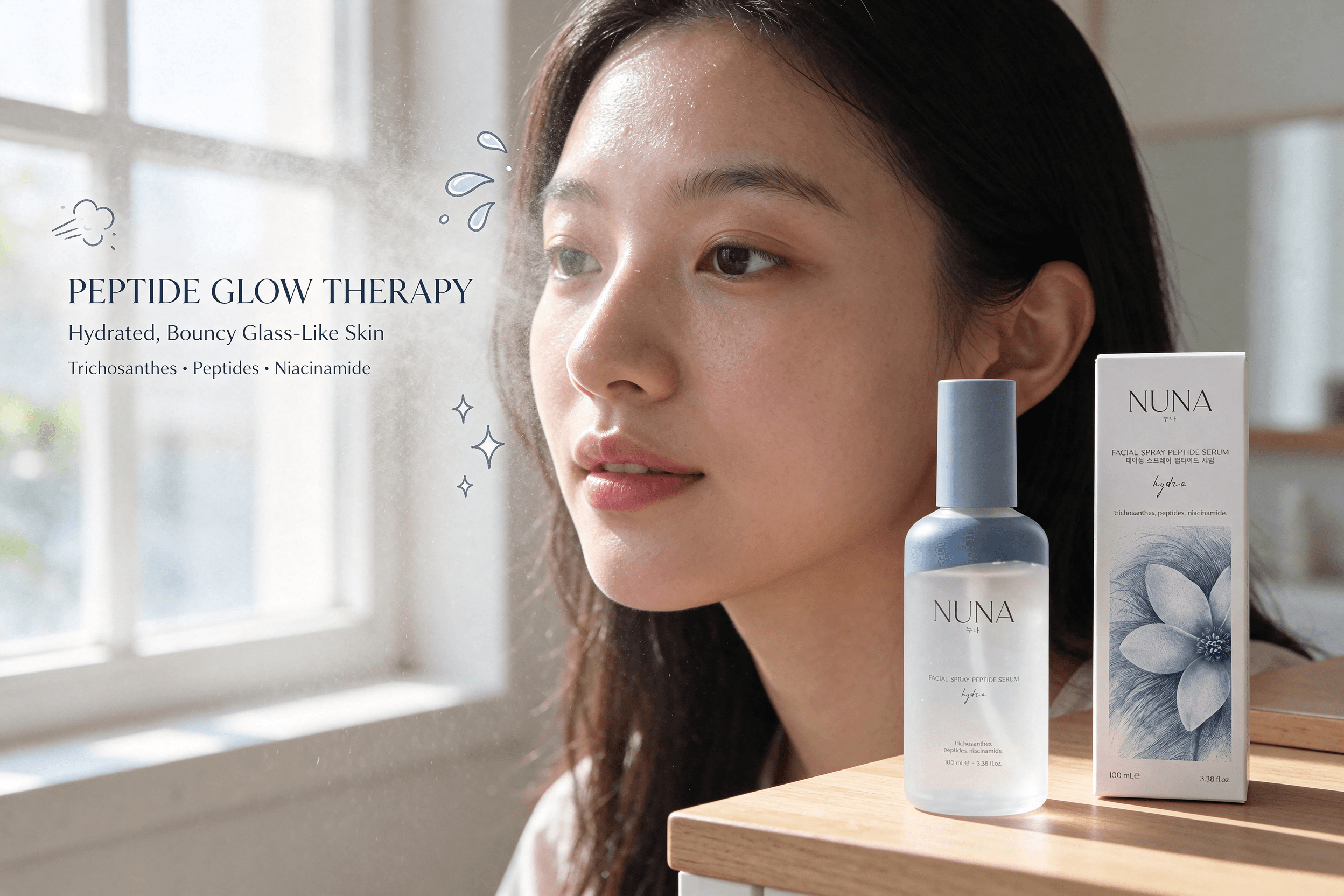
Dual-phase. Which means: shake it. That single instruction is doing a lot of work here, because it tells you this is not a mist with a nice name — it is a serum and a mist in one container, unblended until the moment you use it.
The 3.38 fl oz format is deliberate. A product meant to be sprayed at 9 a.m., again at 2 p.m., and again over makeup at 6 p.m. cannot come in a 1 fl oz dropper bottle.
What is inside, and why it earns the word “ultra”:
- A biomimetic 8-peptide blend for firmness and bounce — the anti-fatigue half of the formula
- 2% niacinamide for barrier support and tone evenness, at a concentration that is effective without being the aggressive 5–10% many skins cannot tolerate
- Multiple molecular weights of hyaluronic acid, so hydration is not stranded on the surface
- Squalane plus jojoba, sunflower seed and grapeseed oils — antioxidant and lipid care from oils chosen for not clogging pores
- Marine botanicals rounding out the Jeju signature
Three legitimate jobs, one bottle:
- As a toner. First layer on damp skin after cleansing; it preps and lowers the “thirst” that makes serums feel tacky.
- As a setting spray. Over makeup, fine mist, pressed in with a palm rather than fanned wildly. Dewy rather than matte.
- As a midday reset. The one nobody thinks to plan for: cabin humidity on a long-haul flight, air-conditioned office, post-gym, pre-dinner when the face has gone flat and cakey at the same time.
Best for: people whose routines are too long to maintain; oily and combination skins who refuse to layer a cream in summer but still feel dehydrated by 3 p.m.; anyone chasing the glass-skin finish without a ten-step schedule.
3. Sealing without suffocating: Double Phase Hydration Cream
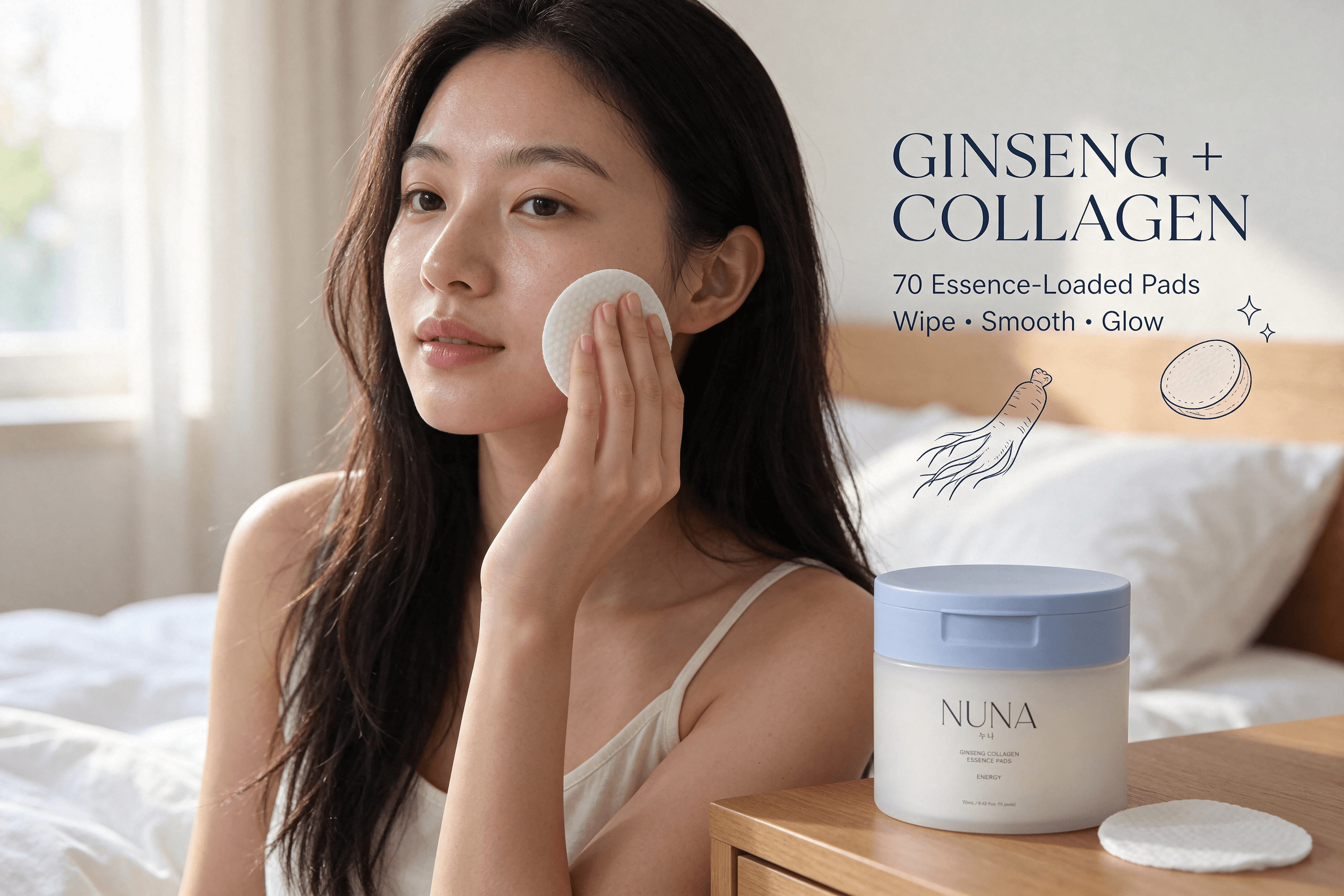
If the spray is the flood, this 2.71 fl oz (80 ml) tube is the levee. And it is a two-material levee.
The gel phase carries Jeju sea water and pearl extract, giving a refreshing, cooling hit that sinks in without a sticky collar. The cream phase carries the structural lipids and the barrier actives. NUNA has resisted the temptation to pick a side — the classic dilemma where oily skin skips the cream and dehydrated skin loads it — by putting both textures in one tube and letting the ratio answer the question on any given day.
The active deck is the most classically “barrier” list on the shelf:
| Active | Role in this cream |
|---|---|
| Multi-hyaluronic acid | Water at several depths, not one surface film |
| Ceramide NP | Rebuilds the lipid mortar between skin cells |
| Camellia japonica oil & extract | Korean botanical lipid; softening, plus the brand’s flower signature |
| Ectoin | The stress-protection molecule — the reason this survives cold wind and cabin air |
| Madecassoside | Centella-derived calming agent for reactive, over-treated skin |
Apply it as the final step, face and neck, pressing rather than rubbing until it disappears. Clinically tested for skin compatibility, which matters more here than anywhere else — the last product in a routine is the one that has to hold up under everything upstream of it.
💬 Counter Chat “I’m oily. Do I need a cream at all?” “You need a cream that doesn’t fight your skin. That’s why this one is half gel — use less in July, more in January, same tube.” “And if I’m using the volcanic mask that same week?” “Then the cream is non-negotiable. The mask opens the door for water; the cream is what stops it walking back out.”
4. The thirty-second version and the fifteen-minute version: Ginseng Collagen Essence Pads
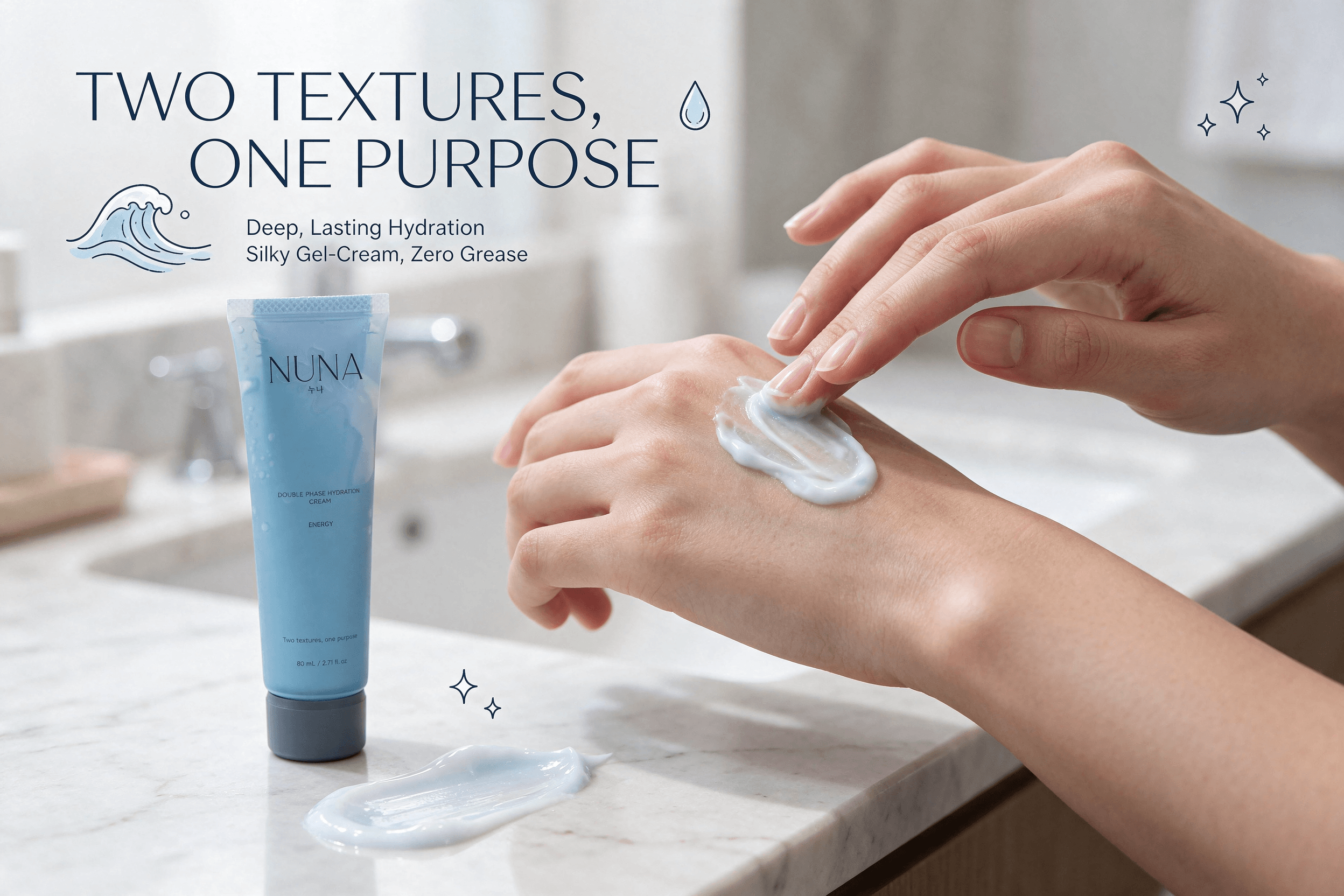
Pre-soaked pads are the most misunderstood category in Korean skincare, because on paper they look like a convenience product — a lazy toner step for people who cannot be bothered with cotton rounds. Seventy pads in a frosted jar with a pastel blue lid says “bathroom counter, every day.”
The formula says something else. This is a treatment deck:
- Dual collagen for immediate plumping and a soft, cushioned surface feel
- Fermented ginseng root extract — the fermentation matters, because it is the difference between a traditional herb and a bioavailable active
- Lactobacillus ferment, the skin-microbiome half of the formula
- A multi-hyaluronic acid matrix for layered water
- Centella asiatica, delivered via madecassoside, for redness and pore-looking balance
And it is genuinely dual-mode, which is where the value hides:
Mode A — the daily swipe (30 seconds). Pull one pad, sweep across cleansed skin, follow with serum or cream. It replaces toner and the mild resurfacing pass, without an acid.
Mode B — the targeted leave-on (up to 15 minutes). Lay pads on the forehead, nasolabial folds, under-eye, or wherever a blemish or dry patch is being difficult. A spot mask that requires no mixing, no cleanup, and no second product.
Best for: the dark-spots-plus-fine-lines-plus-redness crowd, who usually get sold three separate products. Also the single most practical thing here for anyone with a busy-handicap: the step you will actually keep doing at 11 p.m.
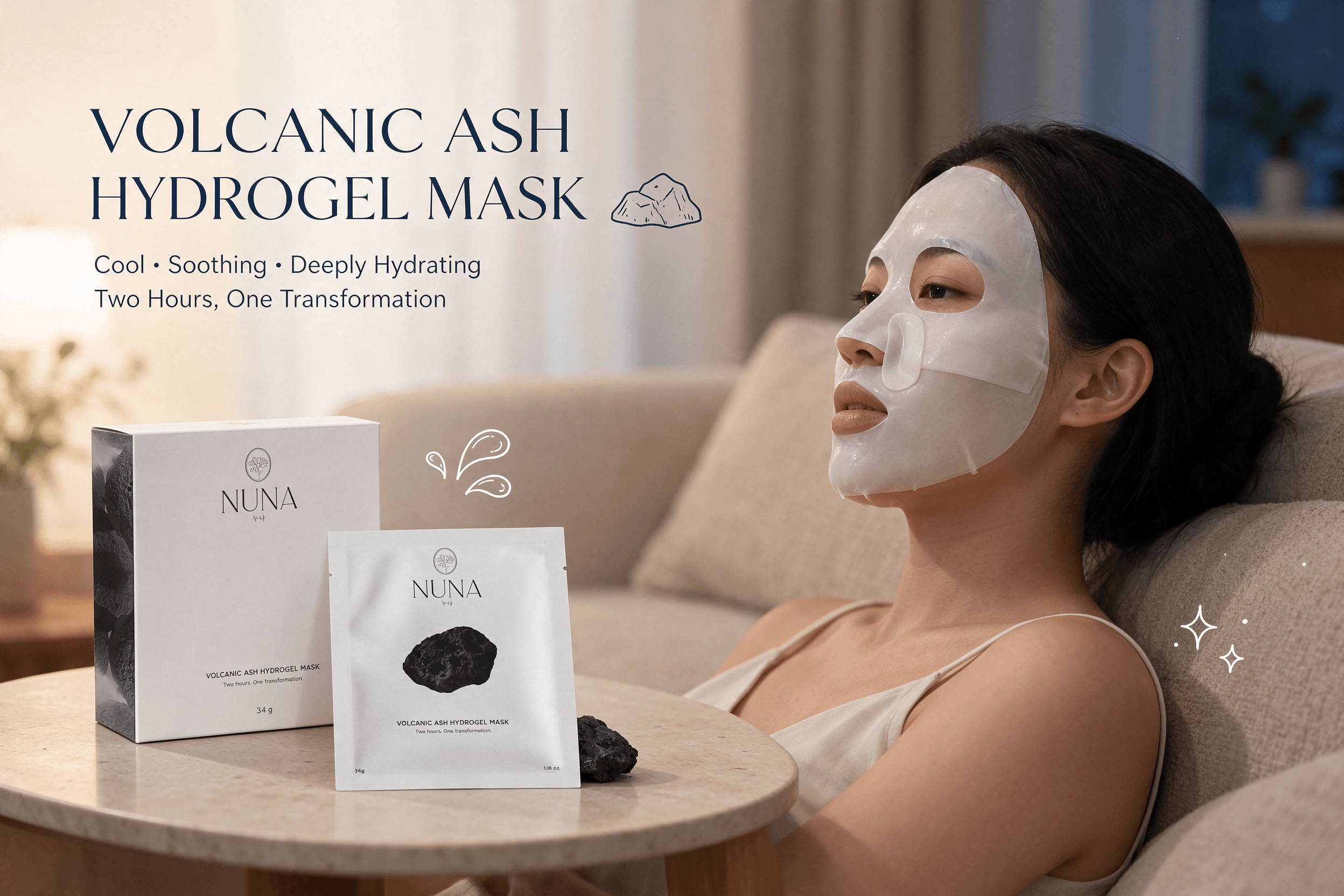
5. Overnight repair, with two patches nobody thought to add: Volcanic Ash Hydrogel Face Masks
Seven masks per pack, and the design detail people mention first is not the volcanic ash.
It is the two extra patches for the smile lines.
That is a genuinely observant piece of pattern-making. Most hydrogel masks stop at cheeks, eyes and forehead, and the nasolabial area — the place expression actually lives, and the first place a plumped appearance reads as younger — is left to whatever is left over. NUNA built the extensions in.
The rest of the formula follows the brand’s system logic rather than the “detox mask” convention:
- Jeju volcanic ash working inside a leave-on, drawing congestion over hours instead of sixty seconds
- A triple hyaluronic acid complex for the deep-water load
- Ceramide NP and allantoin to keep the barrier intact while the mineral work happens
- Panthenol for comfort and surface repair
- Chondrus crispus (Irish moss) forming the hydrogel itself — the cooling, adherent, second-skin base
The clever behavioural feature: the mask turns transparent as the essence is absorbed. You get visible feedback. You know when to take it off, and you are not guessing from a timer on your phone.
Two usage windows:
- 2–3 hours as an intensive treatment before an event.
- Overnight as recovery, which is the unusual one and the one the brand clearly intends.
⌜ Cold trick ⌟ Keep the pouches in the fridge. The Irish-moss hydrogel’s cooling effect is noticeably sharper chilled, and on inflamed or sun-heated skin that shift is the difference between “nice mask” and “why did I wait this long.”
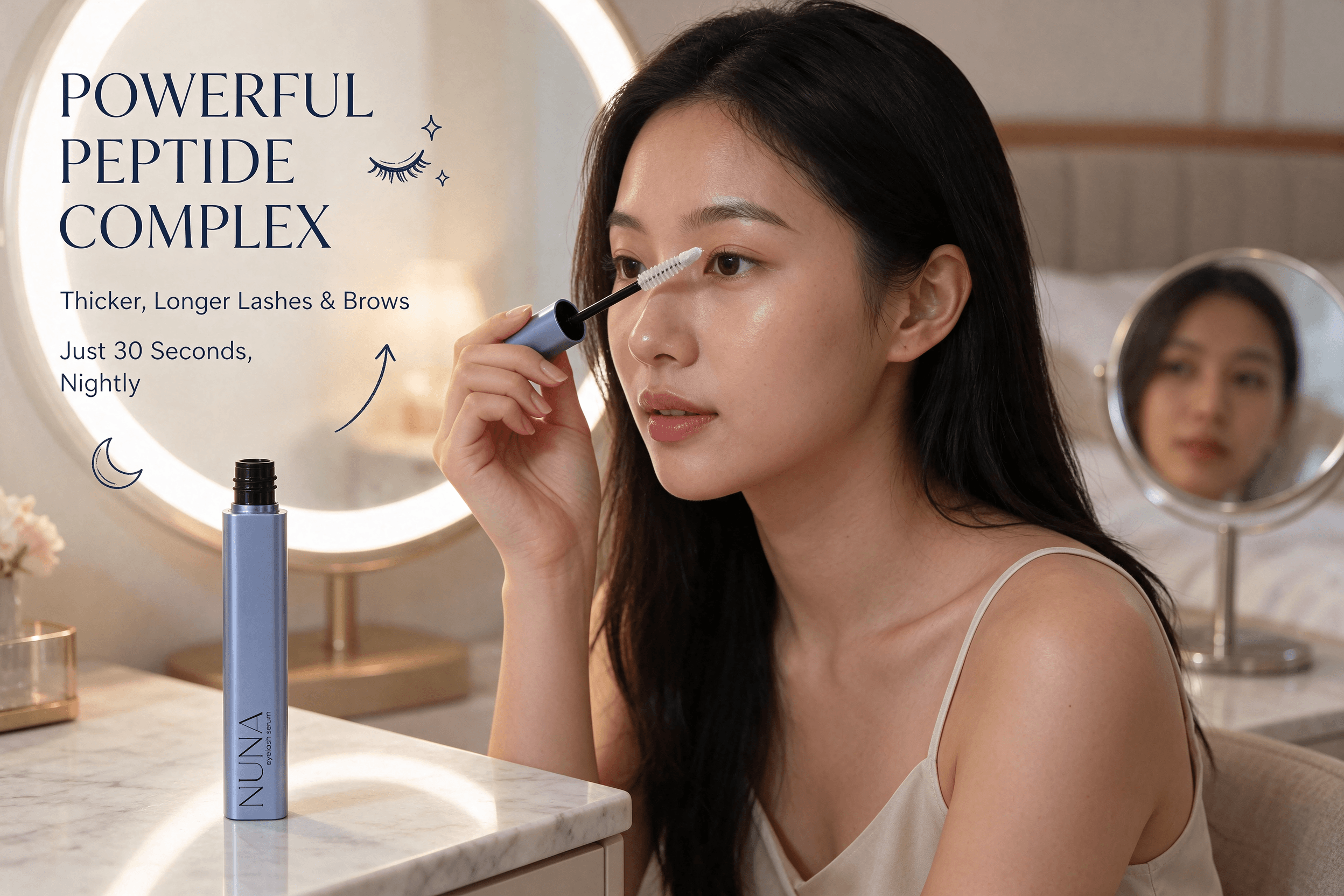
6. The six-month commitment in a 6 ml tube: Eyelash Growth Support Serum
Six millilitres. Read that number again, because it is the most common hesitation with this product — and the least valid one.
A lash serum is applied along the lash line and the brow, once a day, in a film thinner than a eyeliner stroke. NUNA specifies five seconds before bed with the fine-tip applicator wand. At that dose, 6 ml is a six-month supply, which is a longer horizon than almost any competitor’s 3 ml or 5 ml offering. Small tube, unusually good maths.
What is in it:
- Biotin and panthenol as the nourishment base
- A peptide complex — Hexapeptide-9, Nonapeptide-1 and Copper Tripeptide-1 — supporting follicle strength and the lash’s own structure
- Four Korean botanical extracts: Centella asiatica, Houttuynia cordata, Citrus unshiu, Portulaca oleracea, for hydration and a calm lash line
And what is deliberately not in it, which is the more important list:
- No prostaglandins — the analogue class associated with the notorious orbital fat loss, iris darkening and irritation that a lot of shoppers have learned to fear
- No parabens, no sulfates
- 100% vegan and cruelty-free
- Dermatologist-tested for sensitive eyes, suitable for men and women, all skin types
Realistic timeline: the brand cites visible change in 4–6 weeks. Treat that as an earliest-window figure rather than a promise. Lash cycles are slow, and a serum that shows dramatic change in a fortnight is asking uncomfortable questions about what is in it. The prostaglandin-free formulation is precisely why this one takes the full cycle — that is the trade, and it is the right one to make.
Three routines built from the same six shelves
A. The five-minute barrier repair (for skin that has been over-treated)
- Hydra Volcanic Ash Cleanser — 30 seconds, lukewarm, no dragging
- Ginseng Collagen Essence Pads — one pad, swipe only, no leave-on
- Double Phase Hydration Cream — press into face and neck
- Eyelash Growth Support Serum — lash line and brows, then lights out
B. The event-week glass-skin build
- Morning: cleanse → Serum Spray as toner → Cream → SPF
- Evening: cleanse → pads left on 15 minutes on problem areas → Serum Spray → Cream
- Twice that week: Volcanic Ash Hydrogel Mask, 2–3 hours (or one overnight)
- Every night, no exceptions: lash serum, five seconds
C. The minimal starter (three products, no guilt)
- Cleanser
- Serum Spray — the toner, the midday refresh and the setting spray at once
- Cream
Add the pads when the routine survives a fortnight. Add the mask when something is coming up. Add the serum whenever you decide your lashes deserve a six-month plan.
Small frictions worth knowing before you buy
No shelf is flawless, and a brand this restrained has a few predictable trade-offs:
- Dual-phase means shaking. Both the spray and the cream are two textures in one container. If you are the person who grabs a product one-handed while half-awake, build the habit or the payoff drops.
- The mask is a time commitment. Two to three hours, or overnight. This is not a fifteen-minute shower mask, and a seven-pack is a week of evenings, not a single Sunday.
- The lash tube looks alarming. Six millilitres reads like a sample until you do the dose maths. Buy the concept, not the volume.
- Results are stated as ranges, not guarantees. Four to six weeks on lashes; “up to 15 minutes” on pads. Anyone wanting an overnight transformation should temper expectations — the formulation choices here lean toward skin that will still be in good shape in a year, not skin that photographs differently tomorrow.
- The visual language is quiet. If you enjoy your skincare looking like a jewellery drawer, this powder-blue-and-white lab aesthetic will read as understated. That is a feature for most buyers and a genuine mismatch for some.
Frequently asked questions
Is NUNA Beauty Lab a Korean brand?
Yes — NUNA Beauty Lab is a Korean skincare brand, and the Korean identity is structural rather than decorative: Korean characters sit inside the logo, Jeju-sourced minerals and sea water anchor several formulas, and the botanical deck (centella, ginseng, houttuynia, portulaca, camellia, citrus unshiu) is drawn from Korean growing traditions. The difference from a lot of K-beauty is the pairing: those botanicals sit alongside a quantified peptide-and-niacinamide program rather than replacing it.
Does the NUNA lash serum contain prostaglandins?
No. The Eyelash Growth Support Serum is formulated without prostaglandins, parabens or sulfates, and is vegan and cruelty-free. The lash and brow support comes from biotin, panthenol, a three-peptide complex (Hexapeptide-9, Nonapeptide-1, Copper Tripeptide-1) and four Korean botanical extracts. It is dermatologist-tested for sensitive eyes.
Can I use the Ultra Hydrating Face Serum Spray instead of a toner?
Yes — that is one of its three intended jobs, alongside makeup setting and midday hydration. Shake the dual-phase bottle first so the serum and mist phases blend. If your routine is currently cleanser → toner → essence → serum → mist, the spray is the consolidation step.
Are NUNA products suitable for sensitive skin?
The brand consistently designs for it: centella and madecassoside recur across the line, the cream carries ectoin and is clinically tested for skin compatibility, the cleanser uses coconut-derived surfactants, and the lash serum is dermatologist-tested for sensitive eyes. As with any new product, patch-test on the inner forearm for 24 hours before a full-face first use.
How often should I use the Volcanic Ash Hydrogel Face Masks?
Two to three hours for an intensive pre-event treatment, or overnight for recovery. Because volcanic ash is doing mineral purification inside a leave-on, most skins will want two to three times a week rather than nightly — and a seven-pack is sized around exactly that cadence. Chill the pouches for a sharper cooling effect.
Do the Ginseng Collagen Essence Pads replace exfoliating pads?
They are a different tool. Acid-free exfoliating pads work by dissolving the bonds between dull surface cells; these pads work by flooding the skin with dual collagen, fermented ginseng, Lactobacillus ferment, a multi-HA matrix and centella. The result is plumper, calmer, more even-looking skin without an acid step — which is why they can be used daily, and why they suit skins that cannot tolerate an AHA/BHA pad every morning.
What order do these six go in?
Cleanser → pads (swipe, or leave on 15 minutes and remove) → serum spray → mask (weekly, in place of the spray step) → cream → lash serum, last, at night.
The last thing to check
Here is the test any skincare brand should survive, and the one most fail quietly: if you bought two random products from the line, would they work together, or would they merely coexist?
With NUNA Beauty Lab, they work together, because the same five repeaters run underneath everything — Jeju minerals, layered hyaluronic acid, centella, peptides, and fermented or marine actives. The cleanser is not a different brand’s cleanser wearing a NUNA cap. The mask and the cream are arguing the same thesis from two different textures.
That coherence is rare, and it is worth more than any single hero product on the shelf. Routines fail because people buy eleven separate opinions. NUNA’s proposition is simpler: one idea of hydration, six ways to apply it — and a lab coat to prove it was thought through.
Start with the three-product minimal routine above, keep it for a month, and add the rest only where your skin asks for it. That is, incidentally, exactly how a lab would tell you to test a hypothesis.