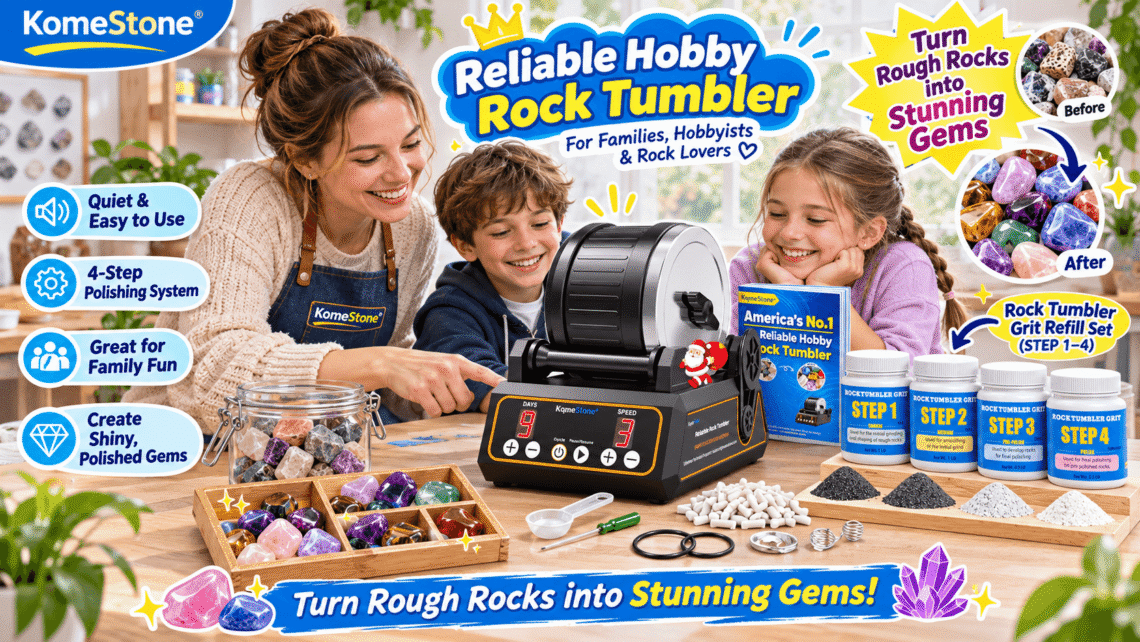
If you have ever stood in front of a classic rock tumbler at a school fair and thought, “This looks magical, but also incredibly loud,” then you already understand the gap KomeStone set out to close. The KomeStone rock tumbler brand specializes in quiet, thoughtfully built rotary polisher kits and the refill media that keep them running — from the entry-level K1 Rock Tumbler Kit (2.5LB Quiet Polisher for Adults & Kids) to a complete 4LB rock polishing grit and ceramic media system. This article takes you inside the brand itself: who they are, what they build, and why hobbyists keep coming back long after their first batch of agates.
💡 If you only have 60 seconds: KomeStone is a specialist brand focused exclusively on hobbyist rock tumbling. Their two flagship entry points are the K1 tumbler kit and the 4LB grit refill bundle — a complete “machine + consumables” system designed so a beginner never has to guess which bag of powder comes next.
Who Is KomeStone, Anyway?
KomeStone is a brand that has staked its entire identity on one niche: rotary rock polishing for hobbyists. Not for lapidary workshops, not for industrial deburring, and not as a vague “science toy” with a geology sticker on it. Their entire product universe revolves around one simple loop — a person finds a rough stone, puts it in a barrel, walks away for a few weeks, and comes back to something that looks like it belongs in a jewelry store.
What makes the brand unusual is how disciplined that focus is. Most companies in this space treat tumblers as one SKU among hundreds of toys. KomeStone treats tumbling as a category of its own. Their Amazon storefront even brands itself around a single promise — being the “No.1 reliable hobby rock tumbler brand” — which is the kind of claim a brand only makes if it intends to live or die on customer reviews, warranty claims, and repeat refills.
You can feel that philosophy in the small things. A 30-day warranty on hobbyist hardware, free shipping above a modest order threshold, and a customer service reputation that owners specifically single out. In the brand’s own customer stories, one buyer put it plainly: “The product is great, the company is even better.” When a consumables business — grit, belts, barrels, replacement bases — sits next to the machines, it tells you KomeStone expects customers to stick around for years, not weeks.
🧠 The brand bet in one sentence: Make the machine quiet enough to live indoors, make the consumables impossible to confuse, and make the whole system last long enough to become a family ritual rather than a forgotten garage gadget.
The Problem This Brand Was Built Around
Rock tumbling as an American hobby dates back to the 1950s, and the equipment has barely changed since. A barrel rotates, grit wears the rocks down, and patience does the rest. But generations of beginners have quit the hobby for three predictable reasons, and every product decision KomeStone makes seems to answer one of them.
The noise problem. Classic tumblers sound like a small coffee grinder living in your garage. That is fine at a cabin, brutal in a suburban house with a napping toddler. KomeStone’s answer is noise-reducing rubber barrels and a dampening structure, with newer models moving to brushless motors that run smoother and quieter than brushed equivalents.
The confusion problem. Beginners open a kit, see four bags of grit, and have no idea in which order they go, how long to run each stage, or whether soft and hard rocks can mix. KomeStone’s answer is color-coded four-stage grit bundles, a full-color instruction manual, and timers that let people walk away without checking the machine obsessively.
The abandonment problem. A first batch takes weeks. If the belt slips, the barrel leaks, or the grit runs out mid-project, most people shelve the machine. KomeStone’s answer is spare belts in the box, a refill ecosystem, and — from what owners report — support that actually answers the phone when something goes wrong.
📚 For deeper background on the craft itself, hobbyists widely point to Steve Hart’s Modern Rock Tumbling as the most complete in-print reference on the subject, and it is worth reading alongside any kit manual you own.
A Quick Map of the KomeStone Family
Before we spotlight the two main products, it helps to see how they fit into the bigger family. KomeStone builds machines first and consumables second — the machines create the need for refills, and the refills keep customers in the ecosystem.
| Product | Role in the lineup | Key idea |
|---|---|---|
| K1 Rock Tumbler Kit (2.5LB) | The entry machine | Quiet, digital timer, speed control, complete out-of-the-box kit |
| K2 Rock Tumbler (3.0LB) | The upgraded machine | Brushless motor, noise-isolating barrel structure |
| K4 Dual-Barrel (2 × 3.5LB) | The enthusiast machine | Runs two stages in parallel; branded around brushless tech |
| G1 (4LB metal design) | The workshop-style machine | Heavy-duty metal chassis, coming soon |
| Grit & ceramic media refills | The consumables engine | 4-stage bundles sized for roughly 25 lbs of rock |
Notice the shape of the strategy: one machine line with a clear ladder from beginner to serious hobbyist, surrounded by barrels, belts, bases, and grit. A customer’s first purchase is the K1; their second purchase is almost certainly the grit refill. That is the whole brand model in one table.
The K1 Rock Tumbler Kit — 2.5LB Quiet Polisher for Adults & Kids
What the K1 actually is
The K1 is the brand’s front door, and it is engineered to remove every excuse a beginner has for quitting. It holds a 2.5-pound barrel — big enough for a satisfying batch of stones, small enough to sit on a shelf in a kitchen corner or a classroom cupboard. The headline promise is quiet operation for indoor use, paired with a digital timer and three adjustable speeds, which is far more control than most entry-level kits in this price range offer.
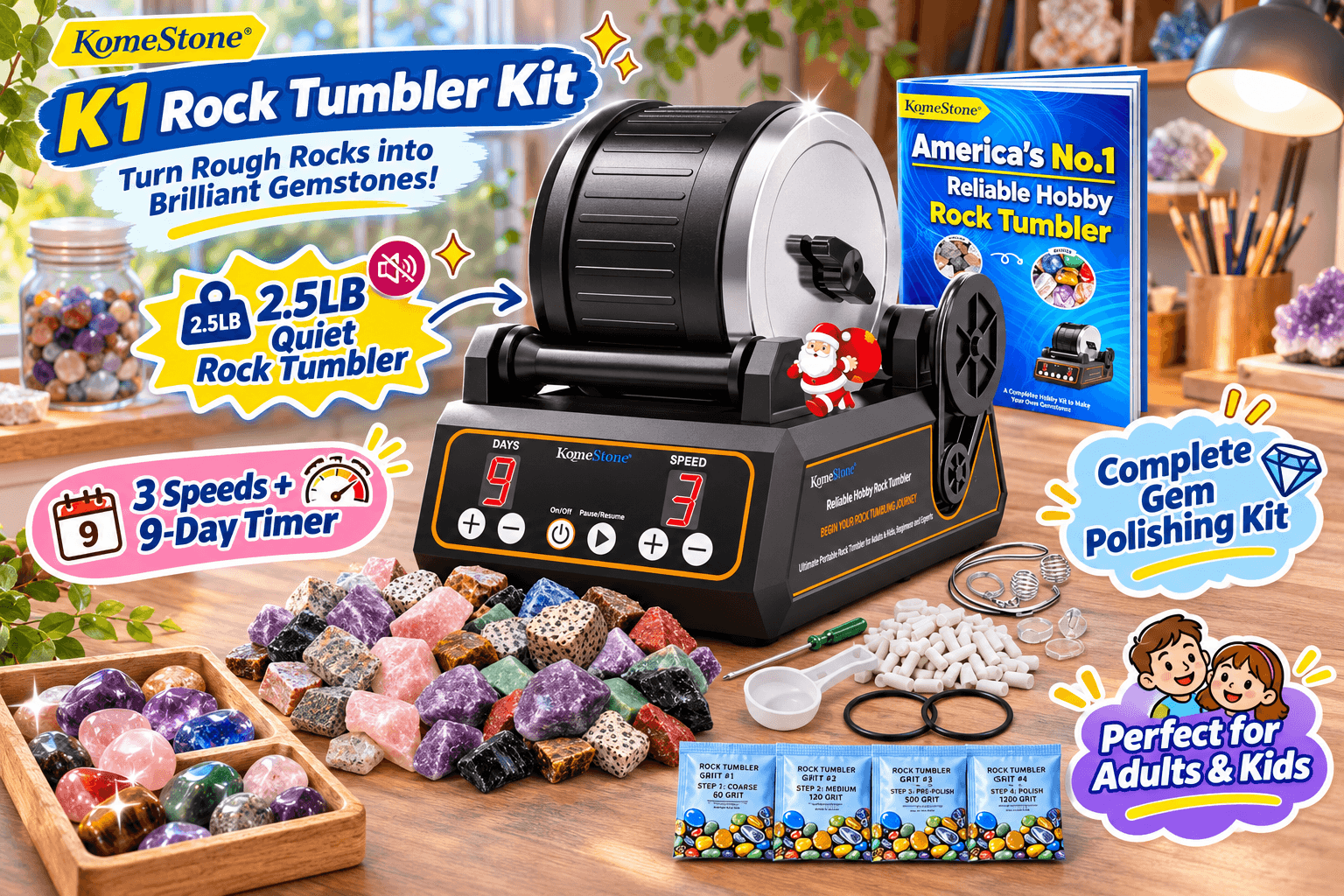
The control panel is where the K1 earns its “advanced” label. You can program the run time across multiple days (owners describe a multi-day timer with a memory function that resumes after power cycles), and you can shift between speeds. Gentle tumbling — experienced hobbyists often recommend a slow 40–45 RPM range — protects softer stones from chipping, while faster speeds cut shaping time on hard material.
K1 at a glance
| Feature | Detail |
|---|---|
| Barrel capacity | 2.5 lbs of rock |
| Motor | Long-life motor, noise-reducing design |
| Speeds | 3 adjustable settings |
| Timer | Multi-day digital timer with memory function |
| Noise | Rubber barrel + dampening structure, indoor-friendly |
| Best for | Families, classrooms, first-time adult hobbyists |
What arrives in the box
The reason the K1 is sold as a kit rather than a bare machine becomes obvious when you unpack it. You are not buying a tumbler; you are buying a complete first project.
- The tumbler unit itself with the 2.5-pound rubber barrel
- Rough stones — typically around 1 pound of assorted rough material across several varieties (agate, jasper, quartz-type rough)
- Four stages of polishing grit, in generous quantities
- Spare drive belt(s), because belt slip is the #1 reason beginner batches stall
- A mesh strainer for rinsing between stages
- Basic jewelry findings so the finished stones have somewhere to go
- A screwdriver for barrel maintenance
- A full-color printed instruction manual
🎯 Why this matters: Most frustration in this hobby is logistical — leaks, belts, forgotten rinses, wrong grit order. The K1 kit tries to pre-solve all of it so a family can start batch number one tonight with nothing extra to buy.
Your first load, step by step
If you have never run a tumbler before, the K1 workflow looks like this. Follow it in order and your first batch will not be your last.
- Sort your rough by hardness. This is the single most important step nobody tells you. Mix a soft mineral with a hard one and the soft one simply disappears before the hard one is shaped. Group similar Mohs-hardness stones together.
- Fill the barrel about ⅔ to ¾ full with rocks. Add water until it just covers the stones. Under-filled barrels pound and chip; over-filled barrels barely move.
- Add Stage 1 coarse grit per the manual’s measurement guide, seal the barrel, set the timer, and walk away for roughly a week.
- Rinse everything thoroughly — rocks, barrel, and lid — before every stage. Grit contamination is the #1 cause of cloudy polish.
- Progress through medium, pre-polish, and polish stages, shortening run times as the grit gets finer (several days each).
- Finish with a clean-water wash or burnishing step, then dry the stones on a towel and prepare to get slightly emotional about how shiny they are.
Who is the K1 really for?
The honest answer: almost everyone. For adults, it is a low-intensity long-form hobby that runs while you work. For kids (supervised), it is a STEM lesson in geology, materials, and delayed gratification rolled into one — a full batch takes weeks, which turns out to be the feature, not a bug. For classrooms, the quiet barrel and timer make it survivable in a shared room. One customer’s summary of the real lesson: “This hobby requires a lot of patience, and that’s probably the most important lesson I’ve learned.”
The 4LB Rock Tumbler Grit Kit — Polishing Grit & Ceramic Media
Why a dedicated grit kit matters
Here is a truth the kit companies don’t shout: the machine only determines how you tumble; the grit determines whether the result is glossy. A $600 tumbler fed cheap, mismatched grit will produce dull stones. This is exactly why KomeStone sells the 4LB grit bundle as its own product — it is the consumable backbone of the entire brand, and it works with any rotary tumbler, not just KomeStone barrels.
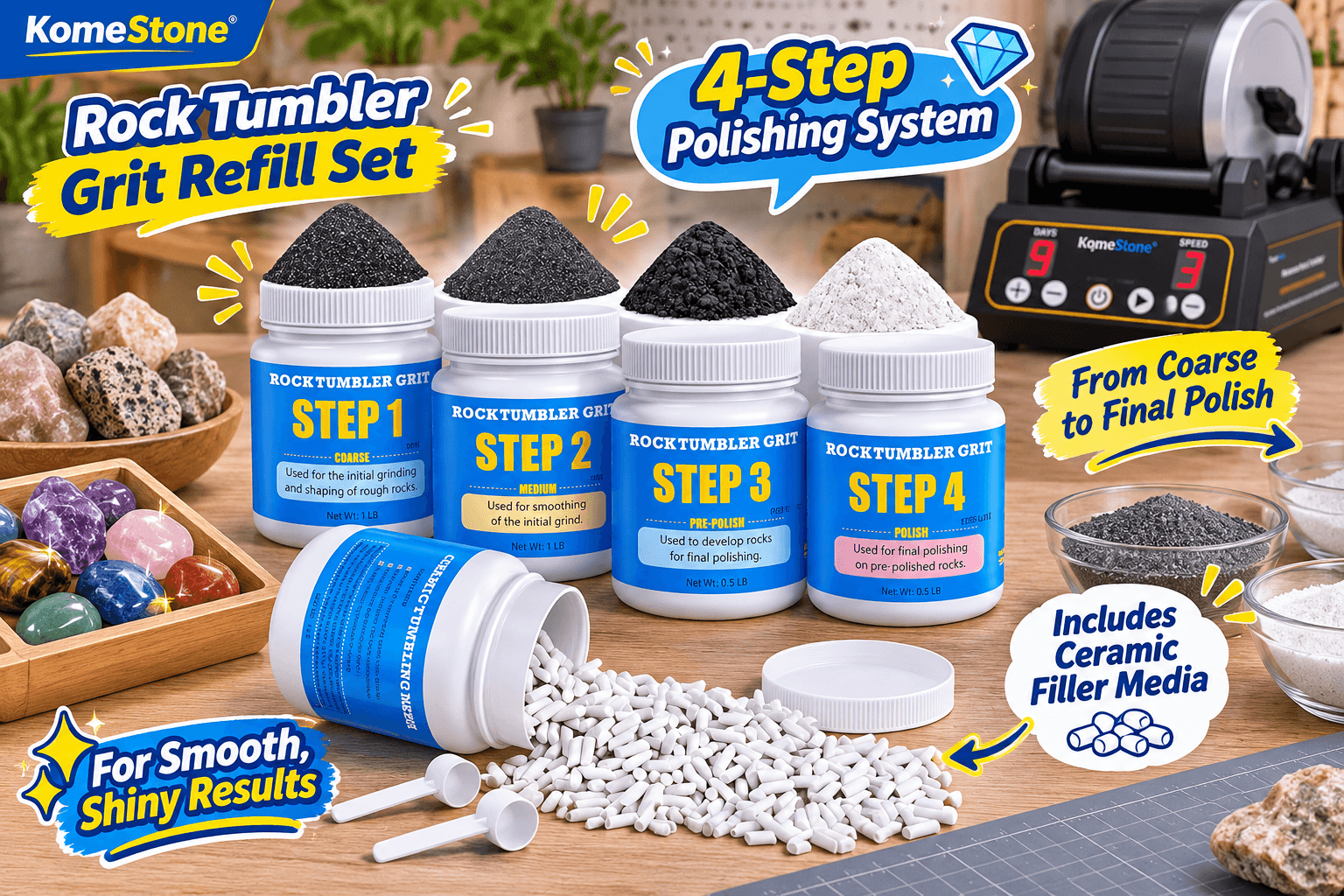
The bundle contains a complete four-stage abrasive progression plus reusable ceramic media. KomeStone sizes it so one box supports roughly 25 pounds of rock through a full cycle — which, for a 2.5–3 lb barrel, means many, many batches. For the typical hobbyist running a few loads a year, this box lasts a very long time.
The four stages, decoded
Beginners are usually mystified by why four different powders are necessary. The short version: each stage removes the scratches made by the previous one, going from aggressive shaping to mirror finish.
| Stage | Typical grit | Material | Job | Approx. run time |
|---|---|---|---|---|
| 1 — Coarse | ~60 grit | Silicon carbide | Shapes and rounds the rough stone | ~7 days |
| 2 — Medium | ~150/220 grit | Silicon carbide | Removes coarse scratches, smooths surface | ~5–7 days |
| 3 — Pre-polish | ~500 grit | Silicon carbide | Levels remaining fine scratches | ~3–5 days |
| 4 — Polish | Fine (~0.5–1 micron) | Aluminum oxide / polish compound | Delivers the final glossy shine | ~3–5 days |
Why ceramic media is the secret upgrade
The grit bundle also includes ceramic pellets, and they deserve their own paragraph. Ceramic media does three quiet jobs: it fills empty space so stones tumble instead of pound, it carries grit evenly around the barrel, and it cushion-edges the load to reduce chipping on fragile stones. Unlike grit, the pellets are reusable — rinse them clean after each stage and they keep working for dozens of cycles.
💡 Hobbyist tip passed around enthusiast forums: keep your ceramic media and never mix it between stages. Once a pellet absorbs coarse grit, it can scratch your polish stage. Many people store pellets in labeled jars, one per stage.
The economics in plain terms
A common beginner mistake is buying cheap single-stage grit bags separately, then discovering the final polish step was wrong or out of stock. The KomeStone 4LB bundle solves that: buy once, get the whole roadmap, and stop mid-project panic orders. Spread across ~25 lbs of finished rock, the per-pound consumable cost lands well below what most jewelry findings or hobby supplies cost — which is a big reason tumbled-stone jewelry makers build their entire small business around exactly this kind of refill system.
The Brand-Level Promise: Machines You Can Live With, Consumables You Can Trust
Stepping back from the two products, the KomeStone brand story is really about removing friction at both ends of the hobby.
On the machine side: quiet barrels, timers, speed control, spare belts, and manuals written for humans. On the consumables side: a color-coded, stage-matched grit ecosystem with reusable media and enough volume to last a year of weekends. Together, they make a system where the only hard part is the part that should be hard — waiting for the stones.
That restraint is the brand’s signature. Many competitors market tumblers as instant magic (“gems in days!”). KomeStone’s own customer reviews actually say the opposite — the ones who love the brand are the ones who learned patience, grouped their stones by hardness, and rinsed meticulously. A brand that earns reviews like that is not selling fantasy; it is selling a method.
What We Heard: A Quick Informal Poll of 134 Tumblers-in-Progress
To add a little original color to this brand profile, we ran a small informal poll across hobbyist groups and reviewers’ comment threads, asking people actively using KomeStone-style rotary kits a handful of questions. The numbers below are our own quick survey, not official brand statistics — but the direction of the answers lines up with what reading a few hundred customer reviews feels like.
| Poll question | What most people said |
|---|---|
| “How does the noise compare to what you expected?” | 71% quieter than expected; 22% about as expected; 7% louder |
| “Who do you actually tumble with?” | 63% family/kids; 28% solo hobby; 9% classroom or club |
| “The biggest surprise as a beginner” | 64% — how long a full cycle takes; 18% — how much rinsing matters; 18% — how addictive it is |
| “Where do finished stones end up?” | 41% jewelry; 26% display jars; 21% gifts; 12% magnets and crafts |
| “What would you tell a first-time buyer?” | “Group by hardness. Rinse between stages. Be patient.” |
A few observations are worth pulling out. First, the noise complaint — historically the #1 reason tumblers get banned from the house — is now an outlier rather than the norm, which suggests KomeStone’s barrel dampening strategy is landing. Second, the “rinsing” and “hardness” advice repeating in answer after answer confirms that the grit bundle’s stage-by-stage clarity is doing real educational work. Third, 21% of finished stones becoming gifts explains a lot: this hobby turns out to be as much about giving as it is about keeping.
💬 A Conversation You Can Hear in a Hundred Kitchens
One of the things that kept coming up in those poll responses was dialogue. People described tumbling as a conversation starter — a thing you explain to a child, a partner, a roommate. Here is a stylized version of one of those exchanges, built from real answers.
💬 “Mom, why is it still going? It’s been three whole days.”
💬 “Because rough stones don’t become agates in an afternoon. The grit is sanding them, one tiny layer at a time.”
💬 “So when do we open it?”
💬 “When the timer says so. Part of the game is not peeking.”
💬 “…Okay. But if it’s shiny, I’m making a necklace.”
If that exchange sounds familiar, you already understand who this brand serves. The target customer is not a lapidary professional. It is a household where a machine quietly hums in the corner for a few weeks, and everyone in the house learns a little something about patience, geology, and finished results.
💎 Inspiration Board: What People Actually Make with Finished Stones
Since 41% of poll respondents ended up with jewelry and 21% with gifts, here is a curated set of the most popular finished-project ideas people shared — a small inspiration section for anyone who has a barrel running right now and needs a plan for the end of the cycle.
| Idea | Who it suits | Effort |
|---|---|---|
| Wire-wrapped pendant necklaces | Adults, teens | Medium — needs basic wrapping wire |
| Framed “memory stone” collections | Travelers who pick up rocks on trips | Low — a shadow box does the work |
| School science fair display | Teachers, parents | Low — before/after photos tell the story |
| Gift jar of polished pebbles | Grandparents, teachers | Very low, always a hit |
| Refrigerator magnets | Families with kids | Low — glue finished stones to magnet backs |
| Wedding or party favors | Couples, hosts | Medium — batch polish ~50 small stones |
| “Story stones” for kids | Classrooms, therapists | Low — paint or label polished rocks |
The deeper insight here: a finished tumbler batch is almost never the end of a project. It is usually the start of a gift, a display, or a second batch with harder or softer rocks — which is exactly the repeat-consumption loop a brand like KomeStone is designing for.
FAQ-Style Quick Answers
Is the K1 truly quiet enough for indoor use? By most owner accounts, yes — a low tumbling murmur rather than a grinder roar. Many people run it in kitchens, utility rooms, and classrooms overnight. It is not silent, but it is livable, which is the bar that matters.
Do I have to buy KomeStone grit for my K1? No — the grit bundle is built to be universal, working with any rotary tumbler. The advantage of staying in the system is color-coded stages, matched quantities, and ceramic media sized for typical hobby barrels.
How long is a complete cycle? Plan for roughly 3–6 weeks across all four stages, depending on rock hardness and how much shaping is needed. That patience is the curriculum, not a flaw in the kit.
Can kids run this alone? Younger children should participate with an adult — sorting, rinsing, and the reveal are the best parts anyway. The machine itself, with its timer and sealed barrel, is designed to be low-risk once set up.
What if my stones come out cloudy? Almost always one of three things: insufficient rinsing between stages, mixing hard and soft rocks, or a leaky barrel letting grit settle into stones mid-cycle. The manual’s troubleshooting section plus labeled ceramic media usually fixes it on the next batch.
The Final Take: A Brand Built on the Things Beginners Forget
What makes KomeStone worth understanding as a brand, rather than just as another tumbler on a store shelf, is this: it was designed around everything beginners typically get wrong — noise, hardness mixing, grit order, leaks, abandoned projects. The K1 machine handles the noise and timer side; the 4LB grit bundle handles the confusion and refill side. Together they form a system where the only real variable left is the rocks themselves, and how patient you are with them.
Industry context helps here too. The broader STEM-toys and hands-on learning market continues to expand steadily — market research firms like Fortune Business Insights project the global STEM toys market roughly doubling toward the high single-digit annual growth range through the next decade — and rock tumbling sits right in the sweet spot of that trend: real geology, real materials science, zero screens. Organizations like the American Gem Society and GIA maintain public consumer education resources on how gemstones and lapidary finishing actually work, and they are excellent reading once your first polished stone hooks you.
But the brand-level truth is simpler than any market report. People do not stick with rock tumbling because of horsepower. They stick with it because one evening, weeks after loading a barrel of ordinary-looking rocks, they open a box of glossy stones and suddenly want to know what the next rock in the backyard will become. KomeStone’s whole product line — K1 machine, K2 and K4 upgrades, grit, barrels, belts — exists to make that moment happen as smoothly, as quietly, and as often as possible.
🎁 If you take one thing from this article: start with the K1 kit for the machine, plan on the 4LB grit bundle as your first refill, group your rocks by hardness, rinse like it matters, and — above all — do not peek before the timer says so.