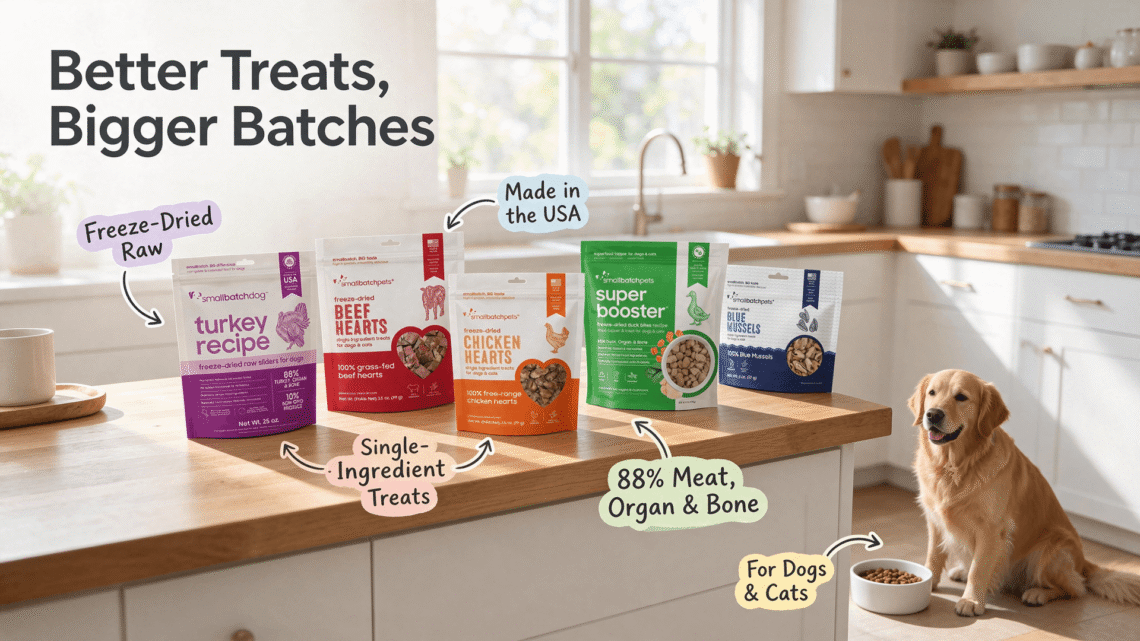
Most nutrition companies scale up. This one built its entire identity on the opposite instinct — and the bowls it fills look completely different for it.
There is a particular kind of irony in the pet food aisle. Every shelf is competing to be the biggest: biggest bag, biggest savings, biggest list of added things. Somewhere along the way, feeding a dog became an exercise in volume — scoop more, buy more, trust more. Smallbatch has spent two decades doing the quiet, unglamorous opposite: making less, adding fewer things, and asking owners to pay closer attention instead. 🐾
That distinction sounds like marketing until you read an ingredient panel and realize the claim is structurally true. This post walks through what the company actually does, how its four product formats differ, what the sourcing commitments really cost, and — honestly — where a food like this is the wrong tool for your household.
Where it started, and why the story matters more than the slogan
Smallbatch was founded in 2005 in San Francisco by the Vogel family — David, Diana, and Michael — and the origin is not a market-gap analysis or a investor thesis. By the company’s own telling, it began with a rescue cat named Blue who had dietary problems that commercial food could not solve. That is a fairly ordinary pet-owner frustration, but it produced an unusual conclusion: instead of asking which product to buy, they started asking why the ingredients were not available in a form a person could trust.
Why does a founding story like that still matter twenty years later? Because constraints set early tend to become permanent architecture. A company founded to solve one animal’s specific digestion problem will build differently from a company founded to capture a category share. Smallbatch’s answer to Blue’s problem was radical in its simplicity — food that a person could recognize as food. Whole muscle meat, organs, bone, produce. Very little else. Nothing synthetic pretending to be nutrition.
Everything else in this review flows from that. The narrow product formats. The refusal to bulk up recipes with cheap fillers. The insistence on small production runs. It is not a brand that grew into a philosophy; it is a philosophy that grew into a brand.
💬 “We didn’t set out to make a pet food company. We set out to figure out what to feed one difficult cat.” — the recurring theme in the brand’s own origin accounts.
What “small batch” means on a production floor
The phrase gets used loosely across food culture — coffee, chocolate, beer, skincare — usually as a synonym for “artisanal” and therefore “expensive.” In nutrition manufacturing, though, batch size is a genuine quality-control variable, not an aesthetic.
Here is the practical difference. When a facility runs a small batch, every unit in that batch came from a narrow window of raw material. If something is off, the traceable surface area is tiny: you can identify the source, quarantine the run, and move on. When a facility runs enormous continuous production, raw material from dozens of suppliers and months of inventory gets blended into a single stream. Blending is excellent for consistency of taste and terrible for accountability of origin. Blending is also how a mediocre ingredient becomes invisible.
Smallbatch produces on the West Coast of the United States in limited runs, and the whole catalog is built around that constraint. It explains three things a shopper would otherwise find confusing:
- Limited, deliberate protein selection. The company does not chase every novelty protein for shelf presence. Each recipe has to be sourceable to a standard, not just findable.
- Minimal processing as a default, not a premium tier. Freeze-drying and gentle cooking are the foundation, not a “wellness” sub-line bolted on later.
- No filler padding. Fillers exist to add bulk and lower cost per pound. A maker committed to small runs and high meat inclusion has no reason to introduce them and every reason to avoid them.
The tagline the storefront leans on — smallbatch, BIG difference — is a bit cute, but the underlying logic is not. Smaller production is a mechanism. Better food is the output.
The 88 / 10 / 2 rule: how the formulas are actually built
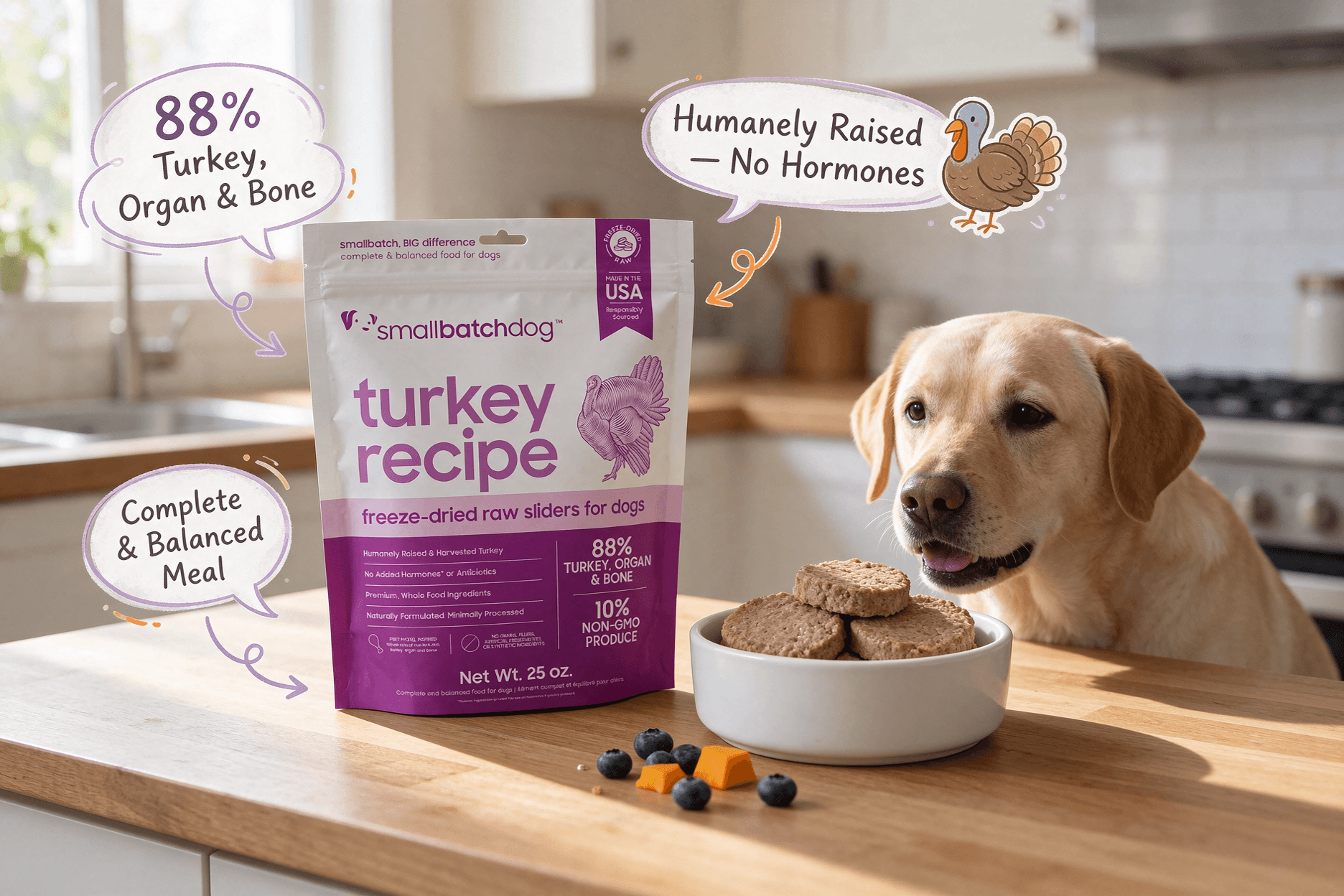
The most useful thing about Smallbatch’s packaging is that it prints its composition as percentages on the front. That is not common in pet food, and it gives you a framework for reading any brand’s panel. ❄️
For the core freeze-dried raw diets, the split is roughly:
| Component | Share | What it does | What it signals |
|---|---|---|---|
| Meat, organ, bone | ~88% | Protein, fat, micronutrients in their natural matrix | High inclusion; no grain or starch bulking the base |
| Organic / non-GMO produce | ~10% | Fiber, phytonutrients, natural vitamins | Plants present, but not carrying the recipe |
| Natural supplements | ~2% | Kelp, pollock oil, probiotics and similar | Targeted gaps filled with whole-source inputs |
Read that panel again slowly, because the ratio is the point. In a great many conventional dry foods, the ingredient list is led by a grain or a legume, and animal protein is the expensive accent. Smallbatch inverts the hierarchy: animals are the recipe, plants are the support cast.
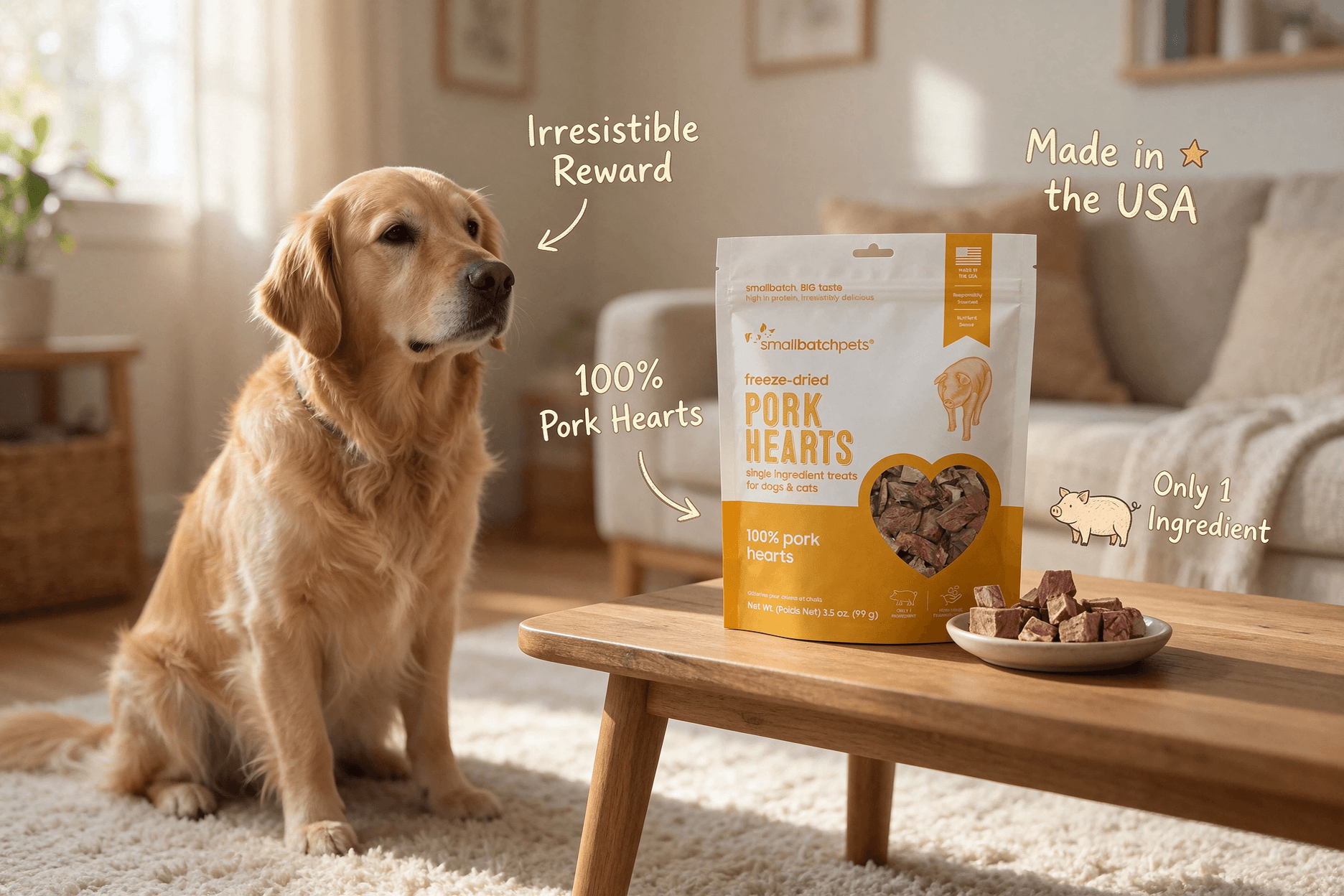
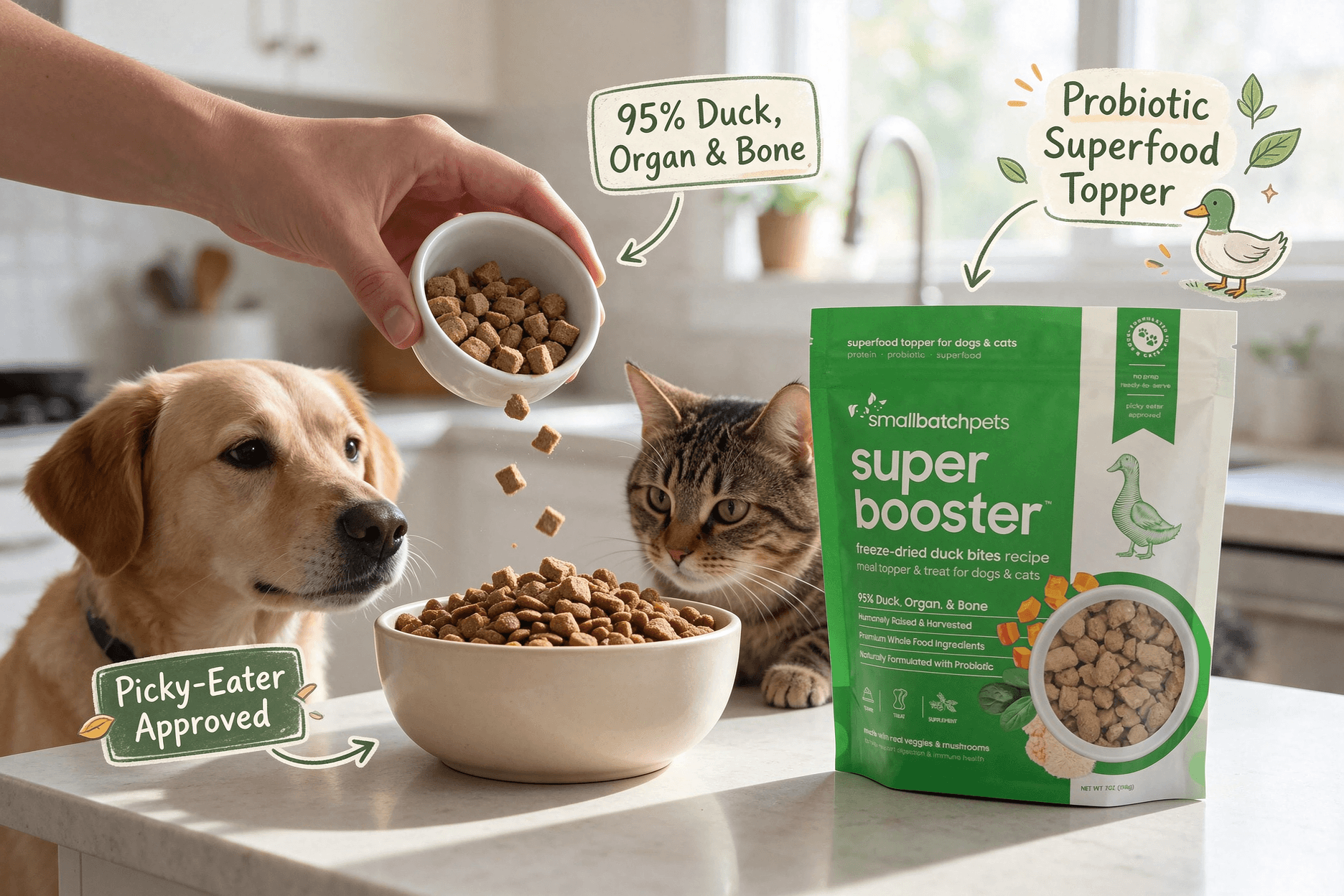
The topper formulas push the ratio even further — Super Booster products sit around 95% meat, organ, and bone, with probiotics and functional additions layered in. That is a product designed not to be a meal, but to fix what a meal is missing.
Two things this composition approach deliberately avoids:
- Synthetic vitamin premixes as the primary nutrient source. Nutrition comes from tissue and food first, supplements second.
- Rendered meals and plant protein concentrates as protein boosters. Those are the standard industry method for inflating a guaranteed-analysis number, and dry-matter protein percentages become meaningless when they come from a blend of cheap inputs.
Independent reviewers have noted the resulting profile — protein content in the mid-50% range on a dry-matter basis, with carbohydrate levels far below typical extruded food. That is not a marketing claim; it is arithmetic that falls out of an 88% animal base.
The lineup, format by format
Smallbatch’s storefront covers dogs and cats across frozen raw, freeze-dried raw, and gently cooked preparations, plus bone broths and single-ingredient chews. For most owners shopping online, the freeze-dried range is the practical entry point — no freezer space required, no thawing, long shelf life. Four formats matter:
Sliders 🍔
Small, patty-shaped freeze-dried portions. The format is the innovation here. A slider is portionable without being crumbly: you can break one in half for a ten-pound dog, crush two over a senior cat’s dinner, or serve a handful as high-value training rewards that are nutritionally identical to the meal. Duck Recipe sliders sit at the premium end of the range, and the reason is the protein source, not the packaging.
Small Bites
The same freeze-dried raw formula in a smaller, kibble-adjacent piece. This is the format for households with picky eaters, small-mouthed dogs, or owners who simply want to sprinkle generously without doing math. Lamb Recipe Small Bites is a representative single-protein option — useful for owners running an elimination diet, since a novel protein with a short ingredient list is the cleanest diagnostic tool available.
Super Boosters
Function-first toppers at roughly 95% animal content, with added probiotics and targeted botanicals. These are not meals and should not be fed as such. Think of them as a daily functional layer: gut support, coat support, appetite. The bright green bag with the circular window is easy to spot on the shelf.
Skin & Chews
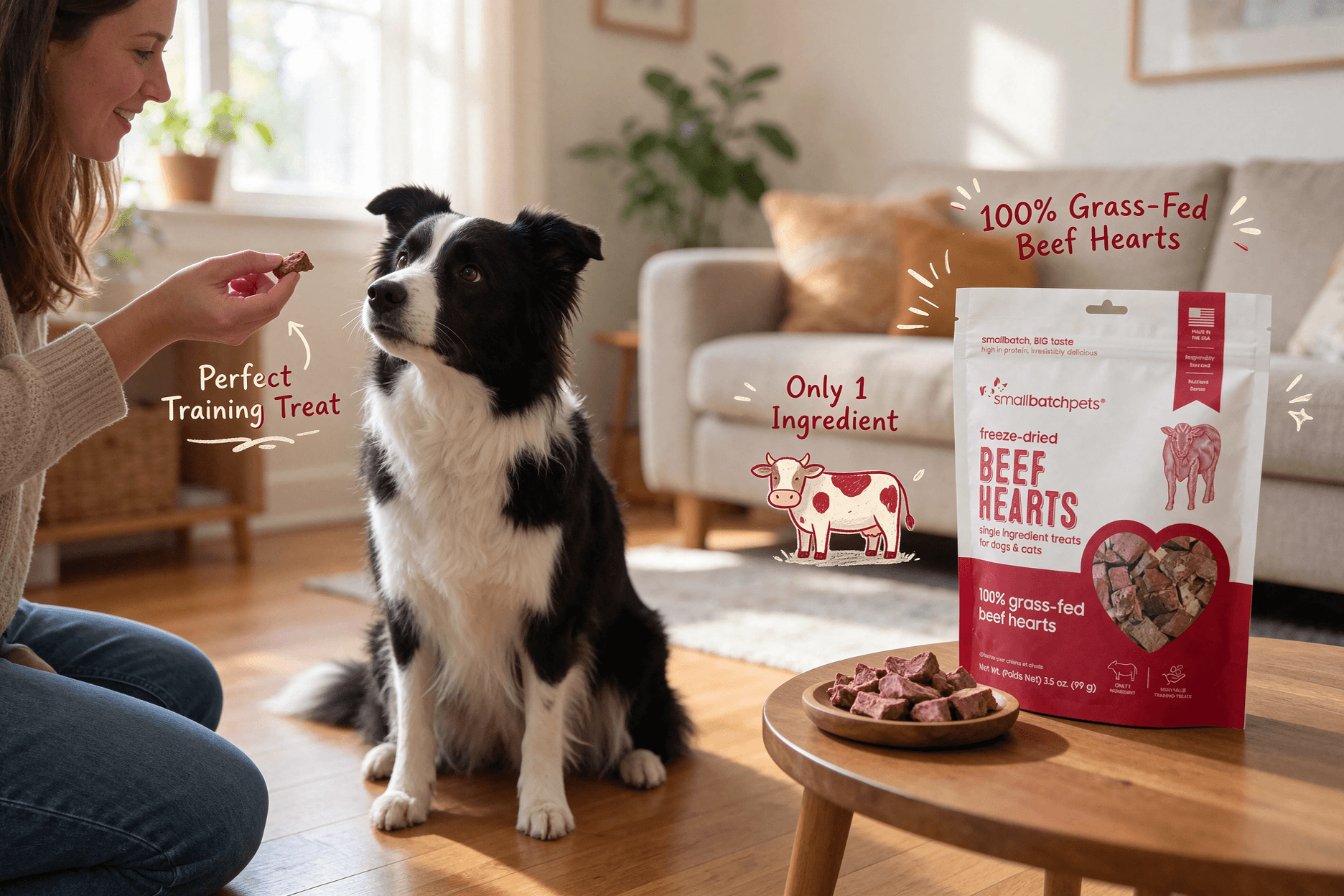
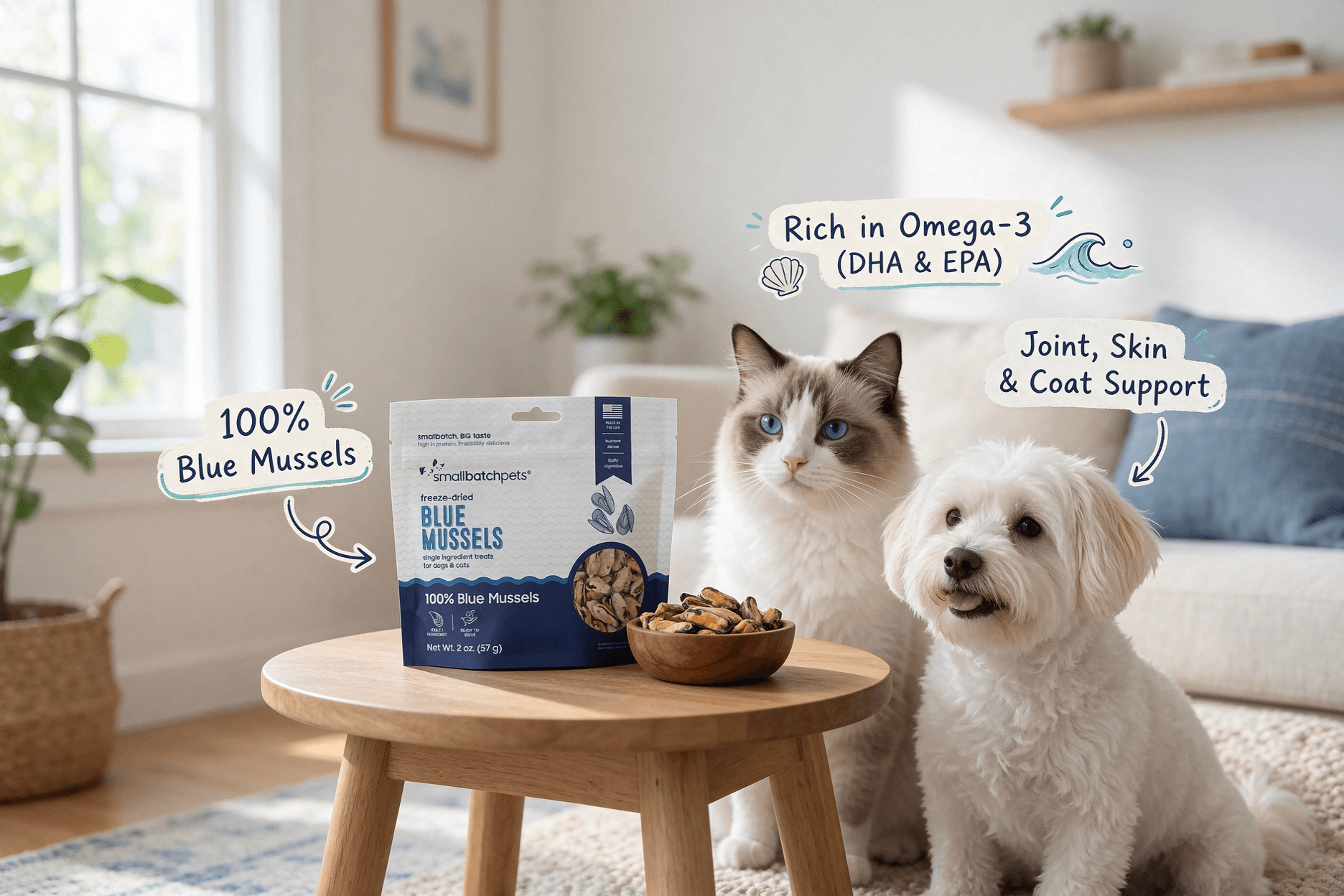
Single-ingredient dried chews such as Dover Sole Skin Chews. Fish skin is dense in omega-3 fats and generally easier to digest than hide-based chews, which is why this category has grown fast in recent years. A single-ingredient chew has an underrated benefit: if your dog reacts, you know exactly what caused it, in one feeding.
Serving flexibility across formats:
- Complete and balanced as a standalone meal
- Crumbled over another food as a topper
- Rehydrated with warm water for aroma and moisture
- Fed dry, whole, or broken, as a training reward
- Split across species in a multi-pet home, portion by portion
Sourcing: the commitments that don’t fit on a label
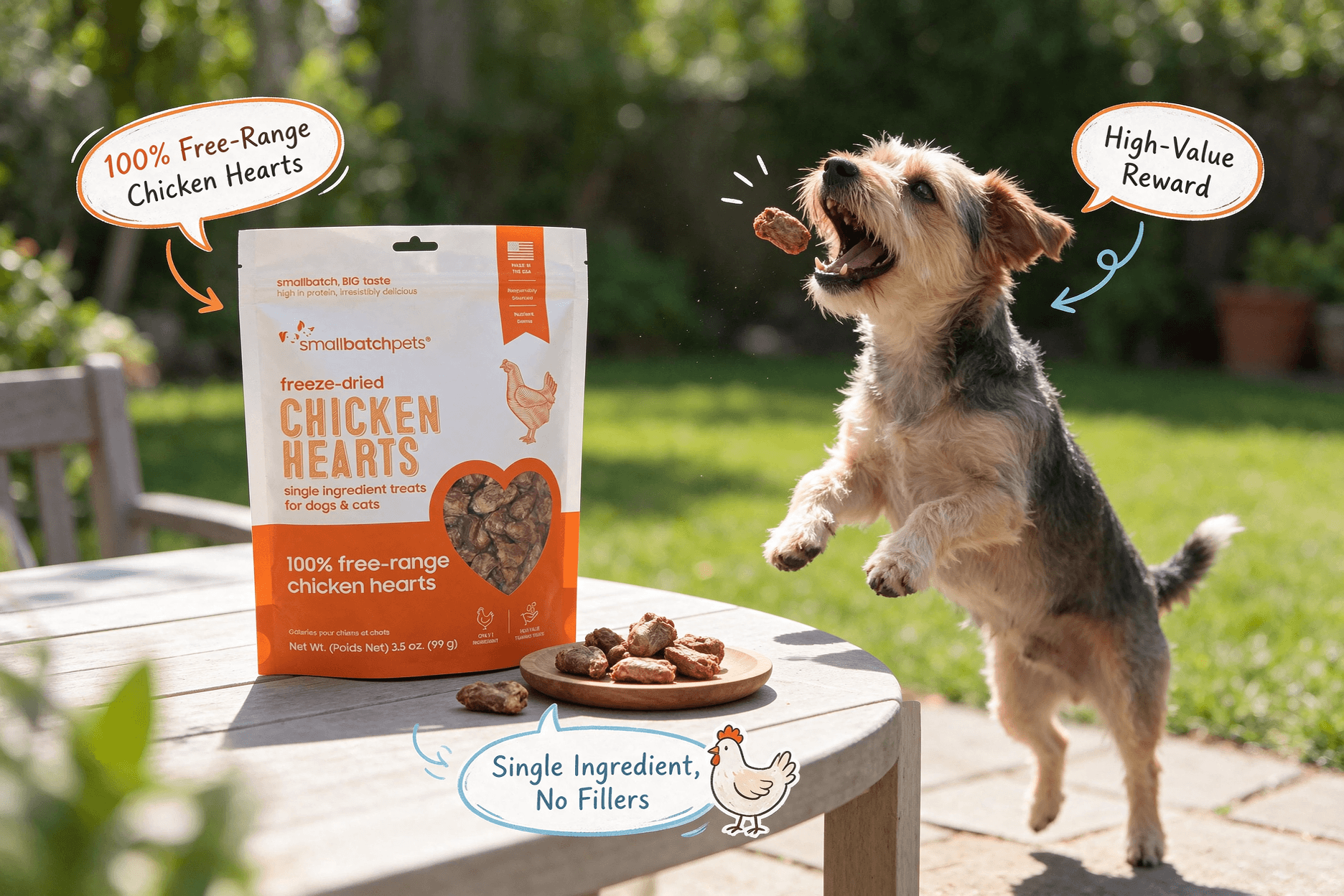
The composition percentages get the attention, but the sourcing rules are where the money goes. Smallbatch’s stated framework: humanely raised meats, no added hormones or antibiotics, certified organic or non-GMO produce, made in the USA, and no artificial fillers or synthetic additives.
Each of those is easy to write and hard to buy. Humanely raised protein is a real procurement constraint — it means a smaller supplier pool, higher cost per pound, and inventory that cannot be swapped at the last minute when a shipment falls through. This is precisely why small-batch production and humane sourcing coexist in one company: you cannot promise ethical protein and run a blended mega-batch. The two commitments are incompatible.
And here is the honest consequence for a shopper: a brand with these constraints will occasionally be out of stock on a specific protein. That is not a logistics failure. It is the visible edge of a sourcing standard. Owners who want guaranteed continuity of a specific recipe are, whether they realize it or not, asking for the flexibility to substitute inputs.
🌿 One nuance worth stating plainly: “grain-free” and “filler-free” are meaningful here, but they are not automatically healthier in isolation. What makes the difference is what replaced the filler — in this case, muscle meat, organ, and bone at a very high inclusion rate.
How to actually serve it: four workable protocols
Most owners underuse freeze-dried raw because they treat it as one thing. It is really four things.
Protocol 1 — Full transition. Feed the recommended daily amount as the complete diet. Rehydrate or serve dry. This is the cleanest nutritional outcome and the best choice if the current food is the problem.
Protocol 2 — The topper layer. Keep the existing food, add crumbled Small Bites or Super Boosters on top. This is the highest-compliance option in practice: picky dogs eat, owners don’t fight at bowl time, and the diet’s protein density improves without a full overhaul.
Protocol 3 — The hybrid rotation. Base food on weekdays, full raw serving on weekends. Not ideal in a strict sense, but it works for households managing cost or freezer capacity, and it still beats feeding a low-inclusion diet exclusively.
Protocol 4 — Situation-specific. Sliders as training rewards, skin chews for travel and chewing anxiety, bone broth poured over dry food when a pet is unwell or refusing to eat.
✅ Transition checklist
→ Start at roughly 25% new food for two to three days
→ Move to 50% for another three days
→ 75% for three days, then full
→ Slow the pace if stools soften; resume at the last comfortable step
→ Watch the eyes and ears, not just the bowl, during week three
The reason to go slowly is not caution for its own sake. A diet at 88% animal content shifts the gut’s microbial environment. Most animals handle it fine on a graded schedule; many handle it badly on an abrupt one.
The picky-eater problem, and why this brand keeps getting recommended for it
There is a specific exhaustion known to owners of difficult eaters: the rotation of foods, the topping of good stuff over the boring stuff, the eventual resignation. Two short exchanges that capture it:
Owner: “He’ll eat nothing. I’ve been through four bags this year.” Clinician: “Then stop buying him meals. Buy him something he’ll treat like food.”
Owner: “My cat ignores the prescription diet.” Friend: “Try warming it. Smell does most of the work.”
Both are pointing at the same mechanism, and it is the one thing a high-meat freeze-dried raw diet reliably delivers: aroma. Extrusion cooks protein at high heat, which mutes volatile compounds. Freeze-drying removes water from raw or gently cooked material at low temperature, preserving the odor signature that animals actually use to evaluate edibility. Rehydrate with warm water and the effect multiplies — the food releases smell, and smell is appetite.
There is a less-discussed benefit too. A picky eater is often a dog who has learned that refusing yields an upgrade. A food that is genuinely high-value removes the negotiation, because there is nothing better waiting in the wings. 🐟
Cost per bowl: doing the math honestly
Storefront pricing runs from about $12.79 for smaller fish-skin chew packs up to roughly $56.09 for a 25 oz bag of premium-protein sliders. That range is wide enough that a flat “expensive” verdict is useless. Do the arithmetic instead.
| Scenario | Approx. monthly spend | Notes |
|---|---|---|
| Chews / toppers only | Low hundreds or less | Lowest-friction entry; existing base food retained |
| Topper on a full diet (mid-size dog) | Moderate | Partial daily ration replaced, not doubled |
| Full raw diet, small dog | Manageable | Lower absolute daily grams; premium per pound matters less |
| Full raw diet, large dog | Highest | Cost-conscious owners often run Protocol 3 or hybrid feeding |
Three variables change the picture more than bag price does: the animal’s weight, whether you feed it as a complete diet or a partial one, and how much of the current food you keep in rotation. A 40 lb dog on a topper protocol can land in a very different budget than the same dog on full raw — and both are legitimate ways to use the catalog.
There is also a counter-accounting that responsible reviews should include. High-inclusion food tends to produce smaller, firmer, less odorous stools, because more of it is actually absorbed. Owners who notice that rarely mention it, but it is a real signal of digestibility, and it quietly offsets part of the per-pound premium.
Where Smallbatch is probably the wrong answer
No credible recommendation without limits, so here are the honest ones:
- Budget-first households. A full raw transition on a large multi-dog home is a genuine financial commitment. Topper protocols exist for exactly this reason.
- Homes with freezer or storage constraints and no patience for format changes. The freeze-dried range solves this; the frozen range does not.
- Owners needing veterinary-prescription specificity. This is a nutritionally excellent general diet, not a therapeutic renal, hepatic, or urinary prescription food. Medical conditions warrant a prescribed formulation and a veterinarian’s supervision.
- Raw skeptics on bacterial-risk grounds. Freeze-drying lowers water activity and the product is handled without cooking, so if a household has immunocompromised members, that conversation belongs with a clinician, not a brand page.
- Anyone expecting novelty for its own sake. The protein roster is curated to sourcing standards, so it will not expand to whatever is trending.
That last point is a feature dressed as a limitation. A short list you can verify beats a long list you cannot.
Reading a label like a Smallbatch person
You do not need to buy this brand to use its logic. Take these four habits to any aisle: 🔎
- Find the first named animal ingredient. If it is a grain, a pea, or a “chicken meal,” the recipe is plant-led with an animal accent.
- Look for a composition percentage printed on the front. Willingness to state inclusion ratios publicly is a confidence signal that almost nothing else replicates.
- Count the fillers, not the additives. Corn, wheat, soy, and legume starches bulk a bag. A long vitamin list is noise; a long starch list is the real story.
- Ask what the batch size is. Traceability is structural. It cannot be added retroactively by a quality promise on a label.
The larger idea: restraint as a nutrition philosophy
Here is what makes Smallbatch worth writing about rather than simply buying. The pet food industry has spent decades solving for convenience and margin, and it has gotten extremely good at both. The result is a shelf full of food engineered to be adequate — nourishing enough to avoid obvious failure, cheap enough to avoid second thoughts.
Smallbatch’s premise is that adequacy is the problem. Not because the company is morally superior, but because the biology of a companion animal does not care about supply-chain efficiency. Restraint — fewer ingredients, smaller runs, narrower sourcing, less processing — is harder and more expensive than engineering. It also produces something the industry has mostly stopped offering: food a person can look at and understand.
That is a rare position. Most brands compete by adding. This one competes by refusing to.
Frequently asked questions
Is freeze-dried raw the same as raw feeding? It is raw material that has had water removed at low temperature, so the nutrient structure stays largely intact while shelf stability improves dramatically. It is safer and more convenient than handling frozen raw, and it retains more of the food’s natural aroma than any cooked extruded equivalent.
Can I feed it to both my dog and my cat? The catalog covers both species with species-appropriate formulations. Feeding a dog formula to a cat long-term is not advisable — cats have non-negotiable requirements around taurine and arachidonic acid that dog food is not built to meet. Match the product to the species.
Do I have to rehydrate it? No. Dry serving is fine and many owners prefer the convenience. Warm water increases aroma and moisture, which helps reluctant eaters and animals that drink poorly.
Are these complete meals or supplements? Sliders and Small Bites are complete and balanced. Super Boosters are toppers, not a standalone diet. Single-ingredient chews are treats. Read the intended-use line before replacing a meal.
Why is one protein so much more expensive than another? Protein economics. Duck and other specialty sources cost more to raise humanely and source consistently than chicken. You are paying for the input, not the packaging.
Will my dog get enough fiber? The roughly 10% organic produce component supplies fiber and phytonutrients. It is a lower-plant, higher-animal design than most dry foods, which is intentional.
Is the food grain-free? Yes — grain-free and filler-free across the range, with no added hormones or antibiotics in the animal ingredients and nothing artificial in the formulas.
Closing thought
Feeding well is mostly a series of small, unglamorous decisions: what the first ingredient actually is, who raised the protein, how the batch was made, how slowly you switched. None of them feel consequential on their own. Combined, they are the entire difference between a pet that is merely fed and a pet that is properly nourished.
Smallbatch is not for every household, and pretending otherwise would be bad writing and worse advice. But if you have been circling the picky eater, the dull coat, the soft stools, the annual bag rotation — the problem is very often not which food you chose. It is that the food you chose was designed to be cheap enough that nobody had to think about it. 🥩
Sometimes the right move is to make it smaller, simpler, and better.