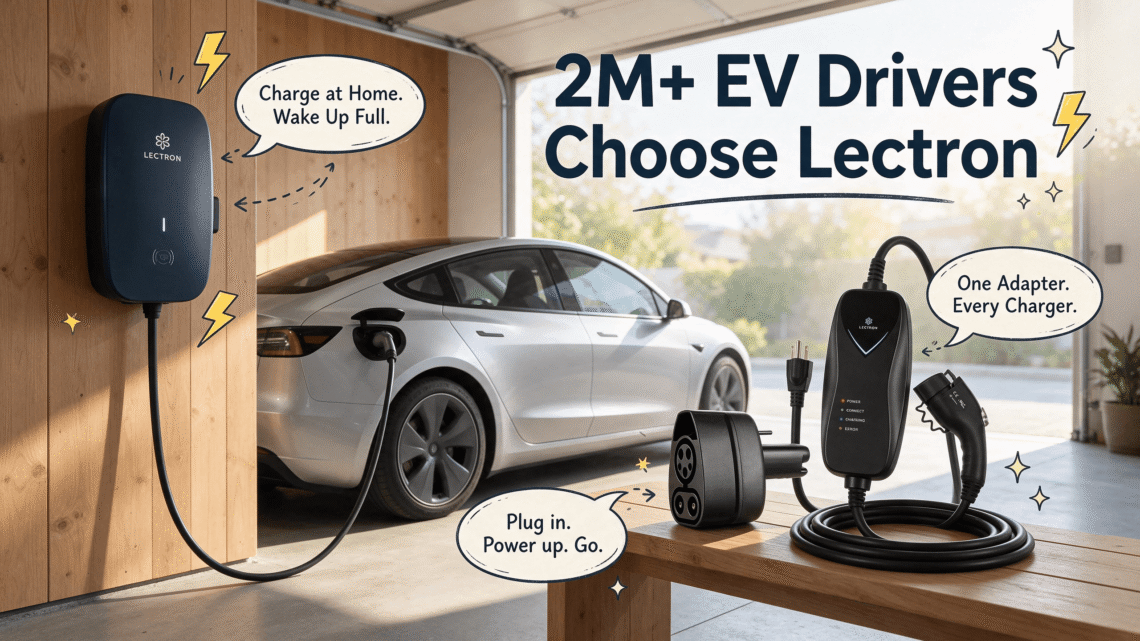
There is a particular kind of frustration that only electric vehicle owners understand. It is not range anxiety, exactly. It is standing in front of a perfectly good charger, in a perfectly good parking lot, with a perfectly good battery, and discovering that the plug on the pedestal and the socket on your car speak two different languages. Most of the conversation around electrification focuses on batteries, kilowatts and highway milestones. Far less attention goes to the small, unglamorous pieces of hardware that decide whether any of that capacity is actually reachable. Lectron has built its reputation almost entirely in that overlooked gap, and the two products examined here — a CCS-to-NACS fast-charge adapter rated to 500A and 1,000V, and an ETL-certified Level 1 portable charger for 120V household outlets — show why a brand that sells connectors and cables has quietly become a default purchase for a very large number of drivers.
The company’s storefront states that more than two million EV drivers choose Lectron. That figure is worth pausing on, because adapters and trickle chargers are not headline products. Nobody writes a viral post about a 120-volt brick in a garage. They are bought out of necessity, usually by someone who has just discovered that their new car cannot use the charger at their workplace, or that the public fast charger two blocks away has a handle their inlet will not accept. Winning that shopper repeatedly, at scale, means a brand has solved a real problem rather than manufactured a desire.
What follows is a close, honest look at Lectron as a company and at two specific pieces of its catalog: what they do well, what the engineering underneath actually buys you, and where their limits sit. The goal is not a sales pitch. It is the kind of reading you would want before spending money on charging hardware that you intend to trust unattended, overnight, outdoors, for six years.
A Brand Built for the Space Between Standards
What Lectron actually sells, and what it deliberately does not
Lectron does not make cars, batteries or charging stations. It makes the interface layer. Its catalog, as presented on its storefront and product pages, clusters into a handful of lanes: portable EV chargers grouped by connector type (NACS, J1772 and a smart-app-controlled variant), a wall-mounted home unit called Nexus, Tesla-specific charging equipment, and a broad family of adapters that carry UL 2252 certification. That is a tightly focused assortment, and the focus is strategic. Every category exists because two legitimate standards failed to agree, and a driver was left holding the wrong cable.
This is a very different posture from a brand that chases the highest-kilowatt spec sheet. Lectron’s products are mostly small, inexpensive relative to the vehicle they serve, and designed to disappear into a trunk, a garage shelf or a charging routine. The design language reinforces that: matte black housings, a compact atom-mark logo, a teal accent used sparingly, and photography that puts the hardware in an ordinary driveway rather than a laboratory. The message is that this is a normal object you buy once and stop thinking about.
Why certification paperwork is effectively the product
Here is the counterintuitive part. In the adapter and portable-charger business, the physical object is not difficult to imagine. Injection-molded shell, copper contacts, a strain relief, some electronics on a board. What is genuinely hard, and genuinely expensive, is proving that the object will not become a fire hazard at 500 amps or a shock hazard in a rainy parking lot at 2 a.m. Lectron’s differentiation sits in that proof. Its adapters are certified to UL 2252, the standard covering conductive couplers and related EV charging connection systems. Its Level 1 portable charger carries ETL certification against the requirements for portable EV supply equipment, in the UL 2594 family. Both marks are issued by accredited third-party bodies, which means an independent laboratory tested samples and audits production, rather than the manufacturer grading its own homework.
A brand that leads with certification rather than speed is making a promise about failure modes. It is saying: we designed for the worst-case hour of this object’s life, not the brochure hour. For a shopper whose charger will live outdoors, be run over by a car in a stall, and be handled by teenagers and strangers, that is the correct priority order.
💬 Speaker A: “Why would I pay more for an adapter? Copper is copper.”
💬 Speaker B: “Copper is copper. A certified coupler is a documented answer to what happens at 1,000 volts when a bit of moisture gets where it should not. That answer is what you are buying.”
Reading the Modern Charging Aisle Like an Engineer
Three connectors, one garage, and the vocabulary that matters
Before looking at either product closely, it helps to be precise about the hardware landscape, because most buyer confusion is vocabulary confusion. Four names cover nearly every situation a North American driver encounters.
| Name | What it actually is | Where you meet it |
|---|---|---|
| NACS (North American Charging Standard) | The compact connector Tesla originated, now adopted by a growing list of automakers | Tesla Superchargers; vehicle inlets on Tesla and newer NACS-equipped cars |
| CCS1 (Combined Charging System) | The DC fast-charging handle that pairs two large power pins with a Type 2 communication section | Most non-Tesla public DC fast chargers in North America |
| J1772 | The AC charging connector for Level 2 alternating-current charging | Workplace, municipal and retail Level 2 posts; almost all non-Tesla AC inlets |
| NEMA 5-15 | The ordinary three-prong household wall plug | Your garage, a kitchen, a motel room, a friend’s driveway |
Notice that the last one is not a vehicle connector at all. That is the source of a great deal of confusion. A Level 1 charger bridges a household receptacle to a vehicle’s AC inlet, and it is the only charging method that requires no dedicated circuit, no electrician and no installation. Its virtue is ubiquity; its penalty is slowness. Lectron’s Level 1 unit lives entirely in that trade-off.
The adapter lives in a different trade-off. NACS and CCS1 are physically incompatible handles, and as manufacturers migrate fleets across the two standards, vehicles and infrastructure routinely arrive at the wrong party. A CCS-to-NACS coupler resolves one specific direction of that mismatch: the pedestal dispenses CCS1, the car accepts NACS, and the adapter becomes the translated handshake in between. Understanding direction matters more than any spec, because the reverse problem — a CCS-equipped car wanting to use a Supercharger — is a different product.
Product One: The Lectron CCS to NACS Adapter, 500A / 1,000V
What the coupler does, stated without marketing
The full listing name is a mouthful, so here is the plain version. You arrive at a DC fast charger whose handle is a CCS1 plug. Your car — a Tesla Model S, 3, X or Y, or one of the growing set of NACS-inlet EVs — has a NACS inlet. You remove the CCS1 handle, thread this adapter onto it, then plug the resulting NACS-shaped end into your car. The station believes it is talking to a CCS vehicle; your car believes it is on a NACS charger. Power and communication both pass through the adapter’s internal electronics, which is why this is not merely a plastic sleeve.
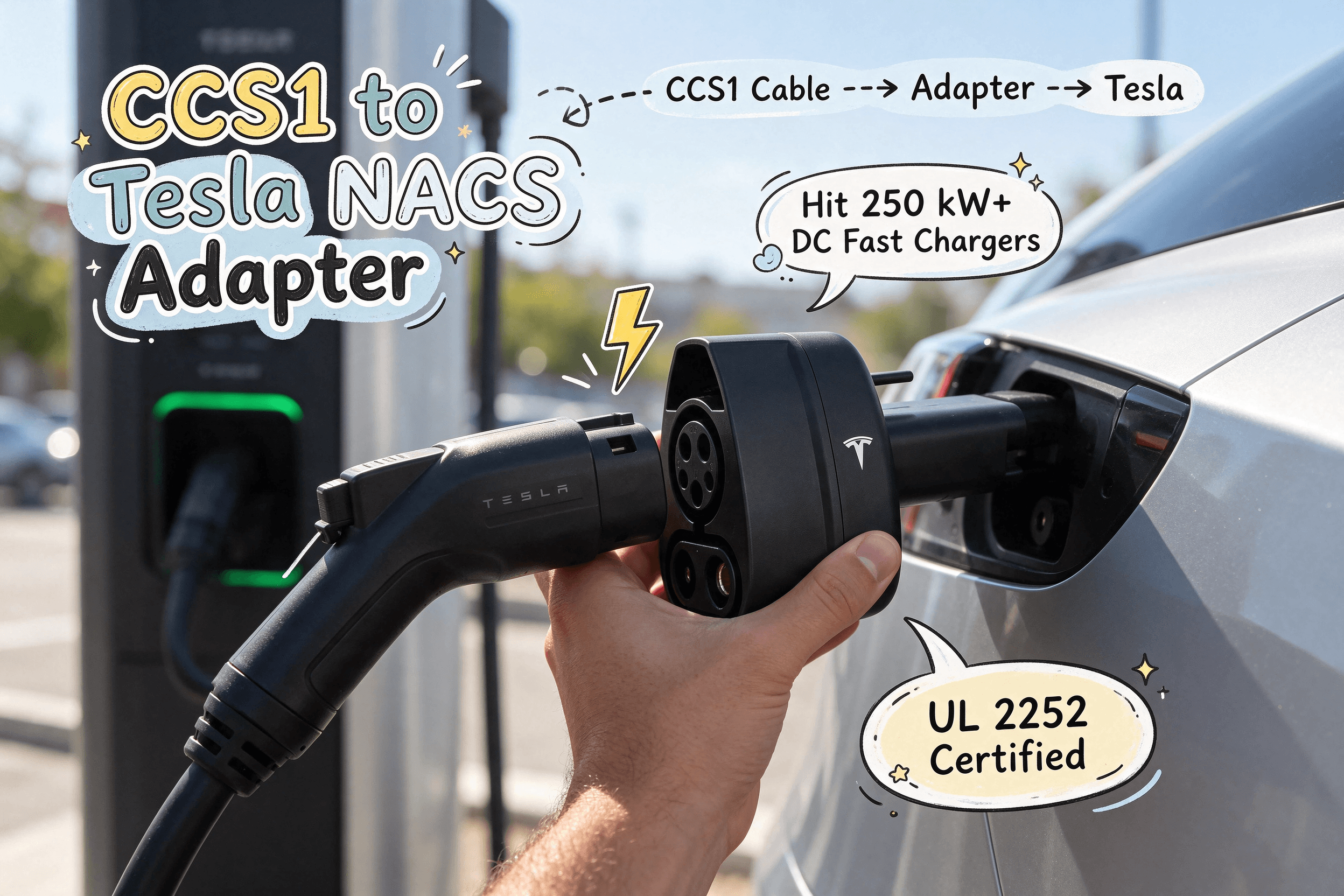
Its ratings are deliberately oversized relative to anything currently deployed. 500 amps and 1,000 volts means the coupler is engineered for 500 kW of DC delivery. No public charger in North America dispenses that today. Lectron is building to the ceiling of the next several years of hardware rather than the present average, and that decision has practical consequences: thermal stress at a 150 kW stall is trivial for a part designed for 500 kW, and a vehicle that later accepts 350 kW will not outgrow the adapter sitting in its trunk.
Specification snapshot
| Attribute | Detail as documented by Lectron |
|---|---|
| Direction | CCS1 fast-charging handle → NACS vehicle inlet |
| Electrical rating | Up to 500A / 1,000V (500 kW capable) |
| Safety certification | UL 2252 certified (NRTL-tested) |
| Thermal management | Active PCBA temperature monitoring with automatic shut-off |
| Impact tolerance | Rated to a 2,500 lb drive-over |
| Environmental sealing | IP67, submersible-rated housing |
| Housing materials | Flame-retardant PC/PA66 to UL94 V-0, UV-resistant |
| Contact treatment | Dual-plated contacts; heavy-gauge busbars |
| Dielectric verification | 1,000V hi-pot tested |
| Production QC | 100% end-of-line testing |
| Excluded vehicle | Tesla Cybertruck (not compatible) |
| Colour | Black |
Inside the housing: the three decisions that matter most
First, the active thermal logic. Cheap adapters manage heat passively, meaning they get hot and hope the vehicle’s battery management system notices and throttles. Lectron’s design monitors the temperature of its own populated board in real time and will cut off if a threshold is crossed. In a device whose failure mode is molten metal, an independent shutdown path that does not rely on the car cooperating is a meaningful layer of redundancy.
Second, the contact plating and busbar mass. Dual-plated contacts reduce contact resistance and resist the oxidation that, over years, turns a good connection into a warm one. Heavier busbars provide the cross-section that 500A demands. Together these determine whether the adapter still performs in year four, which is when most owners actually keep the product.
Third, the shell and its sealing. An IP67 rating means the coupler tolerates immersion, not merely splash, and the flame-retardant UL94 V-0 polymer is chosen for the case where something goes wrong electrically. The 2,500 lb drive-over figure addresses the most common real accident with trunk-stored adapters: someone parks on it. UV resistance matters for the subset of owners who leave hardware in a truck bed or an outdoor storage bin through a summer.
Lectron’s own comparison graphic frames these points against unbranded adapters: no certification, passive thermals, likely to shatter on impact, 400A maximum current, IP54 splash-only protection. That comparison is rhetorical, but the deltas it names are the genuine axes on which this category varies.
Who it fits, and the one vehicle it refuses
The compatibility list on the product page covers Tesla Model S, 3, X and Y, plus NACS-equipped EVs from other marques, with examples spanning Chevrolet Bolt, Hyundai Ioniq 5, Kia EV6, Lexus RZ, Lucid Gravity and Toyota bZ4X model-year designations. Read that list as an illustration of scope rather than a complete registry, and verify your own vehicle’s port generation before purchasing, because the industry shifted inlets across model years rather than on a clean calendar boundary.
The Cybertruck exclusion is stated bluntly in the title, and it is worth respecting rather than arguing with. Physical inlet geometry and communication behaviour differ on that vehicle, and a manufacturer that publishes a clear “not compatible” note is behaving more responsibly than one that quietly hopes buyers will not notice. Likewise, the listing’s claim of access to more than 12,000 CCS fast-charging stations nationwide describes the network the coupler opens up; it does not promise that every operator will authorize the session. Network rules, apps and memberships vary by operator, and occasional vehicles-reporting quirks at certain stalls are a known characteristic of adapter-mediated charging across the industry, not a defect unique to one brand.
Five habits that make an adapter behave
- Seat it deliberately. Thread the adapter onto the CCS1 handle first, fully, before bringing the assembly to the car. A half-engaged coupler at DC power is the classic bad session.
- Inspect before every fast-charge use. Sand, grit and a cracked seal ring cause more adapter problems than electronics do.
- Let the car and station finish negotiating. If a session refuses to start, stop after one or two attempts rather than cycling repeatedly.
- Dry it before storing. IP67 tolerates submersion; it does not reward storing the unit wet inside a closed bag.
- Keep it out of direct, prolonged heat when not in use. UV-resistant plastics tolerate sun; the temperature sensors inside do not appreciate an 80°C trunk.
Product Two: The Lectron Level 1 EV Charger, 120V / 15A
The unglamorous charger that solves a boring but universal problem
Every EV ships with some form of emergency cable, and most owners use it exactly once, in a moment of genuine need, before it migrates to the back of a cargo shelf. Lectron’s Level 1 unit is the version of that cable worth keeping in rotation. It plugs into any standard NEMA 5-15 household receptacle, presents a J1772 connector to the vehicle, and requires no installation, no permit, no dedicated circuit and no electrician visit. For renters, for drivers whose garage outlet is on the far side of the house, and for anyone who keeps a car at a property with no 240-volt infrastructure, that is not a fallback. It is the entire solution.
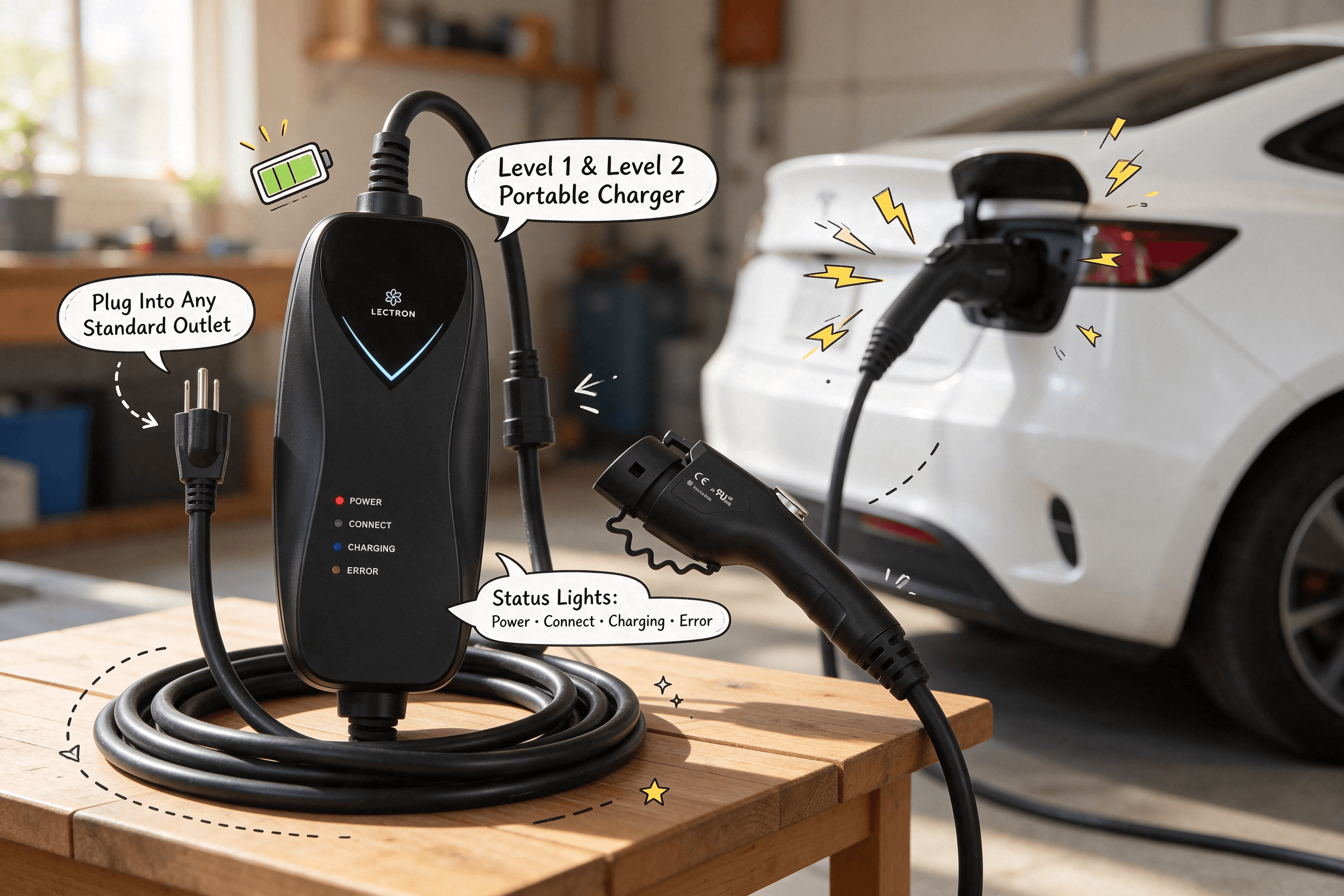
The rating is 120 volts at 15 amps, which works out to roughly 1.8 kilowatts of nominal capacity. There is a nuance worth understanding, because it explains the gap between optimistic brochures and real overnight results: standard residential circuit practice caps continuous draw at about 80 percent of the breaker rating, so sustained operation sits closer to 12 amps. In practical range terms, expect roughly four to six miles of added driving range per hour of charging, with the exact figure depending on vehicle efficiency, climate load and preconditioning. Over a twelve-hour overnight window, that is on the order of 50 to 70 miles.
Specification snapshot
| Attribute | Detail |
|---|---|
| Input | 120V AC, standard NEMA 5-15 household plug |
| Current | 15A rating |
| Nominal power | Approximately 1.8 kW |
| Typical added range | Roughly 4–6 miles per hour of charging |
| Vehicle connector | SAE J1772 |
| Cable package | 16 ft extension cord plus J1772 charging cable |
| Certification | ETL certified for portable EV supply equipment |
| Protection features | Overvoltage, overcurrent and short-circuit protection |
| Environmental rating | IP65 |
| Installation | None; plug-and-play |
| Vehicle compatibility | Any J1772 AC-inlet EV or PHEV |
Where sixteen feet changes the arithmetic
Cable length is the most underrated specification in portable charging, and the 16-foot extension run is the detail that makes this unit useful rather than merely present. Practical consequences include:
- Reach becomes possible. Many garage receptacles sit high, behind a water heater, or on the wrong wall. Sixteen feet converts “not today” into “yes, tonight.”
- Drainage improves. Parking nose-in with the cable running downhill away from the inlet keeps standing water away from the connector in winter.
- Neighbourly charging works. At a rental house or a shared driveway, an extension run lets the car sit where it fits rather than where the outlet is.
- Strain is reduced. A cable stretched taut around a doorframe is a cable whose connectors wear early; slack is a maintenance strategy.
The control unit’s own handling matters as much as length. It is rated IP65, meaning protection against water jets rather than immersion, so the correct habit is to hang the brick or set it on a shelf or a hook, not to leave it lying on wet concrete. The onboard protection set — overvoltage, overcurrent and short-circuit — is what allows the device to be trusted unattended for twelve hours at a stretch, which is precisely how it will be used.
Level 1 versus Level 2, without the hype
| Consideration | Lectron Level 1 (120V / 15A) | A typical Level 2 setup (240V) |
|---|---|---|
| Added range per hour | ~4–6 miles | ~25–40+ miles |
| Electrical work required | None | Dedicated circuit, often an electrician visit |
| Upfront cost band | Low | Higher, plus installation |
| Portability | Trunk, travel, rentals | Usually fixed to one wall |
| Best suited to | Low daily mileage, overnight top-ups, backup | Daily driving, larger batteries, cold climates |
| Weakest against | Large batteries, tight departure windows | Renters, older wiring, no panel capacity |
The honest framing is that these are not competitors. Level 2 is the correct answer for a household that drives a lot and owns its garage. Level 1 is the correct answer everywhere else, and it is also the correct second answer: the portable unit that travels in the trunk, covers the case where the fixed charger is occupied or broken, and makes an unfamiliar outlet anywhere in the country usable.
💬 Speaker A: “Four miles an hour sounds pathetic.”
💬 Speaker B: “It sounds pathetic until you measure your actual driving. Thirty miles a day is eight hours of charging. You parked the car at 7 p.m. and left at 7 a.m. Nothing was compromised, and nobody visited a charging station.”
How the Two Pieces Work as a Single Kit
The weekend arithmetic
Bought together, these two products cover nearly every non-Supercharger scenario a North American EV driver meets, and they cover them in the correct proportions. The Level 1 charger handles the routine: it recovers the day’s driving every night at zero infrastructure cost, and it handles the trip where a host’s household outlet is the only option. The adapter handles the exceptional: the long haul, the detour, the region where the nearest fast charger is a CCS pedestal and your car has a NACS inlet.
| Situation | Which piece earns its place |
|---|---|
| Daily commuting, home overnight | Level 1 charger |
| Apartment or rented house, no 240V | Level 1 charger |
| Road trip, 200+ mile day | CCS-to-NACS adapter at public DC fast chargers |
| Fixed charger out of service or occupied | Level 1 charger as backup |
| Workplace has a CCS post, car has NACS | CCS-to-NACS adapter |
| Long parking at a rest area, need top-up | CCS-to-NACS adapter |
Storage and the details owners neglect
A kit like this fails through neglect far more often than through defect. Keep the adapter in a rigid pouch rather than loose against other metal objects in a trunk well; the 2,500 lb drive-over rating is a defence against a stranger parking on it, not against a year of abrasion. Coil the Level 1 cable loosely, over-under, rather than wrapping it tightly around the brick, which is the single most common way portable chargers develop intermittent faults. And label nothing, but inspect both: a thirty-second look at contacts and seals before a road trip is the cheapest insurance in the entire ownership experience.
The Trust Layer: What a Certification Mark Actually Buys
It is easy to dismiss UL 2252 and ETL marks as logos. They are closer to contracts. Each represents a defined test regime, an accredited laboratory, sample evaluation and follow-up on production. Concretely, for a coupler and a portable charger, that process covers:
- Dielectric withstand, verifying insulation will not break down at rated voltage; in Lectron’s case, hi-pot testing at 1,000V.
- Abnormal and fault conditions, including what happens when a connection is partial, contaminated or thermally stressed.
- Temperature rise under sustained load, which is where undersized busbars and thin plating reveal themselves.
- Mechanical abuse, including impact and drive-over tests relevant to anything stored in a vehicle.
- Material flammability classification, which is where UL94 V-0-rated polymers come in.
- Production consistency, so the unit shipped to you resembles the unit that was tested.
Lectron’s product pages also display “featured in” marks from outlets including Wirecutter, Car and Driver, CleanTechnica, MotorTrend and State of Charge. Press coverage is not certification, and the two should not be conflated; media testing tends to be short and scenario-limited, whereas certification is repetitive and failure-oriented. Still, a category brand that attracts repeated independent testing has cleared a credibility bar that no amount of listing copy can buy.
Honest Limits Worth Naming Before You Buy
A promotional piece that names no limitations is not credible, so here is where these two products sit short of ideal.
- The adapter excludes the Cybertruck, explicitly and without workaround.
- An adapter translates a connector; it does not create power. Your charge rate is still set by the station, the vehicle’s acceptance curve, battery temperature and state of charge.
- Session negotiation through a coupler can occasionally behave differently than a native connection. Some networks and some vehicles are fussier than others, and repeated failed attempts are a bad sign to abort rather than persist through.
- Level 1 charging is slow, full stop. For a 300-mile battery, a full charge from empty on 120 volts takes multiple days. It is a top-up and recovery tool, not a primary charging strategy for high-mileage households.
- The Level 1 unit’s IP65 rating handles jets and rain, not submersion or prolonged standing water; placement discipline is on the owner.
- Household circuits are shared. A 15-amp charger on a circuit that also feeds a refrigerator, a well pump or a space heater will trip, and older wiring may warm at the receptacle. If the outlet is visibly discoloured or hot, stop and have it inspected.
None of these are defects. They are the shape of the category, and a buyer who understands them in advance is a buyer who will be satisfied.
Three Garages, Illustrated
The following are composite scenarios, drawn to show how the hardware behaves in ordinary circumstances rather than to quote any specific owner.
🗂️ Garage one — the renter. Two-car townhouse, no garage, one household outlet on an exterior wall forty feet from the parking spot. The 16-foot extension run reaches with slack. Overnight, the car gains roughly sixty miles. The adapter rides in the trunk for monthly trips, unused, ready.
🗂️ Garage two — the commuter who over-buys. A large-battery SUV, 22,000 miles a year, and a Level 2 installation that was never permitted in the condo basement. The Level 1 unit covers weekdays at a deficit; the CCS adapter covers weekends at 150 kW stalls, and the owner learns to plan the weekend charge around the adapter rather than around the outlet.
🗂️ Garage three — the one-car household that plans. A fixed charger on the wall, the Lectron Level 1 unit coiled beside the water heater as insurance, and the adapter in the door pocket. When the fixed unit’s board fails in month thirty-one, the household does not change a single driving day. That is the entire argument for owning small hardware.
Where Lectron Fits in the Next Five Years
The industry is converging. NACS-equipped vehicles are arriving in volume, CCS handles are being installed on new dispensers alongside them, and the sharp edge of the port-mismatch problem will dull over time. It will not disappear. Installed bases turn over slowly, fleet vehicles carry their inlets for a decade, cross-border travel mixes standards, and any driver who touches a public DC fast charger will keep running into a handle that does not match an inlet. An adapter rated to 500A and 1,000V is, in that light, a long-lived object: it will still be relevant, and still be electrically adequate, after several generations of vehicles.
Level 1 occupies an even more durable niche, for a reason that has nothing to do with technology. The NEMA 5-15 receptacle is the most abundant charging interface on the continent, present at essentially every building with electricity. As long as that is true, a certified, portable, no-installation charger has a job. Home electrification discourse tends to treat Level 1 as embarrassing, which is a strange verdict on the only method that works everywhere, costs nothing to deploy, and requires no permission from a landlord, a municipality or an electrician.
A Closing Checklist, and the Point Beneath It
Before buying any charging accessory, work through these checks in order:
- Identify your vehicle’s inlet type and model year, not your neighbour’s.
- Identify the direction of the mismatch you actually have: pedestal-to-car, not car-to-pedestal.
- Confirm the certification mark relevant to the category — UL 2252 for couplers, ETL or equivalent for portable EVSE.
- Match electrical rating to realistic infrastructure, and prefer oversizing on a part you will keep for years.
- Measure your cable run in feet before ordering a portable charger.
- Read the exclusions first; they tell you more about engineering discipline than the highlights do.
- Plan storage, because most adapter failures are abrasion, grit and moisture, not voltage.
The reason Lectron has accumulated the customer base its storefront claims is not a clever advertisement. It is that the company picked the least glamorous corner of EV ownership — the coupling layer between incompatible standards, and the humble household outlet — and treated it with the seriousness of high-voltage engineering. Certifications, thermal shutdown paths, plated contacts, drive-over shells, sixteen feet of reach. None of it photographs dramatically. All of it shows up at 11 p.m. in a wet parking lot, when the alternative is a tow truck, and it shows up as a driver who does not have to think about the problem at all. That is the quiet standard by which charging hardware deserves to be judged, and it is a reasonable summary of what Lectron has been selling all along.