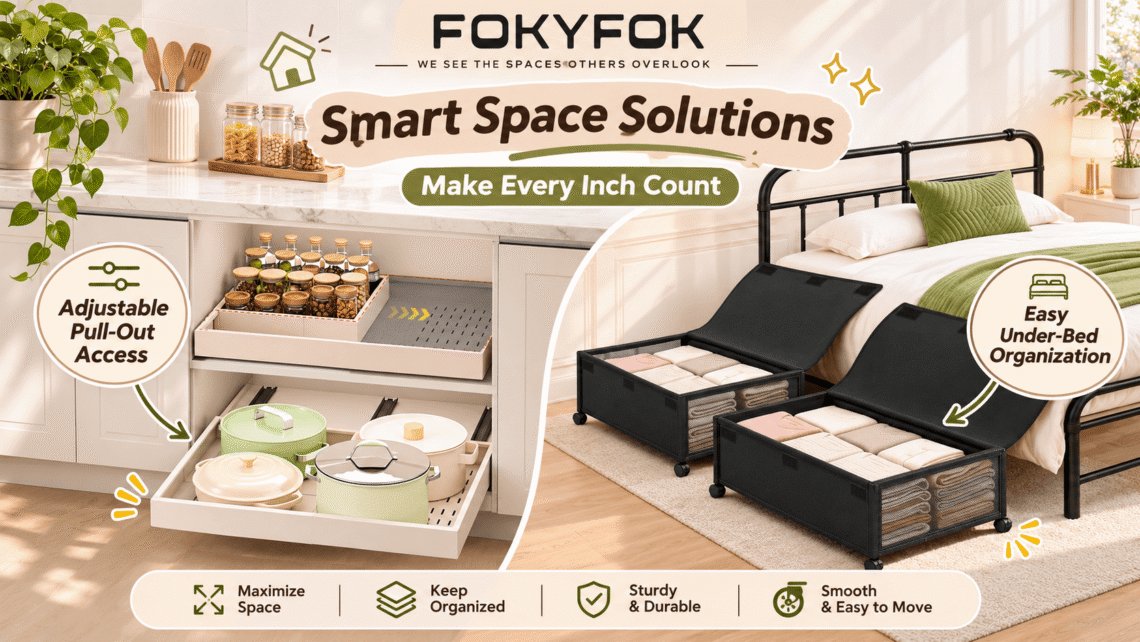
Walk into almost any home-improvement aisle and you will find a hundred ways to fix the wall at eye level. Pegboards, floating shelves, picture rails, decorative baskets built for the part of the room you already look at. What you will not find, in nearly equal abundance, is anything engineered for the eighteen inches of darkness beneath a bed frame, or the two-foot void at the back of a base cabinet where a saucepan goes to disappear. That omission is not an accident of retail. It is an accident of imagination. Most storage brands design for the room you show guests. Fokyfok is a small-space storage brand built around the room you never photograph, and that single shift in attention is the most interesting thing about it.
The premise is worth taking seriously, because the economics of it are undeniable. Floor space is the most expensive square footage in a home, and it is the only dimension most organization advice tries to spend. Depth, height, and the cavity under furniture are already paid for — they are included in the mortgage, the rent, the heating bill — and then left to accumulate dust and lost Tupperware lids. A brand that treats those volumes as design problems rather than as leftovers is not being quirky. It is being arithmetic.
This piece looks at how that philosophy translates into hardware, using two representative products as the working examples: the Fokyfok pull-out cabinet organizer, an expandable, adhesive-mounted drawer that converts unreachable cabinet depth into something your hand can actually reach, and the Fokyfok under-bed storage containers, a two-pack of tall rolling bins that turns the dead air beneath a mattress into organized, dust-sealed cubic footage. Neither is a decorative object. Both are quietly argumentative: they argue that the most valuable square footage in your home is the square footage you have stopped noticing.
Who Fokyfok Is, and Why the Brand Starts Where Everyone Else Stops
There is a habit in consumer branding of leading with a lifestyle promise — warmth, calm, the imagined feeling of a Sunday morning. Fokyfok’s positioning does contain that warmth; its storefront is all sunlit kitchens, cream cabinetry, and linen-toned bedrooms. But the brand’s stated platform is unusually specific for a storage label. Its line is essentially that it sees the spaces other people overlook: the back of a cabinet, the space beneath a bed. Note what that sentence does. It does not promise a feeling. It names two locations, in a house, at the exact coordinates where most organization systems fail.
That is a design brief disguised as a slogan, and it is a rare kind of honesty in a category crowded with vague aspirations about “decluttering your life.”
A Tagline That Doubles As a Spec Sheet
Read the platform as an engineer would and three constraints fall out, and each one explains a product decision you will see later.
- The named spaces are unlit. Nothing about a cabinet’s back corner or a bed’s underside is visible at a glance, which means any solution has to be discoverable by touch and by motion, not by sight.
- The named spaces are fixed in one dimension. You cannot make a base cabinet deeper or a bed frame taller. The container has to adapt to the architecture, never the reverse.
- The named spaces are usually occupied by the structure itself. Cabinet floors, bed frames, and flooring are surfaces most buyers cannot drill into, especially if they rent.
A brand that opens with those two locations has, whether deliberately or not, ruled out half the storage category. Rigid boxed drawers that require screwing into cabinet walls are out. Bins sized to a standard shelf are out. Anything that assumes homeowner privileges and power tools is out. What survives that filter is precisely the two-family lineup Fokyfok publishes: pull-out drawers with adjustable width and depth, and under-bed storage that rolls out for easy access.
Two Product Families, One Operating Principle
The through-line is adaptation, not decoration. Both families treat the overlooked volume as irregular and non-negotiable, and put the burden of fit on the product. That is a meaningfully harder engineering problem than building a bin to a standard size, and it is also why the brand reads as considered rather than opportunistic. Someone decided early that the container should bend so the user doesn’t have to renovate.
It is worth saying plainly what Fokyfok is not. It is not a modular wall-system company, not a boutique homeware label selling aesthetic boxes for open shelving, and not a maximalist organizer promising to transform a garage. It is a focused, small-catalogue brand working a narrow band of the home — the deep, the low, and the dark — and it seems to have concluded, reasonably, that a narrow band done properly beats a whole house done superficially.
The Arithmetic of Forgotten Space
Before the hardware, it helps to quantify the opportunity, because the numbers are more persuasive than any adjective.
Take a standard base cabinet. Interior depth is commonly around 24 inches, and the average person reliably uses the front 10 to 12 inches of it. Everything behind that invisible line is functionally abandoned — not empty, but inaccessible, which in practice is worse than empty, because it holds items you own and cannot find. Now multiply that by a kitchen with six or eight base cabinets and you have several cubic feet of purchased, heated, unused real estate holding pots you have replaced out of frustration.
Under a bed is the same argument in a different orientation. Clearance varies, but a typical platform or frame leaves a slab of air that is long, uninterrupted, and completely shielded from visual clutter. It is, in fact, the only place in a bedroom large enough to hold off-season textiles without competing for closet space.
| Overlooked volume | Typical dimension | What defeats it | What fixes it |
|---|---|---|---|
| Back of a base cabinet | 12–14 in of unused depth | No reach, no sightline | Sliding tray that brings depth forward |
| Under a bed frame | Full bed length × clearance height | Low clearance, dust, dragging | Tall bin on casters with a sealed lid |
| Deep pantry shelf | 16–24 in | Items tip when retrieved | Narrow rolling tray on rails |
| Vanity or laundry cabinet | Shallow but awkward | Plumbing obstructs corners | Adjustable-width drawer, no drilling |
| Behind a sofa or desk | Narrow strip | Invisible, becomes a lost-item trap | Low-profile rolling container |
The pattern across every row is identical: the space is not too small, it is too passive. Nothing in it moves toward you. Fokyfok’s catalogue is essentially a list of ways to introduce motion into static volumes — pull, roll, slide, extend. That is a coherent thesis, and coherence is what separates a brand from a assortment.
Fokyfok Pull-Out Cabinet Organizer: Turning Depth Into Reach
The cabinet organizer is the clearest expression of the brand’s premise, because it addresses the exact location the platform names first: the back of a cabinet.
What the Expandable Frame Actually Solves
Cabinets are not standardized well enough for rigid storage to fit them reliably. Widths vary, depths vary, and the interior often contains a shelf, a hinge arc, or a trash-pull bracket that no product listing warned you about. A fixed-size drawer either floats uselessly small or does not go in at all.
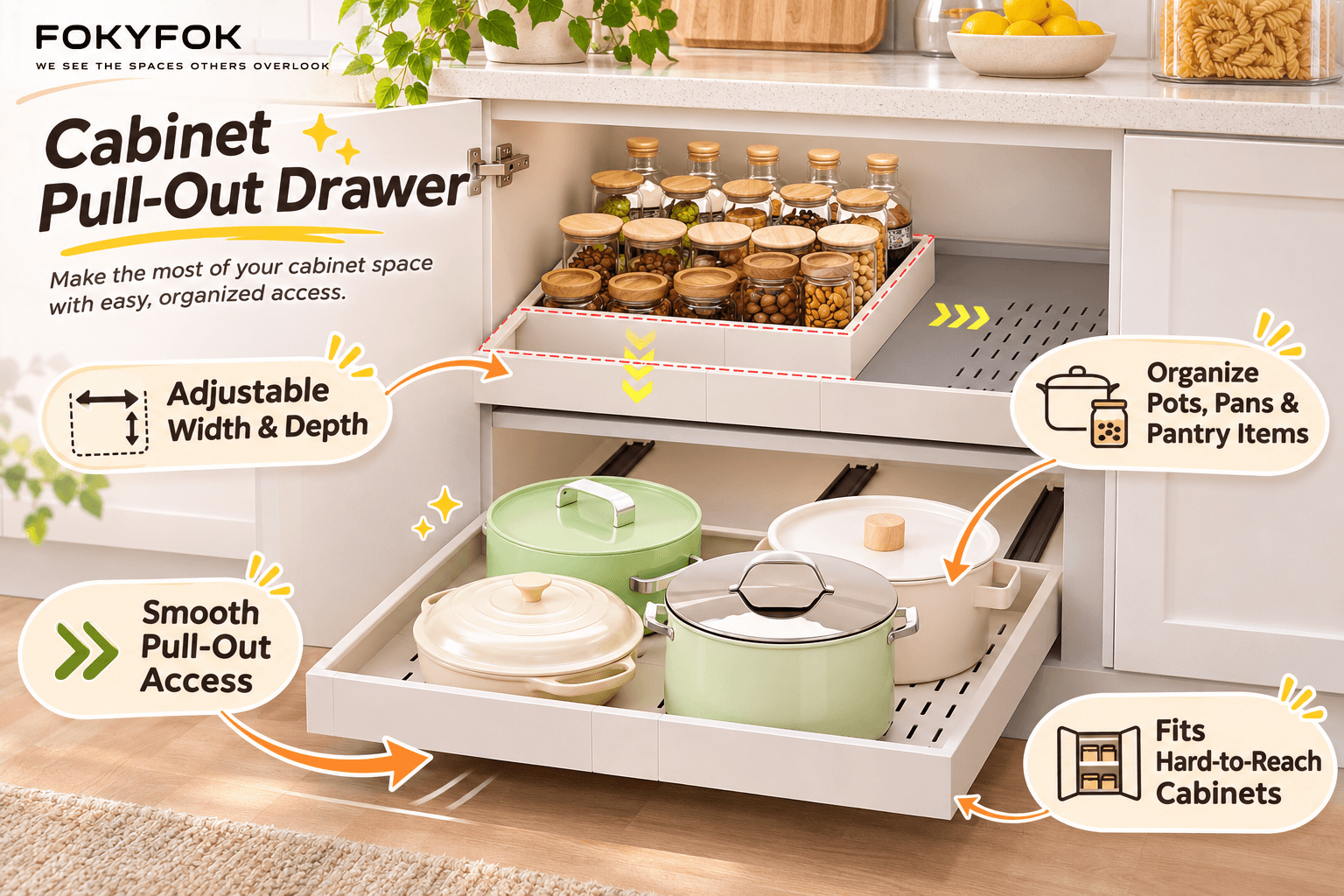
Fokyfok’s answer is a frame that stretches in two axes. Width adjusts from roughly 14 inches to 21 inches, and depth adjusts from roughly 17 inches to 24 inches, so the same unit can serve a narrow bathroom vanity and a deep kitchen base cabinet. Both directions matter. Width adjustment lets the tray fill the cabinet floor without leaving gaps where a jar can tip; depth adjustment lets it occupy the abandoned rear zone instead of stopping at the comfortable front half.
- Set width first, against the cabinet’s interior walls, so the tray is stabilized side to side.
- Then set depth, extending toward the back panel until you reach the part of the cabinet you currently only clean during move-out.
- Load heavy items at the rear, light ones forward — the rails are built for the weight, and this keeps the center of mass sensible.
- Leave hinge clearance, since a door needs its arc before the drawer needs its travel.
Structurally it is carbon steel with a slotted deck, and the perforations are more than visual. A solid tray floor in a cabinet traps condensation and spills against whatever sits in it; a ventilated deck lets both drain and dry, which matters in a bathroom vanity or under a sink-side cabinet far more than in a dry pantry.
No-Drill Mounting, and Who It Is Really For
The installation method is the product’s second argument. It mounts with a peel-and-stick nano adhesive base rather than screws, using a three-track guide rail system, and requires no drills or tools. On paper that reads as a convenience feature. In practice it is an access feature: it opens the product to renters, to people with quartz or ceramic cabinet floors they have no intention of piercing, and to anyone who has ever been told “you can’t drill into that” by a landlord, a spouse, or a very expensive kitchen.
There is an honest trade here, and a brand that pretends otherwise loses trust. Adhesive mounting depends on surface prep — clean, dry, degreased, and flat. It also depends on the cabinet floor having no lip or raised edge, which is why the listing is explicit about lipless interiors. A drawer mounted to a cabinet floor with a lip will not seat flush, and a drawer mounted to a greasy kitchen floor will not stay.
“But won’t a heavy pot pull the rails right off?”
That’s the question everyone asks first, and it’s the right question. The answer is that the failure point was never the steel — it was the bond. Prep the surface like you’re applying a screen protector, not like you’re hanging a picture, then let the adhesive settle fully before the first loaded pull. Treat the first week as a break-in: light loads, no full-extension yanks. Do that and the drawer behaves like built-in hardware. Skip it and you’ve blamed the product for a shortcut.
Five Rooms the Same Organizer Quietly Re-maps
Because the frame expands, one SKU does the work of several single-purpose organizers, which is itself a form of space-saving — you are not storing the organizer when it is idle.
- Kitchen base cabinets. Pots, lids, and Dutch ovens move from the blind rear zone to a tray that slides into your hand.
- Pantry shelving. Canned goods and dry jars get a rolling shelf, so the back row stops being a mystery.
- Bathroom vanities. Toiletries and cleaning bottles stop tipping into the gap beside the plumbing.
- Laundry cabinets. Detergent, stain remover, and dryer sheets get one pulled-forward home next to the machine.
- Wardrobe and office credenzas. Off-season accessories, printer paper, and cables get a shallow drawer in furniture that never had drawers.
| Specification | Fokyfok pull-out cabinet organizer |
|---|---|
| Adjustable width | approx. 14 in – 21 in |
| Adjustable depth | approx. 17 in – 24 in |
| Mounting | Peel-and-stick nano adhesive, no drilling |
| Rail system | Three-track guide rails |
| Frame material | Carbon steel |
| Deck | Slotted / ventilated |
| Best-fit interior | Flat, lipless cabinet floor |
| Tool required | None |
Fokyfok Under-Bed Storage Containers: Vertical Space With Wheels On It
If the cabinet organizer is about depth, the under-bed bin is about height — and specifically about refusing to accept the usual low-profile compromise.
Why Ten Inches Changes the Whole Calculation
Most under-bed storage is built short, around 5 to 7 inches, because that is what fits under a standard platform. The consequence is that you cannot fold anything normally: sweaters get rolled, duvets get vacuum-compressed, shoes go in sideways. You end up buying more bins to compensate for the fact that each one wastes half its own footprint on inefficient packing.
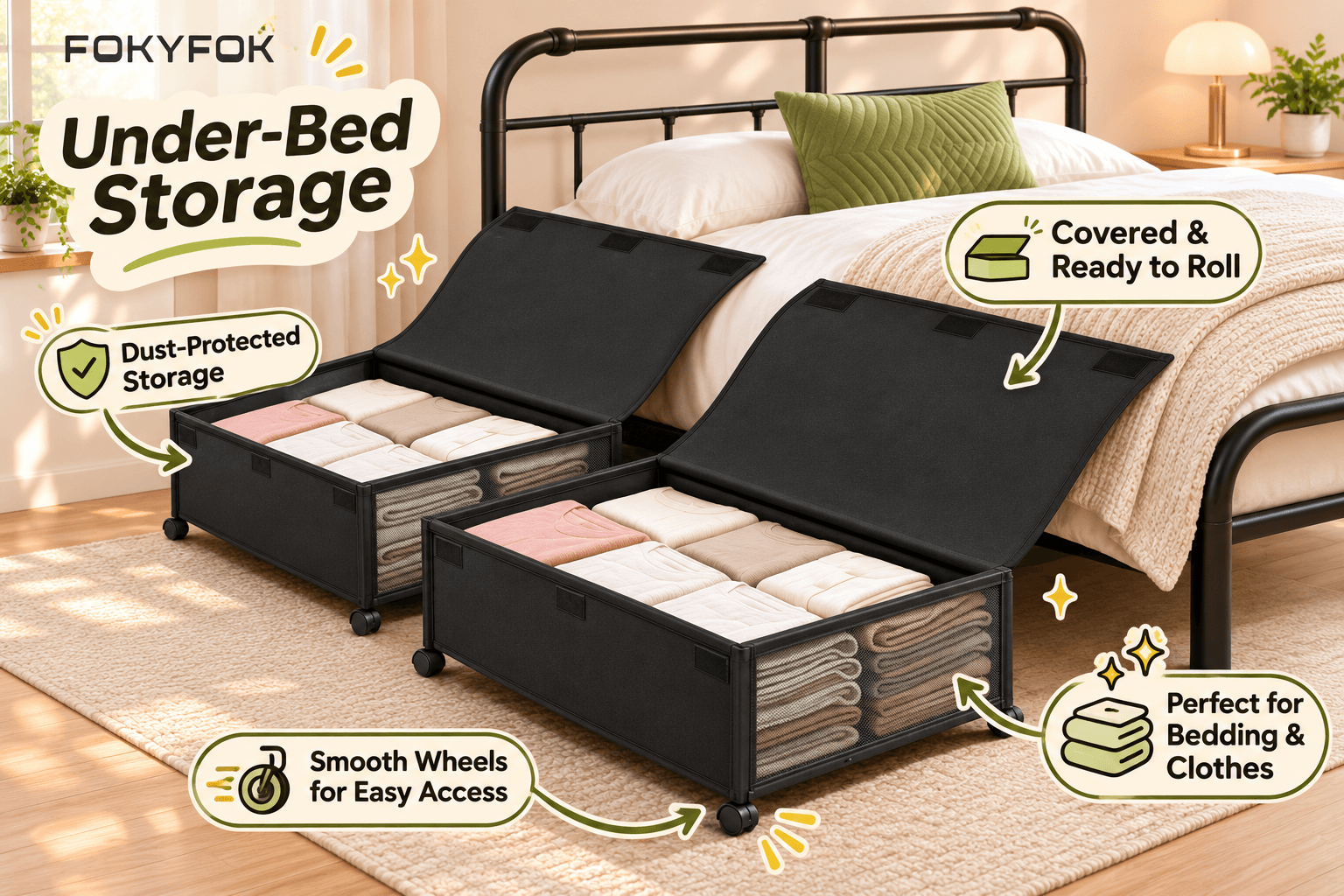
Fokyfok’s version stands about 10 inches tall and roughly 31 inches long, and the brand frames the benefit bluntly: one bin at this height holds what two standard-height bins would. That is not a marketing flourish, it is geometry. Doubling the vertical dimension roughly doubles usable volume without doubling the floor area consumed under the bed — which is the scarce resource, since the bed’s footprint is fixed.
- Bulky textiles go in unfolded. Blankets, comforters, and thick sweaters fold as they would for a shelf.
- Shoes stand upright, sole-down, instead of being laid on their sides.
- Fewer bins for the same contents means less plastic or fabric manufactured, purchased, and later stored when off-season ends.
- Vertical walls resist collapse. A tall rigid-framed bin keeps its shape when half-empty; a shallow soft one caves.
The two-pack matters for the same reason. Under-bed storage works best when it is symmetric — one bin on each side of the bed, or two side by side at the foot — and buying a matched pair removes the awkward leftover gap that single units create.
The Lid, the Wheels, and the Dust Problem
Anything that lives under a bed lives in the dustiest cubic foot of the house. Pet hair, lint, and the fine grey fluff that migrates downward all collect there, and a bare fabric tote offers no resistance. This design pairs a structured fabric body with an Oxford-cloth lid, so contents stay sealed against dust, dirt, and ambient moisture without needing vacuum bags or plastic wrap. The lid is a genuine usability improvement over zip-around tops: you lift it fully back to load, and it stays put while both hands are busy.
The wheels are the other half of the argument. Under-bed access fails not because the bin is heavy but because friction is unmanageable — a 60-pound box dragged across hardwood damages both the floor and the bin’s base. Four casters rotating through a full circle means the bin can be pulled out along the bed’s length and steered sideways into open floor without lifting, which is the difference between a storage system you actually use seasonally and one you avoid.
“Isn’t a tall bin just going to hit the bed slats?”
Check clearance before anything else. Measure from the floor to the lowest obstruction — slat, rail, or a dust ruffle that hangs low — at several points along the bed, then compare against the bin’s 10-inch height. Width is the other number nobody measures; the bin is long, but its end-to-end width determines whether two of them fit side by side. If clearance is marginal, a low bed with a thick box spring is the usual culprit, and a tall bin belongs under a frame with real daylight beneath it.
Frame, Fabric, and the Eighty-Pound Question
The construction is a hybrid: a metal internal frame of iron pipes and plates, panelled with high-density plastic and wrapped in 600D tear-resistant fabric. Rated load runs to roughly 80 pounds per bin. That number is worth unpacking, because 80 pounds sounds arbitrary until you convert it into contents — it is comfortably a winter coat collection, a stack of folded denim, or a dozen pairs of shoes, with margin to spare. The rating also tells you something about rigidity: a frame specified to carry that weight will not bow when packed dense, and it will not buckle at the corners when rolled over a small floor imperfection.
Mesh end panels on certain variants add a practical benefit: you get partial visibility without opening the lid, which is the only realistic way to identify contents in a dark space. Reinforced grab handles and a label window serve the same purpose from the other direction — identification without disassembly.
| Specification | Fokyfok under-bed storage containers |
|---|---|
| Pack size | 2 bins |
| Height | approx. 10 in |
| Length | approx. 31 in |
| Capacity logic | Roughly 2× a standard low-profile bin, per unit |
| Frame | Iron pipes and plates |
| Panels | High-density plastic |
| Exterior fabric | 600D tear-resistant |
| Lid | Oxford cloth, lift-open |
| Mobility | 360° rolling casters |
| Rated load | Up to approx. 80 lb per bin |
| Colour | Black |
How the Two Products Fit Together: A Whole-Home Sequence
Sold separately, these are two good purchases. Used together, they are a method — and the method is the brand’s real proposition. The logic runs from the room where frustration is loudest to the room where it is quietest.
| Zone | Problem | Product | Effect |
|---|---|---|---|
| Kitchen | Rear cabinet depth unused | Pull-out organizer | Every jar enters reach |
| Pantry | Back row becomes invisible inventory | Pull-out organizer | Rolling shelf, no double-buying |
| Bathroom | Bottles tip beside plumbing | Pull-out organizer, narrow setting | Vanity floor fully used |
| Bedroom closet | Off-season textiles have no home | Under-bed 2-pack | Closet freed for current season |
| Kids’ or guest room | Toys and spare bedding on the floor | Under-bed 2-pack | Floor clears, lids seal dust |
| Laundry | Detergent stockpile unmanaged | Pull-out organizer | Reserves slide forward |
A sensible weekend, in order:
- Measure before you shop. Cabinet interior width and depth, at the narrowest point; bed clearance at three spots along its length. Two minutes of tape measure prevents the single most common return.
- Clear one cabinet completely. Not two — one, as a pilot. Empty it, wipe the floor, degrease it, and let it dry fully.
- Install the organizer and let the adhesive set before loading anything.
- Load the rear of the tray first with the items you use weekly but currently lose.
- Assign one under-bed bin per household member, rather than one per category. Ownership beats taxonomy when the storage is out of sight; people remember what is theirs long after they forget which category it belonged to.
- Photograph each closed bin and keep the photos. A dark space rewards a visual index, and a phone album is a free labelling system.
Buying Logic: Four Questions to Answer Before Anything Goes in the Cart
Both products succeed or fail on measurement, not on design taste. The catalogue is flexible by intent, but flexibility is not the same as universality.
- Is the cabinet floor flat and lipless? The adhesive organizer needs a continuous, unobstructed surface. A raised edge, an internal brace, or a pre-installed wire basket will defeat it, and no amount of adjustability compensates.
- Can the door clear the pulled drawer? A shallow tray with a full rack of mugs still needs the cabinet door to swing. Check the hinge arc before committing.
- Does the bed have genuine clearance? Frames with attached dust ruffles, storage beds, or low platform designs leave no room for a 10-inch bin. This product is for tall beds, dorm lofts, and frames on legs — the listing says as much.
- What is the bin’s width, and how many fit? Length and height are published prominently; width is the dimension that determines whether two bins sit side by side or one sits centred. Confirm it against the bed before assuming a pair.
A note on expectations: neither product is decorative. The organizer is white steel that disappears into a cabinet, and the bins are black fabric that stays out of sight by definition. That restraint is consistent with the brand’s premise — these are tools for space no one sees, so they are engineered for the hand and the elbow rather than for the camera. If you want storage that earns its place visually on an open shelf, this is the wrong category. If you want storage that earns its place functionally in a dark cavity, it is exactly the right one.
Care, Longevity, and Getting a Second Season Out of Both
Overlooked space is unforgiving: no airflow, no light, and no one cleaning it. A little maintenance doubles the useful life of both items.
- Wipe the adhesive base with a dry cloth before re-mounting anything, and re-seat it on a fresh surface rather than trusting an old bond.
- Never slide a loaded tray over grit. A single grain of sand under a rail grinds louder than the weight above it.
- Dry spills immediately through the slotted deck; ventilation helps, but it is not drainage.
- Vacuum the bin’s casters at the turn of each season — hair wraps around wheel axles faster than it accumulates anywhere else in the room.
- Air the fabric body out before seasonal storage. A 600D wrap that goes under the bed damp will come out smelling like a basement.
- Store the empty bins flat if the frame allows it, rather than occupying closet space with air.
- Rotate contents once a year and discard at that point. The genuine risk of hidden storage is not dust; it is buying replacements for things you own and cannot see.
What Fokyfok Gets Right That Big-Box Organization Does not
The organization aisle has been optimized for a single metric: how many identical units stack into a warehouse. That produces cheap, uniform, shelf-sized products and a persistent gap in every home — the gap Fokyfok named in its own platform.
Three things distinguish the approach. First, tolerance for irregularity: adjustable width and depth acknowledge that cabinets are not standardized, whereas rigid systems implicitly blame the buyer’s furniture for not fitting. Second, respect for the tenant: no-drill mounting recognizes that a large share of households cannot modify what they live in, and that this is a design constraint, not a niche. Third, attention to the failure mode nobody demos: dust, condensation, friction, and hinge arcs. The slotted deck, the sealed lid, and the rotating casters each answer a problem that only appears after month two.
None of this is loud. There is no proprietary app, no modular ecosystem to lock you in, no aspirational renovation narrative. It is a small catalogue solving two specific geometries well, and the restraint is the point. A brand that limits itself to the spaces it can genuinely improve is easier to trust than one that promises the whole house.
Final Thought: Storage Is a Design Problem, Not a Bin Problem
The most useful thing Fokyfok offers is not steel or fabric. It is the reframing — the suggestion that the reason your home feels disorganized may not be too few containers, but too little motion in the space you already have. Static volume collects entropy. Anything that slides, rolls, or extends forces contact with it.
Once that idea lands, the audit writes itself. Stand in each room and look for the volumes you have stopped perceiving: the shelf that ends in darkness, the drawer behind the drawer, the four inches under the sofa. Those are the rooms inside your rooms, already paid for, waiting to be given a mechanism. A brand that begins by pointing at them and then builds hardware for exactly that spot is doing something rarer than selling storage. It is teaching people where their house actually is.
Frequently Asked Questions
Is the pull-out cabinet organizer permanent once installed? No. Adhesive mounting is designed to be non-destructive, which is the entire appeal for renters. Removal requires patience rather than force, and the cabinet floor is left intact when done slowly.
Will the organizer hold a full stack of cast iron? The frame is carbon steel with a three-rail system rated for heavy cookware, and the under-bed bins carry roughly 80 pounds each. For cast iron specifically, distribute weight toward the rear of the tray and confirm the adhesive has fully set before loading.
Can the under-bed bins fit under a bed with a dust ruffle? Only if the skirt is short or lifted. Measure from the floor to the lowest hanging fabric, not to the frame — the skirt is usually the binding constraint, and a 10-inch bin needs clearance above it.
Do the two under-bed bins have to be used together? No. A matched pair suits a queen or king, but one at the foot of a twin and one under a dorm loft is equally common. Splitting them across rooms is a reasonable way to cover two problem zones from a single purchase.
Which product should be bought first? Start with the cabinet organizer if the kitchen is where daily friction lives; it changes how often you use what you already own. Start with the under-bed pair if closet overflow is visible from the doorway, since that is the faster perceptual win.