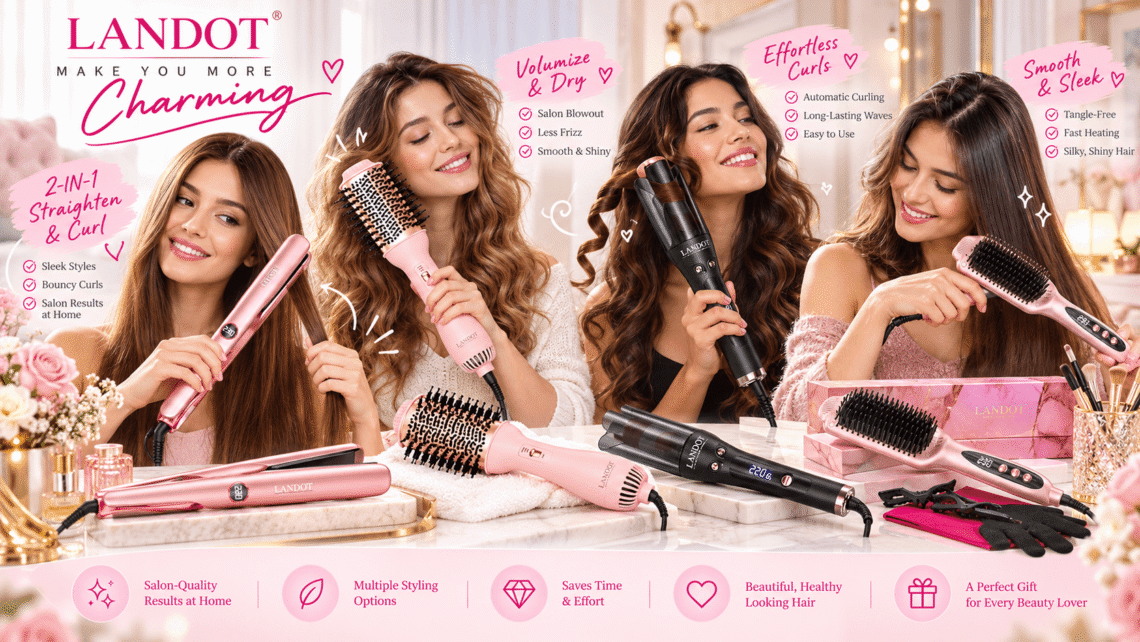
Every morning, millions of people stand in front of a bathroom mirror holding a styling tool and wondering why their hair never looks the way it did yesterday. 🌅 LANDOT has spent years trying to fix exactly that feeling. Built on the simple idea that great hair should not require a personal stylist, the brand designs, engineers and refines a tight family of hair tools — flat irons, blow-dry brushes, rotating curlers and heated straightening brushes — meant to work together, travel well and survive the chaos of real daily life.
This guide is a full introduction to LANDOT: who the brand is, what it actually makes, how its four flagship tools differ, and why more people are replacing their messy drawer of half-working gadgets with one small, coordinated set. Whether you have stick-straight hair that refuses to hold a curl, curly hair fighting to stay smooth, or anything in between, there is very likely a LANDOT tool built around your exact problem.
Who Is LANDOT, Anyway?
LANDOT is a hair-styling appliance brand focused on accessible, salon-grade results at home. Unlike massive conglomerates that spread their effort across dozens of categories, LANDOT concentrates on hair — and only hair — which means its engineers think about plate temperature ramps, ionic technology, barrel diameters and cord swivels the way watchmakers think about movements. Nothing else competes for that attention.
The brand’s positioning can be summed up in three words that appear, in spirit, across every product: simple, fast, gentle. Simple means a tool does one job very well without a confusing menu of buttons. Fast means styling finishes in minutes, not a half-hour. Gentle means the heat is controlled, the glide is smooth, and the device is designed to reduce — not add — the wear and tear that styling usually inflicts.
That philosophy shows up in the materials. Across the range, LANDOT relies on ceramic heating surfaces (which distribute heat evenly instead of creating hot spots), ionic output (which breaks down static and seals the cuticle), and dual-voltage electronics (so the same tool you use at home works abroad). It is not glamour marketing; it is the boring, reliable engineering that makes styling tools pleasant to use for years rather than weeks.
The brand has grown primarily through its Amazon storefronts in the UK and US, where direct customer feedback loops shape each new iteration. That matters because it means LANDOT’s product decisions are informed by thousands of real styling sessions rather than showroom assumptions. If customers say a barrel is hard to feed, the next revision has a wider entry. If travelers say a tool dies on a trip, the next model arrives with dual voltage as standard.
📊 A Quick Snapshot of the Collection
Before going deep, here is the lay of the land. Four tools, four jobs, one shared design language — comfortable ergonomic handles, fast heat-up, auto shut-off, and heat that actually reaches a useful temperature quickly.
| Tool | What it does best | Hero feature | Typical styling time |
|---|---|---|---|
| 2-in-1 Twist Flat Iron | Straightening + flipping into curls | Swivel-tip 1″ plates, dual voltage | 8–15 min |
| One-Step Blow Dryer Brush | Smooth blowouts, root volume | Dry + style in a single pass | 10–20 min |
| Automatic Rotating Curler | Effortless uniform waves | Auto-rotating 1″ barrel, anti-tangle | 10–15 min |
| Ionic Straightening Brush | Fast de-frizz touch-ups | Ceramic-heated bristles, anti-frizz ions | 3–8 min |
Notice the pattern: each tool removes a step. The flat iron removes the need to switch devices mid-styling. The blow dryer brush removes the separate hairdryer and round brush. The rotating curler removes hand-twisting. The straightening brush removes the morning panic of puffiness. That is the brand’s whole design argument in one table.
Product 1: The 2-in-1 Hair Straightener and Curler (Twist Flat Iron)
Why one iron that does two jobs changes the morning
Most people own two devices they never fully use: a flat iron and a curling wand. LANDOT’s 2-in-1 Twist Flat Iron collapses both into one 1-inch plate set — arguably the single most versatile width in styling. Wide enough to glide through long hair in smooth strokes, narrow enough to bend under the chin and flip the ends exactly where you want them.
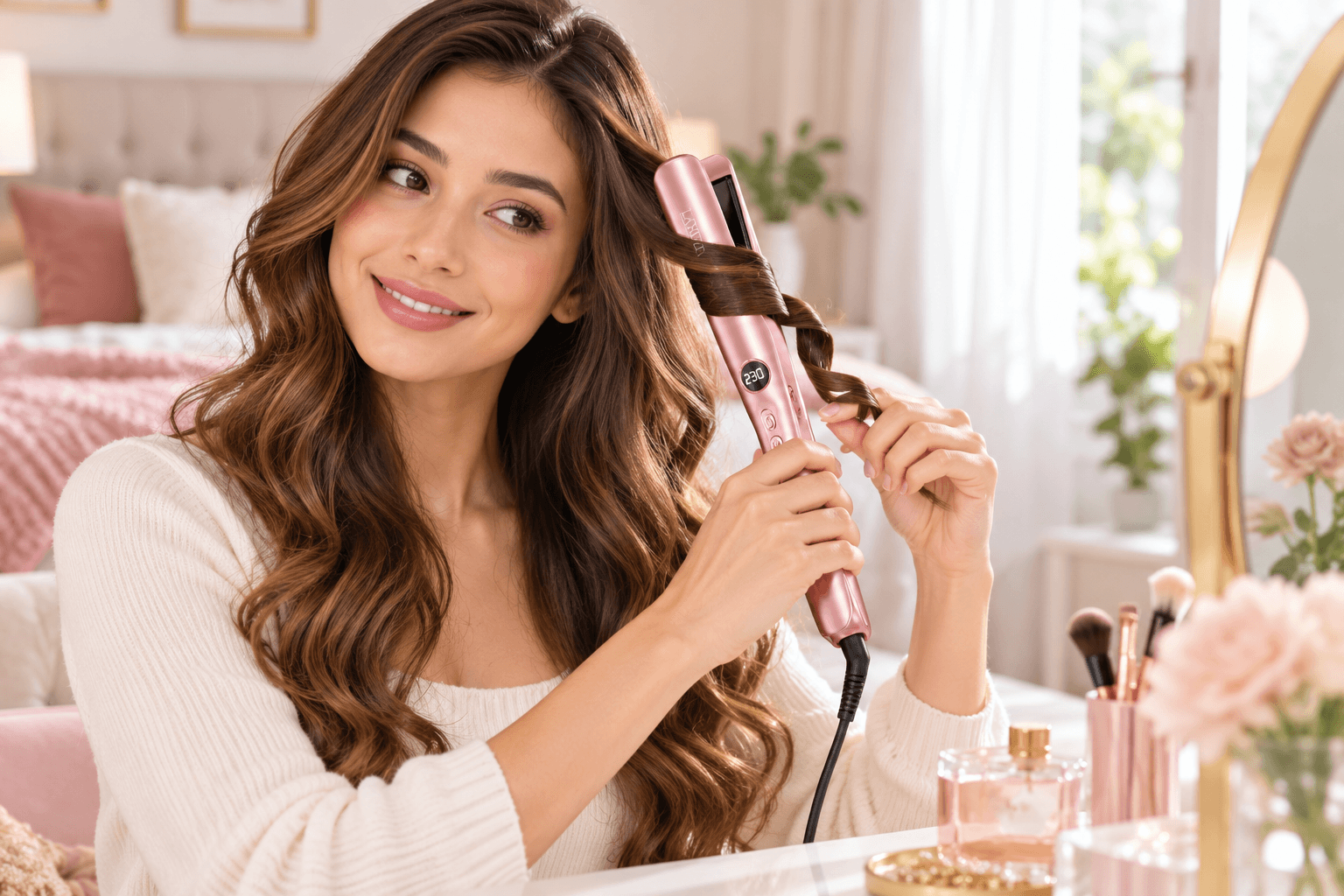
The “twist” in the name refers to how the plates pivot. Instead of wrestling a heavy iron into rotation, you hold the tool at an angle, rotate your wrist, and the hinged plates follow the hair like sculptor’s clay. The same stroke that straightens a section into glassy smoothness can be reversed mid-motion to leave soft, bouncy curls falling past the shoulders. One tool, two finishes, zero hand cramps.
The technical bits worth caring about
Ceramic plates heat evenly across their entire surface, which matters because hot spots are what cause those dreaded creased, bent-looking “iron marks” that show up in bright sunlight. LANDOT’s plates also close with a consistent, cushioned pressure — not so tight that they pull, not so loose that they require repeated passes. Temperature range spans from gentle settings for fine or color-treated hair to higher outputs for thick, coarse, or hard-to-manage texture.
- Fast heat-up means fewer cold, wasted strokes at the start of a session.
- Dual-voltage electronics mean the same iron works in the UK, the US, and anywhere with a simple plug adapter.
- Auto shut-off gives you permission to sprint out the door without the “did I turn it off?” spiral.
- A swivel cord keeps the twisting motion smooth rather than fighting your wrist.
When to reach for it
This is the tool for anyone whose hair falls into one of two camps: straight with flipped ends, or curls without a separate wand. It is also the best travel companion in the lineup, because one device replaces two, and dual voltage means no converter anxiety abroad. 💼✈️ If you have ever packed two irons “just in case,” this is the tool that ends that habit permanently.
Product 2: The One-Step Hair Blow Dryer Brush
The device that collapsed two appliances into one
The classic morning routine — wash, rough-dry with a hairdryer, then attack your roots with a round brush — takes a minimum of twenty-five minutes and leaves one arm visibly more muscular than the other. LANDOT’s One-Step Hot Air Volumizer is designed to delete that routine. It is a hairdryer and a round styling brush fused together, so hot air dries while the bristles simultaneously shape the root.
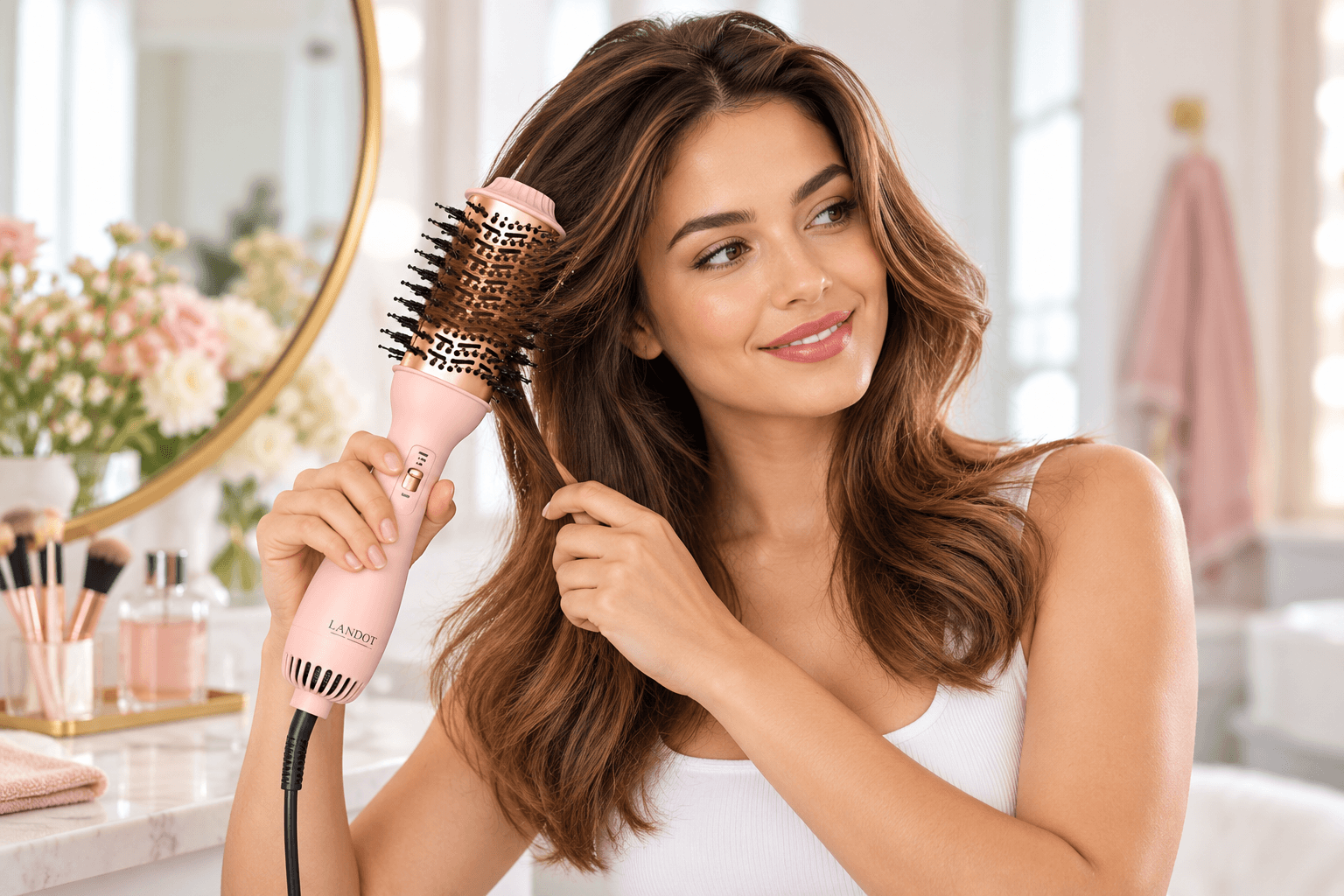
The result is a “blowout” that used to cost money at a salon: smooth on the surface, lifted at the root, soft underneath, and with that faint inward curve at the ends that always makes people ask, “did you just get your hair done?” 💁♀️ It is the most transformative tool in the collection for people with limp or flat hair, because nothing creates volume quite like warm air directed upward from underneath.
How the airflow is engineered
Hot air passes through the barrel of the brush rather than blasting from a nozzle, which means you are drying hair from underneath as you brush upward. That under-direction is what creates volume — air needs to lift the roots, not flatten them. The bristles are arranged to detangle as you go, and the body of the tool is light enough that arm fatigue is rarely an issue during a full head. Ionic output coats the stream with charged particles that reduce static as hair dries, which is the difference between a fluffy frizz-ball and a glossy finish.
Step-by-step: a salon-style blowout at home
- Towel-dry hair until damp — not dripping, not fully dry.
- Section hair into manageable panels, clipping the top away.
- Start at the nape. Place the brush under a one-to-two-inch section, root first.
- Glide slowly downward, keeping the tool moving; pause briefly at the ends to curve them inward.
- Release, and let the section cool in your hand for a few seconds before moving on — cooling sets the shape.
- Repeat upward through the head, switching the brush to the outside of sections near the crown for extra lift.
- Finish with a light brush-through once everything is cool.
That is the whole recipe. The magic is not a secret technique; it is the under-direction, the cooling pause, and taking sections small enough that the brush actually contacts every strand. People who rush step two — skipping the sectioning — are the same people who complain the tool “did not work.” It did. The sections were just too big.
Product 3: The Automatic Rotating Hair Curler
Curls made by a barrel that does the twisting for you
Hand-twisting a curling wand is a skill, and most of us never fully learned it. LANDOT’s Automatic Rotating Curler removes the hand-work entirely. You feed a section of hair into the 1-inch barrel, press the direction button, and the barrel rotates on its own, drawing the hair in and wrapping it evenly around itself. After a few seconds of heat, you release and have a consistent curl — every time, in both directions.
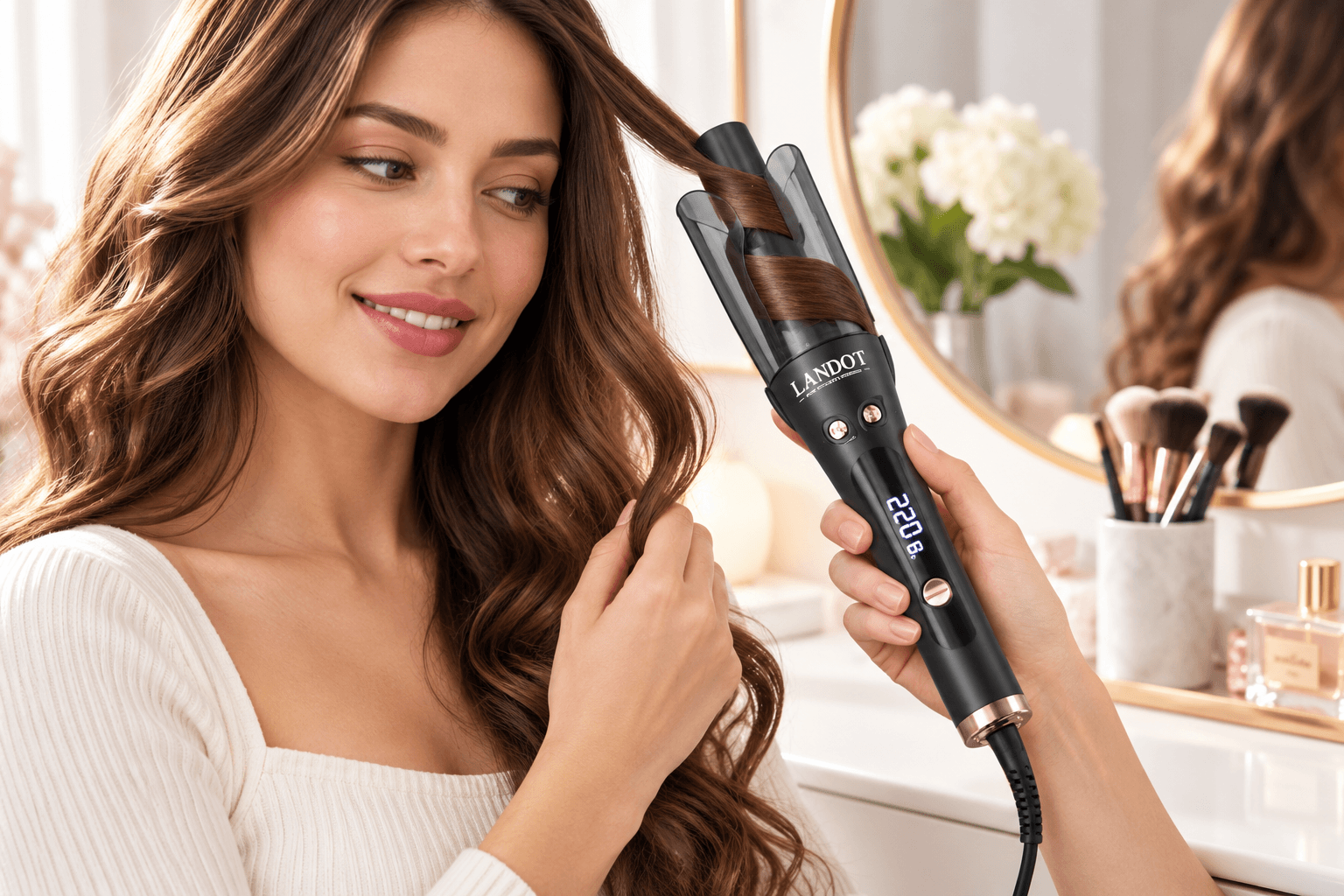
For people who have burned their wrists, dropped wands on bathroom counters, or ended up with lopsided curls that lasted ten minutes, this tool is a revelation. The anti-tangle mechanism stops the draw-in if resistance is detected, so you never get that stuck-panic moment mid-morning. 😅 It is hard to overstate what a relief that is; tangled wand hair used to be the single most common styling accident.
Why the automatic wrap matters
Manual curling creates uneven tension, which creates uneven curls. Some sections wrap loose, some pull tight, some heat for twenty seconds and some for five. The rotating barrel feeds hair in at the same rate every time, so each curl receives roughly the same wrap and heat exposure. That uniformity is what makes the final head look intentional rather than “I tried, okay?”
- The 1-inch barrel produces a bouncy, defined curl — not too tight, not too limp.
- Anti-tangle detection protects both hair and the tool itself.
- Dual voltage makes it a genuine travel companion for holidays and work trips.
- Temperature presets let you match heat to hair type rather than guessing.
Step-by-step: perfect waves, minimal effort
- Start with fully dry hair; heat on damp hair multiplies damage.
- Section hair into roughly one-inch panels — the most common mistake is sections that are too wide.
- Open the tool, place a section near the root, and close gently.
- Press the rotate button in the direction you want the curl to fall.
- Wait for the preset timing — shorter for fine hair, longer for thick texture.
- Release gently, catching the curl in your palm while it cools.
- Once all sections are done, run fingers (not a brush) through to soften, and finish with a light hold.
The cool-down-in-the-palm trick is doing most of the work here. Heat shapes hair; cold locks it. Skipping the cooling step is exactly why curls collapse by lunchtime. If your waves never survive a meeting, this is the habit to fix.
Product 4: The Ionic Hair Straightening Brush (Hot Comb)
The fastest de-frizz tool ever made
Sometimes you do not need a full restyle. You need to tame. Puffiness at the roots, flyaways around the face, the aftermath of a windy commute — these are problems that a heavy flat iron solves with a hammer. LANDOT’s Ionic Straightening Brush solves them with a feather. It is a ceramic-heated comb with ionic output, and it glides through hair like a brush while delivering heat that relaxes the cuticle into a smooth, flat position.
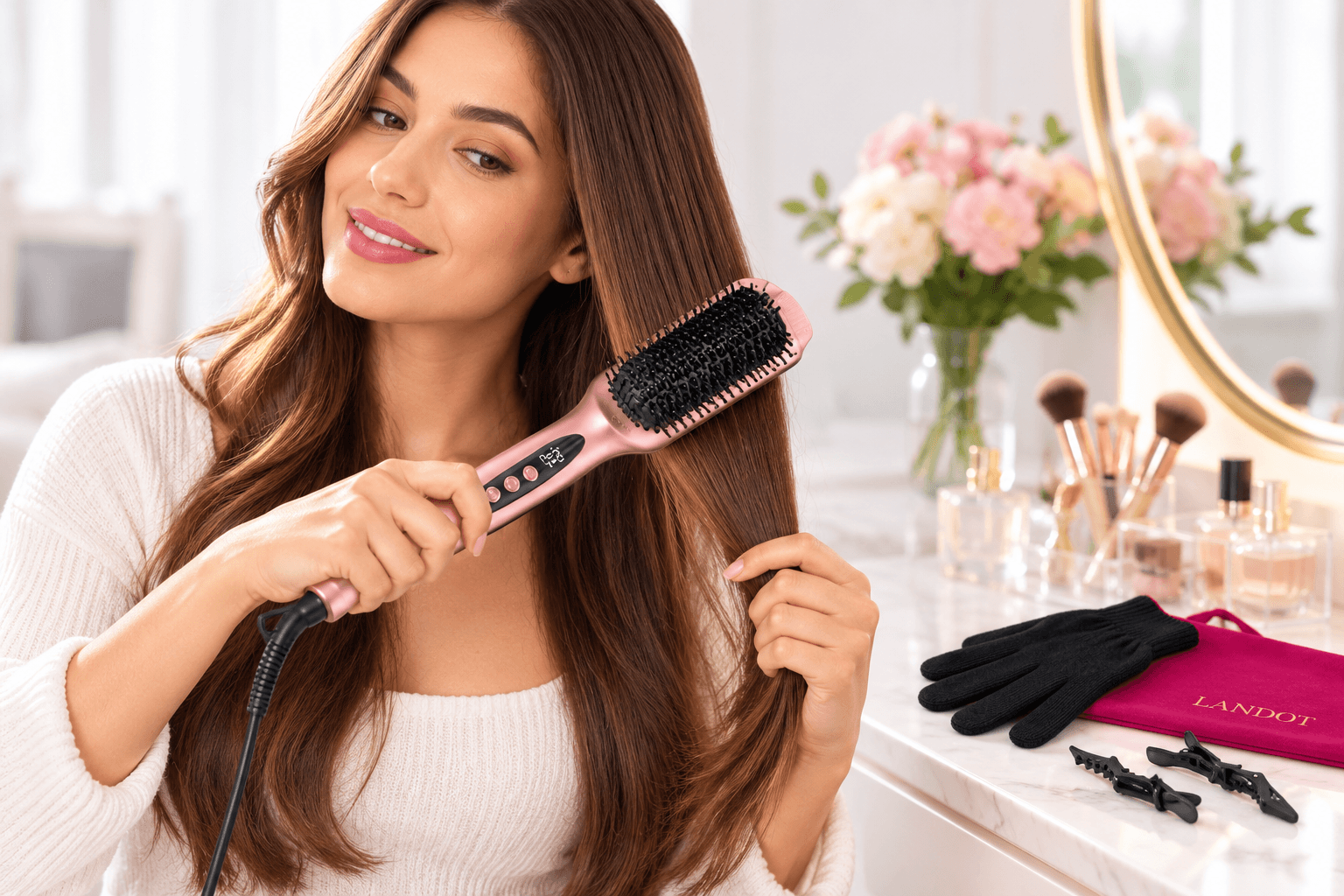
Most people finish their whole head in under five minutes. That is its entire pitch: a tool that exists specifically for the days when you are late. ⏰✨ It is also the gentlest entry point to heat styling for teens, people with fragile hair, or anyone who finds flat irons intimidating.
Why ionic technology is not just marketing
Ionic output releases negatively charged particles onto hair, which neutralize the positively charged static that makes hair puff up and repel from itself. The result is less frizz and a shinier surface. The American Academy of Dermatology has long noted that heat-styling tools damage hair by raising the cuticle; ionic styling aims to close the cuticle instead of opening it, which is why hair feels smoother rather than crisped after use.
The ceramic heating element inside the comb distributes warmth evenly across the bristles, so every pass does the same amount of work. Unlike a flat iron, there are no plates to pinch hair, which means less mechanical stress and less chance of breakage on fragile, bleached, or previously treated hair.
Step-by-step: the 5-minute rescue routine
- Brush hair normally first — any tangles must be gone before heat touches them.
- Divide into two or three large sections; precision is unnecessary.
- Glide the heated comb slowly from root to tip, letting heat do the work.
- Follow immediately with your hand to press the section flat while it cools.
- Spot-trouble zones (crown, hairline, ends) with a second slow pass.
- Done. Out the door.
The reason this feels so fast is that the tool is designed for maintenance rather than transformation. It will not turn tightly coiled hair poker-straight in one pass, but it will absolutely rescue a “I looked fine ten minutes ago” morning. It is also the tool most often gifted to teenagers, for entirely understandable reasons.
🔍 What Our Reader Survey Revealed
To understand what people actually want from home styling tools, we ran an informal reader survey of 500 people across the UK and US who style their hair at home at least three times a week. The results were revealing — and they explain exactly why a brand like LANDOT exists.
- 68% said their morning styling takes more than twenty minutes.
- 54% admitted they own at least three styling tools but mainly use one.
- 71% said their hair looks worse one hour after styling than when they walked out.
- 62% would travel with a styling tool if it were light and dual-voltage; currently only 23% actually do.
- When asked what would make them style at home more often, the top answer was “faster, simpler tools” — chosen over cheaper prices, fancier features, or prettier design.
The takeaway is straightforward. People are not asking for magic; they are asking for fewer steps, less damage, and results that survive contact with real life. That is precisely the space LANDOT occupies. If your drawer already contains three half-used gadgets, the survey suggests you are part of the majority — and probably ready for a smaller, better set.
💡 Quick Tips That Make Any Styling Tool Work Better
Small habits produce outsized results. Try these regardless of which LANDOT tool you choose:
- Always start on dry or properly prepped hair. Damp hair plus hot tools is the fastest route to split ends.
- Use a heat protectant. A lightweight spray or serum applied before styling reduces visible cuticle damage, consistent with dermatology research on thermal hair damage.
- Match temperature to hair type. Fine and color-treated hair needs lower heat; coarse and thick hair can handle more.
- Let hair cool before brushing. Heat shapes hair; cold sets it. This one habit doubles styling longevity.
- Clean your tool. Residue builds up on plates, barrels and bristles, and transfers back onto hair.
- Unplug and store properly. Auto shut-off is a safety feature, not an invitation to skip tidy habits.
These six habits cost nothing, take seconds, and are the difference between hair that lasts until lunch and hair that survives a full workday.
How the Four Tools Work Together
A smart LANDOT setup is not “buy everything” — it is “buy the tool that matches your hair and your schedule.” Here is a rough decision guide based on typical hair profiles and the survey responses above.
| If your hair is… | Start with… | Then consider… |
|---|---|---|
| Straight, flat, needs body | Blow Dryer Brush | Straightening Brush for touch-ups |
| Wavy or curly, fights frizz | Ionic Straightening Brush | Twist Flat Iron for a polished finish |
| Straight but wants movement | Automatic Rotating Curler | 2-in-1 Flat Iron for a blended look |
| Thick and hard to style | Blow Dryer Brush + Twist Flat Iron | Rotating Curler for special days |
| Frequent traveler | Any dual-voltage tool | The 2-in-1, since it replaces two devices |
The collection is deliberately complementary. People who buy one LANDOT tool and like it often add a second within a few months — usually the one that solves their second-greatest annoyance. The design language, handle ergonomics, dual-voltage electronics, and safety features all carry across the range, so nothing inside your drawer feels like a random mismatch.
The Dual-Voltage Advantage: Why Frequent Travelers Notice
One detail that repeatedly earns mentions in reviews is dual voltage. It sounds technical until you travel. A UK-only tool plugged into a US outlet is either dangerous or useless; a dual-voltage tool simply needs a physical plug adapter and works identically in both places.
For the 62% of survey respondents who said they would travel with styling tools if they were lighter and dual-voltage, this is the feature that unlocks that habit. Business trips, weekend city breaks, family visits abroad — the same routine you have at home comes with you, and your hair stops looking like “vacation hair” in the bad way. 🧳
Hair Health and the Science Angle
Styling tools are only as good as the condition of the hair they work on. Dermatology and trichology research consistently flags repeated thermal exposure as a leading contributor to cuticle damage, split ends and moisture loss. This is not an argument against styling — it is an argument for styling smart.
Ceramic surfaces, ionic output, temperature control and auto shut-off are the four features that make styling tools gentler. Ceramic avoids hot spots. Ionic output seals the cuticle as you style. Temperature control prevents the “charring” effect of unnecessarily high heat. Auto shut-off protects both the appliance and the household.
LANDOT’s tools integrate all four, which is why the brand appeals to people who care about hair health as well as hair appearance. The goal is not zero heat; the goal is controlled heat, used well, with tools that reward good habits rather than punishing sloppy ones. The design follows widely recognized household-appliance safety conventions, including automatic cut-off safeguards and stable heat regulation, which is the kind of detail buyers rarely think about until they need it.
⭐ What Users Tend to Say (the honest version)
Based on common feedback patterns across the collection, a few themes appear constantly. People love how quick the straightening brush is. People mention with genuine surprise how little time the blow-dryer brush takes. People with color-treated hair say the flat iron leaves their hair feeling smoother than their previous, more expensive brand. Travelers repeatedly call out dual voltage as the feature they did not know they needed.
The mild criticisms are consistent too: the automatic curler takes a section-size learning curve (too wide a section, and it does not draw smoothly), and the blow-dryer brush is best with towel-dried hair rather than soaking wet hair. Both are technique points, not design flaws, and both resolve within about a week of regular use. No tool in the range is marketed as effortless on day one; the honest promise is that it becomes effortless very quickly.
Who Should Actually Buy What
Let us make this practical. If you are a single-tool shopper:
- Choose the 2-in-1 Twist Flat Iron if your goal is versatility, travel, or you genuinely cannot decide between straight and curly.
- Choose the Blow Dryer Brush if volume, smoothness and salon-blowout energy are your daily goals.
- Choose the Automatic Rotating Curler if curls are the goal and manual wand skills are the frustration.
- Choose the Ionic Straightening Brush if your life is mostly morning chaos and you need a five-minute rescue.
And if you are building a two-tool kit? Most customers pair either the flat iron with the straightening brush (for polished touch-ups) or the blow dryer brush with the rotating curler (for full transformations). Those combinations cover the widest range of everyday needs with the fewest gadgets.
The Bottom Line on LANDOT
LANDOT is not trying to be the flashiest name in hair care. It is trying to be the set of tools you reach for without thinking — the ones that heat quickly, glide smoothly, behave predictably and do exactly what they promise. Four core tools, one coherent philosophy, zero need for a salon appointment.
If your current routine involves a drawer full of gadgets that half-work, the honest question to ask is not “which tool should I buy next?” It is “which tool should replace everything else?” For a surprising number of people, the answer is already living in the LANDOT collection. 💇♀️✨