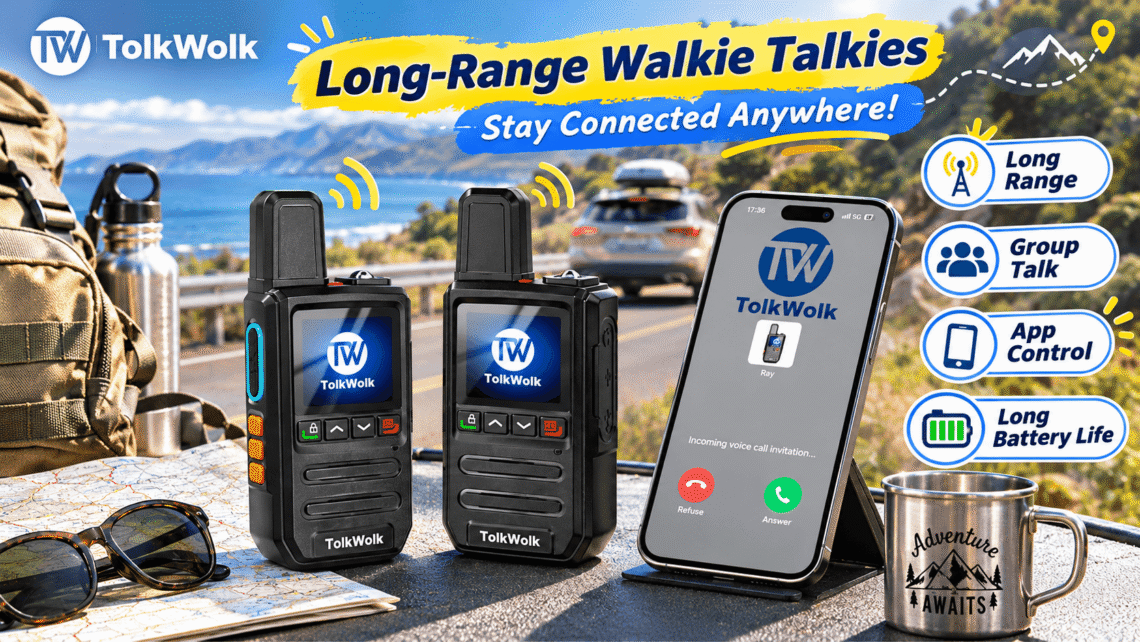
Picture a caravan of three cars winding along a coastal highway at golden hour. Somebody wants lunch. Somebody else wants a detour to the lookout. But by the time you’ve typed “are we stopping?” the moment has already passed — texts pile up out of order, read receipts taunt you, and in the dead zone between cell towers, every phone in the convoy quietly gives up. This is the exact frustration that TolkWolk was built to erase: a fresh take on the walkie talkie that treats “instant voice between groups” as a solved problem, rather than a childhood nostalgia act. TolkWolk is not selling nostalgia. It is selling momentum.
Most people never think about group communication until it breaks down. It breaks down on family camping trips where nobody can find each other on a 500-acre campground. It breaks down on construction sites where shouting over machinery is the default operating system. It breaks down in hotel lobbies, warehouse aisles, festival corridors, and the middle-aisle chaos of a big-box store where one grandparent wanders off with the shopping cart. Every one of these scenarios has the same shape: a group of people who need to say something right now, to everyone at once, without dialing, typing, searching for contacts, or hoping for a single bar of signal.
TolkWolk enters this space with a simple but aggressive thesis. The walkie-talkie format is not outdated — it was the phones that were wrong. Push the button, talk, release. Everyone in the group hears you instantly, simultaneously, in plain voice. That is the oldest, lowest-friction communication protocol humans have ever invented. TolkWolk kept the button and rebuilt everything underneath it.
Where the Old Radio Lost Its Way
Before we get into the device itself, it helps to understand what it is competing against — because TolkWolk is really competing with three things at once.
The first competitor is the traditional walkie-talkie, the chunky GMRS or FRS unit you remember from the early 2000s. Those radios work, but they work within physical limits: a few miles on open ground, far less through hills, buildings, or trees. They require channel selection, privacy codes, and occasionally a license. A pair of them can talk across a valley. They cannot talk across a state.
The second competitor is the smartphone itself, with group chats, group calls, and walkie-talkie apps that live inside social media platforms. These are free and familiar, but they depend entirely on data, battery life, and your willingness to juggle twenty notifications from twelve different apps. In a spot with no signal, the most expensive phone on the market becomes an expensive paperweight.
The third competitor is the satellite messenger — reliable in the backcountry, but expensive, slow, text-based, and burdened by monthly subscriptions that feel like paying for insurance on a trip you take twice a year.
TolkWolk’s cleverness is that it occupies the gap these three options leave wide open. It gives you the instant, press-and-talk simplicity of a real radio, the nationwide reach of a cellular network, and the group-management flexibility of a software app — while, per the brand’s published terms, charging nothing extra for ongoing service.
Meet TolkWolk: A Radio That Grew Up
So, what actually is a TolkWolk? Under the hood, it belongs to a category called PoC — push-to-talk over cellular. Instead of broadcasting on dedicated radio frequencies, the device connects to 4G networks, routes your voice through the cloud, and delivers it to every device in your talk group within a fraction of a second. That is why the brand describes it as offering unlimited range: as long as a participating device has cellular coverage, the distance between the speakers becomes irrelevant. A radio in Maine and a radio in Arizona can have the same instant conversation as two people standing next to each other.
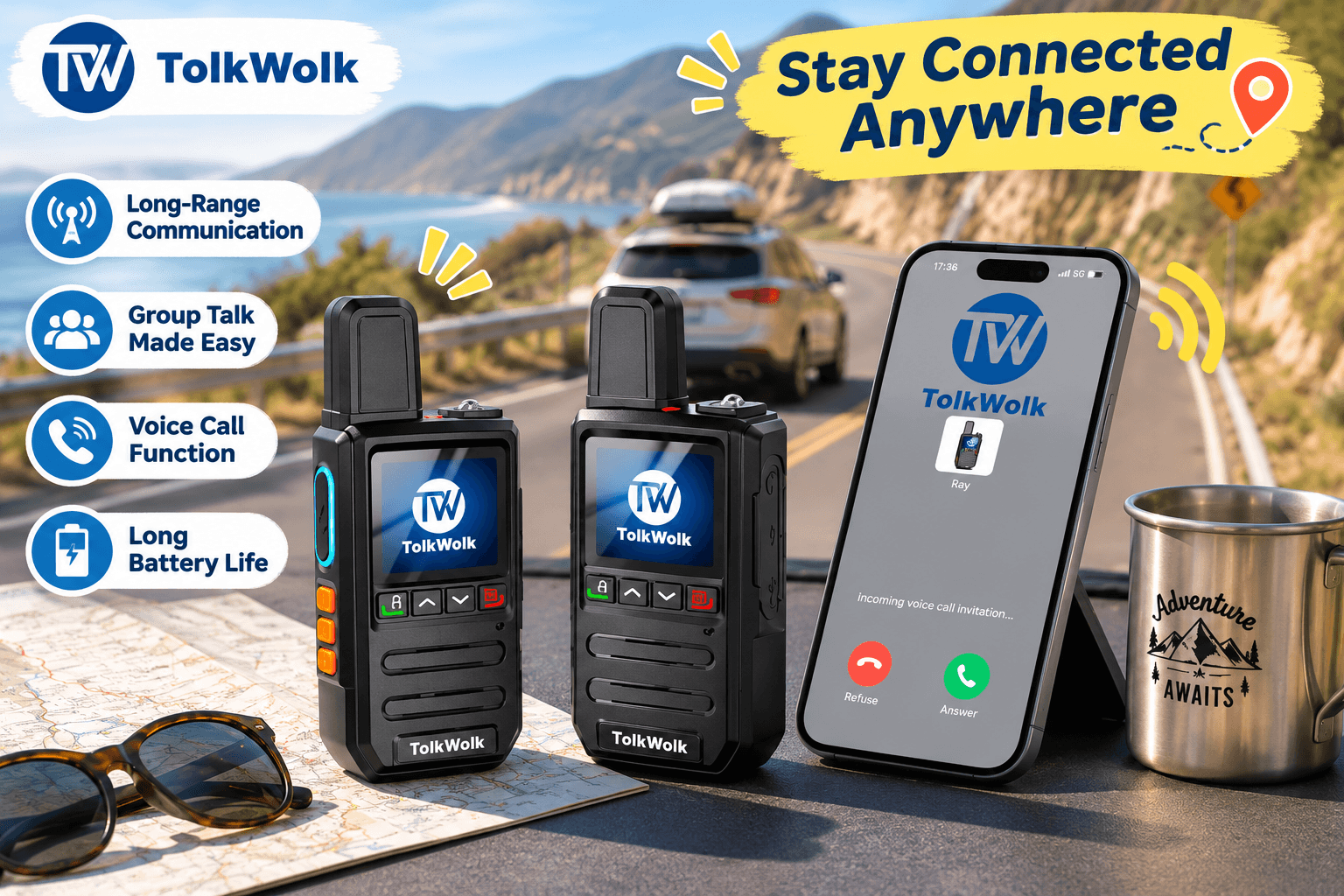
The hardware itself follows a deliberate, no-nonsense design philosophy. It is a compact, black handheld unit with a color display that shows the TolkWolk identity screen, a large push-to-talk button built for thumb operation, side shortcut keys in a contrasting accent color, and a belt clip that suggests it expects to live on someone’s hip all day. This is not a toy radio with flashing lights and a voice-changer. It is a tool. The screen tells you which group you are in, the battery level, and which network is carrying you. The rest of the interface is kept ruthlessly simple: press, speak, release.
Inside the box, each unit arrives with a SIM card already provisioned — one less setup step that usually kills enthusiasm for gadgets. Rather than asking buyers to shop for a data plan, negotiate with a carrier, or hunt down an activation QR code, TolkWolk shipped the devices ready to go. The published plan language is worth quoting plainly: lifetime-free service, with no subscription fees, no roaming charges, and no hidden costs. Real-world users should still verify coverage along the routes they actually travel — “unlimited range” is a description of network reach, not a promise that the device works where no network exists — but the pricing structure itself is unusual for this category, where hardware has historically been a loss leader and monthly plans quietly pay the bills.
💬 Field Note: “Preloaded SIM” sounds like a small detail until you’ve spent forty minutes on hold trying to activate a gadget your family gave you for a road trip. It is the difference between a product that gets used on Friday night and one that lives in a kitchen drawer.
At a Glance: How It Holds Up Against the Usual Suspects
A side-by-side comparison makes TolkWolk’s position in the market a lot easier to grasp. The table below contrasts it with the three alternatives most groups weigh before buying.
| Feature | TolkWolk 4G Radio | Traditional GMRS/FRS Radio | Smartphone Group Chat | Satellite Messenger |
|---|---|---|---|---|
| Effective range | Nationwide via 4G cellular | 1–36 miles, terrain-dependent | Only where phones get service | Globally, via satellites |
| Range consistency across states | Yes | No | No | Yes, but slow |
| Setup effort | Preloaded SIM, app-managed groups | Manual channels and codes | App downloads and contact adds | Hardware + subscription |
| Ongoing service cost | Stated lifetime-free service | None | Free (uses data plan) | Monthly/annual fees |
| Instant push-to-talk voice | Yes | Yes | Uneven, often delayed | Usually text-only |
| Works while driving hands-free | Belt-clip friendly | Belt-clip friendly | Requires phone handling | Niche devices |
| Group size management | App creates and administers groups | Fixed channels | Contact lists | Limited plan tiers |
| SOS safety feature | Built-in alert button | Rarely included | Emergency calling only | Core feature |
| Best fit | Mixed cross-distance teams | Local crews and campsites | Friends with decent signal | True wilderness expeditions |
A note of honesty under all of this: the figures in the “TolkWolk” column reflect the brand’s published claims. The honest takeaway is not that TolkWolk wins every scenario — a GMRS radio still has a quiet, no-network charm in truly remote terrain, and satellite devices remain the right tool where towers simply do not exist. But for the ninety percent of group communication that happens near civilization — highways, suburbs, campgrounds with cell service, job sites, and hotel chains — TolkWolk slots into a space nothing else currently fills at its stated price and service model.
The Part Most Brands Skip: The App Does the Heavy Lifting
Here is where TolkWolk separates itself from the pack in ways that only become obvious after you’ve used one. Traditional two-way radios manage groups with channels: you pick channel three, and everyone else on channel three hears you. Simple, but brittle. Add a new person? Walk over and tell them your channel number. Change your mind about the group? Physically reconfigure every radio.
TolkWolk moves this entire burden into a companion smartphone app. Through the app, you can:
- Create new talk groups in seconds
- Join existing groups with a shared invite
- Rename devices so “Radio (Serial Number 4821)” becomes “Front SUV” and “Warehouse Bay 3”
- Add or remove members on the fly
- Administer the whole roster without waiting for customer service
The rename feature deserves special attention because it is quietly genius. Hand a six-pack of identical black radios to a family and the first thing that happens is nobody knows whose is whose. Naming them through the app takes thirty seconds and instantly turns an anonymous stack of hardware into a coordinated team.
The app also enables the most forward-thinking feature in the entire lineup: your smartphone becomes a walkie-talkie. A team can show up with four physical radios and two colleagues dialing in from their phones, all on the same channel, all hearing the same instant voice. That hybrid model matters for road trippers — a passenger without a radio can follow along — and for small businesses, where not every employee needs dedicated hardware. One person carries the physical unit on the floor; the manager listens from the desk through the phone app.
💬 Field Note: Think of the app as the radio station’s control room. The radios are the speakers in the audience. Everything about who talks, who listens, and what the group is called happens on the phone, and the hardware just obeys.
A Conversation You Can Actually Picture
To show how this feels in practice, here is a lightly dramatized exchange from a typical Saturday convoy on a highway run. Three cars, five people, one golden retriever, and a six-pack of TolkWolk units.
Saturday, 12:04 PM — Highway 101, northbound:
Car 1 (Maya, lead): “TolkWolk check, TolkWolk check — front car to everyone. Gas station ahead on the right, pulling in in two miles.”
Car 2 (Priya, middle): “Copy that. I’m low on coffee and high on the dog’s breath.”
Car 3 (Dan, rear): “Copy from the back. The golden is currently doing a downward-dog on the passenger seat. Fueling up sounds excellent.”
Maya: “Copy. Parking on the far side. Dan, tell your copilot I said hi.”
Dan: “He says hi and wants french fries.”
Priya: “He’s a man after my own heart. I’m in.”
This is what the technology is for. Not crisp specs and marketing adjectives — a handful of seconds saved, forty miles of boredom shared, and nobody missing the exit because they were squinting at a text thread.
Three Carriers, One SIM Card
One of the more quietly impressive details in the product story is the carrier strategy. Rather than locking each radio to a single network, the provisioned SIM is designed to work across three major telecom networks, with the device automatically switching to whichever signal is strongest where it stands. In practice, this means a radio driving from a suburban strip mall into a rural canyon does not fall silent when one carrier’s towers thin out. It simply leans on whichever network happens to be alive at that moment.
That kind of redundancy matters more than buyers expect until they need it. A construction crew in a valley, a food truck parked on a side street, a delivery van crossing county lines — each of these situations punishes single-network devices. TolkWolk’s multi-carrier design treats signal strength as a rolling problem that should solve itself, rather than a spreadsheet you check before every trip.
💬 Field Note: The smartest question to ask before relying on any 4G radio is not “how long is the range?” It is “what networks does it use, and does it hand off between them automatically?” TolkWolk’s answer to the second question is the reason this category works at all.
The SOS Button: When the Beep Actually Counts
Every feature in a product gets polished in marketing copy, but only one feature has justified its existence a thousand times over in real life: the emergency alert. TolkWolk units include a dedicated SOS call and alert function. In ordinary use, you never touch it. In the unlikely event it is needed — a hiker off-trail, a vehicle pulled over on a dark shoulder, a medical moment in a busy warehouse — one button broadcasts a distress signal to every device in the group simultaneously.
The design philosophy here is worth appreciating. Most safety features bury themselves in menus. TolkWolk put theirs on the outside of the unit, big enough to find by feel, deliberate enough that it is hard to trigger by accident. On a device this simple, the safety function is not an afterthought. It is one of the four or five reasons the unit exists at all.
Pick Your Pack: One, Two, Four, or Six?
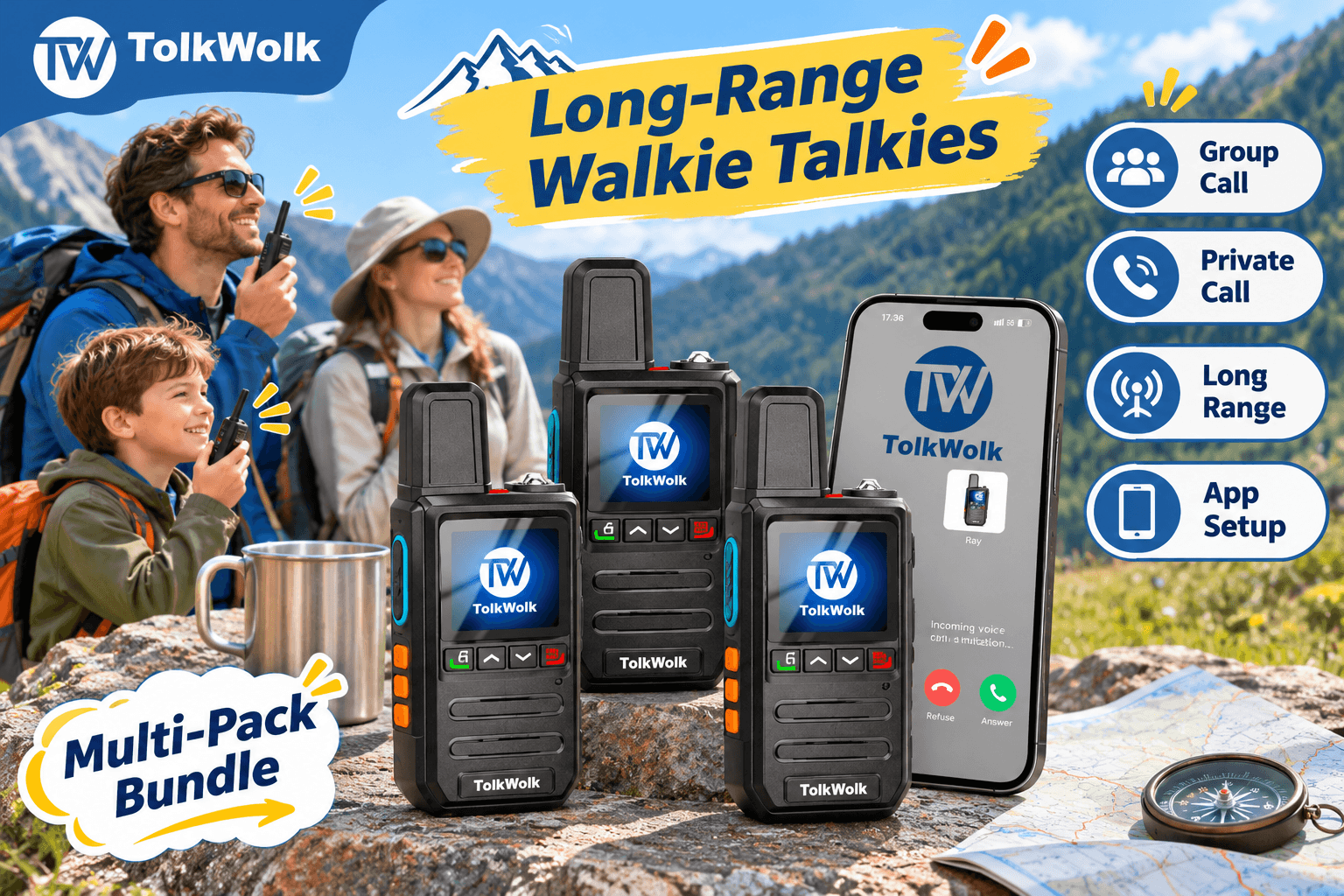
One of the clearest signals of a brand that actually understands its customers is the way TolkWolk structured its bundles. Rather than forcing every buyer into the same configuration, the storefront offers tiered packs — single units, two-packs, four-packs, and six-packs — plus an accessory path that includes items such as a vehicle charger. The decision tree below should help match the pack to the people.
- Single unit: The practical starting point. Best for someone who wants to test the system, or for a solo user who will team up with friends who already own devices. Also the right call when only one person in your group plans to carry hardware full-time and everyone else joins through the app.
- Two-pack: The classic road-trip configuration. Lead car and rear car, guide and paddler, front desk and maintenance closet. If your whole world is a pair, the two-pack is all you ever need.
- Four-pack: The sweet spot for small crews. Family trips with two vehicles, a four-person work team, a small hotel’s front-of-house plus back-of-house, a photography crew. This is the bundle most small operations eventually land on.
- Six-pack: The command pack. Festival staff, warehouse shifts, youth groups, school trip chaperones, logistics fleets. Buy six, name them in the app, and suddenly a dozen scattered people run like a single organism.
Accessories close the loop. A vehicle charger transforms the devices from “bring them on the trip” into “they live in the car,” which is usually the moment the product goes from useful to indispensable.
Who Actually Relies on These?
The brand’s own positioning points at a surprisingly broad set of users, and the range holds up once you think it through:
- Families on the move: Convoys, amusement parks, ski resorts, national parks. Kids get one unit, parents get another, grandparents get the app version.
- Road trippers and overlanders: The single best use case for the product. Multiple vehicles, no charger anxiety, no dead-zone panic.
- Small logistics and delivery fleets: Dispatch from a single desk, instant check-ins, no per-driver phone bills.
- Security and event staff: Crowds, corridors, venue floors — the places where calling someone by phone feels absurd and texting feels dangerous.
- Hotels and hospitality: Front desk, housekeeping, maintenance, valet. A decades-old workflow that ran on clunky pagers now runs on a cheap app and a stack of black handhelds.
- Outdoor guides and instructors: Kayak guides, climbing coaches, camp counselors who need hands-free voice above the wind.
- Construction and trade crews: The noise environment where typing is impossible and shouting is worse.
What unifies all of these use cases is that none of them involves sitting at a desk. Every one of them is about people in motion, who need other people to know something now.
A Quick Decision Checklist
If you are on the fence, run through this short list. Every “yes” tilts you further toward giving the system a real shot.
- Do you regularly coordinate with more than two people who are not in the same room?
- Has a group chat ever actually let you down on a trip, a shift, or an event?
- Would you rather press a button than unlock a phone, find an app, and type?
- Do you want group management that you can adjust yourself, without calling support?
- Does the idea of zero recurring service fees, as published by the brand, align with how you buy gear?
- Would a hands-free SOS alert ever plausibly matter to you or someone in your group?
If two or more of these make you nod, the category is worth your attention. If all six land, TolkWolk is probably the product you didn’t know you were shopping for.
The Bigger Picture: Why Push-to-Talk Made a Comeback
It is worth stepping back for a moment, because the return of the walkie-talkie is, on paper, a strange trend. We live in an era of video calls, instant translation, and AI assistants. Why is a device whose interface predates the touchscreen suddenly relevant again?
The answer, I think, is that modern communication has quietly become expensive. Not monetarily — emotionally. Every conversation on a smartphone carries a small tax: notifications, app switching, battery drain, distraction, the pressure to respond in full sentences with emojis and politeness. Push-to-talk strips all of that away. One button. One breath. Done. It is the communication equivalent of a shortcut, and shortcuts are what busy people reach for all day long.
TolkWolk’s contribution to this comeback is that it removed the two reasons adults stopped carrying real radios: limited range, and inflexible groups. Cross those off the list, and suddenly the old button format is not nostalgia — it is actually better than the thing we replaced it with.
Closing Thought
Great communication tools disappear into the moment. You don’t notice a well-designed bridge while you’re driving over it. TolkWolk is trying to be that kind of product: simple on the surface, quietly powerful underneath, and dependable exactly when the conversation needs to keep moving.
Whether your convoy is three cars on a coastal highway, a six-person crew on a warehouse floor, or a family scattered across a 600-acre campground, the question is the same. How quickly can everyone in your group hear the thing that matters right now? For a growing number of people, the answer is: as fast as a thumb can reach a button. That is the whole pitch, and it turns out to be more than enough.