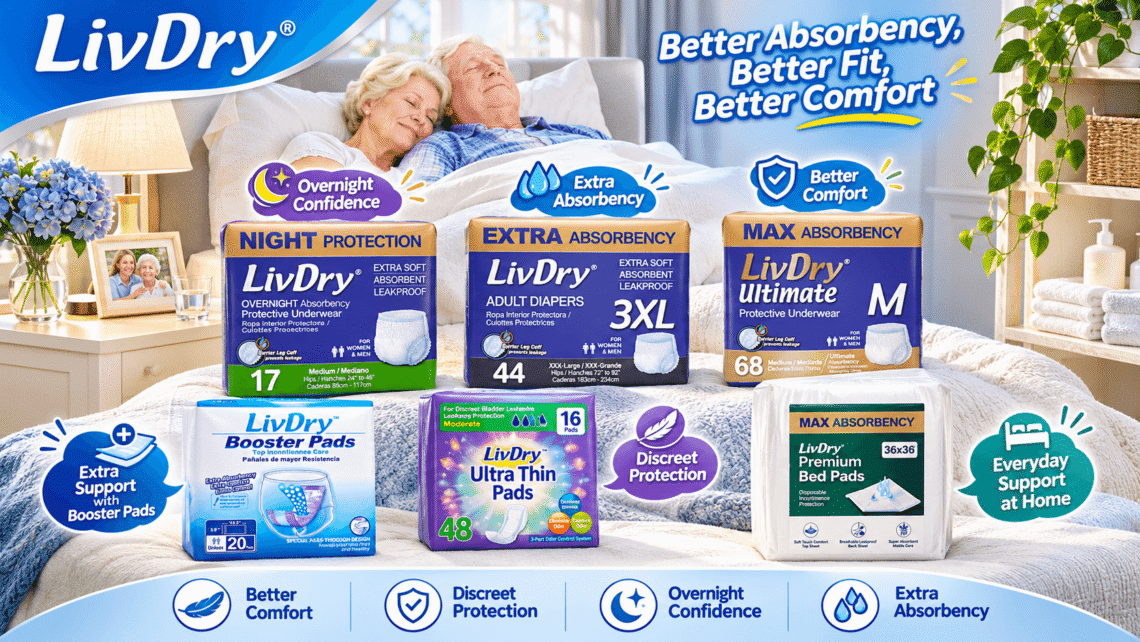
A complete guide to the brand’s protection system — from everyday pull-ons to overnight underpads — and how to build the right setup for your situation.
Bladder leakage is one of the most common health experiences in the world and one of the least discussed. The National Association for Continence (NAFC) estimates that roughly 25 million American adults live with some form of urinary incontinence, yet millions of them wait years before telling anyone — including their own doctor. Silence, not the condition itself, is often what steals quality of life. And into that silence, thoughtful products can make an enormous difference, because dignity at home usually starts with practical decisions made at the store.
LivDry is a brand built around exactly that insight. Rather than treating incontinence care as a clinical afterthought, LivDry designs disposable protection the way modern wellness brands design anything else: with attention to fit, skin comfort, quietness, discretion in delivery, and a tiered product line that lets families match protection to real life instead of settling for one-size-fits-all solutions. The Amazon storefront reads less like a medical supply catalog and more like a thoughtfully organized care kit — overnight underwear, everyday absorbency, booster pads, slim liners for women, and bed protection, each doing a specific job.
This guide walks through the LivDry approach in depth: the brand’s philosophy, all six of its core product categories with honest, practical overviews, a framework for choosing the right combination, and the kind of real-world guidance that product pages rarely spell out. Whether you’re managing leakage yourself or caring for a parent, the goal here is simple — help you spend less time worrying about accidents and more time living.
💬 “The best incontinence product is the one you stop thinking about. You put it on in the morning, you trust it, and you get on with your day. That’s the entire job.”
— A recurring sentiment echoed across thousands of LivDry customer reviews
1. What LivDry Is and Why It Exists
LivDry is a direct-to-consumer incontinence care brand sold primarily through its Amazon storefront, specializing in disposable protective underwear, pads, booster pads, and underpads for adults. The name itself telegraphs the mission — live dry — because the brand’s entire value proposition rests on keeping skin dry, bedding dry, clothing dry, and by extension, confidence intact. It is a brand that understands its product is not really absorbency; absorbency is just the mechanism. The product is normalcy.
The lineup covers the full spectrum of need, which matters more than it might first appear. Incontinence is not one condition. A woman with light stress leakage after childbirth needs something radically different from an adult managing heavy overnight voids, and a family caring for a father with mobility limits needs different logistics again. Many legacy brands in this space effectively ask customers to choose a single product and adapt. LivDry instead offers a coordinated system, from moderate-absorbency slim pads to maximum-capacity overnight pull-ons rated well above two thousand milliliters in independent lab testing.
Two commitments recur across the product line and are worth naming upfront. First, LivDry publishes lab-test figures — many items are independently tested to ISO 11948-1, the recognized standard for measuring absorbent product capacity — which is rarer transparency than you’d expect in this category. Second, the products are built around pull-up, underwear-style design rather than old-fashioned tabbed briefs wherever possible, preserving dignity and independence for people who can still dress themselves.
What Sets the Brand’s Approach Apart
- 🧪 Published, lab-tested capacity numbers rather than vague “heavy protection” labels
- 👕 Underwear-style pull-ons that look and behave like real underwear
- 🌙 A dedicated overnight tier engineered for long, uninterrupted sleep
- 🧩 A modular system — boosters and underpads that stack with the core products
- 📦 Discreet shipping and bulk-friendly pack sizes that respect privacy and budget
2. The Layered Protection Philosophy
The single most useful idea in modern incontinence care — and the one LivDry’s catalog is quietly organized around — is layering. Instead of one product doing everything, a well-built setup assigns each layer a job, and the layers reinforce one another. This is how hospital care teams have managed heavy incontinence for decades, and LivDry brings that logic to home users.
The model looks like this. A core garment — protective underwear — handles the primary absorption. A booster pad sits inside the garment to add capacity where the core is weakest, typically overnight. An underpad protects the bed beneath the sleeper, catching anything that escapes the first two layers. And for lighter daytime moments, a slim pad handles moderate flow without a full garment at all. Match the layers to the actual situation and you get reliable protection without paying for, or wearing, more bulk than the day requires.
The alternative — simply buying the “maximum” product and hoping — fails in predictable ways. Overbuilt garments can gap at the legs if they don’t fit snugly, and gapping causes more leaks than insufficient capacity does. Underbuilt products overflow, which degrades skin and ruins sheets. Layering fixes both failure modes with graceful degradation: each layer catches what the previous one misses.
💡 Think of it like weatherproofing a house. You don’t rely on one giant umbrella for the whole property. You have a roof, gutters, and a sump pump — each catching what the last one misses. LivDry’s catalog is essentially that architecture for incontinence.
3. Product One: Overnight Comfort Underwear (Medium, 17-Pack)
The Overnight Comfort Absorbency pull-on is LivDry’s answer to the most demoralizing version of the problem: waking up wet. Nighttime incontinence is uniquely punishing because it combines long wear time, horizontal positioning — which lets fluid pool against skin and leg seals — and the fact that the user is asleep and cannot respond to the first warning signs. A daytime-grade product simply isn’t built for those eight hours.
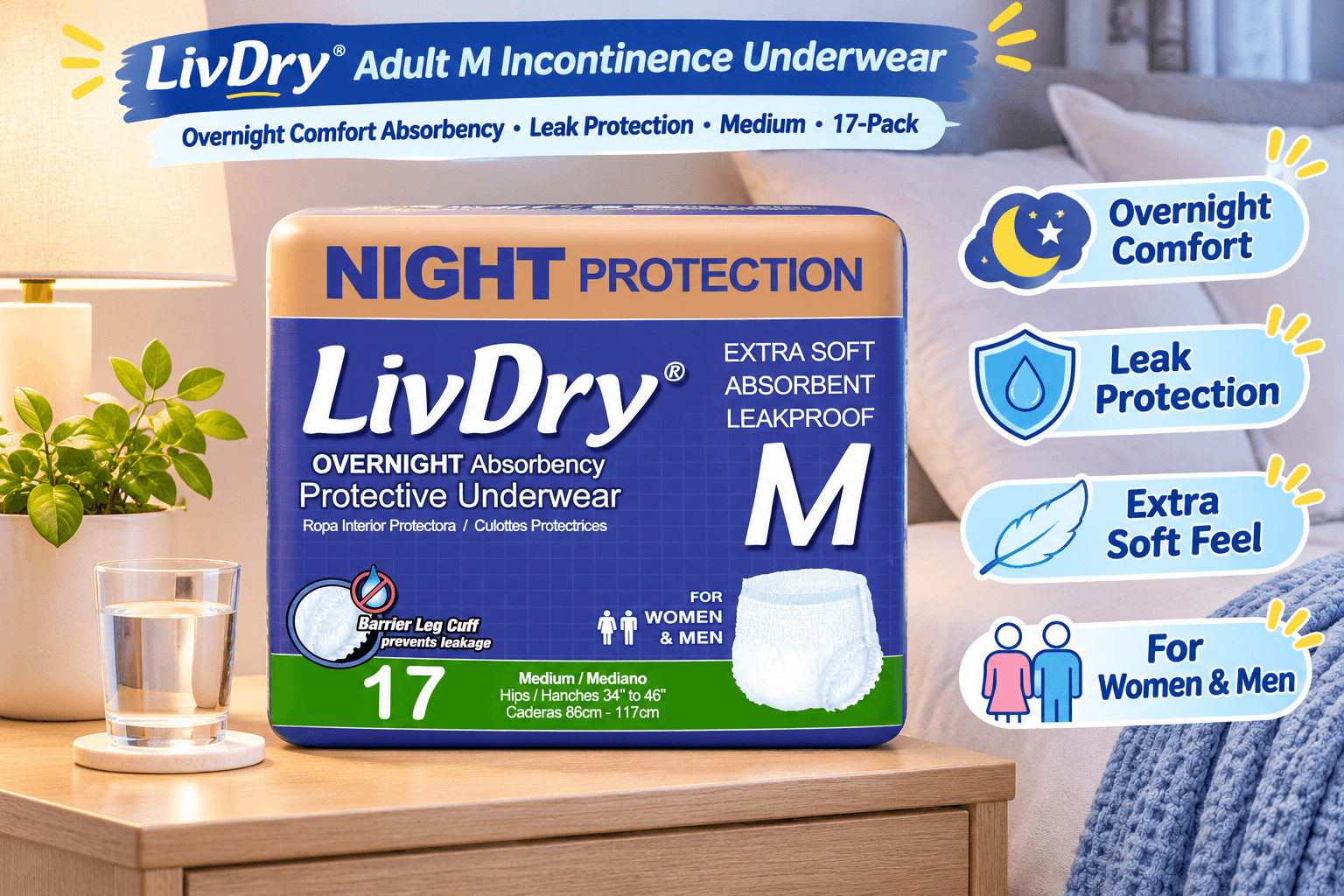
This medium-size 17-pack is engineered specifically for that window. The absorbent core uses fast-wicking material and super-absorbent polymer to pull fluid away from the skin quickly and lock it into gel, which is the mechanism that actually keeps skin comfortable through the night. Elastic leakage barrier cuffs at the legs create the physical seal that side sleepers depend on; gathered, stretchy leg bands channel fluid inward and back toward the core instead of letting it escape sideways into bedding. The cloth-like, latex-free outer cover keeps the garment quiet under pajamas and sheets — a detail anyone who has slept beside a crinkly plastic-backed product will appreciate immediately.
The underwear-style cut means it goes on and comes off like regular underwear, which preserves independence for the many users who need overnight protection but full daytime mobility. For caregivers, the pull-on design also simplifies the evening routine considerably compared to tabbed briefs that require repositioning a person in bed.
Who This Product Fits Best
- 🌙 Adults with moderate-to-heavy nighttime leakage who sleep through the night or long stretches
- 🛏️ Side sleepers, because the barrier cuffs matter most when pressure rests on one hip
- ✈️ Long-haul travelers who need dependable protection through flights and layovers
- 👤 Independent dressers who want dignity-preserving pull-on styling
- 📅 Households that prefer a mid-size pack to test fit before committing to bulk quantities
A practical note on the pack size: seventeen pieces is a deliberately sensible entry point. It’s roughly a three-week supply for nightly-only use, long enough to genuinely evaluate fit and performance across different nights, without the storage commitment of a case. Many families start here, confirm the size works, and then move to larger counts for value.
4. Product Two: Extra Absorbency Protective Underwear (3XL, 44-Count)
Fit is the unglamorous factor that decides whether any incontinence product works, and the plus-size market has been chronically underserved by the industry. Products that technically “come in your size” are often just scaled-up versions of a pattern built for smaller bodies, which means the absorbent core sits wrong and the leg seals gap. LivDry’s 3XL Extra Absorbency protective underwear exists to correct that, and the 44-count format signals who it’s for: a daily, dependable workhorse.
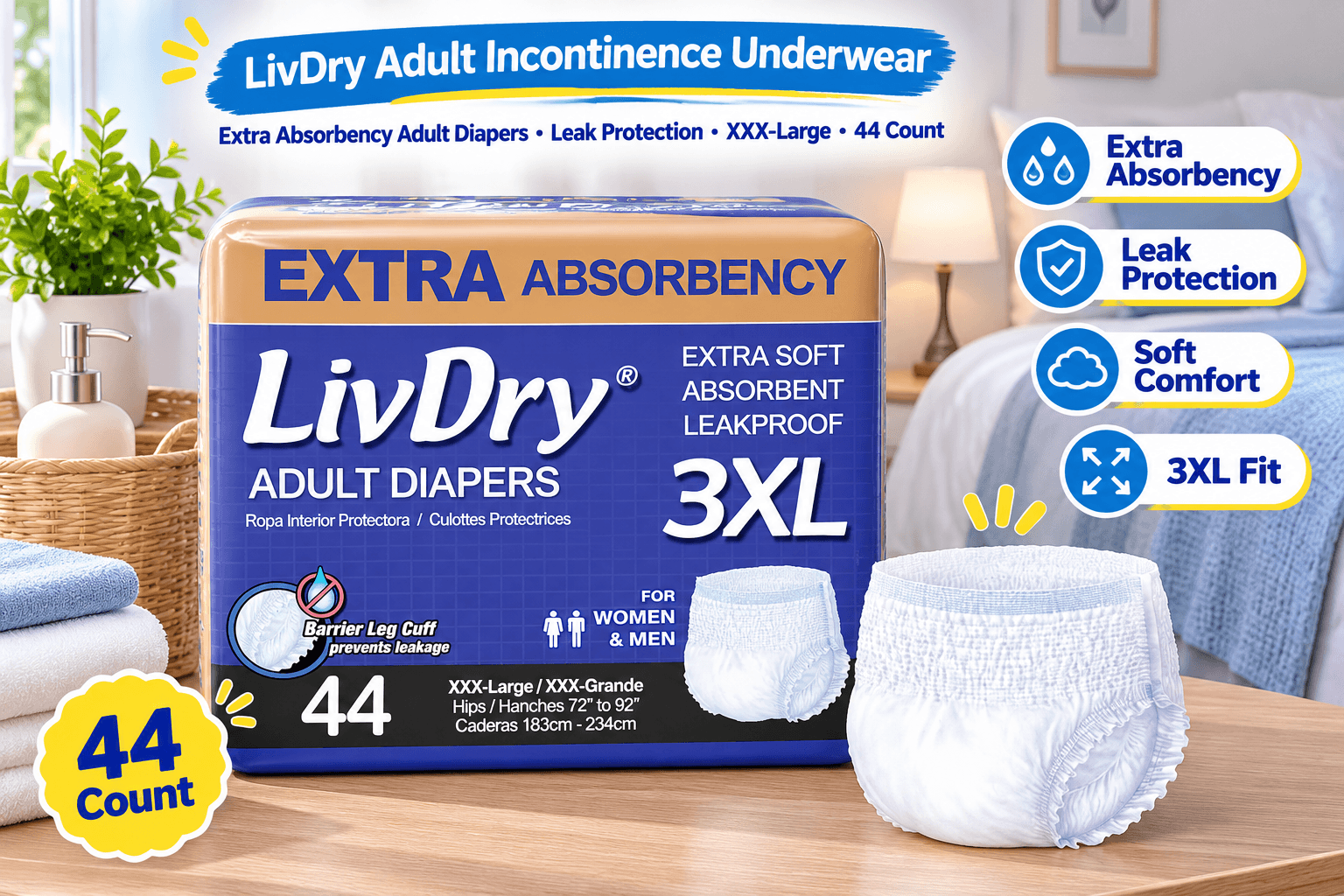
The engineering priorities here are the ones that matter at larger sizes. The core offers extra absorbency tuned for daily wear, wicking fluid into the polymer core so skin stays dry between changes. Stretchy, cloth-like side panels flex with real bodies through sitting, standing, and walking rather than fighting them, and the elastic gathered leg cuffs maintain a seal across a wider range of movement and body geometry. Like the rest of the pull-on line, it’s latex-free and quiet under clothing.
The 44-count economics deserve attention. At roughly six weeks of once-daily changes — or a shorter window for twice-daily routines — a bulk box like this typically prices out meaningfully lower per unit than small packs, and it removes the recurring errand of reordering. For anyone using protection daily, bulk purchasing isn’t indulgence; it’s the rational format.
🗣️ From the review sections, paraphrased:
“Finally, a 3XL that actually fits like it was designed for me and not just stretched over a smaller pattern. No gaps, no sagging, and it holds through my whole work shift.”
Fit feedback like that is the whole ballgame in this size range, and it’s the most common theme in positive reviews of the 3XL tier.
5. Product Three: Ultimate Max Absorbency Underwear (Medium, 68-Pack)
When the situation demands the brand’s highest tier of protection, the Ultimate line answers. LivDry’s maximum absorbency protective underwear carries a lab-tested capacity in the range of roughly 80 fluid ounces — around 2,400 milliliters — independently measured per ISO 11948-1, placing it among the most capable pull-on products available anywhere. For heavy urinary incontinence, post-surgical recovery, or individuals whose changes happen at long intervals, this is the tier built for the job.
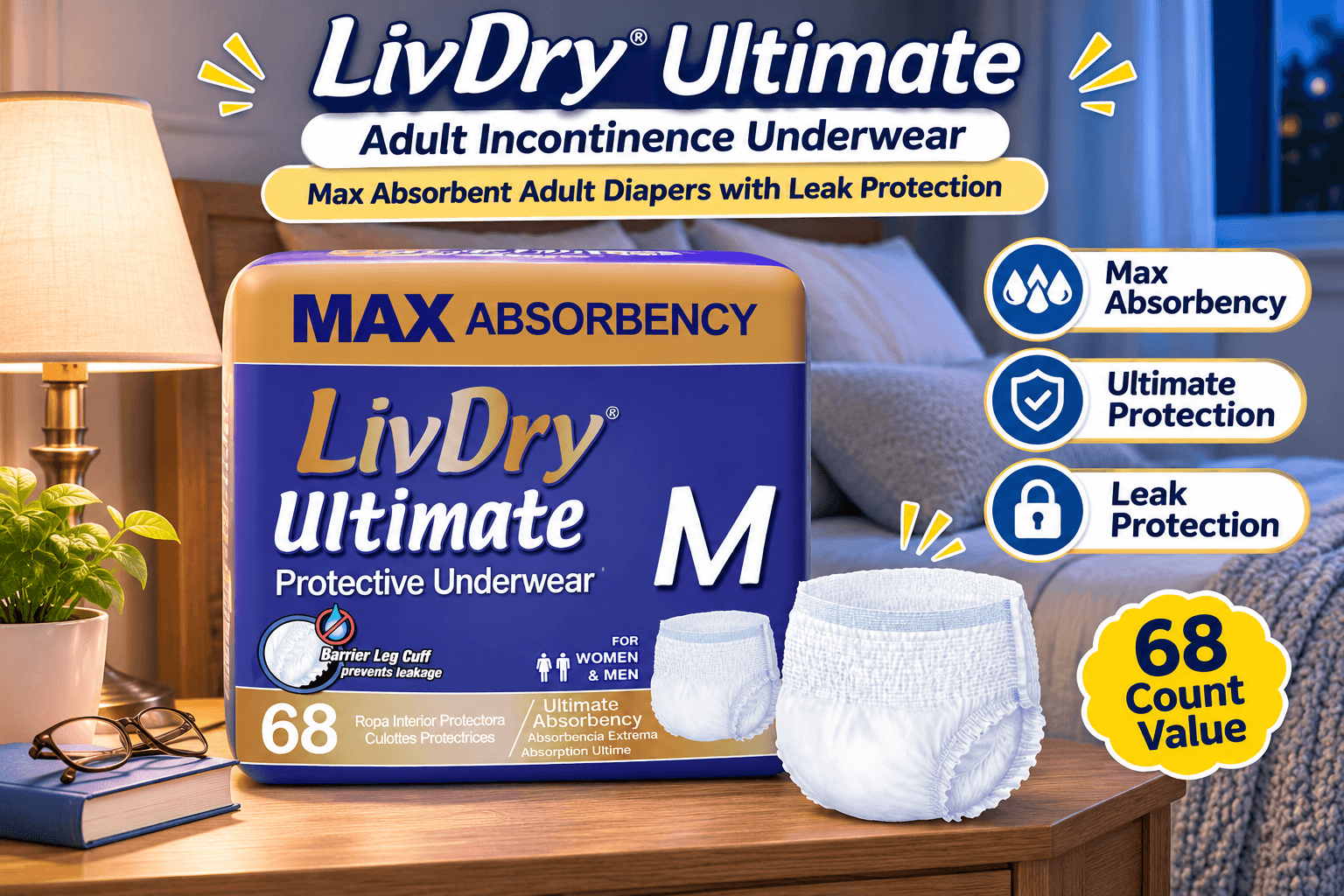
The 68-count medium pack is the “set it and forget it” configuration. This is the box a household orders when protection is a settled, daily reality and the goal is uninterrupted supply at the best per-unit cost. Sixty-eight pieces at one change per day covers more than two months; for higher-change routines, it still spans several weeks. Families managing care for an aging parent consistently gravitate to this format because a stable supply removes one more logistical task from an already demanding routine.
Performance-wise, the Ultimate tier combines the same architecture as the rest of the line — fast-wicking liner, polymer core, leakage barrier cuffs, breathable latex-free cover — but with a substantially larger core. The tradeoff, honestly stated, is some added bulk, though LivDry’s cloth-like construction keeps it noticeably less pronounced than hospital-grade briefs of equivalent capacity. For daytime wear at maximum absorbency, it disappears adequately under normal clothing; for overnight, the bulk is irrelevant the moment the lights go off.
Daytime vs. Overnight Role
| Scenario | Is the Ultimate the right choice? |
|---|---|
| Heavy leakage, 8+ hours between changes | ✅ Ideal — this is its designed purpose |
| Overnight sleep protection, heavy voids | ✅ Excellent, especially with an underpad beneath |
| Light daytime leakage, active errands | ⚠️ Works, but likely more product than needed |
| Skin highly sensitive to occlusion | ⚠️ Consider more frequent changes or a booster on a lighter core |
The honest guidance: buy capacity for your longest wear window, not your heaviest single moment. If eight hours is your reality, the Ultimate earns its place. If you can change every three to four hours, a lower tier will feel lighter and perform just as reliably within that window.
6. Product Four: Booster Pads — The Smart Capacity Add-On
The LivDry Incontinence Booster Pads (20-count, regular length) are the most underappreciated product in the lineup, because they solve a problem most people don’t know can be solved: how do I add capacity without buying a heavier garment? The answer is a flow-through pad worn inside the primary garment.
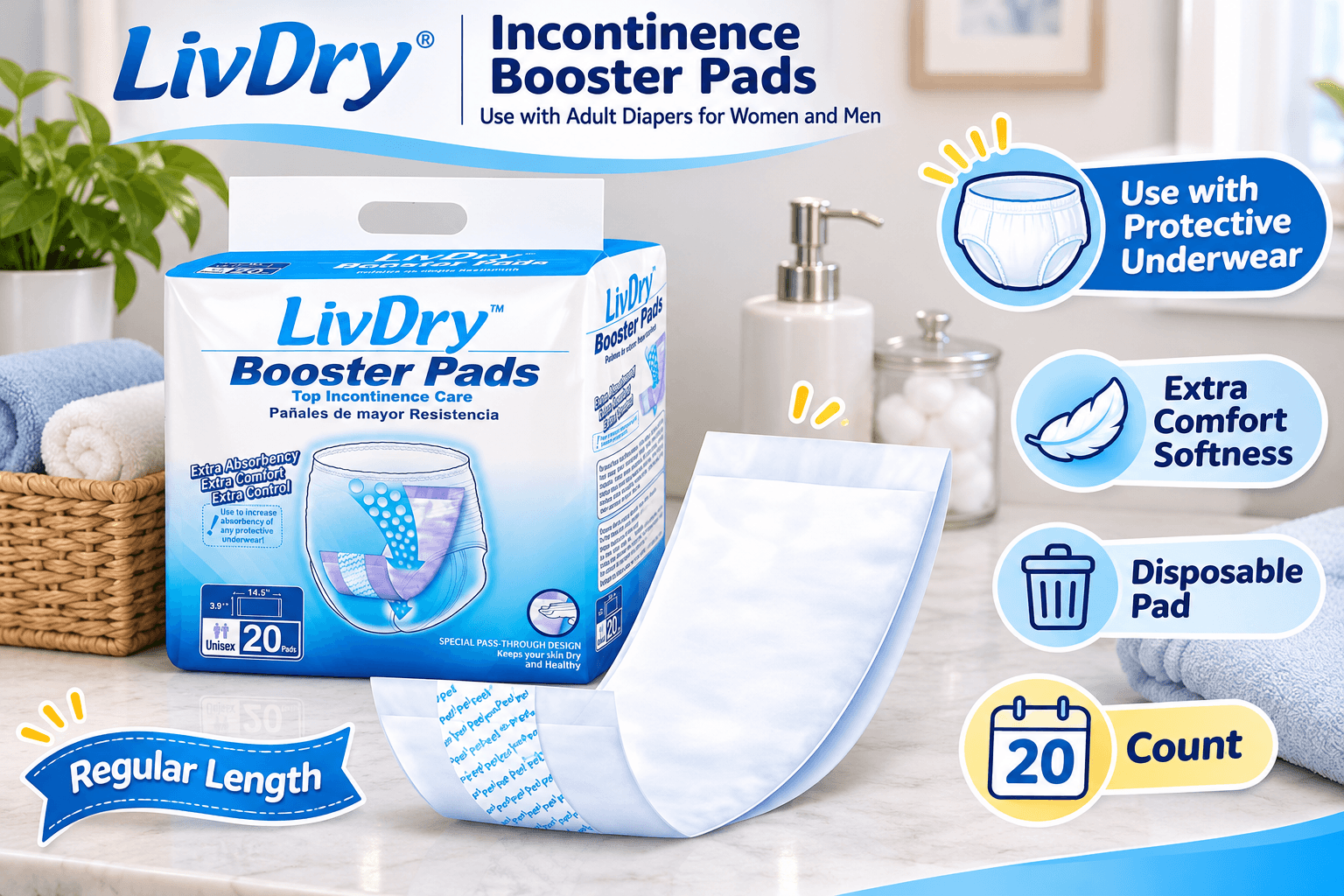
The clever part is the “flow-through” design. A booster pad has no waterproof backing — that’s a feature, not a flaw. Fluid passes through it and continues into the core of the host garment, so the booster effectively extends the system’s total capacity rather than creating a second, competing absorber. When the booster saturates, overflow simply continues into the underwear beneath, and nothing pools at the skin. Used this way, a booster can meaningfully extend wear time, which translates directly into fewer overnight disturbances and fewer middle-of-the-night changes for caregivers.
Beyond capacity, boosters address comfort economics. A light-to-moderate user can wear a lighter, more breathable base garment during the day and add a booster only for long car trips, meetings, flights, or nights — scaling protection to the schedule instead of wearing maximum bulk all day. The soft, extra-comfort surface layer also adds cushioning at the skin interface, which users with sensitive skin often mention appreciatively.
How to Position a Booster Pad Correctly
- Start with the base garment — put on your LivDry protective underwear as usual, snug but not tight.
- Remove the booster’s backing fully; any remaining backing film will block flow-through.
- Position it front-to-center, aligned with where flow actually occurs — slightly lower for men, centered for most women — inside the garment.
- Tuck the top edge over the front waistband of the underwear so it stays anchored as you move.
- Pull the outer garment snug so the booster is held in firm contact with both skin and core — gaps kill performance.
- Change the booster first if only it is saturated and the base garment is dry; on heavy nights, change both.
One crucial caution: boosters are an addition, never a replacement. Wearing a booster alone, or inside regular underwear, defeats the flow-through design — it needs a true absorbent host garment to work as intended.
7. Product Five: Ultra Thin Pads for Women
Not every leak calls for a full garment, and LivDry’s Ultra Thin Incontinence Pads for Women (48-count, moderate absorbency, with odor control) are the brand’s answer for the enormous population of women whose needs are real but lighter. Stress leakage — a cough, a sneeze, a laugh, a jog — affects a large share of adult women, particularly after childbirth and through menopause, and most of them don’t want bladder-control product bulk for what amounts to occasional, moderate flow.
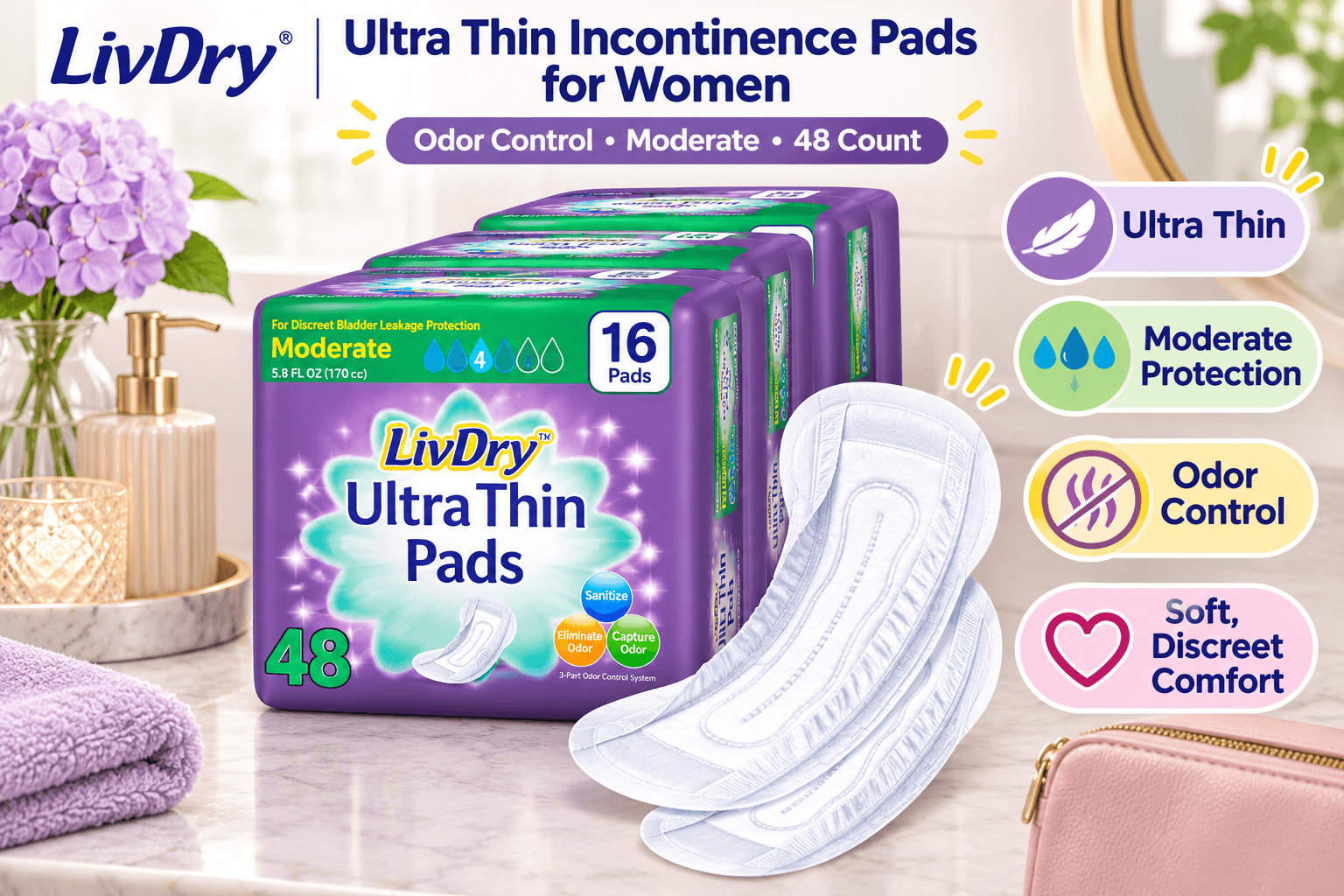
The Ultra Thin pad’s defining trait is right in the name: a slim profile that behaves like a premium menstrual pad while being engineered specifically for urine. That last distinction matters and is worth repeating, because many women improvise with menstrual pads for years. Menstrual pads are designed for slow, viscous flow; urinary leakage arrives fast and liquid, and the two require different absorbent architecture. An incontinence-specific pad wicks quickly into a polymer core, locks fluid away from skin, and neutralizes odor — the three things menstrual pads are simply not built to do.
Odor control deserves its own mention because odor anxiety, more than the leakage itself, is what keeps many women from socializing, exercising, or traveling freely. The odor-neutralizing treatment in these pads addresses that psychological weight directly, and the thin form factor means nothing shows through leggings, jeans, or work attire.
Where This Pad Shines
- 🏃 Active moments — walks, gym sessions, errand days with predictable light leakage
- 💼 Workdays where a full garment would be noticeable or unnecessary
- 🧳 Travel and events as a slim, discreet backup in a purse
- 🔄 Transition periods — postpartum recovery or menopause management, when needs fluctuate
- 🧪 Trial tier for women new to incontinence products who want to start light
The honest framing: this pad is a moderate-absorbency tool, not a heavy-protection tool. Users with heavy or continuous flow will need the pull-on tiers. But for millions of women, this is genuinely the right-sized answer — and right-sizing is what keeps people comfortable enough to live normally.
8. Product Six: XL Disposable Bed Pads (36″ × 36″)
The final pillar of the LivDry system protects not the person but the environment: the LivDry Disposable Bed Pads, extra-large 36-by-36-inch underpads (also known as chux pads), in a 10-count pack. These flat, quilted sheets are laid over the mattress with the absorbent side up and the waterproof backing down, creating a sacrificial layer that catches anything the wearable layers miss.
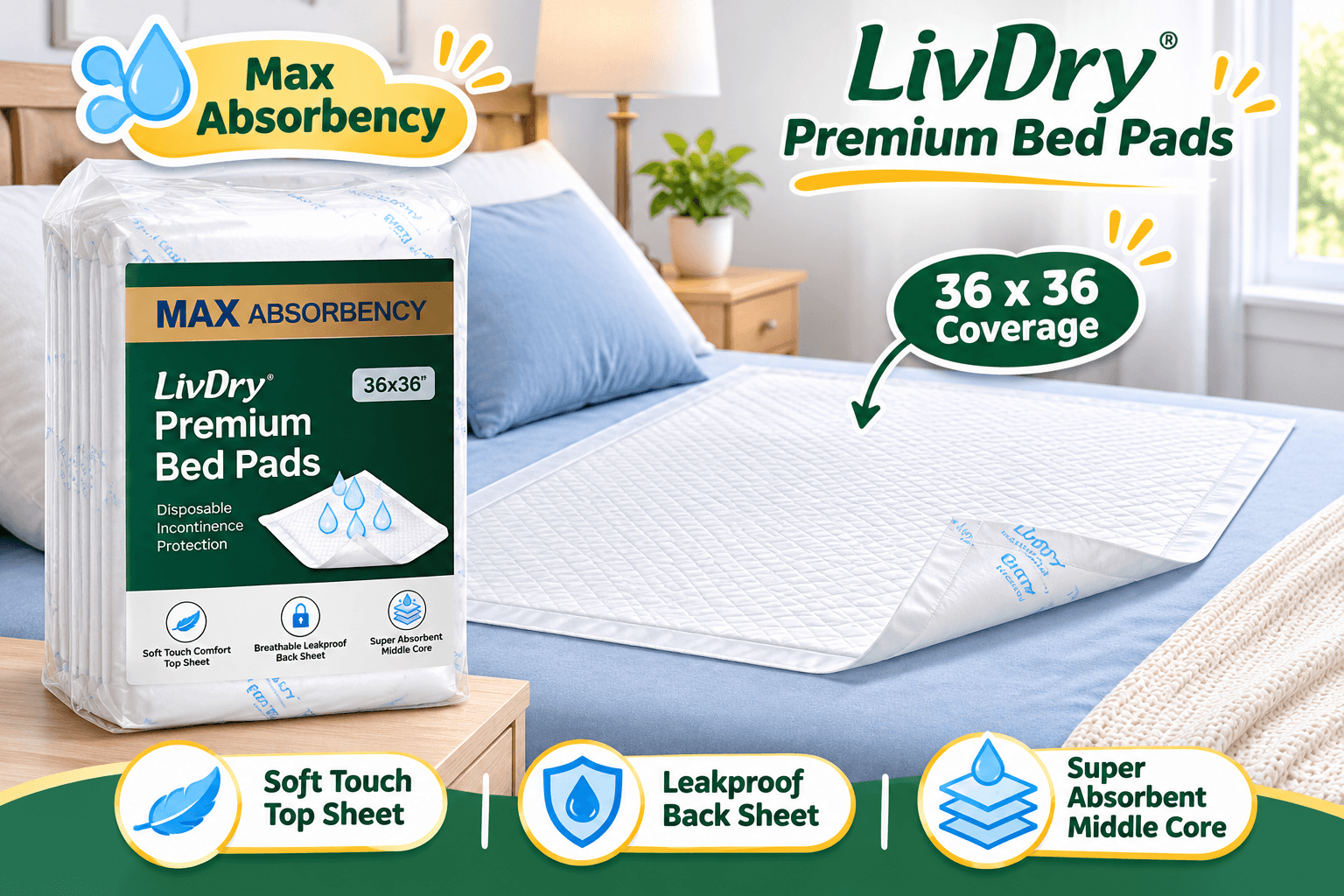
Their value proposition is simple math. Washing urine-soaked sheets and mattress pads is one of the most draining, repeated tasks in home caregiving — and a mattress that absorbs repeated accidents is effectively ruined. A disposable underpad converts that entire chore into a one-motion removal: peel it up, roll it, discard, done. The XL sizing is deliberate; at three feet square, a single pad covers the high-risk zone of a bed — torso to hips — even for a restless sleeper who shifts position during the night.
Construction follows the classic three-layer formula, executed with LivDry’s usual attention to comfort. A soft, quilted top layer stays gentle against skin and doesn’t feel plasticky for back and side sleepers; the high-capacity core absorbs and locks fluid; the waterproof bottom layer is genuinely leakproof, protecting sheets and mattress beneath. Despite the capacity, the pads stay reasonably thin, so they don’t create an uncomfortable ridge under fitted sheets.
Six Places a 36″×36″ Underpad Earns Its Keep
- 🛏️ Across the bed’s center zone, beneath or over fitted sheets, for overnight security
- 🛋️ On recliners, sofas, and fabric armchairs where cleaning upholstery is nearly impossible
- 🚗 On car seats for long trips with a loved one who tires between stops
- ♿ On wheelchairs and transfer surfaces during outings and appointments
- 🏥 Post-surgery recovery, when mobility is limited and bedding changes are burdensome
- 🧳 In hotels and guest rooms while traveling, protecting beds you don’t own
A 10-count pack positions this as a supplemental layer rather than a nightly consumable — ideal for trying the size and performance, for travel kits, or for households where the wearable protection usually holds and the underpad is the safety net.
9. Side-by-Side: The Full LivDry Lineup at a Glance
| Product | Format | Absorbency Tier | Best For | Typical Role |
|---|---|---|---|---|
| Overnight Comfort Underwear (M, 17) | Pull-on | Overnight comfort | Nighttime leakage, side sleepers | Primary night garment |
| Extra Absorbency Underwear (3XL, 44) | Pull-on | Extra | Plus-size daily wear, all-day shifts | Primary day garment |
| Ultimate Max Underwear (M, 68) | Pull-on | Maximum (~80 oz / 2.4 L lab-tested) | Heavy incontinence, long wear windows | Primary heavy-duty garment |
| Booster Pads (Regular, 20) | Insert | Capacity extender | Extending any pull-on’s wear time | Secondary layer |
| Ultra Thin Pads for Women (48) | Adhesive pad | Moderate | Light stress leakage, discreet daytime | Standalone light protection |
| XL Bed Pads 36″×36″ (10) | Underpad | High capacity surface | Bedding, furniture, travel | Environmental safety net |
Read as a system, the logic is elegant: three garment tiers covering light-to-maximum needs, one multiplier that scales any of them, one specialized product for women’s lighter needs, and one surface protector that underwrites the whole setup. Very few brands cover the full spectrum with this level of internal coherence.
10. Choosing the Right Combination: A Practical Framework
Product pages list features; real life needs a decision procedure. Here is a framework distilled from how experienced caregivers and continence advisors actually approach product selection — adapted to the LivDry catalog.
Step-by-Step: Building Your Setup
- Assess your longest wear window. How many hours pass between changes during the day? Overnight? Capacity should match the window, not the worst single moment. Under 3 hours → Ultra Thin Pads or a lighter tier. 4–7 hours → Extra or Overnight tier. 8+ hours or heavy voids → Ultimate Max.
- Measure honestly for size. Hip and waist circumference, measured at the widest point, against the brand’s chart. When between sizes, the general rule is to size up for comfort but verify the leg cuffs still sit snugly — a loose seal leaks faster than a slightly tight core saturates.
- Decide your daytime vs. nighttime split. Many users need one tier by day and a higher tier at night. The Overnight Comfort or Ultimate lines handle nights; the Extra Absorbency or thin pads often suffice by day.
- Layer for the long stretches. If nights or travel days exceed your garment’s comfort zone, add Booster Pads rather than jumping straight to maximum bulk around the clock.
- Protect the surfaces that hurt most. Add underpads wherever laundry is hardest — the bed first, then favorite chairs and car seats.
- Trial in mid-size packs, commit in bulk. Confirm size and tier with packs like the 17-count overnight, then shift to the 44- and 68-count formats for the per-unit savings.
- Reassess quarterly. Incontinence needs change with health, medication, and mobility. What fit six months ago may be the wrong tier today.
💡 The caregiver’s shortcut: if you remember nothing else, remember fit first, capacity second, layers third. Most leaks blamed on “not absorbent enough” are actually caused by poor fit and gapped leg seals. Fix the seal before you buy more capacity.
11. Skin Health: The Underrated Half of Incontinence Care
Absorbency gets the marketing attention, but dermatologists and wound-care specialists consistently emphasize that skin integrity is the more important outcome. Prolonged exposure to moisture, and especially to the ammonia that forms in urine, breaks down the skin barrier and leads to incontinence-associated dermatitis — painful, and a gateway to far more serious problems in older adults. Any product strategy that keeps skin wetter for longer is failing, no matter what its capacity numbers say.
LivDry’s design choices map directly onto this guidance. Fast-wicking liners pull fluid off the skin surface within moments of contact. Super-absorbent polymer locks that fluid into gel so it cannot rewet the skin — the “lock-away” step that separates good products from merely thick ones. Breathable, latex-free cloth-like backings allow some vapor exchange instead of sealing skin under plastic. And the ultra thin pads minimize occlusion entirely for lighter needs. The practical implications for users and caregivers follow directly.
A Simple Skin-Protection Routine
- Change on a schedule, not just on saturation — for heavy protection, every 4–6 hours by day is a sound default; overnight products are the exception, built for the full night.
- Cleanse gently with pH-balanced wipes or wash at each change; harsh soap accelerates barrier damage.
- Dry fully before re-dressing — pat, don’t rub, and give skin a minute of air.
- Use a barrier cream (zinc-oxide based) for heavy wear or sensitive skin, per your clinician’s advice.
- Inspect skin daily in the diaper zone; redness that persists more than a day warrants a change in product tier or a call to a healthcare provider.
These steps cost almost nothing and dramatically improve outcomes — and they work best when the products themselves are engineered to keep skin dry, which is precisely the design brief LivDry builds around.
12. Sizing and Fit: Where Most Problems Actually Begin
Industry data and continence-nurse experience agree on a sobering point: a large share of leakage complaints trace back to incorrect sizing rather than product capacity. An oversized garment gaps at the legs; an undersized one digs in, compresses the core, and fails at the waist. Yet people routinely buy incontinence products the way they buy pants — by habit, guesswork, or embarrassment-driven haste. Slow down here and everything downstream gets easier.
Measure rather than estimate. Hip circumference, taken at the fullest point, is the primary measurement for pull-on products; waist matters secondarily. Compare against the size chart on the specific product page, because adult incontinence sizing is not standardized across the industry and a “medium” in one brand is not a medium in another. Within the LivDry line, the tiered sizes run consistently, so once you’ve confirmed a size in one product, it generally carries across — but verify against each chart the first time.
Movement is the other half of the test. A size can be correct standing up and wrong after an hour of sitting, walking, and stair-climbing. When you first try a new tier, wear it through a full, normal day before judging. Check the leg cuffs — they should rest in soft contact, gathered against the crease of the leg, without visible gaps. Check the waist for red marks after several hours. If either fails, adjust size before adjusting anything else; no amount of absorbency compensates for a broken seal.
13. A Caregiver’s Perspective: Making Life Easier for Two People
Incontinence care is rarely a one-person experience. NAFC and caregiver organizations consistently note that family caregivers — most often adult children and spouses — shoulder the bulk of continence management at home, and the products chosen shape both people’s days. A well-designed system reduces physical strain on the caregiver and preserves autonomy and dignity for the person being cared for. LivDry’s catalog reads almost like it was assembled with that dual audience in mind.
Consider how the pieces distribute the workload. Pull-on underwear lets mobile adults dress and change independently, which preserves privacy and self-respect — an outcome caregivers consistently rank among the most important. Booster pads reduce night wake-ups, which protects the caregiver’s sleep, the resource most likely to collapse first in long-term care. Underpads eliminate the sheet-laundry cycle, converting the most demoralizing chore in home care into a ten-second disposal. And published capacity figures let caregivers plan realistic schedules instead of discovering a product’s limits through accidents at the worst moments.
🗣️ A caregiver’s honest inventory of what actually helps:
“The things that saved me weren’t clever — they were reliable. A product that holds all night. A pad I can strip off the bed in one motion. A pack that doesn’t run out mid-week. Every one of those buys back a piece of my energy, and my mother’s dignity.”
That quote, assembled from themes that recur across caregiver reviews, is the most accurate summary of the category’s real value proposition: not absorbency, but logistics that don’t break down.
14. Cost, Value, and Bulk Buying Logic
Incontinence is an ongoing expense, and treating it with an ongoing expense’s seriousness pays off. The math differs from ordinary consumables because failure is costly in cascading ways: an inadequate product means laundry, skin treatment, disrupted sleep, and re-purchases. Optimizing purely for the cheapest sticker price is usually the most expensive path.
LivDry’s pack-size structure supports a sensible purchasing strategy. Mid-size packs (the 17-count overnight, the 20-count boosters, the 10-count underpads) serve as trial and replenishment formats. Bulk formats (the 44-count 3XL, the 68-count Ultimate) deliver the best per-unit economics for settled routines. Combined with Amazon’s subscribe-and-save mechanics, households can lock in routine supply at the lowest effective cost and adjust quantities as needs change. A few principles make the strategy concrete:
- 📉 Cost per protected day beats cost per pack. Always divide pack price by realistic changes, not by piece count.
- 🧪 Trial small on size, bulk on confirmed fit. Never bulk-buy an untested size — returns and unused cases erase the savings.
- 🔁 Subscribe only the stable tier. Put your confirmed, daily-use product on subscription; buy experimental items à la carte.
- 🧊 Watch HSA/FSA eligibility. Many incontinence products, including items across this category, qualify for health spending accounts — an often-missed discount of 20–30% for users with those accounts.
- 🗓️ Store properly. Keep products sealed, dry, and off concrete floors; the polymer core lasts years when stored well, so bulk buying carries little spoilage risk.
Run honestly, that approach typically lands a household’s total incontinence cost at a fraction of what piecemeal, panic-driven purchasing produces — with fewer accidents along the way.
15. Frequently Asked Questions
❓ How do I know which absorbency tier to start with?
Match capacity to your longest wear window (see the framework in Section 10). When genuinely uncertain, choose the higher tier for the trial period — the cost of a slightly bulkier product is smaller than the cost of leaked nights — then step down once you understand your actual pattern.
❓ Can booster pads be worn inside regular underwear?
No. Boosters are flow-through products with no waterproof backing; they need an absorbent host garment — such as LivDry protective underwear — to pass fluid into. Worn alone, they simply saturate and leak.
❓ Are these products HSA/FSA eligible?
Much of the adult incontinence category qualifies for health savings and flexible spending accounts, and several LivDry items are marketed as such. Confirm eligibility for the specific item at checkout or with your plan administrator, as rules vary.
❓ What does “lab-tested per ISO 11948-1” actually mean?
ISO 11948-1 is an international standard method for measuring the retention capacity of absorbent products under controlled conditions. It means the published ounce/milliliter figures come from standardized testing rather than marketing estimates — a meaningful transparency advantage when comparing brands.
❓ How often should protective underwear be changed?
A practical daytime default is every 4–6 hours for heavy tiers, sooner after bowel accidents, and immediately if skin feels wet. Overnight products are engineered for a full night. Individual schedules should always follow skin condition and a clinician’s guidance where relevant.
❓ Will the pull-ons show under clothing?
The cloth-like, latex-free covers are designed to stay quiet and low-profile under normal clothing. Maximum-absorbency tiers carry more core and therefore more presence, but most users report adequate discretion for daily wear; nights are a non-issue.
❓ Are the bed pads reusable?
The 36″×36″ pads in this lineup are disposable — designed for one use, then roll-and-discard. That’s the core of their convenience. Households wanting washable pads should look at reusable underpad categories separately.
❓ What sizes are available across the line?
The pull-on tiers run from small through 3XL depending on the product, including dedicated plus-size engineering at the 3XL tier. Always verify against the size chart on the specific product page before ordering.
❓ How discreet is shipping?
LivDry products sold through Amazon ship in standard retail packaging without explicit labeling on the exterior, and the brand’s direct storefront emphasizes discretion — a deliberate courtesy given the category’s privacy sensitivities.
❓ When should I talk to a doctor about leakage?
Sooner rather than later. Incontinence is highly treatable and often manageable through behavioral therapy, pelvic floor work, or medication; products manage the symptom, but a clinician may be able to address the cause. If leakage is new, worsening, or accompanied by pain, make the appointment.
16. Final Thoughts
There’s a reason the LivDry tagline — better absorbency, better fit, better comfort — reads the way it does. Each clause attacks a specific failure mode of this category: poor capacity ruins nights, poor fit ruins everything, and poor comfort ruins the willingness to keep using protection at all. Address all three and something bigger than product performance emerges — people stop dreading their own routines and resume living normally, which was always the point.
The six-product system reviewed here covers an unusually complete spectrum: the Overnight Comfort pull-on for restorative sleep, the 3XL Extra Absorbency for the long-underserved plus-size daily user, the Ultimate Max for the heaviest needs with lab-verified capacity, the Booster Pads that scale any setup intelligently, the Ultra Thin pads that give women a right-sized answer for light leakage, and the XL bed pads that quietly protect everything else you own. Taken together, it’s less a product line than a philosophy — that incontinence care should be engineered, layered, and dignified rather than improvised and endured.
If you take one thing from this guide, let it be the framework rather than any single product: fit first, capacity matched to your longest wear window, layers where life runs long, and skin protected throughout. Build that system — with LivDry or with any brand that meets the same standard — and incontinence stops being a daily crisis and becomes what it should have been all along: a routine. Manageable, discreet, and no longer in charge of anyone’s life. 🌙