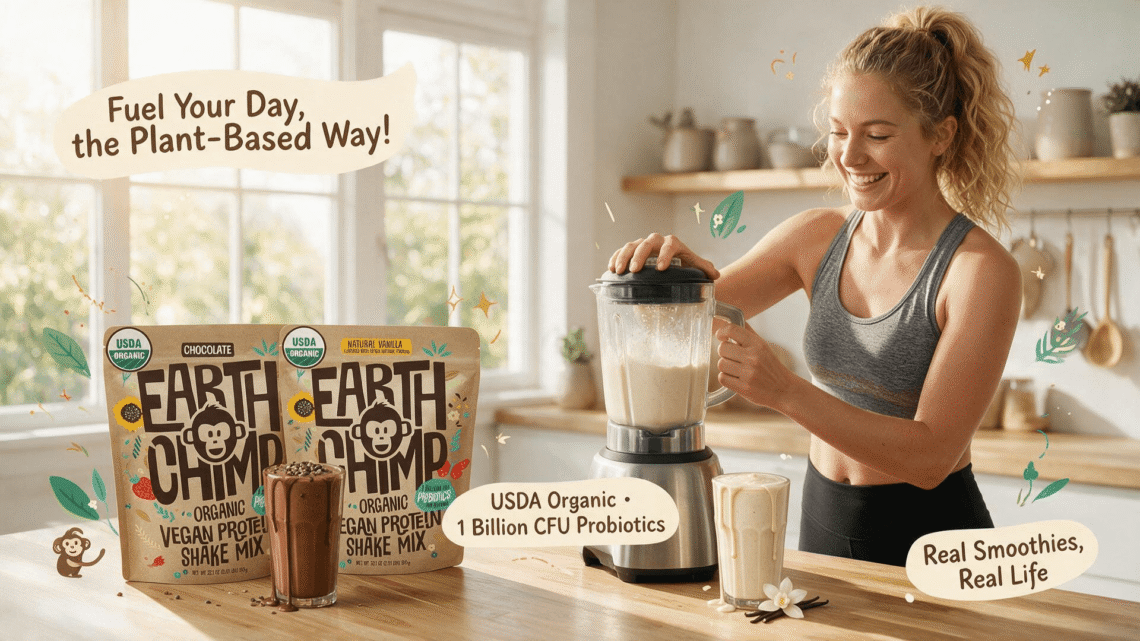
Most protein powders ask to be judged at a distance. A glossy tub, a number printed in enormous type, a phrase like “extreme” or “isolate” or “fuel” doing the heavy lifting, and a wall of ingredient names that a normal person scrolls past rather than reads. EarthChimp is a brand that seems to have built itself around the opposite request: it wants you to read the label, slowly, out loud, and to find nothing in there that needs explaining.
That sounds like a modest ambition. In the plant-based supplement category it is actually a fairly radical one, because the honest middle of this market is crowded with powders that are technically vegan and functionally unrecognizable. This piece is an introduction to EarthChimp — where it came from, what is in the scoop, what is conspicuously absent, how the three-flavor lineup works in real kitchens, and whether the math on a $45.99 bag holds up when you stop thinking in marketing units and start thinking in daily ones.
🌱 The Three-Second Shelf Test, and Why It Keeps Failing
Walk any supplement aisle, online or physical, and you’ll develop a habit that feels like shopping but operates like fraud detection. Flip the container. Ignore the front. Read the first five lines of the back. What you are looking for is not purity — it is coherence: does the protein source match the price, does the sweetener system match the digestive promise, does the certification match the claims made twenty lines earlier.
For a large share of plant proteins, that test collapses at the sweetener. A powder will proudly declare itself dairy-free, gluten-free, clean, and then lean on erythritol or sucralose to make the pea taste acceptable. Another will fail at the protein line, listing four sources in quantities so whimsical that the label is essentially decoration. A third will pass on chemistry and fail on philosophy: everything legal, everything permitted, nothing a person could have served at dinner.
📌 Callout — the category’s quiet problem: plant protein is not hard to make. It is hard to make tolerable. Pea and pumpkin powders carry an earthy, beany, sometimes chalky character that the industry has spent fifteen years trying to mask. A brand’s real skill is not sourcing protein; it is deciding what it is willing to sacrifice in flavor, texture, or cost to hide it.
EarthChimp‘s answer to that problem is unusual enough to be worth a full introduction on its own terms. Rather than masking, the brand chose simplification: a short ingredient list, organic throughout, no sugar alcohols, no artificial flavoring systems, and a sweetness derived largely from fruit and a small amount of monk fruit. The result is a product that behaves less like a sports supplement and more like a food ingredient that happens to be concentrated.
Where the Brand Came From
EarthChimp is an independent company based in Dublin, Ireland, and it has been trading since 2012 — a detail worth pausing on, because the supplement market is not kind to survivorship. Categories churn. Trend-driven brands appear, scale aggressively on one viral format, and vanish inside four years. A brand that has been continuously present for more than a decade has, by definition, cleared the hardest bar in the space: people bought it twice.
The company is founder-led, with Dave McGeady as the public face of the operation — the person who appears holding the pouch and the shaker, which is a small but meaningful signal. Founder-fronted supplement brands tend to make different trade-offs than private-equity roll-ups. They are more likely to reject a cheap filler that would improve margins by six percent if it would embarrass them on a label reading. They are slower. They are also, frequently, less well packaged.
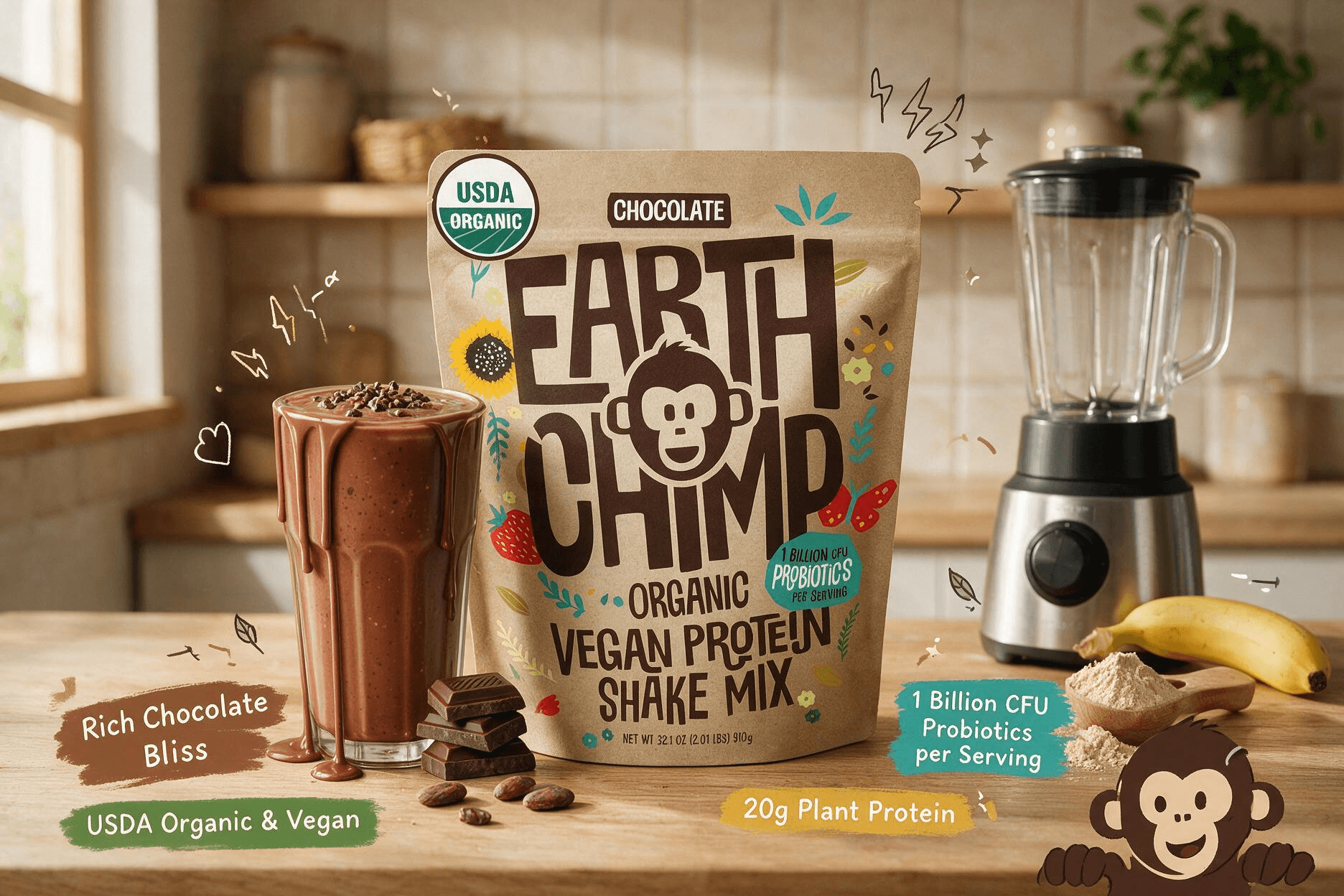
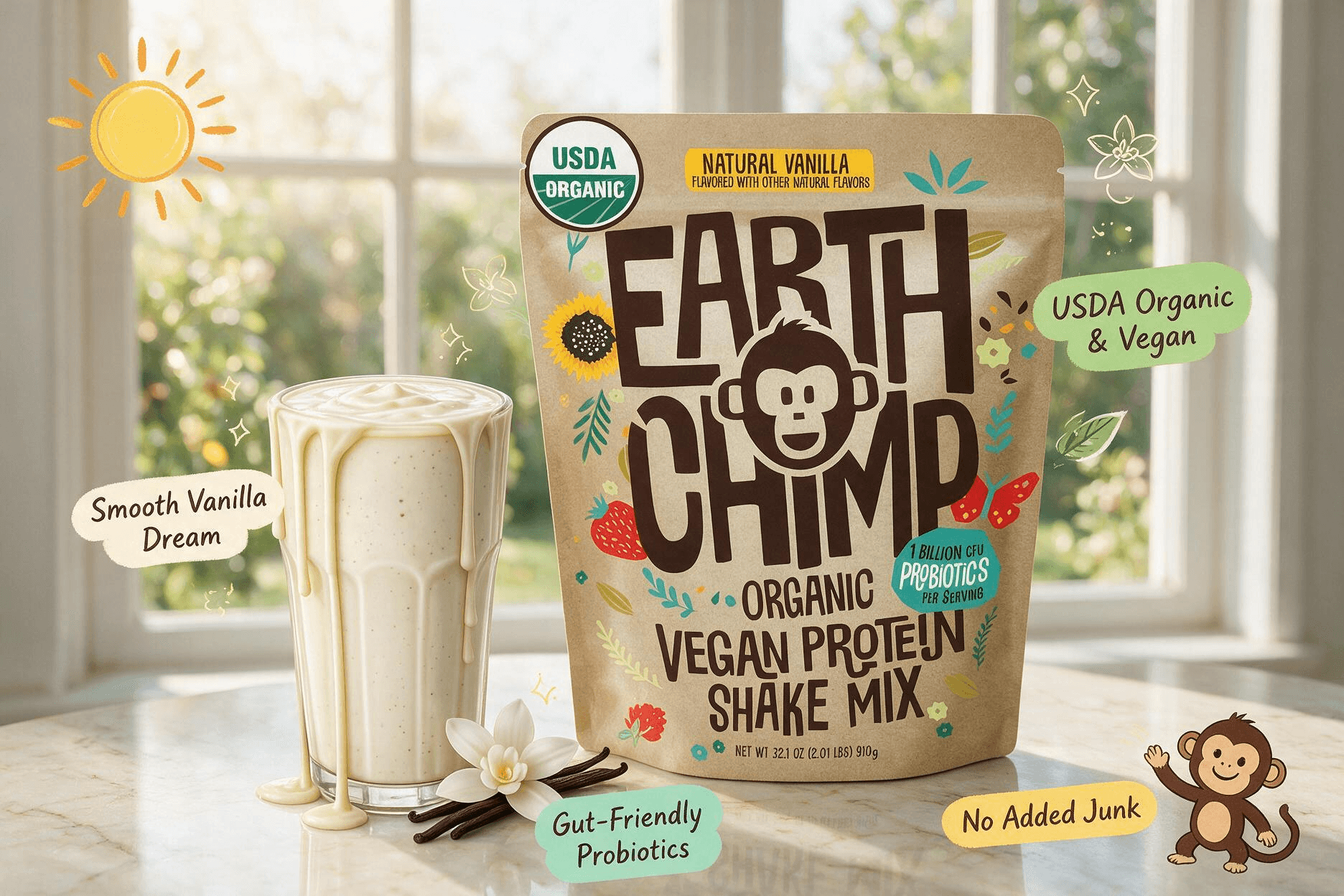
Manufacturing takes place in an FDA-registered facility, and the certifications the brand carries — USDA Organic, non-GMO status, certified vegan — are the boring, expensive kind that require paperwork and audits rather than a design budget. There is no gym campaign here, no athlete sponsorship ladder, no military-style branding. The visual identity is kraft-paper brown with chunky, uneven, cut-out lettering and scattered botanical illustrations in teal, red, and yellow, plus a smiling monkey face at the center of the wordmark. 🐵
That aesthetic is doing real work. Sports nutrition has a strongly coded look — black tubs, angular type, aggressive verbs — and it filters out a large population of people who need protein but do not identify as athletes. EarthChimp’s packaging reads as food, not as gear. Someone with coeliac disease, a dairy intolerance, or a toddler in the house will pick that pouch up without feeling like they are impersonating a bodybuilder.
Reading the Formula Backwards: Four Decisions That Explain Everything Else
A good way to understand a food brand is to stop listing its ingredients and start listing its choices. Every formulation is a chain of decisions, and the interesting ones are the decisions that cost somebody something.
Decision one: build the protein from a blend, not a single isolate
Each 35 g serving delivers 20 g of protein assembled from organic pea, pumpkin, sunflower and coconut proteins. Single-source powders are cheaper to formulate and easier to advertise — “100% pea isolate” is a clean line — but a single plant source carries an amino acid profile that is functional rather than ideal. Blending is the standard way to broaden it, and it also happens to fix texture: pumpkin and sunflower bring a softer, oilier mouthfeel that takes the chalk off pea.
Four sources in one blend also tells you something about restraint in the opposite direction. There is no rice protein in the list, which is the usual fifth column of plant blends because it is inexpensive and virtually flavorless. Its absence is a choice.
Decision two: refuse the sugar-alcohol shortcut
This is the decision that most separates EarthChimp from the mainstream. Sweetness comes from monk fruit alongside organic fruit inputs — dates, banana, and in the chocolate variant, organic cocoa. No added sugar. No erythritol. No stevia-and-erythritol backbone. No “natural flavors” doing anonymous work.
The reason this matters is not calorie-related. Sugar alcohols are notorious for the specific discomfort that drives people away from plant proteins in the first place: bloating, gas, the sensation of a drink sitting in the stomach far longer than it should. A powder marketed as gentle and then sweetened with polyols is contradicting itself on the label. EarthChimp avoids the contradiction.
There is a cost to that choice, and honesty requires naming it: fruit-and-monk-fruit sweetness is less loud than sucralose. The first sip of a clean-label plant protein is often quieter than the first sip of a conventional one. People conditioned on hyper-sweet shakes register that as a flaw before they register it as what it actually is — the absence of a flavor amplifier. By the second week, most palates recalibrate. Then the reverse happens, and the loud ones become unpleasant.
Decision three: treat the gut as part of the product
One billion CFU of probiotics per serving, plus 4 g of fiber, sits in the formula as a deliberate digestive layer. This is where the brand’s whole thesis comes together: plant protein’s real barrier to daily use is not taste, it is tolerance. People quit pea protein because their stomach quits on them.
Adding a probiotic count and meaningful fiber will not fix everyone’s issues, and it would be irresponsible to present it that way. What it does is address the most common stated reason for quitting, using ingredients that fit the label rather than plugging a hole in it. Turmeric, cinnamon, flax seed and baobab round out that supporting cast — superfood names that are somewhat familiar, mildly functional, and, crucially, flavor-compatible with a morning drink.
Decision four: exclude loudly, not quietly
The exclusion list is longer than the inclusion list, which is unusual and intentional: no dairy, no soy, no gluten, no artificial flavorings, no added sugar, no erythritol or gum thickeners. For a customer with coeliac disease, a soy allergy, or a household that has decided dairy is out, exclusions are not a bonus feature — they are the entire purchase criterion. A brand that leads with what it removes has usually been talking to people who were repeatedly failed by products that were “fine except for one thing.”
💬 Speech bubble — the skeptic: “Twenty grams of protein and four of fiber in 120 calories sounds like a marketing slide.” 💬 Speech bubble — the label: “Three grams of sugar, all of it natural, zero added. Two grams of fat. One probiotic count. Nine-ish ingredients you could buy at a grocer. That’s the whole scoop.”
📊 One Scoop, in Plain Numbers
| Item | Per serving (35 g) | Why it matters |
|---|---|---|
| Calories | 120 kcal | Small enough to add, not replace, unless you want it to replace |
| Protein | 20 g | Meaningful for a meal gap without being a megadose |
| Fiber | 4 g | Most adults in this country are short on exactly this |
| Total fat | 2 g | Low enough to disappear into a smoothie |
| Sugars | 3 g, none added | Sweetness from fruit and monk fruit only |
| Probiotics | 1 billion CFU | Digestive support positioned as standard, not premium |
| Servings per bag | 26 | Roughly three and a half weeks of daily use |
| Bag weight | 2 lb | The format the Amazon storefront is built around |
The ratio is the story here. Twenty grams of protein for 120 calories is a strong density figure, and it is achieved without pushing fat or cutting the serving so small that the dose feels stingy. Compare that against a snack-bar-first approach to protein, where reaching 20 g often costs 250 calories and 10 g of sugar, and the logic of a powder becomes obvious again.
🍫 The Three-Flavor System, and Which One You Actually Need
EarthChimp’s lineup is deliberately short: Chocolate, Vanilla, and Plain & Unsweetened. In a category where brands chase limited editions and seasonal collabs, three permanent flavors reads almost austere. It is also the correct number, because each of the three occupies a genuinely different job.
Chocolate is the flagship and the gateway. It is the flavor that appears in the hero imagery for a reason: cocoa is the most effective masking agent available to a clean-label formulator, and it does its work honestly rather than chemically. A chocolate powder with organic cocoa, dates and monk fruit will taste like a mild drinking chocolate, not like a dessert syrup. For someone replacing a nightly sweet drink, or someone who has bounced off three previous plant proteins because they “tasted like dirt,” this is the one to start with. It is also the most forgiving in a blender with frozen banana and peanut butter.
Vanilla is the utility player and the one experienced buyers choose. Vanilla is where a formula cannot hide, which makes it the best test of whether a brand’s ingredient choices were made for flavor or for cover. It is also categorically more useful: vanilla goes into oats, porridge, yogurt-style bowls, coffee smoothies, pancake batter, and chia puddings without announcing itself. If chocolate is the entry, vanilla is the subscription.
Plain & Unsweetened is the blank canvas — and the interesting one. This variant is aimed at a specific buyer who is easy to miss: the person who does not want a flavored shake at all. They want protein in a savory context, in soup, in a green smoothie where berry notes would clash, in bread dough, in food for small children where sweetness is being actively reduced. Unsweetened and unflavored is the least marketable SKU in the lineup and the strongest signal that the brand is formulating for a kitchen rather than for an Instagram caption. 🥄
| Flavor | Best for | Avoid if |
|---|---|---|
| Chocolate | Evening drinks, post-workout, shaking with water, beginner transitions | You want savory applications |
| Vanilla | Breakfasts, oats, smoothies, baking, everyday rotation | You need zero sweetness at all |
| Plain & Unsweetened | Savory cooking, baking, green drinks, low-sugar households, kids’ portions | You expect a shake to taste like a treat |
🥤 Two Hands, One Shaker: Shake Versus Blend
The brand frames this as a breakfast or meal-replacement question, and the practical split is simpler than the marketing suggests.
Shaking — powder plus water or a plant milk, thirty seconds with a shaker — is the weekday move. It is the version that survives a commute, a school run, and a desk. Chocolate in unsweetened almond milk is the most reliable combination for people who dislike sweetness; vanilla in oat milk reads closer to a breakfast and pairs well with ice.
Blending opens up the flavor architecture. Because the sweetness is fruit-based rather than syrup-based, it behaves like fruit in a blender: banana, dates, a spoon of nut butter, cold coffee, spinach, frozen berries. This is where the Plain & Unsweetened variant earns its place, letting you set the flavor profile entirely from the produce drawer instead of subtracting a sweetness you never asked for.
📌 Callout — the ratio that fixes most complaints: more liquid than feels necessary. Clean-label plant powders without gum thickeners do not artificially suspend, so an under-liquidated shake will read chalky. Chalkiness in this case is a pouring problem, not a formula problem.
💰 The Cost Conversation Nobody Wants to Have
$45.99 for a 2 lb bag is not inexpensive, and pretending otherwise would insult the reader. What is more useful is converting the price into the unit people actually consume.
Twenty-six servings per bag puts each scoop at approximately $1.77. Daily use means a new bag roughly every three and a half weeks, or on the order of $80 a month. That is the number to compare — not against a bag of conventional whey, but against the habit it replaces.
| Comparison | Typical monthly cost | Notes |
|---|---|---|
| EarthChimp, one scoop daily | ≈ $80 | 26 servings per 2 lb bag, ~$1.77 each |
| Two bottled plant-based shakes per week, retail | Often similar or higher | Pre-made convenience, far less protein per dollar |
| One café smoothie, three times weekly | Frequently double or more | 10–15 g protein, custom extras |
| Conventional non-organic protein powder | Lower per serving | The gap buys organic sourcing and the excluded-ingredient policy |
The last row is the honest one. You are paying a premium over commodity powder. What the premium purchases is organic certification across the protein sources, a sweetener system that avoids the cheapest option in the category, probiotics included rather than sold separately, and a manufacturing standard that keeps allergen-free claims defensible. Whether that premium is worth it depends entirely on how much of your week currently goes to products with the opposite trade-offs.
🏷️ Certifications as Boring, Expensive Insurance
USDA Organic, non-GMO, certified vegan, gluten-free, dairy-free, soy-free, produced in an FDA-registered facility. Read as a list, this looks like standard badge-collecting. Read as a cost structure, it looks different.
Organic certification on a multi-source plant protein is genuinely harder than on a single-source one, because every agricultural input in the blend has to be documented. A four-protein blend plus fruit inputs plus spices plus a probiotic strain — all organic — is a supply-chain burden that a brand could avoid by substituting one conventional ingredient and quietly losing nothing in flavor. The badges are not decoration; they are receipts.
The same logic applies to the allergen exclusions. “No soy” and “no dairy” are not merely dietary preferences in this formula — they widen the pool of people who can drink it without thinking. Someone managing a soy allergy, a lactose intolerance, or coeliac disease does not get to be flexible about a single ingredient. A brand that removes all three at once is solving for the strictest person in the room, which is the correct design instinct for an everyday food.
♻️ Packaging, and the Small Environmental Note Worth Making
The kraft-brown pouch is a visual choice with an environmental corollary: the brand has publicly linked part of its packaging spend to ocean-plastic removal work. It is a modest commitment and, importantly, not presented as a grand rescue of the planet — no carbon-negative claims, no salvation narrative, no guilt transfer onto the buyer.
That restraint is characteristic of the whole brand. In a category that loves a mission statement big enough to sell merchandise, EarthChimp’s positioning stays close to what it can actually verify: organic ingredients, a short list, certifications held, plastic-reduction contribution funded, and a powder people reorder. A smiling chimp on brown paper is not an environmental achievement, but the tone it sets — light, unbothered, unwilling to lecture — is consistent with a company that would rather be liked for the label than for the manifesto.
Who EarthChimp Fits, and Who Should Keep Looking
Being useful means being selective. This is a strong match for:
- Anyone who has abandoned plant protein twice or more because of digestive discomfort
- Households running dairy-free, gluten-free, or soy-free kitchens as a default
- People who want protein in savory cooking and baking, especially via the Plain & Unsweetened bag
- Buyers who read labels first and cannot stand erythritol-listed “clean” products
- Anyone trying to replace daily café smoothies or bottled shakes with a cheaper, denser habit
It is a weaker match for:
- Someone chasing the lowest cost per gram of protein available — commodity concentrates exist for that job
- A buyer who wants an intensely sweet, dessert-flavored shake on the first try
- Anyone needing a certified third-party anti-doping batch program for competitive sport, which is a separate procurement question
- People who prefer a single-source protein for a specific, known reason and are not open to a blend
Naming the mismatches is not false humility. It is the fastest way to establish that the review was actually read as a description rather than received as an advertisement.
🗓️ What 26 Servings Looks Like in an Ordinary Week
The bag is sized for a habit, not an experiment, and the most revealing thing about a protein powder is what people do with it once the novelty thins out around day nine.
- Monday, before the school run. Vanilla, shaken with cold water, drunk standing up. Twenty grams of protein and four of fiber consumed without a single cooking decision made.
- Tuesday, at the desk. Chocolate blended with frozen banana and a spoon of nut butter. The drink that replaces the 3 p.m. biscuit run, and the one that makes the price per scoop look ridiculous in the brand’s favor.
- Wednesday, savory night. Plain & Unsweetened stirred into a lentil soup off the heat. Almost nobody thinks of this, and it is arguably the smartest use of an unflavored bag.
- Thursday, breakfast bake. Vanilla into oat flour pancakes. The bag becomes a pantry item instead of a supplement.
- Friday, post-session. Chocolate with oat milk and ice. The one day the word “performance” is at least defensible.
- Saturday, slow morning. Plain & Unsweetened into a green smoothie with cucumber, apple and ginger, where no sweetness competes with the vegetables.
- Sunday, prep. Two bottles mixed in advance, one chocolate and one vanilla, both in the fridge. Whatever survives the week is the flavor you should actually be buying. 🧃
🔍 How to Vet Any Powder Once You Have Started
The most durable value from an introduction like this one is not the recommendation; it is the habit. Five checks that transfer to every future purchase in this category:
- Count the protein sources, then check their order. Four sources listed in a sensible sequence suggests a formulated blend. Five sources with the last two appearing after the flavorings suggests label theatre.
- Find the sweetener before you find the protein. Erythritol, sucralose, acesulfame K or “natural flavors” in the top five lines tells you how the taste problem was solved.
- Compare fiber to total carbs. Fiber that is not broken out separately is often doing bulk duty rather than nutritional duty.
- Look for the serving count and the bag weight together. Some products hide a small serving size behind an impressive per-100 g figure.
- Check whether exclusions are stated as absolutes. “Naturally gluten free” and “gluten free” are different claims with different testing regimes behind them.
Run those five against this brand’s page and the exercise becomes reassuring rather than anxiety-inducing, which is precisely the point of choosing a label-first product.
The Question EarthChimp Keeps Answering
Here is what an introduction to this brand ultimately reduces to. The plant protein category has a credibility problem, and it is not caused by pea. It is caused by decades of products that promised gentleness and delivered polyols, promised purity and delivered proprietary flavor systems, promised performance and delivered sugar in a scoop-shaped container. Consumers stopped believing the front of the pack and started reading the back of it, and a large number of brands never adjusted their behavior accordingly.
EarthChimp appears to have adjusted. Four organic protein sources chosen for texture as well as profile. Sweetness from fruit and monk fruit, with the sugar-alcohol escape hatch deliberately closed. Probiotics and fiber included because the digestive objection is the real one. Organic, non-GMO, vegan, gluten-free, soy-free and dairy-free claims held simultaneously, in a Dublin-based founder-led operation that has been reordering its customer base since 2012 rather than reacquiring one. Three flavors, each with a distinct job, and one of them deliberately unflavored — the least profitable kind of SKU to believe in.
None of this makes it the cheapest powder per gram, and it should not be presented as such. What it does is remove nearly every reason a person historically gives up on plant protein after two weeks. That is a narrower promise than “transform your mornings,” and it is a much more useful one. 🌿
If you have bounced around the category and concluded that plant protein simply disagrees with you, the more likely culprit was never the plants. It was the shortcut ingredients wrapped around them. EarthChimp is a brand worth meeting precisely because it declined the shortcuts, then let the label make the argument.