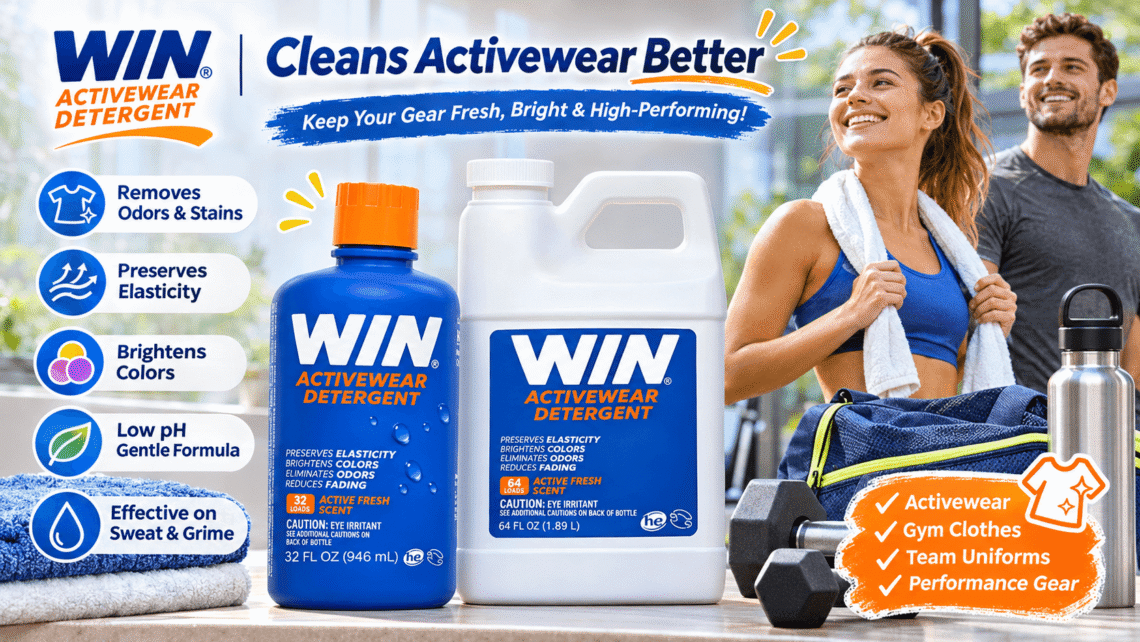
You’ve lived this moment. You pull a pair of leggings out of the clean laundry basket, give them the obligatory sniff, and they smell… fine. Like nothing, basically. You put them on, start moving, the first sweat bead forms, and suddenly you’re wearing last Tuesday’s gym session again. If that story sounds familiar, you’ve met the dirty little secret of modern activewear — and the reason WIN Detergent, the oxygen-powered sports detergent built specifically for high-performance apparel, exists in the first place.
Here’s the uncomfortable truth most laundry advice won’t tell you: washing your workout clothes isn’t really about the stains. It’s about the oils. Human sweat carries more than water — it carries sebum, skin oils, and microscopic residues that bind themselves to synthetic fibers, where ordinary detergent merely swishes them around and calls it clean. The result is fabric that feels done, but the moment your body warms up, the odor comes back like it never left.
WIN Detergent was designed around a simple, stubborn problem: activewear is different from everything else in your hamper, and it deserves a cleaner built for that difference. In this post, we’ll walk through exactly why your go-to laundry routine falls short, how an oxygen-powered formula changes the math, and what a bottle of WIN actually does for the clothes you sweat in most.
Why Your Gym Clothes Survive the Wash and Smell All Over Again
Let’s start with the fabric itself. The workout gear you own is almost certainly a blend of polyester, nylon, and spandex — engineered to wick, stretch, and breathe. That engineering is what makes it comfortable, but it’s also what makes it a sneaky odor trap.
Natural fibers like cotton absorb sweat and release it reasonably well in a standard wash. Synthetic fibers do the opposite: they repel water while trapping oily residues against the fiber surface. Sweat oil, sunscreen lotion, body moisturizer, and even fabric softener leave films that build up over time. Each wash adds another thin layer, and each layer holds more odor molecules.
Meanwhile, most conventional detergents lean heavily on enzymes and alkaline builders. Enzymes are genuinely good at breaking down protein-based stains like blood or food. But the stuff that stinks in your leggings is largely oil-based — the kind of molecules enzymes are only moderately interested in. And the high pH that helps cut grease on your kitchen dishes? It slowly attacks spandex and elasticity, turning once-snappy compression gear into something baggy and tired long before it should be.
So the typical athlete’s laundry ritual — standard detergent, warm or hot water, maybe a sniff of fabric softener, then a trip to the dryer — quietly does three things at once:
- Leaves oily residues intact on synthetic fibers, where they bake in odor with every wear.
- Degrades the very elasticity that made the garment perform.
- Builds up softener and detergent films that make the fabric feel cleaner than it actually is.
The callout nobody asked for but everybody needs: If your activewear passes the “cold sniff” test but fails the “first mile” test, the problem isn’t your nose. It’s oily residue trapped in the fibers, and no amount of re-washing with the same detergent will ever fully fix it.
This is the gap that specialized sports detergents — and WIN in particular — were born to close.
What Oxygen Changes About the Whole Equation
WIN’s core idea is refreshingly blunt: rather than relying mostly on enzymes and alkalinity to clean activewear, the formula leads with oxygen ions as the active cleaning engine.
Oxygen ions are aggressively good at breaking down organic molecules — oils among them. When the detergent hits the wash, those ions seek out the same oily films that ordinary formulas mostly leave behind and chemically dismantle them at the source. Not covering them up with fragrance. Not suspending them briefly and letting them redeposit. Actually breaking them apart so they can rinse away.
Two other design choices matter just as much as the oxygen itself:
- Low pH, non-alkaline formula. Because WIN isn’t trying to scrub dishes, it stays gentle on spandex, Lycra, and other elastics. That means the stretch you paid for stays put, wash after wash. Compression fabric keeps its compression, and waistbands keep their snap.
- Color-safe and rinse-friendly. Dyes in activewear — especially neon team uniforms and vibrant running gear — fade when exposed to harsh builders. WIN’s formulation is designed to lift residue without stripping the color underneath, so bright gear stays bright.
The practical payoff is the part athletes notice within a few cycles: clothes that smell fresh straight out of the dryer and stay fresh during a real workout. That’s the difference between masking odor and removing its cause.
Meet the Bottles: Active Fresh vs. Free & Clear
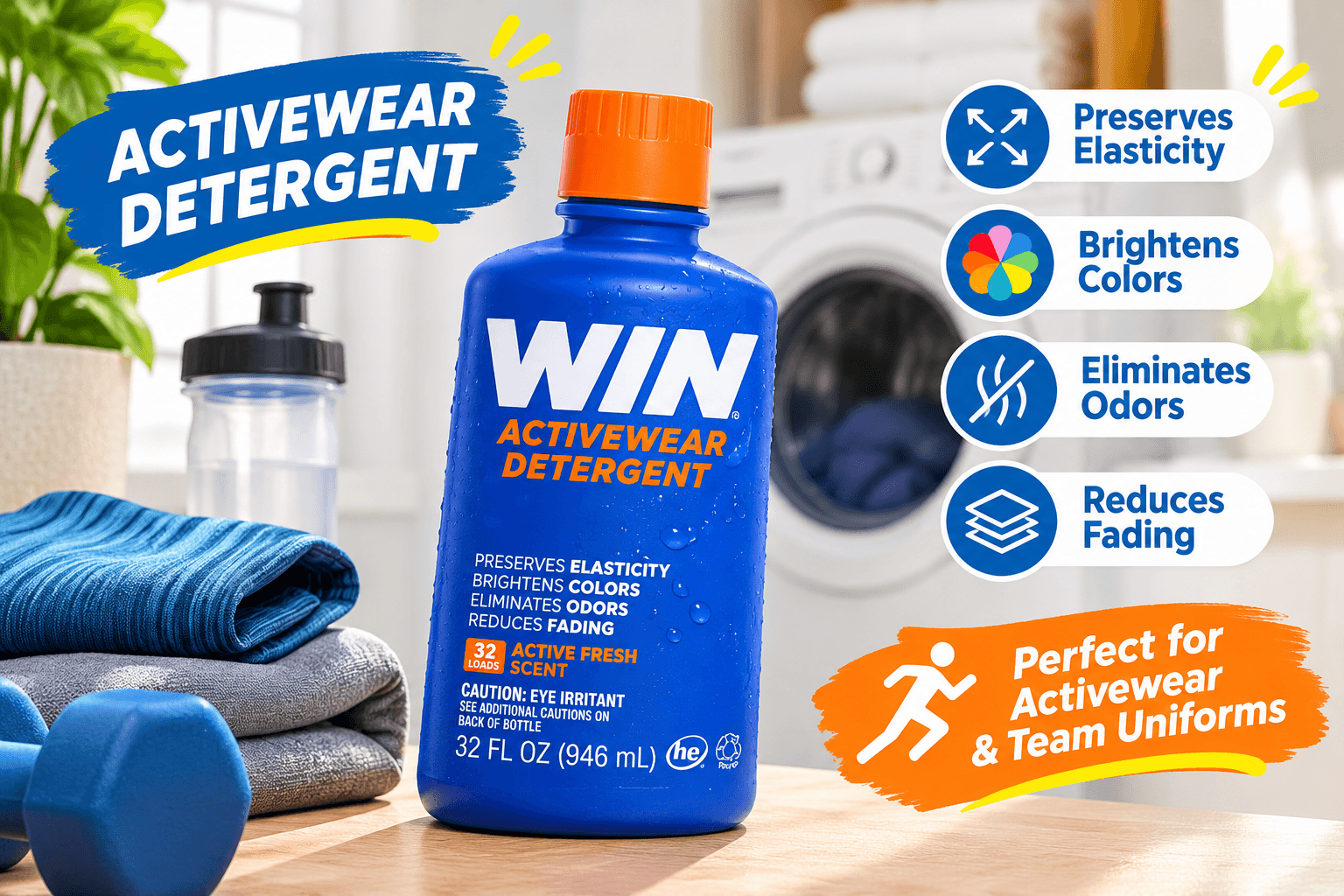
WIN isn’t a one-size-fits-all situation. The line comes in two signature variants, and picking between them is mostly a lifestyle decision rather than a performance one.
| WIN Active Fresh (Blue Bottle) | WIN Free & Clear (Green Bottle) | |
|---|---|---|
| Best for | Everyday training gear, runners, gym clothes | Sensitive skin, close-fitting gear, allergy-prone households |
| Fragrance | Light, clean, sporty scent | Fragrance-free |
| Formula focus | Oxygen-powered odor removal | Oxygen-powered odor removal + minimized allergens |
| Ideal fabrics | Polyester tees, shorts, leggings, team uniforms | Compression wear, sports bras, base layers, kids’ uniforms |
| Feel after wash | Crisp, faintly fresh | Completely neutral — no perfume competing with your body wash |
Here’s a quick way to think about it:
- Choose Active Fresh if you like the satisfaction of laundry that genuinely smells clean, and you don’t mind a light fragrance lingering in your shirts.
- Choose Free & Clear if your skin reacts to fragrances, if you wear gear close to the body for hours, or if you’d rather smell nothing from your laundry. The green bottle is specifically designed without known allergens, which makes it a smart default for athletes with skin sensitivities and for parents washing uniforms for kids.
Both bottles use the same oxygen-driven core. The difference is what sits on top of that core — a light scent, or none at all.
Who Actually Wins with WIN?
Spend ten minutes in any group of active people and you’ll notice the same recurring complaint cycle: the gear is expensive, the gear smells bad, and the gear both smells bad and gets expensive faster than expected. WIN tends to resonate most with the following profiles.
The Daily Runner
You’re out before sunrise two or three mornings a week, and your shirts live in a perpetual rotation. A runner’s worst enemy is the shirt that smells fine at 5 a.m. but turns on you at mile three. Because WIN targets the oily sweat residue rather than the surface smell, long-run tees keep performing longer.
The Studio Regular
Yoga, Pilates, spin, or barre — whatever the studio, the gear is stretchy, synthetic, and worn skin-tight. Spandex is the fragile element here, and the low-pH formula helps preserve the elasticity that makes these garments feel like new instead of turning baggy by month two.
The Cyclist
Cycling kit is basically one long, close-fitting oil-and-sweat lab experiment. Jerseys and bibs take a beating, and conventional washing just moves the problem around. An oxygen-based wash attacks the grime where ordinary detergent stalls.
The Team-Sport Parent
Soccer cleats, hockey jerseys, basketball uniforms — multiply that by two or three kids and you have a full-time odor management program. Color-safe cleaning matters here because uniforms are expensive to replace and fade badly when mistreated.
The Gym Rat Who Actually Cares About Gear
Your pre-workout routine has a plan; your laundry routine shouldn’t be an afterthought. If you’ve ever spent real money on compression wear or moisture-wicking basics, treating that gear with a detergent designed for it is the cheapest maintenance upgrade available.
Conversational snippet, overheard near a laundry room somewhere: “I used to just re-wash the same shirt three times until the smell ‘kind of’ went away. Then I realized the shirt wasn’t dirty on the surface — it was dirty underneath, in the fibers. That’s when I stopped blaming the shirt and started blaming the detergent.”
A Practical Routine: Hamper to Dryer with WIN
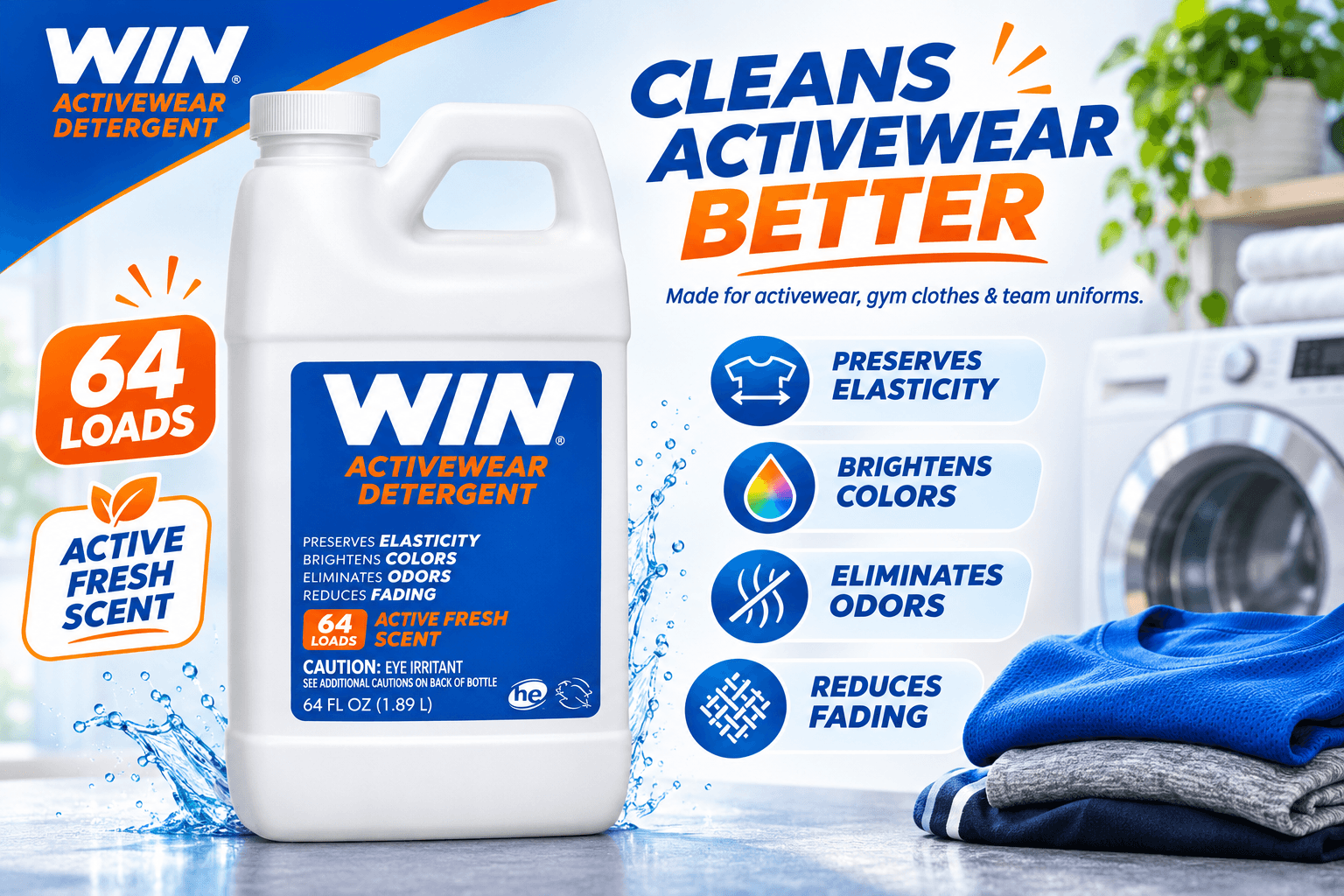
Knowing why a specialized detergent helps is only half the battle. The other half is using it well. Here’s a routine that gets the most out of a bottle of WIN without adding a single extra step to your laundry day.
The pre-wash habit that pays off
- Don’t let sweaty activewear bake in a closed hamper for days. If it’s practical, hang it or at least let it air out before it goes into the basket.
- Zip zippers, turn sports bras and leggings inside out, and empty the pockets. Most residue clings to the inside of the fabric — the side touching skin.
- Treat any visible stains first (oil, sunscreen, grass) with a dab of detergent and a quick pre-rub.
The wash itself
- Use cool or warm water, not hot. Hot water can set oily residues into synthetic fibers and stresses elastic blends.
- Dose by load, not by habit. WIN is concentrated; a standard load needs roughly the recommended fill — check the bottle’s guidance rather than eyeballing.
- Skip the fabric softener entirely. Softeners coat synthetic fibers in waxy films — exactly the residue WIN works to remove. Using both at once works against itself.
- Don’t overload the machine. Activewear needs room to tumble so oxygen ions can reach every surface.
- Skip the dryer when you can, or use low heat. Air drying preserves elasticity far longer. If you must machine dry, keep it gentle.
The cheat sheet you’ll want to screenshot
| Fabric / Item | Water Temp | Detergent | Extra Notes |
|---|---|---|---|
| Polyester tees & tanks | Cool–warm | WIN | Turn inside out |
| Leggings & compression | Cool | WIN Free & Clear | No softener; air dry |
| Sports bras | Cool, gentle cycle | WIN Free & Clear | Use a mesh bag |
| Team uniforms | Warm, if labeled | WIN Active Fresh | Wash darks separately |
| Cycling kit | Cool | WIN | Pre-treat chamois grease |
| Sweaty socks | Warm | WIN | Separate from gear |
The Economics: Cleaner Gear Is Cheaper Gear
Here’s a conversation nobody has enough at the dinner table: activewear is a surprisingly expensive category of clothing when you factor in replacement cycles.
A pair of mid-range leggings might cost fifty or sixty dollars. Compression tops, running shorts, sports bras, cycling jerseys — add it up and a serious athlete’s wardrobe easily runs into the low thousands. Now ask yourself: how many of those items were thrown away not because they were worn out, but because they smelled permanently, or because the elastic gave up six months early?
This is the quiet ROI of a detergent built for the job. When you stop:
- Building up odor film that makes garments unwearable,
- Degrading spandex with alkaline washes,
- Stripping color with harsh cleansers,
…the same garments keep working for more seasons. A bottle of WIN costs a fraction of replacing even one pair of leggings. That’s the math that turns “specialized detergent” from a luxury into an obvious decision.
Common Questions, Straight Answers
Isn’t this just a fancy way to sell me more detergent?
Probably fair to ask. The real test is empirical: switch your activewear loads to WIN exclusively for four weeks, keep everything else about your routine identical, and judge the results by the first-mile sniff test rather than the cold-laundry basket test.
Can I use WIN on regular clothes too?
Yes — it cleans everyday laundry fine. But the honest value is on synthetic, performance, and athletic fabrics. On 100% cotton tees, you’ll see less dramatic difference because cotton doesn’t trap oil the way synthetics do.
Will the scent bother sensitive skin?
The Active Fresh bottle has a light scent; if fragrance sensitivity is a concern, the Free & Clear variant is deliberately minimized in allergens and rinses out clean.
Do I still need to use bleach or sanitizer?
For most training gear, no. The oxygen-powered cleaning removes the residues that feed odor, which addresses the source rather than layering on sanitizers. If you’re dealing with genuinely contaminated uniforms (think: shared contact-sports gear), a periodic sanitizing wash is reasonable — just don’t make it the default.
Is it septic safe and biodegradable?
Yes — the formulation is biodegradable and septic safe, which matters for anyone running a home system or trying to keep their laundry footprint lighter.
A Small Way to Honor the Work You Put In
Here’s the thing about workouts: you show up, you sweat, you earn the tired muscles and the better sleep and the quiet pride that comes from finishing. The least your laundry routine could do is meet that effort halfway.
Most people treat laundry as the boring task that happens after the interesting part of the day. But the gear that carries you through runs, rides, lifts, and studio sessions deserves more than a generic soapy dunk. It deserves a cleaner that understands what sweat is made of, that respects the stretch built into the fabric, and that doesn’t hide odor behind a cloud of fake freshness.
That’s the whole pitch for WIN Detergent, distilled to a sentence: a low-pH, oxygen-powered sports detergent built to remove the oily residues trapped in synthetic activewear — the ones that ordinary washes can’t touch — so your gear smells clean, moves freely, and lasts longer, wash after wash.
Your workouts already demand a lot. Let the laundry demand a little less imagination.