Every Saturday morning, the same ritual plays out in millions of driveways: someone unhooks a heavy, tangled garden hose, wrestles with a kink that refuses to budge, and spends more time untangling than watering. If that sounds familiar, then an expandable garden hose — specifically the kind built by Pocket Hose — is exactly the upgrade your weekends have been asking for.
This brand has spent over a decade refining a simple but stubborn idea: a hose that shrinks down to pocket size when the water is off, then grows up to three times its working length when the tap opens. What started as an “as-seen-on-TV” curiosity has quietly become one of the better-known families of lightweight hoses on the market today. But the marketing is only half the story. What matters is whether the thing survives a full season of real-world yard work — freezing mornings, blazing afternoons, dogs, kids, driveways, and the occasional run-over by a wheelbarrow.
Let’s pull this brand apart piece by piece, without the hype and without the “twist the knob and magic happens” energy of a late-night infomercial.
Why Ordinary Hoses Quietly Ruin the Outdoor Chore Experience
Before we talk about what Pocket Hose does right, it helps to name exactly what’s wrong with the 50-foot rubber coil sitting next to your spigot.
First, there’s the weight. A conventional vinyl or rubber hose carries water plus its own mass, and dragging one around a corner of the yard feels less like gardening and more like deadlifting. If you’re older, recovering from an injury, or simply don’t enjoy hauling 15 pounds of stiff tubing across gravel, that hose becomes a reason to skip watering entirely.
Then there’s the kink. It doesn’t matter how expensive the hose was — a sharp bend, a foot on the line, or a hose reel that twists half a turn can shut the flow off completely. Conventional hoses remember every fold you ever gave them, and they repay you by pinching shut at the worst possible moment, usually mid-rinse on a muddy dog.
Storage is the third annoyance. A full-size hose, even a good one, needs a reel, a wall hanger, or a corner of the garage that’s now permanently occupied. In small yards, balconies, RVs, or boats, that bulk simply doesn’t fit.
And finally, connectors. Cheap plastic fittings crack, leak, and cross-thread. One bad connection and you’re mopping your own foundation while the hose sprays sideways.
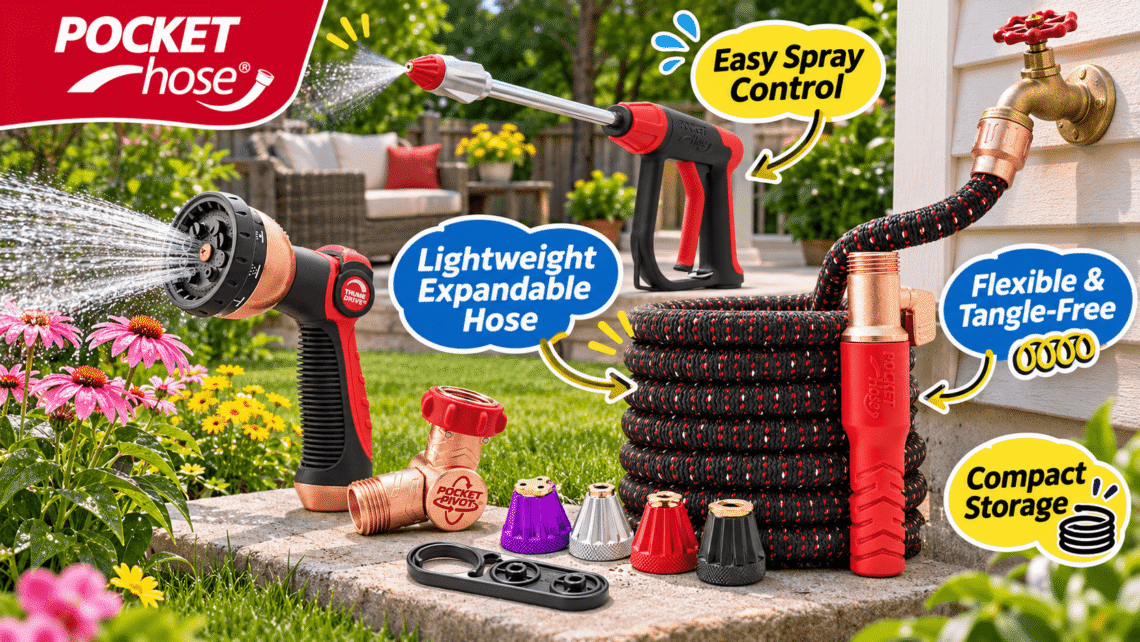
Pocket Hose was designed around all four frustrations at once — light weight, zero-memory tubing that doesn’t kink, collapses small enough to store in a bucket, and reinforced connectors that are the actual engineering centerpiece of the lineup.
Meet Pocket Hose: A Brand Built Around One Physics Trick
At its core, Pocket Hose is a family of expandable hoses. The operating principle is simple: an inner latex tube expands under water pressure, ballooning outward until it reaches its full length. Once you turn off the water, the tube drains, contracts, and folds back into a compact bundle that’s genuinely small enough to drop into a storage tote.
What separates Pocket Hose from the dozens of generic expandable hoses online is the iteration. The brand has been through multiple generations — from early single-layer designs to triple-layer latex cores, from plastic fittings to copper-infused, lead-free connectors protected by what the company calls APT (Advanced Polymer Technology) at the connection points. That history matters because most of the cheap expandable hoses you see are still on generation one.
The brand’s range currently covers a few distinct lines, each aimed at a slightly different user:
| Line | Core Identity | Best For |
|---|---|---|
| Copper Bullet | Best-seller; copper-infused, lead-free connectors, 3-layer latex core, 3X anti-burst outer sleeve | Everyday homeowners who want the most durable all-rounder |
| Silver Bullet | Classic bullet-shell outer casing, lightweight, kink-resistant | Casual gardeners, balconies, light-duty watering |
| Ballistic | Expands up to 3X length, easy-grip paddle connectors, UV-protective coating | Hot climates, users who fight stiff connectors |
| Copper Head | Force Field Jacket exterior, Tri-Tex triple-layer tube, swivel Pivot attachment | Users who battle kinks right at the spigot |
💬 “I used to wrestle a 50-footer that fought me every inch. Now I just hook it on, turn the water, and walk. It follows me like it’s on wheels.”
That sentiment is the whole value proposition in one sentence.
How an Expandable Hose Actually Works — No Magic Required
It’s tempting to think expandable hoses are a gimmick, but the physics is straightforward and worth understanding, because it explains how to use one well.
When you connect the spigot and open the water, incoming pressure stretches the inner latex tube. Meanwhile, the outer sleeve — usually a woven, high-strength fabric — keeps the tube from ballooning chaotically, dictating the hose’s final shape and length. The result is a full-size, full-pressure working hose at roughly a third of the resting weight.
When you close the tap, the residual water drains out, the latex relaxes, and the entire assembly retracts. Because the material is designed for “zero memory,” it doesn’t hold creases — which is why it doesn’t kink the way a conventional hose does.
The practical tips that fall out of this design:
- Let it expand gradually. Walk with the hose as it fills; don’t open full blast and let it whip around uncontrolled.
- Drain before storage. Always shut the spigot off first, disconnect, and purge remaining water before coiling.
- Mind the sprinkler. If you use the hose with a traveling sprinkler, disconnect the sprinkler when the water is off — otherwise the retraction can drag it across the lawn.
- Don’t leave it pressurized for days. Expandable hoses aren’t meant for permanent 24/7 pressurized setups; they’re tools you use and release.
Used this way, a well-built expandable hose is far more durable than its fragile early reputation suggests.
The Copper Bullet: Why the Best-Seller Sells
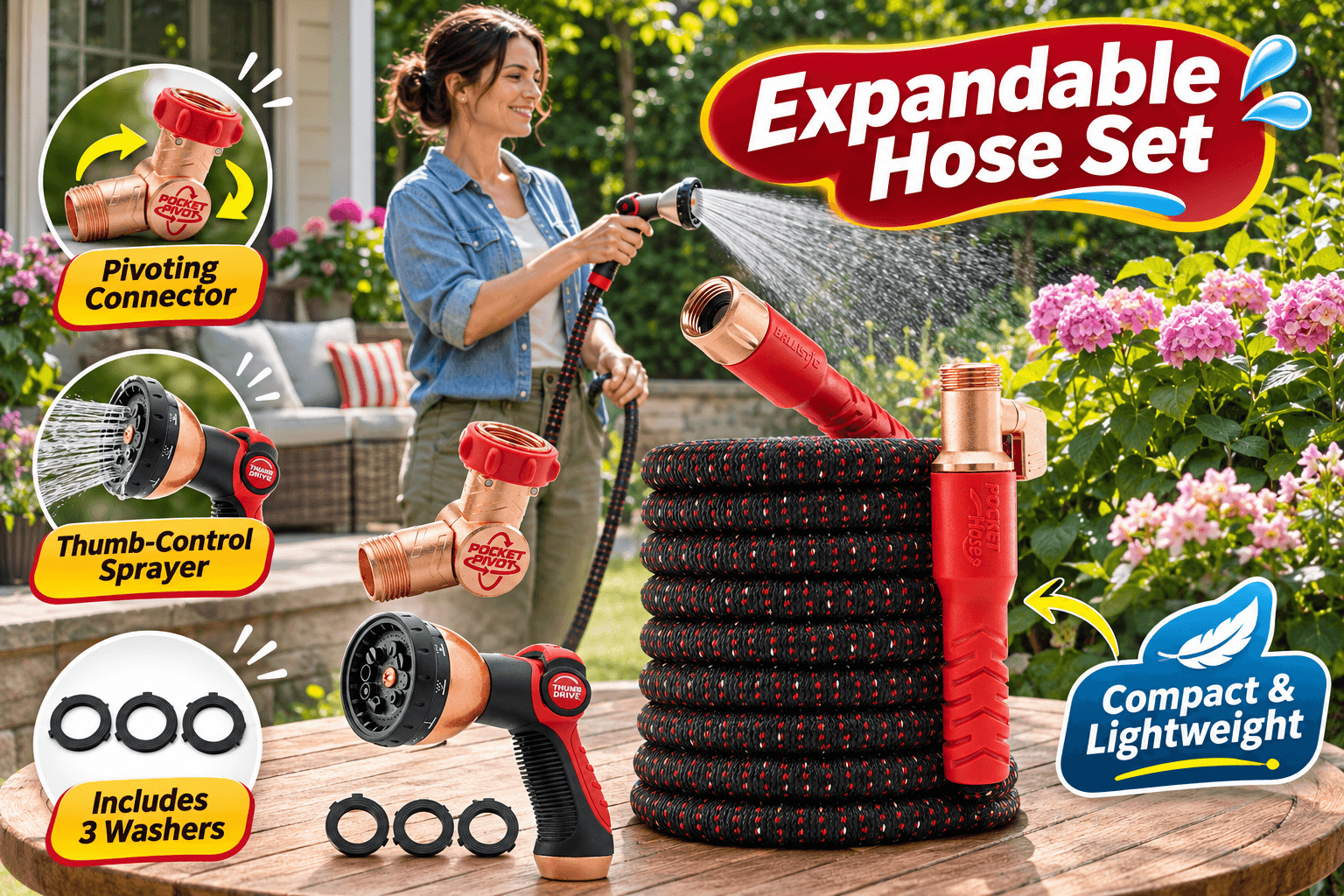
If the lineup had one hero product, it would be the Copper Bullet. Several things set it apart from the crowded expandable-hose shelf.
A three-layer ultra-strength latex core. Single-layer inner tubes are why budget expandable hoses spring pinhole leaks after a summer. A triple-layer construction gives the latex wall redundancy — one layer micro-damaging doesn’t immediately sink the whole hose.
A 3X stronger anti-burst outer sleeve. The woven outer shell is what holds everything together under pressure, and a reinforced sleeve is the difference between a hose that handles household pressure reliably and one that splits along a seam.
Copper-infused, lead-free connectors. This is the detail that matters most at the spigot. Copper-infused fittings are stiffer, resist corrosion, and hold a seal better than plastic. Lead-free also means the water traveling through is safe for drinking — useful if you’re filling pet bowls, a kid’s paddling pool, or a camping jug.
APT-protected connection points. Advanced Polymer Technology essentially adds a flexible protective layer around the joints, so the hose flexes at the connection instead of bending rigidly right where leaks usually start.
On-hose flow control. An easy on/off valve with flow control on the hose itself means you can throttle without walking back to the spigot — handy mid-rinse when you need to pause without soaking your shoes.
And the headline number: the Copper Bullet is rated to handle significantly higher pressure than the earlier Silver Bullet generation, comfortably covering typical household water pressure in most North American homes.
Compare the Lines Before You Buy
Not everyone needs the top-of-the-line model. Here’s a quick decision breakdown:
Pick the Silver Bullet if your yard is small, your use is light, and your budget leans value. It’s the featherweight of the family — easy to carry to a community garden plot, a balcony planter set, or a campsite hook-up.
Pick the Copper Bullet if you want one hose that does everything — watering, washing the car, hosing the patio, filling a pool — and you’re keeping it for multiple seasons. It’s the safe, no-regret choice for most households.
Pick Ballistic if you live somewhere the hose sits in direct sun all day. Its UV-protective coating slows the sun-bleaching and brittleness that finish off so many hoses in desert climates. The easy-grip paddle connectors also make connecting easier for anyone with weak or sore hands.
Pick Copper Head if your single biggest enemy is kinks at the spigot. Its swivel pivot attachment rotates freely, eliminating the sharp bend that forms where most hoses leak first.
The Spray Side: Three Modes, One Nozzle
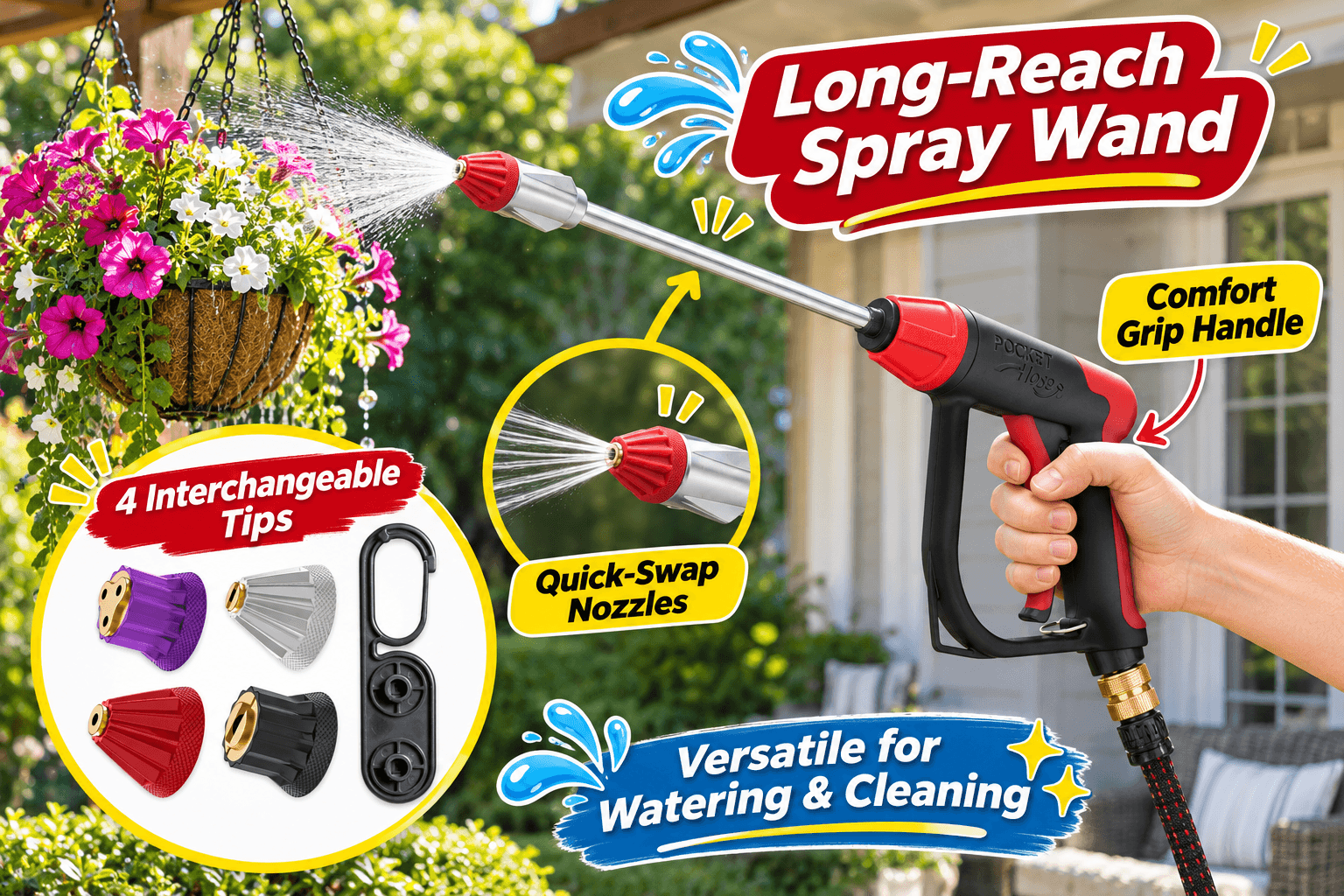
Most Pocket Hose setups pair the hose with a multi-pattern spray nozzle, and the featured three-mode setup is a small piece of engineering worth appreciating.
- Shower mode delivers a soft, wide rainfall — ideal for seedlings, delicate flowers, or washing the car without striping the paint.
- Full power mode concentrates the stream into a tight, forceful jet — for rinsing mud off sneakers, clearing debris from gutters, or blasting a driveway corner.
- Flow mode opens up a gentle, high-volume stream for refilling buckets, pet bowls, or a kiddie pool quickly without a high-pressure splash-back.
🔹 Callout: If you only ever use one spray pattern, you’re leaving half the value on the table. Spend five minutes turning the dial through all three modes next time you water — most people find their go-to pattern shifts depending on whether they’re feeding roses or flushing a patio.
The nozzle sits at the end of the hose, which means the on-hose valve and the nozzle work as a team: throttle volume from the hose, choose the pattern from the nozzle. Two controls, zero walking back to the spigot.
Sizing It Right: 25, 50, 75, or 100 Feet?
One of the most common buyer mistakes is oversizing. A 100-foot hose sounds generous until you’re coiling 100 feet of it.
| Length | Best For |
|---|---|
| 25 ft | Balconies, patios, small raised beds, RV hookups, boat decks |
| 50 ft | The classic suburban backyard — most homes’ main watering zone |
| 75 ft | Larger yards, multiple spigot-to-garden distances |
| 100 ft | Big properties, acreage, anyone genuinely needing maximum reach |
A practical rule: measure from your spigot to the farthest point you actually water, add a small margin, and stop there. Because the hose collapses when idle, “too long” costs storage space, not weight — but a correctly sized hose always feels easier to use.
Safety, Pressure, and the Drinking-Water Question
Two technical points come up again and again in reviews, and both deserve a straight answer.
Pressure. Household water systems typically deliver moderate, consistent pressure. The Silver Bullet generation is engineered for everyday residential pressure, while the Copper Bullet and later models are built to tolerate substantially higher pressure ranges — comfortably beyond what most municipal spigots output. In plain terms: unless you’re running the hose off a fire hydrant-style system, you’re inside the safe zone.
Drinking water. The lead-free connectors on the newer lines mean the water that flows through is fine for topping up pet water bowls, filling swimming gear for kids, or even rinsing fruit off directly if that’s how you garden. Always flush a brand-new hose briefly before its first drinking use, the same way you would with any new food-contact product.
Real-World Jobs: Where a Pocket Hose Shines
Specs are nice. The real test is chore-by-chore.
Watering the garden. The soft shower mode plus the on-hose valve means you can stand at the flower bed and adjust flow without breaking stride. No dragging a heavy hose around tomatoes.
Washing the car. Expandable hoses retract, so you’re not stepping over a coil in the driveway mid-wash. Walk around the vehicle freely, then drain and stow.
Bathing the dog. Full-power mode rinses soap fast; shower mode protects eyes. Light weight matters here because you’re often crouched, one hand on the dog.
Power-washing-adjacent cleanup. Blast patio furniture, flush a muddy entry mat, or clear a gutter edge.
RV, camping, and boat use. This is the sleeper category. Storage space on an RV or boat is gold, and a hose that folds into a bucket-sized bundle is functionally different from a conventional one in those contexts.
💬 “I keep one in the RV bin. The day we stopped bringing the 50-foot coil was the day our under-bed storage finally fit sheets again.”
Care and Feeding: How to Make It Last Two Seasons Instead of One
Expandable hoses live and die by a few habits. Follow these and the Copper Bullet-class models are genuinely year-plus investments:
- Drain completely before storing. Trapped water in winter is the number-one killer — expansion freezes latex.
- Store out of direct sun when idle. Even UV-coated sleeves last longer in shade.
- Coil loosely, don’t fold sharply. Let the zero-memory tubing do the work.
- Check washers seasonally. The thicker leak-resistant washers seal best when clean and flexible; swap if cracked.
- Keep it off hot asphalt while expanded. Summer driveways radiate heat; rest the hose on the lawn or a mat during long washes.
- Disconnect before freezing weather. Simple, but worth saying: bring it in.
Who Is Pocket Hose Actually For?
Let’s be honest about fit.
It’s for the person whose watering takes longer because of the hose, not the plants. It’s for renters who can’t install permanent irrigation. It’s for older gardeners who’ve watched their strength decline and refuse to give up the yard over a 15-pound coil. It’s for RVers, boat owners, balcony growers, and anyone who stores gear in a closet rather than a workshop.
It’s less for commercial landscapers running hoses eight hours a day, or anyone needing permanent pressurized installations — those are jobs for different equipment.
Quick Answers People Actually Ask
Do expandable hoses really kink less?
Yes, measurably. The zero-memory latex doesn’t hold folds, and a woven outer sleeve guides the curve. You’ll still get a blockage from a sharp foot on the line, but random mid-hose kinks mostly vanish.
Will it shrink to truly pocket size?
“Pocket” is branding for convenience — think bucket-to-tote size, not jeans pocket. Relative to a conventional coil, the difference is dramatic.
Can I leave it connected overnight?
Better not. Shut off, drain, disconnect. The design wants to be used and released.
Is it worth paying more than a $12 generic hose?
If you’re replacing a dead generic expandable hose, yes — the triple-layer core and copper connectors are exactly the things the cheap versions lack.
The Bottom Line
Pocket Hose isn’t magic. It’s a thoughtful material evolution: a latex core that expands on demand, a woven sleeve that governs the shape, and connectors that no longer fail first. What makes the brand worth attention is that it stopped treating the hose like an afterthought years ago — every generation fixed the exact points where the last generation broke.
For most yards, the Copper Bullet hits the sweet spot: light enough to carry with one hand, tough enough for a full season, tidy enough to store in a corner. The next time your watering chore feels like a tug-of-war, that’s the moment the physics trick finally makes sense.