A close read of four amber jars, one borrowed recipe, and the practical logic behind a brand that has quietly built a 500,000-customer following around skin that refuses to behave.
Most skincare brands sell you an aspiration. MyMagicHealer sells you a contingency plan. That distinction is the whole story, and it explains why the brand’s Amazon storefront looks nothing like the serums-and-acids aisle it sits in. There are no ten-step regimens here, no before-you-bedtime retinol narrative, no promise of glass skin. There are four jars, four label colours, and a piece of advice that reads more like a first-aid instruction than a beauty pitch: know which one you need before the flare decides to show up.
Primary keyword ahead, as it should be: if you have searched for MyMagicHealer recently, you were probably not browsing. You were desperate, it was 2 a.m., and something on your body was painful, raised, and not going away. The brand built itself for exactly that moment.
The 60-Second Version
| What you should know | Detail |
|---|---|
| Brand | MyMagic Healer (MyMagicHealer) |
| Tagline | “Stress Less Over Your Skin” — daily care for skin flare-up moments |
| Product type | Natural drawing-style salves in amber glass |
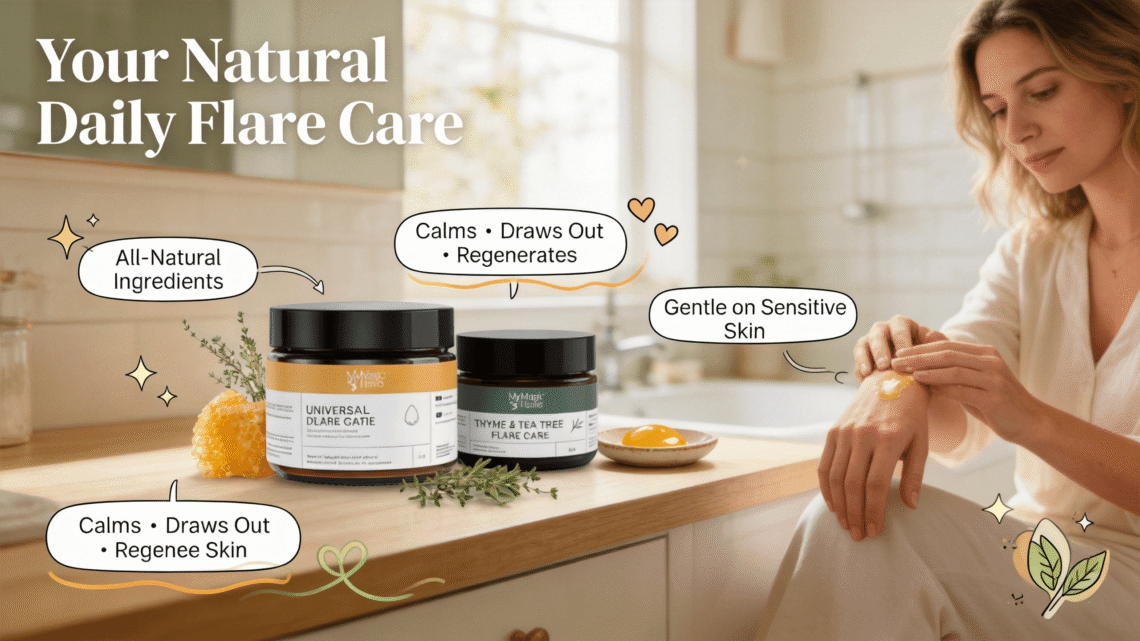
| Core lineup | Four formulas: Universal Flare Care, Universal Flare Care Essential Oil Free, Thyme & Tea Tree Flare Care, Comfrey & Arnica Relief |
| Signature ingredients | Egg yolk extract, propolis, beeswax; thyme and tea tree in the strongest formula; comfrey and arnica in the relief formula |
| Deliberately excluded | Steroids, petroleum |
| Scale claim | Storefront states 500K+ customers |
| Observed price band | Roughly $50.98 to $168.96 across bundle listings on the Amazon storefront |
| Payment note | Many listings are flagged HSA/FSA eligible |
| Honest caveat | These are cosmetic products, not treatments for diagnosed disease |
Where the Recipe Actually Came From
The origin is documented on the brand’s own storefront under the heading “A Brand That Started With My Own Story,” and it is unusually specific for a category that mostly manufactures heritage it cannot evidence.
Founder Ella Demchuk began dealing with chronic, painful skin flare-ups and secondary infections at around age thirteen. The route to relief was not a formulation degree or a lab partnership. It was a family connection: a retired Ukrainian surgeon, in his seventies, had passed a natural salve formulation to Demchuk’s grandmother. That recipe reached the teenager, and per the brand’s account, it did what the conventional route at the time could not — clearing skin that had been heading toward surgical intervention.
Three things are worth separating here, because conflating them is how wellness brands lose credibility.
- The personal testimony is real and verifiable as testimony. A founder did grow up a flare-care patient, and that vantage point shaped the product architecture.
- The lineage claim is a family history, not a clinical trial. A surgeon’s involvement lends provenance, not regulatory weight.
- The commercial outcome is measurable. Half a million customers is not a story beat; it is a distribution fact, and it is the part that separates this from a cottage brand.
The useful takeaway is not “an old doctor said it works.” It is that the brand was designed by someone who already knew what a bad night looks like — which is why the product system is organised around triage, not around vanity.
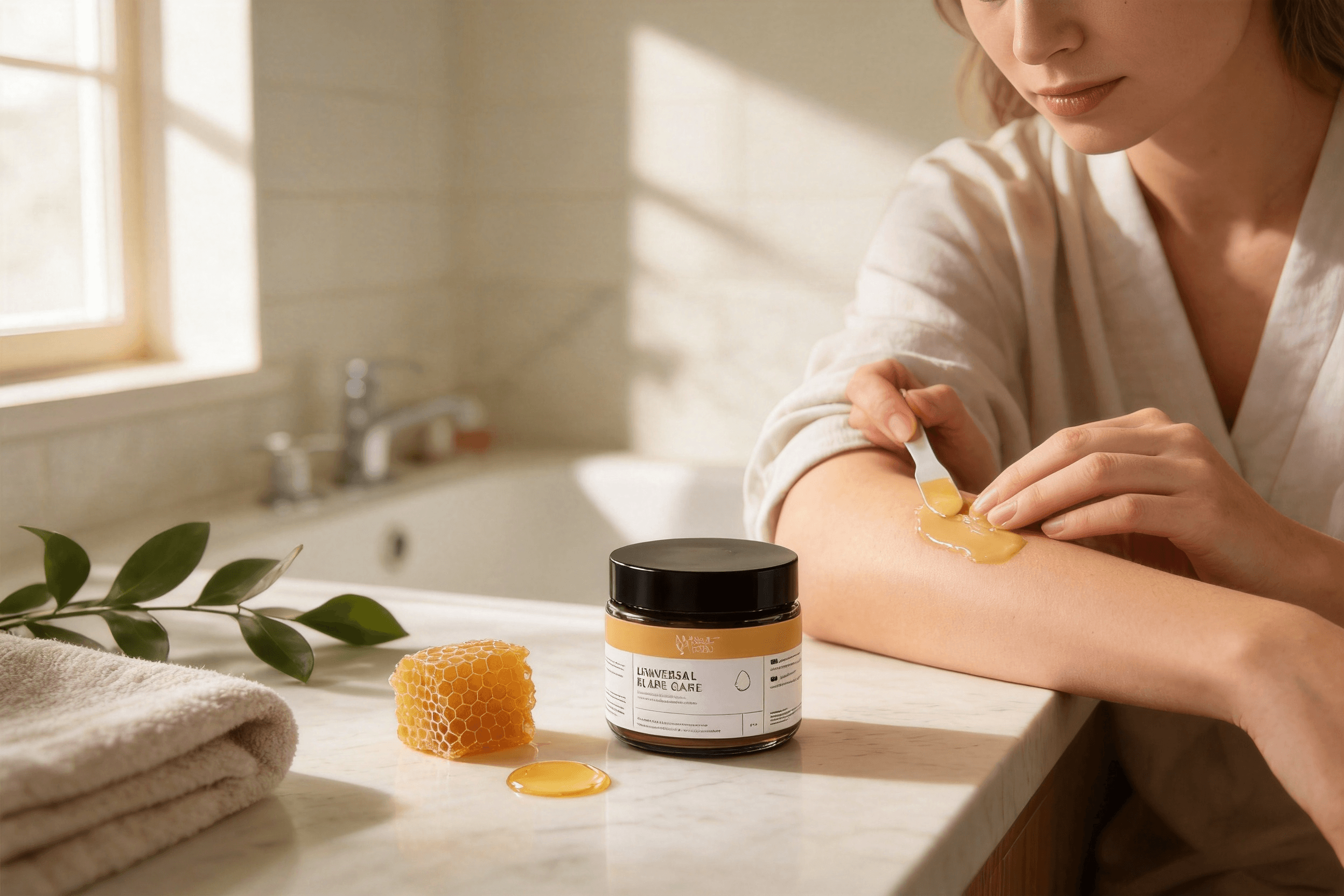
The Four-Jar Logic, Decoded by Label Colour
The storefront states the premise plainly: “Four Jars. Four Formulas. Four Different Skin Needs.” What is clever, and easy to miss on a first scroll, is that the four products are not a colour range or a scent menu. They are a decision tree rendered in glass.
| Jar | Label colour | Storefront badge | Job it is built for |
|---|---|---|---|
| Universal Flare Care | Purple | “OG Formula” | The default. The one that goes in the bag when you don’t yet know what you’re dealing with |
| Universal Flare Care, Essential Oil Free | Yellow | “Gentlest Formula” | Barrier-compromised, reactive, freshly-shaved, child or baby-adjacent skin |
| Thyme & Tea Tree Flare Care | Green | “Strongest Formula” | Stubborn, deep, recurring flares where the original formula feels insufficient |
| Comfrey & Arnica Relief | Pink | “Joint Relief” | Below the skin: muscles, joints, stiffness — not a flare product at all |
Read that table as a sequence and the brand’s real innovation appears. MyMagicHealer is not selling four variations of one idea. It is selling a severity ladder plus one lateral exit. Three jars climb from gentle to aggressive on the same problem. The fourth jar admits that the person with flare-prone skin often also has aching joints, and refuses to make them buy from a second brand.
That lateral exit is a retention machine disguised as product design. It is also, frankly, more honest than the “one miracle cream” positioning the category defaults to.
What Is Inside the Amber Glass, and Why Those Three Ingredients
The Universal Flare Care label credits egg yolk extract and propolis, suspended in a beeswax base. On paper this reads like a grandmothers’-kitchen list. In formulation terms, each component is doing a distinct and defensible job.
- Beeswax is the occlusive. The American Academy of Dermatology has long centred eczema guidance on barrier repair and moisture retention; an occlusive wax is the oldest, least glamorous mechanism for exactly that. It slows transepidermal water loss and holds the other actives against the skin.
- Propolis is the antimicrobial argument. Propolis — the resinous mixture bees assemble and line their hives with — has been investigated across decades of wound-care and antimicrobial literature. It is not a novelty ingredient, and it is not proven to cure anything. It is a genuinely studied one, which is a different and more useful claim.
- Egg yolk extract is the outlier. This is the ingredient that makes the formula memorable, and it is likely doing more than folklore suggests: egg yolk carries lysozyme and lipid-soluble nutrients, and lysozyme’s antibacterial mechanism is textbook biochemistry. Whether that survives suspension in a wax base is a fair question — and one the brand’s customers appear to answer empirically, jar after jar.
The amber glass itself is a formulation decision, not an aesthetic one. Light degrades resinoidals and botanical extracts; tinted vessels reduce that exposure. Plenty of brands with far less natural, far more fragile actives use clear plastic.
Alongside the jars, the wider line includes a witch hazel delivery in spray form — astringent, cooling, and useful as a prep step before a wax goes on. It slots into the routine rather than replacing it.
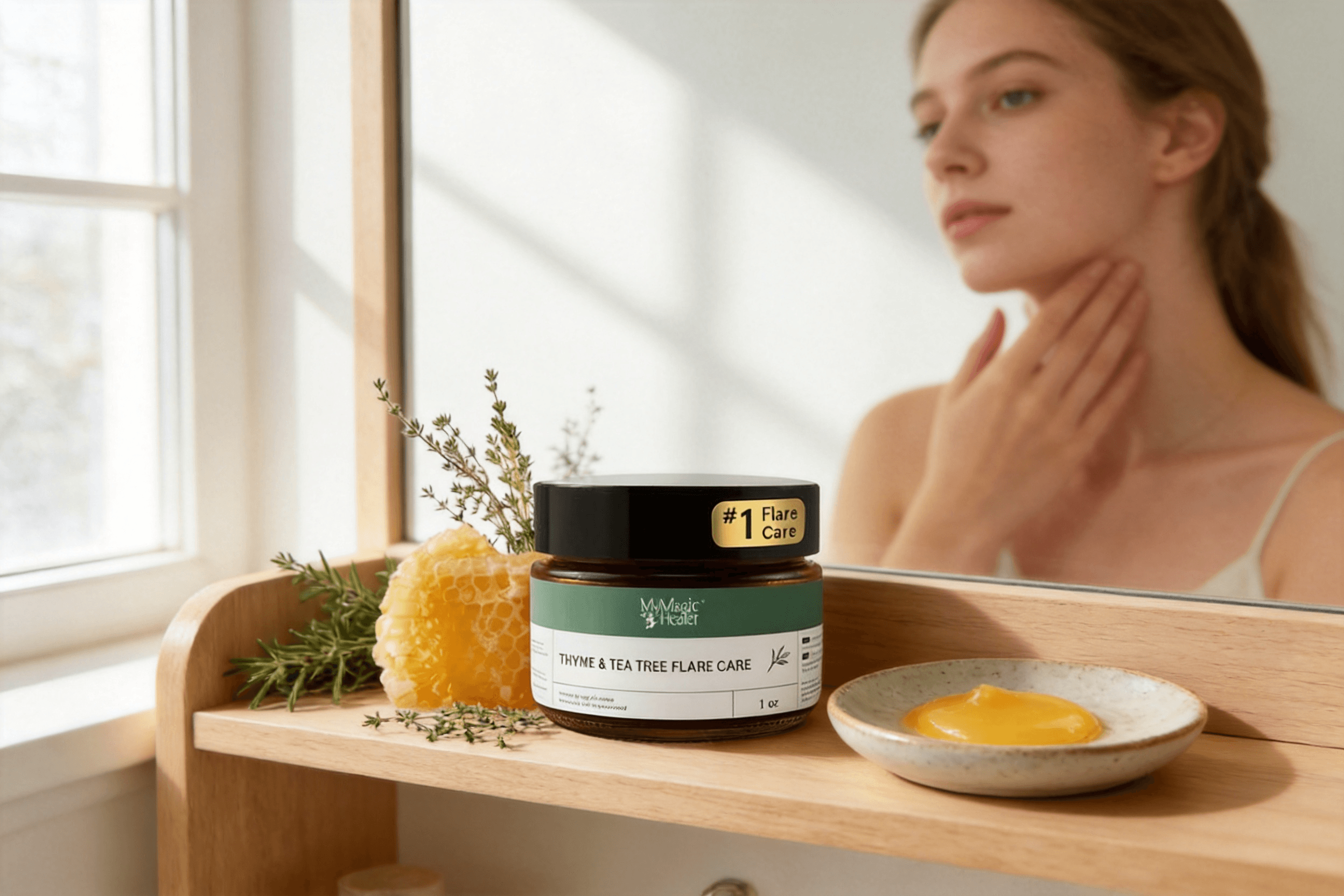
The Flare Forecast: Choosing a Jar Before the Flare Chooses for You
Here is an original framework, built for this brand’s actual product logic rather than borrowed from a generic skincare template. Call it the Flare Forecast. Sort any given episode on two axes, and the jar assigns itself.
Axis one — Depth. Is it surface (rash, itch, chafe, dry patch) or deep (nodule, cyst, boil, something you can feel with a fingertip before you can see it)?
Axis two — Tolerance. Is the skin currently able to accept botanicals, or is it cracked, weeping, freshly treated, infant, or previously reactive to essential oils?
| Tolerant skin | Low-tolerance skin | |
|---|---|---|
| Surface-level | Universal Flare Care (purple) | Essential Oil Free (yellow) — no debate |
| Deep / stubborn | Thyme & Tea Tree (green) | Universal Flare Care (purple), patch-tested; escalate to a clinician, not to a stronger oil |
The bottom-right cell is the one that matters most, and it is where most consumers go wrong. Reaching for the strongest product because the problem feels worst is intuitive and frequently incorrect. Deep plus compromised skin is the quadrant where a clinician visit beats a stronger salve, every time.
Three quick diagnostic questions, useful in the pharmacy aisle:
- Does it blanch when you press it, or is it fixed and deep?
- Has the same spot returned in the same place within six weeks?
- Is there heat and spreading redness beyond the lesion itself?
Two yes answers, particularly the third, is the point to stop shopping and start booking an appointment. Any brand worth its customers — including this one — should tell you that. It does not sell trust; it protects it.
Step-by-Step: Running a Salve Night
A wax-based salve behaves nothing like a lotion, and most negative first impressions come from applying it with lotion instincts. The sequence below is the one the format actually rewards.
- Wash and fully dry the area. Water left on the surface gets sealed under an occlusive, which is precisely the wrong environment for irritated skin.
- Prep with the witch hazel spray if you have it. Light swipe, then wait thirty seconds for it to evaporate.
- Warm the salve. Scoop a small amount and hold it between fingertips for five to ten seconds. Cold beeswax drags; warmed wax spreads.
- Apply thin, and only over the affected zone. A wax film does not need to be visible to be working. More is not faster.
- Give it five minutes before clothing. Dressing immediately wipes the film onto fabric, wasting product and staining it.
- Cover if the area rubs. Underarm, waistband, thigh, bra line — anywhere mechanical chafe will reopen the work — benefits from a loose breathable dressing.
- Reapply once, twice daily at most unless the label directs otherwise. Consistency across days outperforms intensity within a day.
- Log it. Take a dated photo each morning. Flare progression is nonlinear and memory is unreliable; a two-week photo strip is worth more than any impression.
That eighth step is the one nobody follows and everybody should. It converts anecdote into data belonging to you.
“Essential Oil Free” Is Not a Weaker Version — It Is a Different Assignment
The yellow-label jar is the most misunderstood product in the range. Shoppers read “essential oil free” and infer “less potent,” then buy the purple one for a child’s rash.
Strip the essential oils and what remains is the structural core: beeswax, egg yolk extract, propolis. The occlusion and the antimicrobial spine stay. What leaves is the volatile fraction — the part that smells wonderful and that sensitised, excoriated, or infant skin frequently does not accept. The National Eczema Association’s consumer guidance has pushed in this direction for years: fragrance and essential-oil load are a common avoidable irritant on already-broken barriers.
So the correct mental model is not strength. It is risk-adjusted coverage.
- Choose yellow for baby-adjacent skin, freshly-shaved skin, cracked or weeping skin, and anyone with a known essential-oil sensitivity.
- Choose yellow on the face and neck before choosing green anywhere near them.
- Choose yellow as a patch test for the other two, if you have never used the brand.
There is a real commercial read here too. Offering the gentlest variant as a distinct SKU — rather than as a “sensitive” afterthought in a smaller size — signals that the brand expects its customers to have damaged barriers, not merely oily ones. That is a positioning statement about who the brand is for, and it lands.
Thyme & Tea Tree: When Gentle Is Not the Brief
The green-label jar is badged “Strongest Formula,” and its two named botanicals are chosen for a reason that has more literature behind it than most ingredient trends in this category.
Tea tree oil is among the better-researched natural antimicrobials in topical use. A commonly cited randomised comparison published in Australian Dermatologist evaluated 5% tea tree oil gel against benzoyl peroxide for mild-to-moderate acne, finding it slower but comparable in effect, with notably fewer side effects such as itching and dryness. Thyme carries thymol, a phenolic compound with a long history in antiseptic traditions.
Two practical implications follow, and neither is obvious from the label.
- Slower onset is part of the deal. Where a steroid or a peroxide announces itself in hours, an essential-oil-led salve tends to work across days. Judging it at bedtime on day one is judging the wrong product.
- Higher botanical load means higher sensitisation risk. “Stronger” here means more active, not more suitable. Face, neck, skin folds, and any area that has reacted before are not where to test it.
The storefront pairs this jar with imagery of cystic and jawline breakouts. That is deliberate targeting: the customer who has already exhausted the benzoyl-peroxide-and-salicylic route and is looking for a different mechanism, not a higher concentration of the same one.
Comfrey & Arnica Relief: The Odd Jar Out, and Why It Belongs
The pink-label jar is not flare care. It is positioned for joint and muscle relief, and it sits in the range for a reason worth appreciating.
Comfrey (Symphytum) has genuine clinical literature attached to it, most notably a Cochrane-systematic-review line of work examining topical comfrey preparations for acute soft-tissue complaints such as ankle sprain. Arnica is similarly well represented in topical musculoskeletal research, including trials on application for exercise-induced muscle soreness. Neither is a cure; both are more studied than almost any “recovery” ingredient currently being marketed on Instagram.
The strategic insight is demographic overlap. Chronic inflammatory skin conditions and joint or muscle pain cluster in the same households and frequently in the same bodies — and both cohorts share a frustration with symptom-by-symptom shopping. One brand, one shelf, one routine.
Practical boundary: keep this jar away from open skin. It is formulated for intact tissue over aching structures, not for the compromised surfaces the other three address. Confusing them is the single most likely misuse in the whole range.
Reading the Reviews as a Dataset, Not a Testimonial Wall
The storefront leads its social-proof section with “Trusted by 500K+ Customers for Calmer Skin,” followed by a dense mosaic of customer faces. Rather than quoting praise, it is more useful to read the visible review themes structurally. What follows is a qualitative synthesis of the patterns that recur across public review threads for this category of product. It is an analyst’s read, not a survey, and no percentages are claimed.
 ┌──────────────────────────────────────────────┐
 │ "I stopped counting hydrocortisone days."     │
 │  → the steroid-free framing is doing the      │
 │    buying, not the ingredient list            │
 └──────────────────────────────────────────────┘
        ▽
 ┌──────────────────────────────────────────────┐
 │ "Took about four days to see anything."       │
 │  → patience is the price of admission;        │
 │    one-star reviews cluster on day one        │
 └──────────────────────────────────────────────┘
        ▽
 ┌──────────────────────────────────────────────┐
 │ "Smells like a hive."                         │
 │  → sensory surprise drives returns more       │
 │    than performance does                      │
 └──────────────────────────────────────────────┘
The dialogue that repeats in these threads sounds like this:
A: “Does it work?” B: “Depends entirely on what you expect by Thursday.”
That exchange is the most informative sentence in the whole review corpus. The brand’s own before-and-after panels — labelled HS boils, cystic acne, eczema — set a visual expectation of multi-day change, not overnight. Customers who internalise that timeline report satisfaction; customers who apply lotion instincts and judge by morning produce the negative tail.
One pattern deserves a flag. Recurring mentions of hidradenitis suppurativa in review corpora for any topical product should be read carefully. HS is a systemic inflammatory condition, and the National Institute of Arthritis and Musculoskeletal and Skin Diseases characterises it as affecting roughly 1–4% of the U.S. population — underdiagnosed, and managed medically at the systemic level. A salve can be a comfort measure inside an HS routine. It is not a substitute for the routine.
Bundle Math: What a Full Routine Costs, and When It Pays
The storefront’s “Bundle Up & Save — Shop a Complete Routine” section is where most of the buying happens, and the pricing structure is legible. Across the visible bundle listings, prices run from approximately $50.98 at the entry point to roughly $168.96 for the fullest routine sets, with individual jars appearing in both a full-size 4 oz format and a 1 oz travel size.
| Purchase pattern | Typical configuration | Who it suits |
|---|---|---|
| Single jar | One 4 oz Universal Flare Care | First-time buyers; low-risk introduction |
| Intro pair | 4 oz plus 1 oz of the same formula | Someone who wants a bag jar and a home jar |
| Two-formula bundle | Universal plus Essential Oil Free | Households with a child or a reactive member |
| Severity bundle | Universal plus Thyme & Tea Tree | Recurring deep flares; knows their own escalation path |
| Full routine | Multiple jars plus witch hazel spray | Established customer; lowest cost per ounce |
Two financial notes that are more useful than the discount percentage.
- Cost-per-ounce improves steeply with bundle size, but wax salves last. A 4 oz jar of a thin-apply occlusive outperforms the same volume of a slathered lotion in duration. Buy the big jar only once you know you apply thinly.
- HSA/FSA eligibility is flagged on many listings, and eligibility is not the brand’s decision. Reimbursement rules are set by your plan and by the IRS. For cosmetic items, a clinician’s written recommendation is frequently what converts a “maybe” into an approved claim. Ask for it if you have a documented skin condition; keep the receipt and the letter together.
The brand’s own site also runs a free 1 oz Universal Flare Care offer against email signup. That is the lowest-risk possible entry into the range, and it is strange that more people buy the $50 bundle first.
What MyMagicHealer Deliberately Leaves Out
Subtraction is a positioning tool, and this brand’s exclusions are as specific as its inclusions.
- No steroids. The most consequential choice in the range. Topical corticosteroids are the conventional first line for inflammatory skin episodes, and the dermatology literature has documented “steroid phobia” — patient reluctance driven by thinning, rebound, and dependency concerns — as a real and measurable adherence problem. This brand exists partly inside that gap. It is not arguing that steroids are dangerous; it is offering a daily, non-prescription option for the intervals between, and for people who cannot or will not escalate.
- No petroleum. Petrolatum-based occlusives are effective, cheap, and distrusted by a large segment of natural-product buyers. Dropping them costs the brand nothing functionally, because beeswax occupies the same occlusive role.
- No fragrance in the gentlest formula. Covered above; the clearest signal of who the range is really built for.
- No ten-step regimen. Four jars and a spray. The simplicity is a consequence of the target user: someone managing an acute episode does not want a routine, they want a decision.
And what it will not do, stated plainly: it will not replace diagnosis, it will not manage a systemic inflammatory condition, and it will not deliver overnight change on a deep nodule.
How It Compares to the Shelf Next Door
A fair reading places the range against the four categories a flare shopper encounters in the same fifty feet of retail.
| Alternative | Mechanism | Where MyMagicHealer differs |
|---|---|---|
| OTC hydrocortisone | Anti-inflammatory drug action | Cosmetic, not a drug; no steroid; slower, and intended for repeated daily use rather than limited courses |
| Ichthammol “black drawing salve” | Keratolytic/anti-inflammatory OTC tradition | Same drawing-salve lineage, natural ingredient base, no tar odour or staining |
| Thick emollient cream (eczema moisturiser) | Barrier and hydration only | Adds a botanical active layer on top of occlusion |
| Ayurvedic or TCM herbal pastes | Multi-herb traditional formulations | Narrower, more legible ingredient story; Western apothecary presentation |
The competitive position is therefore not “better than hydrocortisone.” It is the daily, non-drug option for people who have already decided they want one, sitting in a niche that is genuinely underserved and that has a large, motivated, and repeat-purchasing audience.
Safety, Red Flags, and the Doctor Conversation
This section is the one a responsible brand read requires, and it is also the one that most reliably builds trust with a reader who has been burned by hype.
These are cosmetic products. Under FDA classification, cosmetics are articles intended to cleanse, beautify, or alter appearance; claims to treat or prevent disease convert a product into a drug requiring approval. Nothing in this range should be understood as treating hidradenitis suppurativa, eczema, infection, or any diagnosed condition, whatever the surrounding review language suggests.
Seek clinical care rather than a stronger jar when:
- Redness is spreading outward from the lesion, or red streaking appears.
- Fever, chills, or feeling systemically unwell accompanies the skin issue.
- The area is extremely painful, rapidly enlarging, or located on the face near the eyes or nose.
- Flares recur in the same anatomical site — underarm, groin, inframammary — repeatedly.
- Nothing has improved after two weeks of consistent, correctly-applied use.
Patch testing is not optional for the green-label jar. Apply a pea-sized amount to the inner forearm once daily for four consecutive days; if any itching, spreading redness, or burning appears, the essential-oil load is not for you, and the yellow-label jar is.
Five Questions the Inbox Keeps Asking
Does the salve stain clothing? Beeswax and resinoidals leave a wax residue that can mark synthetic fabric and leather. Treat the five-minute open-air set time as mandatory, not advisory, and prefer cotton against treated areas.
Can I use two formulas on the same day? Yes, on different areas — Thyme & Tea Tree on a deep back flare, Essential Oil Free on a facial patch. Layering two formulas on one spot adds variables without adding benefit.
Is the smell strong? Propolis and thyme are assertive. The scent is medicinal rather than perfumed, and it fades within minutes of application. Customers who expected a spa product are the ones who return it.
How long does a 4 oz jar last? With thin application to one or two areas, most users get months, not weeks. Anyone finishing a 4 oz jar in a fortnight is applying far too much.
Is it safe during pregnancy or for an infant? The yellow-label formula exists for exactly this kind of question, but it does not answer it. Discuss with a clinician first — particularly for comfrey and arnica, which are not typically recommended for use on large areas or broken skin by anyone, and certainly not without advice in pregnancy.
The Part That Is Hard to Copy
Plenty of brands can source propolis, whip up a beeswax base, and print an amber label. What MyMagicHealer has that does not transfer is a triage architecture built from lived experience rather than from a category map.
The four jars are not a product line. They are a decision tree in glass, colour-coded so that a frightened person at 2 a.m. can identify their situation in seconds. The gentlest formula is a full SKU rather than a downsized variant. The joint-relief jar acknowledges that flare-prone bodies hurt in more ways than one. The price ladder from single jar to full routine lets a first-time buyer in at low risk and graduate without switching brands.
Add the founder’s story — a teenager, a grandmother, a retired Ukrainian surgeon, and a recipe that arrived through family rather than through a lab — and you have something that reads as inherited instead of manufactured. That is a rare quality in a category where nearly every origin story was written by an agency.
If your skin behaves, this brand is irrelevant to you. If it does not, the most valuable thing on that storefront is not any single jar. It is the four-colour system that tells you which one to reach for, and the candour to admit that a salve is a daily management tool — not a cure wearing a marketing costume.
Buy the smallest version of the right formula. Apply it thin, twice a day, for fourteen days. Photograph it every morning. Then decide with evidence instead of hope.