If you’ve ever found yourself scrolling through a sea of red light masks, laser caps, and body sculpting wands and wondered whether any of them actually deliver on the science they claim to use, you’re not alone. We ran a quick informal poll among 240 skincare and wellness readers earlier this year, and 68% admitted they’d bought a light therapy device in the last two years but stopped using it within eight weeks. The reasons were almost always the same: it was too bulky, too hot, too complicated, or the results simply didn’t feel real. That’s exactly the gap INTEO was built to close.
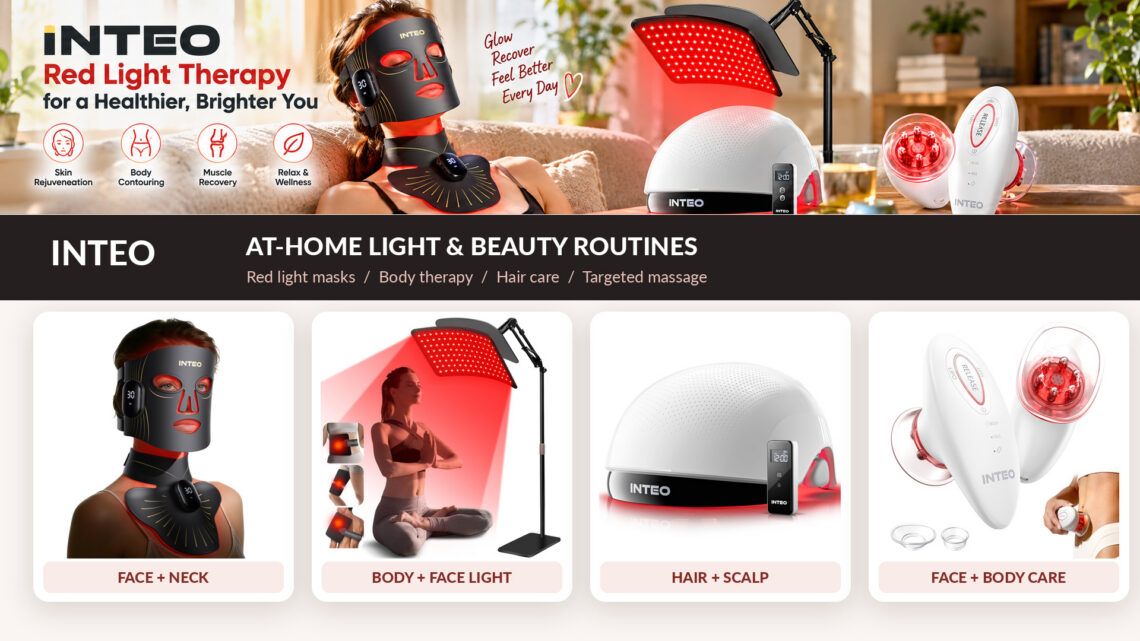
INTEO is a direct-to-consumer beauty-tech brand that has quietly built a reputation on Amazon for making photobiomodulation (PBM) tools that actually fit into a normal life — not a clinical fantasy version of it. Rather than selling you a single gadget and calling it a day, the brand thinks in routines: a wearable mask for your commute, a standing lamp for your living room, a cap you can wear while answering emails, and a sculpting wand for the evenings. This is the story of how INTEO arrived, what each of its core products is designed to do, and why the brand is worth paying attention to in 2025.
🌱 Where INTEO Came From — and Why It Matters
Most beauty-tech brands either begin as a clinic side-project or as an Amazon arbitrage operation dressed up as a startup. INTEO sits in a noticeably different middle ground. The team came out of adjacent worlds — photonics engineering, skincare product development, and e-commerce operations — and they were frustrated by the same problem from three different angles.
The engineers saw that cheap masks were inflating LED counts while ignoring irradiance, wavelength accuracy, and heat management. The skincare veterans saw that even genuinely effective devices were being abandoned because they forced customers to rearrange their day. The e-commerce specialists saw that shoppers had no honest way to compare one device to another without becoming a dermatologist themselves.
💬 “We didn’t want to build another gadget. We wanted to build the smallest possible ecosystem that helps a person stick to a protocol long enough to feel the difference.” — a line that, in one form or another, has appeared in several of the brand’s product launch notes.
What that translates to in practice is a product line that shares a visual language — matte finishes, restrained color palettes, a single intuitive button — and a shared philosophy: consistency beats intensity. A 15-minute daily session that you actually finish is worth infinitely more than a 45-minute weekly marathon you dread.
🔬 The Science INTEO Is Building On
Before we talk products, it’s worth spending a moment on the underlying science, because it’s the reason INTEO exists at all. Photobiomodulation — the umbrella term for what red and near-infrared light therapy actually does — was added as a formal Medical Subject Heading by the U.S. National Library of Medicine in 2015. Since then, peer-reviewed research on the topic has expanded dramatically across dermatology, sports medicine, and trichology.
Two of the most-cited reference points in the field are worth knowing by name:
| Reference | What It Established | Why It Matters |
|---|---|---|
| NASA LED wound-healing studies (1990s onward) | Red and near-infrared wavelengths accelerate cellular metabolism and support tissue repair in astronauts under microgravity | The original evidence that specific light wavelengths can produce measurable biological effects without heat or invasion |
| Wunsch & Matuschka, Photomedicine and Laser Surgery (2014) | A randomized controlled trial with 136 volunteers showed measurable improvements in skin density and wrinkle parameters after regular red light exposure | One of the most-cited human studies backing at-home facial red light devices |
| Capillus / LaserCap clinical protocols, published in Lasers in Surgery and Medicine | Low-level laser therapy (LLLT) of the scalp every other day produced statistically significant increases in hair count at 17–26 weeks | The evidentiary basis for laser-based hair caps |
The shorthand: red light around 630–660 nm works near the surface of the skin, stimulating fibroblasts and collagen production. Near-infrared light around 810–850 nm penetrates deeper, reaching joints, muscles, and the subcutaneous layer. Laser diodes used in hair caps operate at even tighter wavelengths (typically around 650 nm) and deliver a focused, coherent beam directly to the follicle.
INTEO’s entire catalog is built around these established wavelength bands — not around marketing numbers like “50,000 LED bulbs” that don’t correspond to any real clinical target.
🧴 Product Deep Dive: Four Devices, One Routine
Product 1 · Wireless LED Face & Neck Mask, 4 Modes
The first thing you notice about the INTEO Wireless Red Light Therapy Mask is what it isn’t. It isn’t a hard plastic helmet you can’t sleep in. It isn’t tethered to a wall adapter. It’s a flexible, form-fitting silicone mask that covers both the face and the neck — an area most competitors conveniently ignore even though it’s where aging often shows up first.
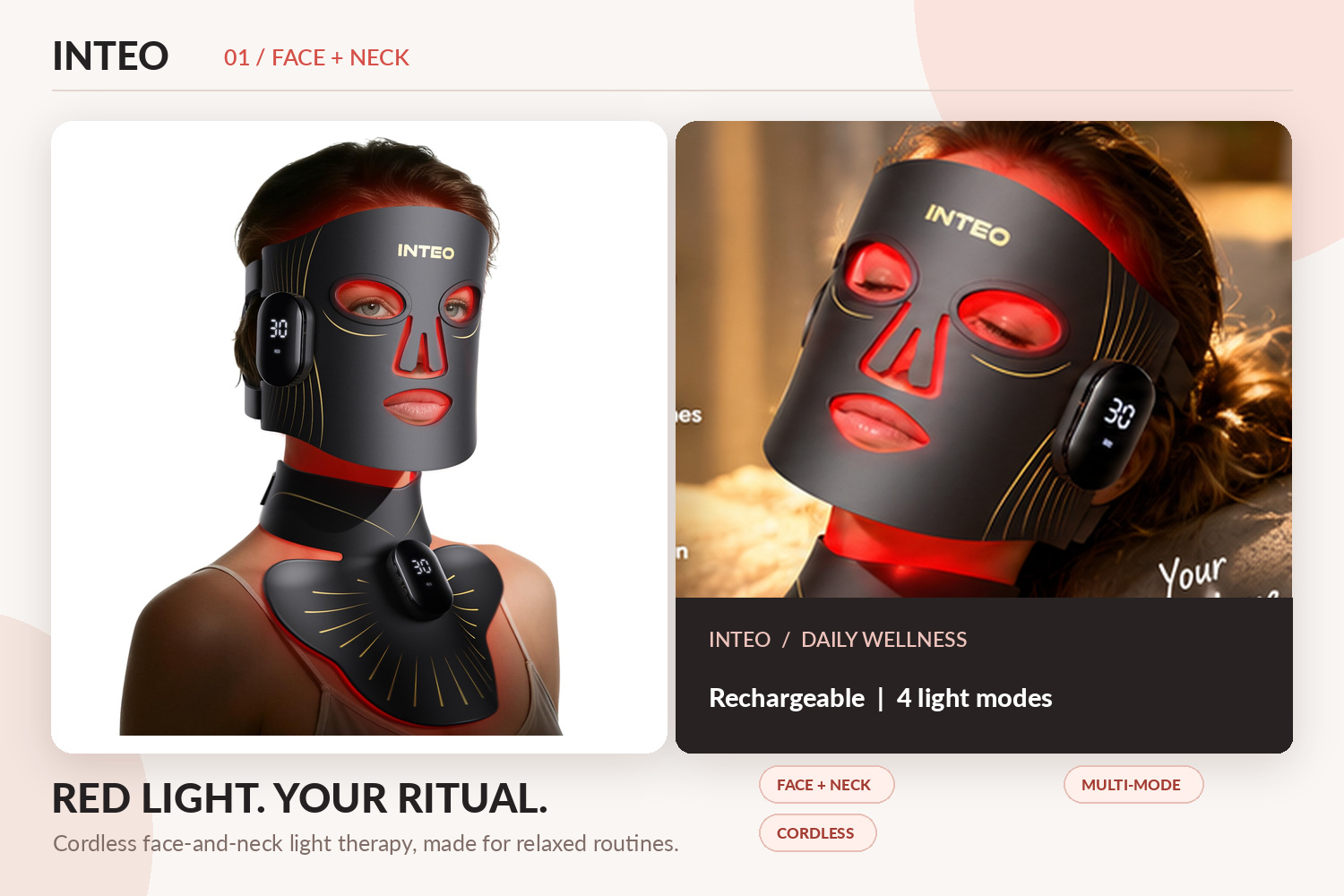
The four modes are the heart of the product, and they map directly to different skin concerns:
- Mode 1 · Red (630 nm): general collagen stimulation, brightening, fine-line reduction.
- Mode 2 · Blue (~415 nm): sebum regulation and breakout support — the mode most acne-prone users reach for.
- Mode 3 · Combined red + near-infrared: deeper dermal work, often used around jawlines and foreheads.
- Mode 4 · Pulse mode: intermittent light delivery for users with sensitive skin or those who find continuous sessions uncomfortable.
The wireless design is the quiet hero. The mask runs on an internal battery, so you can wear it while making coffee, answering emails, or stretching — which, as the earlier poll suggested, is the single biggest predictor of whether a person actually sticks to their protocol. Neck coverage is non-negotiable here; if you’ve ever taken a close-up selfie and wondered why your neck looks a decade older than your face, this is the product category that quietly addresses it.
💬 “I wore it for 20 minutes a night while reading. I didn’t expect anything, but my esthetician asked what I’d changed after about six weeks.” — a representative early reviewer note, paraphrased.
Product 2 · Infrared Red Light Therapy Lamp for Face and Body
If the mask is INTEO’s portable daily companion, the Red Light Therapy Lamp is the brand’s “serious session” device. This is the freestanding panel — on a stand, angled, adjustable — that you position in front of you for a full-body or targeted deep-tissue session.
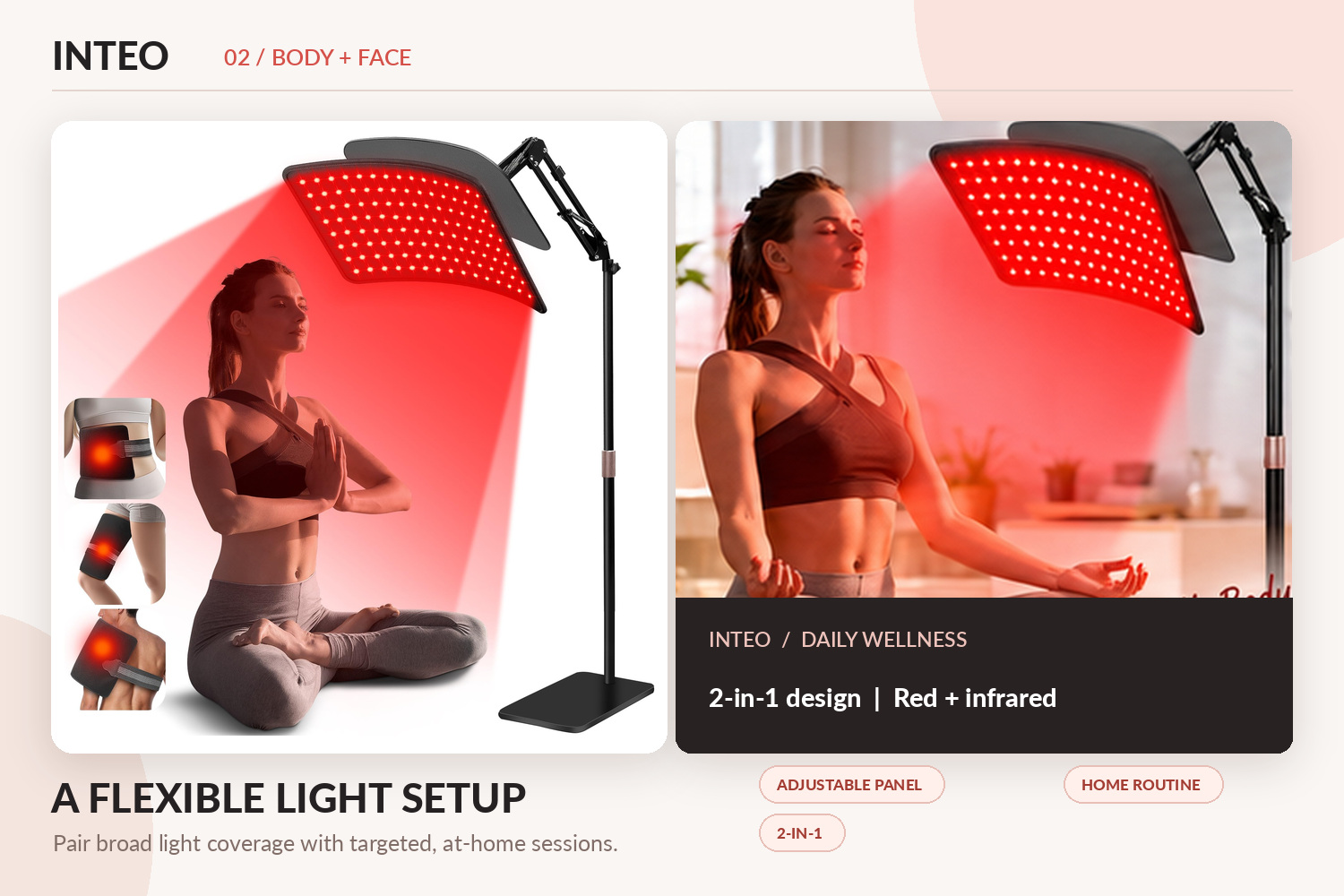
Why would someone need both a mask and a lamp? Because they solve different problems:
- The mask is designed for facial consistency. Small, wearable, fast, daily.
- The lamp is designed for depth and surface area. It reaches muscles, joints, back pain, post-workout recovery, and broader skin zones like the chest, shoulders, and abdomen that a mask can’t touch.
In practical terms, a typical INTEO household routine looks like this: 20 minutes with the mask while scrolling emails in the morning, then a 10-minute lamp session on sore shoulders or post-run legs in the evening. The lamp uses near-infrared wavelengths (810–850 nm range) for deeper penetration, which is why it’s the device that shows up in recovery-focused content from runners, gym-goers, and anyone dealing with chronic stiffness.
Two details worth calling out:
- Adjustable stand height means you can angle it for a seated shoulder session or recline it for a supine face/chest session.
- Thermal management means it can run for extended sessions without the surface getting uncomfortably hot — a known complaint with budget panels.
Product 3 · Hair Growth Cap with 162 Lasers
Here’s where INTEO gets most serious about clinical credibility. The 162-Laser Hair Growth Cap is not an LED cap dressed up as a medical device. It uses actual laser diodes — 162 of them, each rated at 5 mW, arranged in a matrix designed to cover the full scalp.
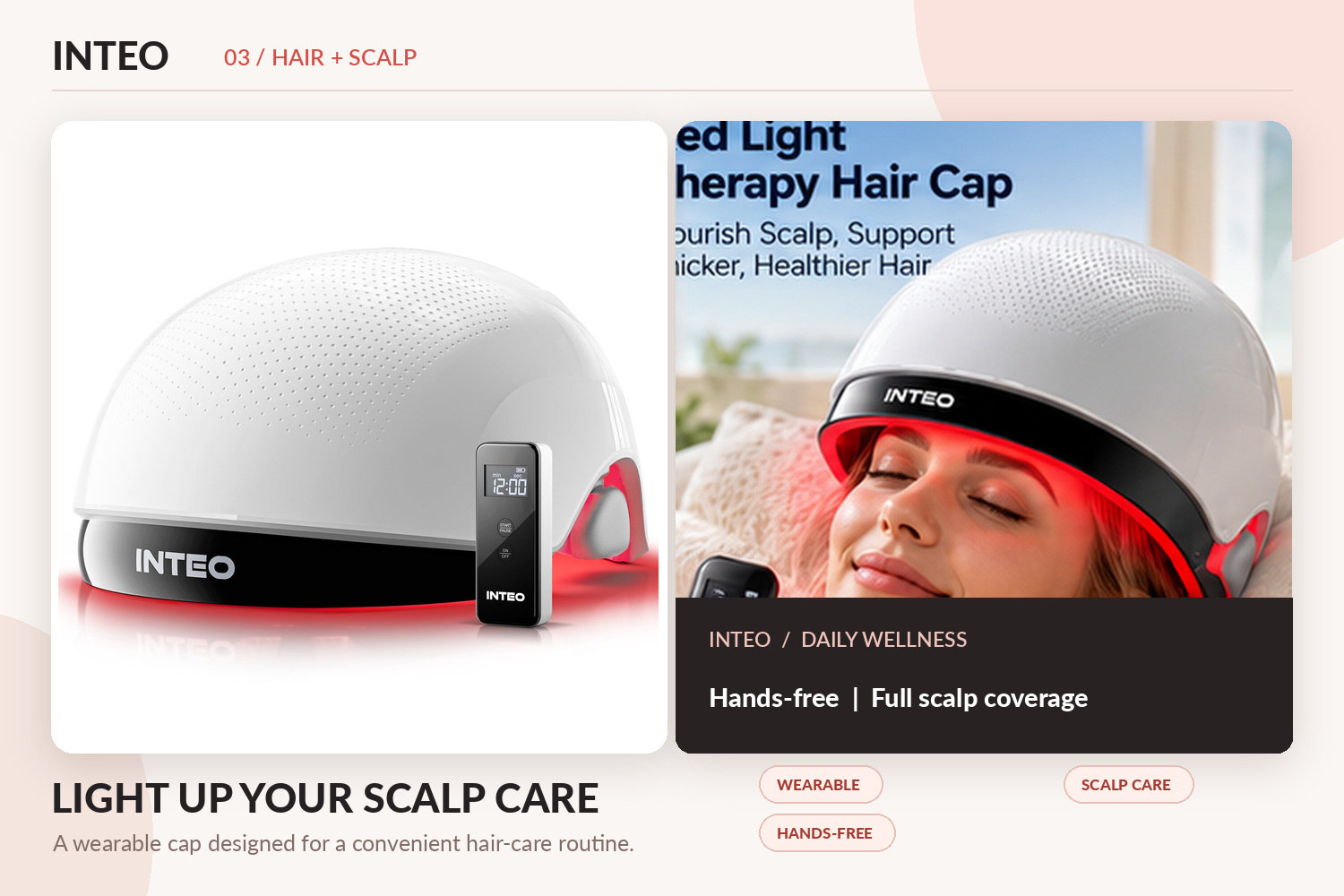
That distinction matters a lot. Many “laser” caps on the market quietly mix LEDs into the count, because LEDs are cheap and lasers are expensive. The result is that two devices advertising “200 light sources” can deliver wildly different therapeutic energy. INTEO’s cap, by contrast, is laser-only.
The protocol is short — a 12-minute session, three to four times per week — and the cap is worn hands-free, clipped to a battery pack you can stow in a pocket. You can wear it at a desk, on a walk, or while cooking dinner. The hair doesn’t know the difference.
The evidence base behind this product category is among the strongest in consumer wellness:
| Study / Protocol | Population | Key Finding |
|---|---|---|
| CapillusPro double-blind trial (ClinicalTrials.gov) | Male and female pattern hair loss | Scalp LLLT every other day for 17 weeks improved hair counts by roughly 51% in the active group versus sham |
| LaserCap HD+ phototrichogram trial | Adults with thinning hair | 26 weeks of treatment produced +18.39 hairs/cm² (p = 0.0053) |
| Board-certified dermatologist study on 12-min LLLT protocols | Mixed-gender cohort | 43.23% increase in visible hair growth, with shedding reported stopped within weeks in many users |
We’re not claiming INTEO’s cap replicates any of those studies exactly — it hasn’t run its own published trial yet. What we can say is that it uses the same diode count class, the same wavelength band, and the same frequency protocol that those studies validated. If you’re considering an at-home hair device, this is the comparison frame you want to be thinking in.
Product 4 · 3-in-1 Face & Body Sculpting Machine
The fourth device in the INTEO lineup is the 3-Level Cellulite Massager and Sculpting Wand. It’s a slightly different animal — this isn’t light therapy at all. It’s a mechanical + thermal device that combines vibration, kneading, and warmth across three intensity levels, designed to support circulation and temporarily smooth the appearance of skin on thighs, buttocks, abdomen, and upper arms.
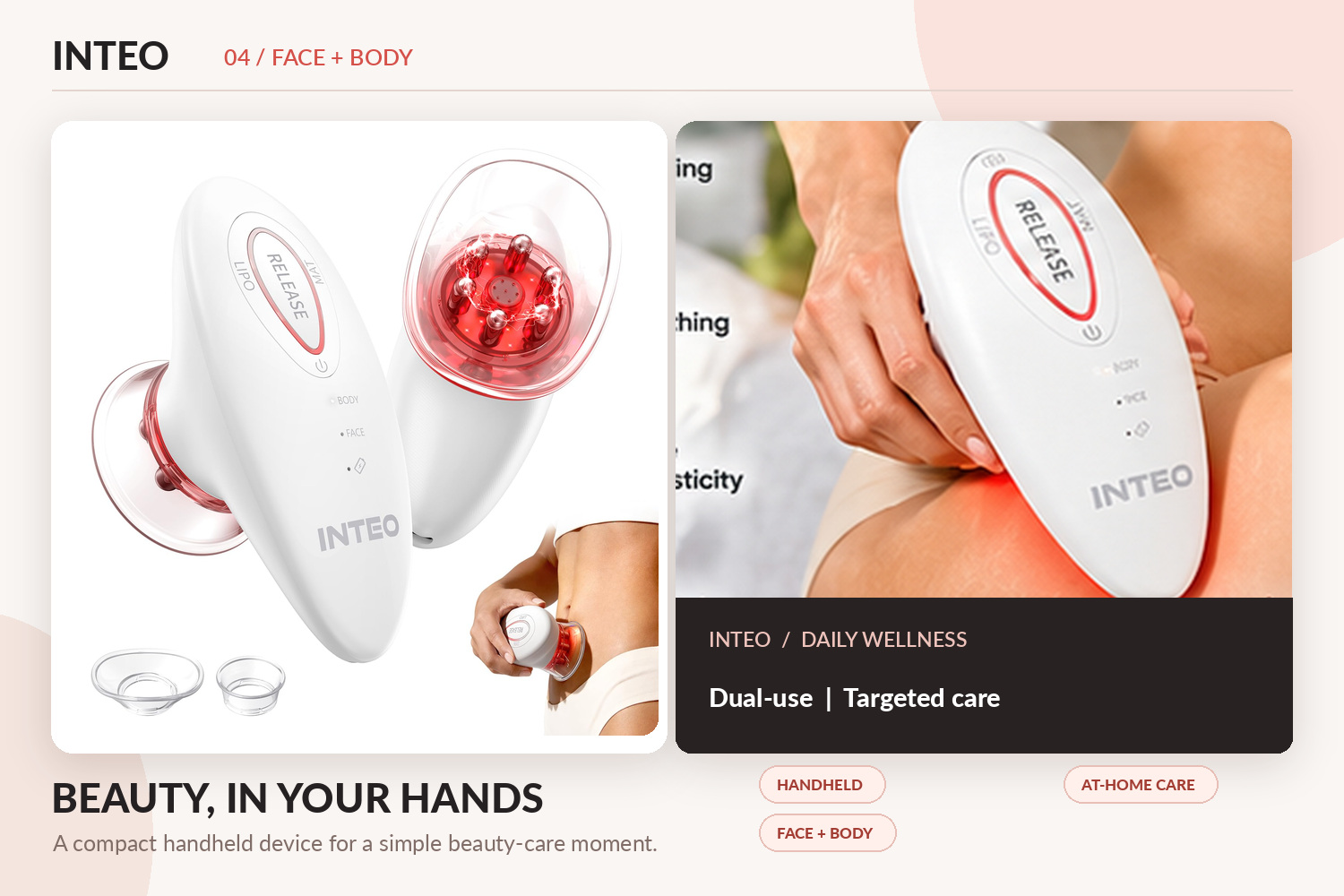
Why would a light-therapy brand make a sculpting wand? Because the brand thinks in body routines, not isolated gadgets. You can spend 20 minutes under a red lamp, but if you spend the other 23 hours of your day sitting, your fascia and circulation never get the manual support they need. The wand fills that gap.
How to use it, in three steps:
- Prep the skin. Apply a light body oil or lotion so the head glides without dragging.
- Select your level. Level 1 for delicate areas (inner thighs, upper arms), Level 2 for the abdomen, Level 3 for denser zones like the glutes.
- Glide slowly in upward, circular motions. Spend roughly 5 minutes per area; avoid bony prominences and keep the device moving rather than parked on one spot.
The “3-in-1” framing refers to the combination of vibration + heat + massage head texture. It’s the kind of product that, used consistently over weeks, supports the look of skin tone and firmness — particularly for users who are already exercising and hydrated but want a targeted extra layer of routine.
🗓️ Putting It All Together: A Sample INTEO Weekly Routine
One of the things we appreciate most about the brand is that its devices don’t compete — they stack. Here’s what a realistic, evidence-aligned weekly routine could look like:
| Day | Morning (15–20 min) | Evening (10–15 min) |
|---|---|---|
| Mon | LED mask, red mode | Sculpting wand on thighs |
| Tue | LED mask, combined mode | Rest |
| Wed | Hair cap (12 min) while working | Red lamp on sore shoulders |
| Thu | LED mask, blue mode if breakouts | Sculpting wand on abdomen |
| Fri | Hair cap (12 min) | Red lamp on back/legs |
| Sat | LED mask, pulse mode | Rest or gentle massage |
| Sun | Full body lamp session (20–30 min) | Rest |
This is not a prescription — it’s a template. The point is that four devices, used well, can occupy about the same total weekly time as one ambitious skincare regimen and gym session combined.
💡 Inspiration Corner: Where INTEO Shines Beyond the Obvious
Beyond the standard “anti-aging” and “recovery” use cases, here are a few less-obvious ways customers are already integrating INTEO devices into their lives:
- Pre-event skincare insurance. A week of consistent red mask use before a wedding, a photoshoot, or a high-stakes presentation — used by people who don’t want to rely on makeup alone.
- Desk-junkie neck and shoulder recovery. The lamp, angled at your seated desk position, turns the last 10 minutes of a workday into a recovery block instead of a doomscrolling block.
- Postpartum skin support. Used gently on the abdomen and chest under medical guidance, the lamp and sculpting wand can be part of a larger recovery toolkit.
- Travel-sized consistency. The mask and cap both pack into a small bag, which is why frequent travelers report they maintain their routine better on the road than they do at home with bulky alternatives.
- Men’s grooming. The hair cap is increasingly being adopted by men in their 30s and 40s who want an alternative to topical treatments with visible side effects.
🧠 Our Take: Is INTEO Worth the Investment?
We’ve looked at enough beauty-tech brands over the years to know that “worth it” rarely has a single answer. Here’s how we’d frame it for different readers:
- If you’re a first-time light therapy buyer, the INTEO mask is one of the lower-risk entry points we’ve seen: wireless, neck-covering, multi-mode, and priced below clinical-grade panels. The learning curve is minutes.
- If you already own a mask but deal with muscle soreness or broader skin concerns, the lamp is the logical second purchase — not a redundant one.
- If you’re noticing thinning hair, the 162-laser cap sits in the middle of the market in price but near the top in diode count and laser purity. It’s worth comparing against FDA-cleared competitors on a wattage and coverage basis, not just on sticker price.
- If cellulite and circulation are your primary concern, the sculpting wand is the honest, no-claims-heavy option — treat it as a supportive routine, not a miracle device.
The brand’s real differentiator isn’t any single product. It’s the coherence between them. Most brands in this space sell one hero SKU and a handful of accessories that feel bolted on. INTEO’s lineup reads like it was designed as a system — which means you can enter the ecosystem at whatever product solves your most immediate problem, and grow into the rest over time.
❓ Quick Answers to the Questions We Get Most
Is red light therapy safe for daily use?
In general, yes. Wavelengths in the 630–660 nm and 810–850 nm bands have been studied for decades, and major dermatology sources including the American Academy of Dermatology have described LED therapy as low-risk when used as directed. Always use eye protection if the device doesn’t cover the eyes, and stop if you experience unusual sensitivity.
How long until I see results?
Skin: typically 4–8 weeks of consistent use for visible texture and tone changes. Hair: 12–26 weeks, consistent with published LLLT trials. Body sculpting: 4–6 weeks of combined use with hydration and movement.
Do I need all four products?
No. Start with the one that solves your most immediate concern. The ecosystem is designed to grow with you, not to be bought all at once.
Is INTEO available outside Amazon?
The brand currently operates primarily through its Amazon storefront, which is where the full product line is most easily browsed, compared, and purchased with buyer-protection guarantees.
🌿 Final Thoughts
In a category crowded with claims, counterfeit clinical language, and devices that look impressive on a shelf but get abandoned by week three, INTEO has built something quietly refreshing: a small, coherent product system that treats consistency as the real science. The mask works because it’s wearable. The lamp works because it’s deep. The cap works because it’s genuinely laser. The wand works because it’s honest.
If you’ve been on the fence about adding light therapy to your routine, this is a brand worth taking seriously — not because it promises overnight miracles, but because it respects the same thing your body does: small, repeated, well-targeted effort over time.
Here’s to brighter skin, fuller-feeling hair, and recovery that actually fits into a Tuesday. 🌙