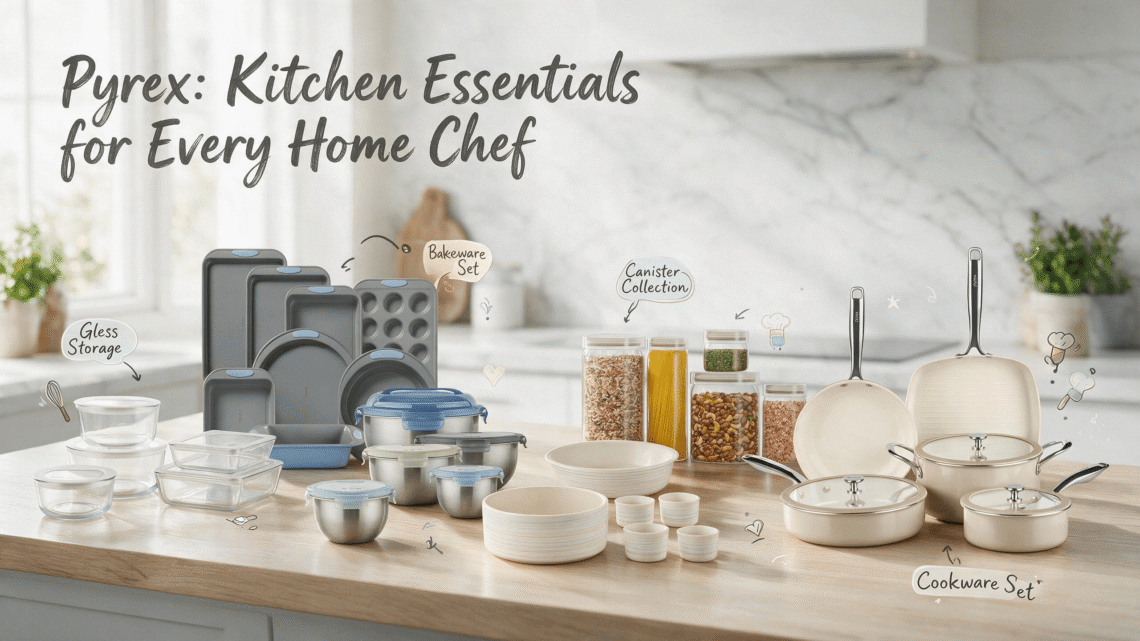
Most kitchenware brands are named after a product. Pyrex is named after a material, and that distinction explains almost everything about the six sets now sitting in the brand’s Amazon storefront. A name tied to glass chemistry can survive fashion cycles, ownership changes and shifting consumer expectations in a way that a name tied to a casserole dish cannot. Here is what the current catalogue is actually arguing, and where each piece earns its cabinet space.
Start With the Material, Not the Logo
There is a useful habit for reading any kitchenware catalogue: ignore the brand story for a moment and look at what each item is made of. Do that with Pyrex today and a pattern appears quickly. Two sets are glass. Two are metal, one steel and one aluminium. One is stoneware ceramic. One is stainless steel with plastic hardware. That is five distinct material philosophies sold under a single lowercase red wordmark, and it is a considerably broader claim than “the company that makes your mother’s mixing bowl.”
What holds the collection together is not colour, silhouette or a designer’s signature. It is a single engineering constraint that Pyrex has been testing against for over a century: the constraint of a kitchen where food moves between temperature extremes many times in one evening. Something has to leave a cold cupboard, meet a hot element, hold heat while it is carried to a table, cool down, get covered, go into a refrigerator, and possibly return to a microwave the next day. Every set in this group is a different answer to that sequence. Some answers involve the oven. Some involve a hob. Some involve nothing hotter than a dishwasher.
That framing matters more than the usual “timeless design” language, because design language tells you how a shelf looks and material language tells you how long you will keep the object. Tenancy of a kitchen shelf is the real currency here.
From Railroad Lanterns to the Cake That Didn’t Crack
The origin of Pyrex is not culinary. Borosilicate glass was developed at Corning Glass Works around 1908 under the name NONEX, and its first jobs were industrial: lantern chimneys that had to resist shattering in wind, battery jars that held corrosive chemistry. Low expansion under heat was a manufacturing requirement, not a cooking one.
The cooking application arrived through a domestic experiment. Bessie Littleton, the wife of a Corning researcher, took one of those glass battery jars, cut it down, and baked a cake in it to test whether the material would tolerate a real oven. It did, and the world’s first oven-safe glassware line followed in 1915 under the Pyrex name. That is a genuinely unusual founding story for a housewares brand: the product category was discovered by someone using an industrial container as a baking vessel in her own kitchen, which is essentially the behaviour every casserole dish still depends on.
The brand’s cultural peak came later. Corning’s 1945 Primary Colors series put solid, saturated red, yellow and blue nesting bowls into American kitchens at a moment when colour was becoming a legitimate consumer good rather than a luxury. The 1950s layered on the printed patterns and, later in the decade, CorningWare, extending the same thermal-shock logic into a stoneware family. Those mid-century pieces are now collected, resold and hunted at estate sales, and the collecting economy is itself a form of brand evidence: people do not build secondary markets around objects they expect to throw away.
The corporate thread has since been rewound several times. Corning exited tableware, the North American consumer brand passed through Corelle Brands and Instant Brands, and it now sits within a Centre Lane Partners portfolio that also includes Anchor Hocking. Through all of that, the name on the glass stayed the same, which is the quiet achievement in this history. Brands change hands far more often than they change meaning.
The Number-One Claim, and What It Actually Measures
The storefront leads with a ranking: Pyrex presents itself as the number one brand of glass bakeware, prepware and storage, sourcing the claim to NPD Group retail measurement data. It is worth reading that claim precisely, because precision is more interesting than hype.
It is a glass-category claim, not a whole-kitchen claim. It says nothing about whether Pyrex saucepans compete with anyone’s saucepans, and the new cookware set is precisely where the brand is stepping outside its measured leadership. It also bundles three functions, baking, prep and storage, into one rank. That bundling is the point. A brand that leads across the whole hot-to-cold chain owns more of a kitchen than a brand that only owns the oven, and it can cross-sell a family of materials rather than a family of shapes.
So the honest reading is this: Pyrex has a documented strongholds in glass, and it is now using that credibility as permission to sell steel, ceramic and aluminium. The six sets below are the permission being spent.
Zone One: The Oven
Ceramic Stoneware, When the Finish Does the Work
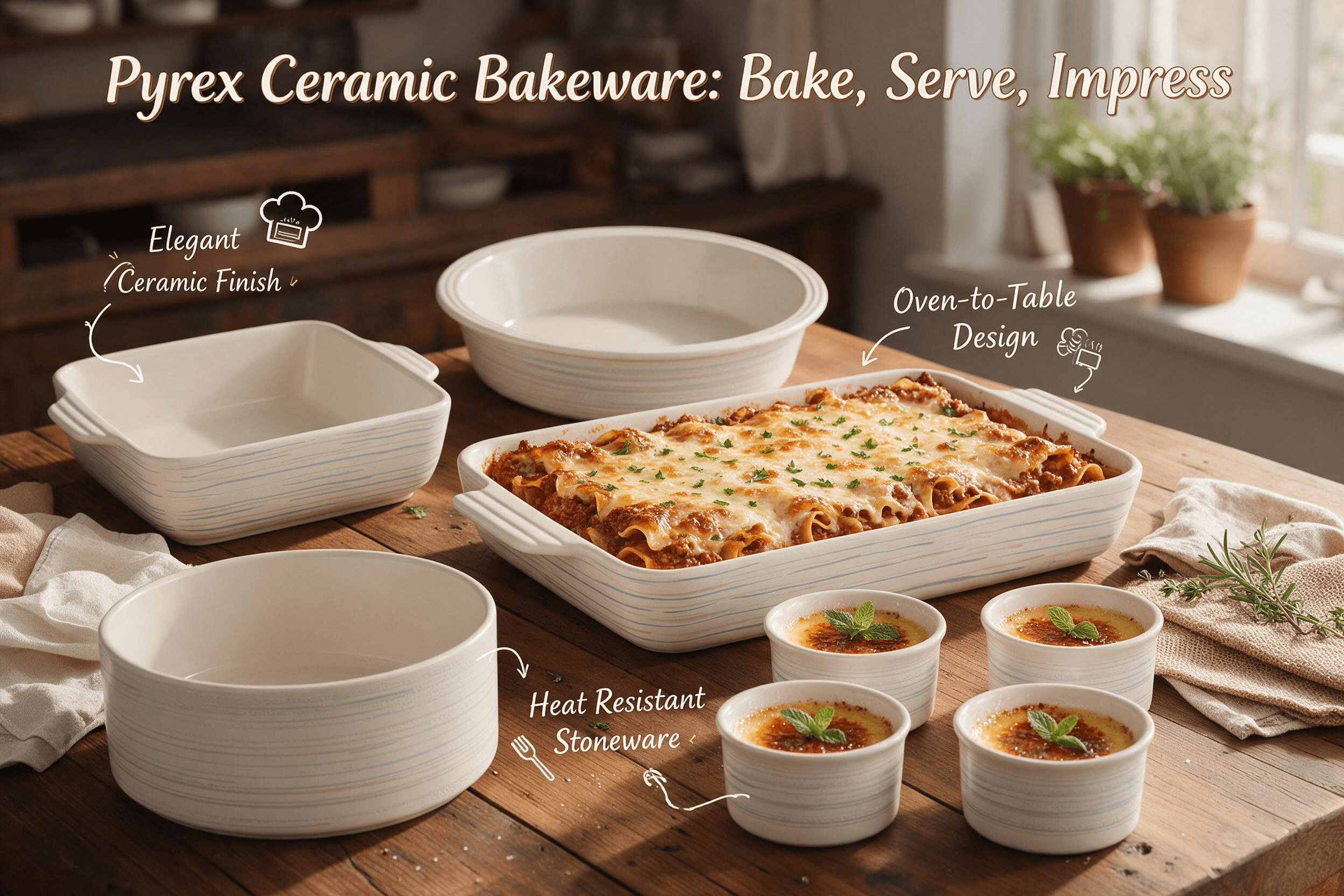
The 8-Piece Ceramic Complete Nonstick Bakeware Set is the most traditional object in the group and, paradoxically, the one making the most modern argument. The set is built around a 3-quart 9×13-inch rectangular dish, a 3-quart round dish, an 8-inch square dish, a 9-inch pie plate and four 6-ounce ramekins. That is a complete baking vocabulary in eight pieces: the holiday pan, the gratin round, the brownie square, the pastry plate, and four individual portions for anything served in its own vessel.
The notable engineering choice is what is absent. There is no chemical nonstick coating here. The release performance comes from a smooth glaze fired onto lead-free, cadmium-free stoneware, so the nonstick surface and the decorative surface are the same layer. That has practical consequences. A glaze cannot peel the way a applied coating can, it does not need to be babied with silicone utensils, and it is dishwasher safe without the maker hedging in a care footnote. Pieces are rated for preheated ovens to 450 degrees Fahrenheit, which is the standard working temperature band for casseroles, roasted vegetables and baked pasta.
Visually, the set moves away from the transparent-glass expectation. It is a light cream base with hand-brushed pink and blue lines, closer to a studio pottery look than to a laboratory one. That matters for a specific reason: bakeware now comes to the table. A dish that goes from oven to centre of the table does not need a serving platter as an intermediary, and four people carrying fewer objects from oven to sink is a real reduction in cleanup friction.
Alloy Steel and the Handle Nobody Properly Solved
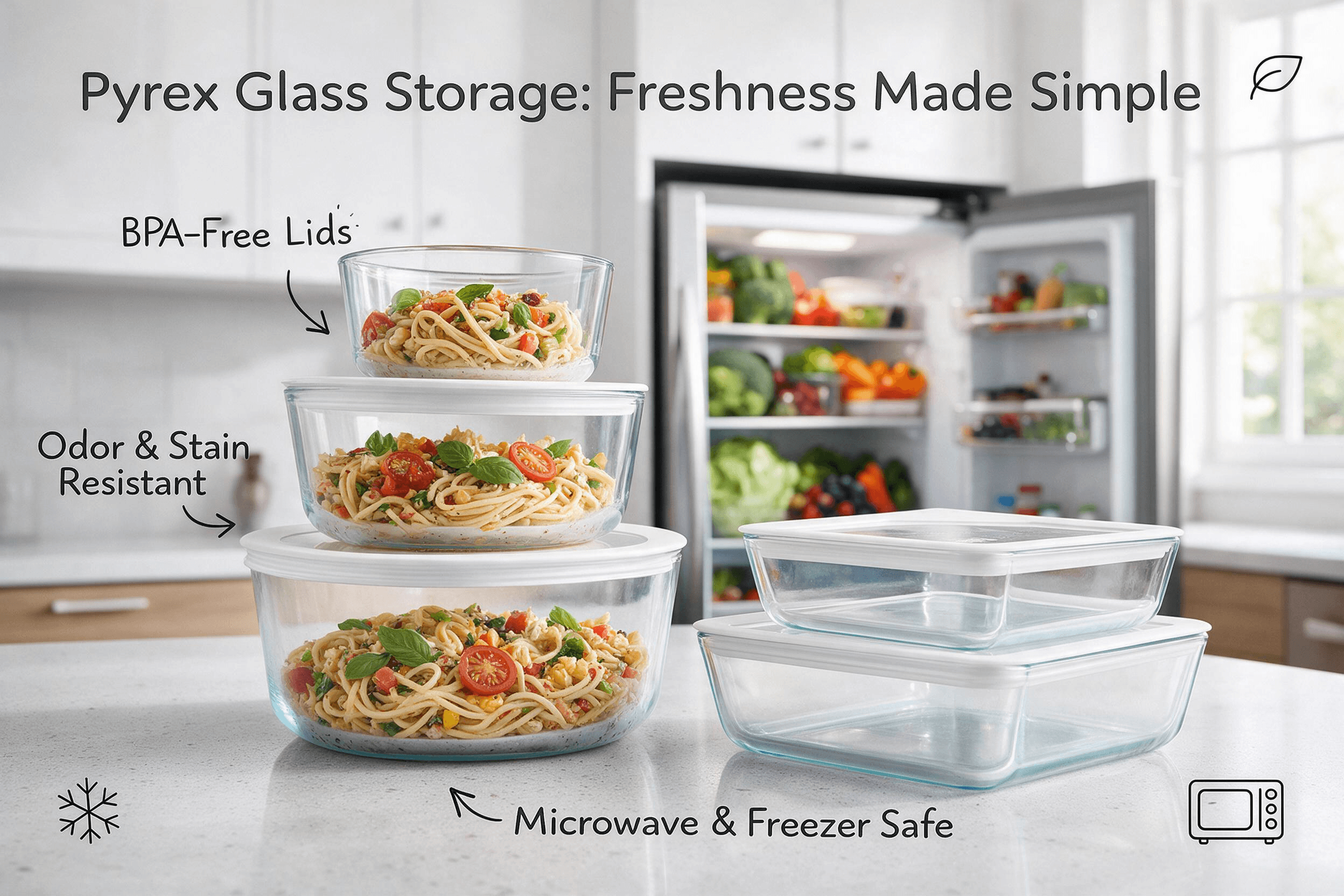
The 8-Piece Metal Bakeware Set with Heatsafe Silicone Handles, in Cerulean, addresses the oldest complaint about sheet pans and cake tins. Metal bakeware conducts heat beautifully and is nearly impossible to hold safely. Glass and ceramic solve the handling problem with thick walls and integrated grips, but they are heavy and they brown less aggressively on the base. The steel-and-silicone combination is an attempt to keep the browning and take the risk out of the grip.
The construction is warp-resistant alloy steel with a dual-layer nonstick silicone coating, and the coating is formulated without PFAS, BPA, lead, cadmium or mercury. The piece list is unusually generous for a single set: two large cookie sheets, a 9-inch round cake pan, a loaf pan, an 8-inch square pan, a 9×13-inch rectangular pan, a 12-inch pizza pan and a 12-cup muffin pan. Oven rating tops out at 450 degrees Fahrenheit. It is dishwasher safe, with hand washing recommended for coating longevity, which is the correct and unglamorous advice any manufacturer should give.
Two observations are worth making plainly. First, the two large cookie sheets are the most useful items in the box and the least likely to be included by a competitor building a “balanced” set. Sheet pans get used weekly; loaf pans get used seasonally. Second, the cerulean silicone is functional hardware that has been allowed to become a design feature. Coloured grips mean the set can live on a stovetop shelf without being hidden, which is how most people actually store bakeware.
Zone Two: The Counter
Four Bowls That End the Transfer-and-Cover Shuffle
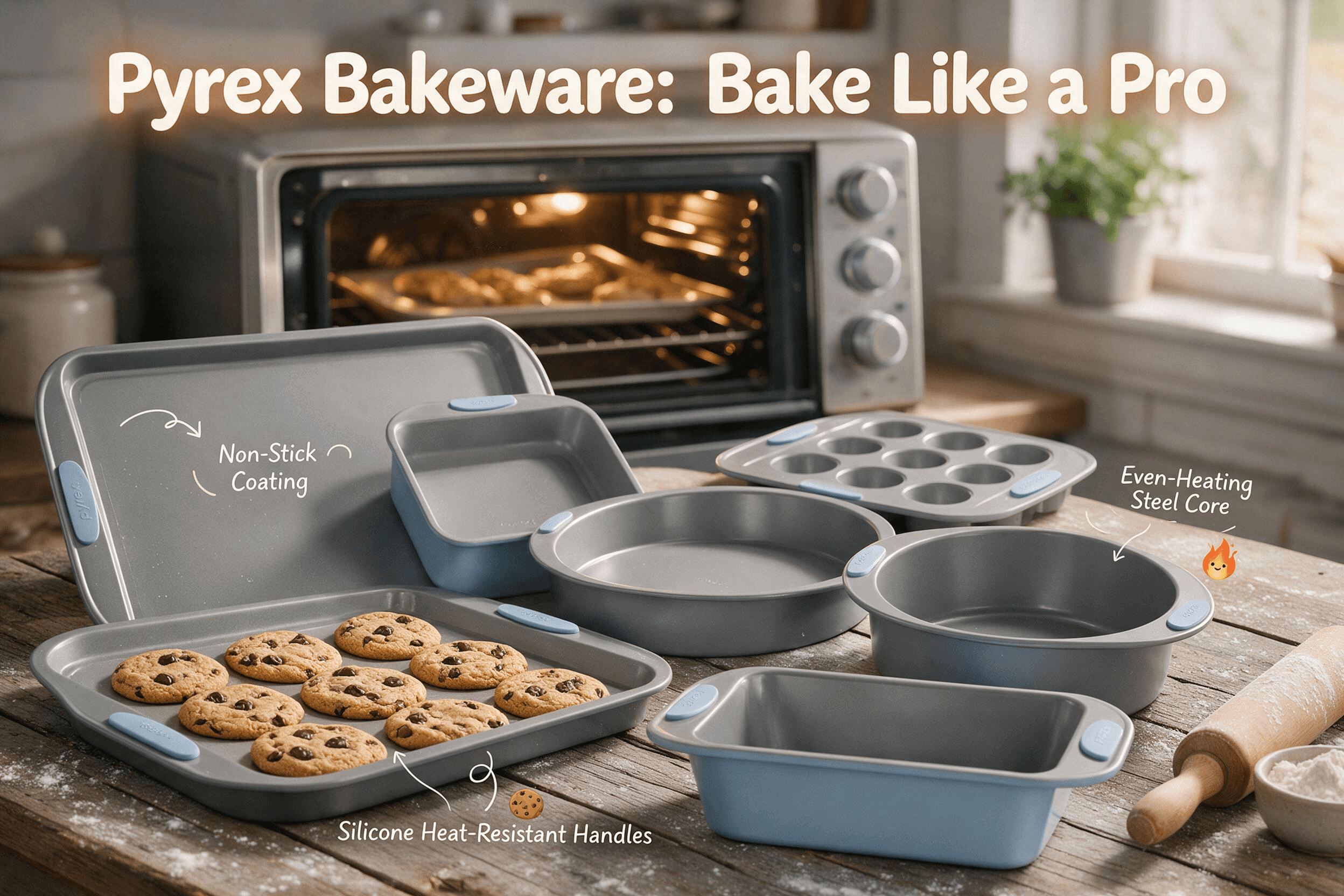
The 4-Pack Metal Stainless Steel Mixing Bowls with Airtight Locking Lids is the least glamorous item in the group and the one most likely to change daily behaviour. Eight physical pieces make up the set: four bowls and four matching lids, in 4.2-quart, 2.5-quart, 1.5-quart and 0.7-quart capacities. The bowls are 304-grade stainless steel, the common food-contact grade used in commercial kitchens, and the set is made without lead, cadmium, mercury or BPA.
The design insight is in the lids rather than the steel. Mixing bowls are usually a single-use station: something gets whisked in the bowl, then poured into a storage container, then covered, then refrigerated, and the bowl goes in the sink. Every transfer costs time and leaves residue. Locking airtight lids collapse that sequence, so the vessel where the vinaigrette was emulsified is the vessel that goes into the refrigerator. The 4.2-quart lid includes a built-in carrying handle, which is the detail that reveals the intended use: the largest bowl is meant to be lifted, full, and moved. Potluck service, marinated protein heading to the fridge, dough that needs to travel.
Bowls and lids are dishwasher safe, with the lids specified for the top rack. That is a small but honest constraint; locking lids with silicone gaskets live or die by whether the seal survives heat and detergent, and top-rack placement is the standard way to protect it. The quart ladder is also sensibly spaced. 0.7 and 1.5 quarts cover dressings, whipped cream and batter for a small cake; 2.5 covers most cookie dough; 4.2 covers bread. Four sizes, no overlap in purpose.
Zone Three: The Stovetop
Induction Compatibility Is the Real Announcement
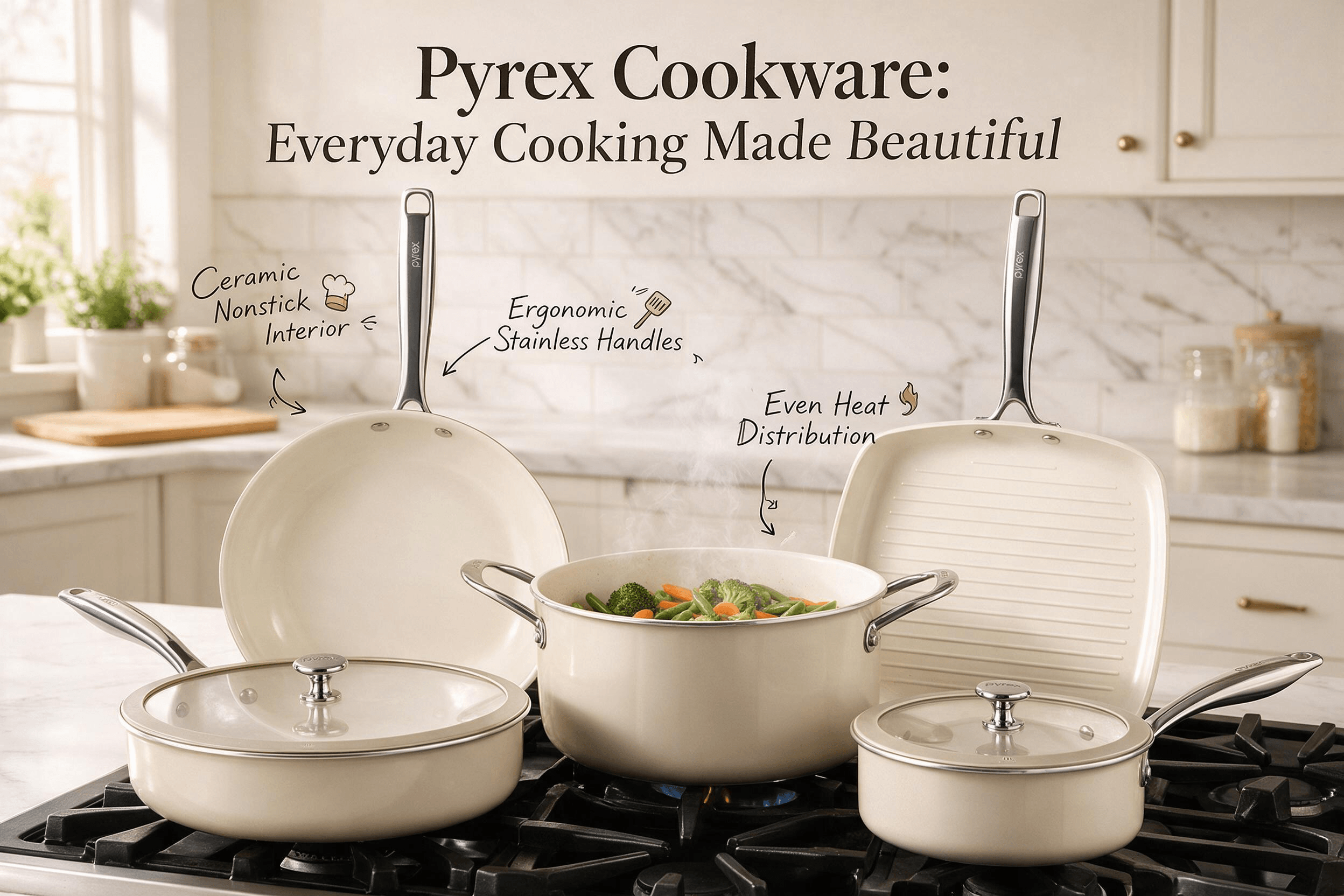
The 8-Piece Ceramic Cookware Set, Pots and Pans with Lids and Handles is the furthest departure from the brand’s documented leadership, and therefore the most interesting line in the catalogue. Pyrex is not claiming heritage here; it is claiming adjacency, and it is doing it with hardware that would have been nonsensical ten years ago.
The set contains a 10-inch fry pan, an 11.3-inch grill pan, a 3.5-quart deep fry pan with lid, a 2-quart saucepan with lid and a 4.5-quart stock pot with lid. Underneath, a lightweight, thermally conductive aluminium core carries a dual-layer ceramic nonstick coating formulated without PFAS, lead, cadmium or BPA. Handles are heat-resistant stainless steel, lids are clear glass, and everything is rated for all cooktops including induction. Oven rating extends to 450 degrees Fahrenheit, so a pan can start on a hob and finish in an oven, and both pans and lids are dishwasher safe with hand washing recommended.
Two things deserve credit. The first is that induction compatibility is stated rather than implied. Aluminium conducts well but does not work on induction unless the base is engineered for it, and a lot of affordable ceramic-nonstick cookware quietly omits that fact. Including it means this set is a viable replacement for someone moving into a home with an induction hob, which is an increasingly common situation. The second is the inclusion of a grill pan alongside a deep fry pan and a stock pot. That is a small-family, high-variance configuration rather than a decorative matched set: something for searing, something for braising, something for boiling, something for sautéing.
The ceramic-coating caveat should be stated plainly, because it is the weak point of every product in this category, not just this one. Ceramic nonstick is a harder, mineral-leaning surface that releases well when new and gradually loses slickness with high-heat use and metal-utensil contact. Treating these pans as low-to-medium heat cookware, and hand washing them despite the dishwasher rating, is how their useful life gets extended. A brand that publishes the 450-degree ceiling and recommends hand washing is not hiding the trade-off.
Zone Four: Cold Storage
The Glass Lid Is the Detail That Matters
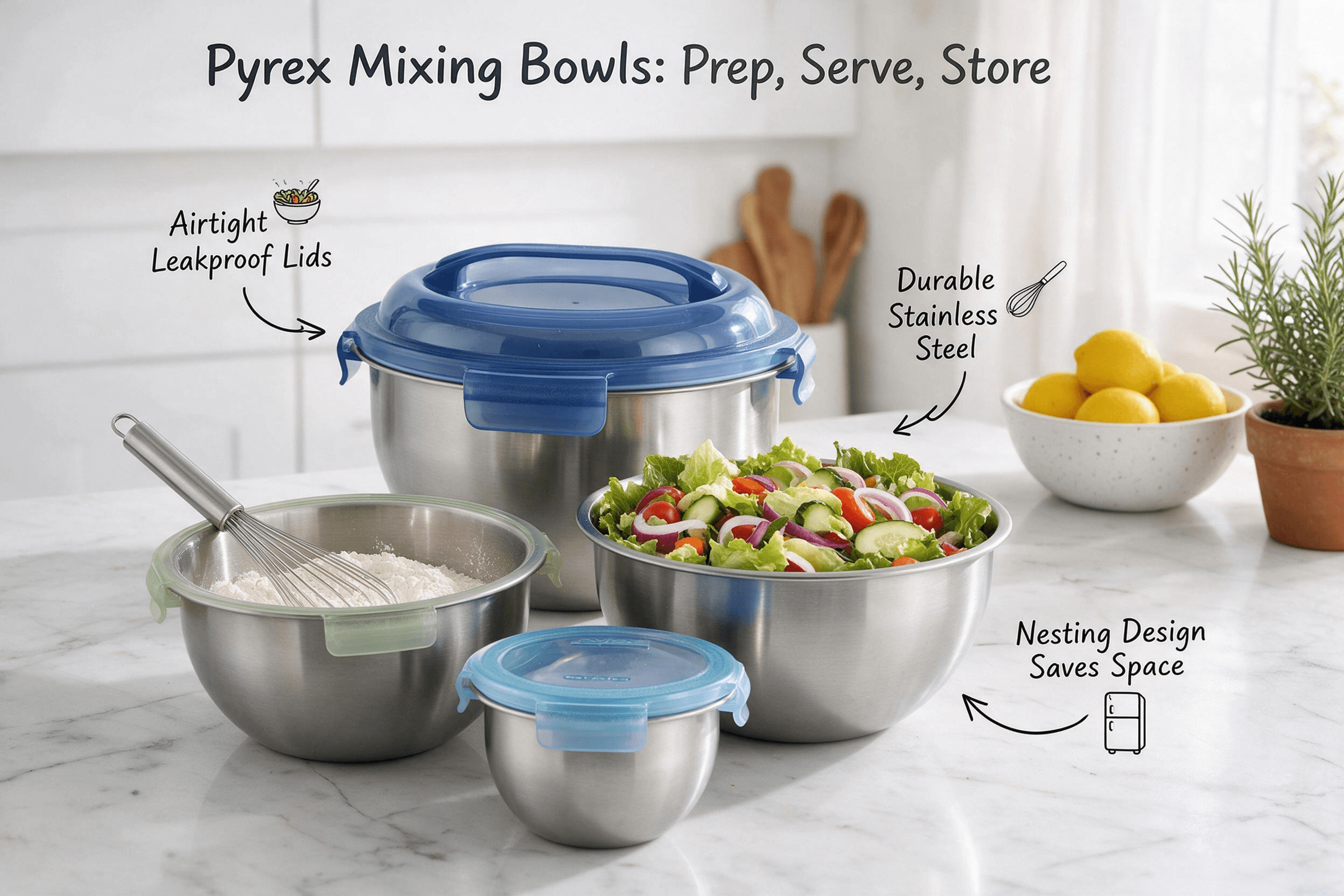
The 5-Pack Ultimate Glass Food Storage Containers with Glass Lids is the clearest expression of the brand’s material identity, and it contains one specific decision worth understanding. The set includes a 2-cup round, a 4-cup round, a 7-cup round, a 3-cup rectangular and a 6-cup rectangular container. Both the bodies and the lids are glass; the sealing is done by a thick BPA-free silicone rim moulded into each lid, producing an airtight, leakproof closure. Containers and lids are rated for preheated ovens, microwaves, freezers and dishwashers.
Plastic lids are the industry default for one reason: weight and shatter-resistance. They are also the reason most storage sets fail emotionally. Plastic clouds, holds odour, stains from tomato and turmeric, warps in a hot dishwasher, and eventually stops sealing. A glass lid with a silicone seal keeps the transparency that makes a crowded refrigerator legible while removing the degradation path. You can also reheat in the same vessel with nothing transferred, which is where the practical value actually lives: leftovers go from fridge to microwave to table without ever meeting a different dish.
The five-size spread is deliberately asymmetric. Three rounds cover the everyday geometry of soups, grains and cut fruit; two rectangles cover lasagna, brownies and anything layered. Round and rectangular containers stack differently, and any household with more than one shelf has felt that difference. Giving both shapes in one purchase is an admission that one shape never solves it.
A Pantry Measured in Cups
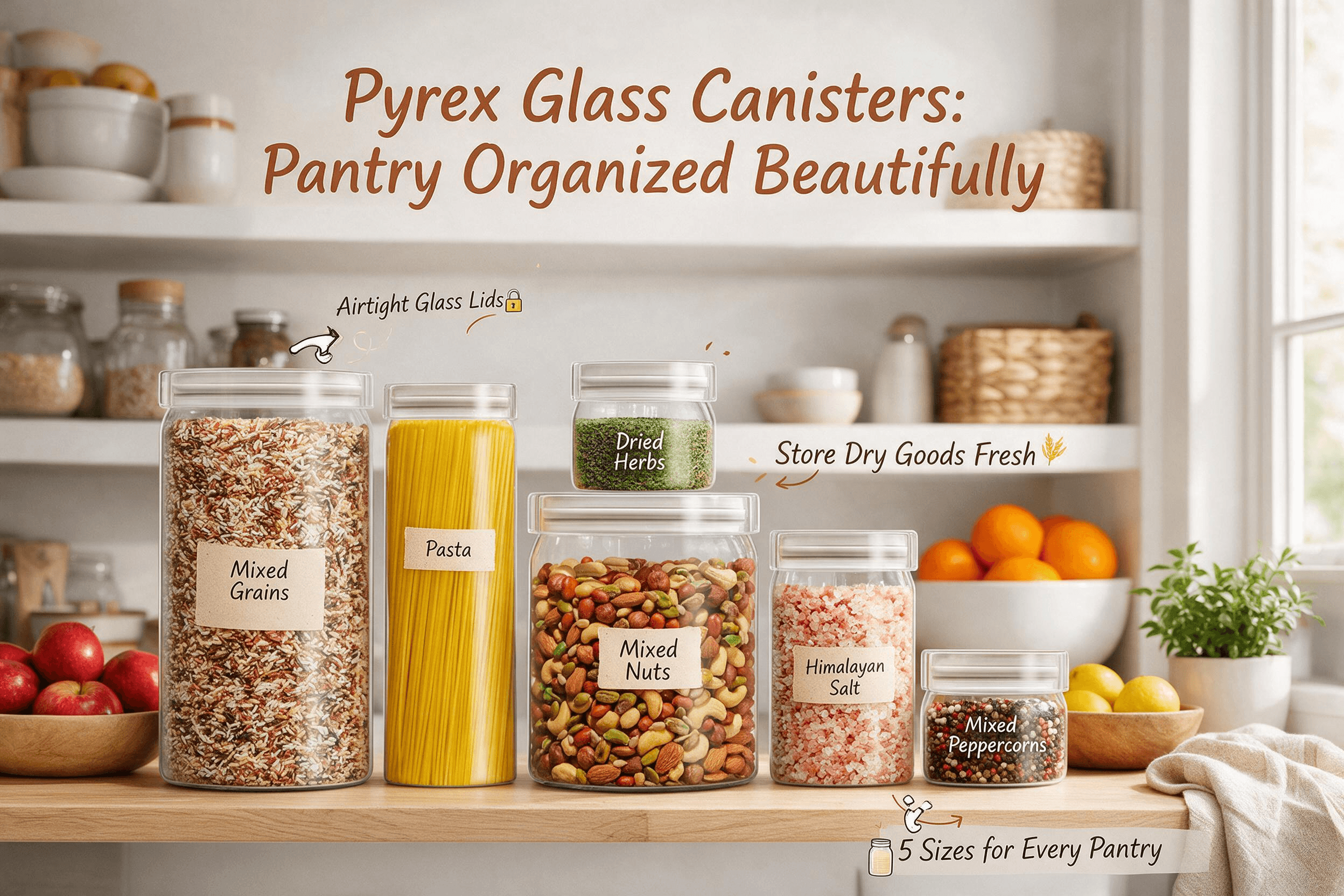
The 6-Pack Glass Canister Set, sold as lightweight dry food storage, works the opposite end of the temperature range: nothing here meets heat, and the job is visibility and pest-proof sealing over months. The set totals 41.5 cups across six canisters, comprising two at 1.5 cups, one at 3.5 cups, one at 7 cups, one at 10 cups and one at 18 cups. Lids are glass with a food-grade silicone seal for an airtight closure; the bodies are lightweight glass, dishwasher safe, and made without lead, cadmium or BPA.
The two smallest sizes are the tell. Most canister sets start around a quart because that is where flour and sugar live, and then include a couple of oversized vessels nobody fills. Starting at 1.5 cups means the set is designed for the things that actually get ruined in a badly sealed bag: salt, spices, coffee, baking soda, nuts, seeds, dried herbs. The 18-cup canister handles the flour-and-sugar tier, and the 7-cup and 10-cup sizes sit between, suited to rolled oats, rice and pasta.
Lightweight glass is worth taking seriously rather than dismissing as a cost note. Canisters get lifted one-handed from deep shelves, carried to counters, and refilled from heavy bags. Weight is the difference between a set that stays on display and a set that migrates to the back of a cupboard. The trade-off is honesty about handling: it is still glass, and it still belongs somewhere it will not be knocked by a standing-mixer arm.
A Sensible Order of Operations
Six sets, one kitchen, limited shelf space. If the goal is a functioning stack rather than a collection, the order matters.
Begin with the Ultimate 5-Pack storage containers and the four mixing bowls. Those two cover the highest-frequency loop in any kitchen: prepare, mix, cover, chill, reheat. Neither depends on the oven, and both earn their space within a week.
Add the ceramic bakeware set next. It is the piece that removes a step, because oven-to-table service eliminates a serving dish and the glaze surface tolerates daily dishwasher use without the care caveats that coating-based products carry.
Bring in the metal bakeware set when baking volume rises, particularly if cookies and muffins are regular rather than occasional. The two large sheets are the justification.
Take the cookware set as a deliberate stovetop replacement, not an addition. It competes with an existing pan drawer, so it makes sense when that drawer is worn, when a hob is induction, or when a single 450-degree-rated pan-and-pot set would simplify moving from sear to oven.
Finish with the canister set, which is the most aesthetic purchase in the group and the one that rewards waiting until the pantry contents are known.
Where the Claims Deserve an Asterisk
A fair reading requires noting the limits, and they are specific rather than generic.
Thermal shock is not infinite. Several listings use the phrase “preheated oven safe,” and those two words carry the whole burden. Glass that goes into an oven that is already at temperature is a rated condition; glass dragged from a deep freeze into a cold oven that then climbs is a different stress profile. Follow the published rating and do not improvise beyond it.
Coatings are consumables. The dual-layer silicone nonstick on the steel bakeware and the dual-layer ceramic nonstick on the cookware will decline with use, no matter how carefully they are treated. Stoneware glaze and glass do not have that failure mode, which is a real argument for weighting a kitchen toward the latter two.
Colour is a commitment. Cerulean grips and brushed pink-and-blue glazes are attractive, and they also mean a future replacement piece will not match. Buying the complete set at once is cheaper than assembling it over years.
Corporate lineage is not the same as unchanged construction. The Pyrex name predates the current ownership by many decades, and material specifications have evolved across that span. Judge each item on its published specs, which is exactly what this article has done, rather than on inherited assumptions about what the name guarantees.
The Point of a Hundred-Year Brand
There is a category of company whose products are so thoroughly absorbed into domestic life that they stop reading as choices. The glass measuring cup, the coloured nesting bowls, the rectangular dish under a layer of foil in the freezer: these are objects people buy without comparing specifications because the brand is assumed to be the default.
Pyrex has earned that assumption honestly, over more than a hundred years, and the current storefront is unusual in how little it leans on nostalgia. The banners reference generations, but the products are specified in quarts, millimetres of silicone, degrees Fahrenheit and induction compatibility. That tension is the story of this catalogue. A brand with enough inherited trust to coast is instead expanding into metal bakeware, stainless prep and full-hob cookware, where it has no incumbency and must compete on piece lists and coatings like everyone else.
For a buyer, that is the best possible position to be in. Trust is already established where it should be, and ambition is what is being sold for the new money. Six sets, five materials, one continuous job: getting food from a cupboard to a table and back again with as few transfers, as few replacements, and as little landfill as possible. That is not a design philosophy. It is chemistry, and it has aged better than most things in the kitchen.