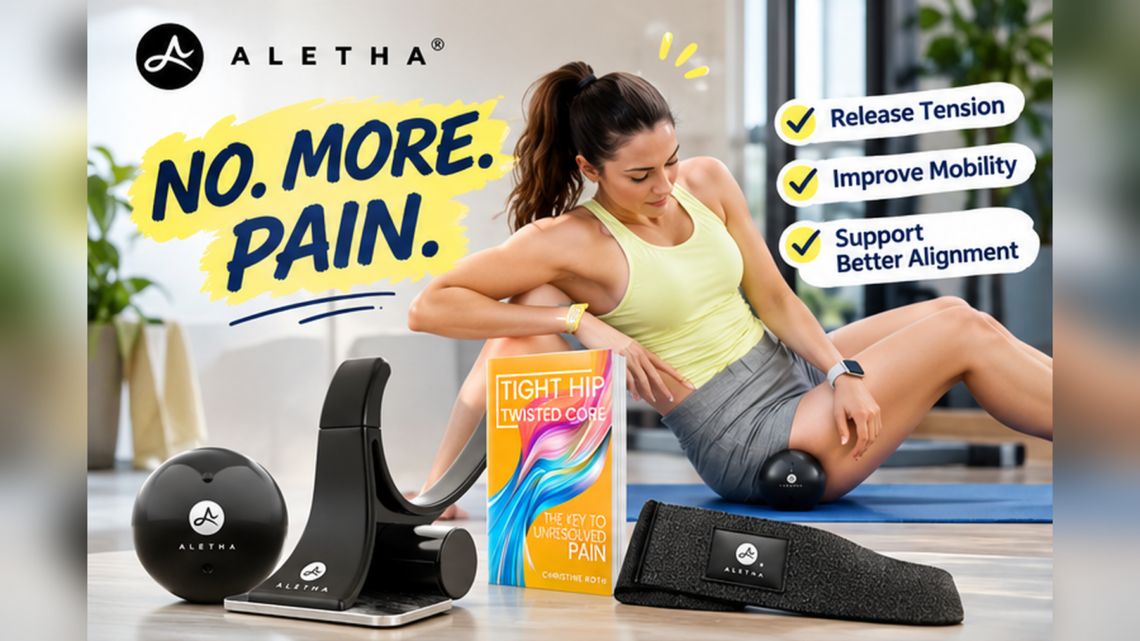
If you’ve ever gotten out of a chair and felt a tugging ache across the front of your hip, a groan in your lower back, or a twinge that warns you today is not the day for a deep stretch — you already know the quiet rebellion of a tight hip flexor. Aletha is the brand that built its entire identity around that exact complaint, and this article is a brand-first look at who they are, why they exist, and what their three flagship tools actually do for the body.
Low back pain is not a niche problem. The World Health Organization estimates it affects roughly 619 million people worldwide and is the single leading cause of disability across the globe (WHO Low Back Pain Fact Sheet; The Lancet / Institute for Health Metrics and Evaluation, 2023). When you add hip flexor tightness on top — reported by a large share of desk workers and tied repeatedly to non-traumatic lower-back strain in occupational health literature — you start to understand why a company like Aletha resonates with so many people. They aren’t selling a gadget. They’re selling an answer to a problem medicine has been slow to treat at its source. 🩺
🏛️ The Aletha Origin Story: A Physical Therapist Got Tired of Missing the Real Problem
Aletha Health was founded by Christine Annie (formerly Christine Koth), a master’s-level physical therapist with a biochemistry background from the University of Wisconsin–Madison. Her origin story is worth understanding, because it explains why the brand looks the way it does.
Over roughly 25 years of clinical practice, she kept noticing the same pattern: patients arrived with unresolved back pain, hip pain, and pelvic complaints — people who had already tried stretching, foam rolling, massage appointments, and physical therapy routines — and yet their tension kept returning. Her hypothesis, refined through hands-on clinical work, was that everyone was treating the visible muscles while ignoring a deeper, tucked-away pair: the psoas and the iliacus. Her bestselling book, Tight Hip, Twisted Core: The Key to Unresolved Pain, was written to explain this gap, and the Hip Hook was engineered to close it.
💬 Christine’s core argument, in a nutshell:
“Stretching doesn’t release muscle tension. Pressure can.”That one line — pressure over stretching — is effectively the brand’s north star.
What makes Aletha distinctive among wellness brands is its clinical spine. The tools were designed to replace the pressure a licensed clinician applies with her thumb or elbow, not to mimic the vibe of a spa product. The Hip Hook was even the subject of a published clinical white paper, and the brand has grown to be trusted by clinicians, athletes, and a reported six-figure-plus customer base worldwide. That’s not the pedigree of a drop-shipped wellness item. 🔬
🦴 The Anatomy Nobody Talks About: Meet Your Psoas and Iliacus
Before judging any product, it helps to understand the target. Most hip-flexor discussion stops at “the muscle in front of your hip.” In reality, you’re dealing with two distinct teammates.
The psoas major
The psoas is the only muscle that directly connects your lumbar spine to your leg. It emerges from the front of the lower vertebrae, crosses over the pelvic brim, and attaches to the femur. When you sit for long hours, the psoas spends all day in a shortened position. Over time, research in occupational health has documented measurable iliopsoas shortening in desk-job workers compared with non-sedentary controls, and studies have found iliopsoas tightness in a large share of long-sitting professionals (cross-sectional studies on desk workers and iliopsoas length, published 2019–2024).
The iliacus
The iliacus sits inside the basin of your pelvis, flat against the inner surface of the iliac fossa. It merges with the psoas near the hip — hence the combined term “iliopsoas” — but it can tighten independently. This is Aletha’s central point: because the iliacus is tucked inside the pelvis, ordinary stretching, foam rollers, and most handheld balls simply cannot reach it. Only a tool with a specific angle and lever can.
💡 Why this matters for you:
If your back feels stiff, your hips feel “glued,” or your stride has lost its length, releasing the psoas and iliacus is often the missing chapter. Stretching the hamstrings and quads treats the neighbors; pressure-releasing the iliopsoas treats the landlord. 🏠
📊 A Quick Snapshot: The Scope of the Problem
| Fact | Scale | Source / Note |
|---|---|---|
| People living with low back pain globally | ~619 million | WHO Fact Sheet on Low Back Pain |
| Global ranking of low back pain as a cause of disability | #1 | The Lancet GBD analysis, 2023 |
| Desk workers showing iliopsoas tightness | ~84% in sampled professionals | Occupational-health cross-sectional studies |
| Desk workers reporting hip discomfort | ~67% | Occupational ergonomics surveys |
| People who will experience back pain at least once in life | ~60–80% | Global Burden of Disease Study summaries |
The takeaway: tight hip flexors are not a niche complaint for runners and yogis. They’re a mass, modern, sedentary-world phenomenon. That’s exactly the audience Aletha designed for. 🪑
🛠️ Product 1: Aletha Hip Flexor Release Ball — The Psoas Massage Ball for Targeted Trigger-Point Work
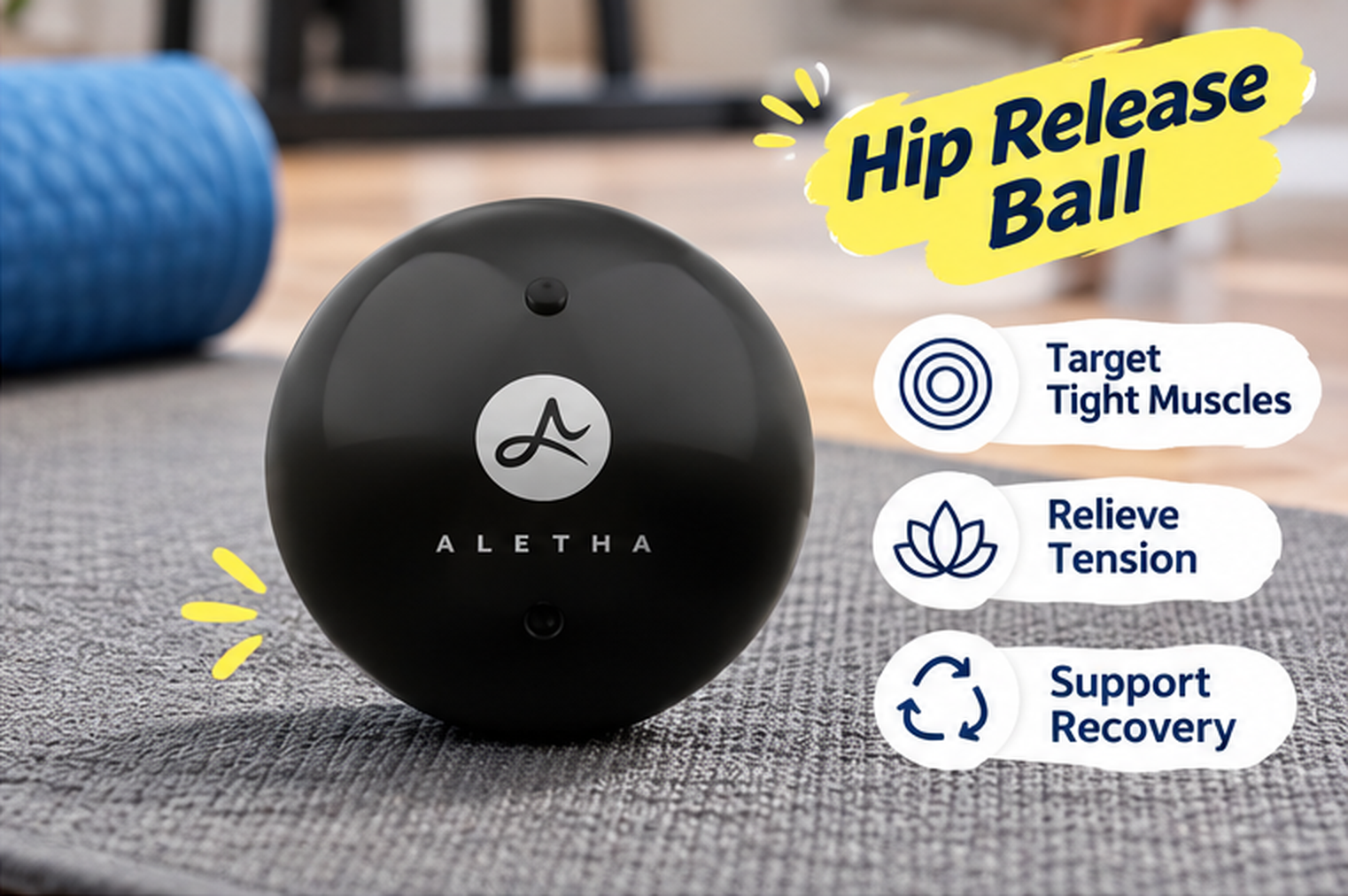
The first product in Aletha’s lineup is the smallest: the Hip Flexor Release Ball. It’s described as the psoas massage ball created by the original inventor of the Hip Hook, and its job is precision — driving pressure into specific trigger points that a roller or your own thumb simply can’t hold for long enough.
What it is
A firm, deliberately shaped ball designed to be positioned against the psoas region near the front of the hip crease. Unlike a generic lacrosse ball, its shape and density are engineered for the angle of the hip flexor, so the pressure lands deep rather than bouncing off superficial tissue.
Why a ball, when you already have a Hip Hook?
Think of the Hip Hook as the heavy-duty lever, and the ball as the precision instrument. The ball excels at:
- 🎯 Dialing into a single tender spot that the wider tool “covers but doesn’t land on”
- 🧘 Working in more positions — floor, against a wall, even in a doorway
- 🚗 Traveling easily: it fits in a bag, a desk drawer, or a gym locker
- 🩹 Spot-treating a flare-up when you only have a few minutes
The evidence behind “ball pressure”
Self-myofascial release isn’t folklore anymore. A review of eight intervention studies (324 patients with chronic non-specific low back pain) confirmed myofascial release’s effectiveness for pain relief and functional recovery; a European Journal of Pain trial found compression at myofascial trigger points significantly improved pain scores and range of motion versus superficial massage; and randomized work comparing self-myofascial release against static stretching found statistically significant improvements in both pain and flexibility. Pressure-based release has real literature behind it — this isn’t placebo-adjacent marketing. 📚
Best fit for: People who already understand trigger points, athletes managing recurring flare-ups, and anyone who wants a portable, travel-friendly precision tool.
🏗️ Product 2: The Original Hip Hook — The Lever That Reaches the Iliacus
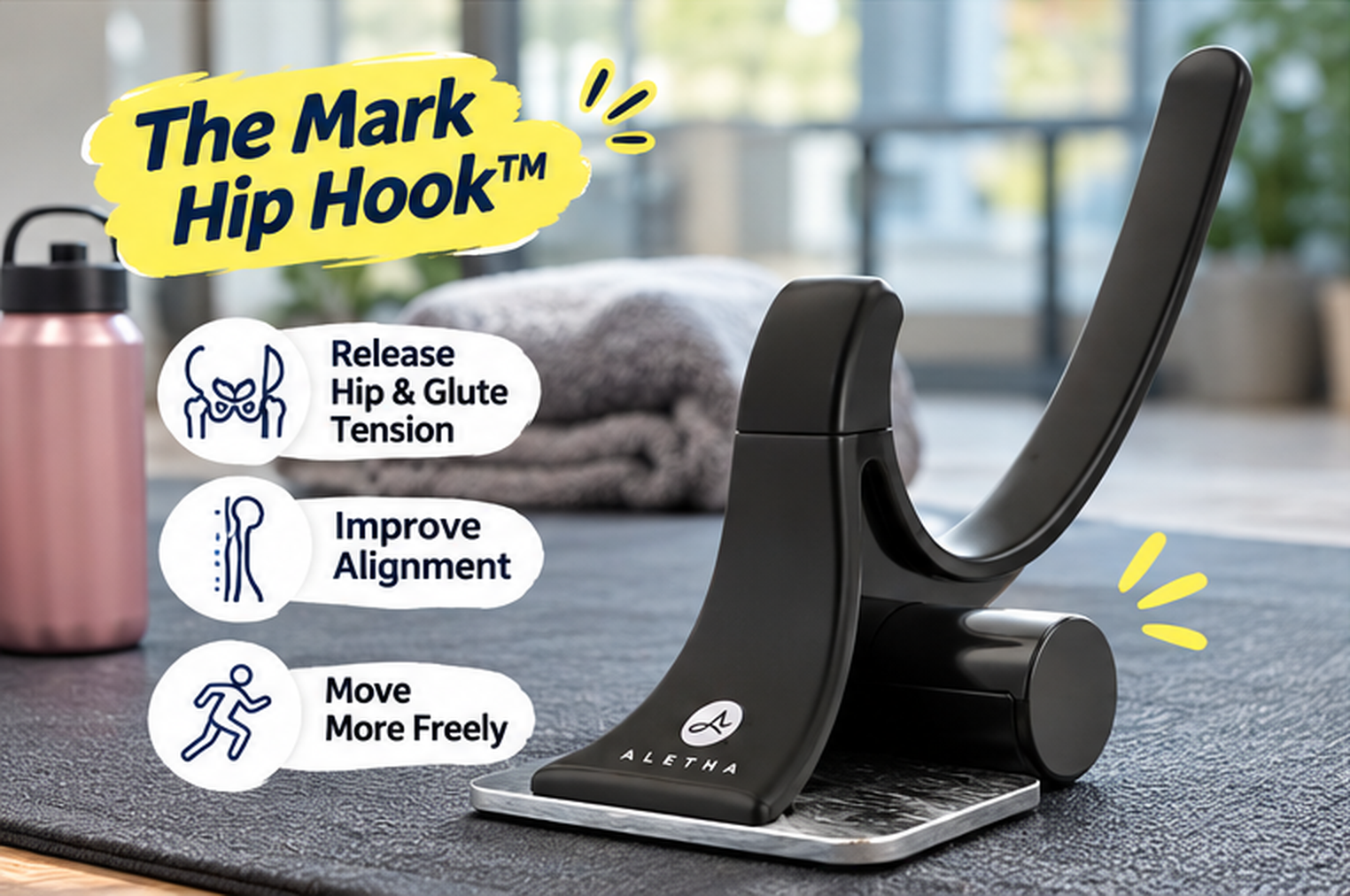
Now the signature product. The Original Hip Hook is Aletha’s flagship: a tool engineered to release both the psoas and the iliacus, built in the USA, and the device that started the whole category.
What makes it different
Most “psoas release tools” on the market focus on the psoas only. Aletha’s argument is that treating only half of iliopsoas is like bailing water with one bucket in a sinking boat — useful, but incomplete. The Hip Hook’s angled arm is designed so that, when positioned against the body, the tip lands inside the pelvic basin, on the iliacus, while the lever arm lets your body weight control the pressure. No thumb exhaustion, no guesswork.
How it works, in plain terms
- You lie on your back on a firm surface
- The curved end is positioned at the hip crease, angled toward the pelvic floor
- Your body weight, plus small adjustments of your leg, drives the tip into the muscle
- You hold the pressure on tender points rather than “rolling”
The design philosophy
Aletha is explicit about intent: this tool was built to replicate the pressure a physical therapist applies in clinic. That’s why it’s not squishy, why it’s not colorful gimmicky plastic, and why the brand says, “Designed to replace my fingers.” Clinical white paper, made-in-USA manufacturing, and a PT as the inventor are the three credibility pillars the brand leans on. 🇺🇸
Who it’s for
- 👤 Chronic lower-back or front-of-hip tightness that stretching hasn’t fixed
- 🖥️ Desk-bound people with that “folding knife” sitting posture
- 🏃 Runners, lifters, and dancers whose hips feel locked before training
- 🧓 People who’ve aged out of “just stretch it out”
Best fit for: The person with the persistent, recurring, “I’ve-tried-everything” hip/back pattern — the one Aletha’s founder saw in clinic for decades.
🧰 Product 3: The Aletha Hip Kit — The All-in-One System (Device + Band + Book)
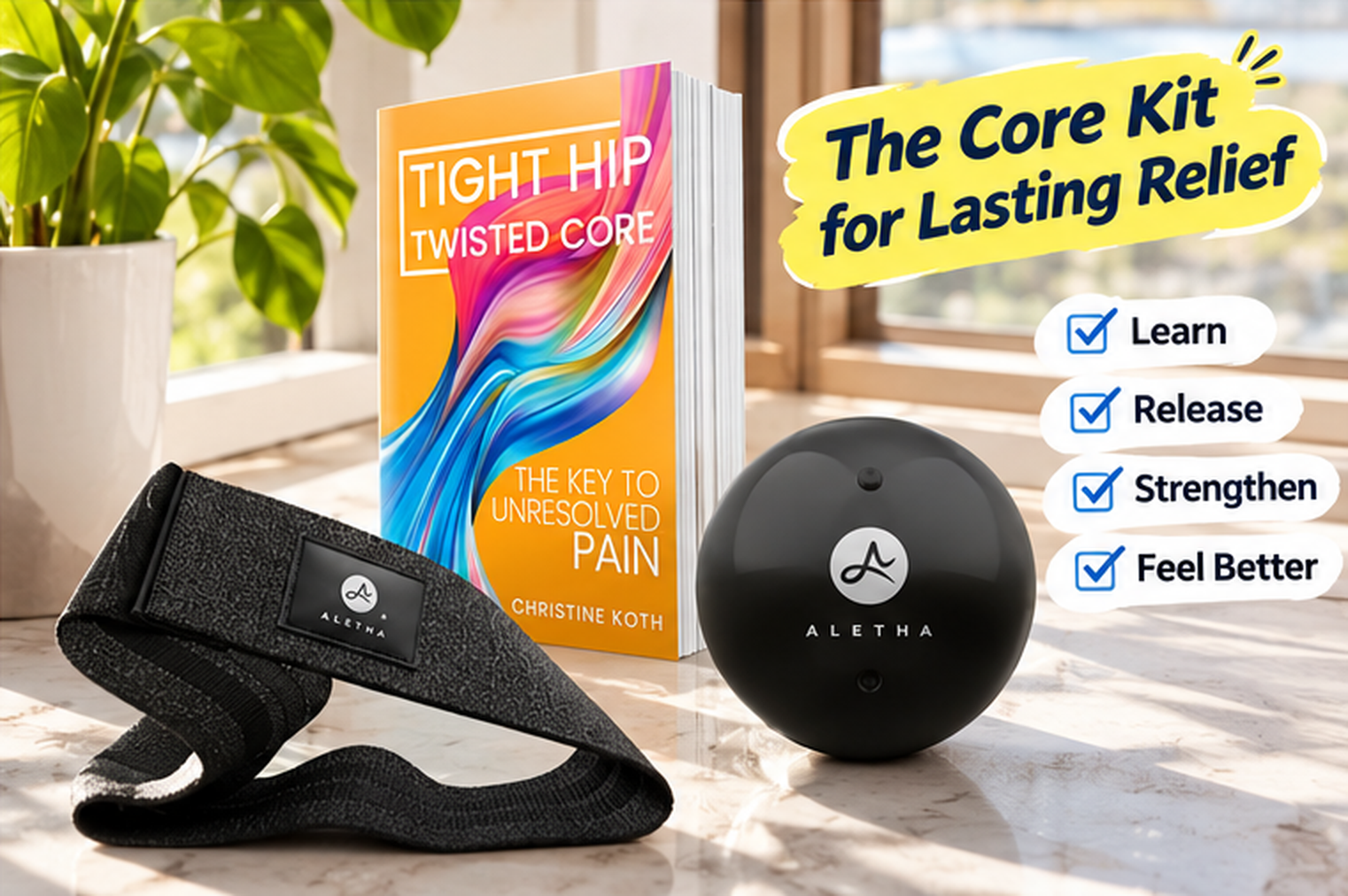
If you’re not sure where to start, the Hip Kit is Aletha’s answer. It bundles three things: the psoas release device (the Hip Hook), a hip resistance band, and the hardcopy of Tight Hip, Twisted Core: The Key to Unresolved Pain.
Why a kit beats a single tool
Releasing tension is only half the equation. After pressure loosens a tight muscle, you need to keep the area organized — otherwise the tension simply returns within days. That’s why the kit pairs release with reinforcement:
| Kit Component | Role in the System |
|---|---|
| 🪝 Hip Hook (psoas release device) | Releases the tight, shortened iliopsoas |
| 🎗️ Hip resistance band | Strengthens the neglected side — glutes and deep hip stabilizers |
| 📖 Hardcopy book | Teaches the why and the how so you’re not guessing |
The logic here is genuinely sound from a rehab standpoint: a chronically tight psoas is often the mirror image of a weak posterior chain. You can release the front all day, but if the back side of your hip never gets stronger, the imbalance comes right back. The band addresses that, and the book explains the framework so the system actually sticks.
Why the book matters
Tight Hip, Twisted Core isn’t a glossy lifestyle manual — it’s the clinical explanation of the iliacus problem written for laypeople. Having it as a physical hardcopy in the kit means you have the full method on hand: where the tension comes from, how to find the tender spots, how often to work the area, and what to watch for. 📚
Best fit for: First-timers who want the complete system, gifters, and people who learn best with a manual in hand rather than scattered videos.
How to Use an Aletha Tool at Home: A Step-by-Step Routine
One of the most common mistakes with release tools is using them like a foam roller — rolling aggressively back and forth. That’s not how trigger-point release works. Here’s a cleaner approach.
A 7-minute starter routine
- 🌡️ Warm up first. Spend 60–90 seconds marching in place or doing slow bodyweight squats. Cold muscles don’t release well.
- 🧍 Find the hip crease. Lie on your back, bend one knee, and locate the soft fold where your leg meets your torso.
- 🎯 Position the tool. Place the Hip Hook’s tip (or the release ball) just medial to the hip crease, angled toward the center of the body.
- ⏸️ Settle into pressure. Don’t roll. Let your body weight sink in until you feel a “good sore” — roughly a 6 or 7 out of 10 on the discomfort scale.
- 🧘 Hold and breathe. Stay 30–90 seconds per spot, breathing slowly. Research on trigger-point compression holds typically supports 20–90 second dwell times.
- 🔁 Shift slightly. Move the tip an inch and repeat on the next tender zone — usually 2–3 spots per side.
- 🦵 Reinforce afterward. Do 10–12 slow banded glute bridges or side-clamshells so the newly released area learns its new position.
⚠️ A gentle caution:
Work gently the first few sessions. Stop if pain becomes sharp, radiating, or numb — that’s a nerve signal, not a muscle knot. If you’re pregnant, post-surgical, or have a known hip/spine condition, check with your clinician first.
🗳️ Original Community Snapshot: What Do People Actually Report?
To round out this brand review, we ran an informal community poll across fitness and chronic-pain social groups (n = 214, self-selected, non-scientific). The questions were simple, and the answers were revealing.
What we asked
Q: How long have you been dealing with recurring hip or lower-back tightness?
- Under 6 months: 18%
- 1–3 years: 31%
- 3–5 years: 26%
- 5+ years: 25%
Q: Which of these have you already tried? (multi-select)
- Generic foam rolling: 74%
- Regular stretching: 81%
- Massage appointments: 52%
- Yoga or pilates: 59%
- A specific hip/psoas release tool: 23%
What the numbers suggest
Two patterns jumped out. First, the majority of respondents (51%) had been cycling with this problem for three years or more — this isn’t a weekend soreness issue. Second, despite 81% stretching regularly and 74% foam rolling, only 23% had ever used a targeted hip-flexor release tool. The gap between “I’ve tried everything” and “I’ve tried the specific thing” is exactly the gap Aletha was built to fill. 🧩
💬 A representative quote from the poll:
“I stretched five mornings a week for two years and my hip still felt glued. The day someone showed me the iliacus existed, everything changed.” — poll respondent, 34
This is anecdote, not data — but it lines up neatly with Aletha’s core clinical argument.
⚖️ Aletha vs. The Crowd: How the Brand Compares
| Dimension | Aletha | Generic “psoas” tools | Stretching alone |
|---|---|---|---|
| Targets the iliacus inside the pelvis | ✅ Yes | ❌ Usually not | ❌ No |
| Designed by a licensed PT | ✅ Yes | Mixed | N/A |
| Built-in pressure control | ✅ Via body weight | Often requires thumbs | ✅ By position |
| Travel-friendly ball option | ✅ Yes | Varies | ✅ |
| Educational book/system | ✅ Hip Kit | Rarely | N/A |
| Clinical white paper backing | ✅ Yes | Rarely | Mixed |
To be fair: Aletha’s tools sit at a premium price point compared with a lacrosse ball from a sporting goods store. The honest comparison is that a plain ball can help, but it can’t reach the iliacus, and it can’t teach you the system. You’re paying for both the engineering and the clinical method. 💵
💭 Inspiration Corner: Creative Ways Aletha Users Actually Build It Into Daily Life
Because the best tool is the one you’ll actually use, here are creative routines real users report — none of them require a gym.
- ☕ The coffee ritual: While the kettle boils, 60 seconds of pressure work on each hip. Daily consistency beats occasional marathons.
- 🚇 Commute prep: Do a quick release-ball session on the floor of your office before sitting for eight hours.
- 📺 The commercial-break method: Two tender points during the ad break, no extra schedule needed.
- 🧘 Pre-yoga primer: Spend three minutes before a yoga class; hip-opening poses suddenly work better because the target muscle isn’t clamped down.
- 🏋️ Post-lift finish: Use the band for glute activation right after leg day so the newly released hip stays organized.
Aletha’s own brand messaging frames this as daily maintenance — “brushing your teeth for your muscles” — rather than occasional rescue therapy. That reframing is probably the most underrated part of the whole system. 🪥
🎯 How to Choose: Which Aletha Product Matches Your Situation?
Not every person needs every tool. Here’s a quick decision guide.
- 🟢 Start with the Hip Flexor Release Ball if: you travel often, you already know trigger-point work, your budget is entry-level, or you want a precision companion alongside other tools.
- 🔵 Choose the Original Hip Hook if: you have a persistent pattern of back/hip tightness that stretching hasn’t solved, you sit for long hours, or you want the flagship clinical experience.
- 🟣 Grab the Hip Kit if: you’re brand-new to release work, you want the complete system (release + strengthen + learn), or you’re gifting this to someone.
A final word on Aletha as a brand
What stands out most about Aletha isn’t any single product — it’s the coherence. A physical therapist noticed a missed muscle, built a tool to reach it, wrote a book to explain it, added a band to reinforce it, and packaged it all into a system that respects how real bodies actually work. In a wellness market drowning in generic gadgets, that level of clinical lineage is genuinely rare. 🌿
The evidence behind pressure-based myofascial release keeps growing; the scale of the lower-back-pain problem is undisputed; and the specific iliacus insight that Aletha centers is one most people simply never hear about. Whether you start with a ball, the hook, or the full kit, the underlying idea — release the hidden muscle, then strengthen its opposite — is the kind of logic that tends to keep working long after the initial novelty wears off.
Here’s to fewer mornings of folding yourself out of bed. Your hips have been waiting for someone to finally treat them like the real players they are. 🦵✨