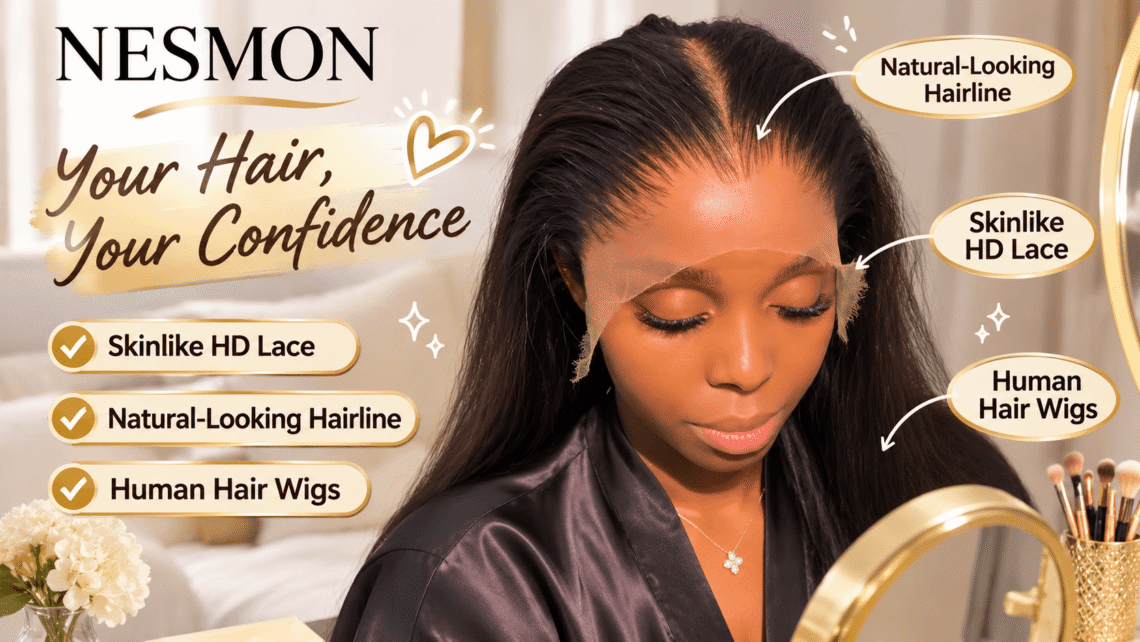
How a rising Amazon hair brand is winning over the wig-wearing world with whisper-thin lace, honest density, and installs that take minutes instead of hours.
Anyone who wears wigs knows the tell. You’re three feet from a mirror in daylight, and there it is — the faint grid of lace sitting on top of the skin instead of melting into it. The hair might be flawless, the cut perfect, the color immaculate. But that visible lace perimeter quietly announces “wig” to anyone who looks closely, and for millions of women, that single detail is the difference between wearing hair and being hair.
Nesmon is a brand built almost entirely around eliminating that moment. Specializing in 100% human hair lace wigs — full frontal 13×6 constructions, Skinlike HD lace measured in fractions of a millimeter, densities up to 200% in lengths stretching from everyday bobs to statement-making 40 inches — Nesmon has climbed Amazon’s crowded hair category by obsessing over the one thing buyers complain about most: realism. Independent review roundups repeatedly flag its lace as among the thinnest and most undetectable they’ve tested, and the brand has built a genuine word-of-mouth following among wig installers and everyday wearers alike.
This post takes a long, unhurried look at what makes Nesmon worth attention — the construction details that actually matter, the texture and length options in the lineup, what real users praise and what they warn about, and how to choose, install, and care for a wig like this so it lasts. Whether you’re a seasoned “wig girlie” with a shelf of units or someone researching a first human-hair purchase, this is the deep dive the product pages don’t give you.
💬 “The best compliment you can give a wig is that nobody noticed it was one. That’s the whole sport.” — a sentiment that shows up, in one phrasing or another, across almost every glowing Nesmon review
1. Where Nesmon Came From and What It Stands For
The human hair wig market on Amazon is a battlefield. Thousands of listings, near-identical product photos, marketing claims that all promise “9A grade, unprocessed, glueless, pre-plucked” — and quality that swings wildly between units. In that environment, buyers have learned deep skepticism. They read reviews forensically. They follow wig influencers on TikTok and Instagram who post raw, unfiltered install footage. They trust patterns, not promises.
Nesmon‘s rise through this market is notable precisely because it happened the hard way: through repetition. The brand carved its niche in the 13×6 full frontal lace wig segment — a construction prized for its ear-to-ear lace span and deep six-inch parting space — and concentrated its efforts on two attributes that reviews consistently reward: an exceptionally thin, skinlike HD lace, and hair that behaves like real hair through washing, heat styling, and months of wear. Third-party comparison sites that rank lace front wigs have repeatedly placed Nesmon units at or near the top of their categories, often specifically citing the lace as the thinnest tested.
The brand’s identity, distilled from its products and the community around it, rests on a few clear commitments. Every unit uses 100% virgin human hair — Brazilian virgin hair in the core lineup — which means the cuticles run in one direction and the hair can be colored, curled, flat-ironed, and washed like your own. Construction is aimed at realism first: pre-plucked hairlines, pre-bleached knots, and lace selected to vanish against the scalp. And the range is deliberately deep within its specialty rather than scattered across every hair product imaginable — wigs and bundles in body wave, deep wave, and straight textures, in lengths from 26 inches up to 40.
That focus is the tell of a brand that knows what it’s doing. In a market where many sellers list everything and master nothing, Nesmon went deep on the product whose one job is to be undetectable — and built its reputation on exactly that.
The Brand’s Pillars at a Glance
- 🧵 Skinlike HD lace — ultra-thin, designed to melt rather than sit
- 💇🏾♀️ 100% virgin human hair — washable, heat-styleable, colorable
- 🎨 Pre-plucked, pre-bleached construction — realistic out of the box
- 📏 A deep length range — 26″ to 40″ across textures
- 🛒 Amazon-native — fast shipping, real review transparency, easy returns
2. Why Lace Thickness Is the Whole Ballgame
To understand why Nesmon obsesses over lace, you have to understand what lace actually is and what it’s asked to do. The lace is the sheer mesh at the front of the wig — the part that sits against your skin, through which individual hairs are tied by hand. Its job is to impersonate scalp. When it works, the hair appears to grow from your head. When it doesn’t, no amount of styling saves the illusion.
Lace comes in a few familiar grades. Standard Swiss lace is durable but relatively visible. Transparent lace improved things but still reads as a grid under close inspection. HD lace — high definition — is the current summit: a Swiss-made mesh so fine it registers as skin rather than material. And within HD lace, there’s a meaningful spectrum of thickness. Nesmon’s flagship lace measures roughly 0.10mm — the thin end of what’s commercially available, and thin enough that comparison testers have called it nearly undetectable even without knot bleaching or heavy customization.
Why does thinness matter so much in practice? Three reasons. First, optical: thin lace creates a lower profile at the hairline, so it doesn’t cast the faint shadow or raised edge that thicker lace produces in daylight. Second, thermal: thinner mesh traps less heat against the forehead, which matters enormously for anyone wearing a unit through a summer, a workout, or a full workday. Third, customization: thin lace takes tint, foundation powder, and adhesive better, so it accepts the finishing work that makes an install seamless instead of fighting it.
There’s a tradeoff, and honesty requires naming it. Ultra-thin lace is more delicate than standard lace. It rewards gentle handling — careful application, patient removal with adhesive remover rather than force, and protective storage — and punishes yanking. For buyers willing to treat the lace with basic respect, the realism dividend is enormous; for buyers who rip units off at midnight, no HD lace at any price survives that. Nesmon’s bet is that its customer understands the exchange: a little fragility in exchange for a hairline that doesn’t announce itself.
💡 The daylight test, explained: step into natural light and look at your hairline from arm’s length. If you can trace the lace boundary with your eye, the lace is working against you. This is the test reviewers apply to Nesmon — and the one its 0.10mm lace was chosen to pass.
3. The 13×6 Full Frontal: A Bigger Canvas for Real Styling
Nesmon’s signature construction is the 13×6 full frontal, and the numbers describe the geometry that makes it special. The lace panel spans 13 inches across — ear to ear — and drops 6 inches deep from the hairline back toward the crown. Compare that to the more common 13×4 frontal, which spans the same width but offers only four inches of parting depth, and to closure wigs, which confine the part to a small square.
What does six inches of depth actually buy you? Everything about how versatile a unit feels in real life. With a 13×6, you can part dead center one day, sweep a deep side part the next, carve a C-part for a softer frame, or gather everything into a high ponytail without exposing the boundary where lace ends and wefted hair begins. That last point is the sleeper benefit: with four inches of depth, high ponytails and updos often reveal the back edge of the lace. With six, the parting space extends far enough back that elevated styles look continuous and natural.
Ear-to-ear width carries its own advantages. It means the hairline is lace from temple to temple — so baby hairs, swooped edges, and pulled-back styles look plausible across the full perimeter, not just at the front. For anyone who styles their edges, this is the difference between an install that ends abruptly and one that reads as a real head of hair from every forward-facing angle.
The practical styling menu of a 13×6 looks like this:
- 💁🏾♀️ Middle parts — the clean, face-lengthening classic
- 🌊 Deep side parts — volume, drama, and a softer hairline
- 🧢 C-parts and Z-parts — trend-friendly parting patterns with dimension
- 🎀 High ponytails and buns — styles that expose the parting area, handled gracefully
- 👶🏾 Custom baby hairs and laid edges — full lace real estate to work with
One honest caveat: a 13×6 uses more lace and more hand-tying than smaller constructions, which is part of why these units command a higher price than 13x4s and closures. It’s also worth remembering that more lace means more perimeter to secure and care for. The upside is styling freedom that smaller constructions simply can’t offer; the cost is a unit that asks slightly more of its wearer. For anyone whose styling rotates — part changes, updo days, edge artistry — the 13×6 is widely considered the sweet spot of the frontal world, and it’s the construction Nesmon clearly hangs its reputation on.
4. Decoding 200% Density — Fullness Without the Wig Look
Density is one of the most misunderstood numbers in wig shopping. It describes how much hair is tied into the lace and cap relative to a natural head of hair — 100% approximates average natural fullness, 150% is the popular “full but believable” middle ground, and 180–200% sits at the lush end of the spectrum. Nesmon’s units run at 200% density, and the choice says something specific about the brand’s read on its customer.
Here’s the nuance most listings skip: density only looks good when it’s evenly distributed and correctly paired with length and texture. Cheap high-density wigs fail not because they’re full but because they’re uniformly bulky — the wig equivalent of a helmet. A well-executed 200% unit concentrates fullness strategically, keeping the parting area airy enough to show a scalp while building real body through the lengths. On a 26-inch body wave or a 40-inch straight unit, that density is what makes the hair read as abundant rather than stringy — long hair thins out dramatically toward the ends at lower densities.
Buyers consistently describe Nesmon’s density in the same terms reviewers use for salon-quality units: full from root to tip, with a part that still looks like a part. That balance is the actual technical achievement. It’s also why the 200% choice pairs naturally with the brand’s length range — at 30, 34, or 40 inches, anything less than high density produces ends that look sparse and tired.
A Quick Density Reality Check
| Density | Best for | Watch out for |
|---|---|---|
| 150% | Short units, bobs, realistic everyday wear | Can look thin on long lengths |
| 180% | Versatile middle ground for most lengths | The safe default |
| 200% | Long units (26″–40″), statement volume, photo work | Needs even distribution to avoid bulk |
If there’s one piece of advice worth internalizing about density, it’s this: judge density by the part and the ends, not by weight in hand. Lift the parting area of any wig you’re evaluating — if the “scalp” looks congested and hair-packed, the unit will wear like a costume. Nesmon’s attention to a believable part at full density is one of the details its repeat customers mention most.
5. The Hair Itself: Virgin Human Hair, Texture by Texture
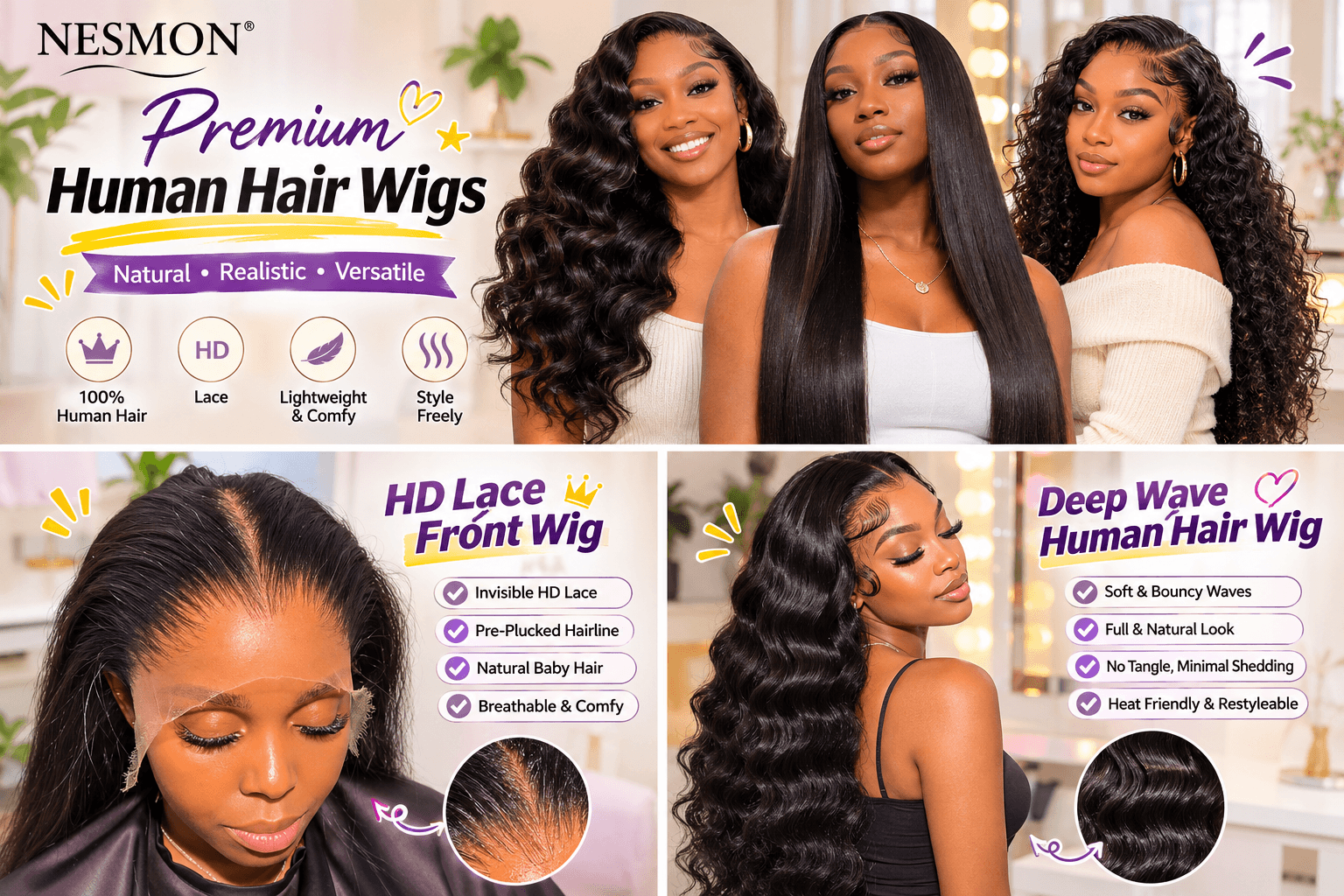
All the construction excellence in the world means nothing if the hair itself is compromised. This is where the wig market’s quality wars are actually fought, and where “100% human hair” claims range from absolutely true to shamelessly false. Nesmon’s lineup is built on 100% unprocessed Brazilian virgin human hair — hair from a single source, with cuticles intact and aligned, never mixed with synthetic fiber or animal hair, and never stripped with acid baths the way lower-grade “human hair” often is.
Why does virgin, cuticle-aligned hair matter so much in daily life? Because it determines how the hair behaves over months, not how it looks on day one. Aligned cuticles lie flat, which means the hair reflects light evenly (that coveted shine), resists tangling, and survives brushing. Acid-stripped or mixed hair looks acceptable for a week, then mats, frizzes, and tangles into a birds’ nest as the damaged cuticles grab each other. Washing accelerates the decline. Virgin hair does the opposite — it often looks better after its first few washes as the hair settles and the true texture emerges.
The Nesmon texture range covers the three styles that anchor most of the wig market, each with its own personality:
- 🌊 Body wave — the best-selling middle path: soft S-waves that straighten easily with heat and bounce back with water and mousse. The most versatile texture for someone who wants one unit to do many jobs.
- 🌀 Deep wave — tighter, more defined ripples with serious dimension and a lush, romantic read. Stunning at full density; asks for a bit more moisture and definition upkeep to keep the pattern crisp.
- ✨ Straight (bone straight) — sleek, mirror-shiny, and high-drama at long lengths. The texture where the 0.10mm lace earns its keep most visibly, because sleek styles expose every illusion flaw.
And because the hair is genuinely virgin, it’s a blank canvas in the chemical sense too: it can be colored, lifted, toned, bleached knots and all — safely, with standard care. For buyers who like to customize their units (dye the roots, add caramel money-piece highlights, gloss the ends), this is the difference between a wig that’s an accessory and one that’s a medium. Just as with natural hair, deep conditioning after chemical work is non-negotiable.

6. Length as a Statement: From Wearable to Unforgettable
Most wig brands stock a sensible ladder of lengths — 18, 20, 22, maybe 24 inches — and stop. Nesmon’s range runs considerably deeper, from a wearable 26 inches all the way to head-turning 40-inch units, and that range is a strategic choice worth unpacking, because length changes everything about how a unit lives on your head.
At 26 inches — the flagship length for the Skinlike HD body wave — hair falls well past the shoulder blades, delivering that long, flowing silhouette that reads glamorous without tipping into costume. It’s long enough for the full repertoire of long-hair styling (buns, braids, mermaid waves) while remaining manageable in daily life. This is the length most first-time long-wig buyers should consider, and it’s no accident that it anchors Nesmon’s most-reviewed product.
Climb past 30 inches and the game changes. At 34 and 40 inches — where Nesmon’s straight and body wave units extend — the hair makes a statement before you say a word. There’s real practical weight to consider: longer units weigh more, require more thorough detangling sessions, take longer to dry after washing, and demand more patience at the gym, in the car, and in the wind. But the payoff is singular. A healthy, high-density 40-inch straight unit moving in the light is one of the most dramatic looks in hair, full stop — and the fact that comparison reviewers consistently highlight Nesmon’s extreme lengths as surprisingly well-executed (full ends, not wispy) tells you the density engineering is carrying its weight.
Choosing Length Honestly
- 📏 26″ — the sweet spot: long, glamorous, manageable. Best first choice.
- 📏 30–34″ — high-drama territory that still functions day to day if you’re committed to detangling.
- 📏 40″ — a statement piece. Budget time for care and consider a dedicated stand; treat it like couture, because it is.
One rule of thumb that saves disappointment: the longer the unit, the more density matters. A sparse 40-inch wig is sadder than a sparse bob, because length amplifies thinning at the ends. This is exactly why Nesmon’s high-density construction and its extreme-length range belong in the same brand — one exists to make the other work.
7. Pre-Plucked Hairlines and Pre-Bleached Knots: The Details That Save Hours
Ask any wig veteran what separated their early, awkward installs from their current ones, and the answer is almost always customization time — the hours spent plucking a doll-perfect hairline into realism and bleaching knots so the lace doesn’t show dark dots at the root. Nesmon ships its units with both jobs already done, and this single decision transforms the out-of-box experience for the majority of buyers who will never set foot in a salon for an install.
Pre-plucking means the hairline has been deliberately thinned and graduated — denser at the back of the hairline, progressively softer and more irregular toward the edge — mimicking how natural hairlines actually grow. Factory-fresh hairlines without this work are uniformly dense and geometrically perfect, which is precisely what makes them scream “wig.” A properly pre-plucked line, like the one on Nesmon units, gives you that soft, slightly imperfect edge that reads as skin.
Pre-bleached knots address the other tell. Every strand on lace is tied in a knot, and on unbleached lace those knots appear as tiny dark specks against the mesh — visible roots on a scalp that shouldn’t have them. Bleaching the knots lightens those ties so the lace reads uniformly like skin. Doing it yourself requires mixing developer, timing it precisely, and risking over-processing the ties. Having it arrive done eliminates an entire skill gate for beginners.
The cumulative effect of these two details plus the ultra-thin lace is a unit that needs dramatically less “work” before it’s wearable. Many buyers report installing Nesmon units with nothing more than lace cutting, a tint or powder pass, and adhesive — skipping the plucking and bleaching sessions entirely. For beginners, that’s the difference between a first install you’re proud of and one you quietly redo at midnight.
🗣️ From the review sections, paraphrased:
“Minimal customization needed. I cut the lace, laid my edges, and walked out the door. First time I’ve ever had a wig be genuinely ready out of the box.”
That review pattern — “less work than expected” — is one of the most consistent threads across Nesmon feedback, and it’s worth more to most buyers than any single specification.
8. Glueless Living: Can You Really Skip the Adhesive?
The word “glueless” gets thrown around the wig market so liberally that it’s nearly lost meaning, so let’s be precise about what it means and where Nesmon’s units fit. A truly glueless install means securing the wig with no skin adhesive at all — relying instead on the cap’s construction: combs, adjustable straps, an elastic band, and the fit of the cap itself. The appeal is enormous: no adhesive cost, no solvent cleanup, no lace-tugging removal, no glue-related skin irritation, and the freedom to remove the unit nightly.
Where do Nesmon units land? The construction supports glueless wear credibly — adjustable straps and a well-fitted cap design are part of the build, and the skinlike lace’s low profile means even without adhesive, the hairline doesn’t lift into that telltale ridge that thicker lace produces. For wearing patterns that don’t expose the hairline aggressively — down styles, low buns, hats and headbands — many wearers run these units fully glueless with confidence.
For maximum melt — slicked-back buns, high ponytails, or anyone wanting the absolute flattest possible installation — adhesive or a grip band still has a role, and the ultra-thin lace rewards it: thin lace melts flatter with less product than thick lace ever will. The honest framing is a spectrum, not a binary:
- Fully glueless, nightly removal — most comfortable, gentlest on lace, ideal for beginners and sensitive skin.
- Grip band or wig grip, no adhesive — adds security for active days without chemicals.
- Light adhesive at the perimeter — the classic melted install for exposed hairline styles.
One genuine advantage of the glueless route that deserves more attention than it gets: lace longevity. Adhesive removal is where most HD lace dies — not from wear, but from impatient peeling and solvent abuse. Wearers who alternate between glueless days and adhered days routinely get dramatically longer lifespans from ultra-thin lace units, because the lace simply isn’t being stressed as often. If you’re investing in a skinlike lace unit, building glueless competence is an investment in the unit’s lifespan, not a compromise.
9. Real Buyers, Real Feedback: The Praise and the Caveats
No promotional look at any brand is complete without the parts buyers wish someone had told them. Sifting the recurring themes across Nesmon’s Amazon reviews, third-party roundup mentions, and social media install content, the feedback splits into clear praise and honest caveats — and both halves are useful.
⭐ What Buyers Consistently Praise
- 🪞 The lace genuinely disappears. The single most repeated compliment, especially from buyers who’ve worn other HD units and can compare. Phrases like “melted with minimal product” and “no lace lines in daylight” dominate.
- 💇🏾♀️ True-to-length and true-to-density. Buyers routinely measure and weigh units on camera; Nesmon runs a reputation for honest specs, with full ends rather than thinned-out tips.
- 💧 Hair that survives washing. Multiple reviewers document wash-and-condition cycles with texture intact and minimal shedding — the truest test of virgin hair claims.
- 📦 Out-of-box readiness. Pre-plucked hairlines and bleached knots mean many installs are genuinely quick.
- 🤝 Customer service responsiveness. A recurring note: when issues arise — a lace snag, a shedding concern — buyers report the brand engaging and making it right, which matters enormously in a category with lots of faceless sellers.
⚠️ The Honest Caveats
- 🧵 Ultra-thin lace demands gentle hands. A handful of reviewers who tore lace during removal learned the hard way that 0.10mm mesh doesn’t tolerate force. Patient removal with proper remover is essential.
- 📏 Extreme lengths are a commitment. The 34″–40″ units are showstoppers, but they’re heavy, take time to dry, and need real detangling sessions. First-time long-wig buyers sometimes underestimate this.
- 🌊 Deep wave needs moisture discipline. Like any defined texture, the wave pattern dulls without regular leave-in and definition refresh. It’s low-effort relative to natural deep wave hair, but not zero-effort.
- 🎨 Human hair has a break-in period. The first wash can release a small amount of shedding — normal for any hand-tied unit — and the hair often looks its best after the first conditioning cycle, not before.
The pattern across both halves is coherent: the product over-delivers on realism and hair quality, and under-delivers only for buyers who treat a delicate luxury construction like a durable synthetic. Buyers who match their handling to the product’s nature report the kind of satisfaction that turns into repeat purchases — and Nesmon’s repeat-buyer base within its own Amazon storefront is among the clearest signals of that.
10. Choosing Your Unit: A Buyer’s Decision Path
The Nesmon catalog is deep enough that first-time visitors can get lost, so here’s a structured path through the decision — the same sequence experienced wig buyers actually use.
Step-by-Step: Finding Your Unit
- Set your wearing pattern first. Daily wear? Occasional events? Active lifestyle? Daily wearers should prioritize comfort and glueless capability; occasional wearers can prioritize drama.
- Choose texture by your styling habits, not by photos. Love styling freedom and straightening? Body wave. Want defined texture with minimal daily styling? Deep wave. Want sleek and formal? Straight. Buy for the week you’ll actually have.
- Pick length by your patience, not your ambition. 26″ for a manageable first long unit; 30″+ only if you’ve lived with long hair before and know the detangling trade.
- Match construction to your style repertoire. If you part in multiple directions, wear updos, or lay edges — the 13×6 full frontal is built for you. If you always wear one part and a down style, you have more flexibility.
- Confirm your cap size and fit. Measure your head circumference and check the cap chart; adjustable straps cover most heads, but measurement prevents returns.
- Plan your install method before it arrives. Order your lace glue or grip band, lace cutter, and edge tools alongside the unit so the first install isn’t improvised.
- Buy the maintenance kit in the same order. Sulfate-free shampoo, a deep conditioner, a wide-tooth comb, and a satin or silk storage solution. A unit without its care kit ages twice as fast.
A final tip worth its own sentence: take photos when the unit arrives — of the lace, the length, the density, the part — before first wear. If anything is ever off, those photos make any resolution conversation with the seller fast and uncontroversial. Experienced buyers never skip this step.
11. Installation Basics: Getting That Melted Look at Home
You don’t need a professional install to get professional results from a unit like this — the out-of-box customization does much of the heavy lifting. But technique still matters, and a clean method separates a good install from a great one. Here’s the process as practiced by the at-home install community, condensed.
The At-Home Install, Step by Step
- Prep the canvas. Braid down or slick back your natural hair flat, and secure a wig cap or the bald-cap method if you’re using adhesive. A flat base is 80% of a flat result.
- Fit and align. Place the unit, aligning the lace hairline with your natural hairline position — roughly one to two fingers above the eyebrows. Adjust straps and combs for a snug, gap-free fit.
- Trim the lace deliberately. Cut the excess lace in small, angled snips following the hairline’s curve — zigzag, not straight across. Leave a few millimeters of lace; cutting too close is the classic beginner error.
- Tint to your skin. A lace tint spray, bronzer, or a light pass of foundation on the underside of the lace takes it from “close to your tone” to “is your tone.” On 0.10mm lace, a little product goes a long way.
- Secure your way. Glueless: adjust straps, add a grip band if desired. Adhered: apply adhesive in a thin layer, let it tack up, and press the lace down section by section — never lay lace onto wet glue.
- Melt and set. Tie down the edges with a satin scarf for ten to fifteen minutes (a cool blow-dryer pass helps with adhesive). This pressing step is what creates the scalp-flat finish people call “melted.”
- Finish the details. Style your part, lay baby hairs if that’s your look, and add a drop of lightweight serum through the lengths for shine.
Two universal rules complete the picture. First, less product is more on thin lace — over-gluing and over-tinting both backfire. Second, patience at removal is where lace lives or dies: saturate adhesive fully with remover, wait until the lace lifts freely, and never, ever pull. A two-minute impatient removal can end a unit that would have lasted a year.
12. Making It Last: Maintenance That Protects Your Investment
A quality human hair unit is a genuine investment — often several hundred dollars — and like any investment, its lifespan is mostly determined by routine, not luck. Well-maintained virgin hair units routinely look excellent for a year or more of regular wear. Neglected ones can decline within months. The good news: the routine is simple and takes minutes.
The Weekly and Monthly Rhythm
- 🧴 Wash every 1–2 weeks of wear with sulfate-free shampoo in lukewarm water, always in a downward motion — never scrubbing or bunching, which roughs the cuticle.
- 💆🏾♀️ Deep condition every wash. Virgin hair has no scalp feeding it; conditioner is its nutrition. Ten minutes with a rich conditioner, rinsed cool, keeps shine and softness.
- 🪥 Detangle from the ends up, section by section, with a wide-tooth comb or wet brush. Bottom-up detangling is the single biggest lifespan extender there is.
- 🔥 Heat with protection, and moderately. The hair styles beautifully with heat, but repeated max-heat flat ironing dulls even virgin hair over time. A thermal protectant and moderate temperatures preserve the hair’s luster.
- 💧 Keep deep wave moisturized. A water-plus-leave-in spritz every few days keeps defined textures from going frizzy at the ends.
- 🌙 Store on a stand or mannequin — never crumpled in a drawer. Silk or satin bags work for travel. Shape preservation is half of long-unit care.
- 🛏️ Sleep smart. A satin bonnet or pillowcase, and loose braids for long units. Friction is the quiet killer of both lace and ends.
One more habit worth adopting: rotate units if you’re a daily wearer. Two alternating units each last dramatically longer than one worn continuously — rest days let the hair recover its moisture and the cap recover its shape. Many Nesmon repeat customers own exactly this: one everyday body wave and one statement-length piece, in rotation.
13. How Nesmon Stacks Up Against the Competition
Context helps a buyer commit, so let’s position Nesmon against the three archetypes it competes with on Amazon — because the category’s price tiers reflect genuinely different products, and knowing which tier you’re shopping in prevents most disappointment.
The Competitive Landscape
| Tier | Typical offering | Where it falls short | Where Nesmon lands |
|---|---|---|---|
| Budget synthetic / mixed hair | Low price, boxy cap, shiny fiber | Can’t take heat, tangles fast, obvious lace | Not competing — different product entirely |
| Mid-tier “human hair” | Real hair but often acid-processed, thinner density, visible lace | Short lifespan, frizz after washes | Nesmon’s virgin hair + 0.10mm lace outclasses this tier on realism and longevity |
| Salon-brand frontals | Excellent quality, boutique pricing, slower access | Cost, availability, less length range | Comparable construction at markedly more accessible pricing, with deep length options |
Against the mid-tier field — where most Amazon wig shopping actually happens — Nesmon’s differentiators are concrete rather than cosmetic: measurably thinner lace, verified virgin hair that behaves through washes, honest density that fills long lengths, and out-of-box customization that used to be a boutique feature. Independent roundup sites that rank 13×6 frontals, HD lace units, and long human hair wigs have repeatedly placed Nesmon in their top selections, typically citing precisely those attributes — and in a category where ranking sites see every brand’s samples, that repetition is meaningful signal, not noise.
The fair summary: Nesmon doesn’t win by being the cheapest listing on the page. It wins by being the last listing you need to click — the one whose specs and review pattern survive the scrutiny that experienced wig buyers apply to everything.
14. Frequently Asked Questions
❓ Is the lace really invisible without bleaching the knots?
The 0.10mm HD lace is thin enough that many reviewers report a convincing hairline with no additional knot work — and Nesmon units arrive with knots pre-bleached anyway, so the question mostly applies to customization purists. In practice: out of the box, the hairline reads natural; with tint and edge styling, it reads seamless.
❓ Can I dye, curl, or straighten the hair?
Yes. This is genuine 100% virgin human hair with aligned cuticles — it takes heat styling and color like natural hair. Deep condition after chemical processing, use thermal protectant before heat, and the hair holds its integrity through the standard styling life of virgin hair.
❓ How long does a unit last?
With the maintenance routine above — gentle washing, bottom-up detangling, protective storage — most buyers report many months of regular wear, with well-treated units often crossing the one-year mark still looking strong. Handling (especially lace removal patience) is the biggest variable.
❓ Is 200% density too much for everyday wear?
It depends on the length and your taste. On 26-inch and longer units, 200% reads as full and healthy rather than bulky, because length consumes density. On shorter styles it would be dramatic — which is why Nesmon’s high density pairs with its long-length range.
❓ Does the unit shed?
Minimal shedding is normal for any hand-tied unit, especially in the first washes as loose hairs release. Reviewers consistently characterize Nesmon’s shedding as low; heavy shedding would signal a construction problem and is worth raising with the seller immediately.
❓ Can I wear it glueless every day?
Yes — the cap construction with adjustable straps supports adhesive-free wear, and the thin lace keeps the hairline low-profile even without glue. For slicked, exposed-hairline styles, adhesive or a grip band adds security. Glueless wear also extends lace lifespan significantly.
❓ What’s the difference between the 13×6 and a 13×4?
Depth of the lace: six inches of parting space versus four. The 13×6 supports deeper parts, more parting styles, and cleaner high ponytails. It’s the better choice for styling variety; the 13×4 is the budget-friendlier option for single-part wearers.
❓ How do I know my cap size?
Measure around your head — following the natural hairline, over the ears, nape to front — and compare to the brand’s cap chart. Most units’ adjustable straps and combs accommodate a range, but measuring prevents the most common return reason.
❓ What should I buy alongside the wig?
A lace cutter or small sharp scissors, lace tint or foundation, your adhesive or grip band of choice, adhesive remover, a wide-tooth comb, sulfate-free shampoo, a deep conditioner, and a satin storage stand or bag. That kit turns delivery day into install day.
❓ What if something’s wrong with my unit?
Photograph everything on arrival before wear. Nesmon sells through Amazon, which provides the platform’s return protections, and reviewers repeatedly report responsive customer service on the brand’s side. Documentation makes any claim fast and clean.
15. The Bottom Line
Wig culture has evolved faster than almost any corner of beauty in the last decade — from something whispered about to something celebrated on TikTok in install tutorials with millions of views. But the technical heart of the craft hasn’t changed: it all comes down to whether the hair looks like it belongs to you. Everything else — density, texture, length, styling — is decoration on top of that single illusion.
Nesmon understood where the illusion breaks and invested there. Skinlike 0.10mm HD lace that dissolves into the scalp instead of sitting on it. Virgin Brazilian hair with intact cuticles that washes, styles, and colors like the real thing. Two hundred percent density that fills 26 to 40 inches without losing a believable part. Hairlines pre-plucked and knots pre-bleached, so the hours of customization that used to gatekeep good installs are already done before the box opens. None of these is a flashy claim; together, they’re the difference between wearing a wig and wearing hair.
If you’re new to human hair units, the 26-inch body wave on skinlike lace is the entry point this brand was practically built around — long enough to feel transformative, manageable enough to live with, forgiving enough for a first install. If you’re a veteran with a shelf of units, the extreme-length straight and deep wave pieces are the ones that keep showing up in comparison charts for a reason. Either way, treat the lace gently, follow the simple maintenance rhythm, and the unit will return the favor for a very long time.
Because in the end, the highest praise this product line can earn is also the quietest: nobody asks. They just assume it’s yours. ✨