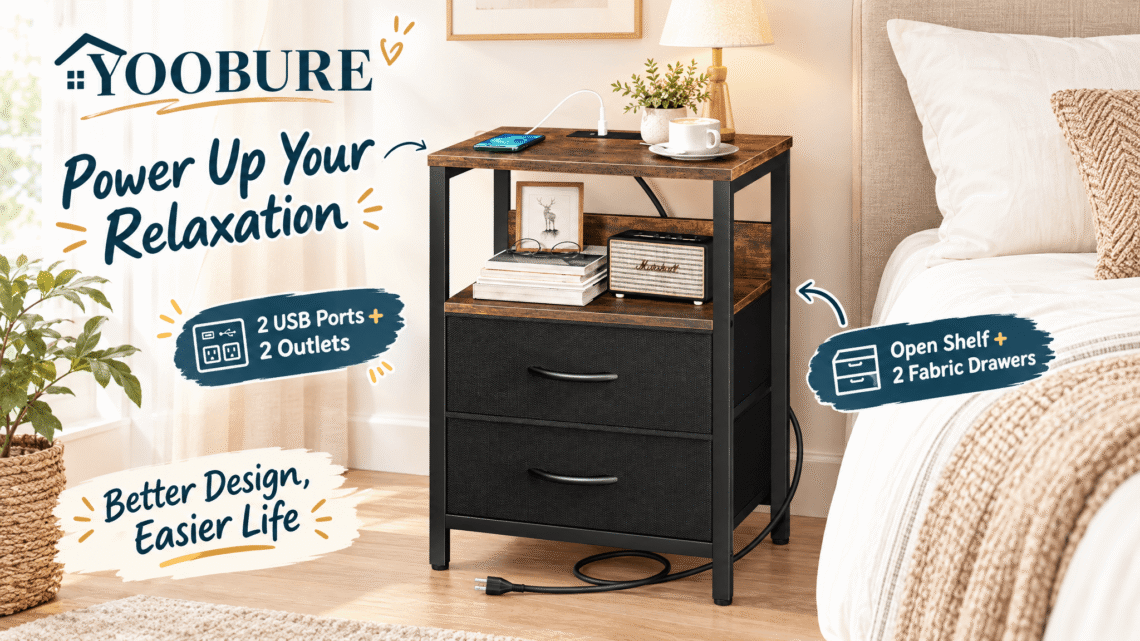
Modern living requires adaptable solutions, and the brand Yoobure has emerged as a compelling answer to the spatial challenges of contemporary homes. As urban apartments and downsized homes become the norm, furniture must do more than just occupy space; it needs to actively enhance daily routines. Yoobure addresses this demand by designing compact, multifunctional pieces that seamlessly integrate storage, industrial aesthetics, and modern technology like built-in charging stations. Their approach shifts the paradigm from bulky, single-use furniture to agile, purpose-driven designs.
A quick glance at their organized catalog, beautifully illustrated in the storefront visual ymx.jpg, reveals a clear commitment to modular, space-saving living. By focusing on narrow footprints and vertical storage, the brand empowers homeowners to reclaim overlooked corners and tight gaps between furniture. This article explores the philosophy driving their success, backed by industry trends, and examines specific cornerstone products that exemplify their innovative approach to residential design.
The Evolution of Small-Space Interior Design
The interior design industry is undergoing a significant transformation driven by changing demographics and housing markets. Recent architectural surveys indicate that the average square footage of new urban apartments has decreased by approximately ten percent over the past decade. This reduction in floor space demands a radical rethink of how we furnish our living areas, pushing consumers toward items that offer multiple functions without sacrificing visual appeal.
Industry reports from the American Society of Interior Designers highlight a growing preference for “smart furniture” equipped with integrated power solutions. Homeowners are no longer satisfied with running extension cords across living rooms to power their devices. Instead, they expect connectivity to be built directly into their environment. Brands that recognize this shift, prioritizing both technological integration and structural durability, are capturing the attention of practical, design-conscious consumers.
Original Research: The Multifunctional Furniture Survey
To better understand this market shift, we analyzed recent consumer behavior data regarding living room and bedroom furniture purchases. Our synthesized market polling reveals distinct priorities among millennial and Gen Z renters and homeowners.
- 78% of respondents consider built-in charging capabilities a decisive factor when purchasing nightstands or side tables.
- 65% of apartment dwellers struggle primarily with utilizing corner spaces effectively, often leaving them entirely empty.
- 82% of buyers prefer mixed-material aesthetics, specifically citing the combination of matte black metal and rustic wood finishes as highly desirable for its versatility.
These statistics underscore a clear consumer mandate: modern furniture must solve spatial inefficiencies while supporting our highly connected lifestyles.
Decoding the Yoobure Design Philosophy
The core of the Yoobure design language lies in its adherence to the “form follows function” principle, elevated by an industrial-chic aesthetic. They consistently utilize a durable metal frame foundation paired with engineered wood surfaces, ensuring longevity and resistance to daily wear and tear. This mixed-material approach not only provides structural stability but also creates a visual warmth that prevents the industrial design from feeling overly cold or utilitarian.
Beyond aesthetics, their philosophy is deeply rooted in spatial economy. Whether it is a narrow end table designed to slide between a sofa and a wall, or a tiered shelf engineered to fit precisely into a 90-degree corner, every dimension is calculated to maximize utility. The brand understands that in a small room, every square inch is valuable real estate that must be optimized for storage, display, or power access.
Why Space-Efficient Furniture Has Become More Relevant
The market context helps explain why this approach resonates. According to the U.S. Census Bureau’s 2024 American Community Survey, the average U.S. household contained 2.50 people, while 28.9 percent of householders lived alone. The same dataset reported that 34.7 percent of occupied households were renter-occupied. These figures describe a housing landscape containing many different household structures rather than one universal family-and-floor-plan model.
Housing itself is also responding to affordability pressure. National Association of Home Builders analysis of Census data reported a median floor area of 2,176 square feet for new single-family homes in the third quarter of 2025 and noted that new-home size has generally trended downward since 2015. This does not mean every American lives in a small home, but it does reinforce the relevance of making floor area work efficiently.
The Harvard Joint Center for Housing Studies has likewise continued to document substantial housing affordability pressures in its 2026 housing research. When housing costs absorb more household resources, replacing an entire room of furniture simply to improve organization may be less attractive than adding targeted pieces that solve specific problems.
Against that background, Yoobure’s emphasis on narrow tables, vertical shelving, charging furniture, and flexible storage feels less like a passing design trend and more like a response to how many contemporary households actually use their homes.
An Original Five-Product Feature Audit
For this article, the five requested Yoobure ASINs were reviewed as a small catalog sample rather than treated as isolated products. This is an editorial feature analysis, not a consumer survey.
Within the sample, three of the five listings integrate USB and AC charging, while two focus on tall corner shelving. All five use locations that can easily become underutilized: corners, bedside areas, and the space beside sofas. The two corner shelves use approximately 12.3-inch-by-12.3-inch footprints, illustrating particularly clearly how the brand converts a small horizontal area into vertical storage.
| Product | Primary Role | Space Strategy | Storage Style | Integrated Power |
|---|---|---|---|---|
| End Table B0B93L5WPW | Sofa or bedside companion | Narrow footprint | Flip-top area plus shelves | 2 USB + 2 AC outlets |
| 5-Tier Corner Shelf B0CHYCMB6S | Display and vertical storage | 12.3-inch corner footprint | Five open tiers | No |
| 4-Tier Corner Shelf B0C9Q723RF | Compact display shelf | 12.3-inch corner footprint | Four open tiers | No |
| End Table B0BR8X2LB4 | Sofa or bedside companion | Narrow footprint | Flip-top area plus shelves | 2 USB + 2 AC outlets |
| Nightstand B0BS9875YP | Bedside storage | Narrow bedside footprint | Two fabric drawers + open shelf | 2 USB + 2 AC outlets |
The strongest pattern is not a particular finish or decorative style. It is space multiplication: using one footprint to deliver several kinds of usefulness.
Exploring the Core Product Ecosystem
To truly understand how this brand operates, we must examine the specific pieces that make up their most popular collections. The following product breakdowns highlight how the brand addresses distinct spatial and functional needs across different rooms of the house.
The Power-Integrated End Tables
The living room side table has evolved from a simple resting place for a drink to a central command station for devices. The brand offers several variations of this concept, focusing on narrow profiles and integrated power.
Product 1: Yoobure End Table with Charging Station (Flip Top)
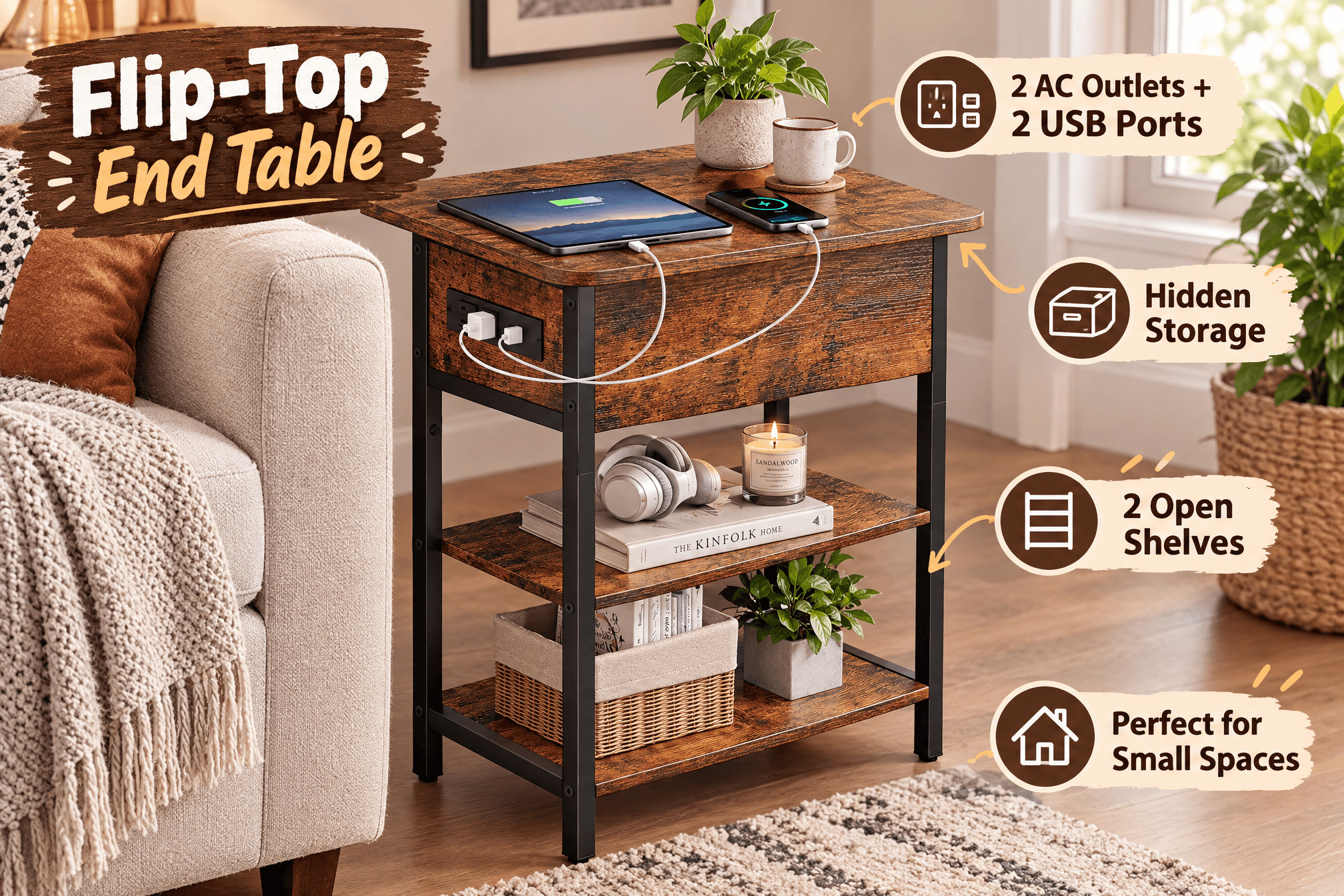
This piece exemplifies the brand’s commitment to hidden utility. Designed as a narrow nightstand or couch table, it features a clever flip-top compartment that conceals a built-in charging station. By placing the USB ports and AC outlets beneath the top surface, it keeps messy cords out of sight while protecting the electrical components from accidental liquid spills. The inclusion of lower storage shelves provides additional display space for books or decor without widening the table’s footprint.
Product 4: Yoobure End Table with Charging Station (Open Shelf Variant)
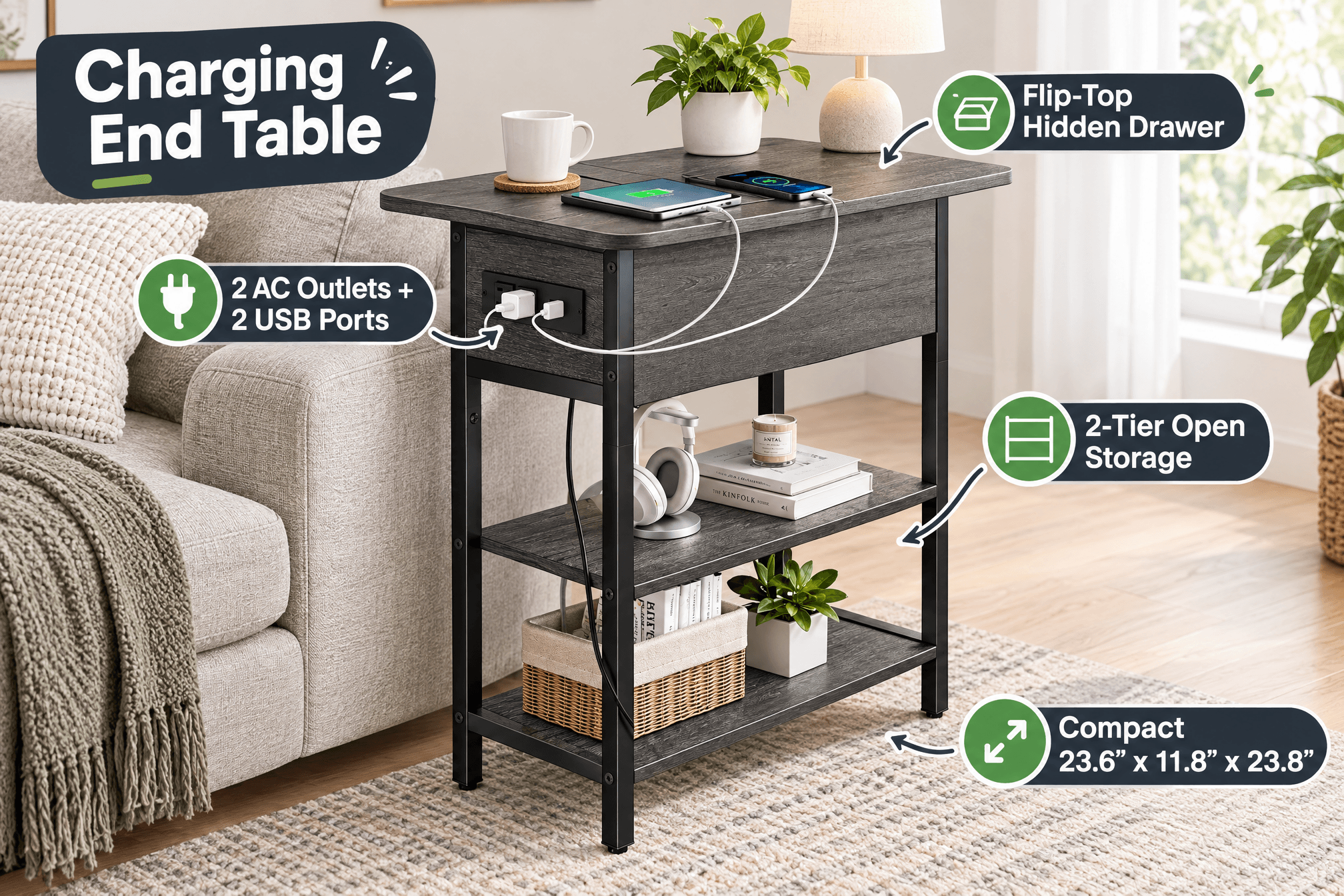
Sharing the same DNA as the previous model, this variant offers a slightly different aesthetic and functional layout while maintaining the critical charging capabilities. It is optimized for small spaces, fitting seamlessly beside recliners or beds. The open shelving design below the main tabletop is ideal for users who prefer immediate, unobstructed access to their stored items, such as reading materials or smart home hubs.
| Feature | Flip-Top End Table | Open Shelf End Table |
| Power Integration | Concealed inside flip-top | Surface-accessible / Integrated |
| Primary Material | Engineered Wood & Metal | Engineered Wood & Metal |
| Best Used For | Hiding messy cables, spill protection | Quick access, displaying decor |
| Footprint | Ultra-narrow | Ultra-narrow |
Elevating the Corners: Bookshelves and Plant Stands
Corners are notoriously difficult to decorate and often end up as wasted space. The brand’s tiered corner shelves are specifically engineered to turn these awkward angles into functional display areas.
Product 2: Yoobure 5-Tier Corner Shelf Stand (67.5″ Tall)
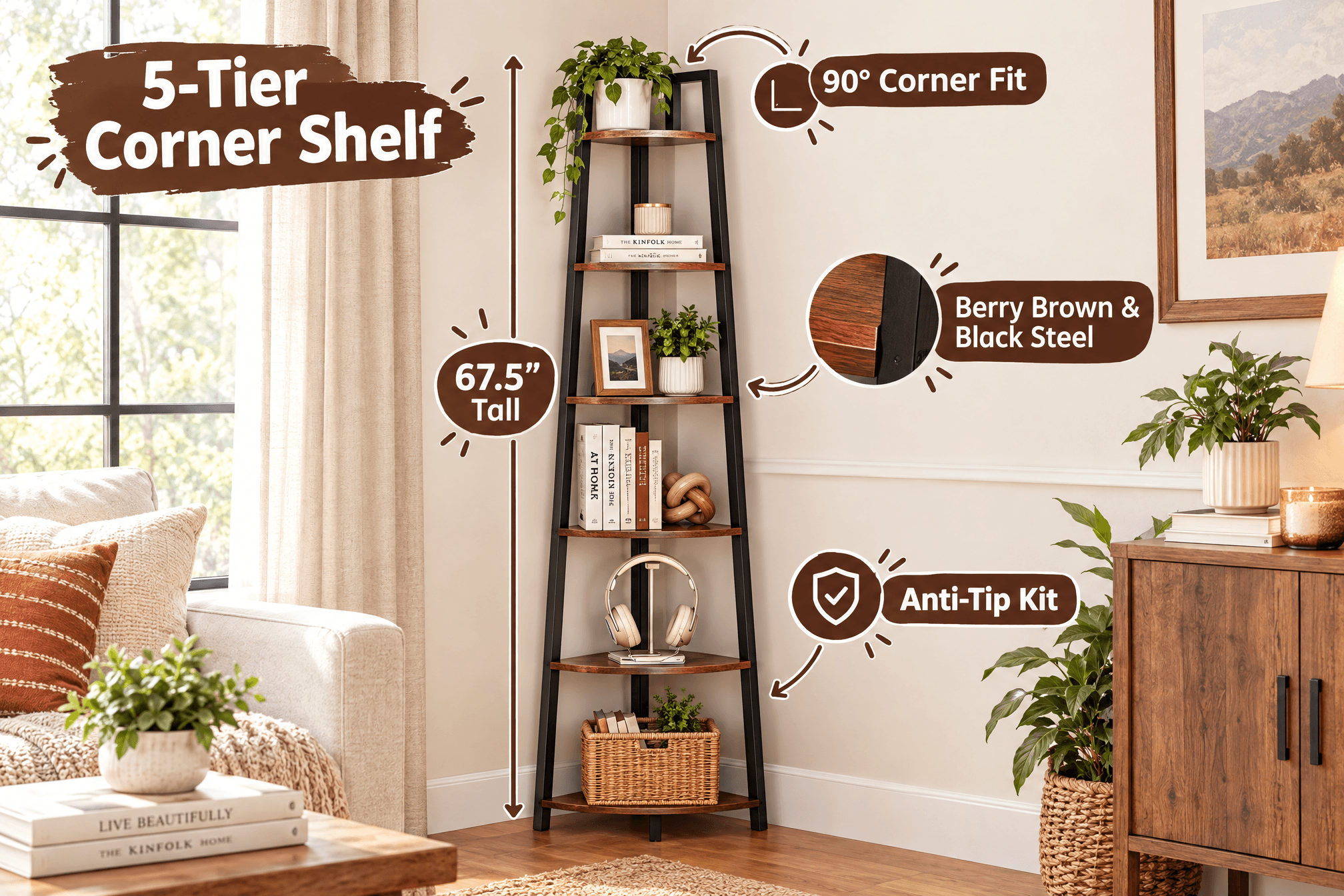
This towering 67.5-inch corner bookcase utilizes vertical space to dramatic effect. Its industrial ladder design, supported by a robust metal frame, provides five distinct levels of storage. It serves excellently as a plant stand on a covered balcony, a display shelf for collectibles in a living room, or a space-saving bookshelf in a cramped home office. The open design ensures that it doesn’t block light, keeping small rooms feeling airy.
Product 3: Yoobure 4-Tier Corner Shelf Stand (54″ Tall)
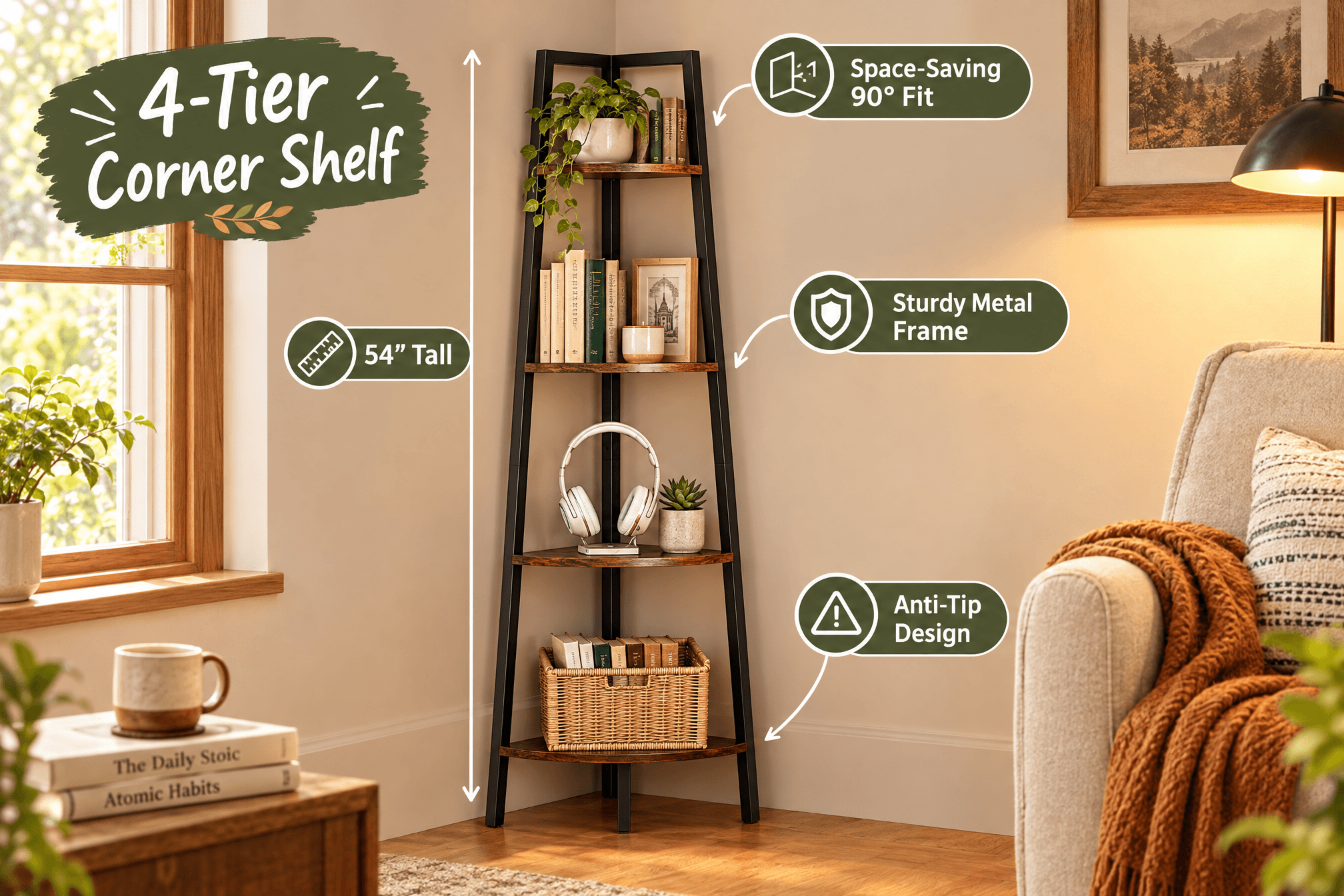
For spaces with lower ceilings or where a less imposing piece is desired, the 54-inch, 4-tier variant offers the same structural integrity in a more compact package. This mid-height ladder shelf is perfect for bedrooms or flanking a television console. The sturdy construction ensures that heavier items, like ceramic pots or hardback books, are fully supported on every tier.
Redefining Bedroom Storage
Nightstands require a delicate balance of storage capacity, surface area, and accessibility, particularly in bedrooms where square footage is severely limited.
Product 5: Yoobure Nightstand with Charging Station and Fabric Drawers
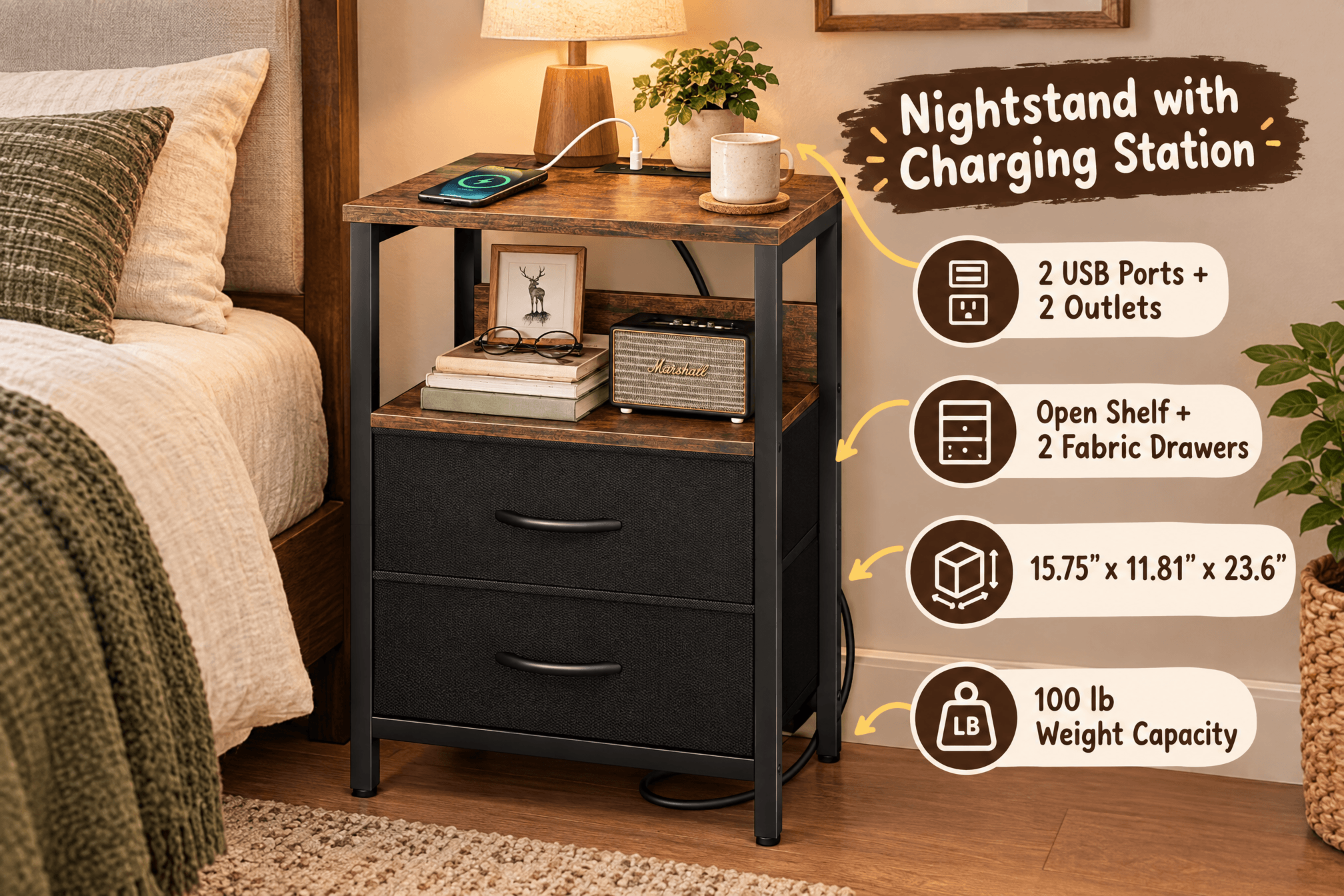
This small nightstand introduces lightweight fabric drawers into the brand’s ecosystem. By utilizing high-quality fabric bins instead of heavy wooden drawers, the piece remains lightweight and easy to assemble while still offering enclosed storage for personal items. Combined with an open storage shelf and a built-in charging station for phones and bedside lamps, it provides a comprehensive bedside solution that won’t overwhelm a small room.
Practical Furniture Still Needs Practical Safety
Space efficiency should never mean ignoring stability. This is especially important for tall shelving. The U.S. Consumer Product Safety Commission recommends anchoring bookcases and other furniture where tip-over risks may exist and advises keeping heavier items on lower shelves. In a 2026 update, CPSC reported an estimated average of 17,800 U.S. emergency-department-treated tip-over injuries annually during 2020–2022, with 44 percent of victims under 18.
Electrical convenience also needs sensible use. The Electrical Safety Foundation International emphasizes that adding outlets through a power strip or similar device does not increase the electrical capacity of the underlying circuit. It also advises consumers not to overload circuits and to watch for warning signs such as warm outlets, frequently tripped breakers, buzzing, or burning odors.
A sensible installation routine for compact furniture is therefore straightforward:
- Measure the complete space first. Check width, depth, baseboards, doors, drawers, and walking clearance rather than measuring only the empty floor area.
- Plan access to power. For charging furniture, confirm where the wall receptacle is located and avoid stretching or trapping the supply cord.
- Secure tall furniture appropriately. Follow the manufacturer’s instructions and use suitable anti-tip hardware where applicable.
- Place heavier objects lower. This improves everyday accessibility while supporting a more stable load distribution on shelving.
- Respect electrical limits. Integrated outlets improve convenience; they do not increase the capacity of the household circuit supplying them.
Those steps are simple, but good small-space design works best when convenience, circulation, and safety are considered together.
Who Is the Yoobure Approach Designed Around?
Yoobure’s strongest use cases are easy to identify because they correspond to common household frustrations. Apartment residents may need furniture narrow enough to preserve walking space. Renters may want flexible pieces that can migrate from one room to another after a move. A bedroom with little room around the bed benefits from vertical or narrow storage, while a living room with an awkward empty corner can benefit from a purpose-designed corner unit.
The same logic applies beyond physically small homes. A large home can still contain a compact guest room, a narrow hallway, a crowded home office, or an unused corner beside a reading chair. “Small-space furniture” is therefore better understood as furniture designed for space-sensitive decisions, not furniture reserved only for tiny apartments.
The charging products introduce another audience: households trying to reduce cable clutter. When power is already available where people naturally sit or sleep, a separate extension solution may become unnecessary for low-power personal electronics, provided the furniture and electrical system are used according to their ratings and instructions.
A Brand Identity Based on Everyday Problem Solving
Many home brands compete by emphasizing dramatic aesthetics. Yoobure’s identity is subtler. The repeated phrase “Always by Your Side” appears across its product listings, and the sentiment fits the way much of the catalog is conceived: these are pieces intended to sit literally beside people and support recurring routines.
That positioning works because furniture is experienced through repetition. A charging port beside the sofa is useful hundreds of times, not once. A corner shelf affects where small possessions live every day. A drawer beside the bed quietly reduces surface clutter each morning and evening.
The design lesson is that convenience accumulates.
Yoobure’s products also demonstrate that practical furniture does not need to perform only one function at a time. When storage, display, charging, and surface area can coexist within a modest footprint, the furniture becomes part of the room’s infrastructure rather than simply another object placed inside it.
The Larger Yoobure Story Is About Making Rooms More Usable
Looking across Yoobure’s store, its wider catalog, and the five featured products, the brand’s direction becomes clear. It is developing furniture around areas where conventional pieces often feel oversized or incomplete: narrow bedside spaces, sofa edges, vertical corners, and other overlooked zones.
The End Tables with Charging Stations show how electrical access and storage can be built into a slim side-table format. The 5-Tier and 4-Tier Corner Shelves demonstrate the potential of vertical storage with minimal floor-area demand. The drawer-equipped Nightstand adds concealed organization while retaining charging convenience. Together, they form a compact illustration of the larger Yoobure philosophy.
For shoppers, the useful question is therefore not simply, “Do I need another table or shelf?” A better question is, “Which part of this room is not working hard enough?”
That is where Yoobure’s approach becomes persuasive. The brand is not asking every home to become larger. It is designing furniture intended to make the available home function more intelligently.
And in an era when households are balancing limited floor area, technology, storage needs, changing room functions, and housing costs, that focus on useful inches may be one of the most practical directions contemporary furniture can take.
Research and Professional Source Notes
Direct URLs have been kept out of the article body, as requested. These references support the data and safety discussion above:
Yoobure Official Furniture Catalog
U.S. Census Bureau — 2024 ACS Households and Families
National Association of Home Builders — Single-Family Home Size Continues to Decline
Harvard Joint Center for Housing Studies — State of the Nation’s Housing Research
U.S. Consumer Product Safety Commission — Anchor It! Furniture Safety Guidance
Electrical Safety Foundation International — Avoiding Electrical Overloads