Dog training has changed significantly over the past decade. For many owners, training is no longer limited to formal obedience classes or basic indoor commands. It now extends into daily walks, outdoor exercise, recall practice, behavioral correction, multi-dog management, and the broader goal of developing a safer and more predictable relationship between pets and their families.
Within this evolving training environment, SLOPEHILL has developed a clear brand identity around practical remote dog training systems designed for everyday use. The brand focuses on products that help owners communicate with dogs across different environments, particularly in situations where distance, distractions, and outdoor activity can make traditional verbal commands more difficult to reinforce.
Rather than positioning itself purely as an electronics manufacturer, SLOPEHILL presents its products as tools that fit into an ongoing training process. Its product range emphasizes usability, multiple configurations, outdoor practicality, recognizable design, and flexibility for different types of dog owners.
This makes SLOPEHILL worth examining not simply as a collection of dog collars, but as a pet-training brand responding to the practical challenges of modern dog ownership.
SLOPEHILL’s Core Brand Position: Training as Part of Responsible Pet Care
One of the clearest themes surrounding SLOPEHILL is the connection between understanding a dog and training a dog.
This distinction is important.
Effective dog training is not simply about stopping unwanted behavior. It is about creating consistency between what an owner expects and what a dog understands. Commands such as come, stay, stop, wait, or leave it only become useful when they are reinforced clearly and consistently across different situations.
SLOPEHILL’s remote training systems are designed to support this communication process.
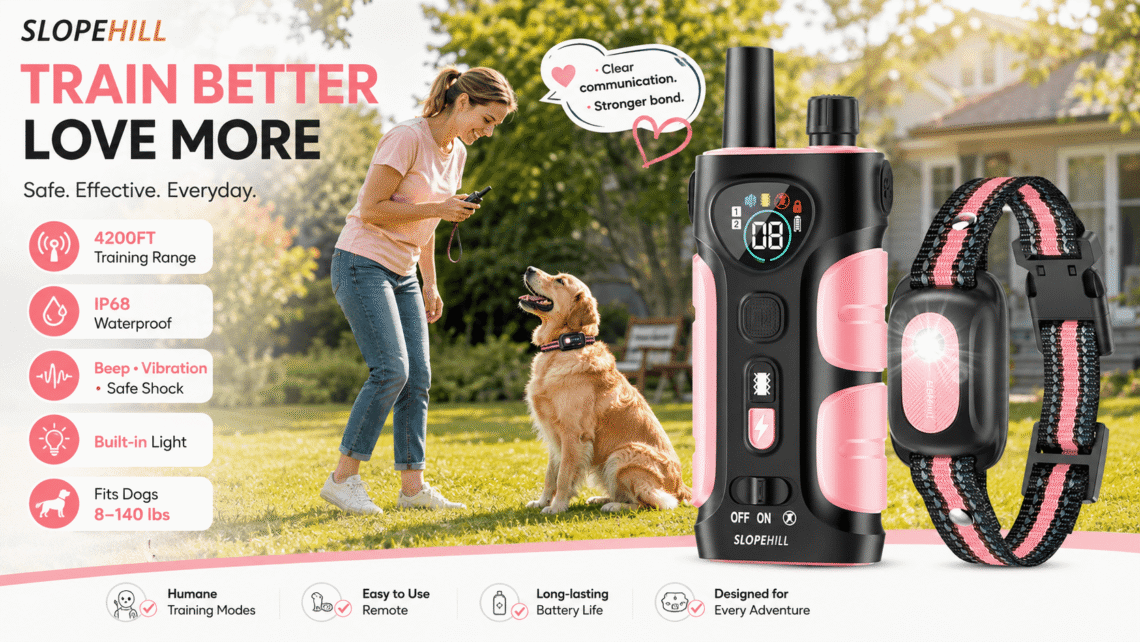
The brand’s products combine wearable dog collars with handheld remote controllers, allowing owners to provide training cues while maintaining physical distance from their dogs. This is especially relevant outdoors, where dogs may become more easily distracted by other animals, unfamiliar environments, moving objects, people, or new scents.
From a branding perspective, SLOPEHILL therefore occupies a useful middle ground.
It is not presenting training as something intimidating or highly specialized. At the same time, it does not treat dog behavior as something that can be managed through accessories alone.
Its product concept makes the most sense when viewed as part of a larger training routine that includes repetition, rewards, clear commands, supervision, and owner involvement.
That practical positioning gives the brand a strong foundation.
A Product Range Designed Around Different Training Needs
A major strength of the SLOPEHILL product collection is variety.
Dog owners rarely have identical training requirements. Some are working with a single young dog. Others manage two dogs simultaneously. Some need a system mainly for backyard practice, while others regularly train in large outdoor spaces.
SLOPEHILL addresses these differences through a broad range of training collar combinations, remote designs, receiver configurations, and color options.
The collection includes recognizable models such as the 880 series and D17T-style training collar systems, alongside multiple other product variations. Some sets are designed around a single collar, while others provide configurations that can be more suitable for households with multiple dogs.
This variety has an important practical advantage.
Instead of forcing every customer toward one standardized system, the brand allows shoppers to consider how they actually intend to train their dogs.
For example, an owner who mainly practices basic obedience around the home may prioritize simplicity and ease of operation. Someone who regularly hikes, exercises outdoors, or manages multiple dogs may place greater emphasis on range, visibility, receiver configuration, or multi-dog control.
The broader SLOPEHILL catalog supports these different use cases while maintaining a consistent visual and functional identity.
This helps the company feel like a focused training brand rather than a seller of isolated products.
Practical Design Is Central to the SLOPEHILL Experience
Remote dog training equipment needs to be functional before it can be impressive.
When an owner is outside with an active dog, complicated operation can quickly become frustrating. A training remote needs to be understandable enough to use without repeatedly stopping to examine the controls.
SLOPEHILL’s products reflect this need for straightforward operation.
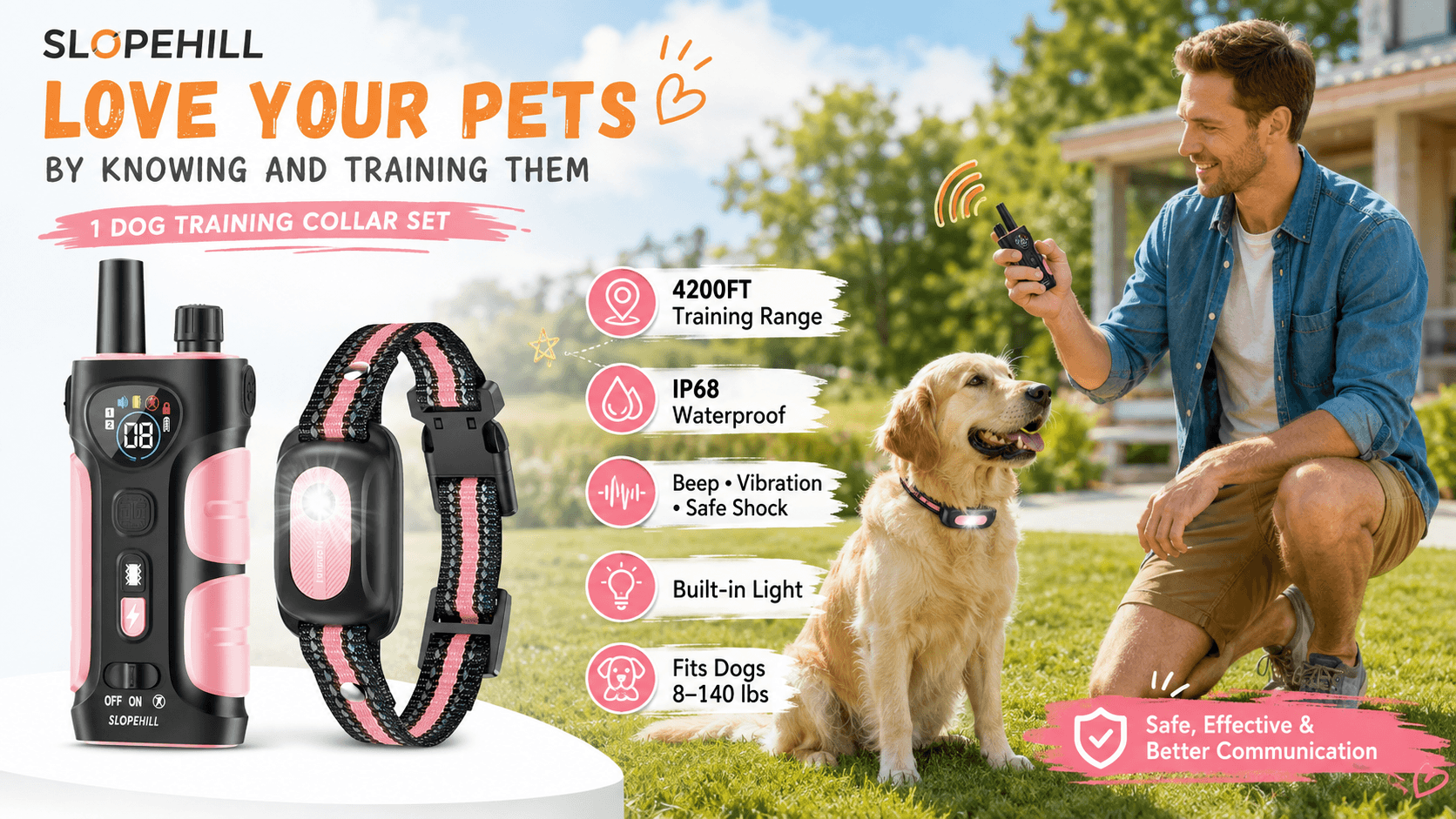
Across the brand’s training systems, the handheld remotes feature prominent buttons, digital displays, and clearly differentiated controls. The overall design appears intended to help users identify and operate key functions with relatively little visual confusion.
This matters because timing is one of the most important elements in dog training.
A training cue is most meaningful when it occurs close to the behavior it is intended to reinforce or redirect. If an owner spends too much time navigating controls, the connection between the behavior and the cue becomes less clear.
A more intuitive remote can therefore support more consistent training.
The collars themselves also contribute to SLOPEHILL’s practical identity. The brand uses a range of colors, including brighter green, orange, pink, purple, and blue accents, as well as darker and more understated alternatives.
These colors give customers more choice, but they can also provide a functional advantage. In multi-dog households, visually distinct collars may make it easier to identify which receiver belongs to which dog.
This combination of functionality and approachable styling is one of the reasons SLOPEHILL products feel appropriate for everyday pet owners rather than only highly experienced trainers.
Built for Training Beyond the Living Room
One of the most relevant aspects of SLOPEHILL’s brand presentation is its strong association with outdoor activity.
Many basic commands begin indoors because the environment is controlled and distractions are limited. However, successful obedience needs to extend beyond the home.
A dog that responds reliably in a quiet room may behave very differently in a yard, field, park, or walking trail.
Outdoor environments introduce unpredictable stimuli. Other dogs may appear suddenly. Wildlife may attract attention. New smells can overwhelm concentration. Greater physical distance can also reduce the effectiveness of verbal communication.
SLOPEHILL’s training systems are particularly suited to this stage of training.
Remote-controlled feedback allows owners to maintain another channel of communication when the dog is farther away. For owners who are practicing recall, boundary awareness, or attention control, this can make structured outdoor sessions easier to manage.
The brand’s outdoor-focused imagery reinforces this purpose. SLOPEHILL products are frequently shown alongside active dogs in yards, fields, and open spaces rather than only in indoor environments.
This creates a clear product message: the equipment is designed to participate in real daily routines.
For customers, that is often more meaningful than highly technical positioning.
The Importance of Flexibility in a Dog Training Brand
A successful training system should accommodate differences between dogs.
Breed, size, energy level, confidence, sensitivity, age, training history, and personality can all influence how a dog responds during training.
For that reason, flexibility is valuable.
SLOPEHILL’s product family gives owners several choices in equipment style and configuration, allowing them to select a system that more closely matches their circumstances instead of assuming that every training situation is identical.
This is particularly important in homes with multiple dogs.
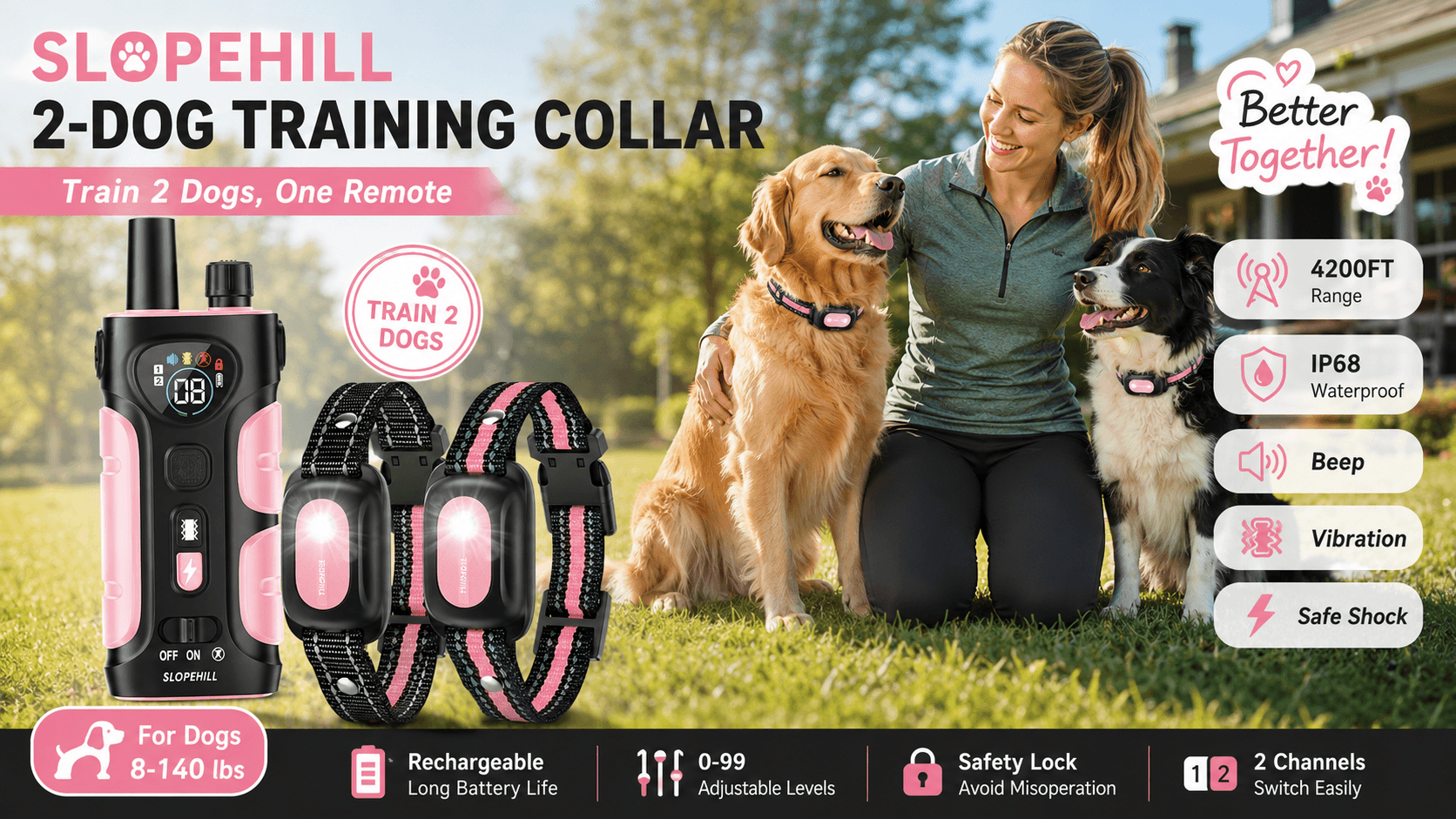
Training two dogs can be considerably more complicated than training one because each animal may learn at a different pace. One dog may respond quickly to verbal commands while another becomes easily distracted outdoors.
Multi-collar configurations can help owners organize these situations more efficiently when the equipment is used carefully and correctly.
The availability of different receiver and remote combinations also gives the SLOPEHILL range a sense of scalability.
A shopper can evaluate products according to actual needs rather than simply purchasing the largest or most complicated option available.
This practical flexibility strengthens the brand’s overall value proposition.
SLOPEHILL Is Better Understood as a Training Tool Brand, Not a Shortcut Brand
Remote collars are sometimes misunderstood as devices that automatically create obedience.
That is not how effective training works.
No electronic tool can replace teaching a dog what a command means.
If a dog does not understand “come,” a remote signal does not suddenly provide that understanding. The owner must first establish the desired behavior through clear instruction, repetition, rewards, and consistent expectations.
SLOPEHILL products are therefore best viewed as supporting tools rather than substitutes for training.
This distinction is essential for responsible use.
The strongest training programs generally combine several elements:
- Clear verbal or visual commands
- Positive reinforcement for desired behaviors
- Consistent rules and expectations
- Appropriate exercise and mental stimulation
- Structured practice in progressively more distracting environments
- Careful and responsible use of training equipment
Within this framework, a remote collar can help reinforce communication, particularly when distance makes immediate interaction more difficult.
This broader perspective also makes SLOPEHILL more appealing as a brand because the value of its products is not based on promising instant results.
Their usefulness depends on how intelligently they are incorporated into the owner’s existing training approach.
Why Ease of Use Matters More Than Excessive Complexity
Pet technology has become increasingly sophisticated, but more features do not automatically produce a better user experience.
Dog training equipment should reduce friction rather than create additional distractions.
SLOPEHILL appears to understand this.
Its controllers emphasize large, visible interfaces rather than excessively minimalist designs that might look attractive but become difficult to operate quickly.
This matters during active training.
An owner walking, jogging, or supervising a dog outdoors often cannot devote full attention to a handheld device. The remote needs to function as an extension of the training process rather than becoming the center of it.
Simple controls can also make it easier for multiple family members to follow the same training routine.
Consistency between people is often overlooked in dog training. If one person uses certain commands while another uses completely different cues, dogs may receive mixed signals.
Equipment that family members can understand and operate consistently can therefore support a more organized approach.
SLOPEHILL’s practical design language aligns well with this reality.
The Brand’s Visual Identity Helps Differentiate Its Products
The dog training collar category contains many products that can appear almost identical at first glance.
SLOPEHILL stands out partly through presentation.
Its use of contrasting color accents gives individual models a more recognizable personality. Bright green, orange, purple, pink, and blue variations create a product lineup that feels more accessible and less industrial.
This is a useful branding strategy.
Pet products increasingly exist at the intersection of utility and lifestyle. Customers still expect durability and functionality, but they also care about design, organization, portability, and appearance.
A training collar may be primarily functional, yet it remains an accessory the dog may wear regularly during outdoor activities.
Offering visual choice recognizes that reality.
The result is a product family that feels coordinated without becoming repetitive.
Suitable for a Broad Range of Everyday Training Scenarios
SLOPEHILL’s product category can support several common training situations when used responsibly.
Recall practice is an obvious example. Teaching a dog to return reliably is important for control and safety, particularly in larger environments.
Boundary training is another common use case. Owners may need to reinforce expectations around specific areas of a yard or outdoor property.
Attention management can also become important during walks or exercise. Highly energetic dogs can become focused on other animals or environmental distractions, making it difficult for owners to redirect them using voice alone.
For multi-dog households, synchronized training can present another challenge. Managing two dogs while maintaining consistent commands requires concentration and organization.
A remote system can help owners maintain clearer communication across these situations.
However, the effectiveness of any training tool depends on responsible handling.
SLOPEHILL products should be introduced gradually, operated according to the instructions, and used with careful attention to the dog’s behavior and comfort.
The goal should always be clearer communication rather than stronger correction.
Responsible Training Should Remain the Priority
Any serious discussion of dog training collars should include responsible-use considerations.
Owners should understand the product before placing it into regular use. Beginning conservatively, observing the dog’s response, and maintaining consistent commands are all important.
Training should also be appropriate to the individual animal.
A sensitive dog may require a very different approach from a confident, energetic dog. Age, previous experiences, and temperament can influence how quickly new training methods should be introduced.
Owners should never assume that increasing intensity is automatically the solution when a dog fails to respond.
Sometimes the underlying issue is confusion.
Sometimes the environment is too distracting.
Sometimes the dog needs additional practice with the basic command.
And sometimes professional guidance may be appropriate.
Responsible ownership requires recognizing those differences.
When used as part of a thoughtful training strategy, products like those offered by SLOPEHILL can become useful communication aids. They should complement good training practices rather than replace them.
What Ultimately Defines SLOPEHILL?
SLOPEHILL’s strongest quality is focus.
The brand has developed a recognizable product family around a specific area of pet ownership instead of attempting to cover every possible pet accessory category.
Its training collars and remote systems share a consistent purpose: helping owners maintain clearer communication with dogs across different distances and environments.
Several characteristics support that identity.
The range provides multiple configurations for different households. The remote designs emphasize accessibility. Color choices give the products stronger visual recognition. Outdoor-oriented presentation reflects realistic training situations. Multi-dog options expand the collection beyond basic single-pet use.
Together, these elements create a brand that feels practical rather than overly complicated.
SLOPEHILL is therefore likely to appeal most to owners who understand that dog training is an ongoing process and want equipment that can become part of that routine.
Final Assessment: A Practical Brand for More Consistent Dog Training
The most valuable dog training tools are not necessarily those with the longest feature lists.
They are the products that fit naturally into the way people actually train.
SLOPEHILL has built its brand around this practical idea.
Its remote dog training collar systems are designed for common situations in which communication becomes more challenging: outdoor exercise, recall practice, distance training, behavioral redirection, and multi-dog management.
The brand combines these functional objectives with approachable styling, multiple product configurations, and controller designs intended to remain practical during active use.
More importantly, SLOPEHILL makes the most sense when its products are treated as part of a complete training strategy.
Good communication between a dog and its owner develops through patience, repetition, consistency, rewards, clear expectations, and appropriate tools. Technology can support that process, but it cannot replace it.
That is ultimately where SLOPEHILL finds its strongest position.
It is not simply selling equipment that dogs wear.
It is providing owners with another way to reinforce communication when voice, distance, and distraction do not always work together perfectly.
For households looking to establish more consistent training habits, explore outdoor training with greater structure, or manage communication with one or multiple dogs, SLOPEHILL offers a focused range of products designed around those everyday challenges.
The result is a brand with a clear purpose: making practical dog training easier to organize, easier to maintain, and better suited to the realities of life beyond the training room.