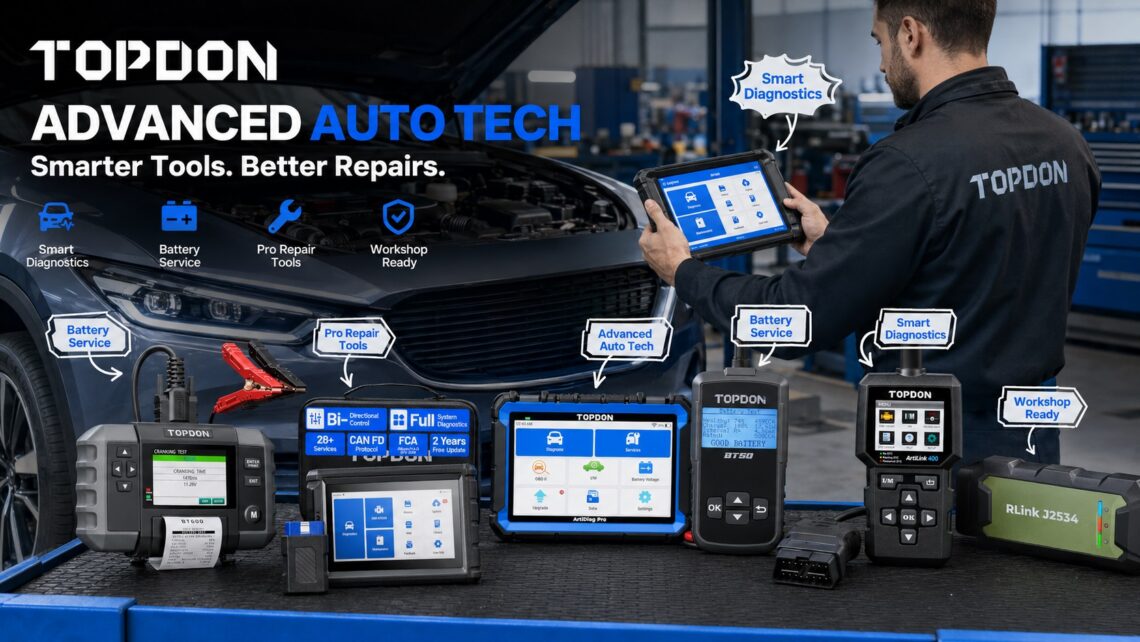
TOPDON Automotive Tools for Diagnostics, Battery Testing, and Repair
From a simple check-engine-light question to deeper system testing and battery analysis, the right automotive tool can turn guesswork into a much clearer repair plan.
There is a familiar moment in vehicle ownership: a warning light appears, the engine sounds slightly different, the battery hesitates on a cold morning, or a car that was running normally yesterday suddenly refuses to start. The temptation is to search a code online, replace the most obvious part, and hope the problem disappears. Sometimes that works. Often, it creates a longer and more expensive chain of trial-and-error repairs.
That is where automotive diagnostic equipment earns its place. A good scan tool does not repair a vehicle by itself, and a battery tester cannot magically restore a worn-out battery. What they can do is provide useful evidence. They help drivers, DIY technicians, and repair professionals move from “something feels wrong” to a more focused set of questions: Which system is reporting a fault? Is the code current or stored? Is the battery actually weak, or is the charging system the real concern? Can an actuator be commanded during testing? Is a repair supported by test results rather than a hunch?
TOPDON’s automotive tool range is built around those practical questions. The lineup includes entry-level OBD2 code readers, more advanced bidirectional scan tools, battery and charging-system testers, and specialized pass-thru equipment intended for professional workflows. Instead of approaching the catalog as a collection of gadgets, it makes more sense to see it as a set of tools for different stages of diagnosis: read, inspect, test, verify, and only then decide what to repair.
Diagnostics Begin With Context, Not Just a Trouble Code
Modern vehicles are networks on wheels. Engine management, transmission behavior, anti-lock braking, airbags, climate control, body electronics, parking sensors, steering systems, and driver-assistance features can all generate information. That information may be helpful, but it can also be misunderstood when it is viewed without context.
A diagnostic trouble code is not automatically a parts list. A code may indicate a circuit issue, an out-of-range reading, a communication problem, or a condition that occurred under a particular set of operating circumstances. It may be caused by a failed component, but it can also be related to wiring, a connector, low voltage, vacuum leaks, software behavior, poor grounds, or an issue elsewhere in the system.
For example, a vehicle that records a low-voltage-related fault may not need a new sensor at all. If the battery is weak, the alternator output is inconsistent, or the terminals have excessive resistance, multiple unrelated modules can behave strangely. That is why experienced technicians frequently start with the basics even when a scan tool reports something more dramatic. Battery condition, system voltage, connectors, fuses, grounds, and live data all matter.
The useful role of a scanner is to shorten the path to relevant information. A basic tool can retrieve generic OBD2 codes, offer code definitions, display freeze-frame information, and help an owner determine whether a warning light should be investigated further. A more capable diagnostic tablet can go much further by reaching multiple vehicle systems, presenting live data, supporting maintenance functions, and, when supported by the vehicle, performing active tests.
The key phrase here is “when supported.” Vehicle coverage varies by make, model, year, market, software version, and system architecture. A responsible approach is to confirm compatibility before assuming that every function shown on a product page will be available on every vehicle. That does not make the tool less useful; it simply reflects the complexity of modern automotive electronics.
Choosing the Right Level of Scan Tool
Not every garage needs the same diagnostic capability. A driver who wants to understand a check-engine light before visiting a repair shop has a very different set of needs from an independent technician who works on several makes every week. The best purchase is not necessarily the tool with the longest feature list. It is the tool that matches the work actually being done.
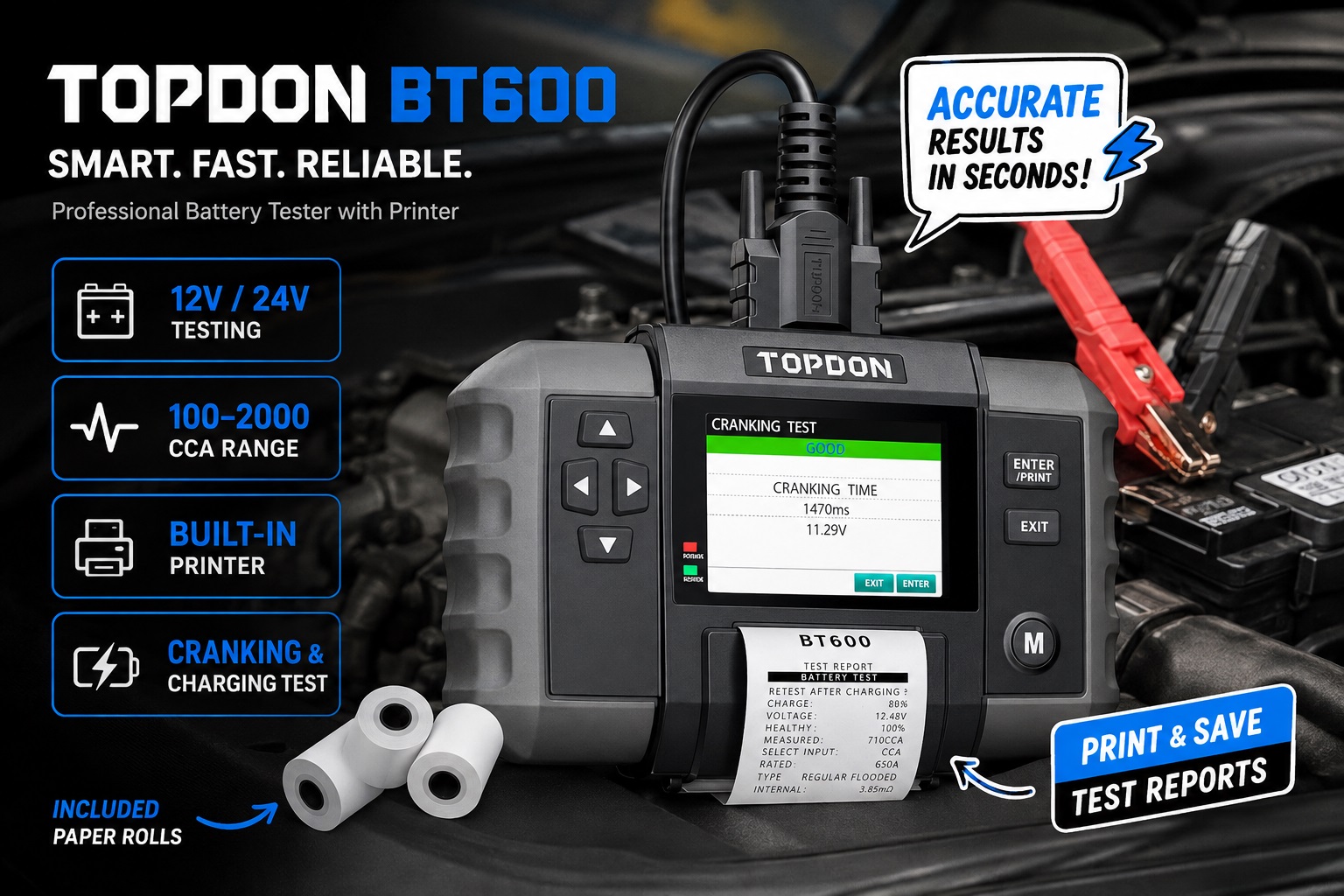
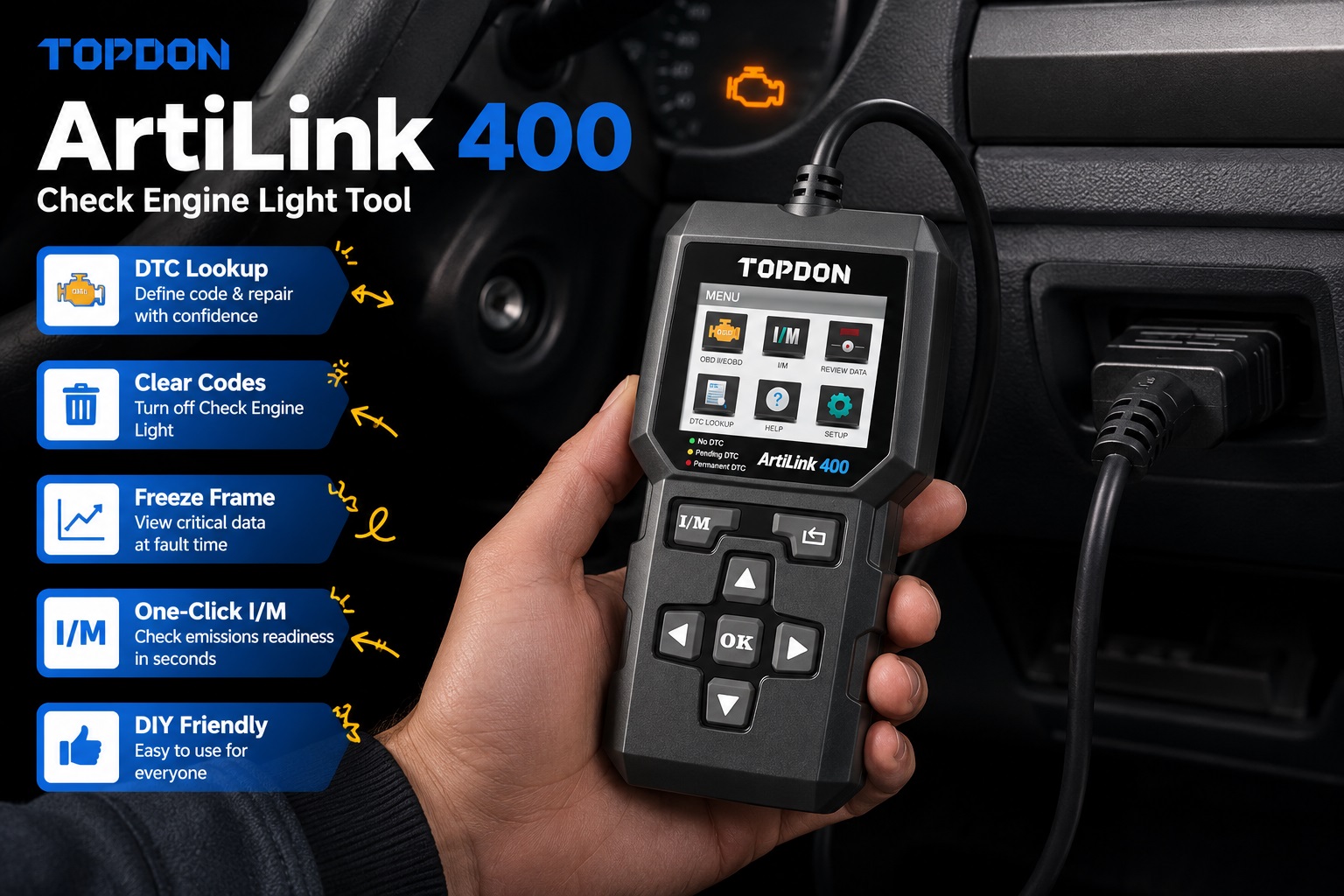
At the accessible end of the range, the TOPDON AL400 is positioned as a full OBD2 code reader for DIY users. Its stated functions include reading and clearing codes, displaying freeze-frame information, DTC lookup, and a one-click I/M readiness check. For someone who owns one or two vehicles and wants a straightforward way to investigate a check-engine light, this type of scanner can be a sensible starting point.
Its value is not that it turns a beginner into a master technician. Its value is that it provides a clearer first look. If the light appears after a loose fuel cap, a basic code reader may help identify whether the vehicle has stored an emissions-related code. If a repair has already been completed, checking readiness monitors can be useful before an inspection. If a code returns quickly after being cleared, that is a sign that the underlying issue is still active and deserves proper diagnosis.
Basic readers are often overlooked because they do not have the drama of a large touchscreen tablet. Yet simple equipment can be extremely useful when the task is simple. A compact code reader is easy to keep in a glovebox, tool drawer, or home garage. It can make an owner more informed before talking to a shop, especially when the alternative is guessing based on a dashboard symbol alone.
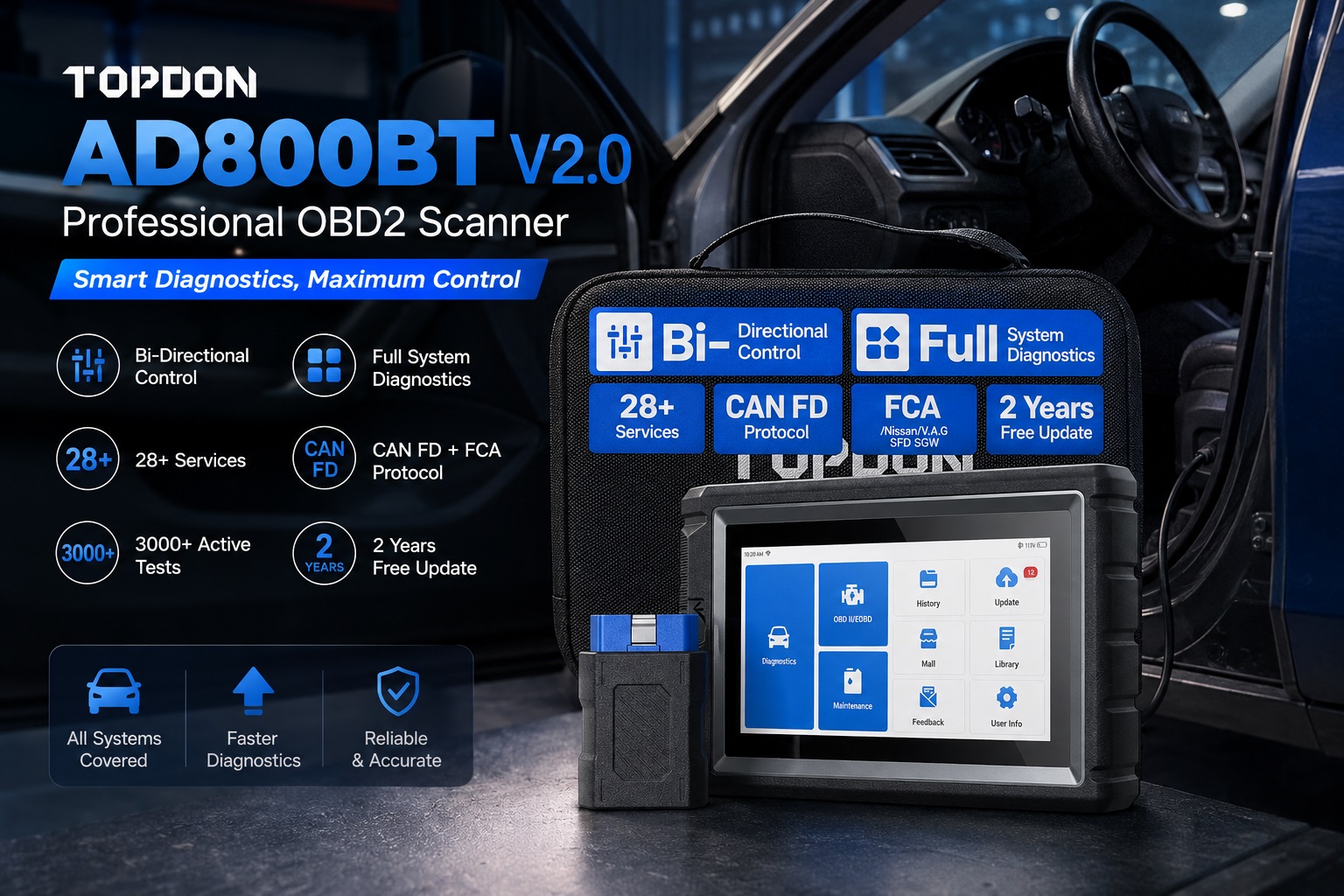
For more involved work, TOPDON offers tools such as the AD800BT V2.0. Its product listing describes a bidirectional OBD2 scanner with full-system diagnostics, active tests, service functions, FCA Secure Gateway access capability, and a vehicle health check. Those features point toward a different style of use: diagnosing beyond generic powertrain codes and interacting with supported vehicle systems during testing.
Bidirectional control is particularly important to understand. Reading data is passive: the tool receives information from the vehicle. Bidirectional testing is active: the tool may command a supported component or system to operate so the technician can observe the response. Depending on the vehicle and function, that could help test components such as fans, pumps, relays, solenoids, windows, lights, or other electronically controlled systems. It is not a replacement for electrical testing, but it can narrow a diagnostic path much faster than replacing parts based on a code alone.
A practical example makes the difference clearer. Imagine a cooling fan issue. A fault code might suggest a fan-control problem, but that still leaves several possibilities: the fan motor, relay, wiring, command signal, module, fuse, or temperature-related input. An active test that commands the fan can help establish whether the system responds. From there, voltage checks and circuit testing can be more targeted. The scanner gives direction; the technician still has to interpret the results.
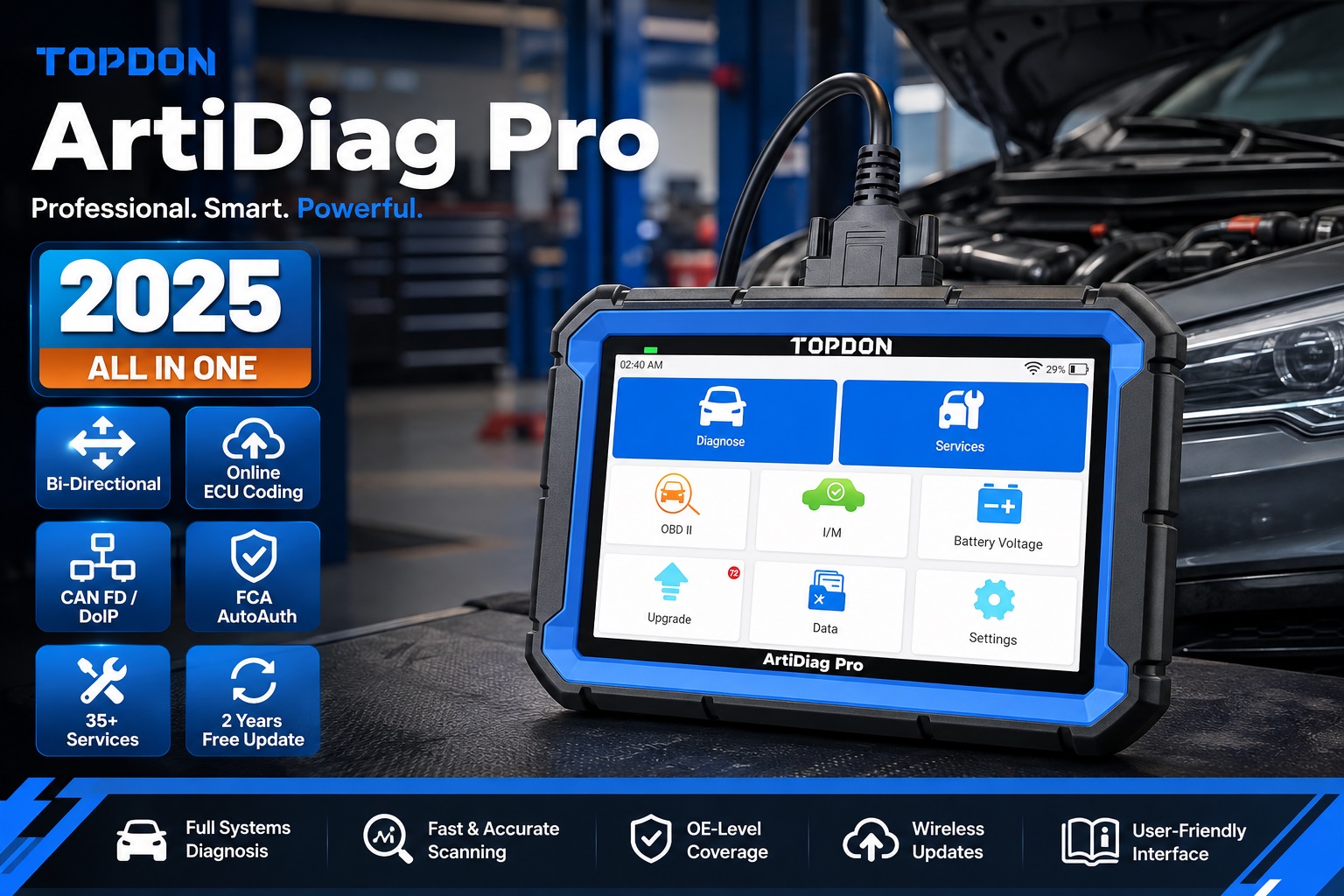
The ArtiDiag Pro is another option aimed at users who need advanced system coverage and bidirectional capability. Its listing identifies ECU coding, more than 35 service functions, V.A.G guided functions, FCA SGW support, CAN FD, DoIP, and all-system diagnosis. That is a substantial set of terms, but their importance depends on the vehicles in the bay. A technician who routinely services newer vehicles may need modern communication protocols. Someone working mainly on older cars may not need every advanced capability on day one.
The point is not to buy complexity for its own sake. It is to avoid outgrowing a tool immediately. If repair work is becoming more frequent, if several household vehicles are involved, or if an independent shop is handling a wider range of systems, a higher-tier scanner can make the diagnostic process more organized. A robust tool is most valuable when it reduces repeat testing, shortens dead ends, and helps document what has actually been checked.
For readers comparing tools across the lineup, TOPDON provides a useful starting point for looking at the available diagnostic, battery-testing, and repair-oriented options in one place. The best comparison is not “which unit has the biggest list?” but “which functions match the vehicles and work I handle most often?”
What a Good Diagnostic Routine Looks Like
Even the most capable scanner is only one part of the process. A repeatable routine prevents a great deal of wasted effort. That routine does not need to be complicated, but it should be disciplined.
Start by listening to the complaint carefully. Does the vehicle fail to start only in the morning? Does the warning light return immediately or after a long highway drive? Is the issue connected to rain, heat, low fuel, a recent repair, or an aftermarket accessory installation? These details matter because many faults are intermittent and condition-dependent.
Next, perform a visual inspection. Look for damaged wiring, loose connectors, battery corrosion, missing grounds, fluid leaks, chewed harnesses, cracked intake tubes, and obvious signs of previous work. It is surprising how often a sophisticated diagnostic challenge begins with something visible once the hood is open.
Then scan the vehicle and record the results before clearing anything. Stored codes, pending codes, permanent codes, freeze-frame data, and module communication faults can all provide clues. Clearing codes too early can erase useful evidence. The goal is to understand what the vehicle saw and under what conditions it saw it.
After that, verify the basics. Battery voltage, charging behavior, fuses, power feeds, and ground integrity should not be skipped simply because the scanner points elsewhere. Electrical systems are interconnected. A battery that is marginal under load can lead to a trail of misleading symptoms, particularly in vehicles with many modules.
Only then should parts replacement become a serious consideration. When a component is replaced, the repair should be verified. Scan for returning codes, perform the appropriate relearn or service procedure when necessary, inspect live data again, and test-drive the vehicle under the conditions that originally caused the complaint. This final step is where many DIY repairs fall short. The warning light is gone, but the actual fault has not been proven resolved.
Battery Testing: The Check Most People Skip Until They Are Stranded
Battery health is easy to ignore because the battery usually works quietly in the background. It does not get the attention of a check-engine light, an oil leak, or a noisy brake system. But a weak battery can create a surprising range of symptoms: slow cranking, intermittent no-starts, warning messages, communication errors, erratic electronics, and poor start-stop performance.
A voltage reading alone does not tell the entire story. A resting battery can show a seemingly healthy voltage and still struggle when asked to supply starting current. Likewise, a battery that is low may simply need charging, or it may have lost capacity and be nearing the end of its service life. A proper battery test aims to assess condition more meaningfully than a quick glance at a multimeter.
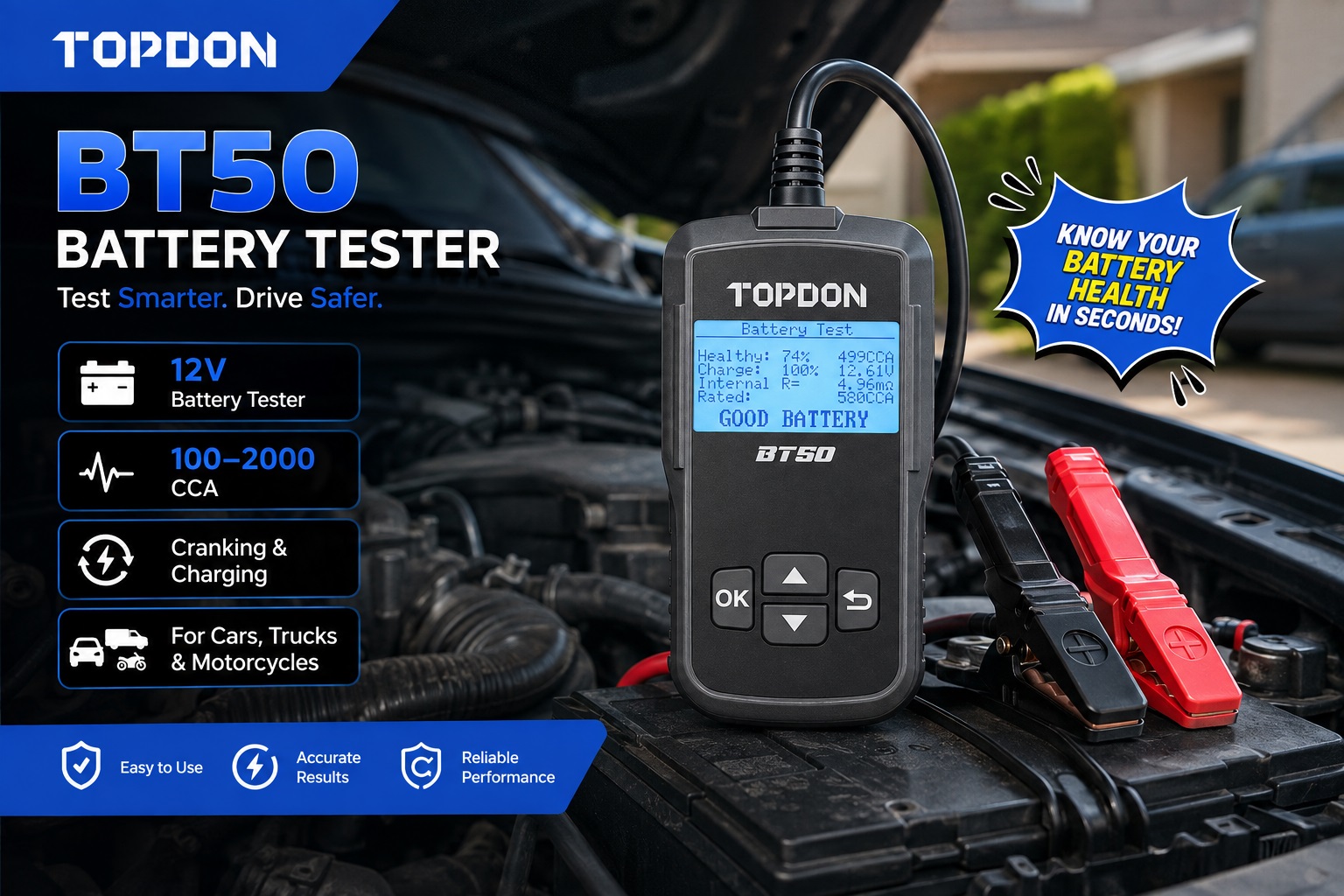
TOPDON’s BT50 is presented as a 12V battery tester for cars, trucks, SUVs, and motorcycles, with coverage for batteries rated from 100 to 2000 CCA. The listing also identifies battery, cranking, and charging-system testing. That combination addresses three closely related questions: Is the battery in acceptable shape? Does the engine crank with an appropriate voltage response? Is the charging system doing its job afterward?
For the average vehicle owner, those are exactly the questions that matter. A battery test can help distinguish between a battery issue and a problem that requires closer attention. If cranking performance is poor, it may point toward the battery, connections, starter circuit, or starter itself. If the battery repeatedly runs low, a charging-system test can help guide the next step. It may be an alternator problem, but it could also be a loose belt, a connection issue, parasitic draw, short-trip usage, or a battery that no longer holds a charge properly.
The BT600 expands the battery-testing concept with support for 12V and 24V systems, a 3.5-inch display, and a built-in printer, according to its listing. It is designed for battery ratings in the 100 to 2000 CCA range and evaluates battery, cranking, and charging systems. The added 24V support and ability to print results make it particularly relevant for workshops, fleet operators, and technicians who need to document findings for customers or service records.
Printed test results may sound like a small convenience, but documentation changes the conversation. Instead of telling a customer that a battery is “probably weak,” a technician can explain the measured condition and the reason further action is recommended. It also provides a useful baseline. If a vehicle returns later with a similar complaint, previous test results can help determine whether the condition has changed.
Battery testing is also valuable after a repair. If a vehicle arrives with multiple warning messages and a poor starting complaint, replacing a battery without checking charging performance may only solve half the problem. Likewise, replacing an alternator without confirming the battery’s condition can leave a customer with an incomplete repair. A good workflow tests the battery, evaluates cranking, checks charging, and then considers whether there may be an excessive draw or another contributing issue.
There is one important caveat: battery testing should be performed with the correct battery information entered and with the terminals in good condition. If corrosion is present or clamps are not making solid contact, the test can be compromised. The battery type and rating on the label matter as well. Using the wrong CCA value will not produce a useful assessment. As with any measurement tool, accurate input and good connections are part of accurate output.
Why Battery and Scan Tools Belong Together
It is common to think of a scan tool and a battery tester as separate categories. In daily diagnostic work, they often support each other. A scan tool tells you what the modules are reporting. A battery tester helps establish whether the electrical foundation is stable enough for those reports to be trusted.
Consider a vehicle that suddenly displays warnings for steering, braking, stability control, and transmission systems after sitting overnight. It would be easy to become overwhelmed by the number of codes. But if those codes share a low-voltage history, the most productive next move may be a battery and charging-system test rather than immediate component replacement. The same principle applies after jump-starting a vehicle. The engine may run, but that does not prove the battery is healthy or that the alternator is charging correctly.
This is especially relevant with modern vehicles, which may remain active after the ignition is switched off. Modules can perform shutdown routines, communicate with one another, and wake under certain conditions. A battery that would have seemed adequate in an older vehicle may produce more noticeable symptoms in a newer one simply because the vehicle is more electronically demanding.
A thoughtful home garage setup can therefore include both a code reader and a battery tester. The code reader answers, “What did the vehicle detect?” The battery tester helps answer, “Is the electrical system in a condition that could be contributing?” Neither replaces a professional diagnosis in every case, but together they create a far more informed starting point.
Going Beyond Read-Only Diagnostics With Active Tests
As vehicles become more electronically controlled, the gap between a generic code reader and a professional-level scan tool becomes more significant. Many faults cannot be diagnosed effectively by reading generic powertrain codes alone. Body modules, airbag systems, ABS modules, transmission controllers, climate-control systems, and newer networked features often require broader access and model-specific information.
This is where active testing becomes genuinely practical rather than merely impressive on a specification sheet. A technician may need to command a fuel pump, cycle an actuator, trigger a fan, run a pump, or test an electronic response while watching live data and using conventional electrical test equipment. The ability to request an action can save time, but it must be used carefully and with an understanding of the system being tested.
A useful way to think about bidirectional controls is that they create a controlled question for the vehicle. Instead of waiting for a component to operate naturally, the technician asks the system to perform a supported function. If the expected result does not occur, the next diagnostic step becomes more focused. Is there power? Is there ground? Is the component itself functional? Is the control module sending a command? Is a safety condition preventing operation?
That process is much better than replacing a part because a code description sounds convincing. A code for a circuit issue does not necessarily prove that the actuator is bad. The actual component may be fine, while the wiring, connector pin fitment, fuse, relay, or module output is the real cause. Active tests are most useful when paired with a wiring diagram, a meter, and a clear understanding of what