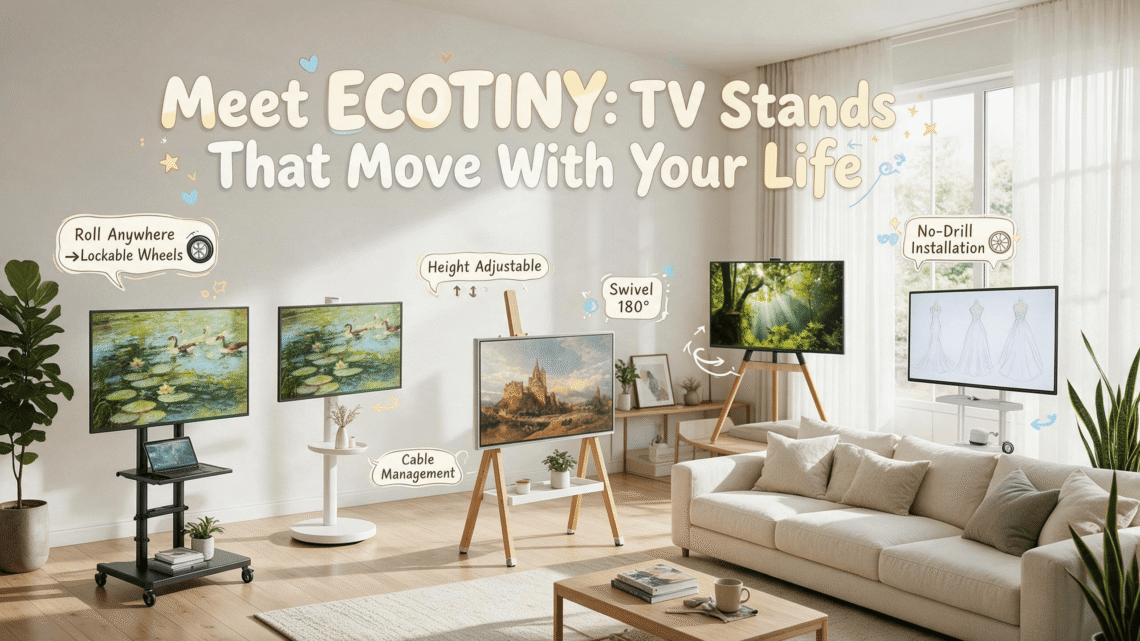
There is a piece of furniture in most homes that nobody designed, and everybody obeys. It is the rectangle of drywall behind the sofa, drilled twice, anchored to a stud, and permanently assigned to a single viewing angle for as long as anybody lives there. The couch was moved in 2019. The television did not.
🛋️ ECOTINY is a brand built around the premise that this arrangement was always a compromise, and that nobody ever agreed to it out loud.
Their catalogue is refreshingly narrow: stands for televisions. Not entertainment centers thirty feet wide. Not mounting hardware sold in a bag of eleven identical screws and a diagram you need to read upside down. Stands — easel-style, rolling, height-adjustable pieces of furniture that hold a screen upright, move with it, and look deliberate while doing so. The company’s slogan, Makes Comfort Sustainable, sits at the top of their storefront, and it works on two levels at once: comfort as something you can keep using for years, and comfort as something assembled from materials chosen with a little more care than the category usually bothers with.
This post is a walk through what that actually means in practice — the product families, the numbers behind the spec sheets, the material decisions, and the handful of rooms where a television on wheels quietly outperforms one bolted to the wall. 💡
💬 In one sentence: ECOTINY makes mobile and adjustable television stands — easel designs in warm wood and steel, rolling carts with locked casters and hidden cabling — for people who would rather reposition a screen than rebuild a wall around it.
A Narrow Catalogue, and Why That Is the Point
Furniture brands often expand sideways. A company launches one well-received cart, then three years later sells bedding. ECOTINY has instead gone deeper into a single question: where should a screen stand, and at what height, and how much should it be allowed to move?
Everything in the range answers some version of that question, and the answers cluster into two recognisable lineages.
🎨 The easel lineage
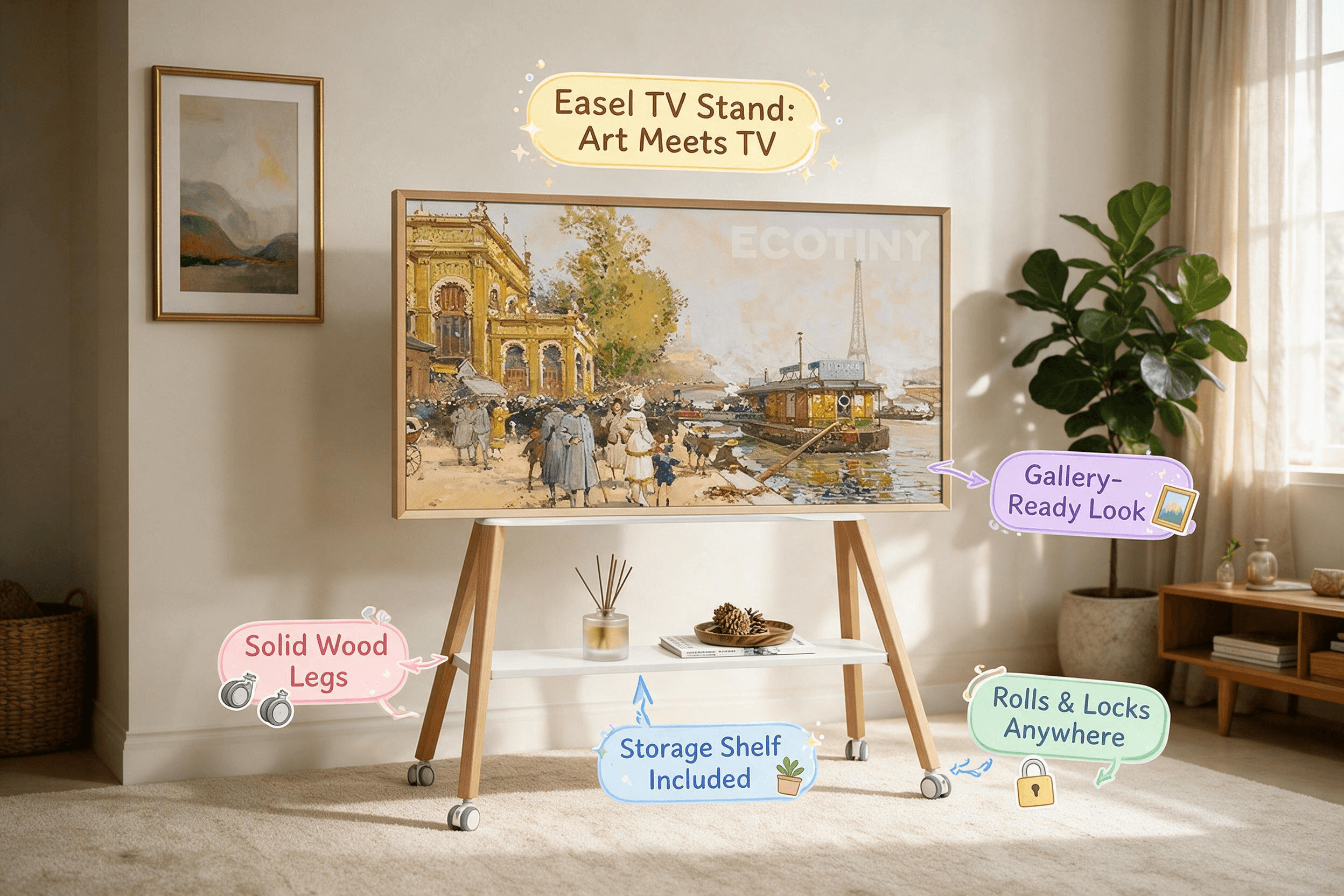
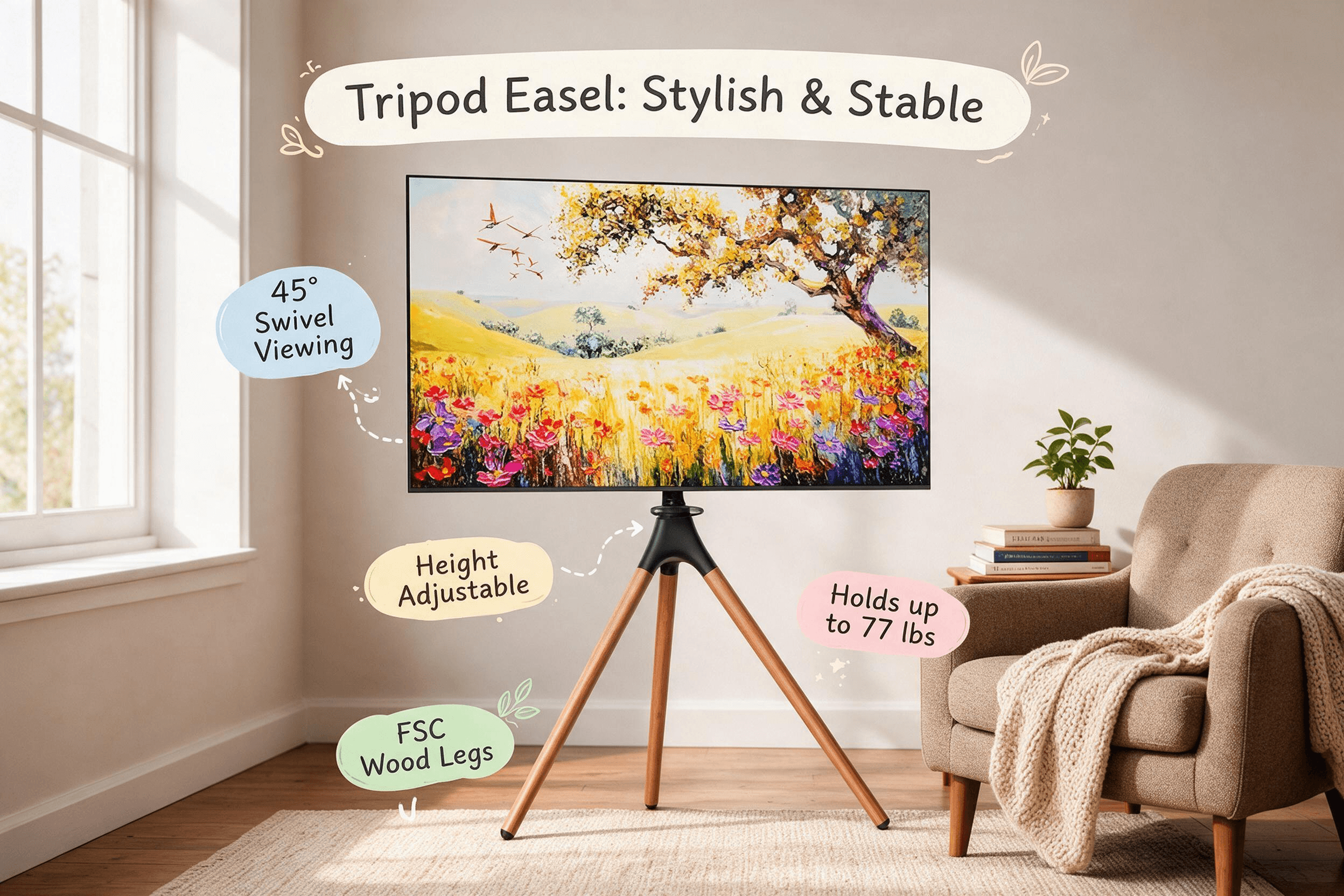
The easel stand is the more visually opinionated of the two. Three legs — a tripod geometry borrowed directly from the artist’s studio — carry a central column, and the column carries the screen. Wood does most of the talking here: pale timber legs, often paired with a media shelf, set against a darker metal spine.
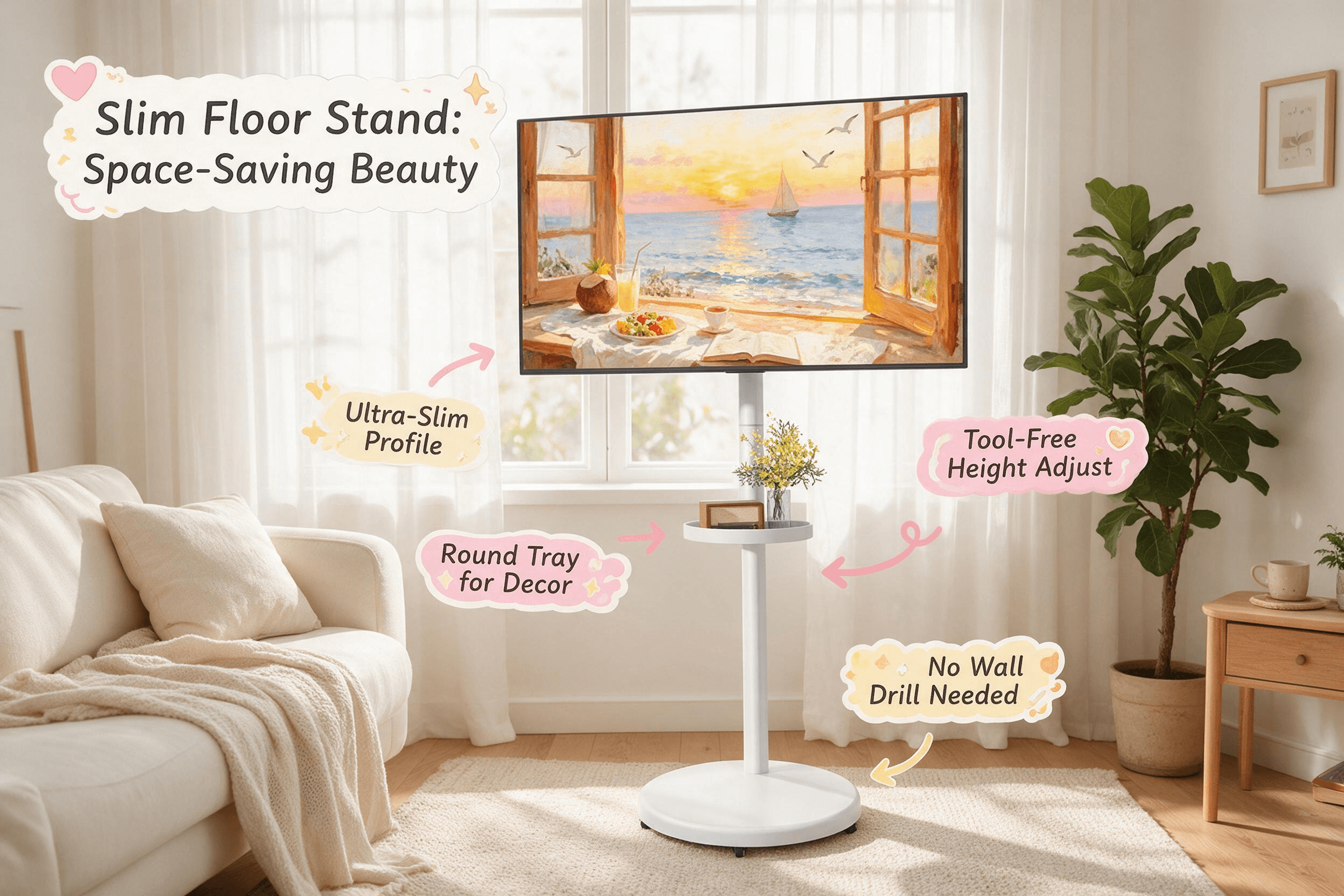
What makes it work as furniture rather than equipment is that a tripod reads as light. A wall mount reads as a decision. A bulk console reads as a room’s permanent occupant. An easel stand sits in the middle of that spectrum — substantial enough to be trusted with an expensive panel, open enough that the floor beneath it stays visible. In a bright room with framed art, plants, or tall windows, it behaves like an object someone chose rather than infrastructure someone tolerated. 🖼️
The rolling lineage
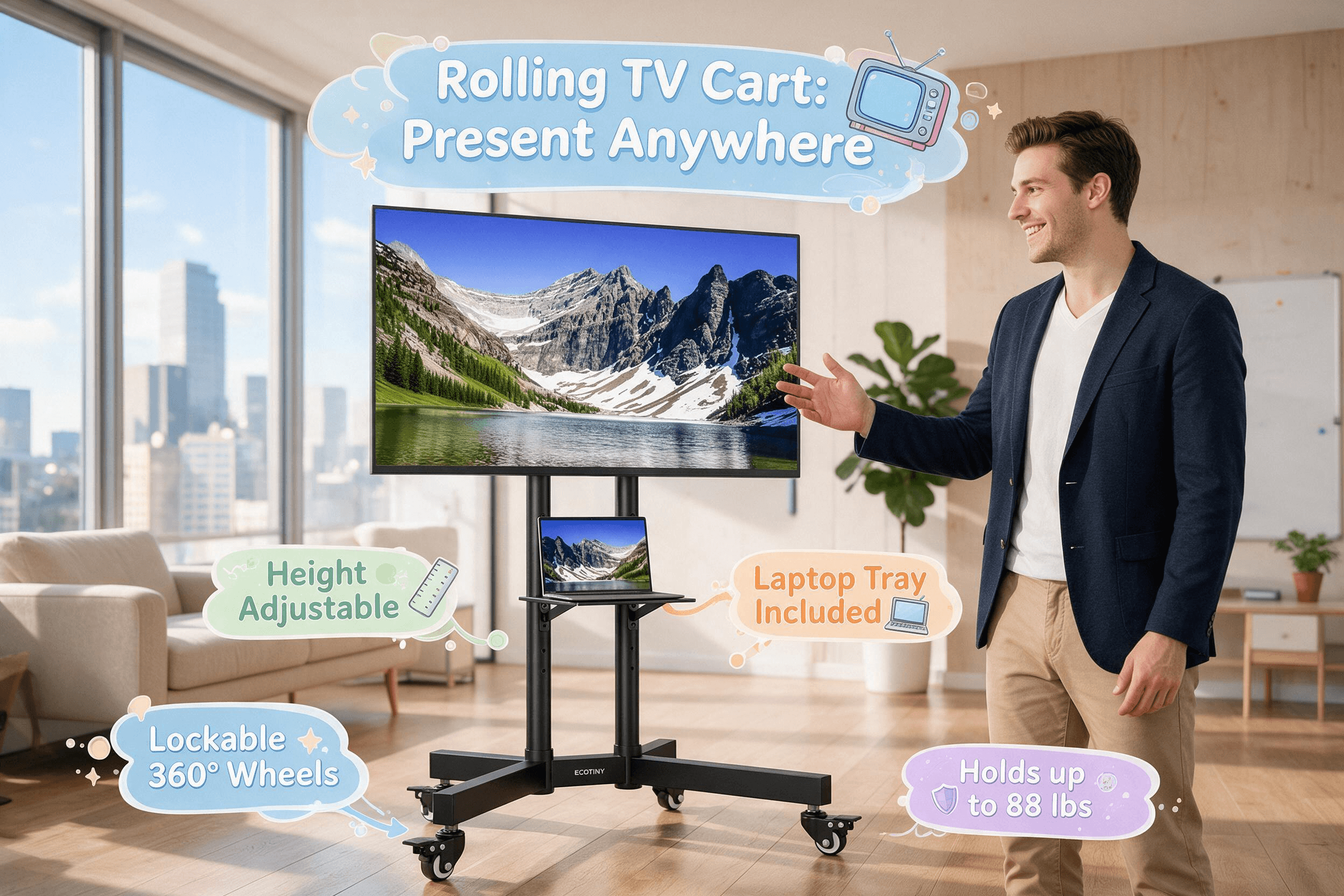
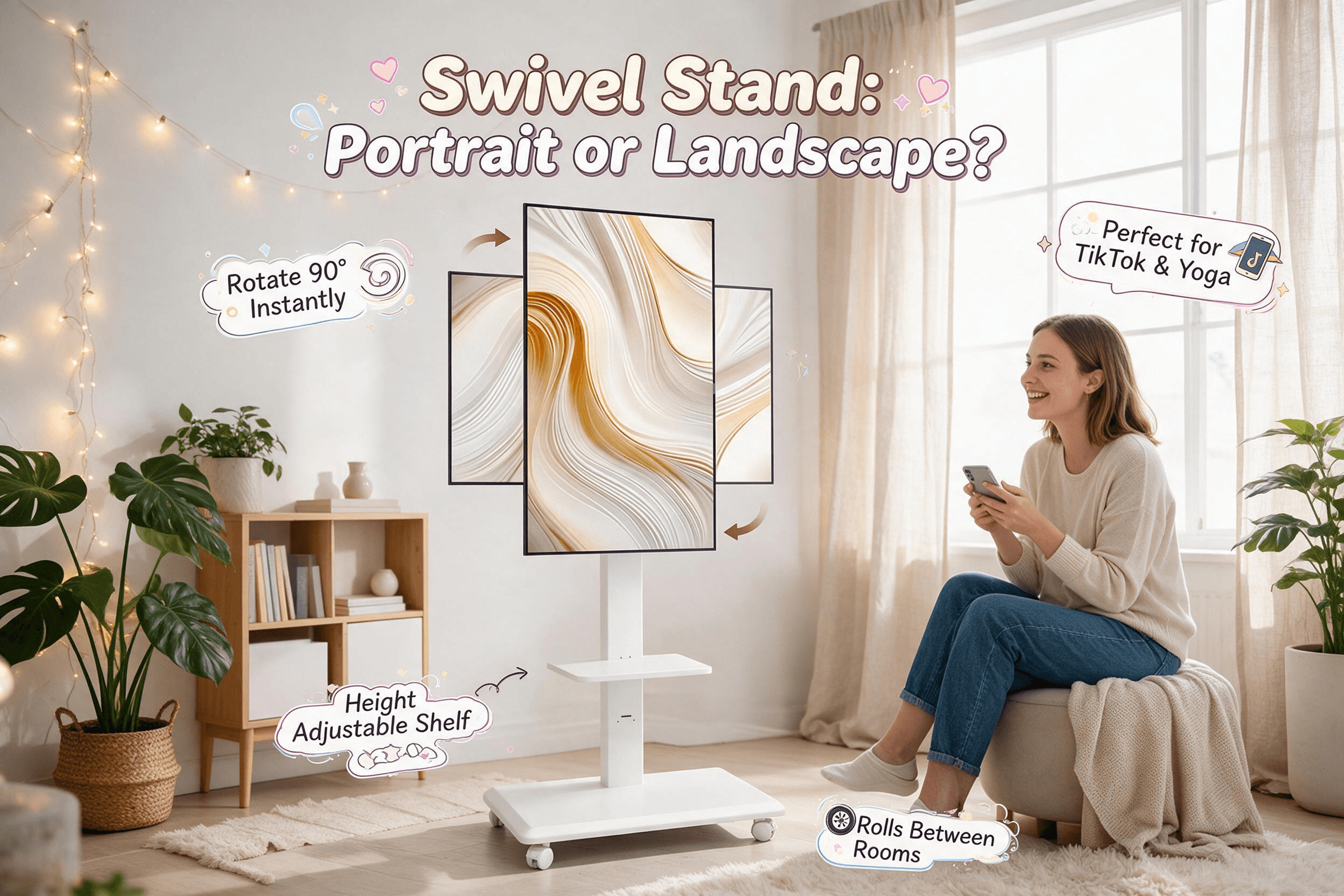
The rolling cart is the workhorse. A wider base, four casters — lockable, so the cart stays exactly where you park it — a vertical post, and usually a shelf for whatever feeds the screen: a console, a streaming box, a soundbar resting below.
Where the easel flirts with the studio, the cart leans industrial: powder-coated steel, clean lines, sometimes in matte black and sometimes in a soft white that disappears against a light wall. It is the version of the product designed for movement as a daily habit rather than an occasional event. Push it from the living room to the kitchen island for a morning of recipes, roll it into the corner for a workout, lock the wheels, done. 🏃
| Easel stands | Rolling carts | |
|---|---|---|
| Visual character | Studio, sculptural, warm | Industrial, tidy, purposeful |
| Dominant material read | Timber legs, metal spine | Coated steel frame |
| Typical footprint | Tripod, open floor beneath | Wider wheeled base |
| Best suited to | Rooms designed around aesthetics | Rooms designed around routine |
| Moved | Occasionally, deliberately | Often, without ceremony |
Reading the Numbers Without an Engineering Background
Mobile television hardware has a vocabulary problem. Once a shopper reaches the specification list, the sales pitch gives way to decimals, and most people skim past them. The decimals matter, so here is a translation. 📐
Height, and the reason it comes in decimals
Storefront listings for the adjustable range cite figures such as 52.6, 54.5 and 56.3 inches, with some configurations reaching roughly 57.8 inches. Those odd fractions are not arbitrary — they are measured to the centre of the screen, which is the only measurement that actually governs your neck.
The rule of thumb interior designers use is that the middle of the screen should sit at your eye level when seated, or slightly below. From a typical sofa seat height, that lands somewhere in the low fifties in inches. A fixed stand gets one number right and everyone else wrong. An adjustable one lets the couch, the armchair, the kitchen stool and the yoga mat each have their own correct answer. ➰
Tilt and swivel
Listed ranges of approximately +3° to −18° tilt and ±12° swivel sound modest, and that modesty is deliberate. These are not acrobatic figures; they are corrections.
- Tilt handles the ceiling-light reflection at 8 p.m. and the fact that you are lying down rather than sitting up. ↕️
- Swivel handles the ninety-centimetre difference between watching from the sofa and watching from the dining chair. ↔️
Twelve degrees each way is enough to shift the viewing axis of a large panel by a meaningful distance at the back of the room. It is also enough that the screen never looks cockeyed when you leave it.
VESA patterns, weight, and screen span
Underneath the design, every stand in this category speaks the same language: a VESA mounting grid, the four-hole square on the back of the television. Larger panels want larger patterns, and a serious stand covers a spread rather than a single size — commonly from around 200 × 200 mm up to 600 × 400 mm. Weight ratings in this class typically run into the 80–110 lb region depending on the model, and screen spans are generally supported across the mid-30s through the 80s in inches. 🔩
Two practical notes that no listing puts in bold:
⚠️ Rating ≠ recommendation. A cart rated for 110 lb will hold a 75-inch panel, but the pairing that matters for daily pushing is heavy screen plus a low centre of gravity. Soundbars mounted high raise the tipping line; devices on the bottom shelf lower it.
⚠️ Thickness varies, bolt length doesn’t come in ten sizes. Curved-back and subtly-thickened “designer” panels occasionally need longer standoffs. If a television has a pronounced rear bulge, that is the one detail worth checking before the box arrives.
| Specification | What it really controls | What to check on your TV |
|---|---|---|
| Height range (in.) | Eye line, neck strain | Seated eye height in the room it lives in |
| Tilt (+3° / −18°) | Glare, reclined viewing | Where the window and ceiling lights sit |
| Swivel (±12°) | Off-axis seating | How far the secondary seat actually is |
| VESA (200×200 → 600×400) | Whether bolts align at all | Owner’s manual, or measure hole spacing |
| Weight rating | Safety margin | Panel weight without the stand’s own base |
| Screen span | Bracket reach and shelf proportion | Diagonal, obviously |
Why Wood Keeps Appearing on a Steel Company’s Product Pages
There is a reason the easel designs pair a metal spine with timber legs rather than going full metal. A television is a black rectangle. Whatever holds it up is either competing with that rectangle or softening it.
Warm legs do the softening. They bring a furniture register into a product that otherwise belongs to the AV-equipment aisle, and that shift is what allows the stand to sit in a living room with artwork and linen curtains without looking like it wandered in from a conference centre.
The sustainability half of the brand’s promise attaches here as well. Timber used in these stands is presented as FSC-certified — forest-stewardship-council chain-of-custody material, meaning the wood is traced to responsibly managed sources rather than merely described as “eco” in a bullet point. Alongside it sits alloy steel for the load-bearing spine, which is the honest division of labour: metal where the physics are, wood where the eye is. ⛰️
There is a durability argument hiding in that split, too. A steel column carries weight without creeping. A timber contact point is warmer to the touch, quieter when a cart bumps a wall, and — unlike thin tube steel — it can be lightly sanded and refreshed rather than replaced. Longevity is a sustainability feature whether or not anyone prints a leaf logo next to it. ♻️
The Least Glamorous Feature, and the First One Anyone Mentions
Ask owners, six months in, what they like about a mobile stand. Almost nobody leads with the tilt range. They lead with the cables. 🧵
A wall-mounted television has a cable problem that gets solved once, badly, with a raceway painted the wrong shade of white. A stand has the same problem and solves it structurally: the post is a chase, the shelf is a tray, and the base is where the power actually enters the system. Listings for the white cart show exactly this — a built-in power strip at the base and a routing hole that takes the tangle down through the column, annotated with the phrase “for a clean and tidy look.”
That phrase undersells it. What the routing actually buys you is portability without a ceremony. If the cables are trapped inside the stand, then moving the television from one side of the room to the other is a two-second push rather than a twelve-minute negotiation with a socket. The whole concept of a rolling stand collapses into a nuisance if the cable tail is longer than the cable allowance. Integrated management is what turns “technically movable” into “actually movable.” ✅
A short list of what good routing looks like in practice:
- 🔹 Power entered at the base, so the strip never dangles behind the shelf
- 🔹 Excess length coiled once at assembly and never touched again
- 🔹 HDMI and power running in separate channels, so nothing hums
- 🔹 A visible service loop at the top of the post, for swapping the panel later
Six Rooms Where a Stand Quietly Beats a Mount
The wall-versus-stand debate is usually argued on aesthetics. It should be argued on schedule. Here is where the mobile format earns its floor space. 🏠
1 · The shared living room. Two households, one room, incompatible preferences. Someone wants football at 7, someone wants a film at 9, and the coffee table is contested territory by 7:15. A stand that swivels and rolls gives each of them a different room inside the same room.
2 · The bedroom without a wall worth drilling. Plaster, lath, historic mouldings, or simply a landlord with opinions. A stand at seated-eye height on a blanket bench beats a mount angled down from a shelf nobody installed. 🌙
3 · The home gym. This is the use case the brand’s own imagery leans into: a panel showing a class, positioned on open floor rather than above a mirror. Fitness content is watched standing, which means it is watched at a height no wall mount was ever set to. Roll it out, lock the casters, start. 🤸
4 · The rental that will be left behind. Average tenure keeps shrinking. Nobody drills four holes for a television they will not own in thirty months, and nobody wants to explain a patch job at deposit time. A stand travels to the next address in a car. 📦
5 · The meeting room. Presentation displays fail on the same three problems everywhere: the cable runs are wrong, the sightline from the back corner is worse, and the room is being used for something else at three o’clock. Height presets and a lockable base turn a fifteen-minute room reset into a ninety-second one. 💼
6 · The studio apartment. When the bedroom, office and lounge share twenty-two square metres, the television is a room divider by accident. Standing it on a wheeled base makes the division intentional — screen toward the bed at night, toward the desk by day. 🪟
💬 “The wall mount assumes the room is finished. The stand assumes the room is still happening.”
Three Words Doing a Lot of Work
Makes Comfort Sustainable. Read it slowly and it stops being a tagline.
Comfort here is not plushness. It is the absence of small daily frictions: the craned neck, the glare stripe across the panel, the sound of casters dragging a cable across hardwood. Ergonomics is comfort expressed in millimetres. 📏
Sustainable carries the material meaning — traced timber, steel that outlasts the trend cycle, a product you repair rather than replace. It also carries the second meaning that matters more for a furniture brand: sustainable as in tenable over time. A solution people stop using after a month is not sustainable no matter how responsibly the wood was harvested. A stand that adapts to a new sofa, a new television and a new address is. 🌍
Makes is the operative verb, and the most telling of the three. Comfort is not described as found, inherited from a heritage design, or licensed from a trend. It is manufactured — which is a manufacturer’s way of saying the engineering is the product, not the packaging around it.
Choosing Well: A Short Field Guide
Shopping this category gets easier with three measurements and one honest question about your own habits. 📝
Step one — measure the seat, not the sofa. Sit in the chair you use most. Have someone mark eye level on the wall with a piece of tape. Measure from floor to tape. That number is your target screen centre, and it is the single most useful figure in the whole process.
Step two — weigh the panel and find the VESA grid. Both live in the manual, and both are on the manufacturer’s site if the manual went missing in a move. Screen diagonal alone is a poor proxy; a 65-inch curved panel and a 65-inch flat panel impose very different loads.
Step three — walk the route. Not the room — the route. Doorway widths, rug edges, the gap beside the island. A cart that is wonderful in place and useless in transit is a stand with a decorative wheel set on it.
| If your screen is about | Look for | Watch out for |
|---|---|---|
| 32–43 in | Compact easel or lighter cart | Shelf that visually swallows a small panel |
| 49–55 in | Mid cart, full height range | Base too narrow for frequent pushing |
| 65 in | Rolling cart, 100 lb-class rating | Tilt range too small to beat ceiling glare |
| 75–86 in | Largest-rated cart, wide wheelbase | Delivery logistics — measure the hallway |
The honest question: how often will you genuinely move it? Once a year is a swivel-and-height purchase, and a fixed-base design saves money. Weekly is a caster-and-routing purchase, and the integrated power strip stops being a gimmick. 🤔
A final consideration that pays off early: leave the shelf empty for the first week. Live with the height and angle before the console, the game cases and the tangle of spare cables turn the stand into a filing cabinet. Most regrets in this category are height regrets, and height is much easier to re-set before things have homes.
Questions People Ask Before the Box Arrives
🧩 Is assembly actually fifteen minutes?
For the carts, realistically forty-five to seventy-five minutes for a first-timer working alone, less with a second pair of hands. The post, base and shelf are the heavy parts; the bracket hardware is where the small bolts live. Having a socket driver rather than the included hex key is the single biggest upgrade to the experience.
🔊 Will it wobble when I type on a nearby keyboard?
A properly locked cart with a correctly tensioned bracket is stable enough for normal living. Rhythmic impact — vigorous typing directly against the shelf, a dog colliding with the base — transmits. Give the panel a firm push test at assembly, before the media shelf is loaded.
🧱 Does a heavy screen make the whole thing tip-prone?
Weight low, mass centred. Put the heaviest ancillary device on the bottom shelf rather than on the mount, and the centre of gravity drops below the middle of the post, which is where you want it. The rating exists for the panel; the shelf exists to stabilise it. ⚖️
🌡️ Is an indoor stand okay on a covered patio?
Indoor hardware is not sealed for weather. Damp shade, sea air and afternoon sun through glass all shorten the life of coated steel and unfinished timber. Keep it inside, or keep it covered and dry in the true sense.
🧴 How does the wood age, and does it need treating?
Occasional dusting and a sparing wipe with a damp cloth. Timber that never sees a cleaning product in its life will look better at year five than timber that gets weekly attention with something alkaline. For the metal, a dry cloth; for the casters, check monthly that nothing has wound itself around a wheel. 🧽
The Case for Treating a Screen as Furniture
Something shifted in the last decade in how people feel about the largest black object in their home. It stopped being a fixture and started being an occupant — a member of the household with preferences, a position it likes, and a schedule that conflicts with everyone else’s.
Wall mounts were the answer to an era when televisions were small, light and permanently on. Stands answer an era when they are large, heavy, and switched off more often than not — when the same square metre is a workout floor at seven, a desk at noon and a cinema at ten.
ECOTINY’s contribution to that shift is less about any single mechanism than about insistence. The easel designs insist that load-bearing steel and studio wood can be the same object. The carts insist that a hundred-pound panel can be repositioned by one person without apology. The material choices insist that durability and provenance are the same conversation, not competing ones. 🌱
💬 A television on a stand is a small declaration: the room belongs to the people in it, not to the drill pattern in the wall.
Unpin the screen, and what you get back is not a cleaner wall. It is a room with more than one use, and the option — always available, never advertised, quietly valuable — to change your mind about where everything goes. 🛞
A quick note on sourcing: specifications quoted above — height presets, tilt and swivel ranges, VESA coverage and weight classes — reflect ECOTINY’s published storefront listings and vary by individual model, so confirm the exact figures on the product page for whichever stand you’re considering.