Some brands arrive with noise. They plaster stadiums, hire the loudest voices, and chase every trend until the trend itself forgets why it started. Then there are brands that simply show up, do the work, and let the product speak long after the marketing campaign has ended. K-Swiss belongs to the second group.
If you have ever laced up a pair of crisp white sneakers and felt an immediate, almost inexplicable lift in confidence, you have already tasted part of the K-Swiss story. It is a story about two brothers from Switzerland who landed in California with a radical idea: what if a tennis shoe could look as clean as a dress shoe and perform like an athletic machine? What if sportswear did not have to shout to be noticed? That question, asked quietly in 1966, is still echoing through every court, running path, city street, and pickleball baseline where K-Swiss appears today.
This is not just a history lesson. It is an invitation to understand why a brand that began with one all-white leather tennis shoe still matters, still innovates, and still manages to feel both timeless and surprisingly current.
The California Dream Wore White Leather
Picture Los Angeles in the mid-1960s. The sun is relentless, the tennis courts are filling up, and a new kind of athletic culture is being invented in real time. Into this scene stepped Art and Ernie Brunner, two Swiss immigrants who understood leather the way surfers understood waves. They had grown up around ski boots and leather goods, and they brought with them an almost obsessive attention to craftsmanship. When they looked at the tennis shoes available in America, they saw a gap. The shoes were functional, yes, but they lacked the refined elegance that the Brunner brothers believed athletes deserved.
So they set out to build something different. The result was the K-Swiss Classic, an all-white leather tennis shoe introduced in 1966. At first glance, it looked almost too clean for sport. The leather upper was smooth and unblemished. The lacing system featured distinctive D-rings. Most memorably, five slender stripes ran along each side, giving the shoe a visual signature that was instantly recognizable without being garish. It was the kind of shoe that looked correct whether you were serving for the match or walking into a restaurant afterward.
That combination of performance credibility and understated style turned out to be revolutionary. Tennis players appreciated the durability and support. Everyone else appreciated the look. By refusing to choose between function and fashion, K-Swiss created a new category: the performance shoe that could live a double life.
What the Five Stripes Actually Mean
Every iconic brand has a visual hook. For K-Swiss, it is the five-stripe signature. Those stripes are not merely decorative. They function as a kind of shorthand for the brand’s entire philosophy. One stripe might represent precision. Another might stand for durability. A third could symbolize the clean lines of Swiss design. The fourth and fifth? Perhaps they are reserved for the two brothers who started it all, and for the athlete who completes the equation by putting the shoe on.
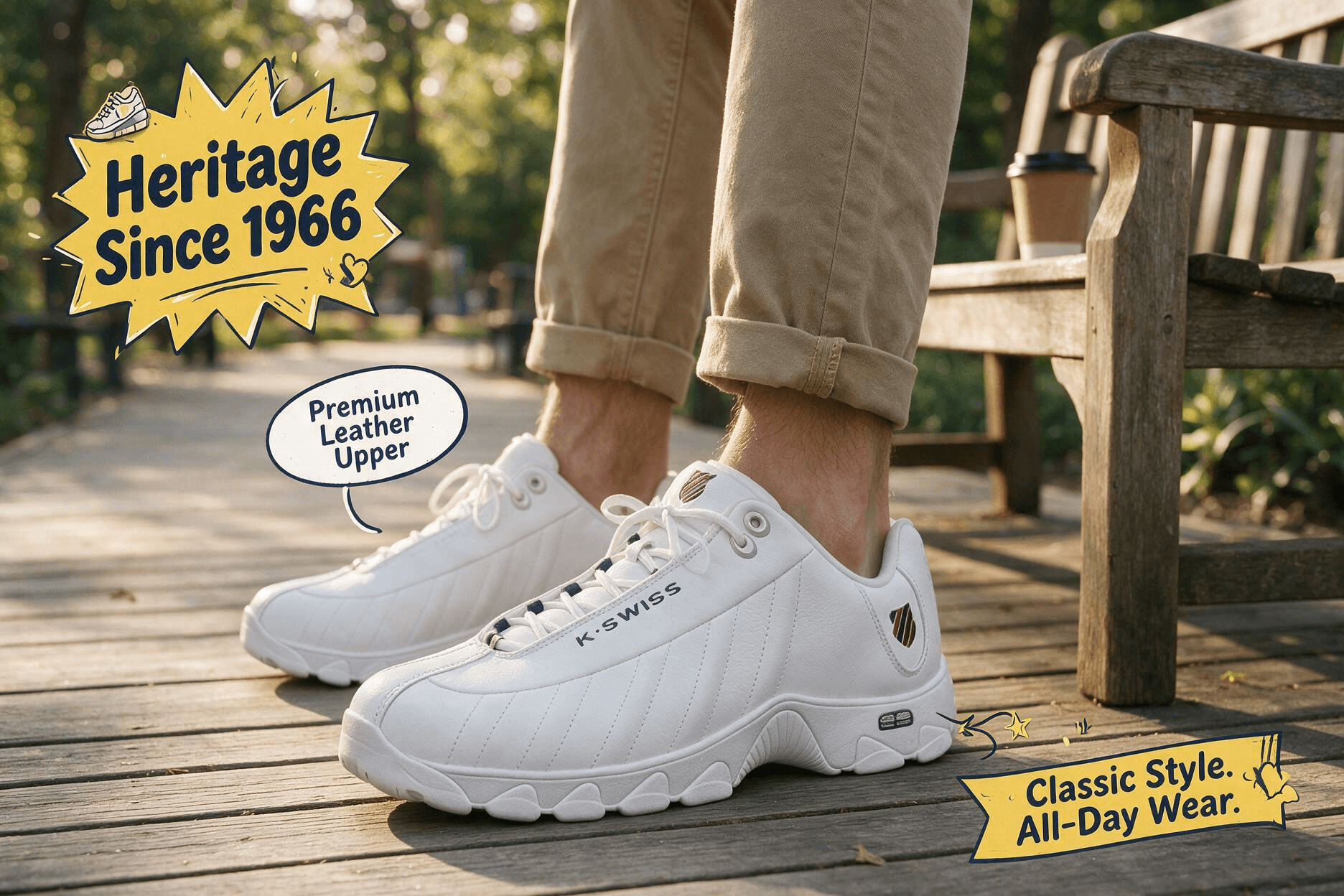
Of course, the brand’s visual identity does not stop at the stripes. The shield logo, with its bold red, white, and blue diagonal bands, carries a sense of heritage and protection. It looks like something you might find on a vintage tennis racquet or a well-made piece of luggage. The K-Swiss wordmark, rendered in a confident blue, completes the picture. Together, these elements communicate stability without stiffness, tradition without stuffiness.
In a footwear market crowded with logos that scream for attention, K-Swiss has always preferred a quieter announcement. The five stripes do not need to be explained. They simply need to be seen.
From Baseline to Sidewalk: The K-Swiss Universe
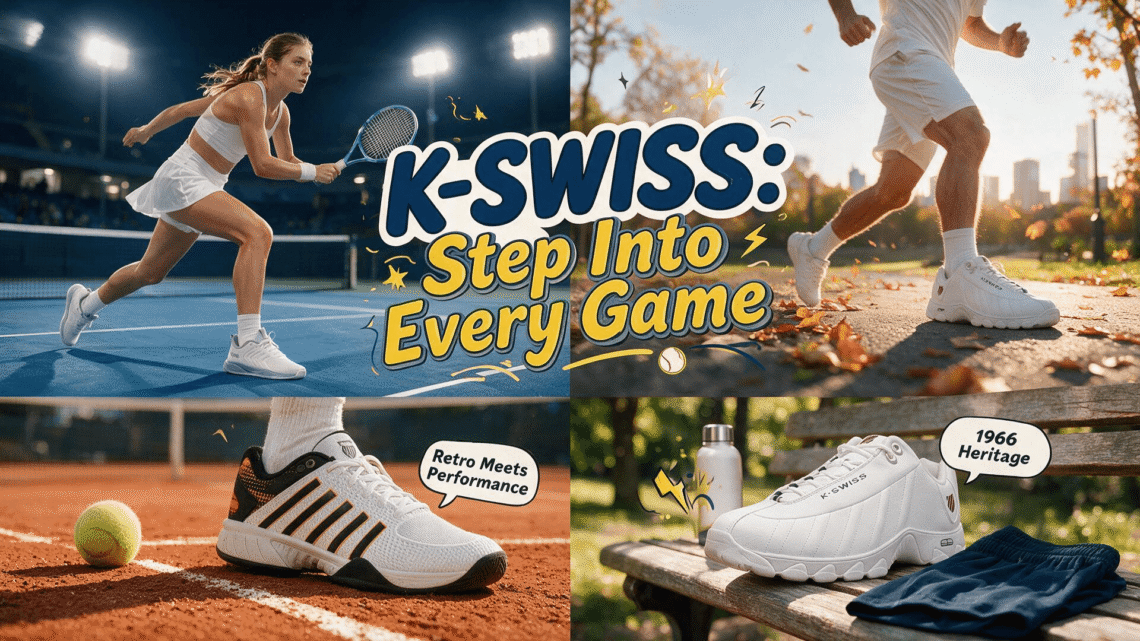
One of the most impressive things about K-Swiss today is the breadth of its lineup. The brand has never abandoned its tennis roots, but it has also refused to be trapped by them. Walk through the current K-Swiss collection and you will find shoes designed for specific sports, shoes designed for urban exploration, and shoes designed simply because looking good is its own kind of performance.
Tennis: Where the Legacy Lives
Tennis remains the spiritual home of K-Swiss. The court is where the brand learned about lateral movement, sudden stops, and the punishment a shoe must endure. Modern K-Swiss tennis shoes carry that accumulated knowledge in every seam. They offer the stability required for aggressive side-to-side cuts, the cushioning needed for hard-court impact, and the durability to survive months of baseline rallies.
What separates K-Swiss tennis footwear from the pack is the refusal to sacrifice elegance for aggression. These shoes look like they belong at Wimbledon, even when they are being pushed to their limits on a public court in the middle of summer.
Pickleball: The New Court in Town
Pickleball is no longer a niche activity whispered about in retirement communities. It is one of the fastest-growing sports in the world, and it demands a very specific kind of footwear. The stop-and-start nature of pickleball, combined with its low impact but high-intensity rallies, requires shoes that can grip, pivot, and stabilize without weighing the player down.
K-Swiss has answered that demand with purpose-built pickleball models. The Ultrashot Light, for example, represents the brand’s understanding that pickleball players want court responsiveness wrapped in a lighter package. These shoes do not feel like borrowed tennis shoes with a new label. They feel like they were designed by people who have actually stood at the kitchen line and felt the urgency of a fast exchange.
Running and Walking: Softness as a Strategy
If tennis taught K-Swiss about precision, running taught the brand about endurance. The modern running collection reflects a clear philosophy: the softer the landing, the longer the journey. Technologies like 40mm Max Cushioning, ENERGYTEX midsoles, and advanced shock absorption systems show that K-Swiss is serious about the miles.
But the brand’s approach to running is not just about stacking foam under the heel. It is about creating a smooth transition from heel strike to toe-off, about breathability on hot afternoons, and about a fit that disappears once you find your rhythm. The Shadx Leather running line, with its urban-ready attitude, proves that a running shoe can handle both morning mileage and afternoon errands without looking out of place.
Walking shoes receive similar attention. After all, most people will spend far more hours walking than sprinting. K-Swiss walking models are built for the long, irregular rhythm of city life: curbs, train platforms, grocery store tiles, and neighborhood sidewalks. They are the shoes you reach for when you know the day will not stay in one place.
Lifestyle: The Classics Never Retire
Then there is the lifestyle category, which is where the K-Swiss Classic continues its quiet reign. These are the shoes that pair with jeans, chinos, shorts, and even the occasional unexpected outfit. They are the shoes that look correct in a photograph taken decades ago and still look correct in a photograph taken this morning.
The lifestyle range also includes modern reinterpretations: bolder colorways, updated silhouettes, and materials that respond to contemporary taste. Yet even when K-Swiss experiments, it rarely loses its sense of restraint. A bright accent here, a textured panel there, but always grounded in the same DNA that made the original white leather shoe famous.
The Quiet Tech Inside the Clean Lines
K-Swiss has a reputation for understatement, but that does not mean the brand ignores technology. On the contrary, some of its most impressive work happens beneath the surface, where the casual observer cannot see it but the wearer absolutely feels it.
The cushioning systems deserve special mention. Modern K-Swiss running and walking shoes often feature thick, responsive midsoles designed to absorb impact and return energy. The brand’s shock absorption engineering is not about creating a marshmallow sensation underfoot. It is about smoothing out the road so the body does not have to absorb every irregularity.
Court shoes, meanwhile, prioritize lateral stability. When you plant your foot and push off in a tennis or pickleball match, you are asking your shoe to resist forces that want to roll it sideways. K-Swiss addresses this with supportive upper constructions, carefully positioned outriggers, and outsole patterns that grip without sticking.
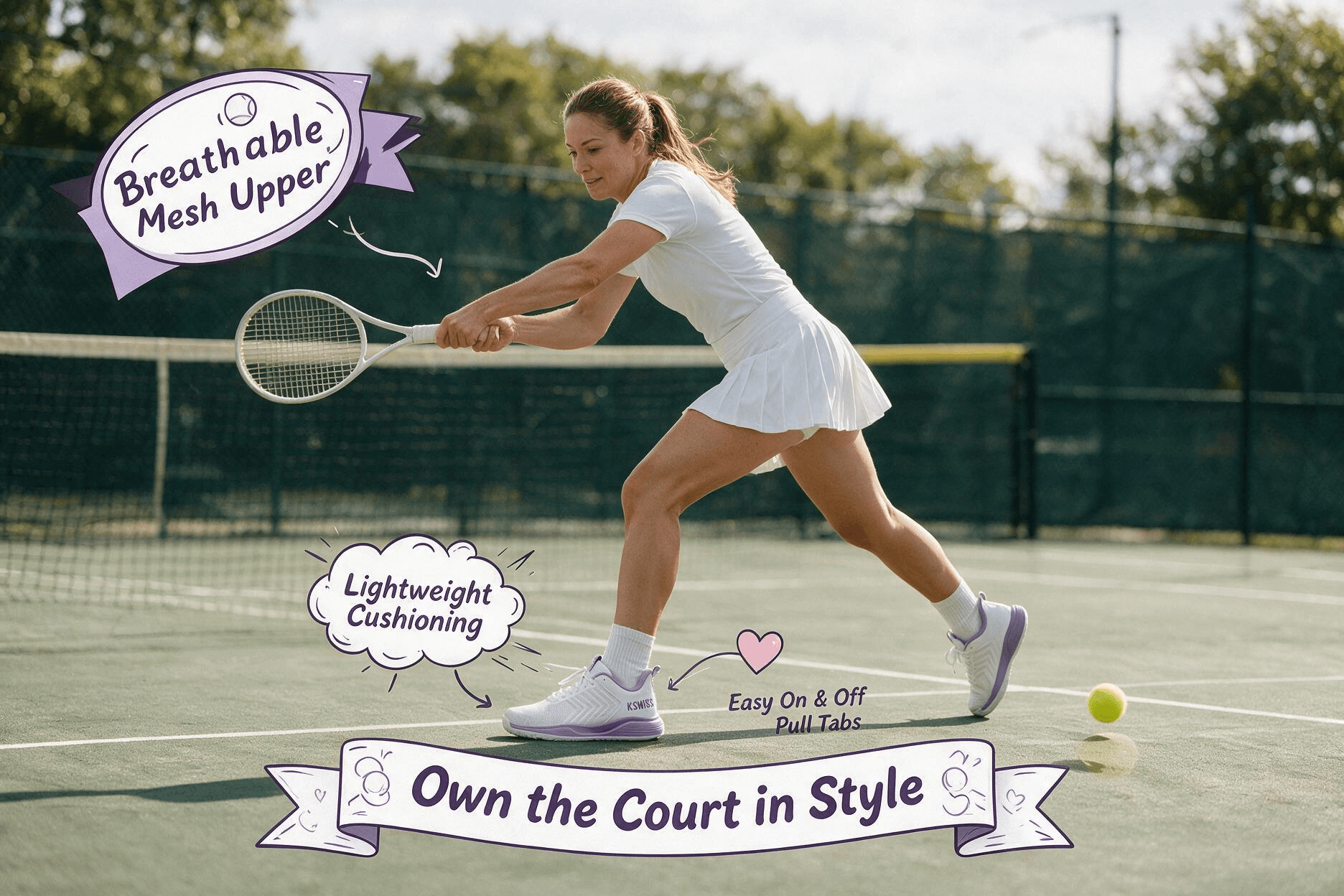
Breathability is another area where the brand has invested heavily. Mesh panels, engineered knits, and perforated leathers all work together to keep feet cooler during intense sessions. This matters more than people realize. A hot, uncomfortable foot becomes a distracted foot, and distraction is the enemy of performance.
Finally, there is durability. K-Swiss shoes are generally built to last. The leather heritage of the brand shows up in material choices that can withstand repeated wear. Whether you are dragging your toe on a serve or logging your thousandth walking mile, a well-made shoe holds its shape longer.
Why K-Swiss Still Matters in a Loud Market
Trends in footwear move quickly. One year, bulky platforms dominate. The next, minimalist designs take over. Colors flare and fade. Collaborations generate headlines and then vanish. In the middle of all this noise, K-Swiss has maintained something rare: a clear identity.
The brand does not chase every micro-trend. It does not release a new silhouette every week just to stay in the conversation. Instead, it refines. It improves what already works. It listens to athletes, to casual wearers, and to the physical demands of real sports. Then it builds shoes that answer those demands without unnecessary drama.
This consistency creates trust. When someone buys a pair of K-Swiss shoes, they are not just buying a product. They are buying into a long tradition of believing that quality, comfort, and clean design are enough. That is a surprisingly radical position in an industry that often feels addicted to spectacle.
A Conversation with Your Feet
Sometimes the best way to understand a brand is to imagine what your own body would say after a day in its shoes. Picture this exchange:
Your feet, at 7 a.m.: “Okay, we have a long day ahead. Commute, meetings, maybe a walk at lunch, possibly a pickleball match after work. What are we doing about footwear?”
You: “K-Swiss.”
Your feet, relieved: “Good. We like the part where they do not pinch, slide, or feel like bricks by 3 p.m.”
Your feet, at 7 p.m.: “That was actually fine. More than fine. We looked presentable in the meeting and held up during the match. Can we do this again tomorrow?”
This little dialogue captures something important. The best shoes are the ones you stop thinking about. They do not demand attention with discomfort, and they do not demand attention with excessive flashiness. They simply do their job, day after day, until you realize you have reached for them so often that they have become your default.
The Look: How K-Swiss Became a Visual Vocabulary
There is a reason K-Swiss shoes appear so frequently in photographs, films, and street-style observations. They have a visual reliability that photographers love and stylists respect. A pair of clean white K-Swiss sneakers can anchor an outfit without overwhelming it. They can make casual clothing feel intentional and athletic clothing feel polished.
The brand’s color palette has historically leaned on white, navy, red, and black. These are not accidental choices. White suggests freshness and athletic purity. Navy suggests trust and depth. Red provides energy. Black offers grounding. Together, they create a visual language that feels both American and European, both sporty and refined.
Even when K-Swiss introduces brighter colors or modern gradients, it tends to deploy them with discipline. A shock of orange on a midsole. A gradient accent that catches light. These flourishes add personality without abandoning the brand’s central commitment to wearable design.

Choosing Your First Pair: A Simple Guide
If you are new to K-Swiss, the range can feel pleasantly wide. Here is a straightforward way to think about where to start.
| If you mostly… | Consider starting with | Why it works |
|---|---|---|
| Play tennis on hard or clay courts | A dedicated tennis model | Lateral support and durable outsoles handle court movement |
| Play pickleball regularly | The Ultrashot Light or similar court-specific options | Lightweight responsiveness for quick kitchen-line exchanges |
| Run or walk long distances | A cushioned running or walking shoe | Shock absorption and smooth transitions protect your joints |
| Want an everyday, versatile sneaker | The classic leather lifestyle line | Clean styling pairs with almost any outfit |
| Need something urban and weather-ready | A leather running or lifestyle model | Materials resist city wear while keeping the look polished |
The truth is, many people end up owning more than one pair. A court shoe for matches, a running shoe for miles, and a classic lifestyle pair for everything else. Once you become accustomed to the K-Swiss balance of comfort and restraint, it becomes difficult to settle for less.
The Bigger Picture: Shoes as a Statement of Intention
Footwear is one of the most personal things we wear. It touches the ground before any other part of us. It absorbs the impact of our choices, literally and figuratively. The shoes we choose say something about how we intend to move through the world.
K-Swiss has always understood this. The brand does not sell shoes merely as objects. It sells the idea that you can be active and elegant, competitive and composed, modern and rooted. You can sprint across a court in the morning and sit down for a coffee in the afternoon without feeling like you are wearing the wrong costume.
That versatility is the real product. The leather, the cushioning, the five stripes, the shield logo, all of it serves a larger purpose: to give you one less thing to worry about so you can focus on whatever comes next.
Where K-Swiss Goes From Here
The future of footwear will likely involve lighter materials, smarter cushioning, more sustainable production, and designs that adapt to increasingly hybrid lifestyles. K-Swiss is well positioned for all of it because the brand has never been about a single moment. It has been about a sustained idea.
As long as people want shoes that feel good, look clean, and hold up under real use, there will be a place for K-Swiss. The brand does not need to reinvent itself every season because its founding idea, that quality and understated style can coexist with serious performance, is not a trend. It is a permanent appetite.
Final Thoughts: The Quiet Power of Showing Up Well
In a world obsessed with going viral, K-Swiss offers a different model. Show up. Build well. Make something people can rely on. Let the stripes do the talking.
The next time you see someone glide across a tennis court in a pair of crisp K-Swiss shoes, or spot a classic white pair waiting by the door of a busy apartment, remember what you are looking at. You are looking at more than a sneaker. You are looking at the result of two brothers who believed that athletes deserved something better, and who built a brand that is still honoring that belief decades later.
So whether you are chasing a personal record, chasing a pickleball victory, or simply chasing the bus on a rainy Monday morning, consider what you put on your feet. Choose something that respects the distance. Choose something that looks like it belongs wherever you are going.
Choose the shoe that never needed to shout to be heard.