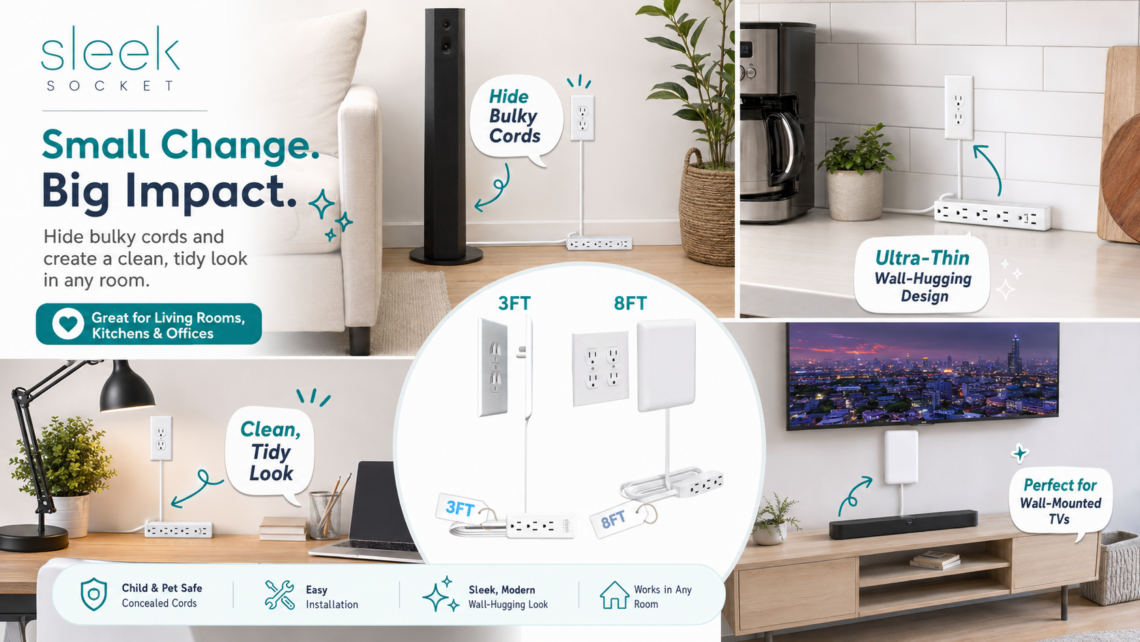
There is a particular kind of visual clutter that almost disappears until you start paying attention to it: the outlet behind the sofa, the plug crowding the kitchen backsplash, the charging cable that seems to lean against a wall no matter how often you straighten it. These details are small, but they can make an otherwise tidy room feel unfinished.
That is where a well-designed outlet concealer earns its place. Rather than treating cords as something to hide with a basket or tuck behind furniture, Sleek Socket approaches the problem at its starting point: the wall outlet itself. The idea is simple—create a flatter, cleaner connection at the wall, then route power more discreetly where it is needed.
For households that care about practical organization without turning every improvement into a major project, sleek socket offers a refreshingly focused solution. Its outlet and plug concealer kits are intended to cover bulky plugs and help cords sit closer to the wall, making them useful in places where furniture, appliances, or everyday charging setups tend to create a messy visual interruption.
A Small Change That Makes a Room Feel More Considered
Most cord-management products solve the problem after the cord has already become visible. They gather, wrap, clip, or channel wires that are running along a wall or across a floor. Those tools can be helpful, but the outlet area often remains the awkward part: a plug sticks out, cords bend sharply, and furniture cannot sit as close to the wall as you would like.
An outlet concealer changes that starting point. With a flat, low-profile connection, the wall can look calmer and the cable path becomes easier to manage. This is especially appealing in rooms where exposed outlets are in plain view—not because every outlet needs to disappear, but because a few high-traffic ones can have an outsized effect on how organized the space feels.
Think of the places that collect visual noise over time: the outlet beneath a mounted television, the spot behind a nightstand, the counter outlet used for a coffee maker, or the wall near a desk where a lamp, monitor, and phone charger all compete for space. None of these situations necessarily requires a full renovation. Often, the better answer is simply a more intentional way to connect power.
Why a Flat Outlet Setup Can Be So Useful
The appeal is not just cosmetic. Traditional plugs often protrude enough to force furniture slightly away from the wall. In a narrow bedroom, a compact office, or a small apartment living room, even a small gap can matter. A flat plug arrangement can help a dresser, console, bed, or sofa sit more naturally in its intended position, while the extension cord can be directed toward the devices that actually need it.
That matters most when the outlet is in an inconvenient but unavoidable location. Maybe the only available receptacle is behind a bookcase. Maybe the outlet is directly beneath a kitchen cabinet. Maybe it is beside a workstation where a power strip is more useful on the desktop than at floor level. A flexible cord-management setup gives you more options without asking you to redesign the entire room around the outlet.
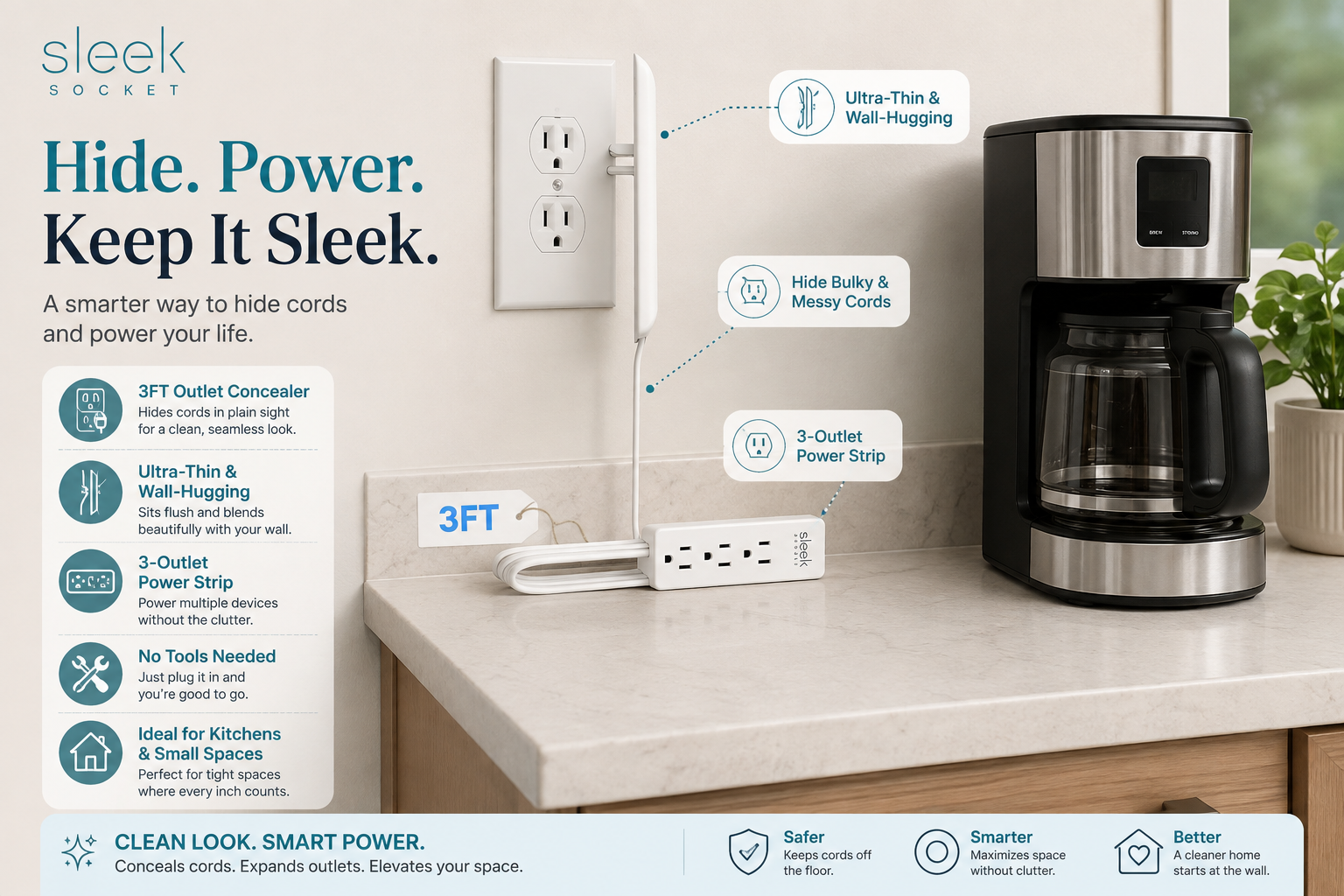
The original Sleek Socket outlet concealer kit is positioned for standard outlet situations and includes a three-foot flat extension cord with a three-outlet power strip. That shorter length can make sense when the destination is nearby: a countertop appliance, a lamp behind a couch, or a small cluster of electronics on a side table. Shorter cords are often easier to manage because there is less excess length to coil, hide, or accidentally trap behind furniture.
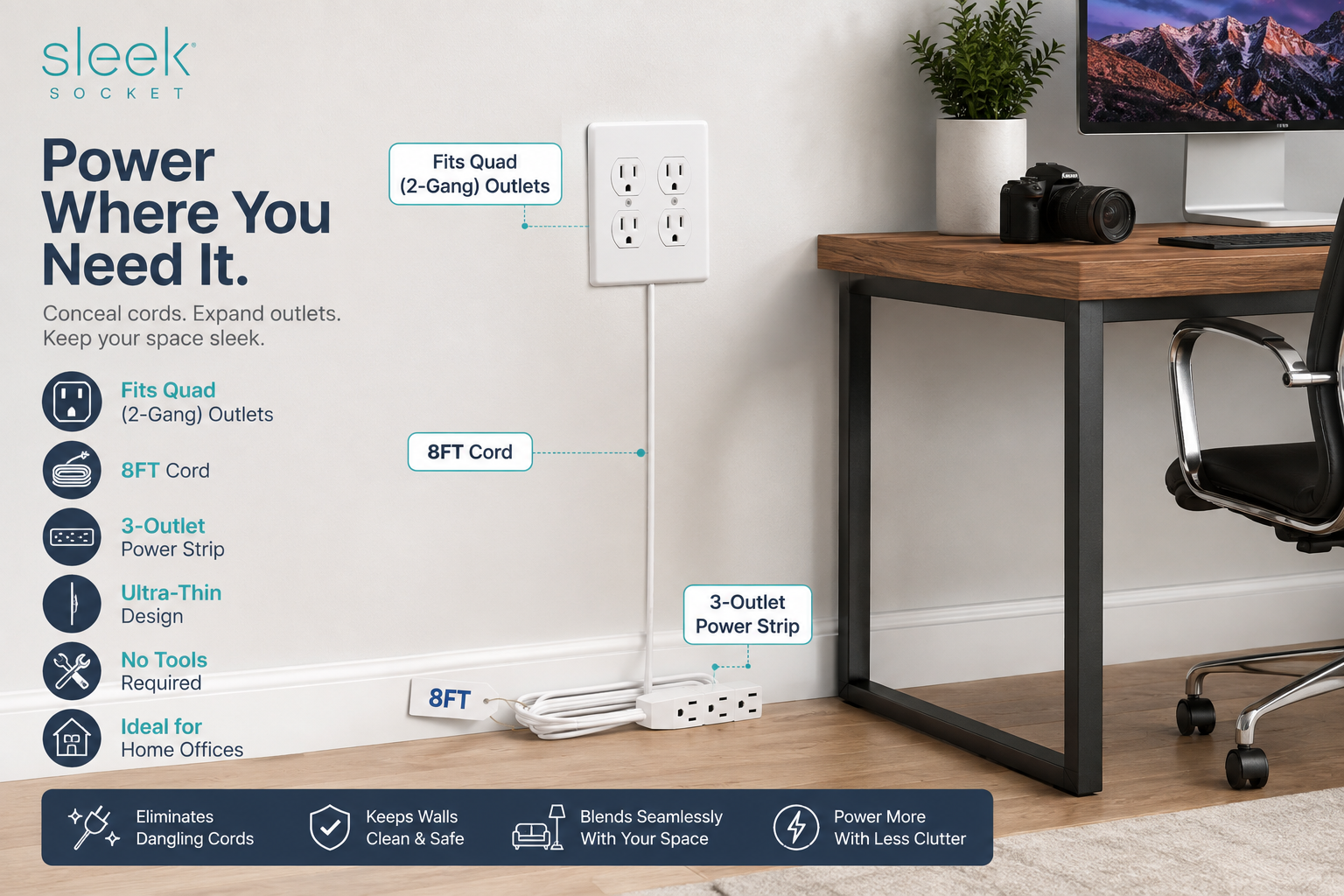
For a different kind of setup, Sleek Socket also offers a version designed for quad, or two-gang, outlets with four receptacles. This model includes an eight-foot flat extension cord and a three-outlet power strip, which can be more practical for a home office, media area, or other location where the outlet and the devices are not close together. The important point is not simply cord length; it is choosing a configuration that makes sense for the wall plate and the actual layout of the room.
Where It Fits Best in Everyday Homes
The strongest use cases tend to be the ones people encounter every day. A good cord concealer should make a familiar annoyance less noticeable—not become another object that needs attention.
Behind furniture
This is perhaps the most obvious application, but it is also one of the most satisfying. Furniture positioned against a wall can look better when it does not have to accommodate a thick plug. A low-profile outlet connection can be particularly useful behind couches, nightstands, media consoles, desks, and headboards. It creates a cleaner edge where furniture meets wall, which is a small detail that can make a room feel more settled.
On kitchen counters
Kitchens tend to accumulate appliance cords quickly. Coffee machines, toaster ovens, mixers, phone chargers, and under-cabinet accessories all seem to find their way to the nearest outlet. In a kitchen, the goal is usually not to hide every cord completely. It is to reduce the sense that cords are permanently taking over the backsplash and work surface.
A flatter outlet concealer can help create a neater starting point, particularly in a small area where a bulky plug is highly visible. Still, kitchens deserve extra care: cords should be kept away from heat, moisture, sinks, and busy prep zones. A cleaner look should never come at the expense of a sensible, safe setup.
At the home office
Home offices are where “temporary” cable arrangements become permanent surprisingly fast. A laptop charger gets added. Then a desk lamp. Then a monitor, printer, speaker, or phone charger. Before long, one outlet is doing far more visual work than it should.
A longer extension setup can help move power access toward the desk rather than leaving every cable stretching from the wall. The result can be a workspace that feels less improvised. It also makes it easier to place a power strip where it is genuinely useful instead of leaving it half-hidden under the desk, surrounded by dust and difficult to reach.
Near a wall-mounted TV or media console
Media areas can look polished from a distance and chaotic up close. The television may be mounted neatly, but the outlet below it can still be crowded with streaming devices, sound equipment, game consoles, and charging cables. A flatter plug profile helps reduce bulk at the wall, while a properly planned power location can keep cords from becoming the first thing you notice beneath the screen.
The best results come from thinking through the entire path. Where will each device sit? Where should the power strip be accessible? Which cords can be routed behind furniture, and which need to remain easy to unplug? A concealer kit is a useful starting piece, but thoughtful placement is what makes the setup look intentional.
Not Every Outlet Needs the Same Solution
One of the more practical aspects of the Sleek Socket range is that it recognizes a basic reality: not all walls use the same outlet configuration. A standard receptacle and a two-gang, four-receptacle outlet call for different coverage and different expectations. Before ordering, it is worth taking one minute to look closely at the outlet you want to improve.
- Count the receptacles and identify whether the outlet is a standard single-gang or a wider two-gang installation.
- Measure the distance from the outlet to the devices you plan to power.
- Consider where the extension cord will travel once it leaves the wall.
- Check whether furniture will press against, pinch, or interfere with the cord.
- Make sure the power strip will remain accessible when you need to use or unplug it.
These details sound ordinary, but they are what separate a clean installation from a merely clever-looking idea. A three-foot cord may be ideal for a nearby appliance and frustrating for a desk across the room. An eight-foot cord may be useful in an office but excessive for a compact nightstand setup. The goal is not to buy the largest or longest option; it is to choose the version that fits the room without adding unnecessary slack.
The Difference Between Concealing and Overloading
It is easy to focus only on appearance when talking about outlet covers and cord concealers. But any product connected to household power should be used with ordinary electrical common sense. A flatter wall connection does not change the capacity of the circuit, the power needs of the devices, or the importance of following product instructions.
Use the included outlets for the type of everyday equipment they are intended to support, and avoid treating a compact power strip as a solution for every high-demand appliance in the house. Keep cords visible enough to inspect, avoid running them where they can be damaged, and do not trap them beneath rugs or in doors. If an outlet is loose, damaged, unusually warm, or otherwise questionable, the right next step is to address the electrical issue—not cover it up.
Sleek Socket states that its products meet applicable UL safety standards, including UL Standard 817 for cord sets and power-supply cords. That is useful context, but it does not replace careful use. The most attractive cable setup is one that is also easy to understand, easy to access, and appropriate for the devices connected to it.
A Better Alternative to “Good Enough” Cable Management
There are plenty of ways to deal with cords. You can push them behind a cabinet, loop them around a furniture leg, hide them in a decorative box, or accept that they are simply part of modern life. Sometimes those approaches are perfectly fine. But they often leave the outlet itself as the unresolved part of the picture.
A dedicated outlet and plug concealer is different because it addresses the problem where it begins. Instead of only containing the visible cable, it helps reduce the projection and clutter at the wall. It can make furniture placement easier, improve the appearance of a frequently used outlet, and create a more natural route to a nearby power strip.
That is why the product feels particularly relevant for renters, apartment dwellers, and anyone who wants a modest home upgrade without drilling, rewiring, or committing to a built-in solution. It is a practical refinement rather than a dramatic makeover—and those are often the improvements that last because they fit into everyday routines.
How to Make the Finished Setup Look Intentional
Once the outlet area is less bulky, the rest of the room tends to reveal its own opportunities for cleanup. You may find that a lamp cord can run behind a table leg instead of across open floor. A charging station can move into a drawer or onto a tray. A desk power strip can sit neatly beneath the work surface rather than on top of it.
A few small decisions help preserve that clean look:
- Route cords along natural edges, such as the back of furniture or the underside of a desk.
- Use the shortest practical cable for each device when possible.
- Leave enough slack to move furniture slightly without straining a cord.
- Keep frequently used chargers within reach instead of burying them behind large furniture.
- Review the setup occasionally, especially after adding new devices.
The best cord management rarely announces itself. You do not notice a complicated system of clips, covers, and channels. You simply notice that the wall looks cleaner, the furniture fits better, and the room feels less cluttered.
Worth Considering for the Outlets You See Every Day
Not every outlet needs an upgrade. The one hidden behind a rarely moved cabinet may never bother you. But the outlets in kitchens, bedrooms, workspaces, and living areas are another story. They are part of the daily view, and their cords often influence how functional a room feels.
For those high-visibility spots, sleek socket provides a straightforward way to make the wall connection less intrusive while adding useful outlet access where it is needed. Whether the right fit is the compact three-foot option for a nearby setup or the longer configuration for a two-gang office outlet, the value lies in making power feel like part of the room—not an afterthought hanging off the wall.
A cleaner home is not always about owning less. Sometimes it is about giving everyday necessities a quieter place to live.