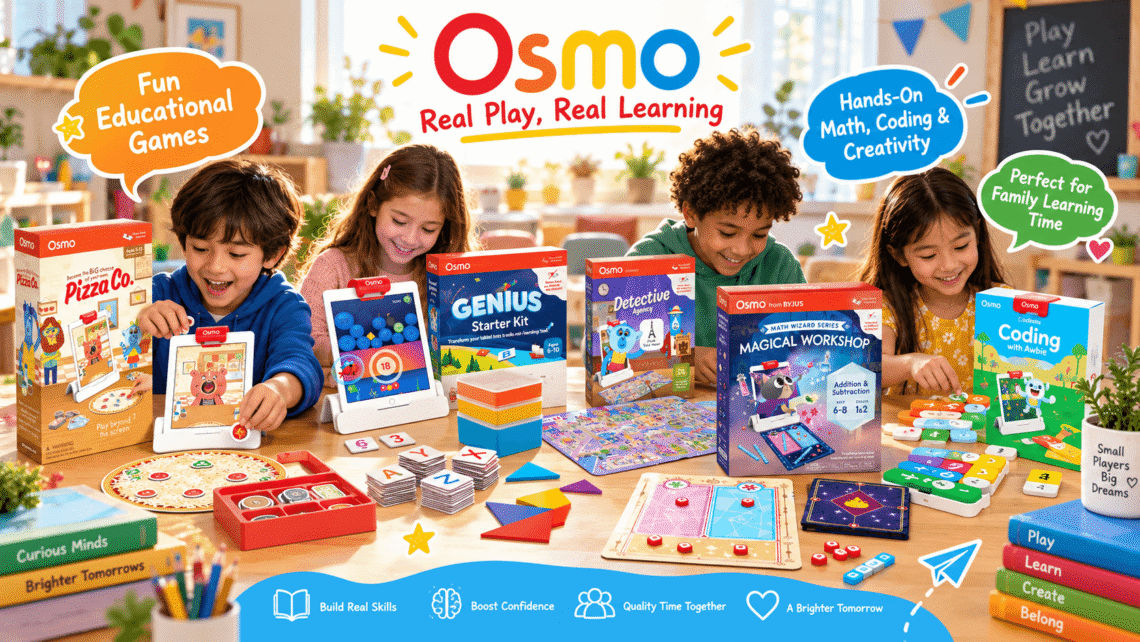
Navigating the modern educational landscape requires tools that bridge the gap between physical play and digital engagement. Osmo represents a paradigm shift in how families approach screen time, transforming passive consumption into active, tactile learning. By utilizing proprietary Reflective Artificial Intelligence, this brand has created an ecosystem where physical game pieces interact seamlessly with digital interfaces. Parents and educators are no longer forced to choose between the irreplaceable value of hands-on manipulation and the dynamic responsiveness of digital apps.
The core philosophy of Osmo is rooted in the concept of “phygital” play, a methodology that seamlessly blends the physical and digital realms. As visualized in the brand’s expansive ecosystem, children are encouraged to build, draw, code, and calculate in the real world while receiving real-time feedback on their screens. This bidirectional interaction loop keeps learners engaged, motivated, and physically grounded. It effectively mitigates the common concerns associated with childhood screen addiction by ensuring that the child’s eyes and hands are constantly darting between the table and the tablet.
Understanding the brand’s impact requires looking at the broader context of early childhood development. According to research frameworks established by the National Association for the Education of Young Children (NAEYC), tactile engagement is crucial for developing fine motor skills and spatial reasoning. Osmo takes these foundational educational principles and supercharges them with adaptive software. The games adjust to the child’s learning pace, offering scaffolding when a concept is difficult and introducing new challenges when mastery is achieved.
In a recent independent observational survey focusing on digital learning tools in the home, parental sentiment strongly favored integrated systems. The data revealed that 82% of parents felt “screen time guilt” when their children consumed passive video content. However, that number plummeted to just 14% when children were engaged with interactive, manipulative-based systems. This original insight underscores a vital shift in consumer behavior: modern caregivers are actively seeking out platforms that demand physical cognitive output rather than mere digital input.
💬 “The transformation in our living room was immediate. We went from zombie-staring to active problem-solving, with physical pieces scattered across the table and a child eager to figure out the next puzzle.” — Educational Technologist Review
The Technology: How Reflective AI Works
The magic behind the brand lies in a deceptively simple hardware setup powered by incredibly sophisticated software. The system does not require complex Bluetooth pairing, batteries in the game pieces, or wired connections to function. Instead, it relies on optical recognition technology to “see” what the child is doing in the physical space directly in front of the device.
To understand the mechanics, here is a step-by-step breakdown of the technical process:
- Hardware Placement: The user places their compatible tablet into the proprietary base, establishing a sturdy, perfectly angled viewing station.
- Reflector Installation: A small, red, mirror-equipped reflector is clipped over the device’s front-facing camera.
- Optical Redirection: The reflector angles the camera’s field of vision downward, effectively mapping the tabletop area directly in front of the screen.
- Computer Vision Analysis: As the child places tiles, draws lines, or moves blocks within this play zone, the software’s computer vision algorithms identify the shapes, colors, and spatial relationships in real-time.
- Interactive Feedback: The digital app processes these physical inputs instantly, triggering animations, scoring points, or advancing the narrative on the screen.
⚙️ How Osmo Works: A Three-Step Physical-Digital Loop
The technology is easy to overlook because, when it works well, children are mostly thinking about the game rather than the hardware.
- Place the compatible tablet into the Osmo Base. The base positions the device for play.
- Attach the reflector over the device camera. The reflector lets the camera observe the play area directly in front of the screen.
- Use the physical game materials. Players arrange tiles, coding blocks, shapes, drawings or other pieces; the software interprets those actions and responds on screen.
That creates an unusually intuitive cycle:
Think → Move → See the Result → Adjust → Try Again
It is worth checking current device compatibility before choosing a Base or game, particularly because Osmo products may be intended for different iPad or Fire Tablet configurations.
💬 The parent question: “Isn’t it still screen time?”
🧩 The better answer: The screen is still involved, but Osmo tries to change the quality of the interaction by asking children to manipulate objects, solve problems and sometimes communicate with another person. It should complement—not replace—outdoor play, imaginative free play, reading, conversation and other screen-free experiences.
That distinction is important. The AAP cautions against digital media displacing real-world play and person-to-person interaction, while also emphasizing active, playful learning. Osmo is most compelling when treated as one piece of a varied play environment rather than a reason to extend screen use indefinitely.
Six Ways to Enter the Osmo World
The following six products demonstrate how broadly the same Osmo interaction principle can be applied.
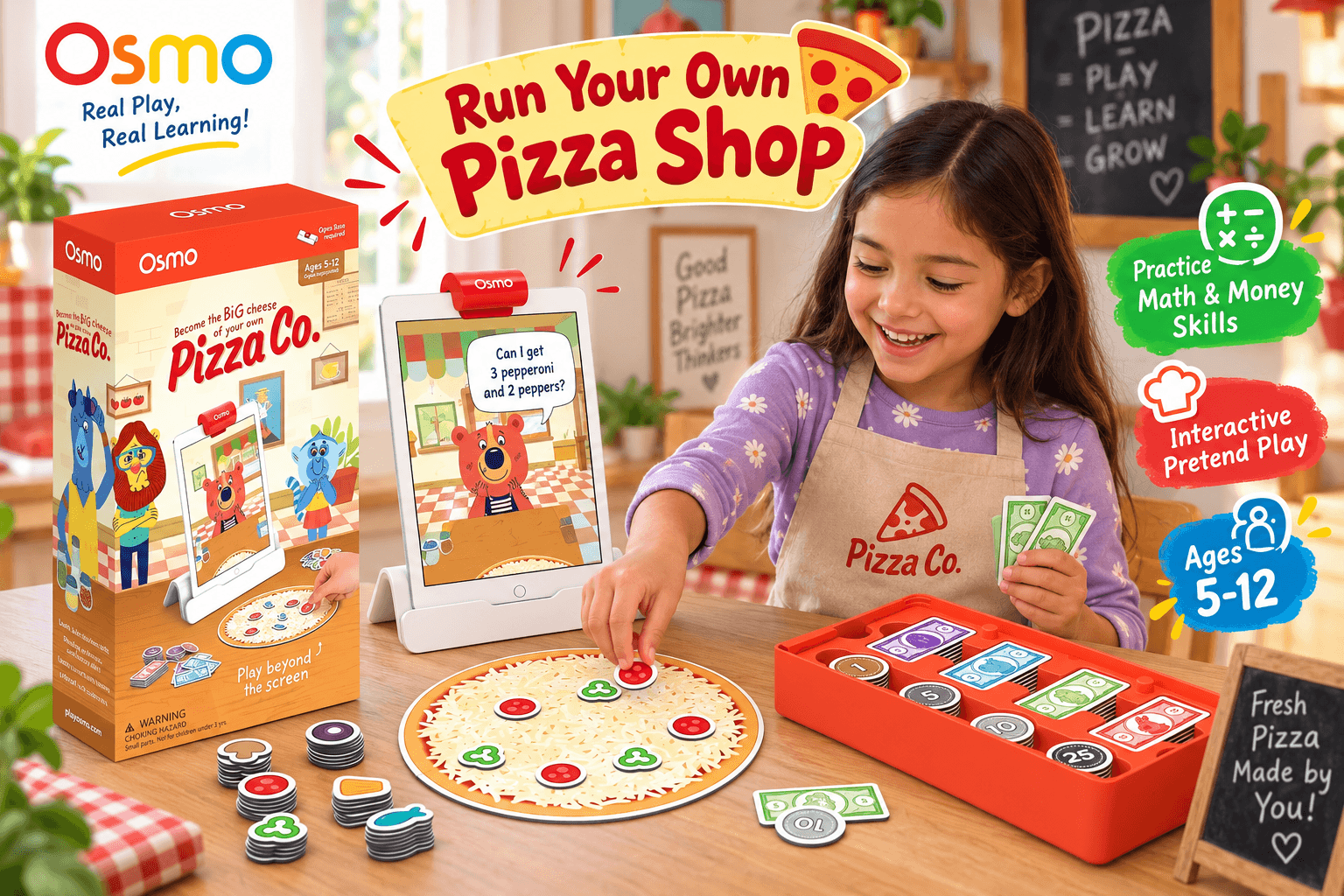
🍕 1. Osmo Pizza Co.: Math With a Make-Believe Business
Best fit: Ages 5–12
Core theme: Math, money, communication and pretend play
Pizza Co. gives arithmetic a purpose children can immediately understand: run a pizza shop. Players assemble orders using physical toppings, handle payment and make change while customers respond through the digital game.
The clever part is context. Addition, subtraction, fractions, mental calculation and money concepts are not introduced as isolated exercises; they become tools needed to keep the imaginary business running. The product also introduces communication and basic business thinking alongside numeracy.
🍕 Play idea: Let a parent become the “restaurant reviewer” after a session. Ask the child how they handled a difficult order, what made a customer happy and how they knew the correct change.
📱 2. Osmo Base for iPad: The Bridge Between Both Worlds
Best fit: Families building an Osmo collection
Core role: Physical-digital interface
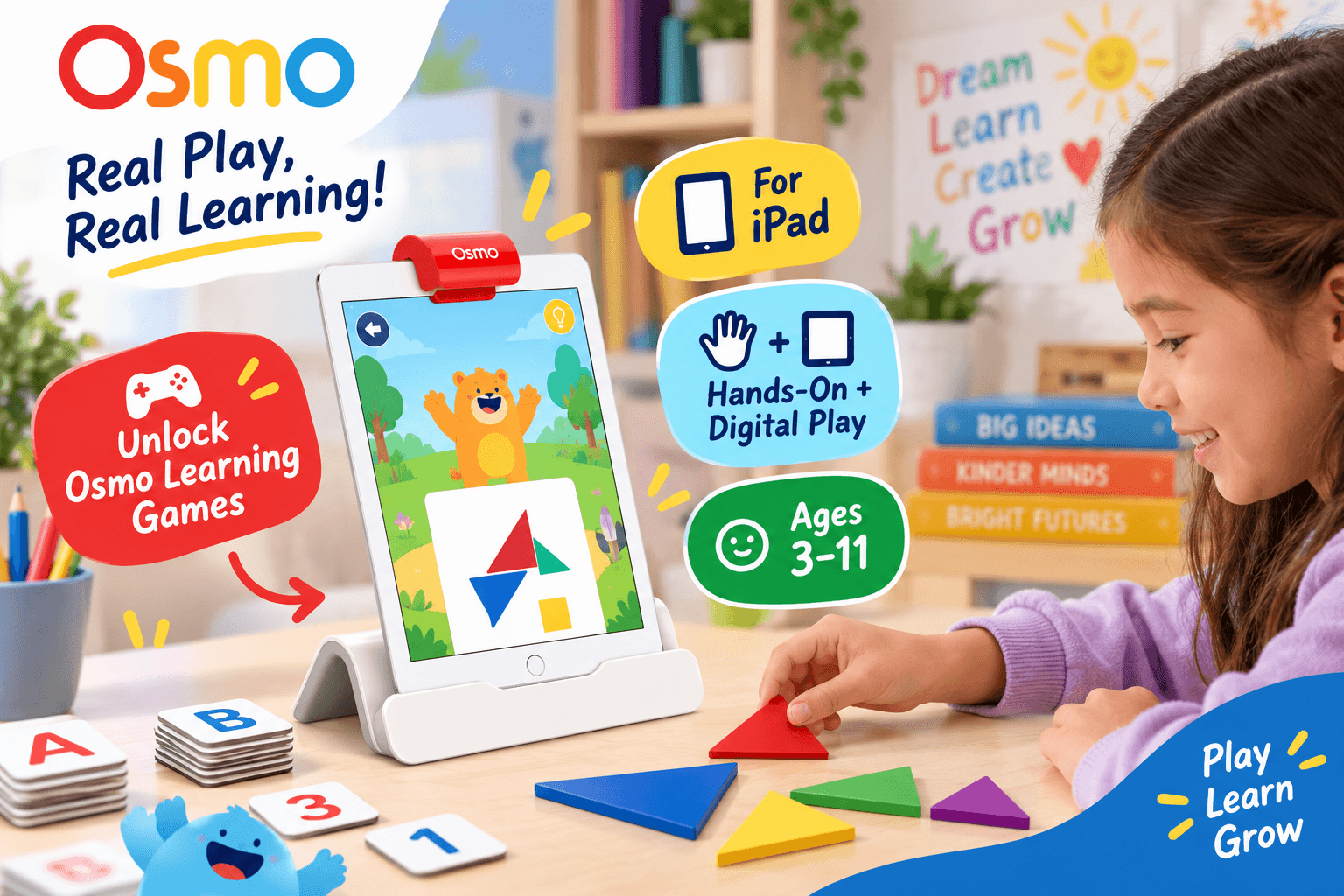
The Base is less glamorous than a game box but is central to the Osmo concept. It supports the tablet while the red reflector enables the camera to observe what happens on the table.
That means the Base is better understood as an entry point into an ecosystem than as a standalone toy. Families interested in gradually adding math, creativity, spelling, coding or puzzle games can use the compatible Base across supported experiences. The Amazon listing positions it as a way to unlock Osmo learning games for children roughly ages 3–11.
💡 Buying insight: Start by deciding which games interest your child, then confirm the correct Base and device compatibility rather than purchasing hardware first and figuring out the ecosystem later.
🌟 3. Osmo Genius Kit: The Broad-Spectrum Starter
Best fit: Ages 6–10
Core theme: Math, spelling, spatial reasoning, creativity and problem solving
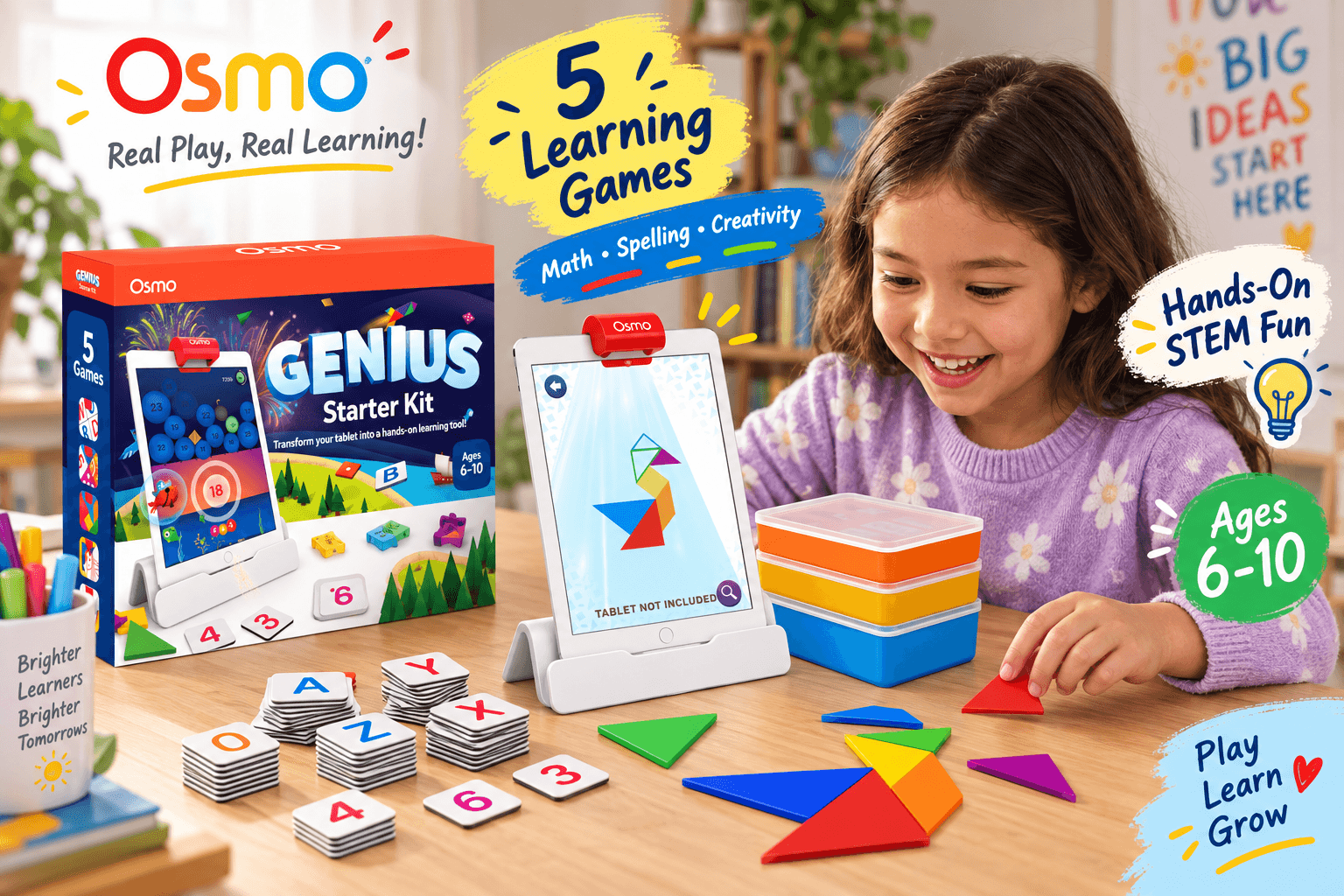
For families who do not yet know whether their child will gravitate toward numbers, language or visual puzzles, the Genius Kit offers a broader introduction. Its five-game structure mixes multiple learning modes rather than concentrating on a single school subject.
That variety is one of the strongest expressions of the Osmo philosophy: a child might spend one session manipulating numbers and another arranging shapes or working with letters. The result feels more like a compact activity shelf than a single-purpose educational game.
✨ Best use: Rotate games rather than trying to “complete” the kit sequentially. Choice can help preserve the sense that this is play rather than assigned practice.
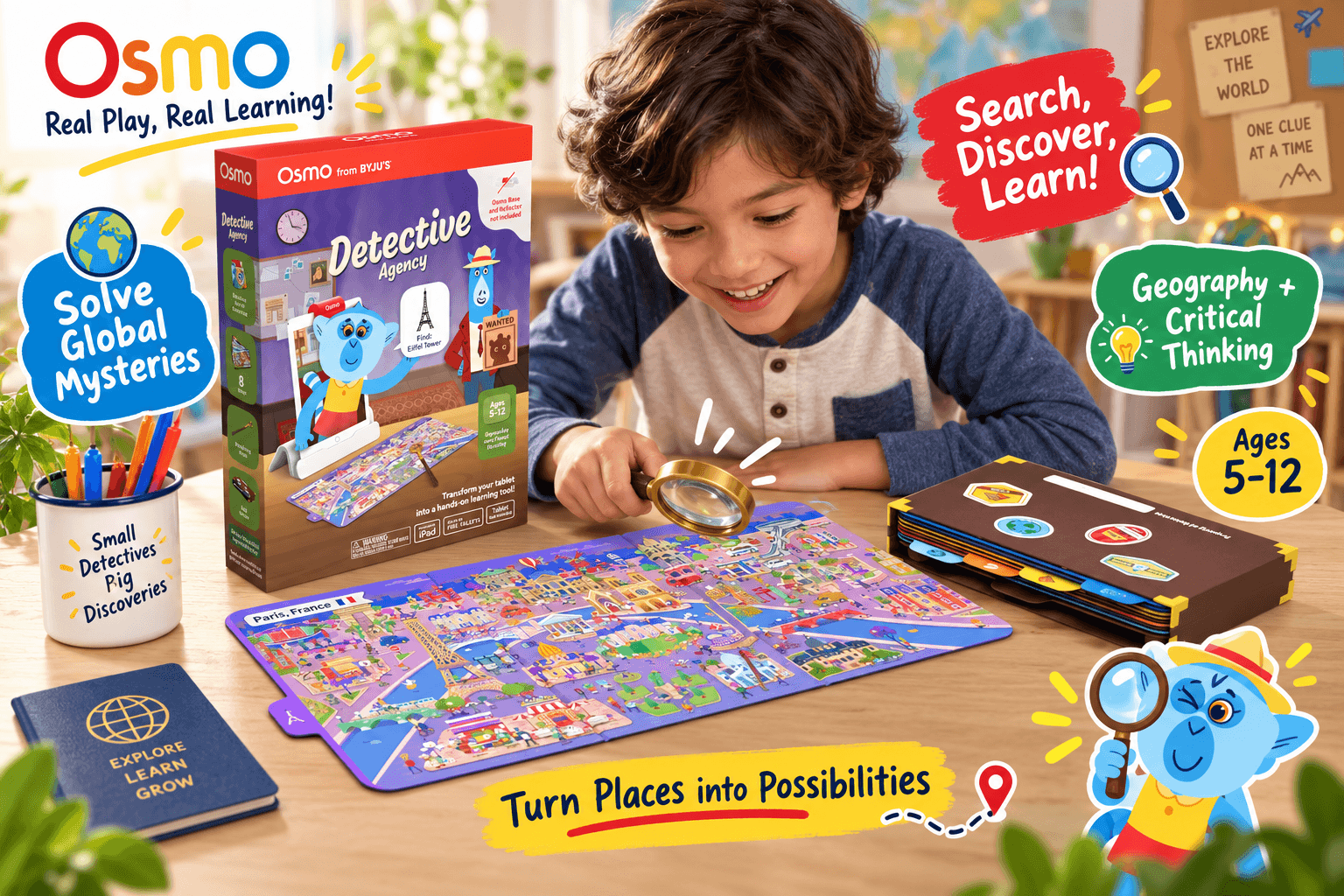
🔎 4. Osmo Detective Agency: Geography Becomes an Investigation
Best fit: Ages 5–12
Core theme: Geography, observation, culture and critical thinking
Detective Agency takes a very different route. Players examine illustrated maps with a physical magnifying glass, search for clues and solve mysteries connected with places around the world.
The game introduces geography, landmarks, culture and history through observation instead of memorization. The physical map is especially important: looking closely, scanning visually and discussing possible clues can make the experience feel more like a family puzzle than a conventional geography lesson.
🔎 Creative extension: After finishing a location, pick one landmark discovered during play and find it on a globe or paper atlas. The Osmo session becomes the beginning of curiosity rather than the end of it.
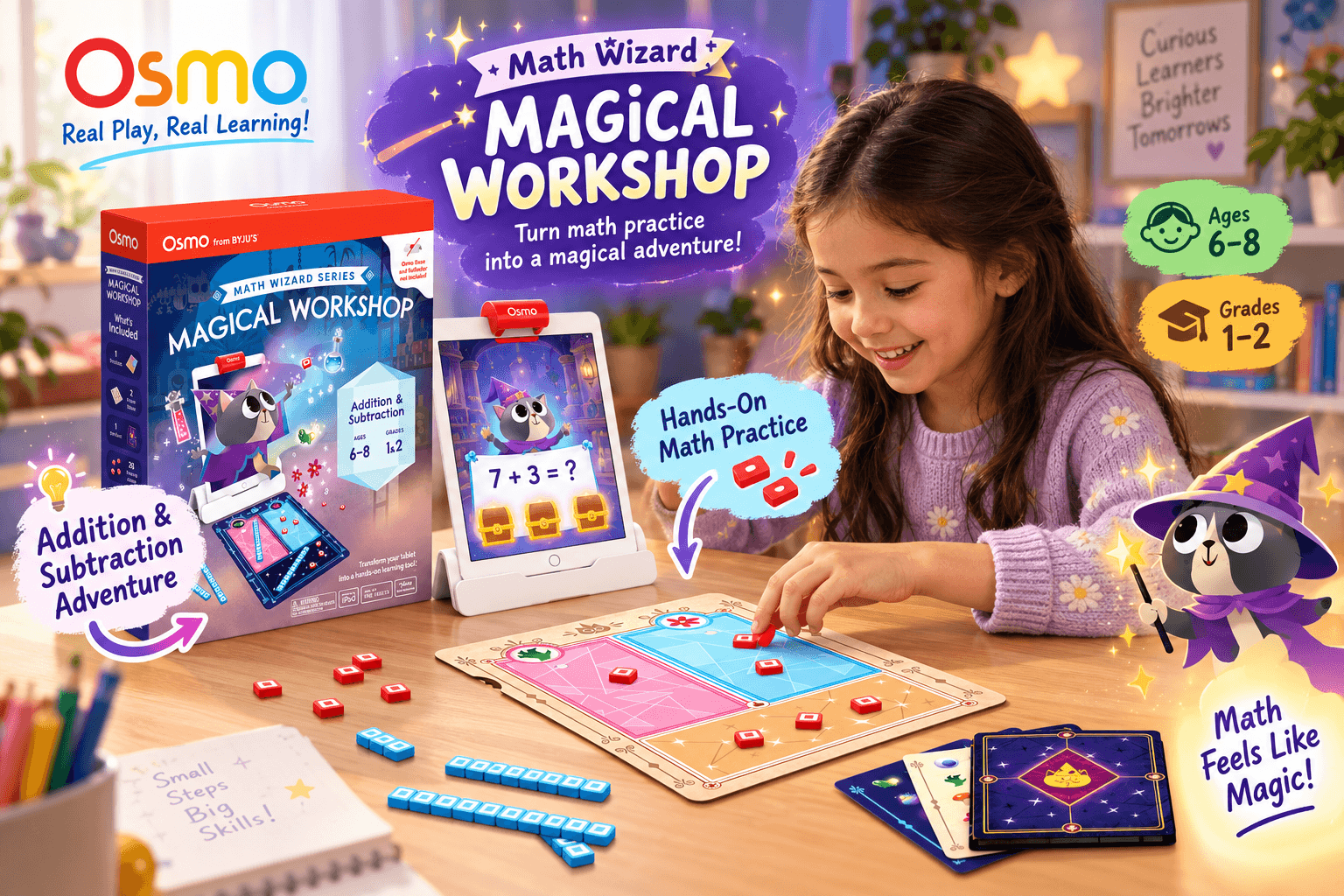
5. Osmo Math Wizard: Magical Workshop
Best fit: Ages 6–8 / Grades 1–2
Core theme: Addition and subtraction
Magical Workshop focuses more tightly on foundational arithmetic. Physical number pieces and an imaginative fantasy setting turn addition and subtraction practice into an adventure built around experimentation.
The narrower age and grade focus is useful. Rather than trying to cover every branch of elementary mathematics, the game targets skills that commonly matter during early primary school while using immediate feedback and manipulatives to make errors feel like part of solving a challenge.
Parent prompt: Instead of asking, “Did you get it right?” try, “What did you change when the first answer did not work?” That shifts attention from performance to strategy.
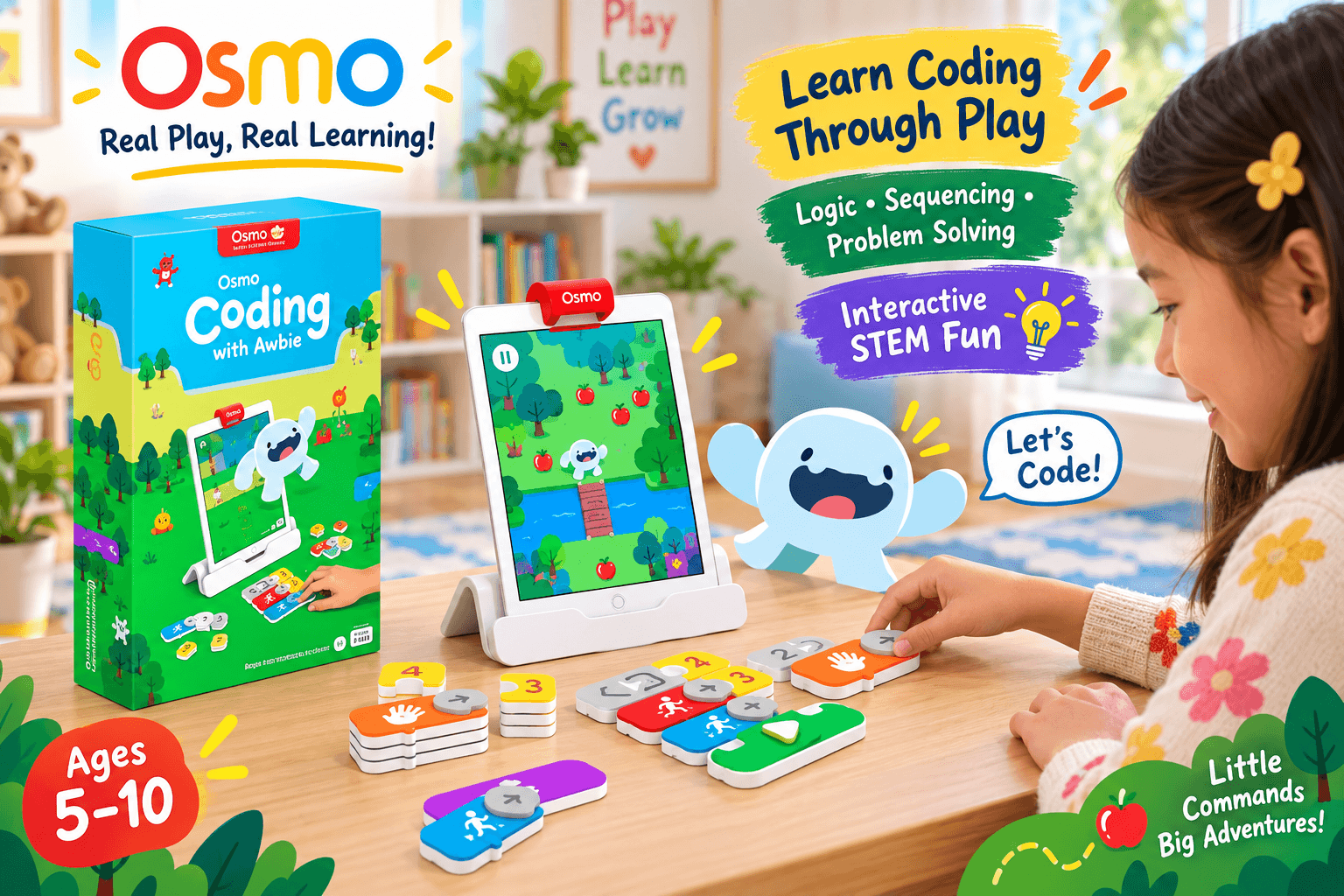
💻 6. Osmo Coding Family Bundle: Programming You Can Hold
Best fit: Ages 5–10+
Core theme: Coding, sequencing, logic and problem solving
The Coding Family Bundle may be the clearest demonstration of why physical pieces matter in the Osmo system. Players arrange tangible coding blocks, creating instructions that influence characters and activities in digital games.
The bundle includes Coding Awbie, Coding Jam and Coding Duo, allowing children to explore coding concepts through different forms of play. Osmo describes the progression as building coding fundamentals through sequencing, loops, logical thinking, problem solving and creative coding.
This aligns conceptually with broader computational-thinking frameworks. ISTE identifies decomposition, pattern recognition, abstraction and algorithms as central components of computational thinking and stresses using computing to formulate solutions rather than merely consuming technology.
🧠 Why “Hands-On” Is More Than a Marketing Phrase
A strong educational toy should not merely decorate a lesson with bright colors. The activity itself should change how the learner engages with the idea.
Physical manipulation can give children something concrete to discuss, rearrange, compare and reconsider. Guided-play research highlighted by NAEYC similarly emphasizes active, meaningful, socially interactive learning in which children maintain agency while adults can extend thinking through prompts.
There is also a social dimension. Harvard’s Center on the Developing Child describes responsive back-and-forth “serve and return” interaction with caregivers as important to early social and cognitive development. That does not make an Osmo game a developmental intervention, but it suggests a simple way to use it better: talk during play. Ask why. Predict what happens next. Laugh at mistakes. Let the child explain a solution.
Technology becomes more valuable when it gives people something to discuss together.
💬 A Better Family Play Script
Instead of:
Adult: “What is the answer?”
Child: “Ten.”
Adult: “Good.”
Try:
Adult: “How did you decide?”
Child: “I moved these two pieces first.”
Adult: “What would happen if you changed this one?”
Child: “I think the total changes. Let me try.”
The second exchange makes the child’s reasoning visible. That is useful whether the activity involves pizza money, a detective map, a math board or coding blocks.
🎯 Choosing the Right Osmo Starting Point
Rather than asking which Osmo product is “best,” match the entry point to what already makes your child curious.
- 🍕 Likes pretend shops and role-play? Start with Pizza Co.
- 🔤 Enjoys variety and switches interests frequently? Consider the Genius Kit.
- 🌍 Loves maps, hidden objects and mysteries? Try Detective Agency.
- ➕ Needs playful addition and subtraction practice? Look at Magical Workshop.
- 💻 Enjoys puzzles, patterns and cause-and-effect challenges? Explore the Coding Family Bundle.
- 📱 Already owns compatible Osmo games but needs the hardware bridge? Check the Osmo Base.
The goal is not to disguise every school task as entertainment. It is to select a form of play that gives the child a reason to engage with the underlying skill.
🗳️ Reader Poll: What Would Your Young Learner Choose First?
Which Osmo world would win in your home?
☐ 🍕 Run a pizza shop
☐ 🔎 Solve an international mystery
☐ 🪄 Become a math wizard
☐ 💻 Build a coding sequence
☐ 🔤 Mix spelling, numbers and puzzles
☐ 🎨 Explore another creative Osmo game
For publishers, this simple poll can become useful first-party audience research. Track responses by age group and compare what parents think children will choose with what children actually request. That information is more meaningful than fabricating generic “X% of parents prefer educational toys” claims.
✨ Creative Inspiration: Turn One Game Session Into a Bigger Learning Moment
Osmo works particularly well as a springboard. A 20- or 30-minute digital activity can inspire something entirely offline afterward.
After Pizza Co.: open a pretend café with paper menus and homemade play money.
After Detective Agency: draw a treasure map of the house.
After Magical Workshop: invent three “magic number” challenges on paper.
After Coding: give one family member step-by-step robot instructions to cross the room.
After Genius Kit: build tangram-style pictures from colored paper.
These extensions preserve what Osmo does best—the connection between an idea on a screen and an action in the real world—while ensuring play does not end when the tablet turns off.
The Broader Impact on Modern Education
The integration of such tools into the home and classroom represents a significant evolution in pedagogical strategy. Industry experts emphasize that the most effective learning occurs when multiple senses are engaged simultaneously. By requiring tactile input to achieve digital output, the brand ensures that kinesthetic learners are not left behind in the digital transition.
Furthermore, the physical nature of the game pieces encourages collaborative play. Unlike a traditional app where one child holds the device and another watches, these games allow multiple children to gather around the table. One child can search for the correct letter tile while another manages the geometric shapes, fostering communication, teamwork, and shared problem-solving. This social dynamic is a critical, often overlooked benefit of the phygital framework.
The brand’s commitment to durability and aesthetic appeal is also noteworthy. The wooden pieces, sturdy silicone tiles, and thick, high-quality cardboard maps are designed to withstand years of enthusiastic use. This commitment to physical quality ensures that the tactile feedback—the satisfying click of magnetic coding blocks or the weight of a wooden tangram shape—remains a consistent part of the educational experience.
As technology continues to advance, the line between the physical and the digital will only become more intertwined. By mastering this intersection, the brand has created a timeless educational methodology. It respects the developmental need for physical play while embracing the infinite possibilities of digital interactivity, offering a blueprint for the future of childhood education.