Imagine showing up to the court at 6 a.m., coffee in hand, no hitting partner to text, no coach booked, and still walking off two hours later having hit more quality balls than most players get in a full week. That is the quiet promise behind TENNIIX — a young equipment brand building ball-feeding machines that treat solo practice not as a sad backup plan, but as one of the most productive hours of your week.
If you have been playing tennis for more than a few seasons, you already know the feeling. You arrive at the court fired up, ready to work on your forehand, your footwork, your transition game — and then you spend forty minutes lobbing balls against a wall, or worse, hitting serves into a fence because nobody showed up. TENNIIX exists to end that cycle. Their tennis and pickleball machines are compact, thoughtfully designed, and built to turn an empty court into a private lesson, a training session, or just the kind of free-swinging hit you cannot always rely on another person to deliver.
This post is not a spec dump. It is a closer look at what TENNIIX actually is, who the brand serves, how their machines differ from the older, heavier equipment many of us grew up with, and whether this is the kind of investment that pays for itself in better tennis — or just a shelf for your extra water bottles.
🏟️ The Problem TENNIIX Was Built to Solve
Competitive tennis is, famously, the most social of solo sports. You can drill your serve alone. You can practice your toss against a backboard. You can even feed yourself forehands with a basket if you are willing to spend ten minutes picking balls up for every minute hitting them. But the things that actually make you a better player — rhythm, consistency, pressure repetition, movement between shots — almost always require a ball coming at you from a consistent place, on a repeatable schedule, without asking your friend to stand there and hand-feed you for an hour.
Ball machines have been solving this for decades. The problem is that most of the options on the market until recently fell into two camps:
The club-grade workhorse. Big, heavy, expensive machines that live on a trolley in a tennis center and cost as much as a used car. They are wonderful for academies and club pros, but they are not something a recreational player wants to haul up three flights of apartment stairs.
The budget plastic box. Tiny, cheap machines that wobble across the court when you turn the oscillation on, jam after three shots, and die halfway through your session. They feel like a toy, and you get exactly what you paid for.
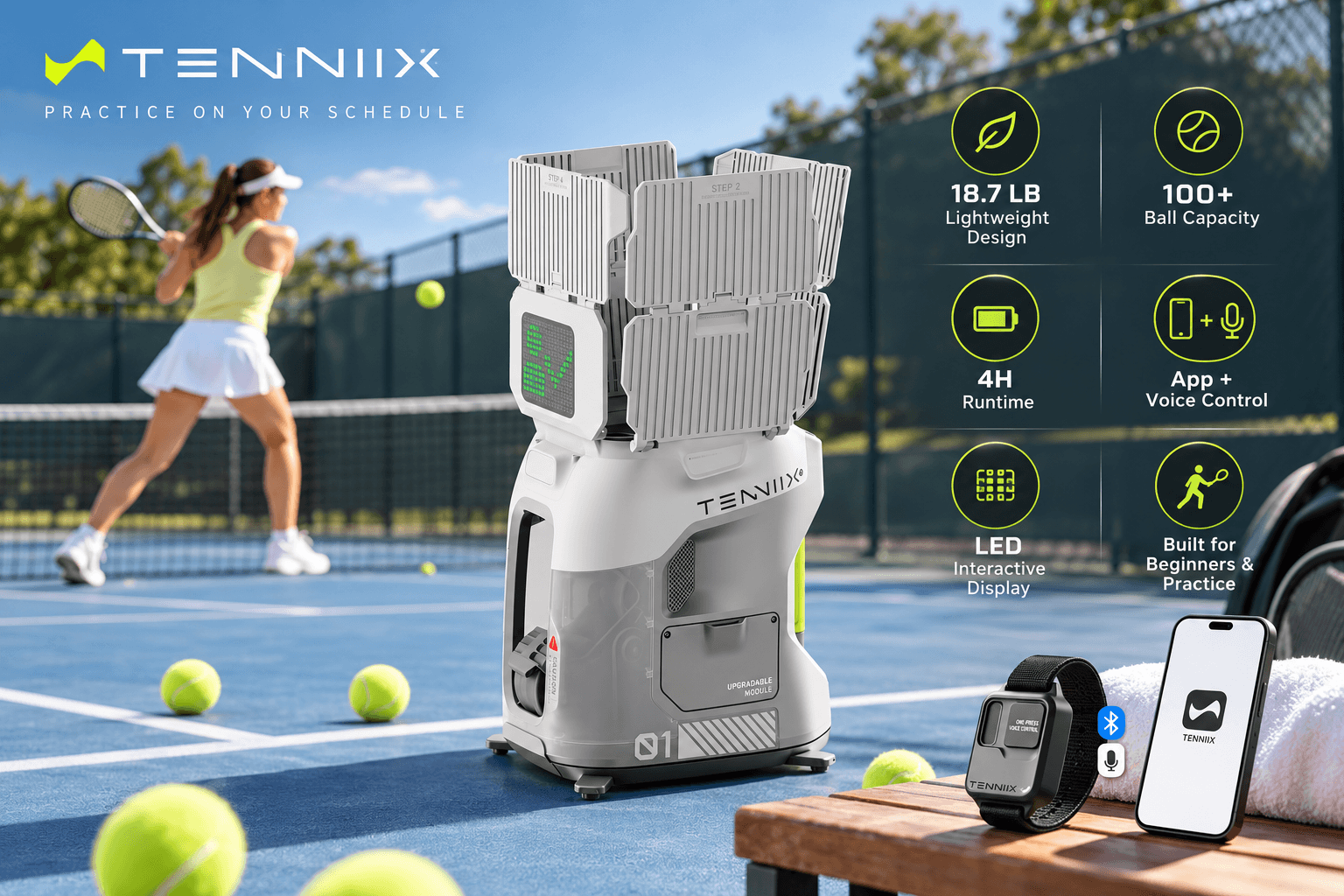
TENNIIX slots into the space between those two worlds. The machines on their storefront are sized for a single player to carry, styled to look like actual consumer electronics rather than gym equipment, and built around the assumption that most of their customers are amateurs, part-time coaches, college players, and parents drilling with their kids — not a full-time academy running six sessions a day.
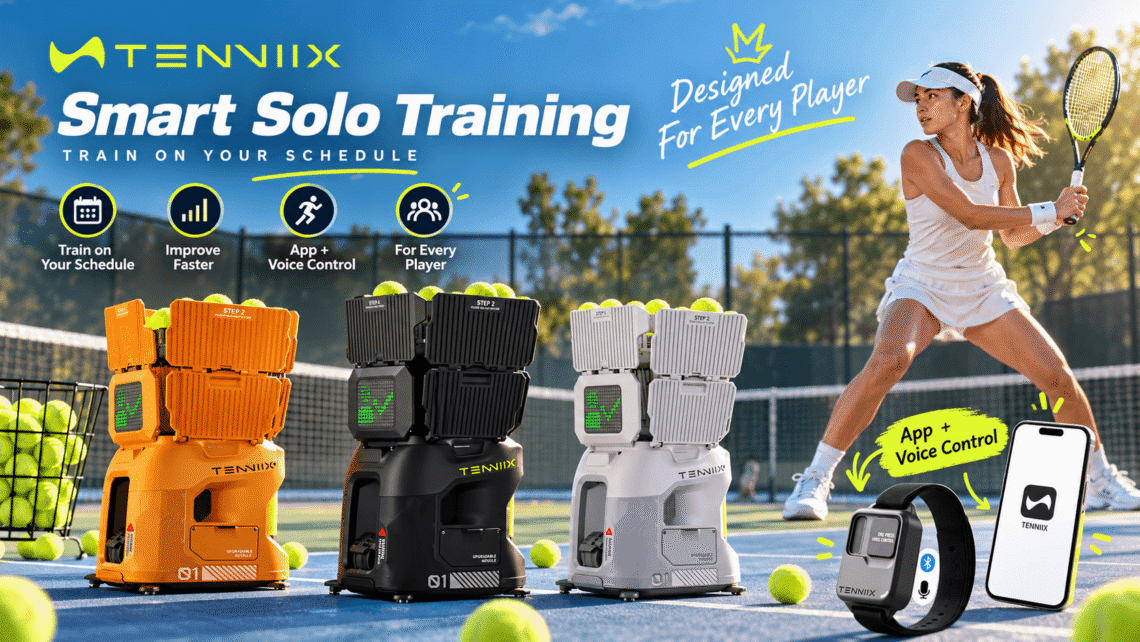
That positioning matters. It shapes everything about the product, from the color choices (matte black, clean silver, and a surprisingly confident orange that reads more design studio than equipment room) to the way they are marketed alongside real courts, real rackets, and real players.
🧢 Who Are the People Behind TENNIIX?
Here is the honest version: TENNIIX is still a young brand, and they are not yet at the level of household-name recognition that legacy tennis equipment companies enjoy. What they are doing, though, is telling a very coherent story on their storefront — and that story is worth taking seriously.
A few things jump out immediately:
- They are not trying to be a general sporting goods brand. Their entire catalog is built around ball-feeding machines for tennis and pickleball, plus the accessories that make those machines usable day to day.
- They are leaning into design as a differentiator. The product shots on their storefront place the machines on clean, bright courts, against studio backdrops, and next to orange and grey packaging that looks closer to a premium coffee brand than a tennis supplier.
- They have already tied themselves into competitive moments — most visibly their collaboration with the Blue Jean King Cup Finals 2026, a women’s team tennis event that gives a small brand a surprisingly loud stage.
- Their customer seems to be a hybrid: the recreational player who wants to improve without a coach, the part-time instructor who needs a portable feeder for group lessons, and the pickleball convert who wants the same kind of solo practice in a sport that is exploding.
That combination — a narrow product focus, visible design sensibility, and a real event partnership — is the fingerprint of a brand that is trying to build something longer-lasting than a single Amazon listing.
💬 “Most tennis equipment brands talk to you like you are fifteen and training for nationals. TENNIIX talks to you like you are forty-two, just picked the sport up two years ago, and want to get better without spending three hours a week arranging practice partners.”
That is not an official quote. It is just the read you get when you scroll the storefront.
🎯 The TENNIIX Product Line at a Glance
Walking through their catalog, the lineup breaks into a few clear families. Here is the landscape as it shows up across the storefront:
| Family | What it does | Who it’s for | Vibe |
|---|---|---|---|
| Tennis ball machine (dark / grey) | Feeds tennis balls with adjustable pace and spin, top-loaded ball hopper, built-in carry handle | Adult recreational players, drillers, hitting alone | Clean, modern, slightly technical |
| Tennis ball machine (orange) | Same core feeding capability in a brighter, sportier chassis | Juniors, coaches, anyone who wants their gear to stand out on court | Energetic, outdoor, summer-camp energy |
| Pickleball machine (orange / grey) | Compact feeder sized for pickleball’s smaller court and shorter rallies | Pickleball players, doubles teams, older athletes moving between sports | Light, portable, social |
| Accessories & consumables | Ball bundles, carrying solutions, consumables that keep the machine running | Existing TENNIIX owners | Practical, after-thought but well-designed |
A couple of things stand out in this lineup.
First, they are not just in tennis. The pickleball machine is a deliberate signal. Pickleball is the fastest-growing racket sport in North America, and the players moving into it are often exactly the people who already own a tennis racket, a gym membership, and a willingness to spend money on gear. Building a pickleball feeder is not a side project for TENNIIX; it is the smartest adjacent move a tennis equipment brand could make right now.
Second, the color story is consistent. The orange version of both the tennis and pickleball machines is the brand’s recognizable signature — it shows up in the packaging, in the court-side shots, and in the group imagery on the storefront. If you have ever held one of these machines in person, that orange color is probably the first thing you remember about it.
Third, the form factor is genuinely portable. Across all the product shots, the machines are sized somewhere between a small cooler and a large carry-on bag. They have a handle, they sit flat on a court surface, and they are clearly designed to be picked up, moved around, and thrown in the back of a sedan — not wheeled around on a dedicated cart.
🎾 Inside the Tennis Ball Machine
The tennis machine is the core of the brand, so it is worth dwelling on for a moment.
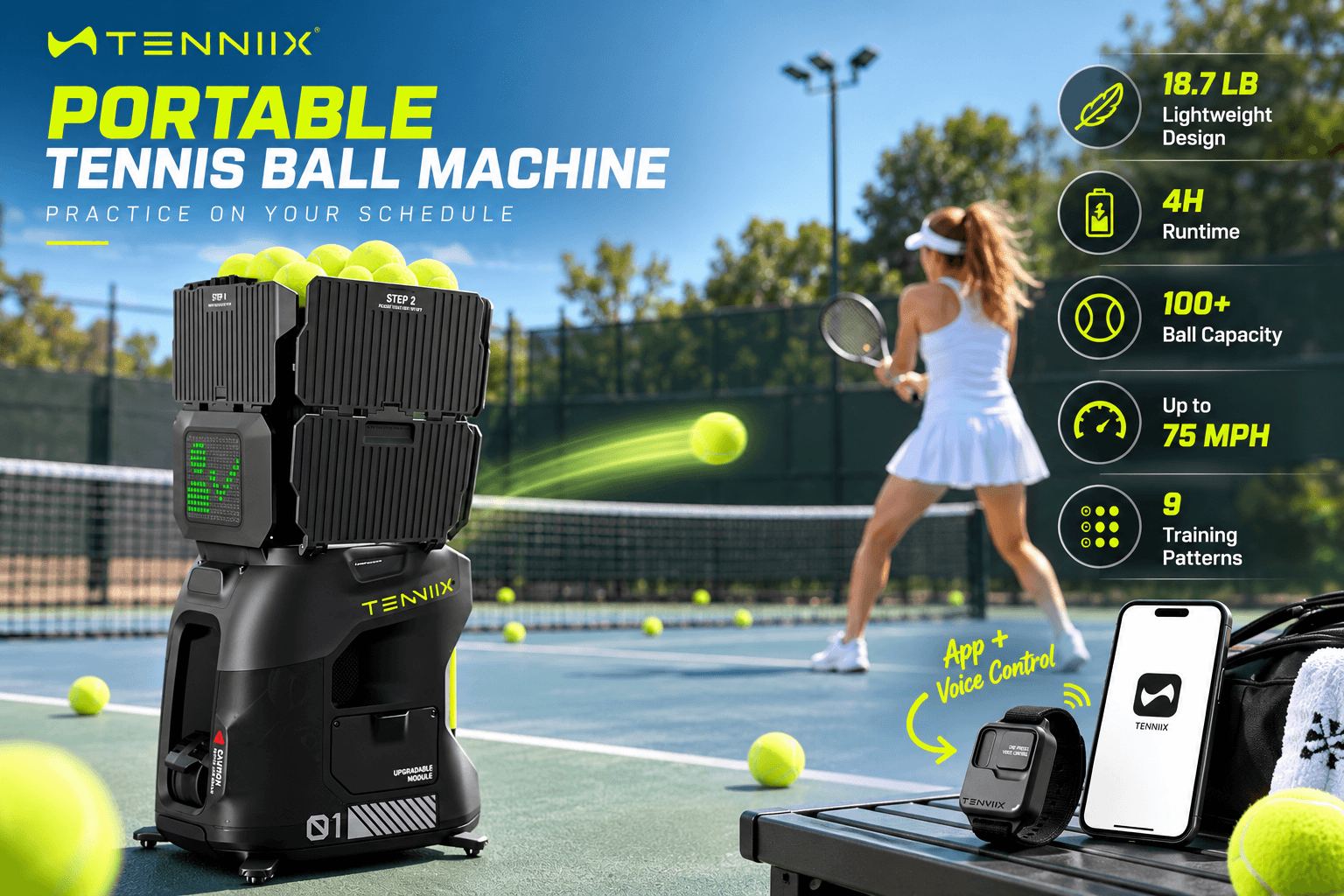
Look at any of the dark or silver units on the storefront and you will see the same design language: a vertical column with a ball hopper on top, a control panel on the front face, and a stable base that sits flush on asphalt or hard court. Balls are loaded from the top, gravity-fed into the mechanism, and launched toward the player at a pace and trajectory that you adjust through the front-facing controls.
This is not a new idea in principle. Every ball machine on the market does roughly this. What is different is the level of polish.
Consider the small things:
- The body lines are soft and rounded, not industrial-sharp. This is a product that lives in a home, not a garage.
- The interface is visually quiet — buttons and indicators rather than a wall of dials and LEDs.
- The hopper capacity looks generously sized for solo practice, which means you are not constantly walking over to reload.
- The base is wide and low, which matters on a windy court. A top-heavy feeder is a toppled feeder.
A typical solo session with a machine like this goes something like this:
You: Arrive at court 4, machine in one hand, racket bag over the shoulder.
Also you: Ten minutes later, having hit forty forehands, twenty backhands, and a half-attempt at a running drop shot.
You, to yourself: Why did I ever wait for a hitting partner?
The honest answer, of course, is that nothing replaces a live rally. Live players adjust, they surprise you, they put pressure on you in ways no machine can. But live players also cancel, they are tired, they want to play points instead of drilling, and they live across town. The machine shows up at 6 a.m. every single time.
🏓 The Pickleball Move
If tennis is TENNIIX’s anchor, pickleball is their expansion play — and it is a smart one.
Pickleball players skew older than tennis players, and they skew newer to the sport. Many of them came over from tennis, from racquetball, or from nothing at all. What they share is a willingness to invest in equipment that makes the game more enjoyable, and a hunger for anything that helps them improve faster than their clubmates.
A pickleball ball machine is a slightly different product than a tennis one:
- It feeds a lighter, smaller ball, which changes the mechanics of the feeder.
- The court is a quarter the size, so portability matters even more.
- The rallies are shorter and faster, which means the machine needs to feed at a rhythm that fits the sport’s pace.
- The audience is more likely to be practicing with a partner already, so the machine becomes a supplement rather than a replacement.
TENNIIX’s orange pickleball machine — visible in several of the storefront shots — is clearly designed with this audience in mind. It is compact, it has a playful color profile, and it reads as an approachable piece of equipment rather than a piece of training hardware. That matters for a sport where half the appeal is that it does not feel like serious work.
👤 Who Is TENNIIX Really For?
Scroll the customer imagery on the storefront and you start to build a mental picture of the people actually using these machines. It is not a single demographic.
The returning adult. Maybe you played college tennis, took fifteen years off, and came back to the game last year. You do not want a coach every week. You want a machine that will feed you a forehand at the exact pace and spin you remember from 1998, so you can rebuild the muscle memory without anybody watching.
The part-time coach. You run a small academy out of a public park, and you cannot afford a $5,000 machine that lives in your trunk. You need something light enough to carry, durable enough to survive four hours a day in the sun, and flexible enough to work for a group of twelve-year-olds on a Tuesday and a private adult lesson on a Saturday.
The junior player’s parent. Your kid is playing three times a week, you have a backyard or access to a club, and you would rather they spend an hour a day hitting balls than an hour a day on a tablet. You want something safe, simple, and not embarrassing to be seen carrying out of your car.
The pickleball convert. You moved to Florida or Arizona or suburban Denver, and suddenly everyone you know plays pickleball. You are 55, reasonably fit, and want to be the best player at the community center by next season. A feeder machine is the fastest shortcut to that.
The competitive team. TENNIIX’s tie-in with the Blue Jean King Cup Finals 2026 is not a random sponsorship. It is a way of telling serious, competitive players — especially in women’s team tennis — that this brand belongs in that environment. A feeder machine used by touring pros for warm-ups, practice sessions, and off-court skill work is the strongest possible endorsement for the recreational buyer who wants the same tool the pros use.
🎨 Why the Design Actually Matters
Here is a thing about sporting equipment that nobody talks about enough: if the product feels ugly, you use it less.
There is a famous story about a gym chain that redid its locker rooms and saw usage go up by 30 percent, simply because people stopped dreading the fifteen-minute changing ritual. The same logic applies to tennis gear. If your ball machine looks like a piece of industrial equipment, you leave it in the garage. If it looks like a consumer product you would be proud to set up on a public court, you take it everywhere.
TENNIIX gets this. Look at their product photography:
- The machines are shot against clean backgrounds, not on cluttered court fencing.
- The orange version is almost a fashion statement — it pops on a blue hard court in a way that makes it look intentional, not accidental.
- The packaging is designed as part of the product. The tall orange box that shows up in several storefront shots is something you would actually leave in your apartment rather than toss immediately.
- The brand logo is small, confident, and not screaming. It reads more like a tech startup than a sporting goods company.
This is not vanity. It is the reason a recreational player will actually load the machine into their car on a Tuesday evening after work, instead of leaving it in the corner of the living room.
🏟️ From Storefront to the Blue Jean King Cup Finals 2026
One of the most striking things on the TENNIIX storefront is the hero banner for TENNIIX × BLUE JEAN KING CUP FINALS 2026 — a bright, stadium-lit shot that places their product in the middle of a major team tennis event.
For a young brand, this is a big move. The Blue Jean King Cup is the women’s equivalent of the Davis Cup — a national-team competition with deep tennis heritage. Being associated with it, even at a sponsorship or co-branding level, tells three things about TENNIIX:
- They are not a fly-by-night Amazon brand. Real sponsorships cost real money, and real events do not partner with companies they do not believe in.
- They take women’s tennis seriously. Aligning with a competition named for Billie Jean King’s legacy is a strong signal about where they want their brand to live.
- They want credibility with serious players. A recreational buyer can look at the storefront and think, if this is good enough for national-team warm-ups, it is good enough for me.
That last point is the one that actually moves product. Recreational players do not need a machine that can spin a ball at 5,000 RPM. They need a machine they can trust to work, to feel well-built, and to not embarrass them in front of their hitting partners. A visible event partnership is the fastest way to communicate that.
🧪 A Typical Practice Session With TENNIIX
Let’s make this concrete. Here is what an hour on the court actually looks like with one of these machines.
0–5 minutes. You roll onto the court, pull the machine out of its carry case, and set it in the deuce-court corner. You load the hopper with a basket of balls. You dial in a moderate pace, neutral trajectory, and no oscillation. You stand at the baseline and hit ten forehands, just to feel the rhythm.
5–20 minutes. You bump the speed up. You start the side-to-side oscillation, so the machine is feeding alternately to your forehand and backhand. You spend fifteen minutes simply moving between two balls, trying to get your feet set before each shot. This is the single most valuable thing a ball machine gives you: repetition without a partner.
20–35 minutes. You switch to a focused drill. Maybe you are working on high backhands, so you set the trajectory higher and stand closer to the machine. Maybe you want transition practice, so you place the machine at the service line and hit volleys. Nobody is telling you what to work on. The machine simply does what you ask.
35–50 minutes. You add an element of pressure. You set the machine to feed at a faster pace, and you challenge yourself to hit eight out of ten shots cross-court. You miss the first few. By the end, you are hitting them cleanly.
50–60 minutes. You cool down with serves, because nobody is keeping score and nobody is watching. You pick up the balls, reload your basket, and walk off the court feeling like you actually practiced.
That hour is worth more than two hours of casual hitting. And it would not have happened if you had needed to find a partner.
🗣️ The Conversation You’ll Have With Yourself
Here is the part of solo practice nobody warns you about: you end up having a very long conversation with yourself.
“Okay, that forehand was good.”
“That one? That was terrible. What did I do wrong?”
“You lifted your head. Do it again.”
“…better. Again.”
“Okay, now pretend the machine is your opponent. It is not your friend. Hit it like you mean it.”
A ball machine forces this kind of internal monologue. There is nobody else to blame, nobody else to joke with between shots, nobody to tell you what a great hit that was. You are the coach, the player, and the critic, all at once.
This is why people who use ball machines regularly tend to improve faster than people who don’t. It is not the machine itself. It is the clarity of being alone with your own mistakes.
🛠️ What to Actually Look For When Choosing a TENNIIX Machine
If you have decided you want to bring one of these into your life, here is a practical decision framework.
1. Tennis or pickleball? This is the easiest question. If you regularly play on a standard tennis court with yellow felt balls, you want the tennis machine. If your weekends now revolve around a fiberglass paddle and a plastic whiffle ball, the pickleball machine is the one for you. Trying to use the wrong one will frustrate both you and the machine.
2. Indoor or outdoor? If you mostly play outdoors, you want the orange version — it stands out against the green or blue court, it is easier to see at dusk, and it reads as an outdoor piece of equipment. If you mostly play indoors or in a club setting, the matte black or silver version blends in more quietly.
3. Solo drilling or group coaching? If you are buying for yourself to hit alone, portability and battery life matter more than raw speed. If you are buying as a coach, hopper capacity and durability become much more important — you will be running this thing for hours a day.
4. Color preference. This sounds shallow, but it matters. The orange machine is the one people will comment on. The dark one is the one that disappears into the background of your garage. Buy the one you will actually enjoy setting up.
5. Accessories from day one. Look at the bundles on the storefront. A ball machine is only as good as the number of balls you have to feed it. Buy the machine, then immediately buy a full basket of matching balls, so you are not constantly reloading.
🧗 The Real Costs of Owning One
A ball machine is not a small purchase. Let’s be honest about what you are getting into:
- Upfront cost. This is a serious piece of equipment. It is not a toy. Plan accordingly.
- Court time. You need somewhere to use it. A public park works. A private club is better. A backyard, if you are lucky enough to have one, is ideal.
- Balls. You will go through them. Budget for replacement balls every season.
- Carrying it. The machines are portable, but they are not weightless. Make sure you can actually get it from the car to the court by yourself.
- Time. A machine only pays off if you actually use it. The people who get the most value from TENNIIX are the ones who build it into their weekly routine, not the ones who buy it in January and leave it in the garage by March.
That last point is the honest advice nobody will give you in a product description. Buy the machine only if you are already the kind of person who gets up early to hit anyway. If you are not, the machine will not turn you into that person.
🌱 TENNIIX vs. the Rest of the Market
For context, the ball machine category has a few well-established names:
- Lobster. The legacy brand. Club-grade, heavy, expensive, and beloved by academies.
- Sports Tutor. Another long-standing option, popular in high school programs.
- Spinshot. A newer, lighter option aimed at the recreational market.
- Various budget Chinese brands. Cheaper, variable quality, often sold through Amazon.
TENNIIX sits in the Spinshot neighborhood — aimed at the recreational and part-time coach buyer — but with a stronger design sensibility and a clearer brand voice. They are not trying to out-spec the legacy academies. They are trying to look better, feel better, and fit into the life of an actual human being rather than a tennis club’s equipment room.
This is a viable lane. The recreational tennis and pickleball market is enormous, and most of the equipment options in it are either too serious (academy-grade) or too cheap (toy-grade). The middle is wide open, and TENNIIX is clearly trying to own it.
💭 Who Should Not Buy This Machine
A blog post is only honest if it also tells you who should walk away.
You should not buy a TENNIIX machine if:
- You play tennis once a month. The machine will spend more time in your closet than on a court.
- You hate practicing alone. Some people simply cannot get anything done without another human being present. That is a fine personality trait, and a ball machine will not change it.
- You are looking for a complete coaching solution. The machine feeds balls. It does not correct your grip, explain unit height, or tell you why your backhand is breaking down. You still need lessons.
- You live in a fifth-floor walkup with no car. Even portable equipment gets old to carry up and down stairs every week.
If any of these describe you, save the money, book a coach, and play socially.
✨ What Happens If You Do Buy It
Here is the payoff. People who actually use a ball machine, consistently, over the course of a year, almost always get better. Not because the machine is magic — because they are hitting 300 or 400 balls in a session, twice a week, when they would otherwise have been sitting on the couch.
The math is simple:
| Activity | Balls hit per week | Skill growth over 6 months |
|---|---|---|
| Social hitting only | ~200 | Slow, mostly points-based |
| Lessons + casual play | ~350 | Good, but limited by lesson frequency |
| Lesson + weekly solo machine session | ~700–900 | Noticeable, measurable |
| Machine 2x/week + occasional hitting partner | ~1,200+ | Real improvement in less than a season |
TENNIIX is the tool that unlocks that last row. It does not matter whether your goal is to stop losing to your office buddy, to win a club-level tournament, or just to feel competent on a tennis court. The fastest route to any of those goals is more clean repetition — and no hitting partner will ever give you as much clean repetition as a machine that shows up on time, every time.
🌍 What to Watch for Next
As TENNIIX grows, a few things to keep an eye on:
- More event partnerships. The Blue Jean King Cup Finals 2026 is just the start. Expect more women’s and college team tie-ins.
- Expansion of the pickleball line. Pickleball is not going away, and the people who play it have money. Expect more colorways, more compact models, and more coaching-oriented bundles.
- Smart features. Older ball machines are purely mechanical. Newer ones have app control, programmable drills, and shot randomization. TENNIIX will likely move in this direction as the brand matures.
- A stronger content presence. Brands that build community — drill videos, practice routines, player stories — tend to outlast brands that only sell on Amazon. Watch for TENNIIX to start investing here.
If you are an early customer, you are getting in on a brand that is clearly building for the long run, not just clearing inventory.
🎬 Final Thoughts: Is TENNIIX Worth It?
Here is the honest answer.
If you are the kind of tennis or pickleball player who shows up to the court even when nobody is coming with you — who is willing to spend an hour alone, hitting the same shot fifty times, just to see if you can make it cleaner — then yes, TENNIIX is one of the best investments you can make in your game.
If you are a part-time coach running small group lessons, the TENNIIX machine is the kind of piece of equipment that makes your life significantly easier and your students significantly better.
If you are a parent wanting to give your kid a head start, this is a way to turn an empty court into a daily training session without hiring a full-time coach.
And if you are just someone who loves the sport and wants a nicer way to spend your Saturday mornings? The orange machine on a blue hard court, with the sun coming up over the fence, is one of the quietest, nicest pleasures in adult athletics.
TENNIIX is not trying to replace your hitting partner, your coach, or your favorite weekend league. What they are trying to do is fill the space in between — the mornings, the off days, the lonely practice hours that are actually where your game is built.
They are building a practice partner that never cancels, never gets tired, and never judges you for hitting that same forehand badly for twenty minutes in a row.
For a lot of us, that is the friend we have been missing on the court all along.