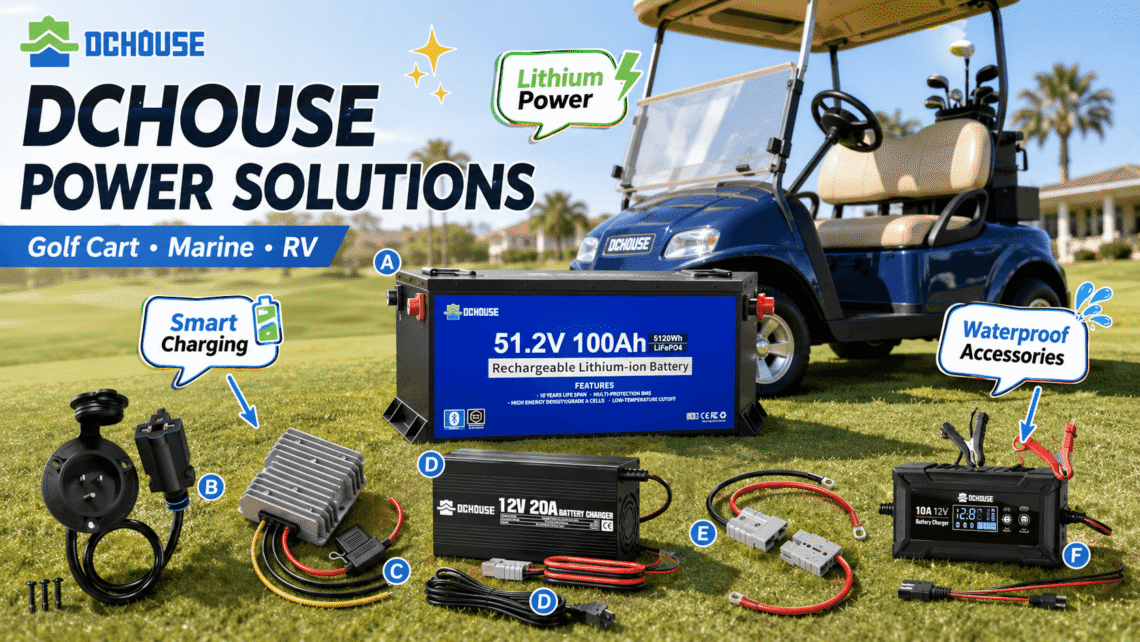
Imagine a world where your off-grid aspirations and recreational vehicle adventures are never curtailed by power limitations. In the vast landscape of portable power solutions, one name has consistently risen to prominence on platforms like Amazon, known for delivering reliable, cohesive, and innovative energy management systems. That name is DC HOUSE. This brand is not just about individual products; it is about engineering a seamlessly integrated power experience for demanding applications in golf carts, RVs, boats, and beyond.
From robust energy storage to efficient conversion and intelligent charging, DC HOUSE provides a comprehensive solution for modern explorers and leisure enthusiasts. Their commitment extends beyond just the hardware, focusing on safety, durability, and empowering users to get the most out of their equipment. As a brand that has carved a niche for itself by offering high-quality, high-value components, DC HOUSE represents a powerful choice for anyone looking to upgrade or build their ideal mobile power setup.
Let’s delve into some of their flagship products to understand how this brand is transforming the way people think about and manage their recreational power.
🔋 The DC HOUSE Approach: Think in Systems, Not Just Batteries
A powerful battery is useful only when the rest of the electrical setup can support it. A golf cart owner upgrading from traditional batteries, for example, may also need an appropriate charger, lower-voltage power for accessories, reliable connectors, monitoring tools, and a convenient external charging point.
DC HOUSE appears to understand that relationship.
Its product catalog stretches across several connected categories, including 36V and 48V golf cart batteries, 12V and 24V trolling motor batteries, batteries for scooters and other electric mobility applications, and a growing collection of battery accessories. That structure gives the brand a practical advantage: shoppers can begin with the main energy source and then explore supporting components that solve the smaller electrical challenges around it.
The brand’s visual identity reinforces this approach. Blue battery cases, clearly marked capacities, straightforward accessory designs, and functional product photography create an engineering-oriented feel without making the products look unnecessarily complicated.
💬 Power Thought: “The most useful battery upgrade is the one that fits naturally into the rest of your system.”
That idea runs through many of the products highlighted below.
⚙️ DC HOUSE at a Glance
| Power Need | DC HOUSE Category | Typical Application |
|---|---|---|
| Main energy storage | Lithium battery systems | Golf carts, trolling motors, electric equipment |
| Battery charging | Smart and dedicated chargers | Garage, RV, marine, mobile power systems |
| Voltage management | DC-DC converters | 12V accessories powered from higher-voltage systems |
| External AC access | Shore power inlets | Golf carts, RVs, boats |
| Fast cable connection | Quick battery connectors | Marine, RV, golf cart and utility systems |
| System monitoring | App/LCD-enabled battery solutions | Battery status and power management |
What stands out is the continuity between these categories. Instead of asking customers to assemble an electrical system from unrelated brands, DC HOUSE can cover several stages of the same setup.
01. ⭐ DC HOUSE Metal Case 48V 100Ah Lithium Golf Cart Battery Kit
For shoppers looking at a major golf cart power upgrade, this battery kit is one of the clearest examples of the DC HOUSE ecosystem philosophy.
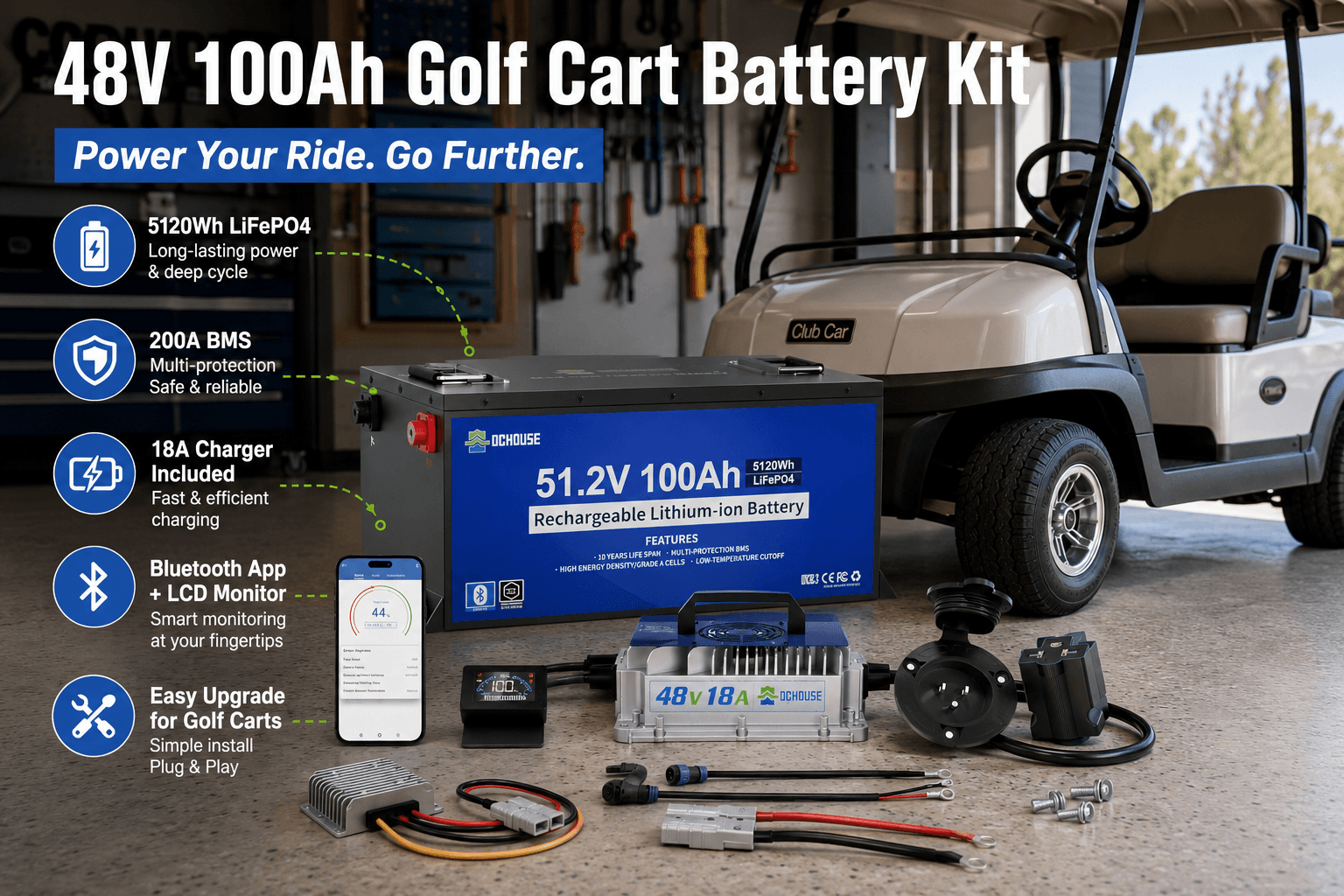
The centerpiece is a 48V-class 100Ah LiFePO4 golf cart battery housed in a substantial metal enclosure. The product image identifies the pack as 51.2V 100Ah with 5120Wh of energy, reflecting the operating voltage commonly associated with this type of LiFePO4 configuration.
But the battery itself is only part of the package.
The kit also includes an 18A charger, an LCD-style monitoring component, mobile-app monitoring support, connection hardware, and associated cables. That makes the package especially appealing for users who want to approach an upgrade as a complete project rather than purchase the battery first and solve charging or monitoring later.
⚡ Quick Highlights
- 48V-class 100Ah lithium golf cart battery
- 5120Wh LiFePO4 energy capacity
- Metal battery enclosure
- 18A charger included
- Bluetooth/mobile monitoring support
- LCD monitoring component
- Designed around golf cart power upgrades
The strongest feature here is integration. Golf cart owners moving toward lithium power often value reduced maintenance and a more modern battery-management experience, and combining battery, charger, and monitoring components makes the transition feel more organized.
💬 Upgrade Idea: “Battery + charger + monitoring = fewer pieces to figure out separately.”
For DC HOUSE, this kit functions almost like a flagship demonstration of what the brand wants to offer: not just stored energy, but a more complete power-management package.
02. 🔌 DC HOUSE 15A AC Port Plug and 125V Shore Power Inlet
Not every important electrical upgrade is large.
Sometimes the small component that makes charging easier becomes the part you appreciate most frequently.
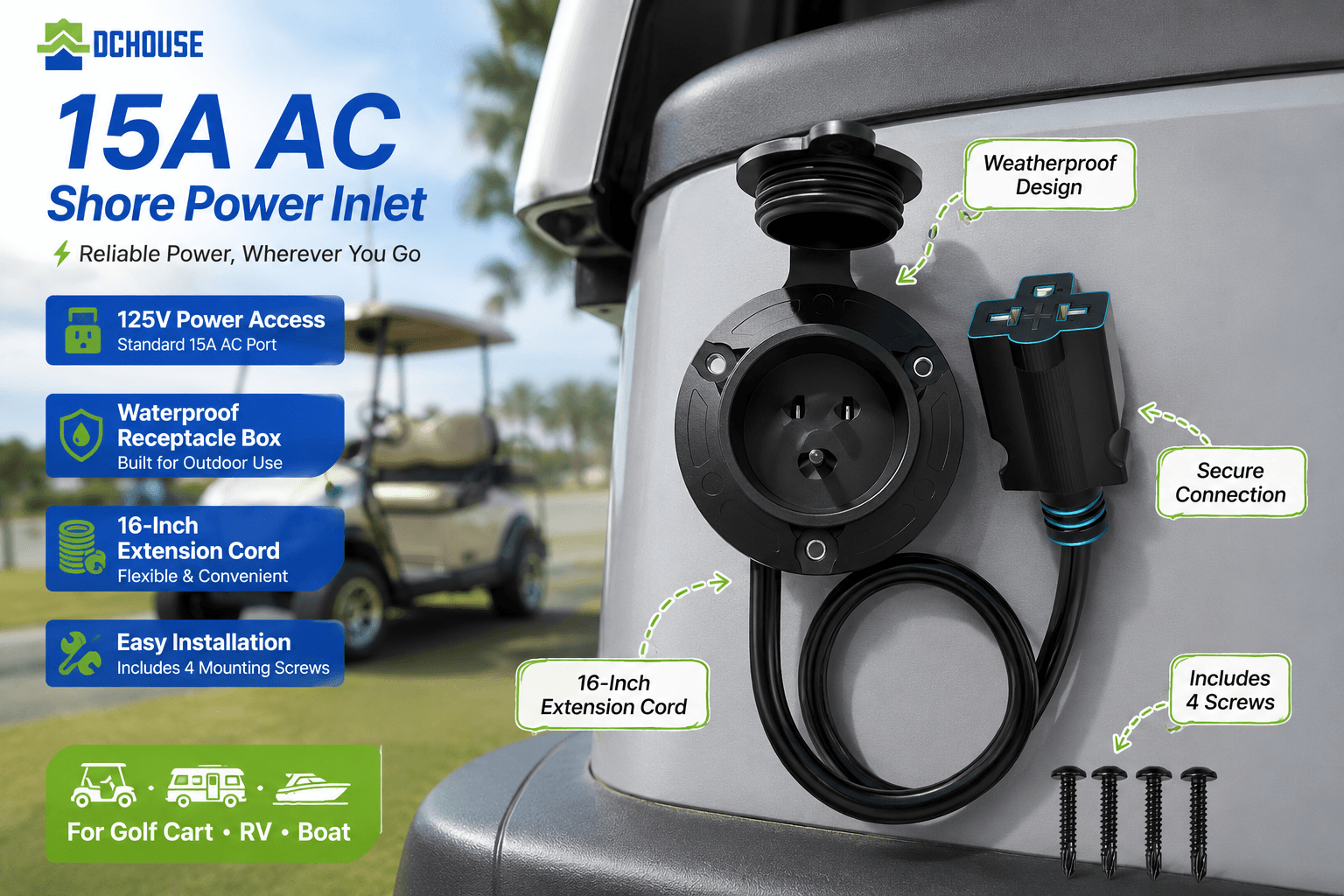
The DC HOUSE 15A AC Port Plug is designed as a 125V shore power inlet for applications such as golf carts, RVs, and boats. Its compact circular housing, covered inlet design, attached cable, and included mounting screws create a simple solution for bringing external AC power into a vehicle or mobile system.
This type of product can help create a cleaner installation by giving users a fixed external charging or power-access point rather than repeatedly routing loose cables through openings.
The included 16-inch outdoor extension cord further supports convenient installation.
🌧️ Why it fits the DC HOUSE ecosystem: batteries and chargers handle the energy, but a dedicated inlet helps make routine access to that energy more convenient.
Its design is straightforward, compact, and application-focused—exactly the kind of supporting accessory that helps transform individual power products into a usable system.
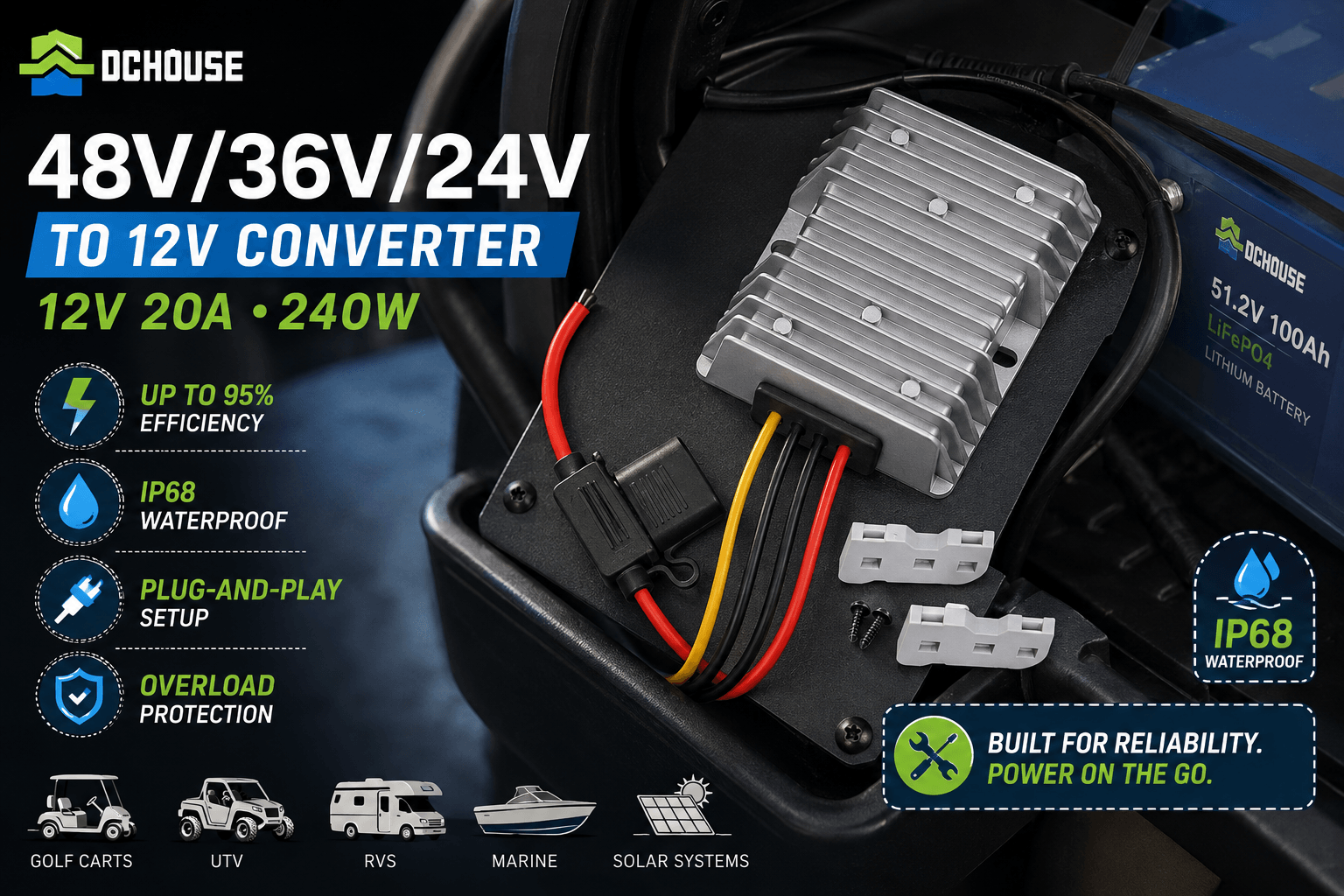
03. ⚡ DC House 48V / 36V / 24V to 12V 20A 240W DC-DC Step Down Converter
Higher-voltage battery systems create an interesting challenge: many everyday accessories still operate on 12V.
That is where the DC HOUSE step-down converter enters the picture.
This unit is designed to take a 24V, 36V, or 48V electrical system and provide 12V output, making it useful for applications where a higher-voltage traction battery needs to support lower-voltage accessories.
Its rated output is 12V, 20A, and up to 240W, giving users a practical way to power compatible accessories without creating an entirely separate electrical system.
The finned metal housing also gives the converter a distinctly industrial appearance. Its wiring and inline fuse arrangement emphasize function over decoration.
🛠️ Where a converter like this can make sense
A golf cart may use a high-voltage battery for propulsion while still needing 12V for lights, USB charging equipment, electronics, or other accessories. Similar voltage differences can appear in RV, utility vehicle, marine, and custom electrical installations.
That makes this converter less visually impressive than a large lithium battery—but potentially just as important to the finished system.
It demonstrates another recurring DC HOUSE theme: solving the electrical details around the battery, not merely supplying the battery itself.
04. 🔋 DC HOUSE 12V 20A Lithium Battery Charger with Quick Connector
Charging equipment deserves more attention than it often receives.
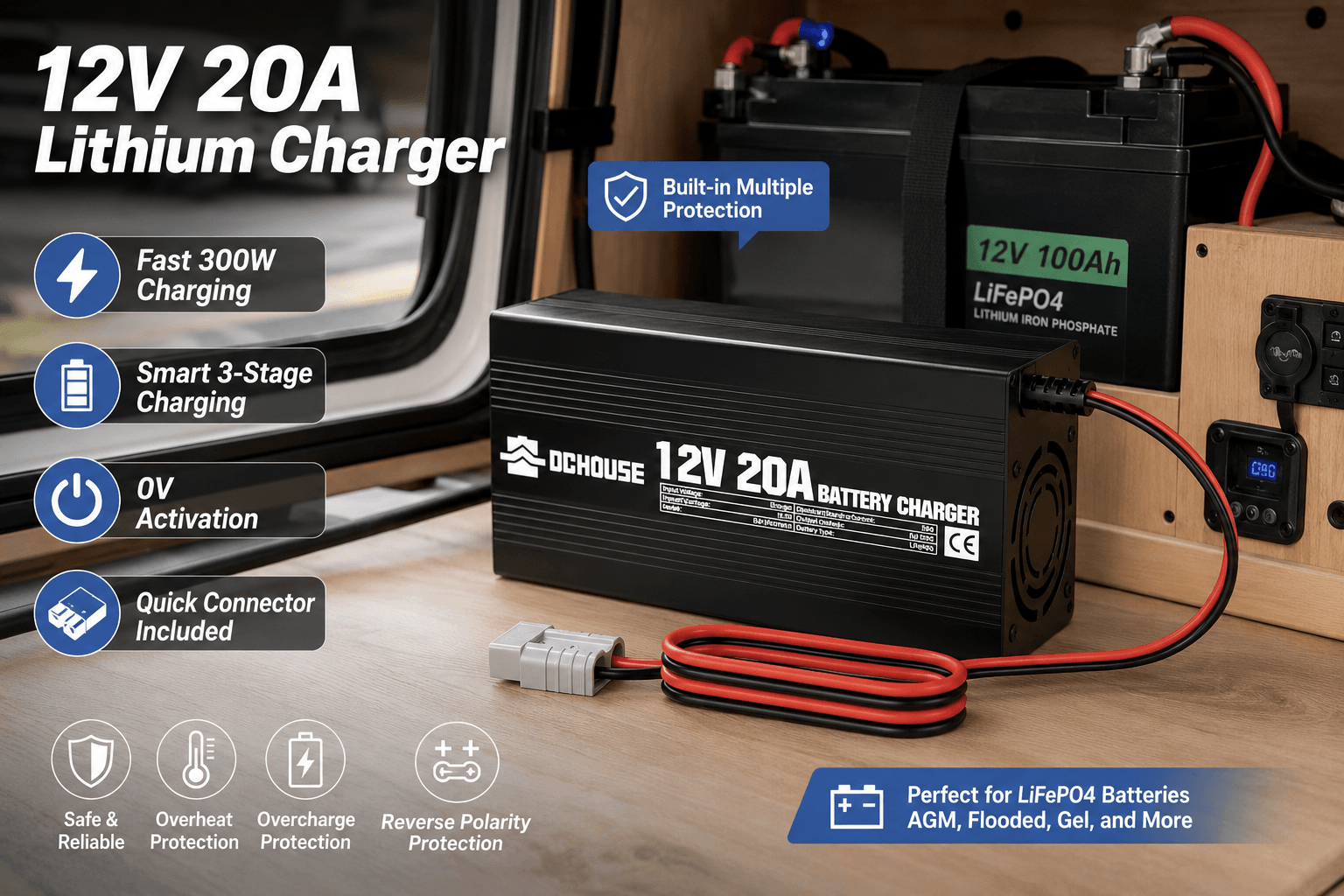
A battery can only perform as part of a practical system if keeping it charged is straightforward, and the DC HOUSE 12V 20A Lithium Battery Charger is aimed at that routine responsibility.
The charger uses a sturdy rectangular metal housing with integrated cooling ventilation, red-and-black output cables, an AC power cable, and a quick-connection arrangement. Its 12V 20A specification positions it as a higher-output option for compatible 12V lithium battery systems.
The product is particularly relevant to users building RV, marine, solar-support, garage, or off-grid battery setups where batteries may be charged regularly rather than occasionally.
⚡ The appeal is simplicity: connect, charge, disconnect, and return the battery system to service.
The inclusion of a quick connector also complements other DC HOUSE products. Rather than treating charging cables as an afterthought, the company increasingly seems to design its accessory lineup around easier connection and disconnection.
05. 🔗 DC HOUSE 2-Pack 50A Waterproof Quick Battery Connector
If batteries are the heart of a mobile power system, cables and connectors are its circulation system.
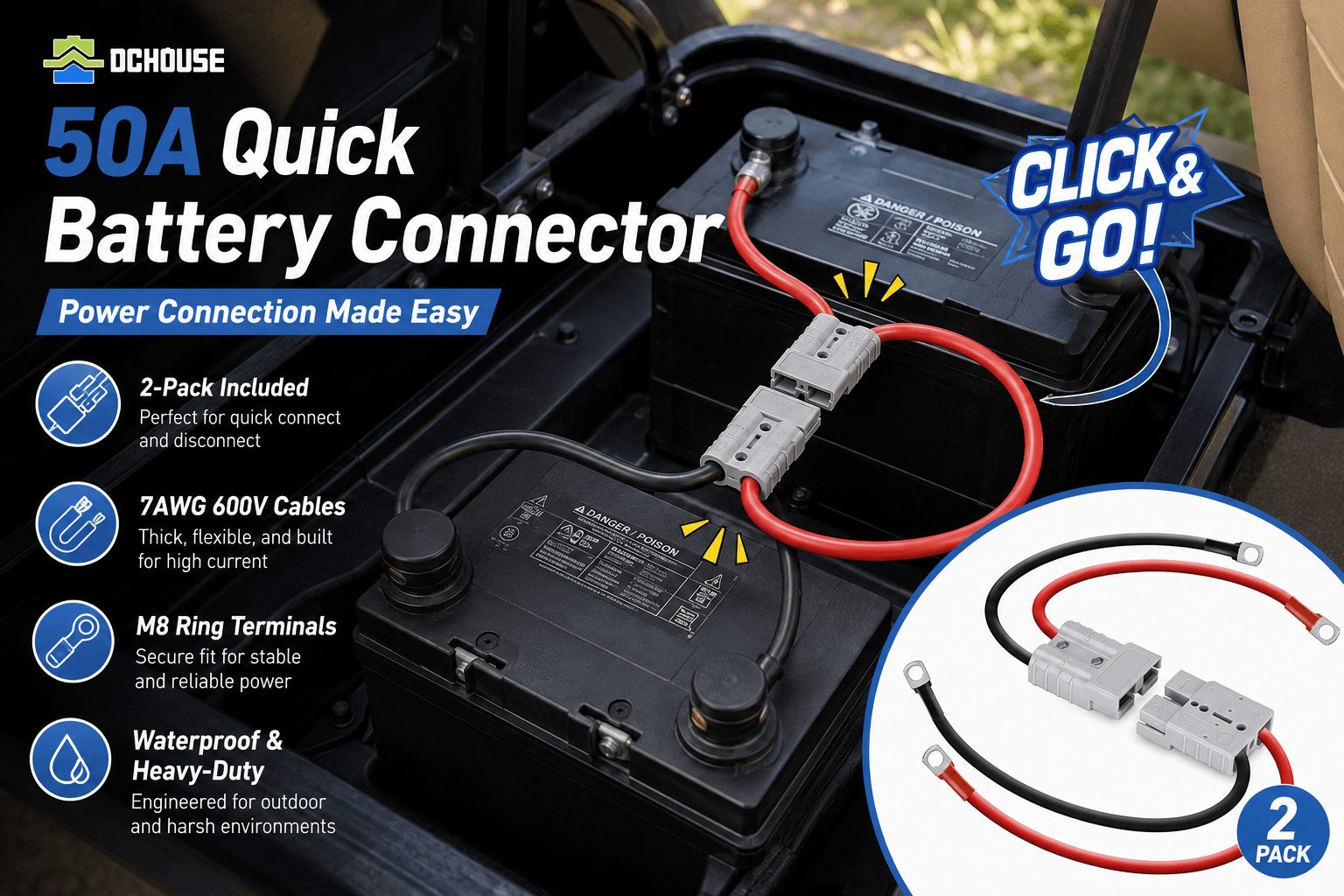
The DC HOUSE 50A Quick Battery Connector set is designed for applications including marine equipment, RVs, golf carts, trolling motors, trailers, and other battery-powered systems. The product uses substantial red and black cables with gray quick-connect housings and ring terminals.
It is sold as a two-pack, allowing users to create convenient connection points between compatible power components.
Why does that matter?
Battery systems often require servicing, charging, equipment swaps, or seasonal removal. A quick-connection system can make those processes more convenient than repeatedly removing traditional terminal connections.
💡 Small accessory, big workflow improvement: connectors do not increase battery capacity, but they can significantly improve how pleasant the system is to use.
This product also shows why the DC HOUSE accessory catalog matters. Once customers begin assembling batteries, chargers, converters, and electrical equipment, reliable connection hardware becomes part of the same purchasing conversation.
06. 🔌 DC House 12V 10A Battery Charger for Lead-Acid and LiFePO4 Batteries
The sixth featured product takes a more flexible approach to everyday battery charging.
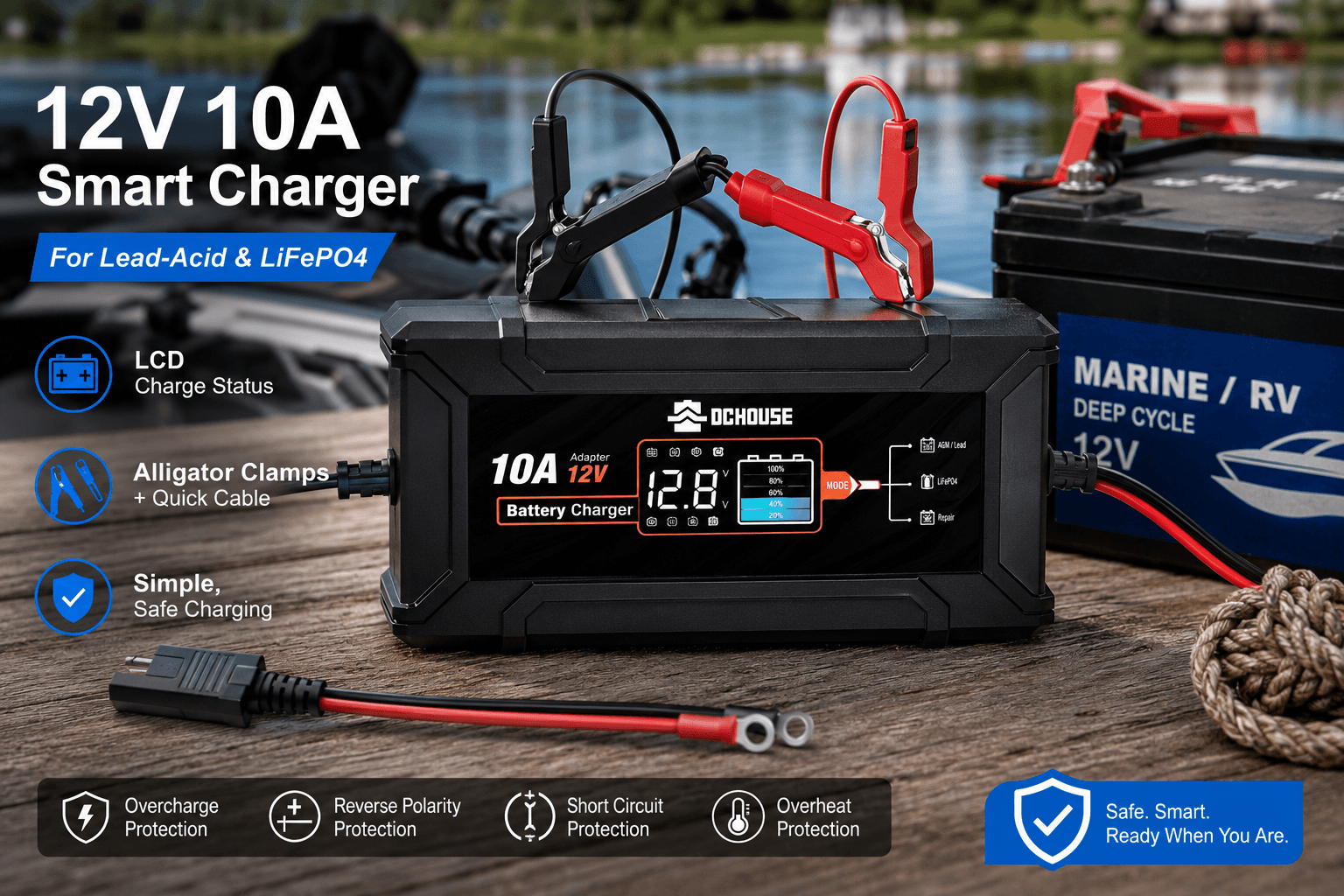
This 12V 10A charger is presented for both lead-acid and LiFePO4 battery applications, giving it broader relevance for users who may maintain different types of 12V batteries.
Its rugged black housing includes an integrated digital display, while the package shown includes charging clamps and additional connection cables. That combination gives the charger the appearance of a practical workshop, marine, RV, or garage tool rather than a permanently installed charger.
The LCD-style interface also makes the charging process more visible at a glance.
Compared with the 20A charger above, this model feels oriented toward users who prioritize versatility, accessible monitoring, and convenient portable charging.
💬 Charging Choice: “Need dedicated higher-output lithium charging? Look toward the 20A model. Want a versatile 12V charger with an integrated display? The 10A model may be the more natural fit.”
Together, the two chargers illustrate how DC HOUSE can serve different power-maintenance scenarios without abandoning the broader battery ecosystem.
🧩 The DC HOUSE “Build Your System” Formula
One useful way to understand the brand is to imagine its products as six building blocks:
🔋 STORE — Choose the battery system that matches the application.
⚡ CHARGE — Pair it with appropriate charging equipment.
🔄 CONVERT — Step voltage down when 12V accessories need power.
🔌 ACCESS — Add an external power inlet where convenient.
🔗 CONNECT — Use practical battery connectors for easier installation and servicing.
📱 MONITOR — Keep battery information accessible through compatible displays or app-enabled solutions.
That framework is more compelling than treating every product as an isolated listing.
It turns the DC HOUSE catalog into something closer to a toolbox for building mobile energy systems.
Conclusion: Power Your Next Passion
In conclusion, DC HOUSE is not just another brand in the crowded power solutions market. They are innovators dedicated to simplifying and enhancing the way people power their lives on the move. By offering comprehensive, cohesive, and high-performance components, DC HOUSE empowers users to focus on the joy of the adventure, rather than the logistics of power management.
From the beating heart of their high-performance metal case battery kits to the silent workhorses of their converters and intelligent chargers, every product is engineered with quality, efficiency, and reliability in mind. We encourage you to visit the DC HOUSE store on Amazon to discover how their integrated approach to power can transform your next adventure. Your off-grid dreams are closer than you think, with DC HOUSE powering your next passion.