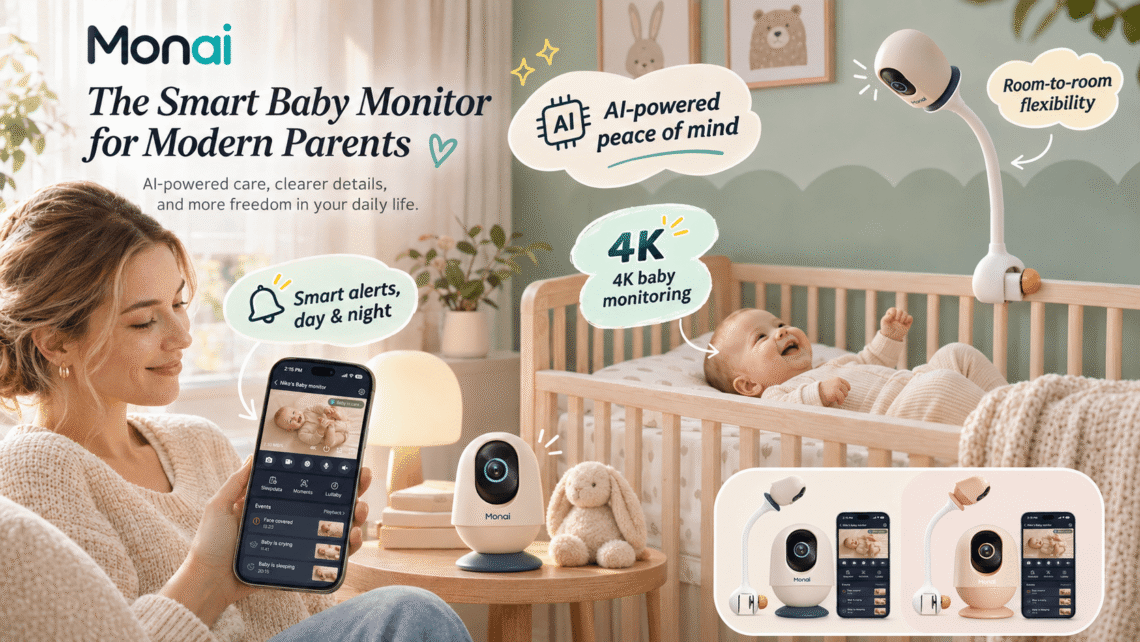
Here is a small, unspoken ritual that happens in nurseries around the world every single night. A parent lies in bed, phone face-up on the pillow, thumb hovering over the screen. They pull up the feed. They watch. The baby stirs. The parent holds their breath. The baby resettles. The parent exhales — and thirty seconds later, opens the app again.
Multiply that by every night, for months, and you begin to understand what modern parenting has quietly become: a part-time surveillance shift, worked by volunteers who never asked for the job.
Monai is the brand that walked into this conversation and asked the question nobody else seemed to be asking: What if the monitor did the watching, so you didn’t have to?
That single idea — a baby camera that behaves like an attentive partner rather than a window you have to keep peeking through — is what Monai has built its entire lineup around. This is the story of how they got there, what their monitor actually does, and why a growing number of parents are choosing it over the familiar names they saw at their baby shower.
The Problem Nobody Talks About at Baby Showers
Walk down the baby aisle (or, more realistically, scroll through a registry) and you’ll notice something odd. Baby monitors come in exactly two flavors, and both of them are compromised.
The first option is the cheap no-name camera. It ticks a lot of boxes on paper — “HD,” “app-enabled,” “night vision” — and then, in practice, delivers a grainy 720p feed, an app that logs you out at 3 a.m., and zero understanding of what you’re even looking at. You get a video of your baby, but no sense of what’s happening in it.
The second option is the premium brand monitor. Beautiful hardware, reliable app, feature list that goes on forever — and then, tucked in the fine print, a subscription. Want the smart alerts? That’s monthly. Want to keep your recording history past a few days? That’s also monthly. Want the feature that actually justified buying the expensive monitor in the first place? Surprise. It’s a recurring bill.
💡 The quiet math of the modern nursery: a $200 monitor plus a $10 monthly subscription, paid for three years, quietly becomes a $560 child-rearing appliance. Nobody budgets for that.
Monai’s founders, a Hong Kong-based team behind the Himax technology group, looked at this landscape and saw a market that had given up on solving the actual problem. Parents weren’t asking for more pixels; they were asking for fewer interruptions and less anxiety. So they set out to build something that alerts you only when something actually matters — and stays out of your life the rest of the time.
Their tagline says it plainly: “Built to outsmart.” Not “built to show you more,” not “built to upsell you more.” Outsmart, as in outsmarting your own worry loop.
So, Who Actually Is Monai?
If you’ve only ever seen the product on a store page, Monai can look like “another smart nursery brand.” But the way the company describes itself — and the way it engineers its products — tells a different story.
Monai positions itself around one internal principle they call “For Growing, By AI.” The phrase is their north star: the technology exists to support the baby’s development, not to become a spectacle in the nursery. Everything else flows from that.
A few things that distinguish the brand right off the bat:
- They own their intelligence layer. Rather than bolting on a third-party AI kit, Monai built its own on-device engine called CogniFlow AI, which processes the camera feed locally on the hardware itself.
- They refuse the subscription treadmill. Core monitoring, smart alerts, sleep insights, and family sharing all work out of the box with no monthly fee. Extended cloud backup exists as an optional add-on, but the device is never crippled without it.
- They design for the nursery, not the showroom. Monai’s camera lineup comes in soft, nursery-friendly finishes — a warm milk white, a muted sage green, a slate charcoal, and a pale lavender — instead of the default glossy black “security camera” look that most brands ship.
- They’re privacy-forward by architecture, not by slogan. Because the AI runs on the device and recordings default to a local memory card, your nursery footage never has to leave the house at all.
In a market where most brands treat “smart” as a marketing adjective, Monai treats it as an engineering commitment. The monitor is expected to earn its keep every night — not just look impressive on a spec sheet.
The Camera That Actually Sees the Room
Let’s start with the hardware, because it’s tempting in this category to overpromise software while underdelivering on the basics. Monai’s smart WiFi baby monitor takes the fundamentals seriously.
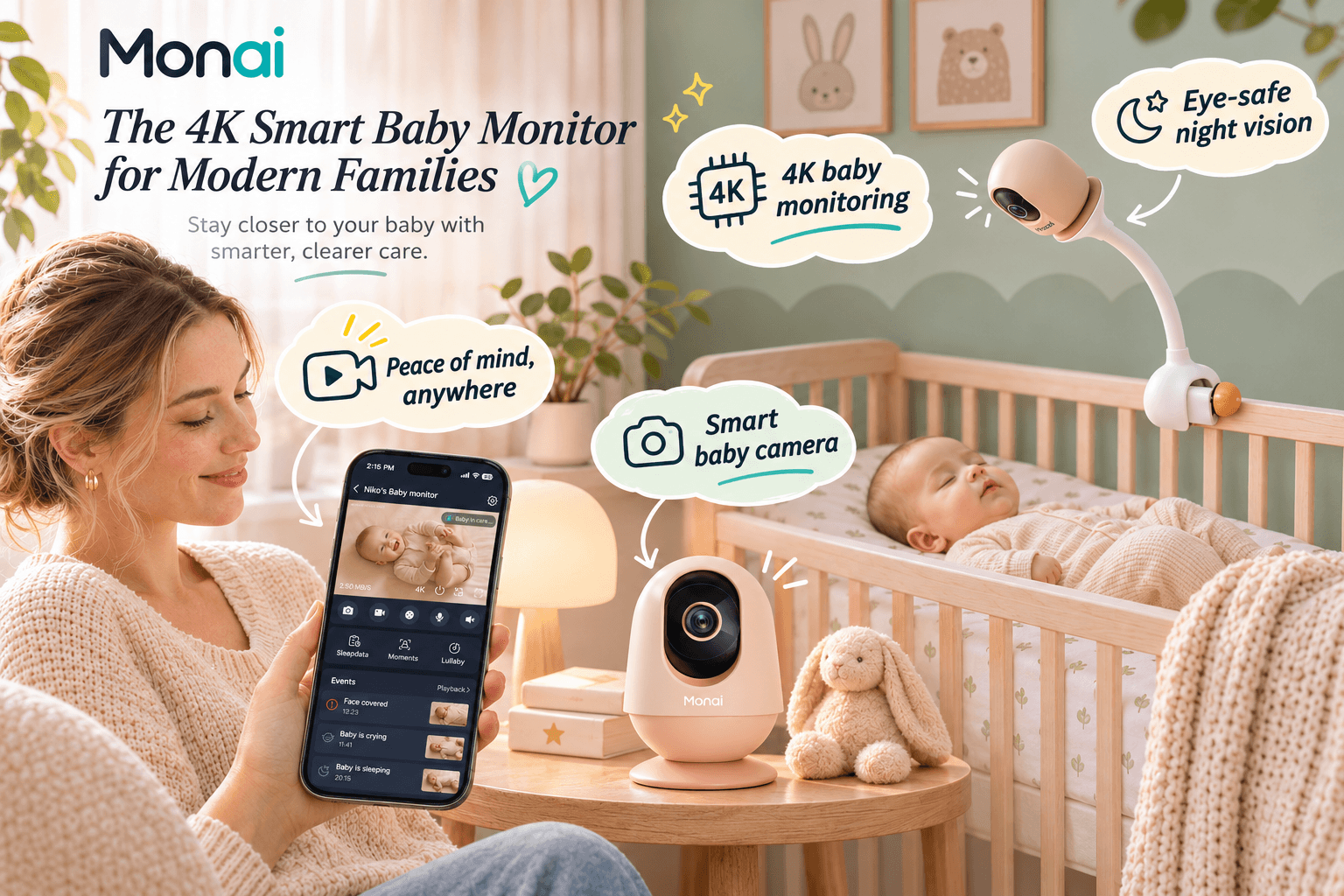
At the center of the device is a 4K UHD camera — the company’s phrasing, and the meaningful takeaway is this: that’s roughly four times the detail of the 1080p feed most monitors ship with. In a nursery setting, that difference isn’t vanity. It’s the difference between seeing “something near the face” and actually reading what’s happening — whether a blanket has migrated, whether the pacifier fell out, whether baby’s breathing is visible under the sheet.
The camera sits on a motorized dual-axis gimbal that pans 350 degrees horizontally and tilts 65 degrees vertically. More importantly, it can auto-track: when your baby rolls or crawls across the crib, the head follows, keeping them framed instead of making you manually steer a clunky joystick from bed.
Then there’s night vision — Monai calls its version Deep Night Vision. Again, the practical value matters more than the branding: in a completely dark room, you get a clear, usable image rather than the murky, washed-out green glow that defined the previous generation of monitors.
Here’s the quick rundown of the core hardware you get in the box:
| Hardware element | What it means for your nursery |
|---|---|
| 4K UHD camera | Crisp detail enough to read facial expressions and bedding position |
| 350° / 65° motorized gimbal | Pan and tilt from your phone, no physical touch needed |
| Auto-tracking | The camera follows movement on its own |
| Deep night vision | Clear feed in a pitch-black room |
| Built-in audio (capture + playback) | Two-way talk and built-in soothing sounds |
| 32GB microSD card included | Local recording starts the moment you plug in |
| Five-person sharing | Partner, grandparents, and caregivers can all watch |
One detail parents consistently notice: the monitor is compact and unobtrusive. It disappears on a shelf or dresser instead of looking like a surveillance rig planted next to the crib.
CogniFlow, Explained Without the Buzzword Soup
Okay. Time to talk about the part that actually matters: the intelligence.
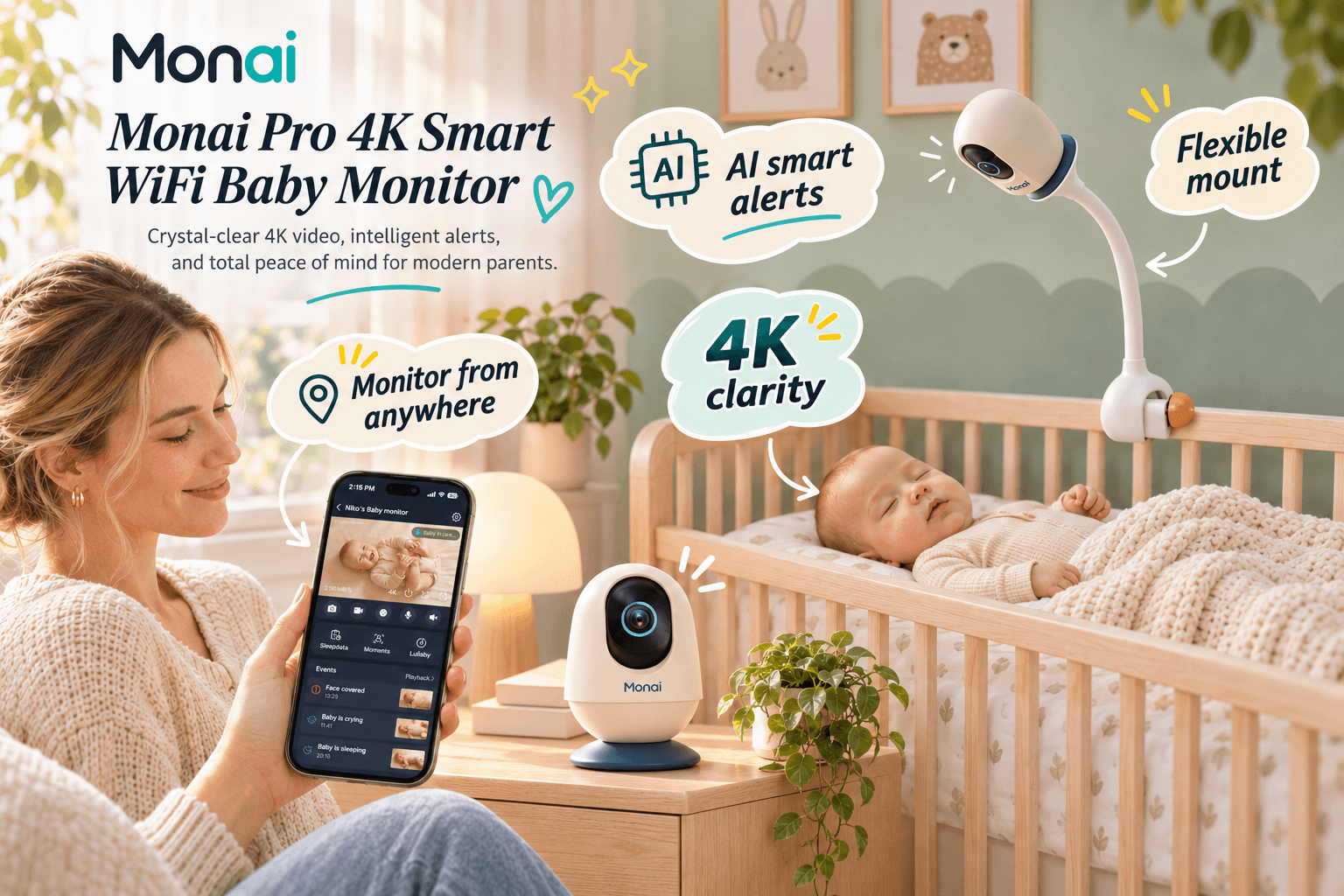
Monai’s CogniFlow AI is the brain of the operation. Instead of simply streaming video to your phone, the camera continuously analyzes what it’s seeing and hearing — and only pings you when the analysis suggests you should care.
It works like a very attentive third shift on night duty. The system watches for the patterns that matter to a sleeping baby, applies a layer of noise filtering so the HVAC doesn’t trigger a false alarm, and then sends you a precise, contextual alert: not “something happened,” but “baby cried,” or “face appears covered.”
The three core safety alerts parents rely on are:
1. Cry detection. The monitor distinguishes genuine baby crying from household noise. Monai trains its sound recognition on large sample sets and layers environmental-noise filtering on top — so the vacuum, the dog, and the TV in the next room don’t light up your phone at midnight.
2. Covered-face alert. This is the feature most parents describe as the one that changed their night. If the camera sees bedding or fabric covering your baby’s face, the monitor immediately alerts — both in the app and through a voice prompt from the camera itself — before the situation escalates.
3. Virtual safety fence. Using the app, you draw a “safe zone” on the crib or play area. When the camera detects your baby moving toward the edge of that zone, you get an early heads-up. It’s the crib-equivalent of a tripwire — prodding you before a tumble, not after.
And here’s the part that makes the system feel like family infrastructure rather than solo-parent technology: up to five people can share the feed. Mom, Dad, grandma on her visit, the nanny, the older sibling who’s “in charge” — everyone sees the same real-time picture and receives the same alerts. The whole village stays in the loop, from anywhere.
🗨️ “It’s like having a co-pilot in the nursery. I wake up to an actual useful alert instead of checking the feed every twenty minutes out of habit.”
— How a lot of parents describe the shift from traditional monitors to an alert-driven system
From “Watching” to “Understanding”: Sleep Insights and Milestones
A camera that alerts you is already ahead of the curve. But Monai’s ambition is a level further: helping you understand your baby’s days and nights over time.
Here’s the logic. After months of half-asleep guesswork, every parent eventually asks the same questions: Are they actually sleeping well? Is the 4 p.m. catnap helping or hurting bedtime? Why is the wake-up time drifting earlier?
Monai’s sleep layer tackles this by analyzing overnight data — wake-ups, movement patterns, crying episodes — and turning it into a readable sleep report you can actually glance at. It doesn’t replace a pediatric sleep consultant. What it does is replace the parent’s foggy, sleep-deprived memory (“I think they woke up twice? Maybe three times?”) with a clear, consistent record.
Then there’s the softer layer — the part that makes the camera feel less like a safety device and more like a gentle companion:
- Smart milestone capture. The system can automatically photograph sweet moments — a gummy smile mid-nap, a tiny hand reaching through the crib rails — without you hovering and risking waking the baby. Those saved clips become a growth archive you’ll actually want to revisit.
- Built-in soothing. When a cry is detected, the monitor can play soft music or ambient sound through its speaker to help settle the baby before you’re even out of bed. It’s a small buffer between “stirring” and “full meltdown.”
The combined effect is subtle but meaningful. You stop managing the nursery moment-to-moment, and start reading it over time — which is the actual difference between surviving infancy and navigating it with confidence.
Privacy Is the Foundation, Not a Marketing Footer
Now, the question every thoughtful parent asks before putting a camera in the nursery: where does the footage go?
This is where Monai’s architecture quietly becomes one of its strongest arguments.
Because CogniFlow runs on the device itself, the AI analysis doesn’t require your nursery video to be streamed up to a cloud server just to generate alerts. The camera looks, thinks, and decides locally. The footage defaults to a 32GB microSD card that ships in the box — meaning your recordings live in your nursery drawer, in your home, on hardware you physically own.
For the remote viewing that does leave the house — when you pull up the feed on your phone from the office or grandma’s living room — Monai applies enterprise-grade AES-256 end-to-end encryption, with TLS protection on every viewing session. It’s the same encryption tier used in serious security environments, which matters when the camera is pointed at your most private domestic space.
A plain translation:
- 🔒 AI decisions happen on the camera, not on someone else’s server.
- 💾 Recordings default to a local card you keep.
- 📡 Remote sessions are encrypted end-to-end.
- 🚫 The brand does not sell or share family data, and the privacy posture aligns with GDPR and CCPA standards.
For a device that’s literally pointed at a sleeping infant, this isn’t a footnote. It’s the reason a camera can belong in a bedroom in the first place.
The No-Subscription Gamble
Here’s where Monai makes its most daring, most parent-friendly bet.
Let’s be honest about the industry norm. Most smart nursery products give you the camera for an upfront price, then quietly gate the “smart” features behind a monthly subscription. No subscription = a passive camera. Smart alerts, history, insights — all locked behind a paywall that arrives two or three months after the excitement of unboxing.
Monai does the opposite. Core monitoring, AI alerts, sleep insights, and family sharing all work forever with no mandatory monthly fee. The 32GB card is included out of the box. If you ever want extended cloud backup, it’s there as an optional add-on — but the device is never crippled without it.
At the time of writing, the monitor is priced at $99.99 during its promotional window (down from a $169.99 list), with free shipping, 30-day returns, and a one-year warranty.
🗨️ “We sold the hardware, we already got paid. You shouldn’t have to rent back the features you paid for.”
— The unwritten philosophy behind Monai’s no-subscription model
That’s a commercial risk for the brand. It’s also a signal of what kind of company they want to be: one that competes on product quality, not on recurring billing inertia.
Monai vs. How Things Usually Work
If you’re weighing Monai against the category as a whole, here’s an honest side-by-side:
| Typical cheap camera | Typical premium brand monitor | Monai | |
|---|---|---|---|
| Image quality | 720p, soft detail | 1080p | 4K UHD |
| Smart alerts | None, or unreliable | Yes, usually behind subscription | Yes, included free |
| Covered-face detection | Rare | Often subscription-gated | Included, app + voice alert |
| Virtual safety fence | No | Usually no | Yes, draw your own zone |
| Night vision | Grainy infrared | Decent | Deep Night Vision |
| Local storage | Often no SD slot | Usually cloud only | 32GB card included |
| Family sharing | Limited | Limited | Up to 5 people |
| Monthly fee | Low hardware, weak software | Common, often required | None for core features |
| Nursery-friendly design | Generic | Often bulky | Soft finishes, compact |
The takeaway isn’t that Monai is perfect on every axis — it’s that it collapses the usual compromises into a single product, without the lease-style billing most competitors rely on.
Who Is Monai Actually For?
In practice, the brand tends to resonate with four specific groups of parents:
The working-duo household. Two parents, both busy, both wanting to actually sleep at night. Monai’s alert-driven model means neither partner is on permanent “check the camera” duty — the system decides when someone’s needed.
The extended-family care village. When grandma, grandpa, and a nanny all trade shifts, the five-person sharing becomes essential. Everyone sees the same feed and receives the same alerts; nobody is out of the loop.
The second-time parent. They already know how little sleep they got the first time around — and they’d rather invest in technology that reduces nighttime interruptions than in another camera that adds another habit.
The apartment dweller. In a smaller home, the “camera pointed at the baby” question feels more acute. Local storage, on-device AI, and a compact, unobtrusive footprint fit the realities of urban nurseries.
If you’re the parent who keeps your phone on the pillow at night, this product was designed with you specifically in mind.
An Honest Moment: What Monai Won’t Do
A promo post that only sings praises isn’t worth your time, so let’s be clear about the boundaries.
Monai won’t replace your pediatrician. It won’t diagnose sleep conditions, reflux, or allergies, and it shouldn’t be treated as a medical device.
Monai won’t magically make your baby sleep through the night. What it can do is dramatically reduce the times you wake up unnecessarily — which is the closest thing most exhausted parents get to a miracle.
Monai won’t replace basic babyproofing. The virtual safety fence is an early-warning layer, not a substitute for anchored furniture, secure sleep surfaces, and sensible crib setup.
And Monai won’t silence every worry — no technology can. What it will do is narrow the range of things you worry about to the ones that genuinely deserve your attention.
Closing: The Monitor As a Partner, Not a Window
The baby monitor market has been stuck in a rut for years. It either sells you a window into the nursery, and leaves you holding the vigil, or sells you a window plus a subscription, and leaves you holding the bill.
Monai’s contribution is simpler — and, in its own way, more ambitious: a camera that watches, thinks, decides, and only summons you when it’s your turn to act. A 4K eye in a soft pastel shell. An on-device brain that never sends your baby’s footage up to someone else’s server. A sleep report in the morning instead of a memory you can’t trust. Five-person sharing so the whole family is on the same page. And a hard refusal to rent the features back to you every month.
For parents who have spent too many nights squinting at a grainy feed, “Built to outsmart” isn’t just a tagline. It’s a promise to give your evenings back — one useful alert at a time.
Meet Monai. Close the app. Actually rest. 🌙