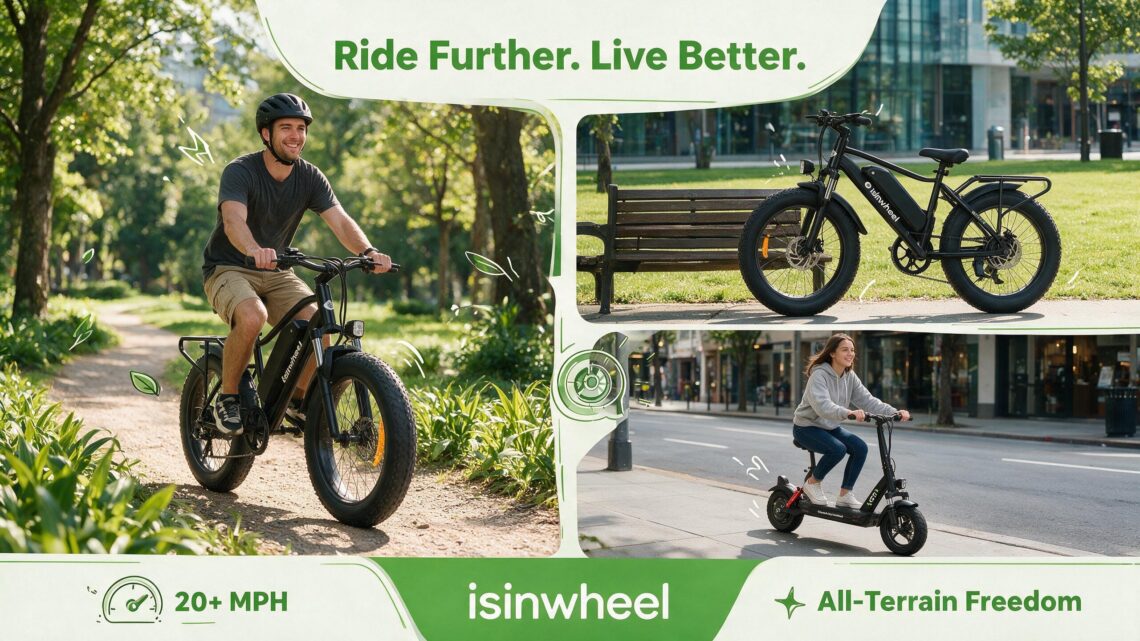
Most electric bicycle companies sell you a sport. They photograph their bikes on coastal roads at sunrise, talk about cadence and climbing grades, and quietly assume the buyer already rides. isinwheel has built its catalog around a different and considerably less glamorous customer: the person who currently drives 1.8 miles to the grocery store, sits in a parking lot for twenty minutes, and drives home again with a trunk that was never fully used.
That distinction sounds like marketing positioning, but it determines the hardware. A bike meant for sport gets light frames, narrow high-pressure tires, and a geometry that rewards an aggressive riding posture. A bike meant to absorb errands gets fat tires that tolerate potholes and gravel shoulders, a frame that folds so it can live in a apartment closet or a car trunk, suspension that does not need to be thought about, and a battery sized so that a week of short trips fits between charges. isinwheel’s lineup sits almost entirely in the second category, which is why its catalog reads less like a performance range and more like a set of answers to household logistics.
This article looks at what the brand actually offers, how to read its specifications without being led astray by the numbers vendors emphasize, who should and should not buy one, and what the practical ownership picture looks like once the bike is out of the box.
What isinwheel Is, and What It Deliberately Is Not
isinwheel is a consumer mobility brand rather than a bicycle manufacturer in the traditional sense. That is not a criticism; it is a description of a design lineage that shows up clearly in the product. The company’s approach resembles that of a well-run consumer electronics house: identify a proven platform, source mature components, tune the specification for a target price band, and distribute at scale through channels where the average buyer already shops. Its storefront slogan, “Bring Fun To Your Way!”, understates this. The real promise is accessibility — the idea that assisted riding should not require a specialist’s knowledge to purchase correctly.
The breadth of the catalog reinforces that reading. isinwheel sells full-size fat-tire electric bikes, compact folding commuter models, utility-oriented frames suited to carrying cargo, and a parallel line of electric scooters that stretches from a high-power adult machine to a lightweight kids’ unit. Very few brands in the premium bicycle world are comfortable displaying a children’s scooter next to a 1500-wpeak trail bike. That juxtaposition is the brand’s identity in miniature: it is aiming at households, where one vehicle rarely covers everyone’s needs.
What the brand is not, equally importantly, is a boutique. There is no hand-built steel frame here, no frame-set-only option for people who want to spec their own drivetrain, and no pursuit of the last 400 grams of weight savings. Buyers who want titanium, internal gear hubs, or a local bike shop’s personal fitting service should keep looking. isinwheel’s value proposition is the opposite trade: accept a heavier, mass-produced aluminum platform and gain a machine that is affordable, replaceable, and robust enough to be abused without emotional damage.
Reading the Lineup Without the Jargon
The D4: the folder that anchors the catalog
The EBike-D4 is the model the brand’s storefront gives the most visual real estate to, and it is the clearest expression of the company’s design thinking. It pairs a 500-watt rated rear hub motor with a peak output in the region of 750 watts, a removable 48V 15Ah battery (roughly 720 watt-hours), 20-inch by 4-inch fat tires, and both front and rear suspension on a folding aluminum frame with a seven-speed Shimano transmission.
On paper, “folding” and “fat-tire dual-suspension off-roader” look contradictory. Folding bikes are conventionally small-wheeled city machines; fat-tire bikes are conventionally big, rigid-framed trail tools. The D4 collapses both into one object, and the logic is sound once you accept the intended use. A 20-inch wheel keeps the folded package manageable while still clearing obstacles far better than a 16-inch city folder. A 4-inch tire run at low pressure — typically 10 to 15 PSI rather than the 50-plus PSI of a road tire — provides a large portion of what a suspension fork achieves, at the cost of some rolling resistance. The rear shock then handles the hits the tire cannot, which matters because a folding hinge is a compliance weak point that rigid frames do not have.
The claimed range figures follow the industry’s standard two-number convention: up to about 43 miles on pure throttle, and up to about 55 miles with pedal assist engaged. Those are best-case laboratory-style numbers on flat ground with a moderate rider, and no realistic buyer should plan around them. The useful takeaway is the ratio rather than the absolute: the gap between throttle-only and assisted range tells you that pedal assist is doing genuine work, and that a rider who uses it sensibly will get a week of typical suburban errands from one charge.
The M60 and U8 Ultra: when range stops being a compromise
Above the D4 sits a tier where the specification stops being about packability and becomes about distance and terrain. The M60 is positioned as an all-terrain machine, with peak output around 1500 watts, 26 by 4-inch fat tires, and a claimed range reaching 70 miles. The larger wheel diameter compared with the D4’s 20s is the meaningful difference for anyone riding real distances: 26-inch fat tires maintain momentum, track straighter at speed, and are less susceptible to the wallowing sensation smaller wheels produce in loose material.
The U8 Ultra pushes the range claim further still, to figures around 105 miles, and adds the two components that serious riders actually notice over long distances: hydraulic disc brakes and a seven-speed Shimano derailleur. Hydraulic braking is worth pausing on, because it is the single upgrade that most changes the character of a heavy e-bike. A 70-pound machine carrying a 220-pound rider at 20 mph has enormous momentum; mechanical cable discs fade on long descents as the pads heat and the cable stretches, while hydraulics modulate consistently and require far less lever effort. On a bike marketed for 100-mile days, that is not a luxury item.
The honest caveat for both models is weight. Nothing in this class lifts easily. Anyone planning to carry a bike up a flight of stairs should measure the frame weight before ordering rather than after.
The M10Pro and U7: the utility branch
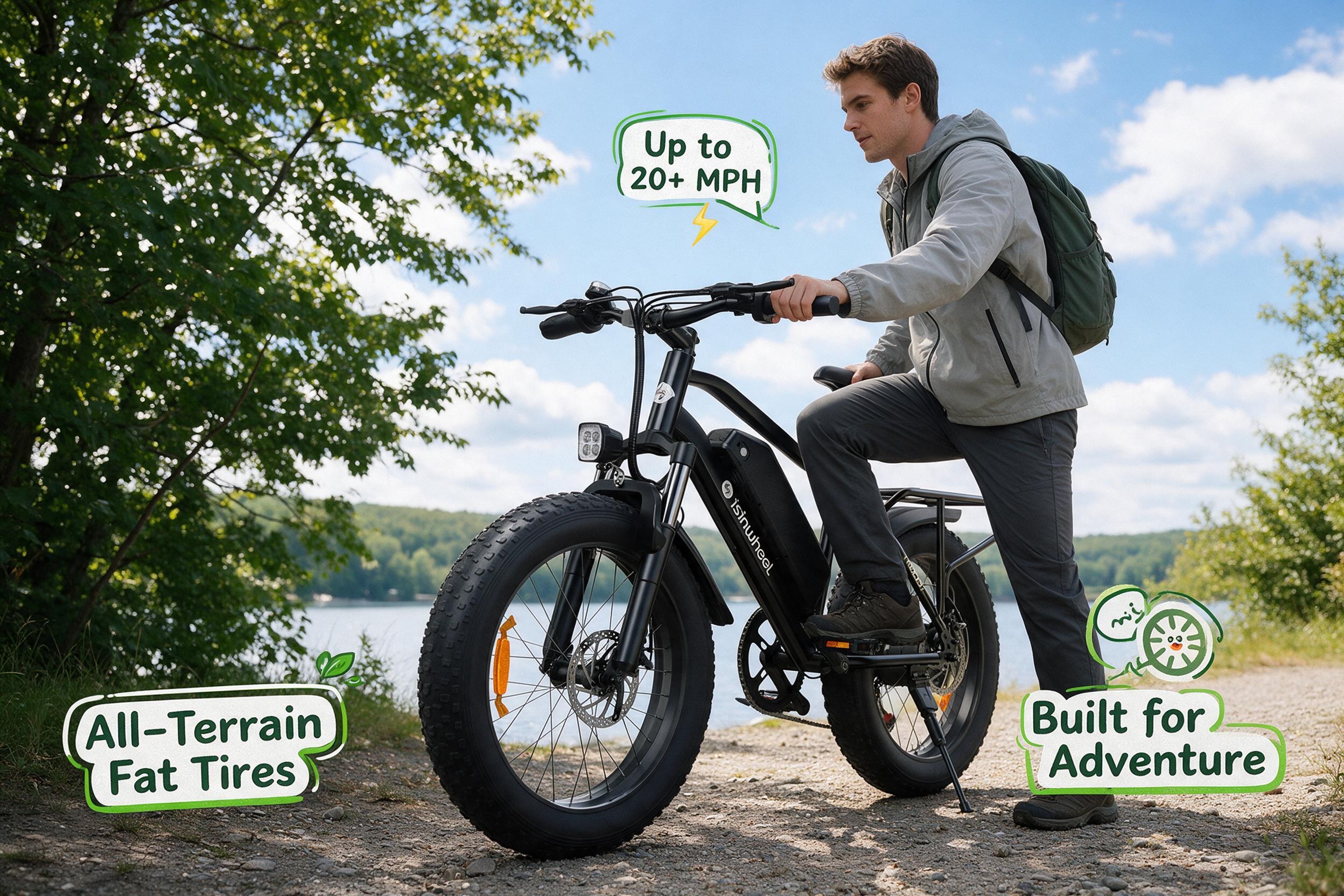
The M10Pro and U7 series occupy the everyday-workhorse part of the range — fat tires for mixed surfaces, generous torque for starts with a load, and frame layouts that tolerate racks, baskets, and child seats. This is the segment where the “replaces the car trip” thesis is most literal. School runs, tool runs, garden-center runs and dog runs are the actual use cases, and the specification priorities follow: sturdy kickstands, reliable lighting, simple controls, and enough reserve power that a full cargo load on a hill is not an anxiety event.
Buyers in this segment should think about mounting points early. A utility e-bike without a rack is a commuter; with one, it is a hauling platform. Confirming what the frame supports before purchase avoids the awkward stage of discovering that a universal rack does not clear the fender or the battery.
Beyond bicycles: the GT1 and the S4
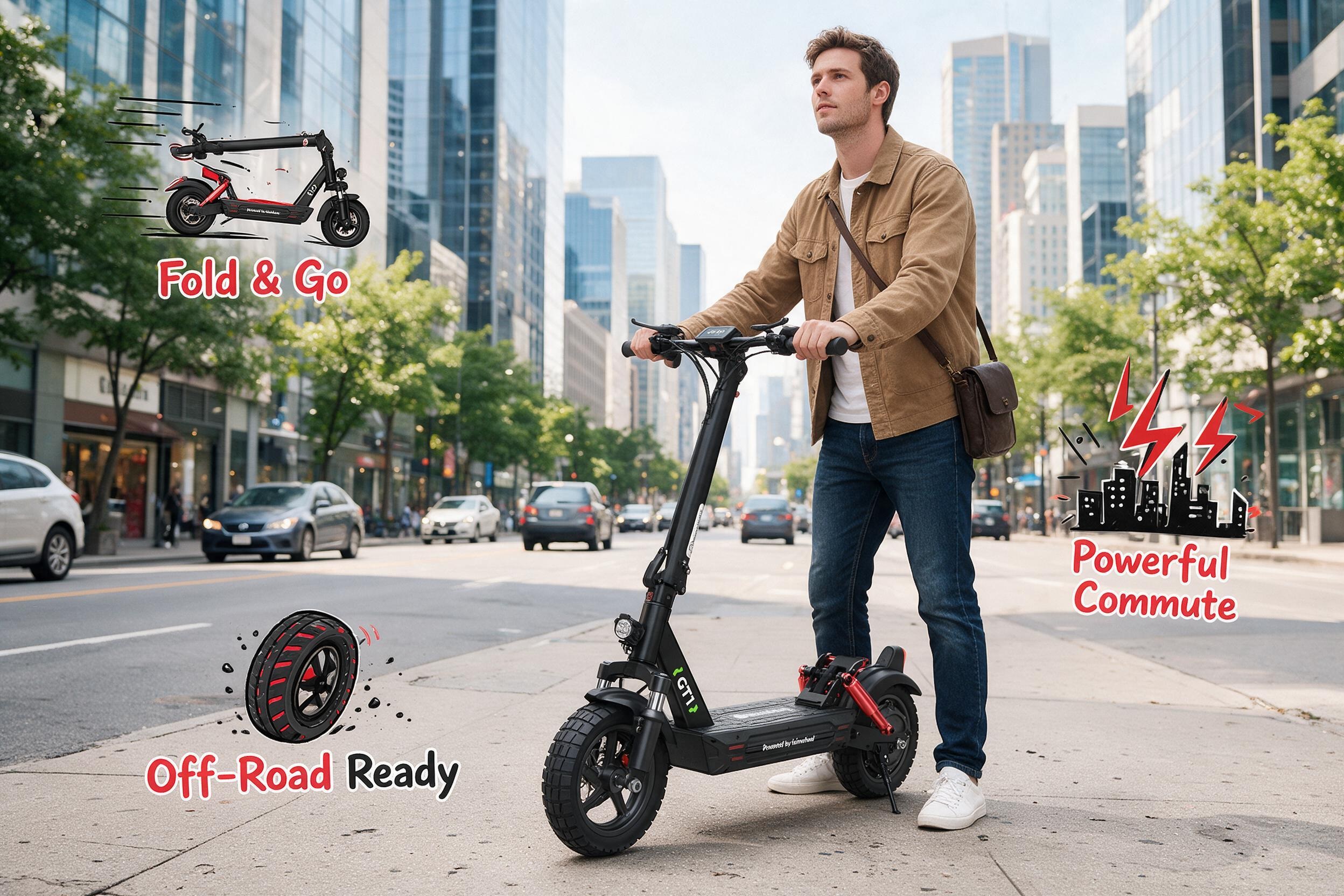
The scooter side of the catalog explains a lot about the brand’s household ambition. The GT1 is a genuine performance machine — dual motors peaking near 1600 watts, a top speed around 32 mph, roughly 35 miles of range, 10-inch off-road tires, and dual swingarm suspension. At that power and speed it is a vehicle that demands the same respect as a small motorcycle: protective gear, legal awareness, and an understanding that standing on a platform with no crash structure changes the consequences of a mistake.
The S4 sits at the opposite end: a 15.2-pound folding scooter for roughly ages six to fourteen, with a 200-watt motor, a 12 mph ceiling, solid tires, Bluetooth speaker and LED lighting. The pairing of these two products on one storefront is the brand’s strategy stated plainly. A family can outfit two of its members from one vendor, with one shipping window and one return policy. That convenience is not trivial in a category where buyers are simultaneously learning about watt-hours and hinge mechanisms.
Three Numbers That Matter More Than Peak Wattage
Vendors lead with peak watts because it is the easiest number to make impressive. Shoppers who have bought one e-bike tend to lead with different figures on their second.
Watt-hours, not “miles up to.” Battery capacity in watt-hours is the only figure that lets you compare two bikes honestly. A 48V 15Ah pack is approximately 720 watt-hours; a 48V 20Ah pack is approximately 960. That 33 percent difference is real and portable to any terrain, whereas a “range up to” claim depends on rider weight, wind, temperature, tire pressure, assist level and elevation — any one of which can halve it. Cold weather alone routinely removes 20 to 30 percent of achievable range. Convert voltage to amp-hours, multiply, and compare like with like.
Tire casing, not tire width. Everyone markets “fat tires,” but the durability story lives in the casing and the puncture protection layer, not the 4-inch number. A casing rated for puncture resistance matters disproportionately on a heavy bike, because fixing a flat at roadside with a loaded e-bike is a genuinely unpleasant afternoon. Check whether the tires are labeled puncture-resistant, and invest in a proper high-volume pump — the pressure range for fat tires is so low that a standard road pump cannot measure it accurately.
The hinge, not the frame. On any folding model, the latch and its surrounding reinforcement are the components that determine whether the bike is still quiet after a year. isinwheel’s D4 imagery emphasizes a heavy-duty locking latch, which is the correct thing to highlight. When evaluating any folder, look for the number of locking points, whether the hinge includes a secondary safety catch, and whether the manufacturer publishes a load rating. Then, after assembly, retorque the hinge and the stem bolts after the first 50 miles, because folding joints settle.
Understanding Classes, and Treating the “Unlock” Conversation Carefully
American e-bikes are sorted into three classes. Class 1 provides pedal assist only, cutting out above 20 mph. Class 2 adds a throttle that can propel the bike to 20 mph without pedaling. Class 3 offers pedal assist to 28 mph, usually without throttle beyond 20. Some D4-family listings describe a 20 mph Class 2 configuration with the possibility of unlocking higher speeds.
That last detail deserves a clear-eyed response rather than enthusiasm. Modifying a speed limiter changes the legal classification of the vehicle in most jurisdictions, and in a growing number of municipalities it voids warranty coverage and can affect insurance and liability position after a collision. Multi-speed paths, bike lanes and shared-use trails each enforce their own class rules, and enforcement has tightened considerably as these vehicles became common.
There is also a hardware-reality argument that has nothing to do with regulation. A 20-by-4-inch fat tire at 30 mph on a frame designed around 20 mph interacts with pavement differently. Brake thermal capacity, head tube angle stability, and tire heat buildup were all specified against the stock ceiling. The sensible reading is that the stock configuration is the engineered configuration, and anyone genuinely needing 28 mph should buy a Class 3 model on its own merits rather than convert a Class 2 one.
Who Should Buy One, and Who Should Honestly Look Elsewhere
The clearest fit is a household with at least one car that wants to reduce very short trips. If a majority of your driving is under three miles, an assisted bike removes the friction that makes those trips inefficient — finding parking, warming a vehicle, walking back to a lot — without asking you to become a cyclist.
A second strong fit is people with constrained storage. A folding fat-tire model fits in a trunk, under a staircase, in a garage bay shared with two cars, or in a apartment hallway closet. This is a genuine unlock for renters who were told their building has no bike storage, because “it folds” is a much easier conversation with a landlord than “I need a bike room.”
A third fit is first-time e-bike buyers who want to learn the category without a four-figure commitment. When a machine costs in the hundreds rather than the thousands, people ride it more freely, make mistakes more cheaply, and figure out what they actually value.
Now the disqualifications, which matter more than the recommendations. If you commute 15 miles each way on dedicated bike infrastructure and care about weight, a lightweight commuter from a bicycle-first brand will serve you better; every isinwheel in this discussion is heavy by comparison. If you ride technical singletrack seriously, this is not the trail hardware for it, regardless of what the fat tires suggest — suspension travel, motor tuning and IP ratings on mass-market units are not built to that abuse. And if you want a personalized fitting, component upgrades, or someone who knows your name at a local shop, the direct-to-consumer model cannot supply that relationship.
Buying Through Amazon: What the Storefront Actually Changes
Distribution channel is part of the product in this category, and isinwheel’s presence on Amazon is a deliberate structural choice with real consequences for ownership.
The advantages are concrete. Shipping logistics for a 70-pound box are handled by an operator with unmatched infrastructure, and delivery speed and return handling are meaningfully better than most independent brand webstores can offer. Reviews are visible in volume on the listing itself, which lets a buyer cross-check claims about range and hinge durability against hundreds of independent reports rather than a handful of curated testimonials. Payment flexibility, including installment options, lowers the barrier for a household buying two units at once.
The trade-offs deserve equal airtime. Amazon retail pages are notorious for mixing model years and configurations, so a buyer must confirm the exact specification block on the listing — battery amp-hours, motor rating, wheel size and included accessories — rather than assuming the title captures it. Accessories bundled with one SKU may not appear with another. And when something goes wrong mechanically, the resolution path is a marketplace return or a replacement-part request, not a mechanic who can diagnose a squeak in thirty seconds. For a category this new, that is an acceptable trade for most buyers, but it is a trade.
Two habits protect almost every purchaser. First, photograph the serial number and the packing contents immediately on arrival, before assembly. Second, register the product with the manufacturer directly, because warranty clocks and recall notifications run through the brand, not the marketplace.
The First Ninety Minutes After the Box Arrives
Most complaints that look like product defects are assembly issues. A fat-tire folding e-bike needs perhaps forty-five to ninety minutes of attention out of the box, and rushing it causes the noise and vagueness people then blame on the brand.
Start by charging the battery to full before riding, even if it arrives partially charged; the first charge is when the battery management system establishes its reference and when any shipping-related cell imbalance is corrected. Then work through the mechanical items in order: install and torque the handlebar stem, set the seat post to your height and clamp properly, fit the pedals — remembering that the left pedal is reverse-threaded and forces in the obvious direction only on the right — and check tire pressure with a high-volume gauge rather than by squeezing.
Brake adjustment comes next and should not be skipped. Dish the front wheel so it sits centered between the pads, then pull each lever firmly and confirm it does not travel to the grip. On a heavy bike this is a safety item, not a comfort one. Finally, power on and confirm the display shows the correct assist levels, that the throttle cuts out when the brakes are squeezed, and that the lights function. Only then take the first ride, and take it somewhere empty.
Living With It: Maintenance Realities for a Fat-Tire Folder
Ownership effort on these machines is modest but specific. Fat tires lose pressure noticeably faster than narrow ones — check them every two weeks rather than monthly, because riding a 4-inch tire below its range increases rolling resistance dramatically and raises pinch-flat risk. Lubricate the chain every 100 to 150 miles given the additional torque, and wipe off excess before it collects grit.
The folding hinge and the stem are the two places to inspect quarterly for play, and to retorque if movement appears. Electrical connections benefit from a dielectric grease on the battery terminals, particularly for bikes stored outdoors or ridden in winter. Disc brake pads on a heavy assisted bike wear faster than cyclists expect; check thickness at 1,000 miles rather than waiting for the metal-on-metal sound.
Battery care is the single highest-leverage habit. Store the pack indoors at room temperature, avoid leaving it fully depleted for days, and if the bike sits unused through winter, keep the pack at roughly 50 to 70 percent charge and check it monthly. Replacement packs are the most expensive consumable on any e-bike, and their lifespan is almost entirely determined by storage behavior rather than ride behavior.
The Value Arithmetic
isinwheel’s pricing — with flagship folding fat-tire models commonly landing in the high hundreds rather than the low thousands — invites a comparison that is more useful than the usual “cheap versus expensive” framing.
The relevant benchmark is not another bicycle. It is the cost of the car trips being displaced. A vehicle used for short errands is exceptionally inefficient: cold starts cause disproportionate wear, short low-speed cycles prevent the engine from reaching optimal temperature, and fuel consumption per mile peaks in exactly the pattern these bikes replace. Add parking, insurance, registration and depreciation, and the per-mile cost of the second car — or of the single car doing errand duty — is often several times the per-mile energy cost of an assisted bike, before counting the battery amortization.
Seen that way, a sub-$1,000 machine that pays for itself against avoided vehicle costs within a season or two is not a bargain-bin purchase. It is a rational capital allocation. That is the argument the brand’s catalog makes most convincingly, without ever stating it in those terms.
Where the Category Goes From Here
The American e-bike market is moving toward specialization. Generic all-rounders are giving way to machines built for a defined job, and the two segments showing the strongest sustained demand are commuters and fat-tire all-terrain models — precisely the two pillars of isinwheel’s range. At the same time, class regulation and enforcement are maturing, which will increasingly reward brands that specify honest stock configurations rather than leaning on unlock potential as a selling point.
isinwheel‘s position in that future is unusually strong for a brand that does not market itself on heritage. It has distribution where its buyers already shop, a catalog broad enough to serve an entire household, and a specification philosophy that matches what most people actually need from a second vehicle: not speed, not lightness, but the quiet elimination of the small car trip from weekly life.
The brand’s own slogan asks riders to bring fun to their way. Judged by the hardware, the more accurate description is the reverse — the fun arrives once the machine removes enough friction from daily life that riding becomes the default choice rather than the planned one.