There is a small category of products that sound like a lifestyle overhaul until the moment you actually install one. A bidet attachment belongs near the top of that list. For decades, Americans treated the bidet as someone else’s custom — a fixture glimpsed in European hotels, a luxury renovation line item, or a vaguely embarrassing conversation topic best changed quickly. LUXE Bidet took one look at that cultural wall and decided not to push against it, but to remove the reasons it existed. No electrician. No remodeling. No second plumbing fixture. Just a slim attachment, a household water supply, and an idea expressed in four plain words: water cleans better.
What followed was less a product launch than a slow, review-fueled migration. According to its Amazon storefront, LUXE Bidet is America’s #1 best-selling bidet, with figures the brand reports of more than eight million bidets sold, hundreds of thousands of Amazon reviews, and more than eighteen years spent refining the category. Those numbers matter less as trophies than as evidence of something harder: converting a skeptical mass audience one bathroom at a time. This is a look at the brand behind those numbers — what it sells, how its lineup is built, and why a non-electric attachment ended up on so many ordinary toilets.
💧 Why this post exists If you’ve been bidet-curious but intimidated by the category, this guide walks through the LUXE Bidet lineup in plain language, explains who each model suits, and separates the genuinely useful features from the ones you can skip.
One Small Unit, One Big Cultural Reframe
The most interesting thing about LUXE Bidet is what it chose not to be. The brand didn’t enter the market with an elaborate smart toilet costing thousands, didn’t require a dedicated circuit, and didn’t ask renters to renegotiate their leases. Instead, it bet on the attachment: a mechanical fixture that mounts beneath an existing toilet seat, taps into the same cold-water line that fills the tank, and delivers a controlled wash at the turn of a dial.
That bet rested on a genuine insight into household decision-making. People don’t resist feeling cleaner; they resist disruption. A renovation triggers measurements, contractors, budgets, and spousal negotiation. An attachment triggers roughly fifteen minutes and a single T-valve. By shrinking the friction from “bathroom remodel” to “weekend errand,” LUXE Bidet converted a niche aspiration into an impulse upgrade — the kind of purchase a shopper adds to a cart alongside toothpaste and lightbulbs.
The brand’s visual identity reinforces that demystification. Its storefront leans on whites, water-blues, and chrome, with flat line icons instead of cross-section plumbing diagrams. Nothing about the presentation whispers “intimidating appliance.” It whispers “bathroom section, simple hardware, you’ve got this.” Tone matters in a category where discomfort has historically been the largest barrier to entry.
The Core Argument: Why Water, Why Now
To understand the brand, you have to take its central claim seriously. Dry paper moves residue; water rinses it. That’s not a controversial statement in most of the world — bidets and handheld sprayers are standard across Europe, Asia, the Middle East, and Latin America — but it remains a minor heresy in a country whose bathrooms were plumbed and furnished around the roll.
LUXE Bidet’s “Water Cleans Better” position works because it’s experiential rather than educational. The brand doesn’t lecture about global habits; it builds a product cheap and easy enough that shoppers can run the experiment themselves. Once someone has used a wash for a week, the comparison sells itself the way a shower does versus a sponge bath. The product’s job is simply to get people to that first week.
🗨️ “I assumed it would feel like sitting under a garden hose. It feels like someone finally took the concept of washing seriously.” — the sentiment, in various forms, repeats across thousands of the brand’s buyer reviews.
The supporting arguments do the quieter work. Households notice reduced toilet paper purchasing. Travelers notice the difference the moment they’re stuck without one. Parents notice it during potty training and childhood stomach bugs. None of these benefits requires a smart toilet’s circuit board; they require a reliable stream of water aimed correctly, adjustable to preference, and easy to keep clean. LUXE Bidet’s engineering effort has gone overwhelmingly into those three things.
Reading the Lineup: NEO, NEO PLUS, and WHIFT
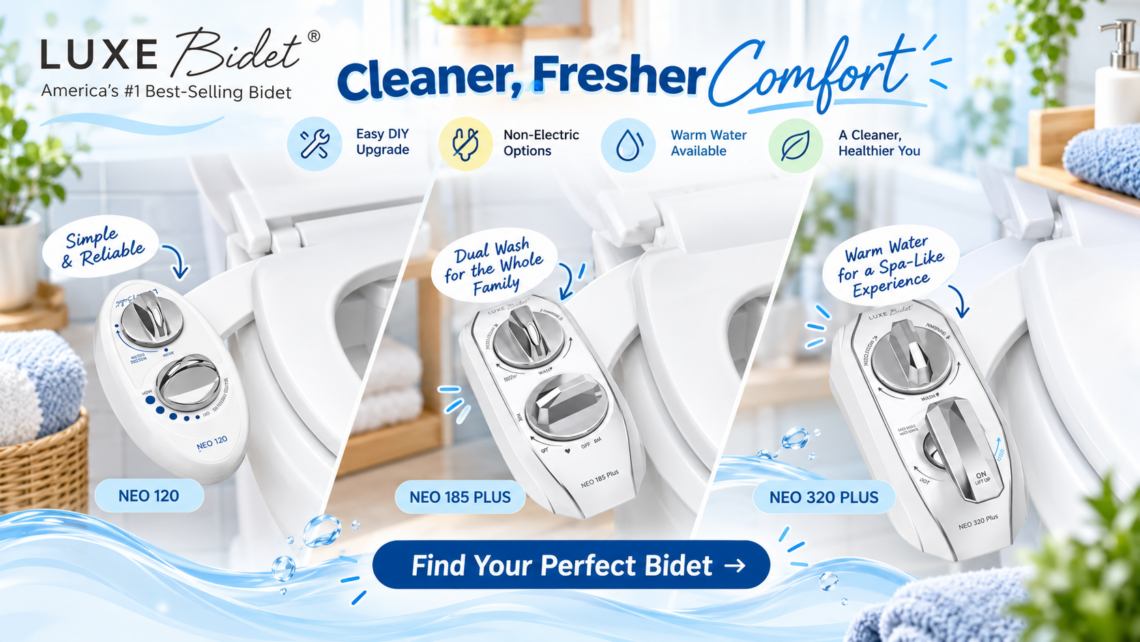
The storefront organizes the family around three tiers, and the structure is genuinely shopper-friendly rather than a maze of near-identical SKUs. Here’s the map before we walk each tier.
| Tier | Personality | Signature Traits | Best For |
|---|---|---|---|
| NEO (The Original) | The essential mechanical wash | Rear wash, feminine wash on select models, nozzle cleaning, warm-water option on select models | First-time buyers, rentals, simplicity seekers |
| NEO PLUS | The refinement tier | Slide-in installation, 360° self-cleaning, EZ-Lift hinges (brand-exclusive features) | Daily drivers who want easier upkeep and install |
| WHIFT | The newcomer with an odor focus | First non-electric bidet with a built-in deodorizer; 500+ sprays per bottle, per the brand | Households, shared baths, anyone odor-conscious |
| Portable | The travel companion | Squeeze-bottle handheld design | Travel, office, assisted care, small bathrooms |
| Accessories | The ecosystem | Filter, matching seat, valves, bundles | Completing and protecting the setup |
The tiers don’t represent abandonment of the lower lines — a pattern some brands use to force upgrades. Each remains stocked and supported, which tells you the brand sees first-time buyers as a permanent audience rather than a rung to graduate from.
NEO: The Attachment That Started the Conversation
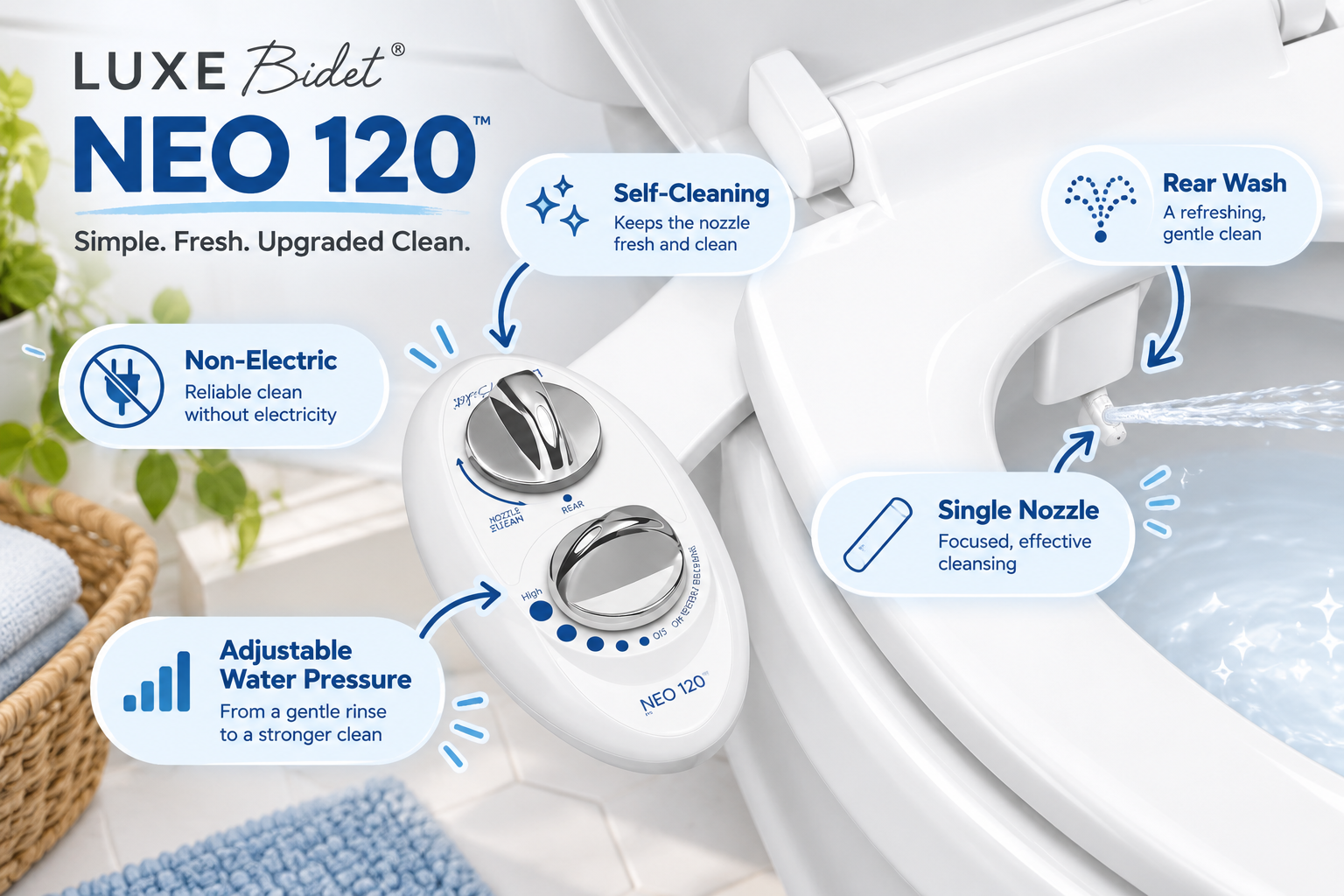
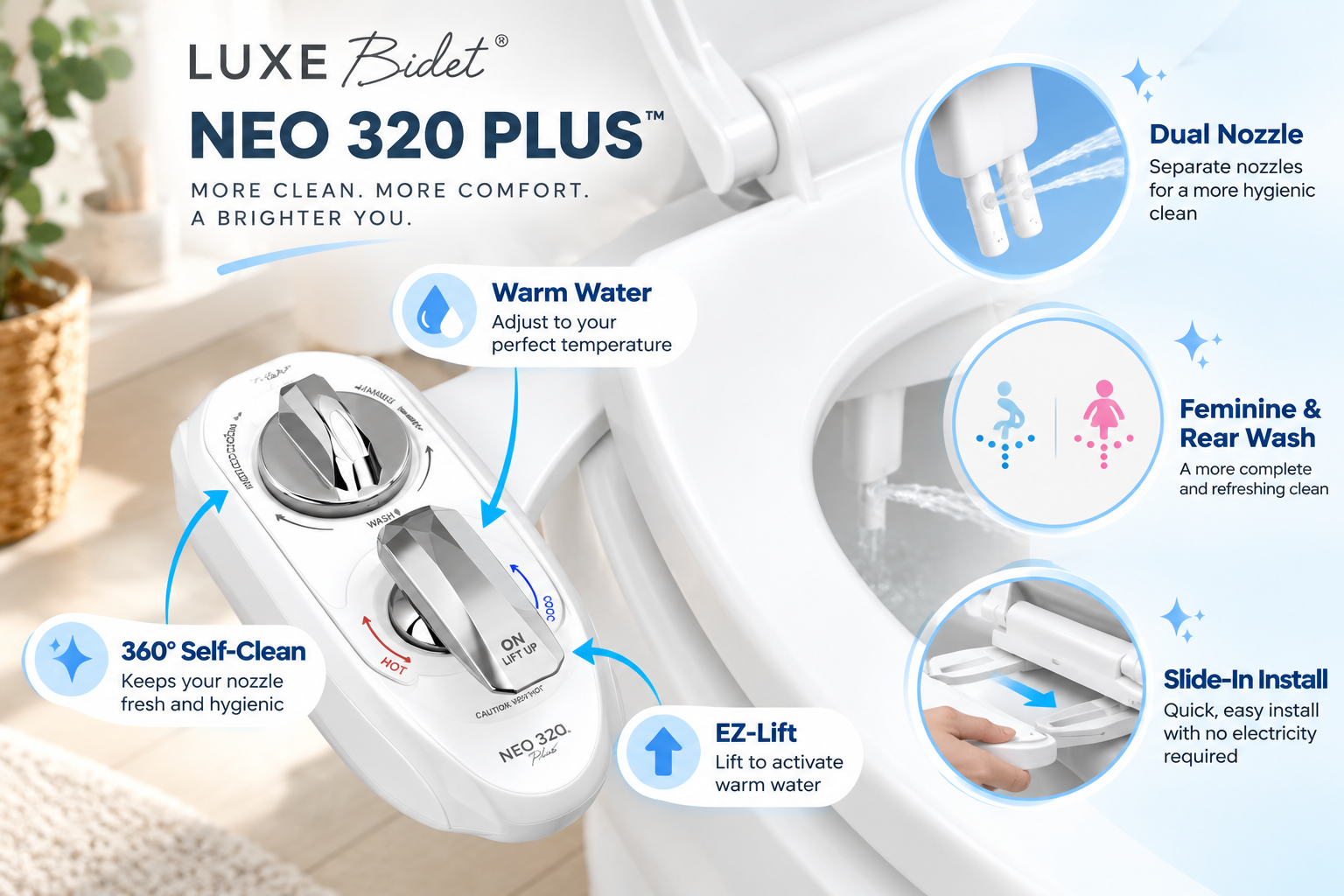
The original NEO line is the brand in its purest form: non-electric, mechanical, and focused on adjustable water pressure. Depending on the model, shoppers add a dedicated feminine wash nozzle — a softer, forward-angled stream — and a warm-water hookup that blends hot and cold from the sink supply. A nozzle-cleaning function rinses the wand itself, which addresses the unspoken question every first-time buyer has but few voice aloud.
What the NEO does well is restraint. It doesn’t bury the wash under presets, remotes, or LEDs. A dial controls pressure, a knob or lever directs the function, and the retractable nozzle stays guarded behind a self-retracting gate when not in use. For an apartment, a guest bathroom, a kid’s bath, or a rental where every modification must be reversible, that simplicity is the feature.
The line also acts as the brand’s proof engine. The review counts attached to flagship NEO listings run into six figures, with the storefront showing tens of thousands of monthly purchases on top models. In a category where trust was the scarce resource, that volume of verified feedback is itself the marketing — newcomers aren’t adopting an oddity, they’re late-joining an established norm.
NEO PLUS: Polishing the Daily Ritual
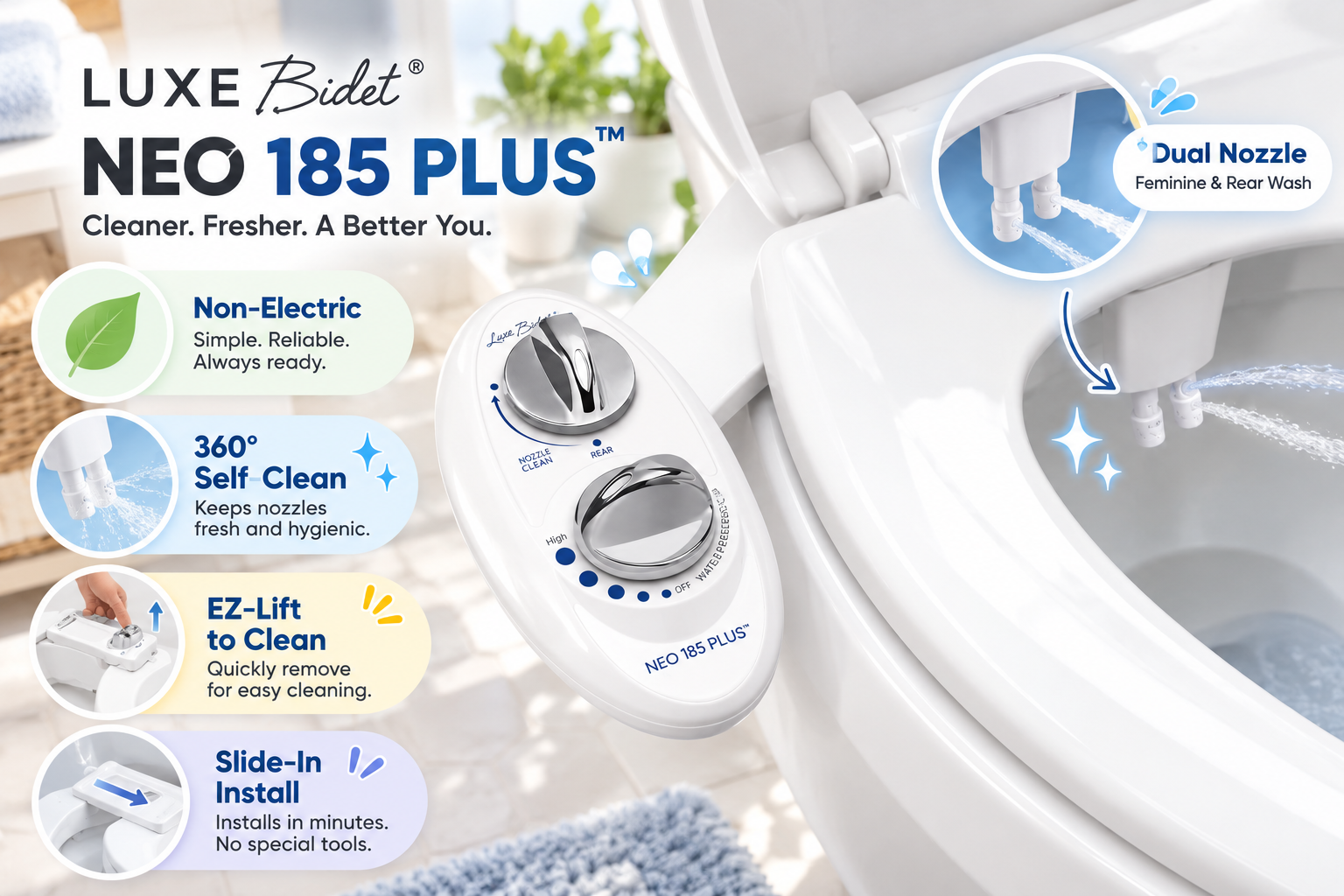
If the NEO answers “why a bidet,” the NEO PLUS answers “what annoyed people afterward.” The tier bundles three brand-exclusive upgrades that target the actual friction points owners discover over months, not minutes.
The first is slide-in installation. Traditional attachments require fitting the unit under the seat in a way that can feel like threading a needle in a cramped corner. The slide-in approach lets the body seat itself along a track, which matters far more in real bathrooms — dark, tight, and badly lit — than on a showroom table.
The second is 360° self-cleaning, which extends rinsing around the nozzle rather than across a single face. It’s a hygiene detail that sounds minor until you consider that the wand is the one component a user can’t conveniently scrub by hand mid-use.
The third, and arguably the most underrated, is the EZ-Lift hinge system. Anyone who has cleaned around an attachment knows the chore: the seat sits a fraction higher, the gap underneath becomes a dust-and-drip zone, and wiping it down requires leaning at improbable angles. EZ-Lift raises the seat so the attachment and the rim can be wiped in seconds. It’s the kind of feature you only invent by reading owner feedback obsessively — or by living with your own product for years.
✨ The upgrade test Choose NEO PLUS over NEO if you already know the attachment will live on your primary, daily-used toilet and you’re the person who cleans that bathroom. Choose NEO if it’s for a guest bath, a rental, or a first experiment.
WHIFT: Asking the Question Nobody Likes to Ask
The WHIFT is the most curious and revealing product in the lineup, because the brand didn’t have to build it. The company describes it as the first non-electric bidet with a built-in deodorizer — a unit that masks odor before you go, with a replaceable bottle the brand rates for more than five hundred sprays.
Odor is the last unspoken variable in shared bathrooms. Sprays and candles react afterward; ventilation fights a battle already underway; the courtesy flush is a ritual of guilt. WHIFT reframes timing: a discreet pre-use spray neutralizes at the source rather than chasing the result. That the brand packaged this into a non-electric unit matters, because the bathrooms that need odor management most — guest baths, offices, shared family rooms — are often the ones without an outlet near the toilet.
WHIFT also signals something strategically. After nearly two decades in the category, LUXE Bidet is still willing to introduce a genuinely new mechanism rather than coast on color variations and repackaged SKUs. The deodorizer isn’t an upsell gimmick layered onto a flagging line; it’s a new product answering a different, equally real bathroom anxiety.
Beyond the Fixture: The Accessory Ecosystem
A tell of a mature category brand is whether it thinks in systems or in boxes. LUXE Bidet’s storefront devotes real space to the surrounding setup, and each accessory solves a specific problem rather than padding a catalog.
🚿 The inline water filter (the LWF200). Installed between the supply valve and the attachment, it catches sediment before it reaches the nozzle. In households with older plumbing, hard water, or well water, that’s not paranoia — it’s maintenance prevention. Mineral buildup is the quiet enemy of every small water appliance, and an inline filter is the cheapest insurance available.
🚽 The matching toilet seat — “The Perfect Pair.” An attachment changes the geometry under a seat by a few millimeters, and older or warped seats may never sit flush again. The brand’s made-to-pair seat is designed to close over the attachment cleanly, eliminating the wobble and gap that otherwise tempt buyers to abandon the project at step three.
🔧 Shut-off valves and bundles. A dedicated T-valve lets the attachment be isolated without crawling behind the toilet every time. Bundling the unit with a seat or valve at a discount addresses the other rookie mistake: buying the attachment, then discovering two missing parts on installation night.
🧴 The portable bidet. A dark-blue squeeze bottle with an extended angled nozzle, sold for travel and small baths, extends the habit outside the home. Portable units also appear in postpartum care and assisted-care routines, uses the brand’s audience tends to discover rather than the brand needing to shout about.
The ecosystem approach matters because bidet adoption has historically failed at the edges — the buyer whose seat wouldn’t close, whose water was hard, whose rental valve seized. LUXE Bidet has, piece by piece, built the answers to those edge cases so the path from cart to installed unit stays short.
What Installation Actually Asks of You
The brand’s reputation rests heavily on the claim that anyone can install the unit, so it’s worth being precise about what that means. The process is mechanical rather than technical: the water supply at the wall is turned off, the tank hose is detached, a T-valve is threaded between the wall and the tank, a thin hose feeds the attachment, and the attachment itself is secured beneath the seat hinges. No electricity is required for the core NEO and NEO PLUS units. Tools are typically limited to what most households already own, and the slide-in design on NEO PLUS reduces the fussiest step.
Warm-water variants add one additional run to the sink’s hot supply, which is the point at which less confident DIYers may want fifteen extra minutes and a towel. The payoff, for users who dislike a cold stream in winter, is substantial — though many buyers report that ambient-temperature water ceases to register as cold within a couple of weeks, a familiar sensory-adaptation effect that cold-plunge enthusiasts and splash-of-cold-water-on-the-face types will recognize.
| Installation Factor | NEO | NEO PLUS | WHIFT |
|---|---|---|---|
| Electrical outlet needed | No | No | No |
| Core plumbing change | T-valve at fill valve | T-valve at fill valve | T-valve at fill valve |
| Seat fitting | Standard mount | Slide-in, EZ-Lift | Standard / tier-dependent |
| Extra consumable | None | None | Deodorizer bottle (500+ sprays) |
| Warm water | Select models | Select models | Model-dependent |
🔧 Saturday-morning checklist Towel, adjustable wrench or pliers, ten to twenty minutes, the included T-valve, and — for older homes — a willingness to replace a corroded supply hose while you’re back there. Treat the filter as recommended, not optional, if you have hard water.
Who the Brand Actually Built This For
Catalogs describe products; audiences describe brands. Walking the storefront and the review texture, five distinct buyers emerge, and the lineup maps onto each with unusual neatness.
The renter. Security deposit intact, walls untouched, outlet absent. A non-electric NEO that installs and reverses in under a half hour is essentially the only bidet option that makes lease sense.
The eco-minded household. The paper-reduction argument is real and recurring: households that adopt a bidet routinely report dramatic cuts in roll consumption, which means fewer bulky packs in the cart and less paper heading to treatment systems. The brand doesn’t have to moralize here — the math shows up on the receipt.
The hygiene-first convert. Often someone who encountered bidets abroad or through family and never adjusted back to paper. For this buyer, the feminine-wash models and warm-water options tend to be the deciding factors, with NEO PLUS’s self-cleaning nozzle sealing the decision.
The shared-bathroom diplomat. Roommates, guests, in-laws, toddlers — anyone navigating the politics of a shared toilet. WHIFT’s preemptive deodorizing and the NEO PLUS’s easy-clean hinges speak directly to keeping peace through design rather than passive-aggressive notes.
The caregiver and the postpartum household. Gentle, adjustable water and a portable option answer needs that wipes irritate and paper simply can’t meet. This audience rarely makes up the headline marketing, but it consistently produces some of the category’s most grateful buyers.
The Design Decisions That Age Well
It’s tempting to read product lines as feature checklists, but brands survive on the decisions that don’t appear in bullet points. A few are worth pulling out.
Choosing non-electric as the flagship architecture meant accepting fewer flashing features in exchange for enormous reach: no outlet dependency, no standby draw, fewer failure points, and nothing to charge or reboot. In a bathroom, reliability is a luxury feature.
Keeping manual pressure control rather than motorized presets gives instant, analog feedback. Users dial until it’s right instead of learning a remote with braille-sized buttons at 6 a.m. That choice is especially kind to older users and to anyone who dislikes instruction manuals on principle.
Protecting the retractable nozzle behind a guard gate keeps the wand away from the bowl’s normal splash zone when idle. Combined with nozzle self-cleaning, it answers the hygiene objection that kills most bids before purchase.
Staying color-conservative and slim means the attachment doesn’t announce itself. Bathrooms are design-cohesive spaces; a gadget that looks like a gadget resents itself within a year. White and chrome disappear against porcelain and metal.
And investing in patented features — the storefront highlights a section of patented mechanics — shows the brand defending the engineering rather than racing generic clones to the bottom. In a category now crowded with knockoff attachments, that matters for parts availability, warranty support, and long-term trust.
Addressing the Honest Objections
A credible introduction earns trust by conceding limits. A few are worth stating plainly rather than papering over.
Non-electric units use your household water temperature, which means cold unless you run a warm-water model to the sink. The stream is gentler than the term “bidet” conjures, but pressure does require tuning on first use. An attachment adds a small height under the seat, which is exactly why the matching seat exists. Very old plumbing can spring surprises at the T-valve — seized connectors, slow drips — that have nothing to do with the unit itself. And, as with any fixture, skipping the filter in hard-water regions shortens the interval between cleanings.
🗨️ Common first-week question: “Is it normal to still use a little paper?” Yes — most people use a square or two for patting dry, not for cleaning. That’s precisely where the paper savings come from.
None of these objections is fatal; all of them are predictable. The brand’s accessory lineup and tiered choices exist largely because someone hit each one and the company chose to engineer a response rather than an FAQ deflection.
Why the Review Volume Changes the Buying Math
High review counts are common online; what’s uncommon is a product category where the purchase itself once felt socially awkward. The storefront’s six-figure review pools on flagship NEO models do something advertising structurally cannot: they normalize. A shopper hesitating over a bidet isn’t weighing a feature against a price so much as an identity against an expectation — is this the kind of thing people like me actually do? A hundred thousand visible answers settles the question.
The review texture also functions as a free, brutally honest installation guide. Odd toilets, unusual valves, rental scenarios, septic questions, and travel use all surface in buyer language, often more useful than the manual. For a brand built on lowering friction, that organic knowledge base is effectively a second product — one competitors can’t manufacture with marketing spend.
From Curiosity to Default: The Bigger Shift in the Bathroom
LUXE Bidet is competing less with other attachment makers now than with the default assumption that paper is sufficient. That assumption held for generations because no convenient alternative existed in the American bathroom. The attachment dissolved the inconvenience, the reviews dissolved the social hesitation, and the accessory ecosystem dissolved the installation edge cases. At that point, inertia is the only thing left — and inertia doesn’t survive a single week of actually feeling cleaner.
Expect the next decade of the category to involve consolidation and quiet refinement rather than spectacle: better deodorizing, better filtration, warmer water without complicated hookups, and design so integrated that “bidet” becomes a checkbox on toilets the way heated seats became one on cars. Brands that treated the attachment as a fad will thin out; brands that built patents, parts, and tiered lines will set the pace. LUXE Bidet’s eighteen-year head start and millions of installed units position it less as a trend rider and more as the company that did the early, unglamorous convincing.
Making the Call: A Simple Way to Choose
If the lineup still blurs, use this closing decision path rather than a spec sheet.
- 🛠️ Renting, testing the concept, or outfitting a guest bath → start with a NEO.
- 🧼 Installing on your daily toilet and doing your own cleaning → step up to NEO PLUS for slide-in fit, 360° self-clean, and EZ-Lift hinges.
- 👃 Sharing the bathroom or genuinely odor-conscious → WHIFT, the non-electric built-in deodorizer with 500+ sprays per bottle.
- ✈️ Frequently traveling, postpartum, or caring for someone → add the portable bidet.
- 💧 Hard water or old plumbing → add the inline filter; mismatched or aging seat → add the perfect-pair seat.
🌟 The one-sentence version LUXE Bidet turned a category that used to require a renovation into an attachment that requires a Saturday, then spent eighteen years polishing the details people only notice after they’ve already bought one.
The Bottom Line on LUXE Bidet
Most “as seen online” products promise a transformation and deliver a novelty. LUXE Bidet runs the other direction: it promises something modest — a controlled rinse of water instead of dry paper — and delivers a change in daily routine so complete that reverting feels like stepping backward. The NEO established that an affordable, non-electric attachment could work on a standard toilet. The NEO PLUS refined installation and maintenance around how people actually live. WHIFT opened a second front on the one bathroom concern nobody likes to say aloud. The filters, seats, valves, and portables quietly ensure the experiment doesn’t fail at the edges.
That’s the whole formula, and it’s harder to copy than it looks: respect the skeptic, remove the friction, engineer for years instead of unboxings, and let the result speak in hundreds of thousands of customer voices. The brand hasn’t made the bidet glamorous. It’s done something more durable — it’s made it normal. And in the slow history of household habits, normal is the only upgrade that ever truly sticks.