The Quiet Problem Nobody Wanted to Admit
Here is a strange truth about cycling: most riders spend their entire budget on the bike and almost nothing on being noticed. We research drivetrains, tire widths, and saddle geometry for weeks, then roll into dusk wearing a helmet that does one job — absorbing impact — and hope the traffic around us is paying attention. The hope is rarely enough.
Lumos was built around the uncomfortable gap in that equation. A conventional helmet protects you during a collision; it does almost nothing to prevent one. Lumos asked a deceptively simple question: what if the thing strapped to your head did both? What if your helmet communicated your presence, your direction, and your slowing to everyone around you before a situation ever became dangerous?
That question turned a Boston-born startup into one of the most quietly influential names in urban cycling. Lumos makes smart helmets and smart lights engineered around a single promise — ride smart, stay safe, look great — and it has spent the better part of a decade convincing the rest of us that protection and intelligence belong on the same shelf.
💡 The idea in one sentence: Lumos moved the light from your handlebar to the highest, most visible point on your body — your head — and then networked it so it could actually communicate.
Why “Being Seen” Is a Harder Problem Than It Looks
Visibility is not a flashlight problem. A bright beam pointed forward does nothing for the driver approaching from behind, and a blinking red dot at seat-post height disappears into a sea of taillights the moment traffic thickens. Road safety research and plain commuter experience agree on a few stubborn points:
- Height matters. Lights positioned higher sit closer to a driver’s natural eyeline and remain visible over parked cars and congested traffic.
- Direction matters. A blinking red light says “something is there.” An amber sweep to the left says “that person is turning.”
- Behavior matters. Decelerating is the most critical moment in traffic — yet traditional lights give following drivers no braking signal at all.
- Coverage matters. Daylight riding creates its own hazards; drivers pulling across side streets in bright sunlight are a classic collision scenario.
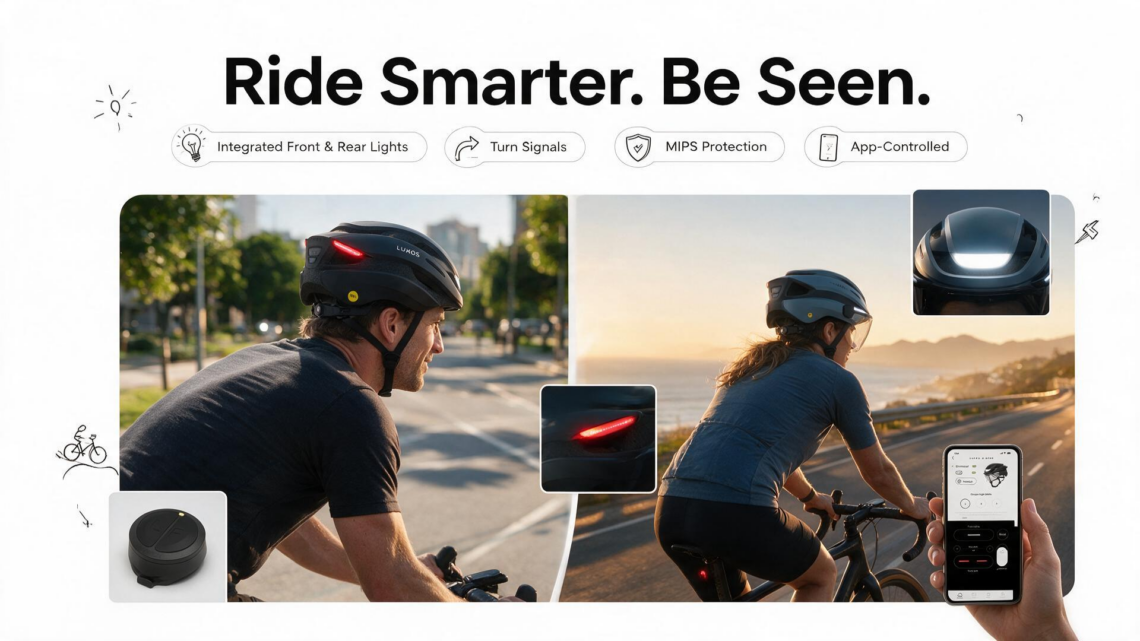
Lumos essentially productized that checklist. Integrated front and rear LEDs wrap the rider in 360° of light. Handlebar-mounted remotes trigger turn signals without taking a hand off the bar. Built-in accelerometers detect deceleration and flare an automatic brake light. The result reads less like a helmet with a gadget glued on and more like a piece of personal signaling equipment — which is exactly what it is.
The Lumos Lineup at a Glance
The range is organized around how people actually ride rather than a catalog of specs. Commuters, e-bike users, and road riders each get a purpose-built platform, plus a modular lighting system that works on anything with two wheels.
| Product family | Built for | Standout traits |
|---|---|---|
| Lumos Nyxel | Everyday urban commuters | Integrated front + rear LEDs, turn signals, auto brake lights, MIPS protection, featherweight all-day fit |
| Lumos Ultra | Riders who want maximum technology in a streamlined shell | Customizable light arrays, app control, voice/remote signaling, deep venting, premium fit system |
| Lumos Ultra E-Bike | Faster e-bike and speed-pedelec commuting | NTA 8776-rated protection for higher speeds, integrated retractable eye shield, extended coverage |
| Lumos Firefly | Any rider — helmet, bike, or body | Tiny wireless smart lights that pair, sync, and respond as one networked visibility system |
| Road helmets & accessories | Sport and fitness riders | Sleek silhouettes plus remotes, mounts, and replacement pads to complete the setup |
The important word in that table is ecosystem. Lumos products talk to one another through the Lumos app and wireless remotes, so a helmet and a set of Firefly lights don’t just coexist — they flash in sync, signal together, and brake together as a single coordinated display.
Meet the Nyxel: The Daily Rider’s Quiet Confidence
If the Lumos collection has a natural starting point, it is the Nyxel. It was designed for the largest, most underserved audience in cycling: the person who rides to work, to class, to the grocery store, and back home again, year-round, in whatever the sky decides to do.
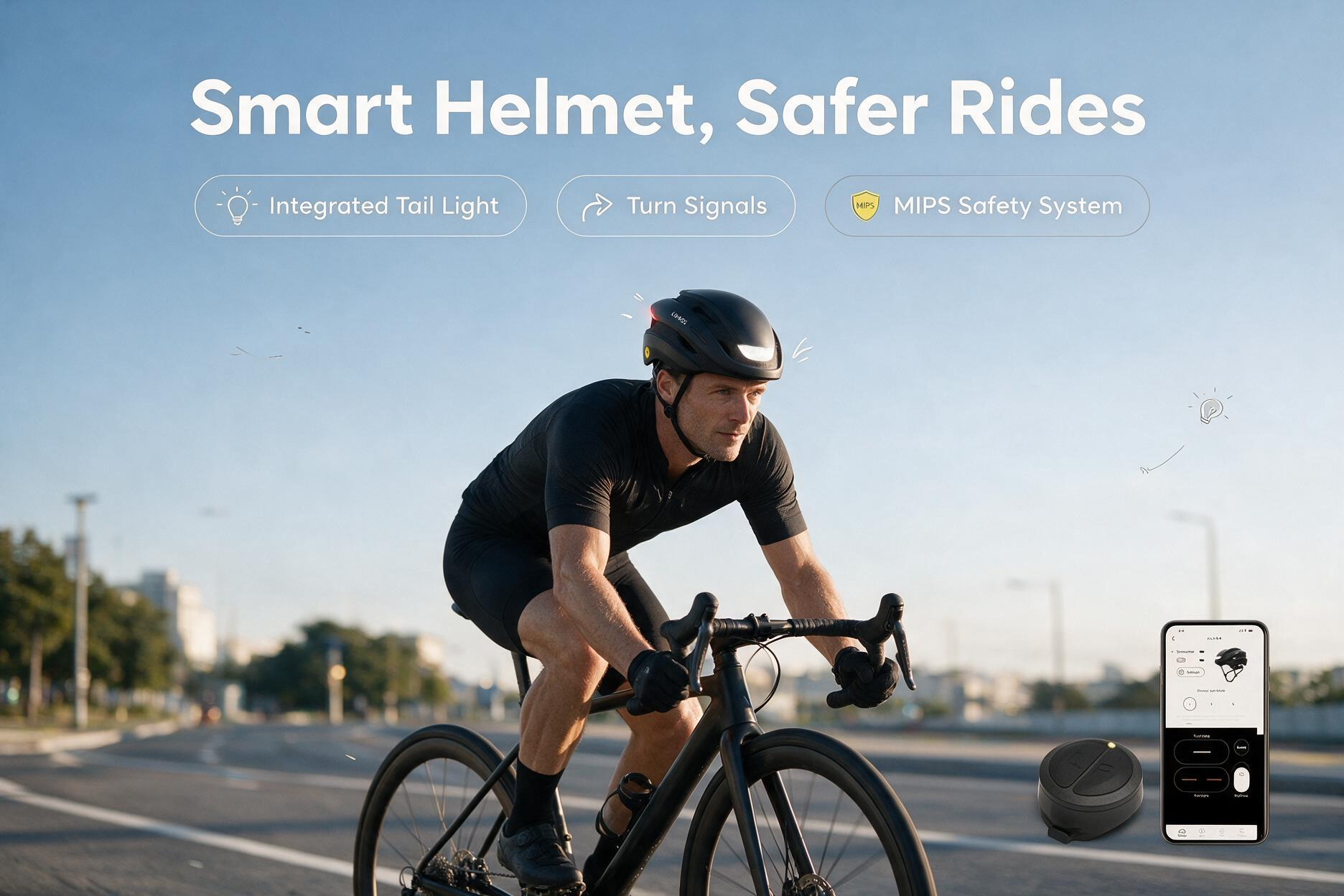
The Nyxel keeps the feature list that made Lumos famous — white illumination at the front, a bold red array at the rear, left-and-right turn signals, and automatic brake detection — while shrinking the package toward what everyday riders actually want to forget they’re wearing. The shell is light, the retention system dials in a precise fit, and generous ventilation keeps the helmet bearable on climbs and summer commutes. A MIPS layer inside addresses rotational forces, which is the detail safety-conscious riders look for first.
The genius is emotional rather than technical. A rider wearing a Nyxel stops treating low-light hours as a risk window and starts treating them as normal. Dusk rides, winter shortcuts, and late trains home stop requiring a mental calculation about whether the trip is “safe enough.” The helmet is already on your head — and so, therefore, is the lighting.
🗨️ Commuter’s note: “I stopped clipping a light onto my bag and then forgetting to charge it. My lights are now part of the one thing I never leave home without.”
The Ultra: Where the Helmet Becomes a Gadget You Actually Want
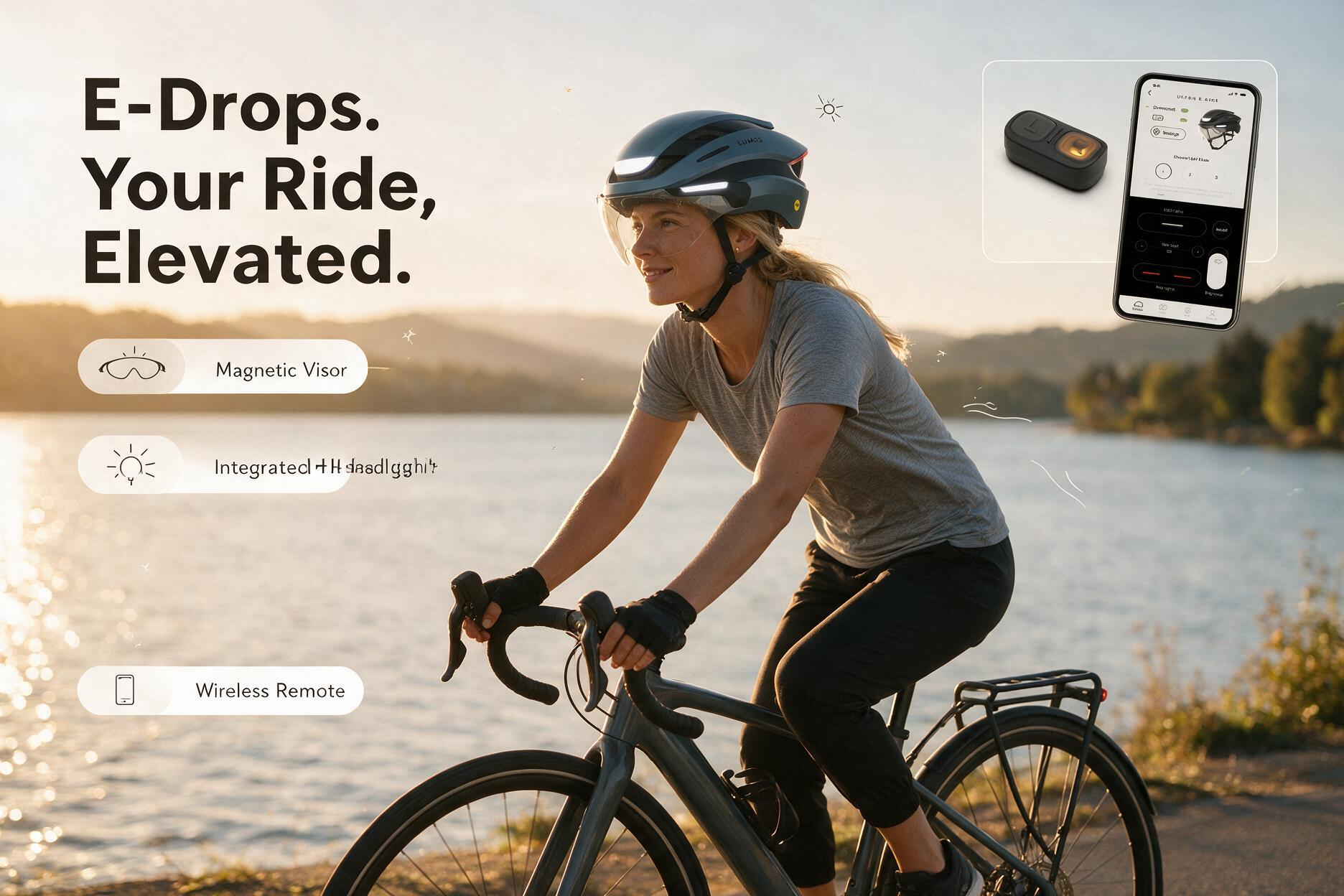
The Ultra is Lumos swinging for the fences — the platform built to prove that smart head protection can be genuinely desirable as an object. It carries a sweeping light surface across the front and rear, programmable through the Lumos app so riders can choose flash patterns, adjust intensity, and tailor how the helmet communicates.
Signaling is handled through a wireless handlebar remote: a quick tap triggers an animated turn indicator, and the helmet’s accelerometer handles braking automatically, flashing a warning the moment you slow. Pairing, firmware, and battery management all live in the app, where riders can also check status and customize behavior.
What separates the Ultra from “helmet with LEDs bolted on” is integration discipline. The electronics are recessed and weather-sealed, the shell is deeply vented, and the fit system competes with premium non-smart helmets on comfort alone. It is a piece of safety equipment that earns its place on style merits — which, for a product that only works if people actually choose to wear it, is a safety feature in itself.
Why the Ultra E-Bike Exists — and Why NTA 8776 Matters
E-bikes changed the math of urban riding. Higher average speeds, heavier bikes, and longer daily distances mean impacts that do happen tend to happen with more energy. The Ultra E-Bike is built to the Dutch NTA 8776 standard, a certification developed specifically for speed-pedelec use and meaningfully more demanding than conventional bicycle helmet norms, with extended coverage around the temples and back of the head.
It pairs that protection with an integrated retractable shield — a flip-down eye protector that replaces sunglasses and fends off wind, rain, and road spray at e-bike speeds — along with the full Ultra lighting and signaling package. For the fast-growing category of riders using an e-bike as a primary vehicle, it is arguably the most “complete” helmet Lumos makes.
Firefly: A Lighting System That Goes Anywhere
Not every rider is in the market for a new helmet, which is exactly the gap Firefly was created to close. Firefly lights are small, wireless, rechargeable, and almost absurdly versatile: clip them to a helmet, strap them to a frame, stick them to a backpack, or wear them on your body. Multiple units pair together and synchronize automatically.
The concept behind Firefly is distributed visibility. Instead of one or two fixed points of light, a rider becomes a moving constellation — higher, wider, and harder for any driver to misread. Pair Firefly units with a Lumos helmet and the whole network signals and brakes in unison; use them standalone and they still deliver front-and-rear coverage in a form factor light enough to live in a jacket pocket.
⚡ Think of it this way: a traditional light makes your bike visible. A Firefly network makes your shape and intentions visible.
Firefly also became a community phenomenon in its own right, drawing thousands of backers during its crowdfunding run — part of a Lumos tradition we’ll return to in a moment.
The Technology, Explained Without the Jargon
It is worth slowing down to appreciate how much engineering hides behind “the lights are built in.” Each Lumos platform solves the same set of linked problems:
- Power management. LEDs must be bright enough for daylight visibility yet efficient enough for realistic battery life between charges. Lumos balances output and run time with selectable modes and USB-rechargeable cells.
- Sensor interpretation. A brake light that triggers on every bump would be useless; one that misses real braking would be dangerous. Onboard accelerometers are tuned to distinguish genuine deceleration from ordinary road texture.
- Wireless reliability. Turn signals have to respond the instant the remote is pressed, in rain and alongside city radio noise. The remote-helmet link is engineered for low latency and simple reconnection.
- Physical integration. Electronics add weight, consume ventilation space, and complicate impact performance. Lumos designs shell, foam, light channels, and retention as one system rather than retrofitting.
- Durability. The product has to survive daily handling, sweat, weather, and the inevitable drop onto a garage floor.
None of these capabilities is shouted at the rider. The user experience collapses to three actions: charge it, put it on, tap to signal. Everything complicated stays under the surface.
App, Remote, and the Connected Ride
The Lumos ecosystem is deliberately low-friction. The handlebar remote mounts within thumb reach and controls turn signals and (on supported setups) auxiliary functions without forcing a hand off the grip. The Lumos app handles the deeper layer:
- Pairing helmets and Firefly units into one synchronized group
- Choosing light modes, patterns, and brightness
- Monitoring battery status
- Adjusting signal and brake-light behavior
- Installing firmware updates that improve products over time
This last point matters more than it sounds. A “dumb” helmet is frozen on the day it leaves the box; a connected Lumos platform can gain behaviors and refinements after purchase, which changes how the product ages.
A Company Funded — and Shaped — by Its Riders
Lumos has never pretended to be a faceless corporation handing products down from a skyscraper. Its origin story is written in crowdfunding backer numbers, and the brand keeps those receipts visible on its own storefront as a matter of identity. The Ultra campaign rallied tens of thousands of backers and raised close to $3 million in community funding; the Firefly campaign followed with another seven-figure run and thousands more supporters.
Those numbers are impressive, but the more meaningful number is the feedback loop they represent. Backers didn’t just pre-order — they argued for features, reported quirks, requested colors, and effectively co-designed refinements. The phrase “created with the community, for the community” on Lumos’s storefront is not decorative; it describes how the company actually learned what riders wanted: lighter weight, better fit, cleaner signal controls, lights that work on any helmet. The products in the catalog today are direct answers to those requests.
🗨️ The Lumos philosophy, in its own words: gear that protects you and allows you to move freely, without hesitation.
That external validation extended beyond backers. Lumos products have collected attention from design and cycling institutions alike — Eurobike awards, international design recognition, and write-ups in publications ranging from Forbes and Mashable to Esquire and Bicycling. For a safety product, being taken seriously by both designers and cyclists is a rare double endorsement.
Who Lumos Is Actually For
Smart helmets are easy to pigeonhole as “a gadget for gadget people.” The actual rider base is far broader.
- The year-round urban commuter who rides in the dark half the year and refuses to gamble on being noticed.
- The e-bike commuter traveling at car-adjacent speeds who wants NTA 8776-grade coverage and an integrated shield.
- The road and fitness rider who wants clean aesthetics plus serious daytime visibility on training routes.
- The student or campus rider who values never having to remember a separate light.
- The family rider who puts Firefly units on multiple bikes and helmets so everyone is lit on evening paths.
- The safety-minded pragmatist who has already had one close call and decided not to have a second.
If any of those descriptions fit, the purchase logic is less “do I want a smart helmet?” and more “which platform matches the way I ride?”
A Quick Decision Path
Still unsure where to start? Walk through this in order:
- Do you ride an e-bike at higher speeds? → Ultra E-Bike for NTA 8776 protection and the shield.
- Do you commute daily and want everything built in? → Nyxel for the lightest all-rounder, or Ultra for maximum customization.
- Is road cycling or sport riding your focus? → the road-oriented Lumos helmets for vented, sleek coverage.
- Happy with your current helmet? → Firefly adds the networked visibility layer without replacing anything.
- Riding as a household? → mix a Lumos helmet with Firefly pairs so all riders share one synchronized system.
Style as a Safety Feature
Here is a thesis worth stating plainly: the safest helmet is the one people will actually wear. History is littered with protective gear that was technically excellent and emotionally repulsive — dorky, heavy, loud, forgettable. Lumos treats aesthetics as part of the engineering brief, with monochrome shells, considered colorways, and light signatures that read as design rather than distress beacon.
The brand’s visual language leans dark, cinematic, and precise: matte helmets, red LED accents, urban photography after sunset. That look does real work. When a helmet feels like something you’d choose to wear to a café, an office, or a date — not just something you tolerate on the bike — compliance stops being a negotiation. Riders who like their helmet wear it for the coffee run they “didn’t really need it for,” and that errand is statistically where protection matters most.
🌃 Inspiration snippet: Safety used to mean dressing for the accident. Lumos redesigned it so you can dress for the destination.
Real-World Moments Where the Difference Is Obvious
Feature tables understate what this gear does in practice, because the value appears in specific seconds of ordinary life.
The left turn across four lanes. Instead of an ambiguous arm gesture in traffic, you tap the remote; an amber sequence sweeps across the rear of the helmet. Following drivers read intent, not guesswork.
The sudden stop at a yellow light. Your hand never reaches for a brake button — the helmet detects the deceleration and flares red on its own, giving the driver behind you the extra moment they need.
The winter commute at 5 p.m. It is fully dark, raining lightly, and the bike lane threads between parked SUVs. Front and rear LEDs at head height keep your silhouette above the metal.
The bridge in broad daylight. Counterintuitively, midday is when many side-street collisions happen. Daylight-flash modes make the helmet register against bright backgrounds.
The group night ride. Paired Firefly units pulse in unison across several riders, turning a loose line of cyclists into a coordinated, legible presence.
In each case, Lumos is doing the same job: converting an anonymous rider into a readable one.
Charging, Care, and Living With It Long-Term
Ownership is deliberately simple. Helmets and Firefly units charge over USB; battery life depends on mode, with steady settings trading run time for maximum presence and flash patterns stretching intervals between charges. A few habits keep the system effortless:
- Charge on rhythm, not on memory. Plug in the helmet when you plug in your phone on Sunday night; most riders settle into a weekly routine.
- Store it sensibly. Keep the helmet out of prolonged direct sun and away from heat sources, just like any helmet with protective foam.
- Clean gently. Wipe shell and straps with a damp cloth; remove and wash pads as needed; never submerge the electronics.
- Replace after a real impact. Smart or not, a helmet is a single-impact device — the electronics surviving does not mean the foam did.
- Update the app occasionally. Firmware updates are where long-term improvements arrive.
A subtle bonus: because the lighting is integrated, there is one fewer thing to remove when locking up, one fewer battery to forget, and one fewer cable to lose.
How Lumos Fits Into the Bigger Shift in Urban Mobility
Lumos did not arrive in a vacuum. Cities are rebuilding around micromobility; e-bike sales have expanded who rides and how fast; cycling is increasingly transport, fitness, and recreation simultaneously. Infrastructure, however, moves slowly. Protected lanes, lower speed limits, and better driver awareness are coming, but unevenly. Riders need a bridge between today’s roads and tomorrow’s — personal technology that improves the odds now.
That is the strategic space Lumos occupies. It treats the rider, not the city, as the unit it can immediately make safer, while designing products that look natural in the mobility landscape that is emerging. A helmet that signals like a vehicle and protects like certified headgear is a category that barely existed before companies like Lumos argued it should. The brand’s ongoing product evolution — lighter platforms, app-connected lighting networks, e-bike-specific protection — tracks the maturation of cycling itself.
Questions Riders Ask Before Their First Lumos
Is a smart helmet heavier than a normal helmet? Early generations paid a noticeable weight penalty. Current platforms like the Nyxel are engineered around all-day comfort, and most riders stop noticing the weight within the first few rides — the trade buys lights, signals, and brake detection that would otherwise require separate devices.
What happens if the battery dies? The helmet remains a certified, fully protective helmet; only the electronic features go dark. Run-time management through the app and a simple charging routine keep surprises rare.
Are the lights legal to use everywhere? Integrated riding lights are broadly accepted as visibility aids; they complement rather than replace required local equipment in jurisdictions with strict bicycle lighting rules. Firefly makes a practical add-on where additional illumination is required.
Can I wear it in the rain? Yes — the systems are designed for real-world weather, including wet commutes.
Does it work with glasses, caps, or ponytails? Fit systems are built for everyday accessories, and the e-bike platform’s retractable shield is specifically designed around eye protection at speed.
Is Firefly only for Lumos helmets? No. Firefly works standalone on bikes, bags, and clothing; pairing it with a Lumos helmet simply unlocks synchronized behavior across the whole setup.
🗨️ Bottom line: you are not choosing between “a helmet” and “lights.” You are choosing a system that handles both jobs at once.
Why the Lumos Story Still Matters
Plenty of companies add electronics to familiar objects. Very few start by questioning whether the object was solving the right problem. Lumos looked at a century-old helmet design and noticed it was optimized entirely for the moments after things go wrong — then committed to the moments before, when being seen and understood can change the outcome entirely.
The company’s community-funded beginnings keep that instinct honest. Backers asked for lighter helmets, simpler controls, serious protection, and lights they could move between bikes, and the lineup responded: the approachable Nyxel, the fully featured Ultra, the speed-rated Ultra E-Bike with its shield, and the pocket-sized Firefly network. Awards and editorial acclaim followed, but the product logic has stayed grounded in utility.
For the rider, the promise is refreshingly concrete:
- See and be seen across 360 degrees, day or night.
- Signal your turns without guessing whether anyone noticed.
- Warn traffic automatically the instant you brake.
- Protect your head with modern, certified impact technology.
- Wear gear you’re genuinely happy to put on.
That is the whole idea, and it has been the whole idea since the first crowdfunding campaign.
Ready to Ride Like the Road Is Paying Attention?
If you have ever finished a dusk ride feeling faintly lucky that traffic noticed you, you already understand what Lumos is for. The next step is simple: match the platform to your riding — Nyxel for the everyday commute, Ultra for the complete connected experience, Ultra E-Bike for high-speed riding with NTA 8776 confidence, and Firefly when you want visibility everywhere else.
Explore the full Lumos collection in its official Amazon store, where the complete helmet and smart-light lineup, colorways, and current configurations are gathered in one place.
The road will never stop being unpredictable. The question is whether you’ll arrive on it as an afterthought in the dark — or as the brightest, clearest, most intentional signal in the lane.
Ride smart. Stay safe. Look great. Let the road do the reacting.