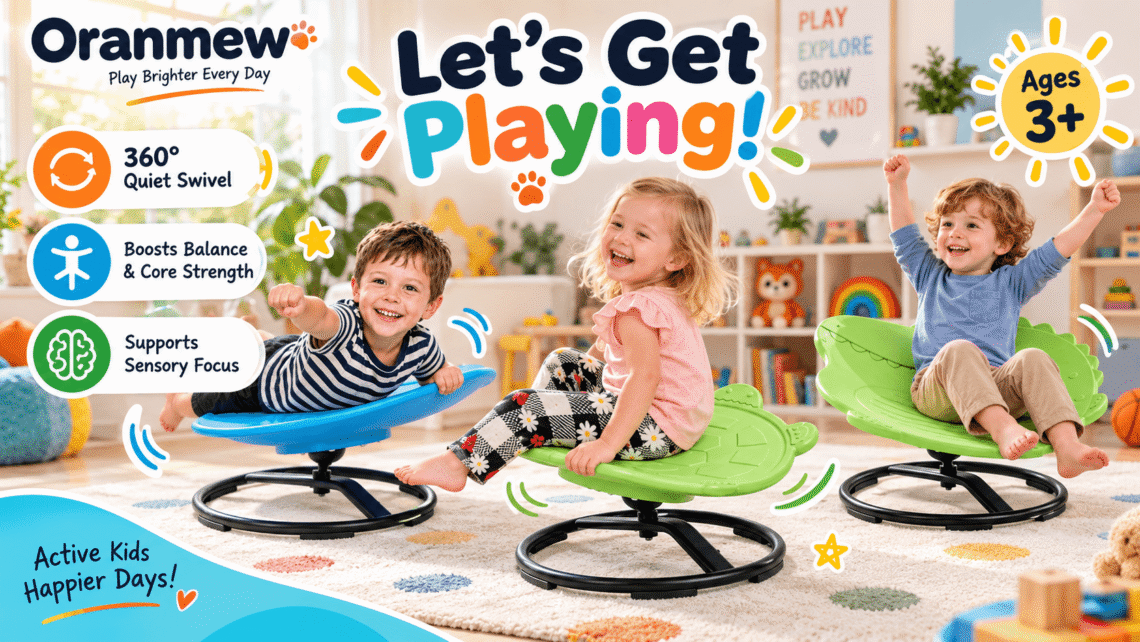
Every parent has lived through the same paradox: children are born to move, yet modern homes are not always built for movement. Screens beckon from every corner, weather traps energy indoors, and the old advice to “just go outside and play” does not always fit real life. Oranmew enters that gap with a simple, joyful mission — to give kids safe, beautiful tools that turn everyday spaces into places where bodies get busy and minds get calm. 🌈
Oranmew is a children’s physical-activity and sensory brand built around one truth: active play is not a luxury, it is how children regulate emotion, build confidence, and learn about their own bodies. The brand’s Amazon storefront bursts with color, movement, and a friendly orange mascot who seems to whisper, “Let’s get playing!” That slogan is more than marketing. It is a reminder that physical development can happen right beside the couch, in a classroom corner, or on a bedroom rug.
This post takes an in-depth look at what makes Oranmew different, who it serves best, and why its products are earning attention from parents, teachers, and therapists who want playtime to mean something.
🎯 What Is Oranmew? A Brand Built on Movement With Meaning
Oranmew is not a generic toy company chasing the latest cartoon license or flashing gadget. It is a focused family brand that designs physical activity toys for children who need to move, balance, spin, and explore. Its catalog centers on three clear categories: sensory spinning chairs, 2-in-1 maze balance boards, and modular hopscotch agility rings.
The visual identity is instantly recognizable. Bright pinks, lime greens, and sky blues dominate the product photography. A cheerful cartoon fox-slash-cat mascot greets shoppers from the banner. The packaging and product images favor clean, infographic-style callouts rather than cluttered text, which makes it easy for tired parents to see safety specs and developmental benefits at a glance.
What separates Oranmew from many indoor toy brands is its deliberate focus on proprioception and vestibular input — the sensory systems that tell the brain where the body is in space. Spinning, balancing, and hopping are not random motions. They are the very inputs that help children calm down, focus up, and feel grounded. Oranmew products are engineered to deliver those inputs safely at home.
🌟 The Oranmew Product Family: Three Paths to Active Play
Rather than flooding the market with dozens of unrelated items, Oranmew has built a tight, purposeful collection. Each product solves a specific movement need and can be used independently or combined into a mini home gym.
1. 360-Degree Sensory Spinning Chairs 🌀
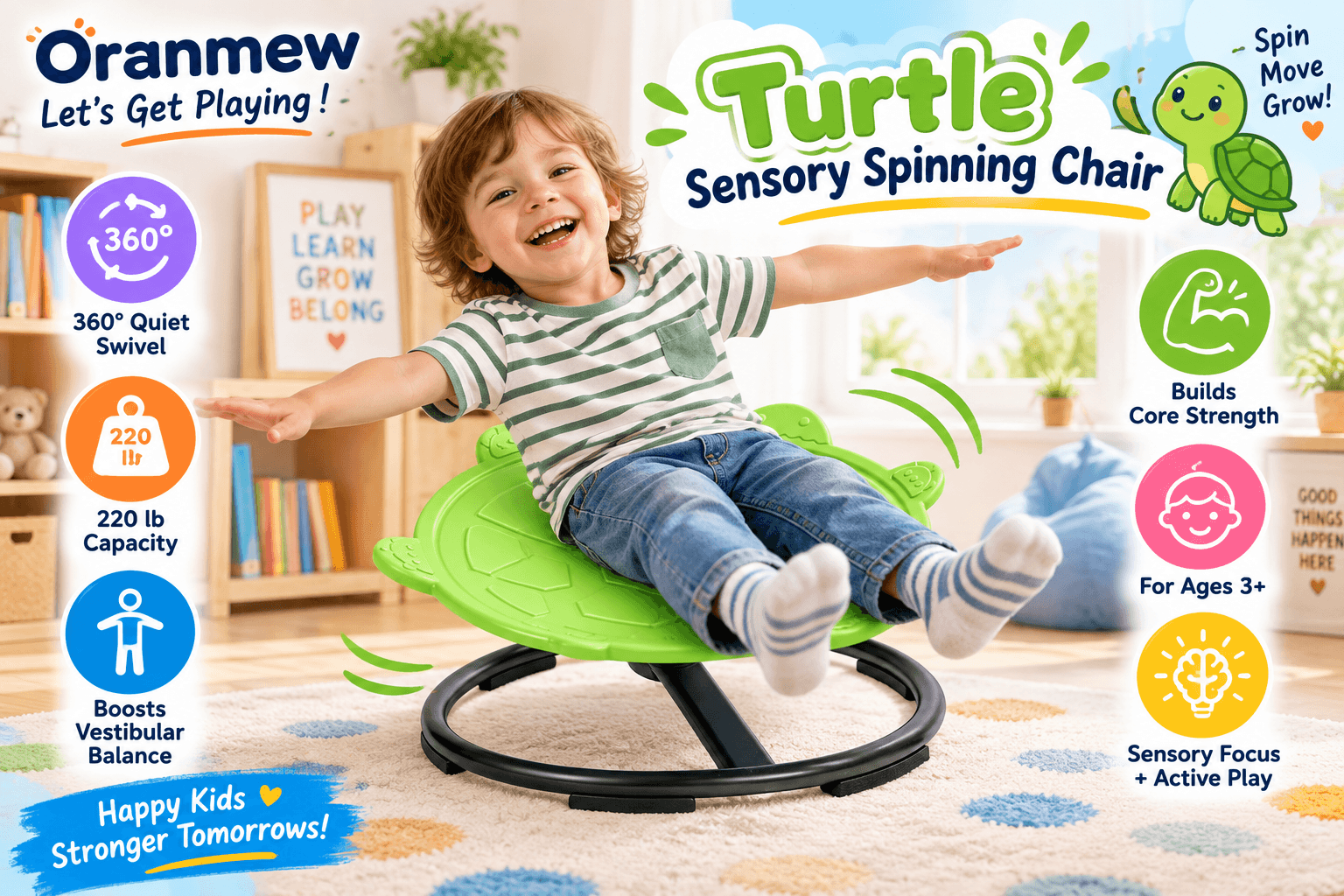
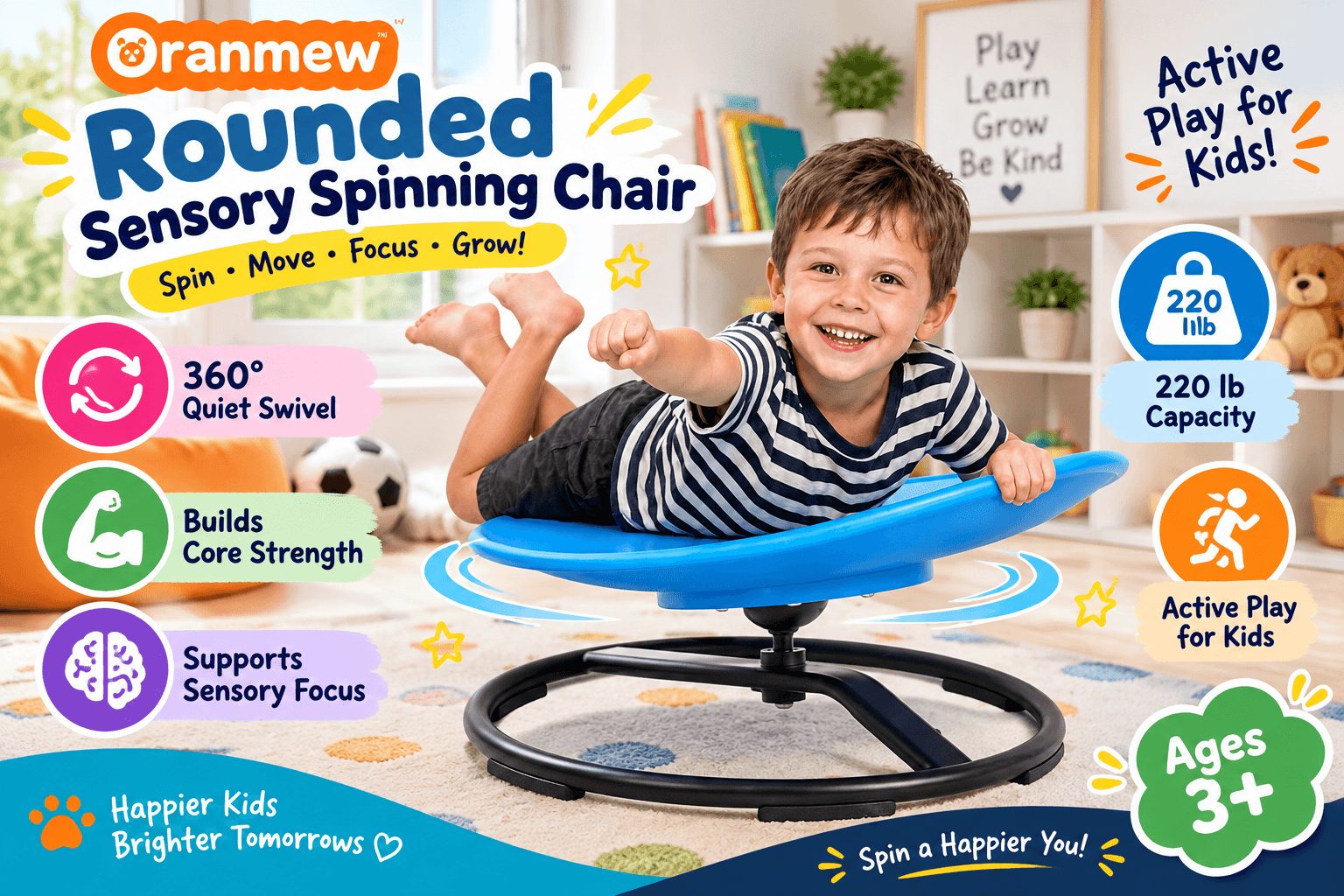
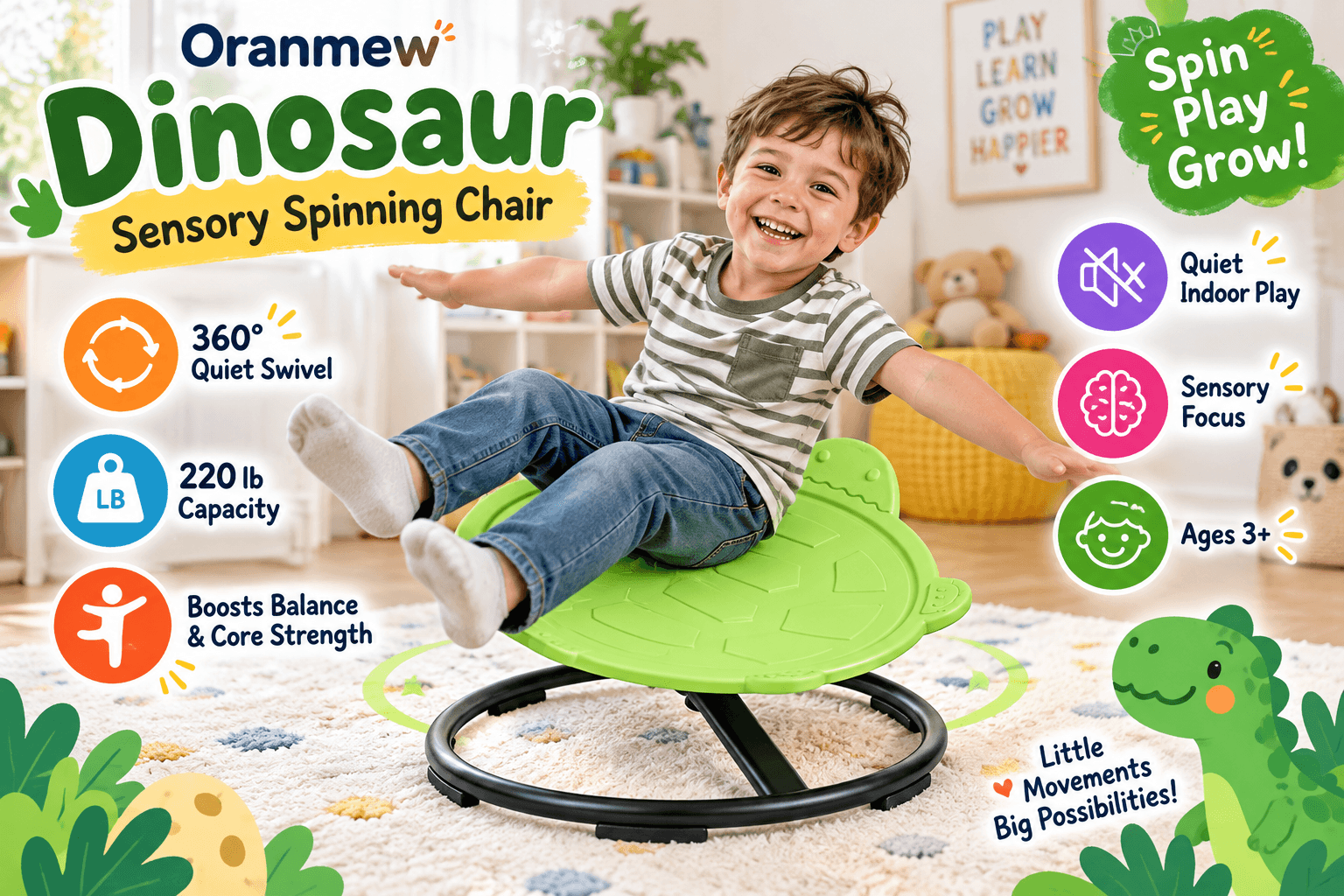
The spinning chairs are the flagship line. They come in cheerful shapes such as a flower petal, a turtle shell, and a classic rounded seat. Each chair sits on a sturdy circular base and rotates a full 360 degrees with a whisper-quiet mechanism.
Parents who have lived with squeaky, wobbly toys will notice the difference immediately. The base is heavy-duty and anti-tip, rated to support up to 220 pounds. That is robust enough to outlast preschoolers, elementary kids, and even the occasional curious adult who wants to test it. The chairs are sized for stability, typically recommended for ages three and up, and designed for heights starting around 33 inches.
The spinning motion delivers calming vestibular input. Many children with autism, ADHD, or sensory-seeking tendencies naturally crave rotation because it helps them regulate arousal levels. A few minutes of controlled spinning can act like a reset button for an overstimulated nervous system.
2. 2-in-1 Maze Balance Boards ⚖️
Balance boards are having a well-deserved moment in pediatric therapy and physical education. Oranmew’s version adds a twist: a maze puzzle built into the board surface. Kids tilt, shift, and balance to guide a ball through winding paths.
The standout feature here is nine progressive skill-building levels. Swappable maze plates and different ball types let families start simple and increase difficulty as coordination improves. It is a clever way to keep a toy interesting long after the novelty would normally wear off.
The benefits extend beyond balance. Core strength, ankle stability, spatial reasoning, and patience all get a workout. Because the maze requires focus, the board naturally trains sustained attention — a skill that pays off at school, at the dinner table, and during homework time.
3. Modular Hopscotch Agility Rings 🏃♀️
Hopscotch is a classic for a reason. It builds bilateral coordination, timing, and cardiovascular endurance, and it requires almost no instruction. Oranmew’s agility ring sets update the sidewalk chalk version for indoor use.
The rings connect modularly, so families can create straight lines, curves, squares, or custom obstacle courses. They store flat, wipe clean, and travel easily to grandma’s house or a therapy waiting room. For teachers, they make an excellent addition to classroom movement breaks without taking up permanent space.
💡 Why Oranmew Matters: More Than Just “Burning Energy”
It is tempting to describe these products as “energy burners,” and they certainly do help children work off excess steam. But that label undersells what is happening neurologically. Active sensory play supports several developmental pillars at once.
- Emotional regulation. Rhythmic movement, especially spinning and rocking, soothes the nervous system. A child who spins for five minutes after a meltdown is not avoiding the problem; they are using their body to return to baseline.
- Focus and attention. Research in occupational therapy and education consistently links short movement breaks to improved concentration. A balance board session before homework can make sitting still feel less impossible.
- Physical confidence. Mastering a spin, completing a maze, or hopping through a full course gives children measurable proof of their own progress. That confidence transfers to playgrounds, sports teams, and social settings.
- Inclusive play. Many Oranmew products are sized and designed with neurodivergent children in mind. They offer predictable, repetitive motion and clear sensory feedback, which can feel safer and more satisfying than open-ended, chaotic group games.
👨👩👧👦 Who Is Oranmew Really For?
The short answer is: any family with children who move. But the brand especially shines for specific households and settings.
- Parents of sensory seekers. If your child climbs furniture, spins in circles, or asks to be swung upside down, Oranmew gives those impulses a sanctioned outlet.
- Families creating calm-down corners. A spinning chair tucked into a quiet corner with soft lighting can become a self-regulation station.
- Homeschool and remote-learning families. Without recess bells and PE classes, daily movement has to be intentional. Oranmew tools make it easy to schedule active breaks.
- Teachers and therapists. The products are durable enough for classrooms, clinics, and waiting rooms, and their visual appeal makes them inviting rather than clinical.
- Anyone dealing with limited outdoor space. Apartments, rainy climates, and long winters no longer have to mean sedentary days.
🛡️ Safety and Quality: The Details Parents Notice
One of the first questions any caregiver asks is, “Will this hold up, and will it be safe?” Oranmew addresses those concerns directly in its product specifications.
| Feature | Why It Matters |
|---|---|
| Anti-tip heavy-duty base | Reduces the risk of the chair tipping during enthusiastic spinning |
| Up to 220 lb weight capacity | Supports growing children and occasional adult use |
| Whisper-quiet rotation | Allows use during homework time or while others are nearby |
| Rounded, smooth edges | Minimizes bumps and scrapes during active play |
| Non-toxic, child-safe materials | Aligns with expectations for toys used by young children |
| Compact, modular designs | Easy to store, clean, and transport |
The brand also emphasizes age-appropriate sizing. Most spinning chairs are recommended for ages three and older, which gives parents a clear starting point. As always, supervision matters, especially when children are first learning how to use balance equipment.
🗣️ “But Will My Child Actually Use It?” — Real Parent Questions
Choosing a sensory or activity toy can feel like a gamble. Here are some of the questions families often ask, answered in plain language.
Speech Bubble: “My kid has a short attention span. Won’t this get ignored after a week?”
Oranmew’s progressive designs help. The maze board has nine levels to unlock. The agility rings can be rearranged into new courses. The spinning chair remains satisfying because the body itself keeps asking for that input.
Speech Bubble: “We live in a small apartment. Where would we put it?”
The chairs are compact stools, not bulky furniture. The rings store flat. The balance board doubles as a puzzle toy that can slide under a bed or lean against a wall.
Speech Bubble: “Is this only for kids with sensory needs?”
Not at all. Every child benefits from balance, coordination, and movement. Neurodivergent children may need these tools more intensely, but typical-developing kids love them too.
🏠 How to Build an Oranmew Movement Zone at Home
Setting up a successful active-play space does not require a dedicated playroom. A corner, a hallway, or even a cleared patch of carpet can work. Here is a simple step-by-step guide.
- Choose the location. Pick a spot with a flat, non-slip surface and enough clearance that a spinning child or hopping feet will not hit furniture.
- Add soft flooring. A yoga mat, foam tiles, or a small rug protect little feet and muffle sound for downstairs neighbors.
- Introduce one tool at a time. Let your child explore the spinning chair for a few days before adding the balance board. This prevents overwhelm and keeps novelty high.
- Set gentle rules. “Spin until you feel calm,” or “Three maze levels before dinner,” turn play into predictable routines.
- Rotate activities. Move the agility rings into different shapes. Swap maze plates. A small change makes the same toy feel new.
- Join in occasionally. When parents model movement, children are more likely to engage. A family balance challenge can be surprisingly fun.
🎨 Creative Inspiration: 7 Play Ideas Beyond the Basics
Oranmew products are designed for open-ended use. Here are some fresh ways families have stretched them into full play experiences.
- Sensory Storytime. Spin gently while listening to an audiobook, then stop and discuss the story. The motion can help auditory processors stay tuned in.
- Obstacle Course Night. Use the agility rings as stations combined with couch cushions, tunnels, and stuffed-animal “lava” zones.
- Balance Board Beat the Clock. Time how long your child can keep the ball in the maze. Track progress on a chart.
- Spin-and-Count Math. Hop through the rings while calling out multiples, or spin and solve simple addition problems during the slowdown.
- Calm-Down Corner Ritual. Five slow spins, three deep breaths, and a weighted blanket finish. Repeat as needed.
- Sibling Challenges. Set up parallel courses and let kids race without comparing raw speed. Focus on completion and personal bests.
- Rainy-Day PE Class. Teachers and homeschool parents can run a 15-minute circuit: spin, balance, hop, rest, repeat.
📊 Oranmew at a Glance: Quick Comparison
| Product | Best For | Key Skill | Space Needed |
|---|---|---|---|
| Petal Sensory Spinning Chair | Calming, self-regulation | Vestibular input, focus | Small corner |
| Turtle Sensory Spinning Chair | Younger kids, themed rooms | Balance, calming motion | Small corner |
| 2-in-1 Maze Balance Board | Concentration, coordination | Core strength, problem-solving | A few feet of floor |
| Modular Hopscotch Rings | Energy burning, group play | Agility, bilateral coordination | Hallway or open floor |
🔬 What the Research Says About Movement and Childhood Development
While this article is focused on Oranmew as a brand, it is worth grounding the conversation in established science. Organizations such as the Centers for Disease Control and Prevention recommend that children ages six through seventeen get at least 60 minutes of moderate-to-vigorous physical activity each day. For younger children, the recommendation is even simpler: move often and move freely.
Occupational therapy literature has long recognized the value of proprioceptive and vestibular activities for self-regulation. Schools that incorporate movement breaks report better classroom behavior and academic engagement. Sensory-friendly tools are increasingly understood not as special-needs-only equipment, but as universally beneficial resources that support a wide range of developing brains.
Oranmew’s product philosophy aligns with these findings without making medical claims. It offers practical, home-friendly ways to put movement science into daily family life.
✨ The Verdict: Why Oranmew Deserves a Spot in Your Home
Oranmew succeeds because it understands the real constraints of modern parenting. It knows that not every family has a backyard. It knows that some children need more sensory input than others. It knows that toys have to be safe, durable, and visually appealing before parents will let them through the front door.
The brand’s three core product lines — spinning chairs, maze balance boards, and hopscotch agility rings — cover the major movement categories children need: rotation, balance, and jumping. Each product is designed with progressive challenge, heavy-duty construction, and a clear sense of fun.
For families building a calm-down corner, a homeschool gym, or simply a more movement-friendly living room, Oranmew offers a refreshing alternative to passive entertainment. The products invite children to use their bodies, trust their balance, and discover what it feels like to be calm, capable, and in control.
So the next time the energy in your home starts to spike, you do not have to reach for a screen or bundle everyone into rain gear. You can point to the corner where the Oranmew chair waits, where the balance board leans, where the rings form a new challenge. You can say the words on the banner, the ones the orange mascot seems to beam across every product page: “Let’s get playing!” 🦊🎉
Oranmew products are available through the brand’s Amazon storefront. As with any physical activity equipment, adult supervision is recommended, and families should follow the manufacturer’s age and weight guidelines for each product.