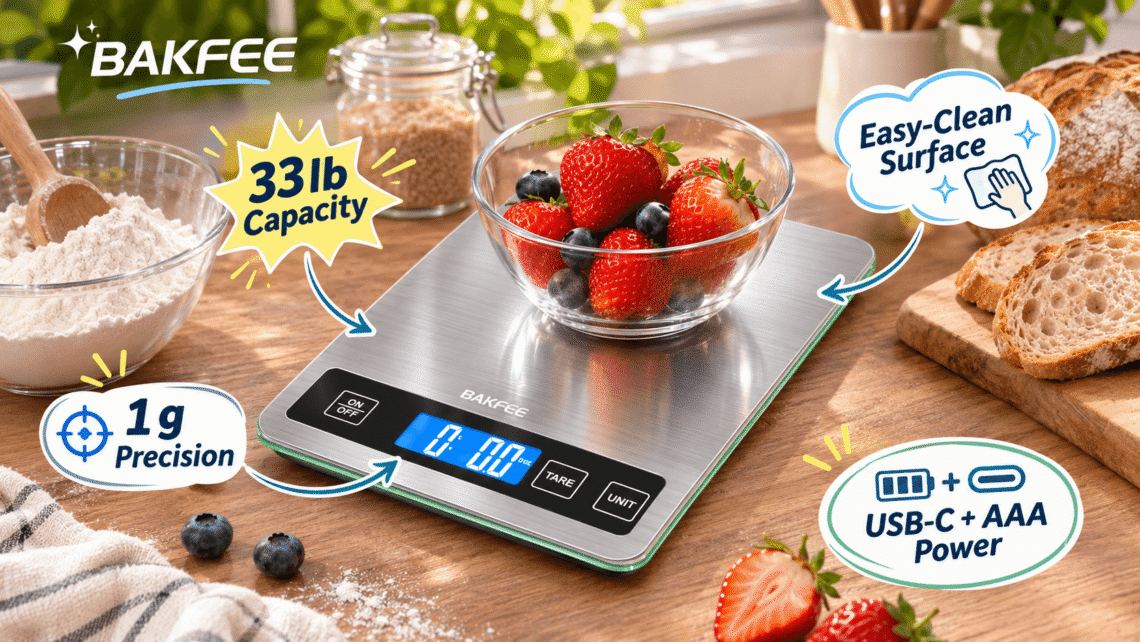
Walk into a serious home baker’s kitchen these days and you’ll notice something has shifted. The measuring cups still sit in the drawer, sure, but the real work happens on the countertop — on a slim, silent BakFee kitchen scale that sits beside the mixing bowl like a quiet partner. Bakers weigh flour. Meal preppers weigh chicken. Coffee people weigh beans to the gram. And increasingly, the scale they choose is the one that doesn’t treat precision as a luxury feature.
This post is about that shift. It’s about a brand most people haven’t heard of yet but will, and about why the humble kitchen scale — long dismissed as “equipment for professionals” — is quietly earning a permanent place in ordinary American kitchens.
We Forgot How Much Weighing Matters. BakFee Wants to Remind Us.
Here’s an uncomfortable truth about home cooking: most of us have been guessing at ingredients our entire adult lives. A “cup of flour” can weigh anywhere from 110 to 160 grams depending on how hard you packed it, how humid the air was, and whether you leveled it with a knife or just tapped it once and moved on. That single 50-gram swing is the difference between a crumb that melts and a crumb that turns into a brick.
Professional kitchens moved past this decades ago. Every pastry chef on earth weighs ingredients because weight is objective while volume is not. A gram is a gram whether your flour is sifted, clumpy, or three years past its best-by date. A cup changes its mind constantly.
What’s interesting is that home cooking has been catching up. Sourdough’s second wave, macro-based meal prep, the third-wave coffee obsession, and the rise of home protein bakes all share one common thread: the people doing it want consistency. And consistency, it turns out, arrives in grams more reliably than in scoops.
BakFee was built on exactly this realization. The brand isn’t trying to sell you a gadget. It’s trying to sell you the confidence that your Tuesday cake will look like Saturday’s cake — or at least be close enough that no one complains.
What BakFee Actually Is (and Why “Fee” Might Be the Key)
BakFee positions itself as a kitchen-scale specialist, which is rarer than it sounds. Most appliance brands treat scales as a footnote — a $19.99 accessory tacked onto a line of blenders and toasters. BakFee does the opposite. It builds a small, focused family of scales and pushes the idea forward: better displays, better platforms, rechargeable batteries, washable bodies, and — on its smart model — an app that actually wants to know what you ate.
The name hints at the personality: a baking brand that wants to be your “fee,” your quiet companion in the kitchen. It’s not a testosterone-laden performance brand, and it’s not a cutesy lifestyle brand either. It sits in a friendly, practical middle — the kind of company that designs scales first and asks about marketing later.
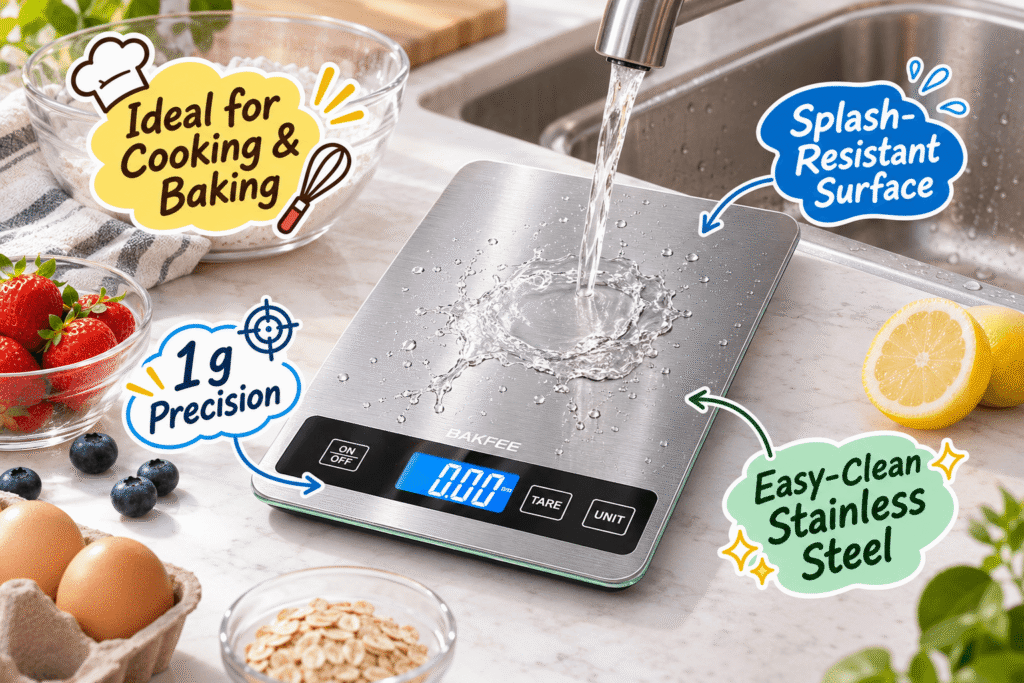
That focus shows in the details. A BakFee scale platform is brushed stainless steel, not shiny plastic. The display is angled, not flat. The rechargeable model charges over USB instead of begging for coin batteries every other month. The waterproof version can be rinsed under the tap instead of wiped around like something fragile. These choices add up to a product that behaves like a kitchen tool, not a science experiment you’re afraid to scratch.
The BakFee Lineup at a Glance
BakFee’s range is deliberately small — four main flavors of the same core idea. Here’s how they break down:
| Model | Capacity | Readability | Standout Feature | Who It’s For |
|---|---|---|---|---|
| Classic Stainless Steel Scale | 22 lb / 10 kg | 1 g (0.1 g on light items) | Angled backlit display | Everyday bakers, soup makers, bread dough |
| Rechargeable 22 lb Kitchen Scale | 22 lb / 10 kg | 1 g | USB rechargeable, no coin batteries | Anyone tired of drawer batteries |
| Waterproof Food Scale | 22 lb / 10 kg | 1 g | Rinsable body, easy wipe-down | Cooks who work with sauce, oil, raw meat |
| Smart Nutrition Scale | 22 lb / 10 kg | 1 g | App + food diary + nutrition database | Macro trackers, calorie counters, meal planners |
Notice what’s not there. No 50-pound industrial behemoths. No jewelry-grade 0.01 g trinkets. BakFee picked a lane — the everyday kitchen — and optimized for it. Twenty-two pounds of capacity covers a Dutch oven of stew, a five-pound bag of flour, or a week’s worth of prepped chicken breast. One-gram precision is sharp enough for yeast, baking powder, and espresso without tipping into the overprecise, anxiety-inducing territory that makes casual cooks abandon their scale after two weeks.
That balance is harder to hit than it looks.
The Details That Make the Difference
The Angled Display Solves a Tiny, Daily Frustration
Flat displays on kitchen scales are a minor crime. You set a big bowl of dough on the platform, and suddenly the screen disappears behind the bowl’s rim, forcing you to crouch, tilt your head, or lift the bowl every time you want to check the reading. BakFee’s angled display fixes this by tilting the screen toward you, the way a car’s dashboard faces the driver. It’s a small engineering decision, but it’s the kind of small decision that changes how often you actually use the scale.
The Platform That Won’t Surrender to Tomato Sauce
Brushed 304-grade stainless steel isn’t there for looks. It shrugs off citrus, vinegar, hot oil, raw chicken juice, and red sauce without staining, warping, or absorbing smells. Plastic platforms on cheap scales go gray around the edges after six months and start holding onto last Tuesday’s garlic. BakFee’s platform looks the same in year two as it did out of the box.
No More Coin-Battery Roulette
Most digital scales run on LR44 or AAA coin cells that die at the most inconvenient moment — usually halfway through a double-layer cake. BakFee’s rechargeable model removes this anxiety. A standard USB charge (the same cable most people already carry for their phone) gives weeks of normal use. It sounds like a small thing until you’ve thrown away a perfectly good Sunday because your scale was dead again.
💬 “I used to keep a stash of coin batteries in the junk drawer like someone who expects a household disaster. With the rechargeable BakFee scale, that stash is gone — and so is the 11 p.m. panic before batch-cooking Sunday.”
Waterproof Isn’t a Gimmick — It’s a Cleaning Strategy
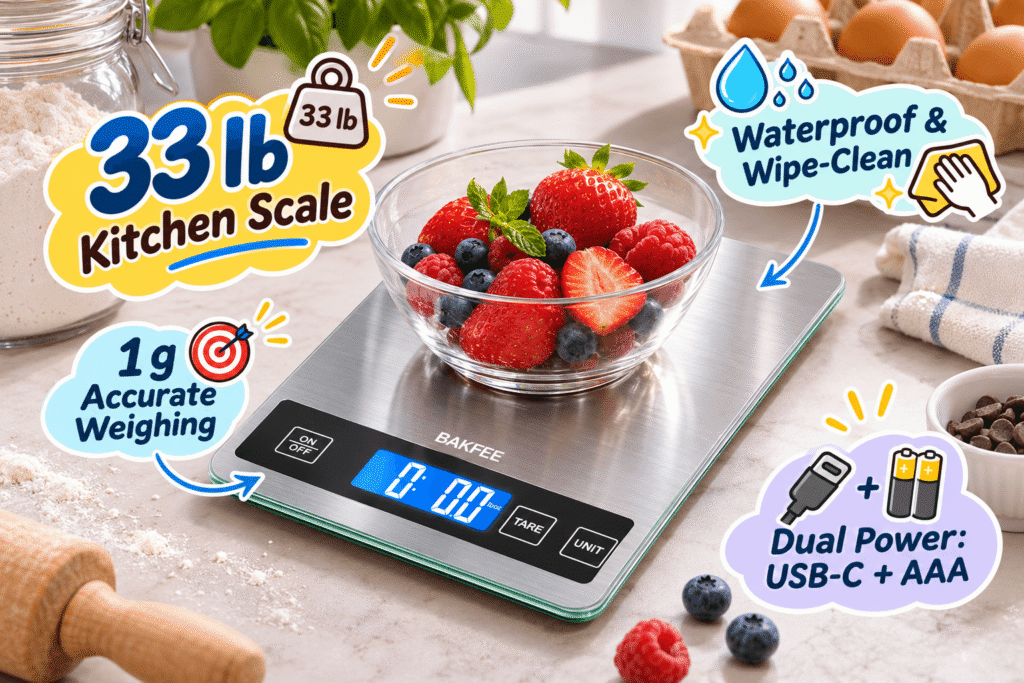
There’s a reason BakFee made a dedicated waterproof model. Kitchen scales get gross. Not mildly dusty — actively gross. Olive oil drips, honey sticks, flour coats, and raw-meat residue waits silently for the next thing you put on the platform.
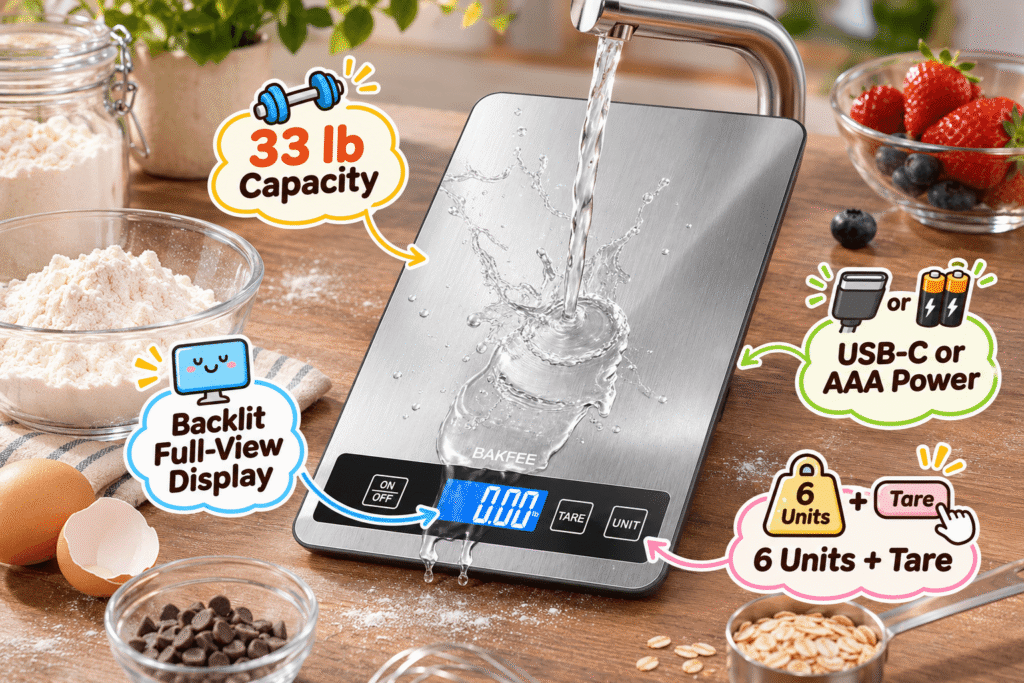
Most scales answer this with “wipe with a damp cloth.” Fine, for coffee grounds. Useless when you’ve just weighed a pound of ground beef and need to sanitize. The waterproof BakFee scale answers it with: hold it under the tap. Rinsable body. No crevices that hide crumbs. A wipe-down and you’re done, platform and display both.
For meal preppers, that’s the whole selling point. You can weigh 15 portions of protein on Sunday, rinse once, and put the scale away clean. For bakers, it means you can measure honey directly on the platform, watch it drip off, and not worry about it crystallizing into a sticky souvenir.
When a Scale Learns Your Groceries: The Smart Nutrition Model
Here’s where BakFee gets genuinely interesting. The smart nutrition scale doesn’t just show grams — it connects to an app that turns those grams into nutrition information. Drop a bowl of rice on the platform, and the app looks up what you’re likely weighing, estimates calories and macros, and files it into a food diary. Scan a barcode on a packaged food and the app pulls the label directly.
This isn’t a full-blown fitness ecosystem. It’s something more practical: a lightweight, friendly nutrition log that starts the moment ingredients hit the scale, instead of one you have to remember to open after dinner.
The use cases write themselves:
- A runner training for a half-marathon who wants to track protein without spreadsheets
- A parent trying to understand whether their toddler’s snack habit is actually balanced
- Someone recovering from an illness who needs gentle portion awareness
- Anyone who has ever typed “banana” into a tracking app and wondered whether it registered the whole banana or half
The point isn’t perfection. The point is automatic. A scale that nudges your diary for you is one you’ll actually keep using, which is more than you can say for the three fitness apps currently gathering dust on your phone.
Who Actually Uses a BakFee Scale?
If you’re picturing a laboratory, reset that image. The people on BakFee’s community photos are:
- The serious home baker. Sourdough, laminated dough, macarons — anything where a 2% ingredient shift changes the outcome. These folks weighed ingredients long before BakFee existed, but they switched for the angled display and stainless platform.
- The Sunday meal prepper. Ten portions of grains, protein, and roasted vegetables, all weighed once and logged. The waterproof model lives in this world.
- The coffee person. Pour-over, AeroPress, espresso. A gram scale is the difference between “decent coffee” and “what is happening in my cup.” The precision models shine here.
- The macro tracker. Not the obsessive kind — the calm kind who wants a rough weekly sense of protein, carbs, and fat. The smart app model handles this without shame or hype.
- The parent of small humans. Portion control for toddlers, measuring formula-adjacent solids, sneaky vegetable bakes. You weigh more than you expect when someone tiny is watching.
- The “vintage scale refugee.” Anyone who inherited a mechanical spring scale from grandma and finally accepted that it was never actually accurate.
Cup, Meet Gram: A Friendly Dialogue
The Measuring Cup: I’ve been in this kitchen since 1978. Nobody needs numbers. A pinch is a pinch.
BakFee Scale: Sure. And a “cup of flour” is between 110 and 160 grams. Your pinch of salt is fine. Your cup of flour is a gamble.
The Measuring Cup: offended You’d replace me with a battery?
BakFee Scale: I’m not replacing you. I’m the thing you call when you actually want the recipe to work. You’re for when guests are coming and you need to eyeball mashed potatoes.
The Measuring Cup: …We can share the drawer?
BakFee Scale: Happily.
It’s a silly exchange, but it captures the reality: scales and cups aren’t enemies. Cups stay fast and convenient for loose, forgiving cooking. Scales quietly take over the jobs that actually matter.
Five Habits That Make Any Kitchen Scale Smarter
Owning a scale isn’t the skill — using it well is. These habits apply to a BakFee scale or any good digital scale:
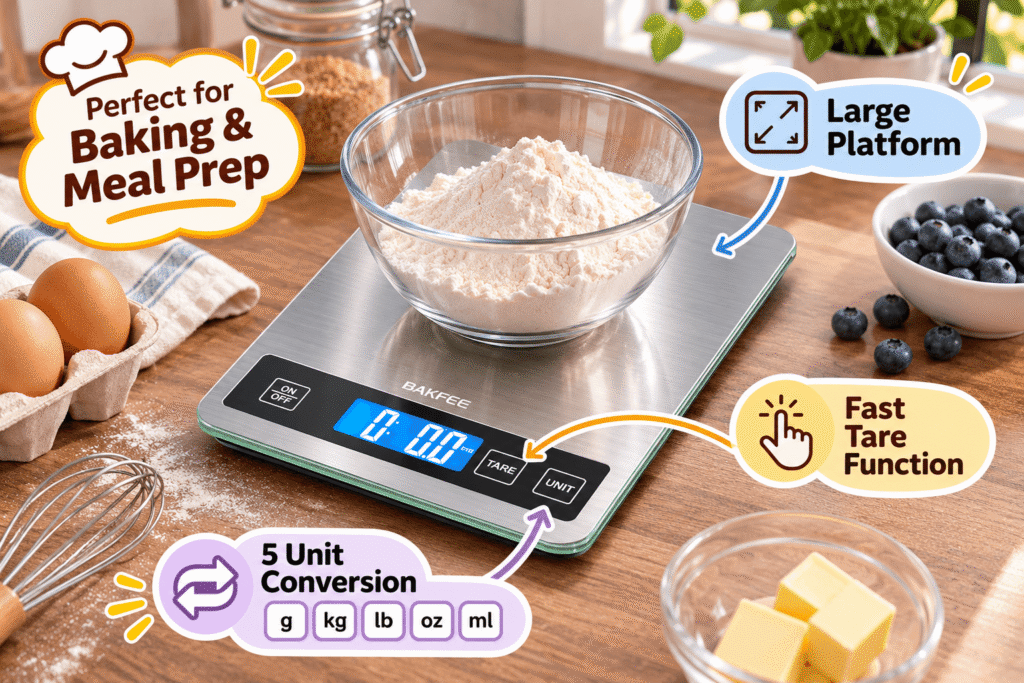
- Tare constantly. Put the bowl on first, hit tare, then add ingredients. Your reading is always just the thing you’re adding, not the bowl you’re adding it into.
- Weigh dry goods first, wet goods second. Flour is easier to brush off. Honey is easier to measure last and rinse away.
- Give it room. Scales on the edge of a counter get bumped. Scales on a steady, flat spot last longer and read more reliably.
- Charge before you need it. The rechargeable model runs for weeks, but getting into a “charge while I bake” rhythm means you never hit zero mid-recipe.
- Clean as you go. A quick wipe after each use beats a deep scrub in month three. The waterproof model makes this nearly effortless.
Questions People Ask Before They Buy
Do I really need a scale if I have measuring cups?
Only if you bake, meal prep seriously, or care about nutrition numbers. For casual boiling and steaming, cups are fine. For anything where the recipe says “until it feels right” and you don’t trust your feeling, scale wins.
Is 1-gram precision sharp enough for yeast and baking powder?
Yes. Standard active yeast doses are measured in 2–7 gram ranges, and 1-gram readability catches the edge cases without forcing you to buy a jeweler’s scale.
Can I weigh liquids on a kitchen scale?
Absolutely. Water is 1 gram per milliliter, oil is close enough, and most BakFee models can toggle units between grams, ounces, milliliters, and pounds.
What’s the difference between the waterproof model and the regular one?
Same platform logic, but the waterproof body seals the casing and display so you can rinse it directly. Choose it if raw meat, sauces, or honey are regular guests on your counter.
Does the smart scale need the app to work?
No. It works as a regular standalone scale. The app is an optional upgrade layer for people who want nutrition logging.
The Quiet Countertop Anchor
Here’s the part that sounds sentimental but is actually practical: a good kitchen scale becomes invisible. You stop noticing it sits there — until you reach for it out of habit, then reach again the next morning, and then wonder how you ever measured oats without it.
BakFee’s whole ambition is to be that kind of tool. Not loud, not flashy, not here for your Instagram. Just accurate, clean, rechargeable, and quietly capable of turning your least reliable kitchen habit — guessing — into something trustworthy.
The 1-gram revolution isn’t about numbers taking over cooking. It’s about numbers removing doubt. Once you’ve weighed a cake twice and gotten two nearly identical cakes, you don’t go back to cups-only cooking. You just don’t.
And that, really, is the whole story.