Making the Bedside Easier: A Practical Look at Step2Health Safety Steps and Rails for Seniors
There is a moment many families recognize: getting into bed, getting out of bed, or reaching the bathroom at night starts to feel less automatic than it once did. It may not be dramatic. A loved one may simply pause before stepping down from a high mattress, brace a hand against a dresser, or ask for help with something they used to manage independently. Those small moments are often where thoughtful changes at home matter most.
Bedside safety equipment is not about making a bedroom look clinical. At its best, it is about creating a more predictable routine around one of the most frequently repeated movements of the day: sitting, standing, stepping up, stepping down, and finding stable support in low light. For older adults, people recovering from surgery, individuals with limited mobility, or anyone dealing with a bed that sits higher than is comfortable, a well-chosen bedside step or rail can make the room feel more manageable.
The Step2Health range focuses on this practical area of home mobility. Its products include bedside steps with handles, adjustable-height platforms, illuminated features, compact step stools, and bed rails designed to provide a more deliberate path around the bed. Rather than treating every bedroom challenge as the same problem, the selection reflects a useful idea: the right solution depends on the person, the bed, the available floor space, and the way the bedroom is used every day.
This guide takes a closer, plain-English look at how bedside safety steps and rails fit into a safer home setup, what to consider before choosing one, and how Step2Health products may suit different household situations. It is not a substitute for advice from a physician, occupational therapist, physical therapist, or other qualified professional. It is, however, a practical starting point for families who want to think more carefully about bedside access.
The Bedside Is a Small Space With a Big Job
A bedroom can appear simple because it is familiar. Yet the area around the bed asks a great deal of the body. A person may need to move from lying down to sitting, rotate their legs, find the floor with their feet, stand up, regain balance, and begin walking—all within a few seconds. At night, the same sequence may happen when someone is sleepy, wearing loose footwear, adjusting to dim light, or trying not to wake a partner.
That is why bedside safety is not only about the bed itself. Mattress height matters. So does the thickness of the bedding, the firmness of the mattress edge, the distance to the bathroom, the placement of nightstands, the type of flooring, the presence of a rug, and whether the person uses a cane, walker, or other mobility aid. A safety product can be helpful, but it works best as part of a room that has been arranged with movement in mind.
For example, a very high bed may require a person to slide downward before their feet find the floor. That can be uncomfortable for someone with knee, hip, back, or balance concerns. A lower bed can present the opposite challenge, requiring more effort to stand. In either case, a stable step, platform, or rail may make the transition feel more controlled. The goal is not to rush the movement; the goal is to give it a repeatable sequence.
There is also an emotional side to this. Needing help at bedtime can feel private and frustrating. Many people do not want a full room renovation or a large medical-looking installation. They may simply want a sturdy place to put a foot, a handhold that is easy to find, or a clearer route from the bed to the door. Products designed for bedside use can help preserve a sense of autonomy while giving family members greater peace of mind.
Why Steps and Rails Often Work Better Together
A bedside step and a bed rail solve related but different problems. A step reduces the height difference between the floor and the mattress. A rail provides a place to hold while repositioning, sitting, standing, or turning. Some people may need one but not the other. Others may find that the combination is more intuitive, especially when their bed is high or when they feel unsteady during transitions.
Think of the movement as a short route rather than a single action. A person may hold a rail while sitting up, place both feet securely on a step, pause, stand with support, and then turn toward a stable walking path. When that sequence makes sense for the individual, it can feel much less awkward than using furniture that was never intended to serve as a handhold.
Furniture can be deceptive. A nightstand may shift. A lightweight chair can slide. A dresser handle may not be built to bear downward force. Even the edge of a mattress is not always consistent, particularly with soft or pillow-top styles. A dedicated bedside support product is designed around a specific task, which is an important distinction when comfort and confidence are priorities.
It is equally important not to assume that a rail or step automatically fits every person or every room. Someone who transfers independently may use equipment very differently from someone who needs assistance. A person with weakness on one side may need the support positioned in a particular direction. Someone with cognitive changes may benefit from an especially simple setup with a clear, uncluttered route. Good selection starts with observation rather than a one-size-fits-all checklist.
A Closer Look at the Step2Health Approach
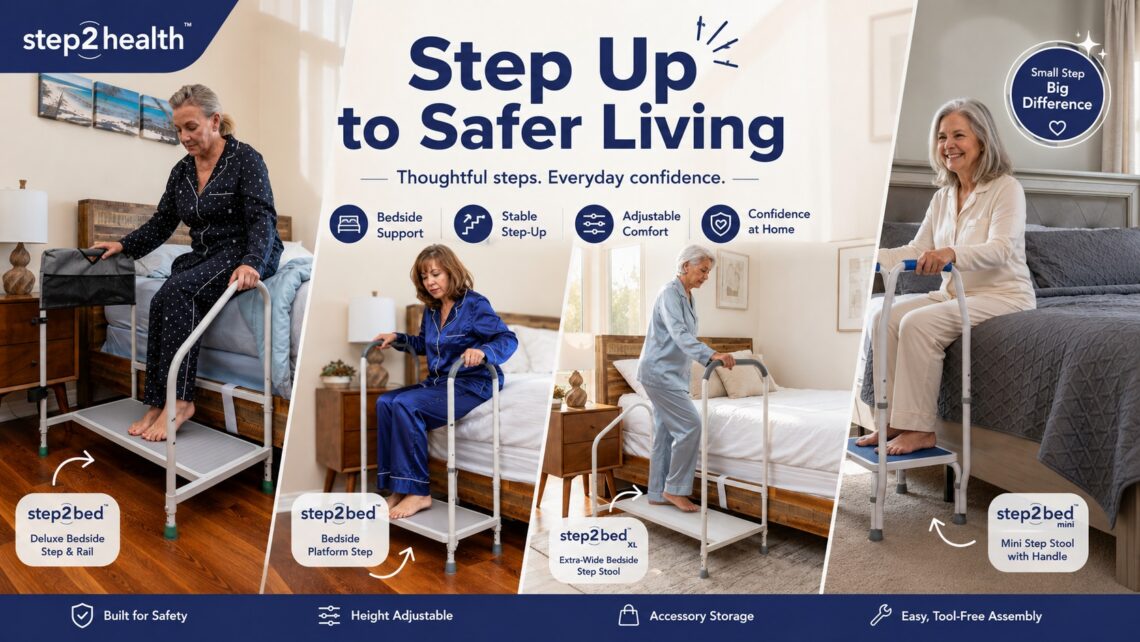
Step2Health offers products that address several common bedside situations. The range includes a bedside platform with a safety handle and motion-sensor light, an XL bed-climbing aid with adjustable height and LED-guided rails, a compact adjustable step stool with a handle, and a deluxe bed rail with accessory features such as a cane holder, mesh bag, and LED light. These are not interchangeable products. Their differences are exactly what make it worthwhile to consider how a person moves in and around their own bed.
The practical appeal of Step2Health products is that they concentrate on the parts of a bedroom routine that are easy to overlook until they become difficult: the height of the first step, the location of a reliable handhold, and the challenge of navigating in darkness. Details such as adjustable configurations, wide bases, integrated handles, and lighting are not merely extras when they match the user’s needs. They can shape how confidently a person approaches the bed.
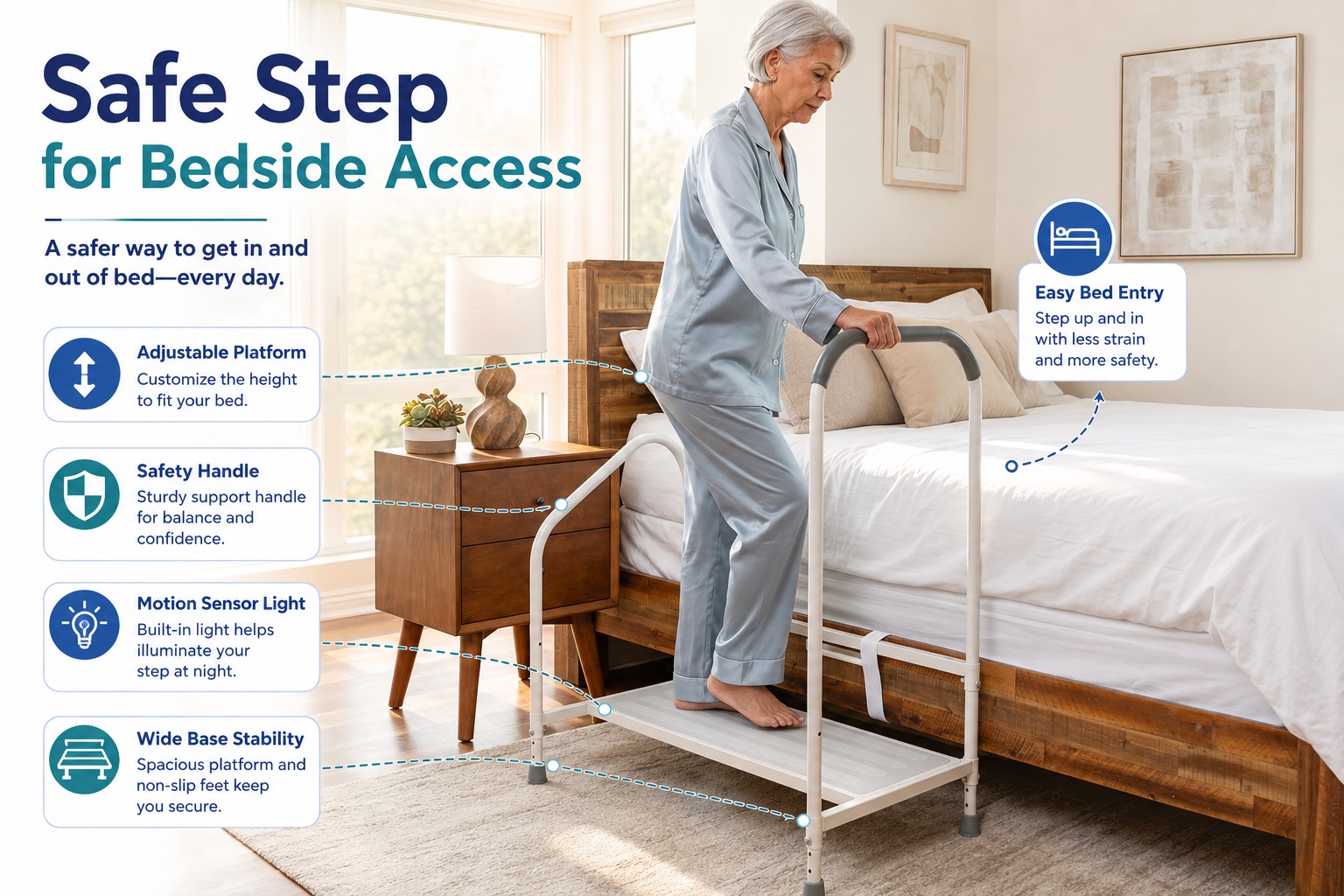
One product listed in the collection is an adjustable bedside step stool for adults with a safety handle, motion-sensor light, and wide base. This type of design can be useful when the central concern is climbing into or down from bed rather than needing a full-length rail. A platform step gives the user an intermediate landing point. Instead of managing one larger height change, the body moves through a smaller, more gradual sequence.
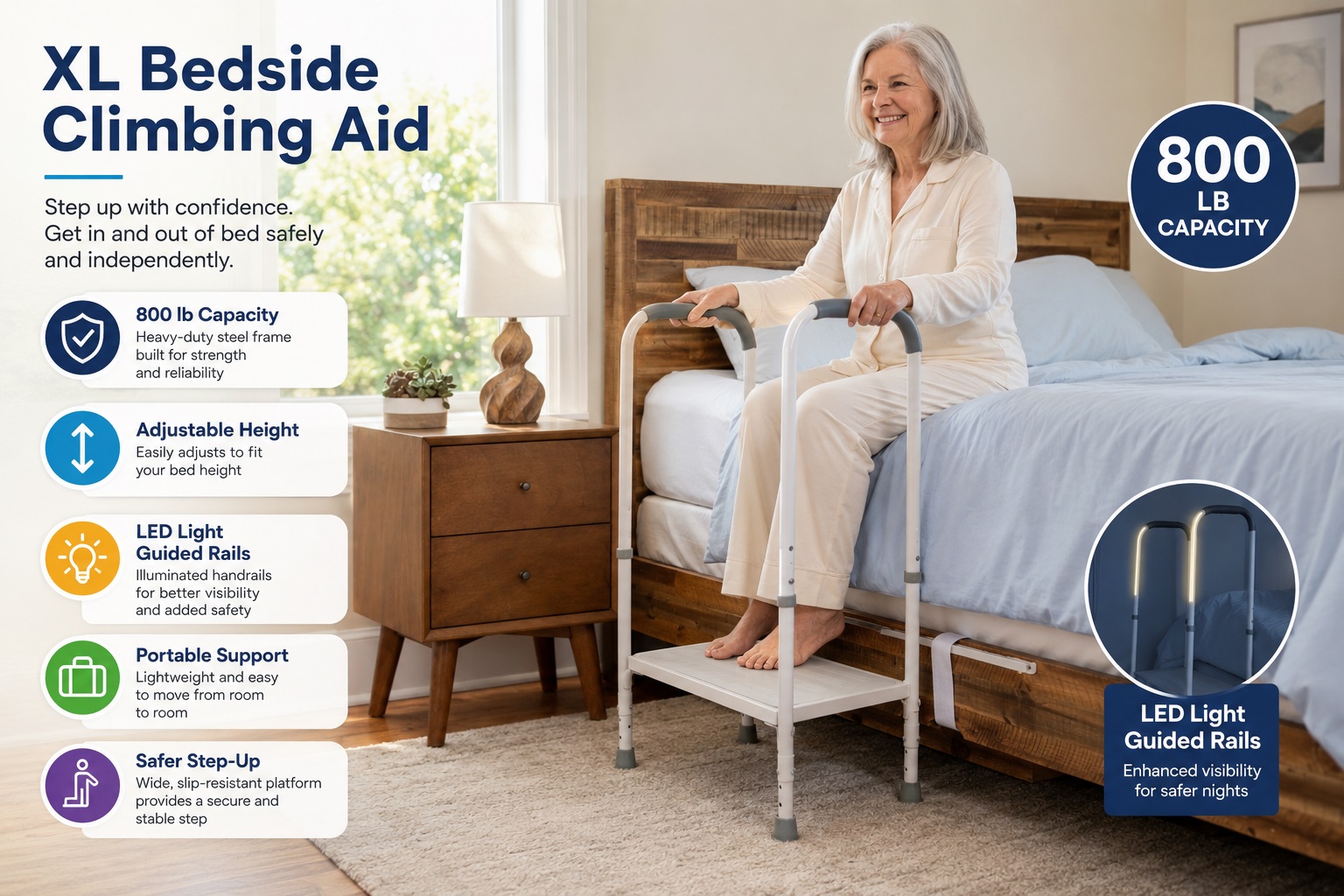
Another option is an XL bedside step stool or bed-climbing aid featuring LED-guided rails and adjustable height. The listing describes a stainless-steel construction and an 800-pound stated capacity. That kind of larger-format design may be more appropriate for households looking for a more substantial bedside platform and two-sided guidance during the transfer. Still, capacity is only one consideration; the footprint, layout, placement, and actual user needs deserve equal attention.
When a Bedside Step Makes Sense
A bedside step is most relevant when mattress height is the main obstacle. This happens more often than people expect. Modern mattresses can be thick, and bed frames, foundations, adjustable bases, or decorative beds can add even more height. A taller bed may be comfortable for some people because it reduces the distance required to stand, but it can also make the climb into bed difficult when the feet do not reach the floor comfortably from a seated position.
Before choosing a step, watch the actual transfer. Does the person sit on the bed and struggle to lift a leg up? Do they scoot or hop slightly to reach the mattress? Do they avoid sitting on the edge because it feels too high? Do their feet swing above the floor when seated? These are not diagnoses, but they are useful observations. A step may be worth considering when the height difference interrupts what should be a steady, controlled movement.
There is a difference between a small generic stool and a bedside platform designed with support in mind. A typical household stool may be too narrow, too lightweight, or too easy to shift. It may also lack an easy-to-grasp support point. Bedside safety steps are intended to remain in a consistent position and provide a wider, more intentional place for the foot to land. That predictability is especially valuable when someone gets up during the night.
The Step2Health bedside platform listing emphasizes an adjustable format, a safety handle, a wide base, and motion-sensor lighting. Those features are worth considering in context. Adjustability can help align the step with the bed’s actual height. A handle can offer a defined place to hold. A wide base may support a more stable feel on suitable flooring. Motion-activated lighting can help make the first step easier to see without requiring the user to search for a switch in the dark.
Of course, a step only helps if it is used consistently and correctly. It should not be positioned where it blocks a walking path or makes it harder for a caregiver to assist. It should be placed on a level surface, away from loose rugs and trailing cords. The user should be able to put a full foot on the platform without twisting awkwardly. If the arrangement creates a turn, reach, or stretch that feels unnatural, reconsider the setup rather than trying to make the person adapt to the equipment.
What a Bed Rail Can Add
Bed rails are often associated with hospitals, but bedside support rails for home use can serve a more modest purpose. They can provide leverage for sitting up, a reference point while repositioning, and a handhold when standing. For someone whose issue is not the height of the bed but the lack of something secure to grasp, a rail may be the more direct answer.
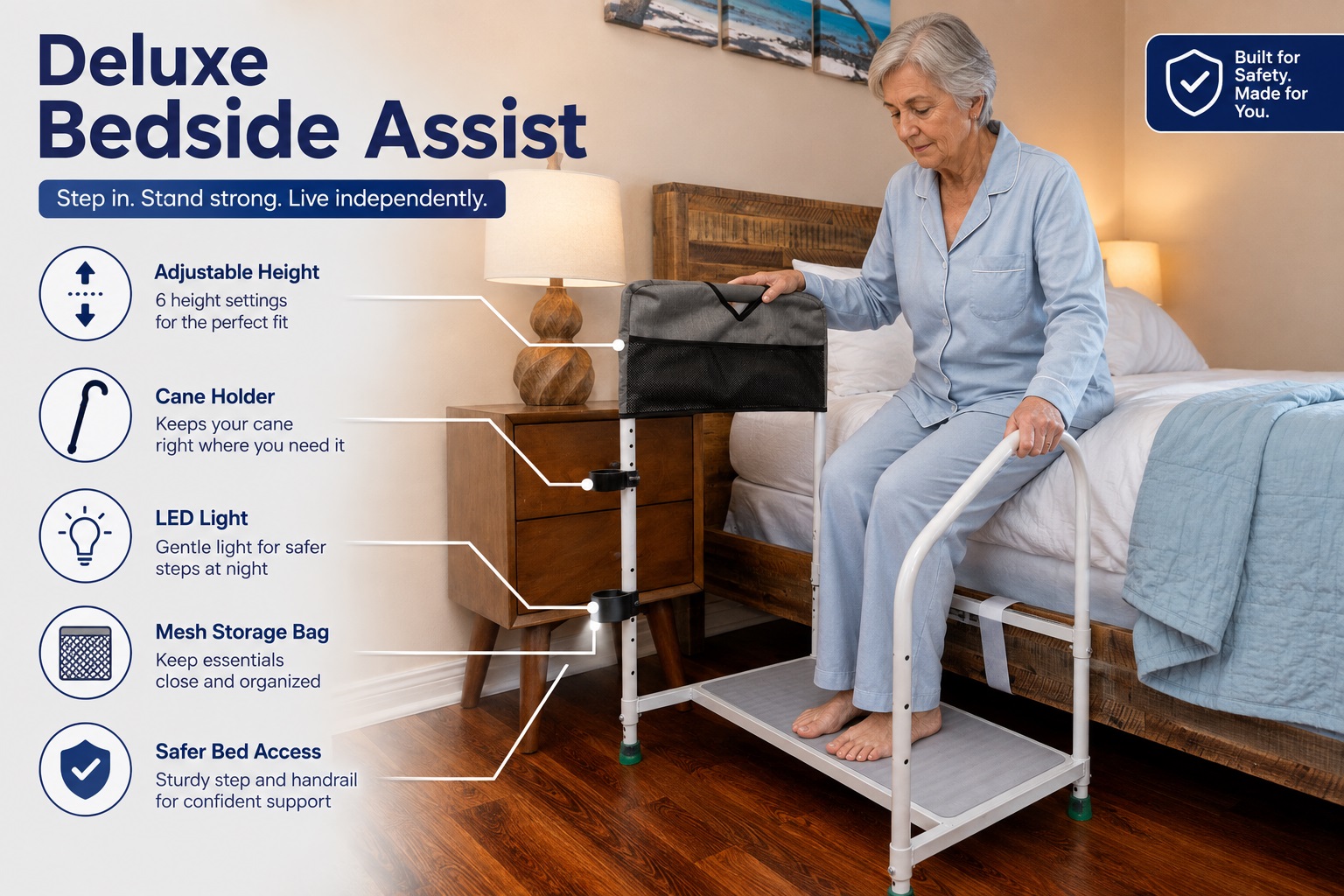
The deluxe Step2Health bed rail is presented as an adjustable-height rail for older adults with a cane holder, LED light, mesh bag, and grab-bar-style support. This combination suggests a design meant to keep several nighttime essentials close at hand. A cane holder can reduce the temptation to reach across the room. A storage bag may keep glasses, a remote, a phone, or medications organized, although medication storage should always follow the person’s own safety plan. A light can help define the immediate area around the bed.
Convenience matters because it reduces unnecessary movement. If a person has to lean toward a distant nightstand to find a cane or search under bedding for a phone, the transfer becomes more complicated. Keeping commonly used items within easy reach can make the space feel calmer and more orderly. The best accessory is not necessarily the one with the most features; it is the one that helps the user avoid awkward reaching and makes their routine easier to remember.
Rail placement deserves special care. The support should be on the side of the bed where the person normally enters and exits, unless a professional recommends another arrangement. It should be positioned with awareness of furniture, closet doors, bathroom routes, and any mobility equipment nearby. In a shared bedroom, the partner’s access and the ability to make the bed should also be considered. Safety equipment that causes daily frustration may not be used consistently, and consistency is part of what makes a setup effective.
Families should also read the manufacturer’s instructions closely to confirm compatibility with their mattress, bed frame, and intended use. Bed rails are not a casual purchase. Installation, securement, regular inspection, and suitability for the specific user all matter. For individuals with significant mobility limitations, confusion, agitation, or a history of getting caught between bedding and furniture, consult a qualified clinician before selecting or installing any rail system.
The Quiet Value of Nighttime Lighting
Lighting is one of those bedroom details that seems secondary until the lights are off. A person may know their bedroom perfectly well during the day and still misjudge the distance to a step, slipper, or doorway after waking at 2:00 a.m. Harsh overhead light can be unpleasant, while complete darkness can make a familiar route feel uncertain. A small, targeted light can be a practical middle ground.
Several Step2Health listings incorporate LED or motion-sensor lighting. The benefit is not about brightness for its own sake. It is about creating visual orientation at the exact moment someone begins to move. A soft light near the floor or support area may help a person identify the bed edge, step surface, rail, and direction of travel before they place their weight.
Lighting should support, not replace, basic room safety. Keep the route from bed to bathroom clear. Make sure cords are not crossing the floor. Consider whether a favorite pair of slippers, a walker, or a cane has a predictable place each night. If the person wears glasses, ensure they are easy to reach. A light can reveal obstacles, but the room still needs to be free of them.
There is also a useful behavioral benefit to a consistent illuminated path. When people repeat the same sequence—sit up, hold the rail, step down, find the cane, walk toward the bathroom—the routine can become more automatic. That may be particularly helpful after a move, after a hospital discharge, or when a temporary change in mobility has made familiar movements feel less certain.
Choosing Between the Mini, Standard, XL, and Rail-Focused Options
It is tempting to choose the largest or most feature-rich product immediately, but bedside equipment should fit the situation rather than overwhelm it. The most suitable option is the one that provides enough support without creating crowding, confusion, or an awkward route through the room.
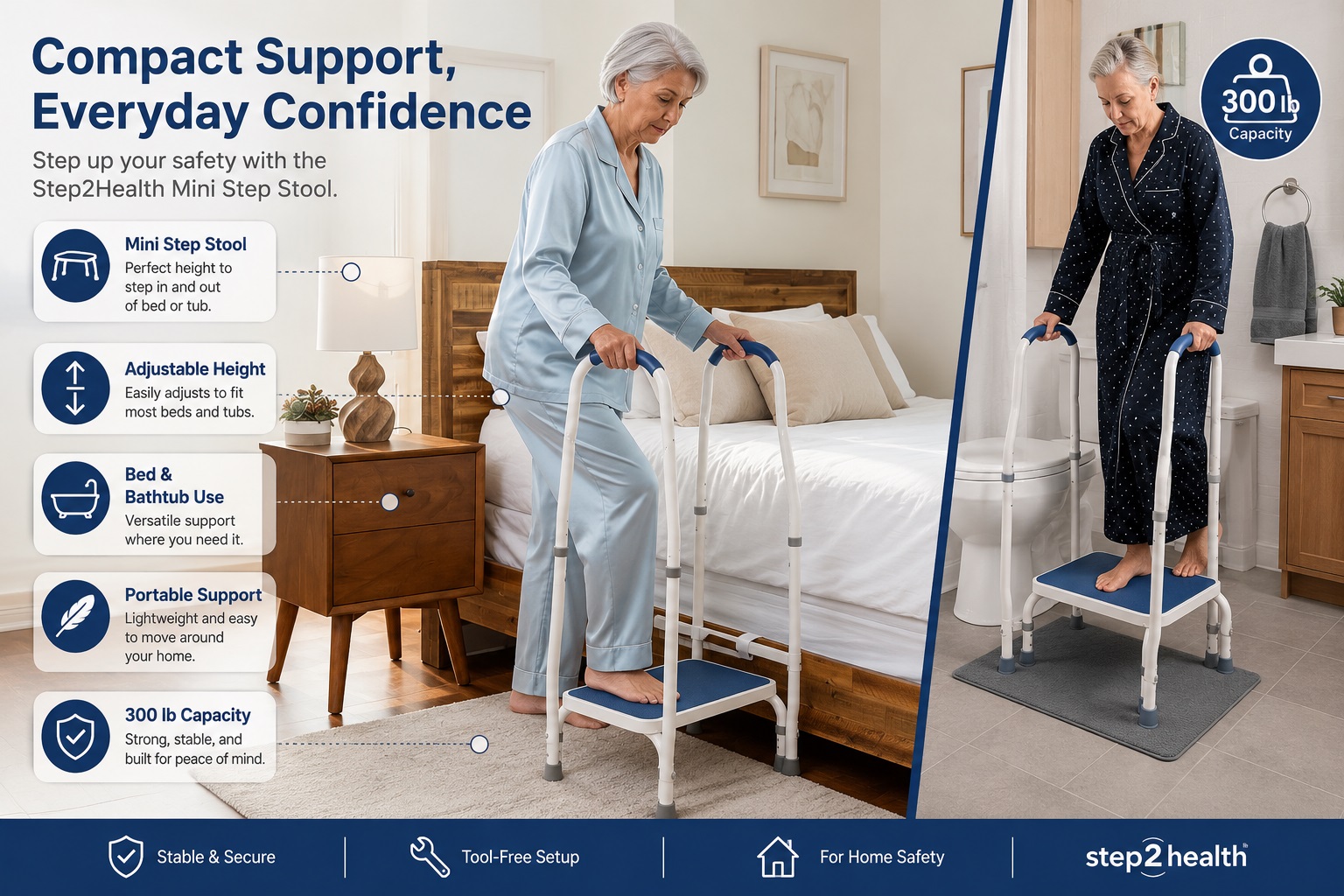
A compact step stool with a handle may suit a smaller bedroom or a person who needs only a modest height adjustment. The Step2Health mini step stool is described as adjustable in height and designed with grab-bar-style handles. Its listing also notes a 300-pound stated capacity and suggests use near a bed or bathtub. This kind of smaller step can be appealing where space is limited, provided there is enough clearance to approach and use it safely.
A standard bedside platform may make more sense for someone whose bed is noticeably high and who benefits from a broader step surface and a dedicated handle. The added platform area can give the feet a more defined landing place. This can be especially useful when the person’s balance is less reliable immediately after sitting up or when their mobility changes from day to day.
An XL platform with guided rails may be better suited to a person who wants a more structured approach to climbing into bed. The larger design may offer more presence and support, but that also means it requires more floor space. Measure the room honestly. Consider not only the space beside the bed but also the path around it. There should be room for the user to turn, for bedding to be changed, and for a caregiver to assist if necessary.
A rail-focused product can be a strong choice when the bed height is already appropriate but the person needs leverage or reassurance while sitting and standing. The deluxe bed rail format may be particularly attractive for people who like to keep a cane, reading materials, or a phone close by. Yet it should be selected for the support it provides—not simply for the accessories attached to it.
In other words, choose based on the hardest part of the movement. If stepping up is the issue, start by evaluating a step. If sitting up or standing is the issue, look at a rail. If both are difficult, a combination approach may be worth discussing with a mobility professional. The room should support the person’s natural routine rather than asking them to learn an entirely new one.
A Realistic Bedroom Walk-Through Before You Buy
Before bringing any bedside step or rail into the home, take ten minutes to do a simple walk-through. Begin with the bed made as it normally is. Have the person sit at the edge, stand, and walk toward the bathroom or doorway while someone observes from a respectful distance. The purpose is not to test or pressure them.