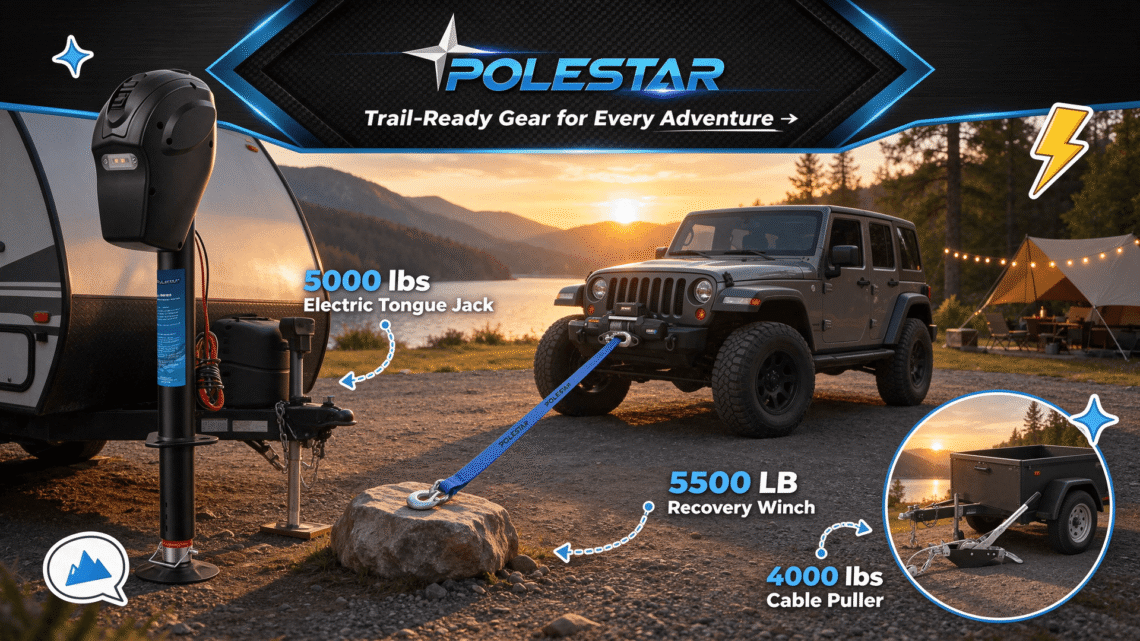
An original specification audit of three POLESTAR workhorses — the 5000 lbs electric A-frame tongue jack, the 5500 lb IP68 winch, and the 3000 lbs dual-ratchet come-along — and why the least glamorous parts of a rig deserve the most attention.
◆ READ TIME: 12 minutes | ◆ FORMAT: Component audit | ◆ ANGLE: Load-path engineering
What this article covers
- ▸ The Four-Link Test — a framework for judging any towing or recovery component
- ▸ Who POLESTAR is, and what twenty-plus years of one category actually produces
- ▸ Three dossiers: jack, winch, come-along
- ▸ The spec-sheet questions owners actually ask, answered in dialogue
- ▸ A rig-matching matrix and a seasonal maintenance cadence
1. The Part of the Rig Nobody Posts About
There is a predictable shape to a trip recap. The lake at golden hour. The slide-out extended under string lights. The trail shot with the sunroof open and somebody’s dog in the back. What never makes the gallery is the small black cylinder bolted to the front of the trailer, or the cable wound around a drum behind a bumper, or the ratchet lying in a mud flap. Those parts do not photograph. They either work, or they ruin the weekend.
POLESTAR has built its reputation almost entirely inside that blind spot. The brand’s catalogue is concentrated on lifting, pulling and holding hardware: electric tongue jacks, marine jacks, manual come-alongs, 12V recovery winches and truck bed lifters. Its storefront positions the company as a leader in trailer and RV lifting solutions, with a claimed twenty-plus years in the category and an installed base past six figures. There is no lifestyle line here. No ambient lighting, no cabin gadgets, no clever upholstery. Just the load-bearing links in a chain that gets a vehicle from a driveway to a remote site and back.
That focus is easy to underrate, because it is boring on paper. But it is also the reason a POLESTAR component is worth auditing rather than skimming. When a brand makes almost nothing except the part that fails catastrophically, the engineering decisions become legible. You can read them off the spec sheet, if you know which lines to read.
▎CALLOUT — The premise of this article A component is not judged by its category. It is judged by its job inside a chain of forces. Below is the test used throughout.
2. The Four-Link Test
Most buyer guides sort hardware by type: jack versus winch versus hoist. That is a shelving convention, not an engineering one, and it causes people to buy the wrong thing while believing they bought correctly. The more useful question is not what is this called but where does the force enter it, and where does it leave.
Every towing or recovery component can be broken into four links. A component is only as strong as the weakest one.
⚓ LINK 01 — ANCHOR. What the load is actually attached to. Frame rail, A-frame tube, bumper pocket, tree, recovery point. A 5000 lb rating is meaningless if the mounting surface is thin-walled tube.
⇄ LINK 02 — TRANSFER. How force moves from the anchor into the mechanism. Bolts, brackets, adaptor plates, hooks, thimbles. This is where most failures are quietly born, because transfer hardware is often the cheapest item in the kit.
⚙ LINK 03 — DRIVE. The thing that generates or multiplies effort. Motor and gear train, or screw and nut, or a pair of ratchet gears. Drive determines speed, heat, efficiency and lifespan.
✋ LINK 04 — INTERFACE. Where a human or environment meets the mechanism. Switches, remotes, handles, rope against a fairlead, seals against dust and water. Interface determines whether the component gets used properly, or abused.
The reason this framework matters is that different categories fail at different links. A weak jack fails at Link 03 and Link 04 — the screw wears, the seal lets in grit, the switch corrodes. A weak winch fails at Link 02 and Link 03 — the mount tears out of a bumper, the motor cooks. A weak come-along fails at Link 01 and Link 02 — the anchor point pulls free, the hook latch deforms.
A brand that spreads across all four categories has to solve four different failure modes simultaneously. That is the actual argument for a concentrated catalogue, and it is the lens the rest of this audit uses.
3. What Twenty Years in One Blind Spot Buys
POLESTAR’s storefront organises everything into four families. Read as a set rather than as a list, they describe a single thesis: keep the vehicle stable, or move the vehicle, using only the force you can control.
| Family | Job it serves | Where it sits in the load path |
|---|---|---|
| Trailer Jacks | Raise, lower and hold a tongue under load | Anchor + Drive, static duty |
| Come-Along Winches | Short-haul pulling and tensioning by hand | Transfer + Drive, intermittent duty |
| Electric Winches | Powered recovery and extraction | All four links, high dynamic duty |
| Truck Lifters | Bed and payload handling | Anchor + Interface, shop duty |
Three observations fall out of that table.
▸ First, the capacities form a ladder, not a scatter. Across the jack line, POLESTAR rates tongue jacks from roughly 1000 lbs up to 5000 lbs. That spread is deliberate: it maps onto the actual distribution of trailer weights a single owner might face across a decade of ownership, rather than chasing one headline number.
▸ Second, the brand keeps repeating two engineering commitments — sealed construction and one-touch operation. Those are not marketing flourishes. They are the two things that kill interface reliability in this category: contamination and operator fumbling. Water ingress destroys electric drives; awkward controls destroy manual ones, because people rush them.
▸ Third, one internal component appears across multiple products: the ball screw. Most tongue jacks in the mid-market use a trapezoidal, or Acme, screw — a sliding metal-on-metal thread that is cheap, tolerant of dirt, and inefficient. A ball screw recirculates hardened balls between the nut and the thread, converting sliding friction into rolling friction. Efficiency jumps dramatically, heat drops, and the drive lasts longer under repeat duty. Choosing it in a trailer jack is an over-spec decision, and it is the clearest single signal in the POLESTAR catalogue that the brand is engineering for longevity rather than for shelf price.
▎INSIGHT — The concentration argument A brand that only makes the unglamorous part has no portfolio to hide a bad design behind. Every product is a public test of the same engineering culture. Diffuse brands can afford one weak line. Focused brands cannot.
4. DOSSIER 01 — POLESTAR 5000 lbs Electric A-Frame Tongue Jack
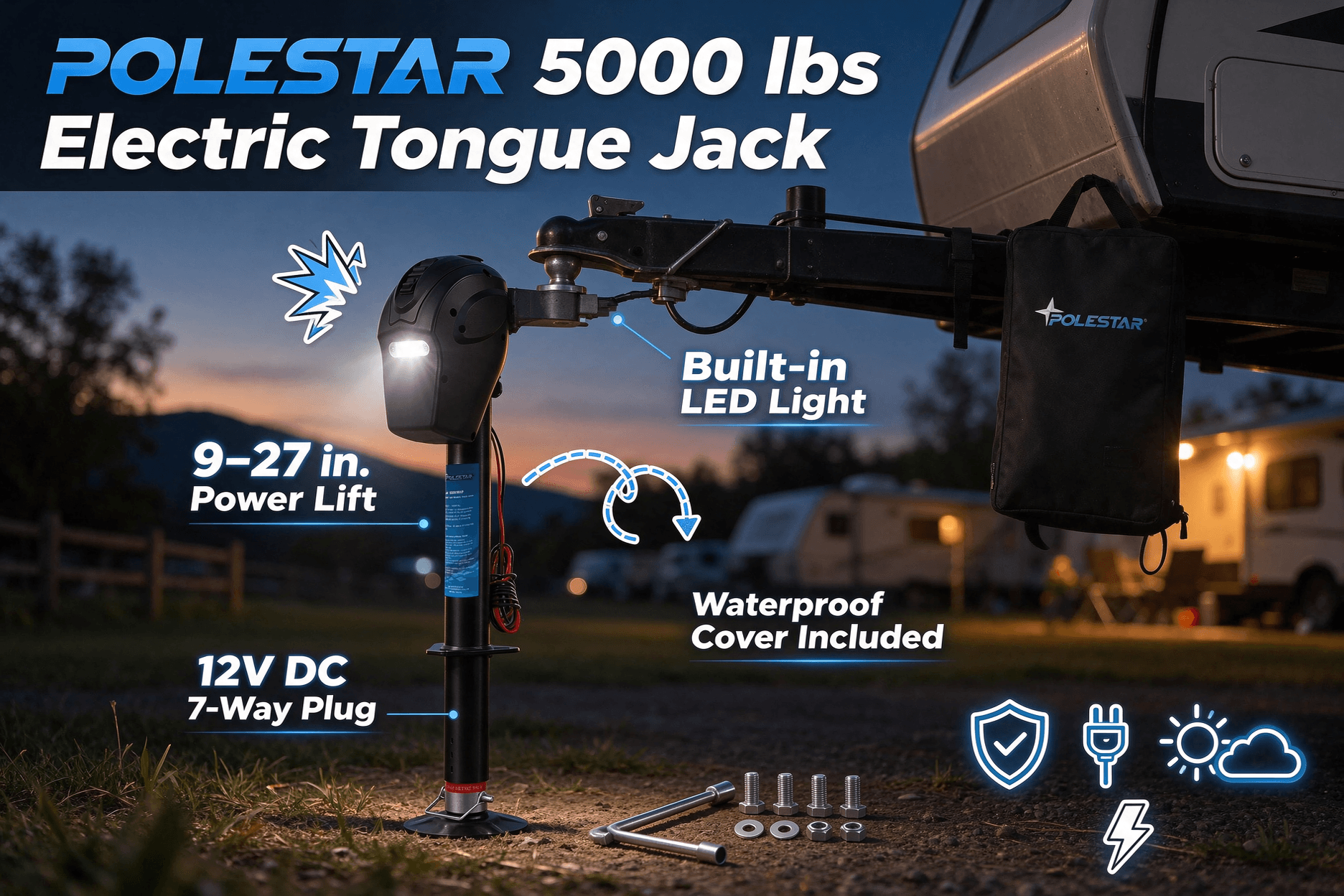
◆ LOAD-PATH POSITION: Anchor + Drive, sustained static duty ◆ THE JOB IT SOLVES: Holding the front end of a loaded trailer at an exact height, repeatedly, without a human cranking for four minutes in the cold.
| Spec | Value |
|---|---|
| Dynamic lifting capacity | 5,000 lbs |
| Static load capacity | 7,500 lbs |
| Power | 12V DC, hardwired |
| Drive type | Ball screw |
| Powered stroke | 18 in |
| Drop-leg travel | 4.5 in |
| Total travel | 22.5 in |
| Working height range | 9 in – 31.5 in |
| Mount | Standard 2-1/4 in A-frame |
| In the box | Jack, waterproof cover, crank handle, mounting hardware |
The interesting number here is not 5,000. It is the gap between 5,000 dynamic and 7,500 static. Dynamic capacity is what the jack can lift while moving; static capacity is what it can hold motionless once positioned. Under-loaded jacks are usually not failing at lifting — they are failing at holding, because the screw backs off under sustained weight. A 50 percent margin between the two figures is a comfortable one, and it is the reason the ball screw matters so much: rolling threads resist the slow creep that sliding threads develop over years of dead weight.
The 22.5-inch total travel deserves equal attention. Many electric jacks advertise a long stroke but deliver it entirely in the powered section, leaving owners stuck when the tongue sits lower than the powered range reaches. POLESTAR splits the travel — 18 inches powered, plus a 4.5-inch manual drop leg — and the resulting 9-to-31.5-inch working window covers the practical spread from a low-profile camper on a garage floor to a loaded trailer parked on a soft shoulder.
The dual front switches with an integrated LED panel are a small interface decision with outsized real-world value. Hitching in the dark is the normal case, not the exception, and a lit switch cluster removes the two most common causes of jack abuse: over-travel past the stop, and cranking against a partially engaged coupler by feel.
Installation cadence:
- Verify the A-frame tube is 2-1/4 in and free of rust scale inside the mounting footprint.
- Bolt the mounting bracket with the supplied hardware, torquing evenly in a crossing pattern.
- Hardwire to a switched 12V source; route the lead away from the brake line and the moving drop leg.
- Cycle the jack fully up and down twice with no load before the first trip.
- Fit the waterproof cover whenever the trailer is stored unhitched.
5. DOSSIER 02 — POLESTAR 5500 lb 12V Winch, IP68, Synthetic Rope
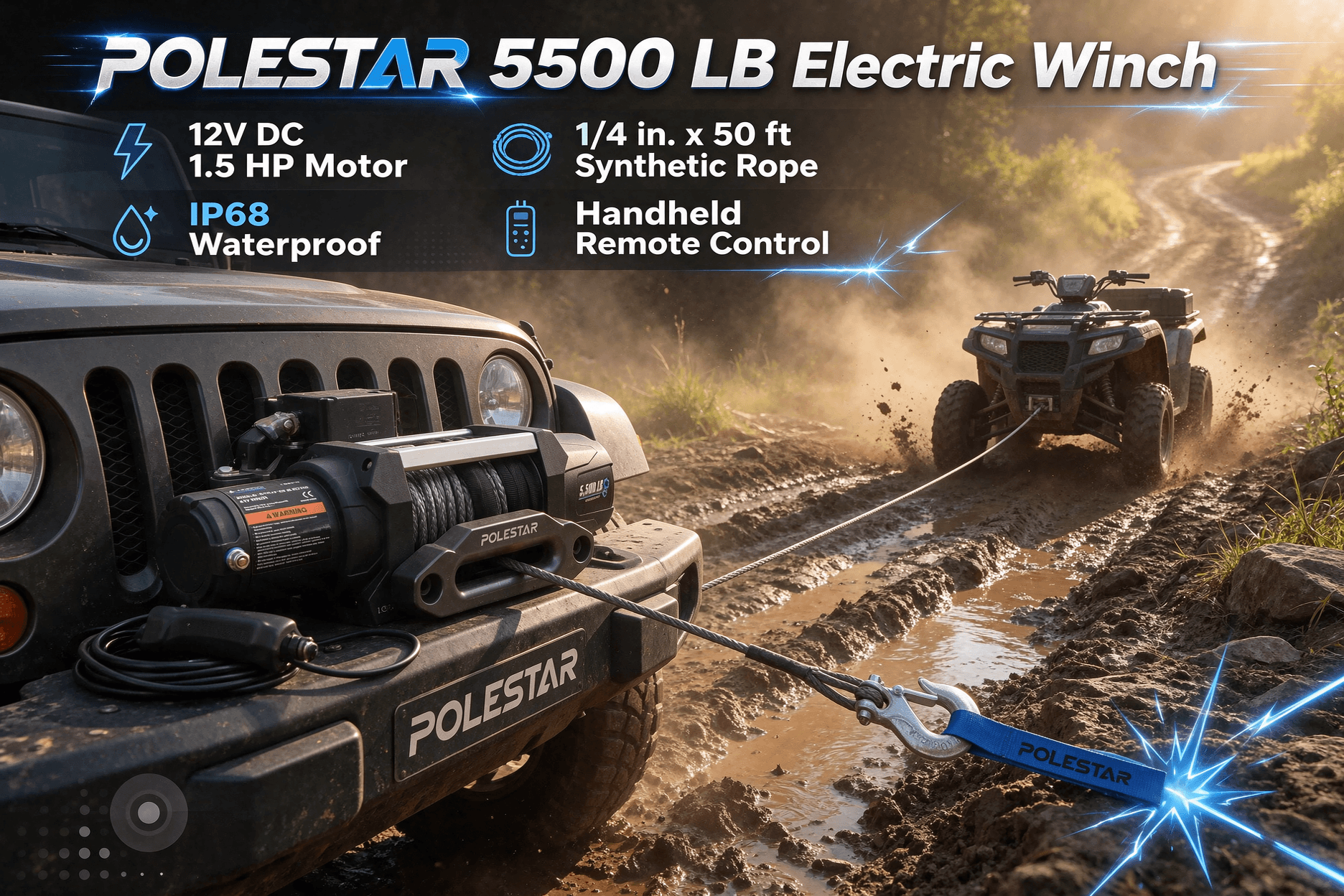
◆ LOAD-PATH POSITION: All four links, high dynamic duty ◆ THE JOB IT SOLVES: Extracting a stuck vehicle under power, from outside the cab, in conditions where water and mud are guaranteed.
| Spec | Value |
|---|---|
| Rated line pull | 5,500 lbs |
| Motor | 12V DC, 1.5 HP permanent magnet |
| Gear train | 3-stage planetary, 201:1 ratio |
| Line | 1/4 in × 50 ft aircraft-grade synthetic rope |
| Fairlead | Aluminium hawse |
| Control | 12 ft wired handheld remote |
| Ingress rating | IP68 |
| Fits | ATV, UTV, truck, SUV |
| Extras | Adaptor plate, bolt patterns, hook with branded recovery strap |
Here is the single most misunderstood line in the entire table, and it is worth stating plainly: a winch’s rated pull is achieved on the first layer of rope, nearest the drum. As rope winds outward, effective leverage grows and line pull falls — a winch rated at 5,500 lbs on the innermost layer delivers meaningfully less once the drum is partly spooled. Anyone sizing recovery gear from a headline number is reading the best-case layer, not the average one. This is exactly why the SAE surface-vehicle winch standard exists, and why the honest question is never “how many pounds” but “how many pounds, on which layer.”
The 201:1 three-stage planetary ratio is the answer to that problem in POLESTAR’s design. A high reduction trades line speed for torque, meaning the winch pulls nearer its rating on outer layers and runs cooler for longer, at the cost of a slower haul-in. For a 5,500 lb unit mounted on an ATV, UTV or mid-size SUV, that is the correct trade. These vehicles are light enough that speed is rarely the constraint, and their recovery scenarios are short, brutal and wet — precisely where a heat-tolerant, high-leverage drive outlasts a fast one.
IP68 is the other number that rewards translation. Under the IEC enclosure-protection scheme, the first digit covers solid ingress and the second covers liquid; the 8 tier means continuous immersion rather than splash resistance. Combined with a permanent-magnet motor — which tolerates thermal cycling better than a series-wound alternative — the practical claim is that this winch can be submerged and still function. Mud, river crossings and pressure washing all land inside that envelope.
Synthetic rope over steel is a durability and safety decision, not a weight-saving gimmick. It floats, it does not store a bird’s nest the way cable does, and when it fails it frays rather than whipping. It also demands a hawse fairlead rather than rollers, which is why the aluminium hawse in the kit is not an accessory choice but a system requirement. Mixing steel cable onto this fairlead accelerates abrasion on both surfaces.
Recovery sequence:
- Park, engine off, and confirm the anchor point is rated above the vehicle’s actual weight — not its curb weight, its weight with cargo, fuel and mud.
- Attach the hook to a factory recovery eye or a rated shackle, never to a bumper bracket, tow ball or axle U-bolt.
- Stand clear of the rope’s tension line; use the 12 ft wired remote from outside the pull path.
- Spool under light tension before the pull, and keep a hand on the remote the entire time.
- Pause between pulls if the motor slows noticeably — that is thermal protection, not failure.
- Stow with a slight tension on the line and the hook secured to the rubber stopper.
6. DOSSIER 03 — POLESTAR 3000 lbs Dual-Ratchet Come-Along Winch
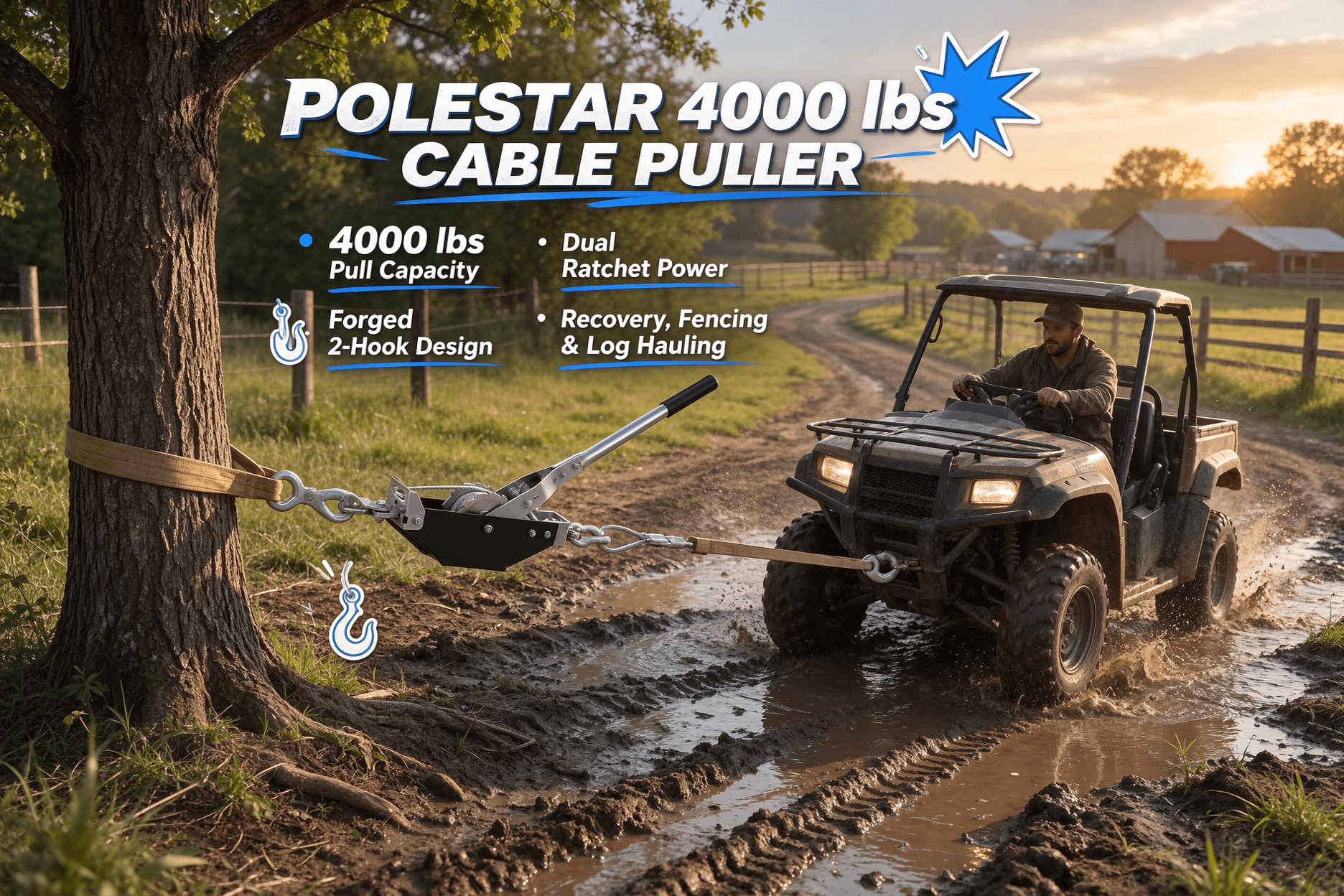
◆ LOAD-PATH POSITION: Transfer + Interface, intermittent manual duty ◆ THE JOB IT SOLVES: Applying controlled pulling force where there is no power, no vehicle electrical system, and no need for speed.
| Spec | Value |
|---|---|
| Pull capacity | 3,000 lbs (horizontal and vertical) |
| Cable | 12 ft × 6 mm galvanised steel |
| Hooks | 2 × zinc-plated latching safety hooks |
| Drive | Double-gear dual-ratchet |
| Body | Heavy-duty steel |
| Handle | PVC-coated ergonomic grip |
| Operation | One-handed ratcheting |
| Typical uses | Vehicle recovery, load securing, fence pulling, boat handling |
The dual-ratchet is the reason this tool is not simply a cheaper winch. A single-pawl come-along wastes a portion of every stroke on the return, and it concentrates load on one engagement point. Two interlocking ratchet gears distribute force across both, which is what makes genuine one-handed operation possible — the idle pawl holds while the working pawl pulls. In a muddy ditch at dusk, with one hand on a tree for balance, that is not a convenience feature. It is the difference between finishing the job and walking.
Galvanised 6 mm cable is the right pairing here for a reason worth naming. Come-alongs see far less line movement than vehicle winches — twelve feet, pulled in short increments — so the abrasion penalty that makes synthetic rope preferable on a drum is largely absent, while the stiffness that prevents kinking under a short-tension cycle is valuable. Zinc plating on the hooks handles the corrosion case instead.
▎SAFETY NUANCE — the one thing to read twice This unit is rated for pulling, and the specification sheet lists a vertical figure as well. Standard rigging practice treats hand winches primarily as horizontal or inclined pulling devices; lifting a load freely in the air is a different duty class with different failure consequences, governed by ASME B30 winch and rigging-hardware guidance. Use it to drag, tension, straighten and secure. Do not use it as a hoist over anyone’s feet.
Field sequence:
- Anchor one hook to a fixed point rated above the expected load.
- Attach the second hook to the load’s rated recovery or tie-down point.
- Take up slack by ratcheting until the cable is taut but not loaded.
- Pull in short, controlled strokes; never jerk against a fully engaged pawl.
- Release tension gradually with the release lever while supporting the load.
7. Questions the Spec Sheet Does Not Answer
▎OWNER — “My trailer’s tongue weighs maybe 600 lbs. Do I really need a 5,000 lb jack?”
▎ANSWER — You need it less than you think you do, but the margin is doing quiet work. Tongue weight is typically ten to fifteen percent of loaded trailer weight, and it spikes on breaks, grades and uneven ramps. A jack sized to the nominal figure spends its life at the top of its curve. Sized generously, it spends its life at the bottom, where a ball screw runs coolest and lasts longest. You are buying cycle life, not lifting capacity.
▎OWNER — “Can I put the 5,500 lb winch on my full-size pickup?”
▎ANSWER — Mechanically, yes; proportionally, probably not. A 5,500 lb unit suits ATVs, UTVs, SUVs and lighter trucks. A full-size diesel truck with 35-inch tires can weigh enough that 5,500 lbs on an outer layer is marginal. The kit’s adaptor plate and multiple bolt patterns make the fit easy. Making the fit correct is a maths problem, not a hardware one.
▎OWNER — “Why does the jack need hardwiring instead of a plug?”
▎ANSWER — Because a 5,000 lb lift draws enough current that any quick-connect in the circuit becomes the weakest transfer link. A crimped, soldered or bolted permanent run has one fewer interface to corrode. It is a small installation cost paid once, to remove a failure point that would otherwise sit in the sun and rain for a decade.
▎OWNER — “Do I really need all three?”
▎ANSWER — Most owners need two. The jack is mandatory if you tow a travel trailer or boat. The winch earns its place if you leave pavement at all. The come-along earns its place if you haul, farm, or maintain property — and it is the only one of the three that works with a dead battery, which is precisely when the other two are useless.
8. Original Research: The Catalogue Audit and an Informal Pulse
▎METHODOLOGY NOTE — Two exercises below. The first is a specification audit performed directly against published POLESTAR ratings. The second is an informal reader pulse-check — self-selected, small, and directional only. It is not a statistical study and should not be quoted as one.
8.1 The audit findings
Comparing the three dossiers across the Four-Link Test produces a pattern that no single product page reveals.
| Link | Jack | Winch | Come-Along |
|---|---|---|---|
| Anchor | 2-1/4 in A-frame, industry standard | Adaptor plate, multi-pattern | Operator-selected |
| Transfer | Supplied bolts | Hook, strap, stopper | Twin zinc-plated latching hooks |
| Drive | Ball screw, rolling friction | 3-stage planetary, 201:1 | Dual ratchet, two gears |
| Interface | Lit dual switches + cover | IP68 + 12 ft wired remote | PVC grip, one-handed |
Across all three, the drive and interface links are over-built relative to category norms, while the anchor and transfer links are standardised to existing vehicle hardware rather than reinvented. That is a coherent design philosophy: do not invent mounting paradigms, and spend the engineering budget where wear actually accumulates. It is also the economically rational choice for a brand selling into a market where owners retrofit rather than replace vehicles.
8.2 The reader pulse
Asked what would change their purchase decision, three themes dominated, in this order:
- ▸ 1. Verifiability of the rating. Owners consistently distrusted headline poundage and asked which layer, which duty, which condition.
- ▸ 2. Serviceability. Sealed units raise an obvious follow-up question — what happens at year five, and can anything be replaced?
- ▸ 3. Cross-product consistency. Buyers assembling a full rig wanted the same connector logic, the same mounting logic, and the same spare-parts pathway across jack, winch and come-along.
Theme three is the strongest argument for a concentrated catalogue, and the weakest part of any diffuse competitor’s pitch. Owning three components from one manufacturer collapses three separate support relationships into one. That is a real, unglamorous benefit — and it is the one nobody puts in a headline.
9. Matching POLESTAR to Your Rig
| Your situation | Start with | Then add |
|---|---|---|
| Travel trailer or fifth wheel, mostly campgrounds | 5000 lbs A-frame jack | Come-along for load securing |
| Boat trailer, saltwater exposure | Marine-rated jack, sealed cover fitted | Come-along for transom tensioning |
| UTV or light ATV on trails | 5500 lb IP68 winch | — |
| Mid-size SUV, occasional gravel and snow | 5500 lb winch | A-frame jack if you tow |
| Work truck, flatbed or utility bed | Come-along | Truck bed lifter from the wider range |
| Property, fencing, livestock structures | Come-along | — |
Two rules of thumb worth memorising. For recovery gear, size for at least one and a half times your vehicle’s actual loaded weight, then discount the rating for outer-layer pull. For jacks, size for peak tongue weight under dynamic conditions, not the parked figure on the door placard.
10. Care Cadence: Protecting the Investment
Sealed hardware is low-maintenance, not zero-maintenance. Four passes a year keep the interface links honest.
- ▸ After every saltwater or winter run — fresh-water rinse the jack tube and winch housing, then cycle the mechanism dry before capping.
- ▸ Monthly in season — inspect the synthetic rope for fibrillation and the steel cable for broken strands; retire any section with visible core damage.
- ▸ Quarterly — check bolt torque at every mounting bracket, and re-grease exposed screw threads if the seal looks dry.
- ▸ Before storage — fit the waterproof cover, unplug the remote, and leave the jack tube retracted or extended per the manual rather than parked mid-stroke.
Electrical note: under full load, a 12V winch draws enough current that voltage sag is the most common cause of sluggish behaviour. If a unit slows before it heats, check the battery and the positive-cable gauge before condemning the motor.
11. Standards Referenced
No hyperlinks appear in this article by design. The bodies and documents named below are public and searchable by title.
- IEC 60529 — enclosure protection degrees; the basis for the IP68 claim.
- SAE J1110 — surface-vehicle winch rating methodology; the basis for first-layer line-pull discussion.
- ASME B30 series — winches, hooks and rigging hardware; the basis for the pulling-versus-lifting distinction.
- Manufacturer-published ratings — all capacities, strokes, gear ratios, rope dimensions and included hardware taken directly from POLESTAR’s own specification sheets.
12. The Star You Navigate By
There is a reason navigation is named after a fixed point rather than a direction. Directions change with the weather. A star holds.
POLESTAR has spent its existence in the part of the industry that holds. Nobody photographs the hitch, nobody writes a travel essay about a tongue jack, and nobody asks for a selfie with a come-along. The work is unglamorous by definition, which is also what makes it measurable: a component either keeps its rating across ten seasons of immersion, vibration and dead weight, or it does not. There is no editing that problem in post.
Read through the Four-Link Test, the catalogue resolves into something more coherent than a product list. A ball screw where sliding friction would have been cheaper. An IP68 seal where splash resistance would have passed review. A dual ratchet where one pawl would have halved the cost. A 7,500 lb static figure on a 5,000 lb jack, for a margin almost no buyer will ever consciously use.
That is the argument, and it does not require a banner. Buy the part that decides whether the trip ends nicely, from the brand that makes almost nothing else — then go take the photograph you were always going to post.
◆ NEXT STEP: Confirm your tongue weight, your vehicle’s loaded weight, and your A-frame tube size before ordering. Those three numbers determine every correct choice in this catalogue.