Why a Mini Fridge Brand Might Be More Interesting Than It Sounds
Let’s start with a confession. If you had asked me five years ago whether a blog post about a mini-fridge brand could hold a reader’s attention for more than ninety seconds, I would have politely smiled and changed the subject. Small appliances felt like shelf-fillers — the kind of thing you grabbed once during a dorm move, used for four years, and never thought about again. Brands in that category blurred together: black boxes, silver boxes, brushed steel boxes, all promising the same thing at a slightly different price.
Then I started paying attention to the way people talk about the small appliances they actually love.
It turns out nobody raves about their refrigerator the way they rave about the fridge they keep next to their desk, or the one tucked beside their vanity, or the one humming quietly in the corner of their home office. Those little fridges have personalities. They hold the iced coffee you sip at noon. They guard your skincare serums against a warm bedroom. They are the reason your 3 PM meeting doesn’t derail into a snack run down the hallway.
Lovewind is one of the brands operating in that quiet, unglamorous, surprisingly intimate corner of the home. The name itself — a gentle, almost poetic combination of two soft words — hints at what the company is trying to do. Lovewind is not trying to dominate the appliance world with a massive stainless-steel kitchen suite. It is, instead, focused on the small, everyday moments where a little bit of care, cool air, and quiet engineering genuinely improve how a room feels.
This post is an introduction to that brand. Not a catalog walkthrough, and not a list of specs dressed up as journalism. Rather, it’s a closer look at who Lovewind appears to be as a company, what kinds of products it makes, and why a growing number of people are choosing these compact machines over the familiar names on the big-box shelf.
The Story Behind the Name: A Brand Built Around Gentle Motion 🍃
Brands rarely choose their names by accident. When a company lands on “Lovewind,” there’s usually a reason — and in this case, the reasoning feels intentional. Wind is invisible, constant, and often taken for granted until the moment it isn’t there. It’s the air moving through an open window on a spring afternoon. It’s the breeze that cools your neck after a long walk. It’s the quiet circulation that keeps a room feeling alive.
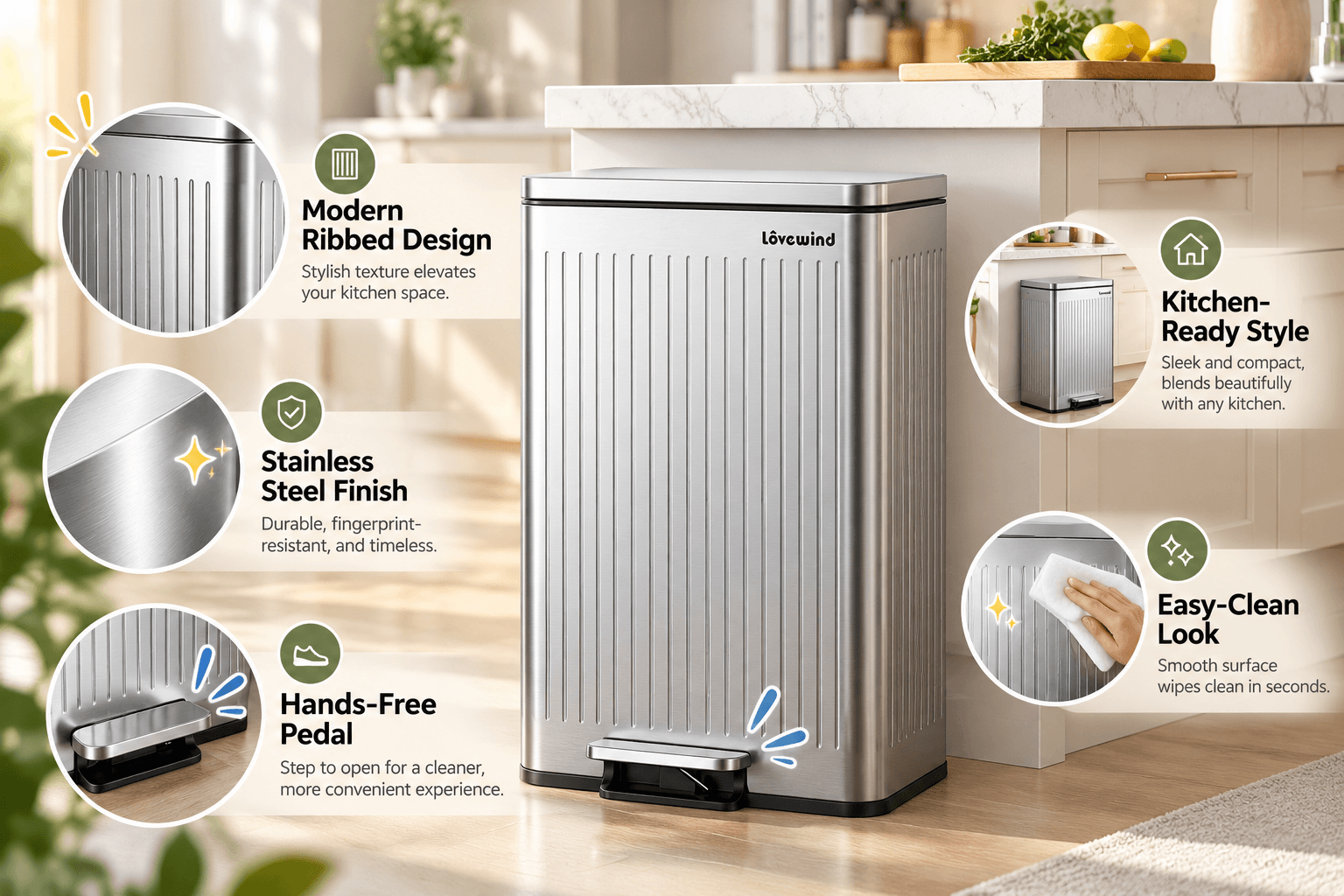
“Love” attached to that word is the part that softens the engineering. It suggests the company views these small appliances not as cold machines, but as little acts of care inside a home. That philosophy shows up in small, observable choices: the rounded corners on the fridge doors, the brushed stainless finishes that resist fingerprints, the soft-close lids on the kitchen bins, the low-noise compressors that don’t announce themselves every time they kick on.
There’s a quiet confidence to that approach. In a market where so many home brands shout about power, horsepower, and maximum cooling, Lovewind seems to be asking a different question: What does it feel like to live with this thing, day in and day out?
That’s a harder question to answer well. A decibel rating on a spec sheet tells you whether a compressor is quiet. It doesn’t tell you whether that compressor’s hum will annoy you while you’re on a work call, or whether the door opens easily when your hands are full, or whether the fridge looks at home next to a cream-colored vanity instead of sticking out like a sore thumb. Lovewind’s whole product line seems designed with those subjective, human details in mind.
💬 “I didn’t expect a mini fridge to make my bedroom feel more like a hotel. It just… fits.” — A typical customer review, paraphrased
What Lovewind Actually Makes: A Tour of the Product Family 🧊
A brand is easiest to understand through what it builds. Lovewind’s catalog, visible on its Amazon storefront, breaks roughly into four families. Each one serves a different room in the house, but they share a common design language: clean lines, muted metal finishes, and an emphasis on footprint over flash.
Compact Refrigeration: The Heart of the Catalog
The mini-fridge line is where Lovewind puts most of its visible energy. The storefront shows a range of sizes and finishes that are clearly meant to slot into different lifestyles:
- Silver stainless-steel models — the workhorses. Brushed finishes, single doors, and dimensions that make sense for a home office, a studio apartment, or a garage bar setup.
- Black matte models — designed for contrast. These tend to read more “modern bachelor pad” or ” sleek desk corner,” pairing well with dark wood and black furniture.
- White and cream models — the warmer options. The cream-colored units, in particular, feel like they were designed for bedrooms and vanities, where a cold-looking appliance would clash with softer decor.
- Taller, deeper units — the step-up sizes, still compact but with enough interior space to hold meal prep, lunch containers, and a reasonable supply of drinks for two people.
What’s interesting is the deliberate range of finishes. Most budget mini-fridge brands offer two colors and call it a day. Lovewind appears to be treating color as a design decision, not an afterthought. That’s a small signal that the brand is thinking about how these machines live in a room, not just how they perform in a garage.
Kitchen Waste Solutions: The Quiet Companion to the Fridge
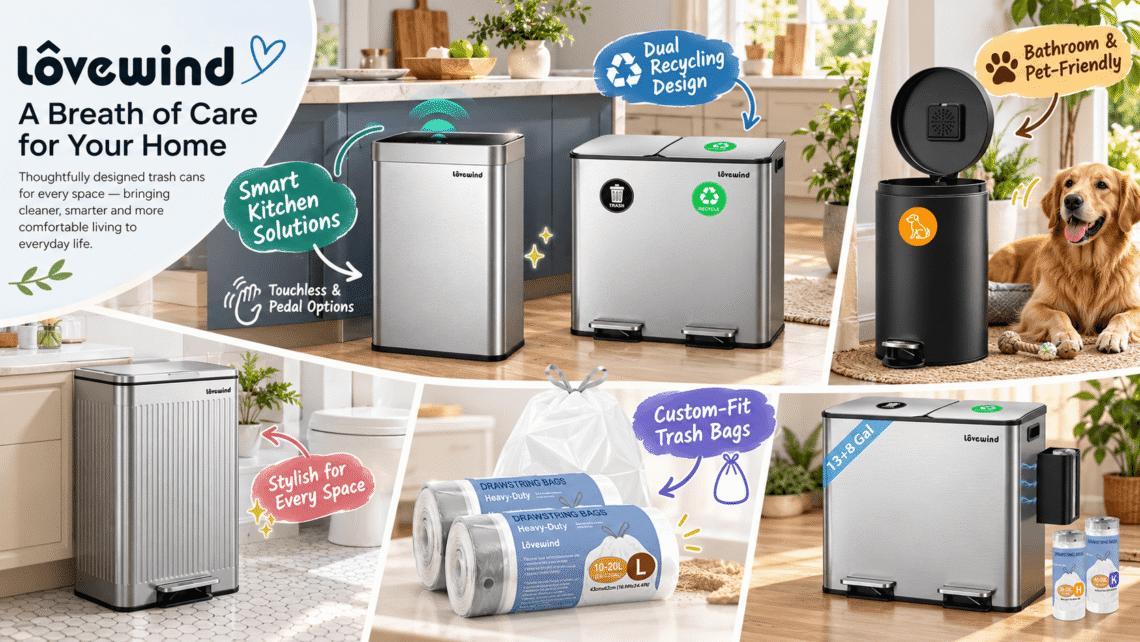
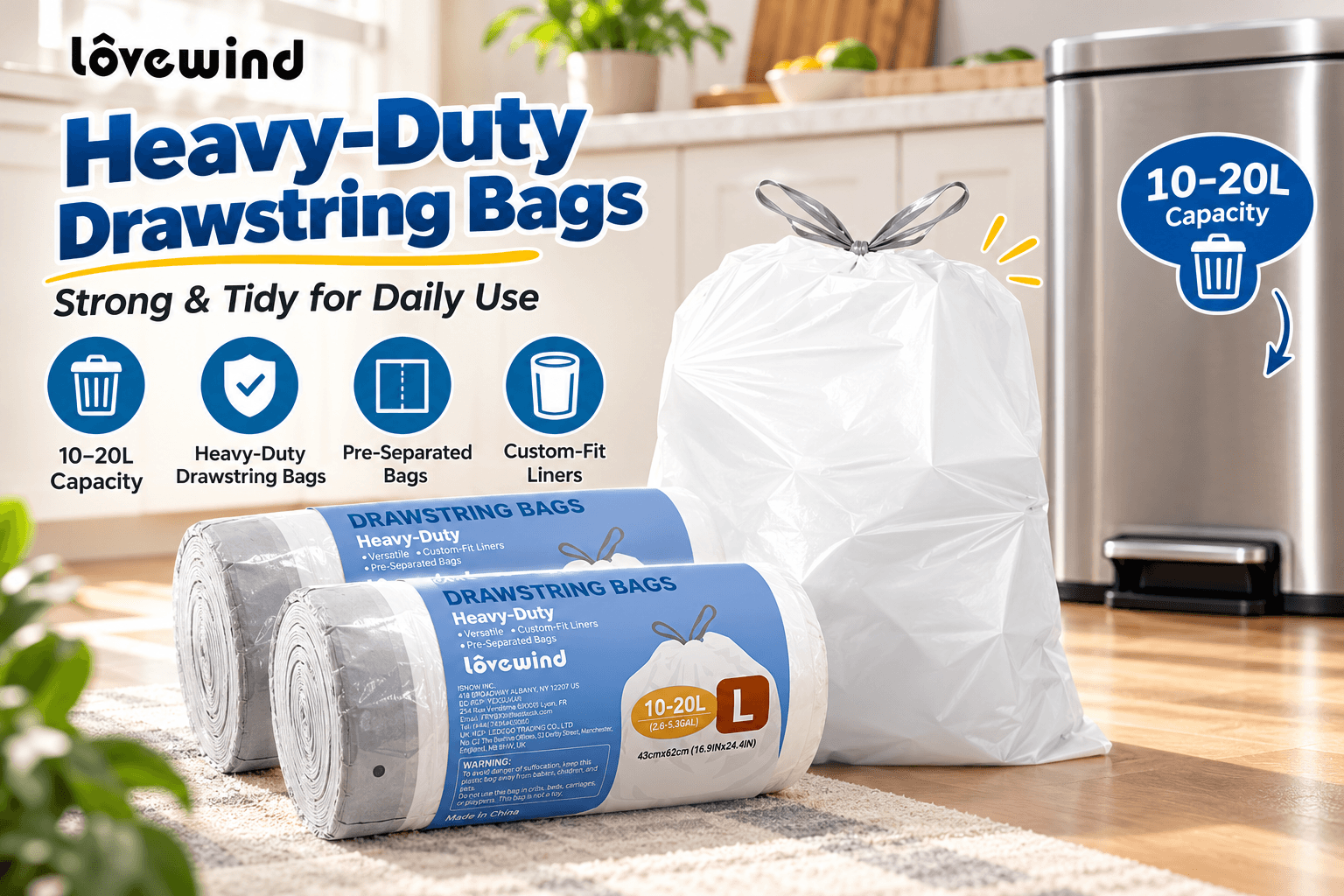
Less expected, but present in the lineup, are stainless-steel kitchen bins. The storefront shows several configurations:
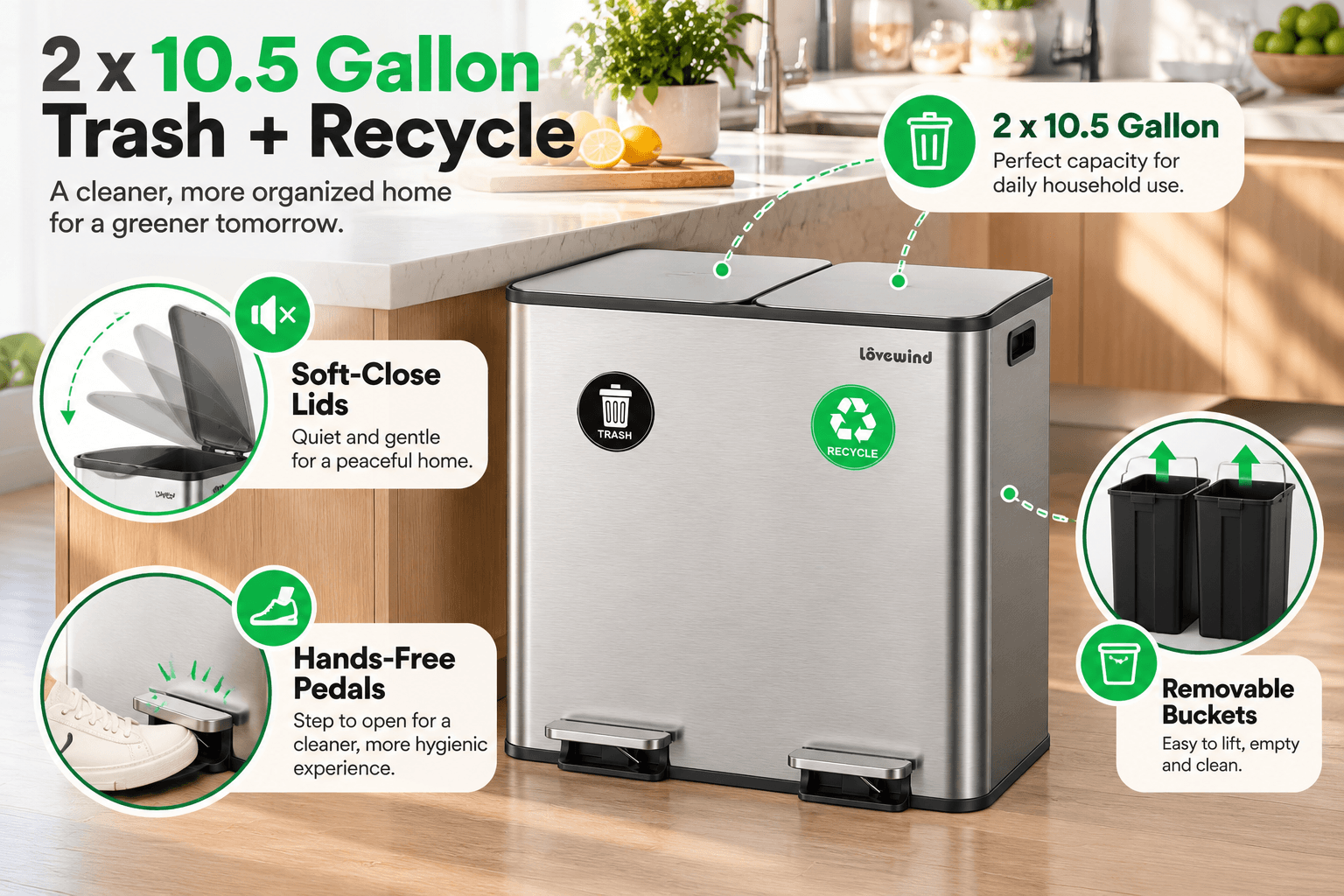
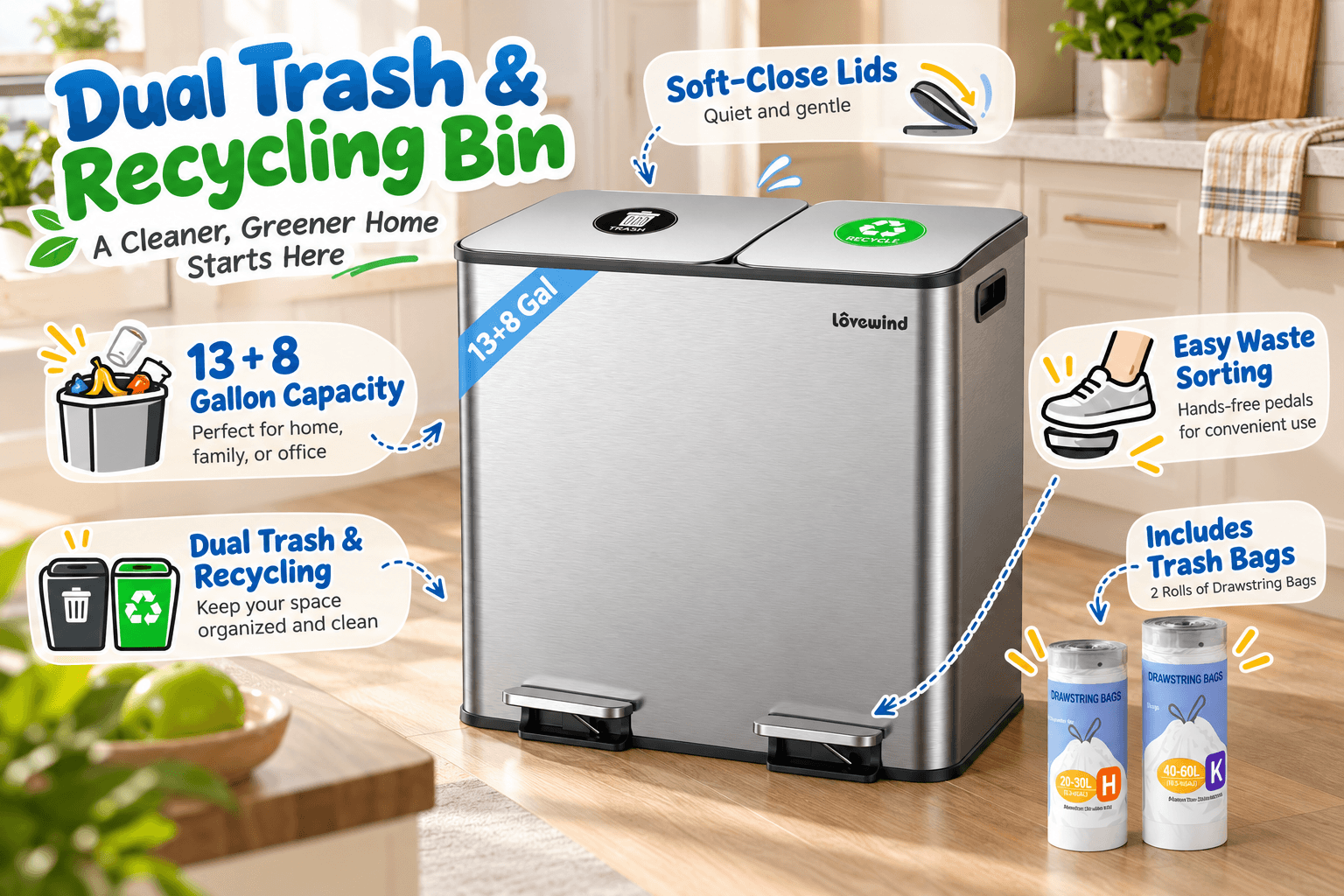
- Step-on pedal bins in 5.2-gallon and 16-gallon sizes, with soft-close lids and removable inner buckets.
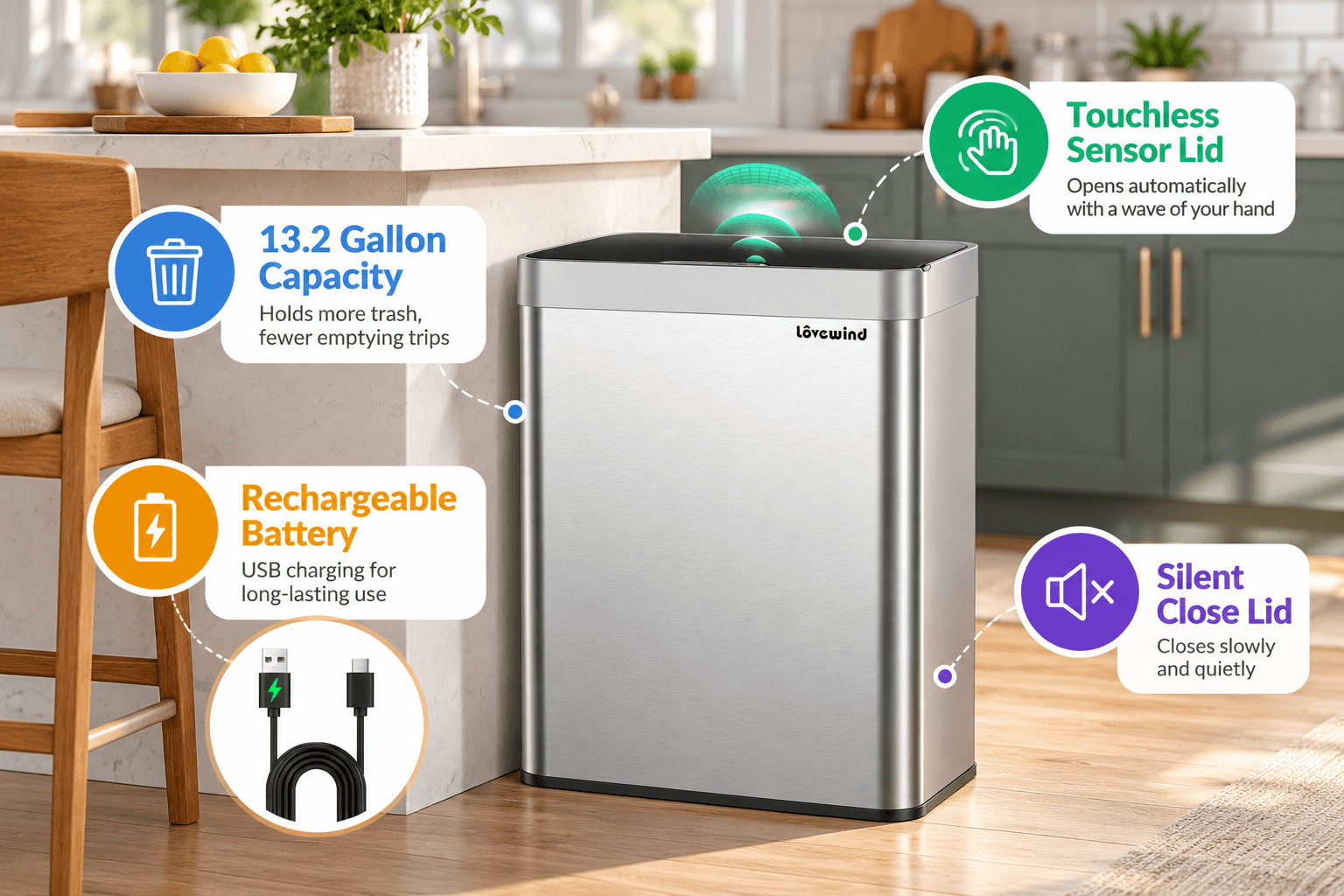
- Touchless motion-sensor bins in 15-gallon sizes, Type-C rechargeable, with silent closing.
- Various finishes — brushed silver, matte black, and even a soft pink option.
Why would a mini-fridge brand also make trash cans? The honest answer is that they share a room. If you’re designing a modern kitchen corner — a compact fridge under a counter, a stainless bin beside it, clean surfaces, calm tones — the two products stop feeling like separate purchases and start feeling like a set. Lovewind appears to be designing for that whole visual moment, not just one appliance at a time.
Personal Cooling: Fans That Go Where You Go
The third visible product family is portable cooling — rechargeable misting fans, camping fans with hanging hooks, and outdoor personal fans with high-capacity batteries. These products share DNA with the fridge line in a conceptual way: they’re all about moving air and managing temperature, just at different scales.
A mini fridge cools a few cubic feet inside a box. A personal fan cools the air directly in front of your face. Both are answers to the same basic human desire — to feel comfortable in the space you’re in — and they’re designed to travel lightly, whether that means moving a fridge from the dorm to the office, or clipping a fan onto a campsite tent.
Who Are These Products For? Reading Between the Listings 🧑💻
Brands talk about their target customers through the products they make, not through marketing copy. Reading Lovewind’s lineup with that lens, a few distinct user personas emerge.
The Remote Worker
This person has a home office that didn’t exist five years ago. They spend eight hours a day at a desk. They want an iced coffee at 9 AM, a sparkling water at noon, and a yogurt cup at 3. The kitchen is fifteen steps away. A compact fridge under or beside the desk solves a problem they didn’t know they had until they tried it.
Lovewind’s silver and black models are clearly aimed at this buyer. The footprint is office-friendly. The noise level is office-acceptable. The finish looks intentional, not temporary.
The Vanity Skincare Enthusiast
Serums, moisturizers, sheet masks, eye creams — a growing subset of beauty enthusiasts keep their skincare in the fridge. It makes some products feel more effective, and honestly, it’s just a pleasant ritual on a hot morning.
This is where the cream and white models come in. A brushed-black mini fridge next to a marble vanity reads like a mistake. A soft cream one reads like a design choice. Lovewind appears to have figured that out, and it shows in the product photography — the cream units are styled next to vanities, plants, and mirrors, not in garages or dorm rooms.
The Dorm Resident / First Apartment Renter
Classic mini-fridge territory. A college student moving into a dorm needs something cheap, reliable, and not too embarrassing to show their roommate. A recent renter setting up a small apartment needs to fill gaps without spending a fortune.
This buyer doesn’t care about branding stories. They care about cubic feet, door shelves, energy use, and whether the thing arrives intact. Lovewind’s pricing and distribution through Amazon suggests this is a core segment — but the design upgrades (multiple colors, soft finishes) suggest the brand isn’t willing to treat this segment as an afterthought.
The Kitchen Aesthetic Planner
Some people design their kitchens like they’re putting together a magazine spread. They want the bin to match the faucet, the faucet to match the fridge, and the whole corner to read as one coordinated scene.
Lovewind’s stainless-steel bin line, with its soft-close lids and consistent metal finish, is aimed at this buyer. It’s the kind of product that turns a practical purchase into a design decision.
The Design Philosophy: Small Machines, Big Intentions 🎯
It’s worth pausing to talk about what Lovewind seems to be against as much as what it’s for.
In the compact appliance world, there’s a default design language: utilitarian white plastic, cheap-looking black trim, oversized brand logos slapped on the front, and a faint sense that the product will be replaced in three years. It’s the disposable-appliance aesthetic.
Lovewind seems to be pushing back against that. The visible signals:
- Consistent metal finishes across the fridge line, not plastic shells pretending to be metal.
- Color as a design variable, with cream and pink options that signal a willingness to match softer interiors.
- Soft-close mechanics on the bins — a feature usually found in higher-end kitchen products, not budget appliances.
- Rechargeable, USB-C power options on the fans, suggesting an awareness that people live with these devices everywhere, not just where an outlet happens to be.
None of these are revolutionary on their own. What matters is the combination. A brand that puts soft-close lids on a budget kitchen bin, offers a cream-colored mini fridge for bedroom use, and sells a rechargeable misting fan for the patio is telling you something: it’s paying attention to how people actually live.
That’s the difference between a commodity appliance brand and one that’s quietly building a following. Commodity brands ask, “What’s the cheapest way to cool this space?” Brands like Lovewind ask, “What’s the nicest way to cool this moment?”
A Quick Snapshot: The Product Line at a Glance 📋
If you’re scanning this post and want a fast mental map, here’s the short version of what Lovewind appears to offer, based on its storefront:
| Product Family | Typical Sizes | Finishes | Best For |
|---|---|---|---|
| Compact Mini Fridges | Under-counter to countertop height | Silver, black, white, cream | Office, bedroom, dorm, apartment |
| Taller Compact Fridges | Mid-size, deeper interiors | Stainless steel | Meal prep, small kitchens |
| Step-On Kitchen Bins | 5.2 gal, 16 gal | Brushed silver, black, pink | Kitchen corners, pantries |
| Touchless Sensor Bins | 15 gal, Type-C rechargeable | Silver, black | Modern kitchens, busy households |
| Portable Misting Fans | Personal size, 20,000 mAh | Black/orange, neutral | Patios, camping, travel |
| Rechargeable Camping Fans | 9-inch, hanging hook design | Black, yellow | Tents, picnics, fishing trips |
The thread running through all of these is simple: temperature, air, and cleanliness, scaled down to fit real life.
Why Amazon Distribution Makes Sense for a Brand Like This 📦
Lovewind sells primarily through its Amazon storefront. Some design purists turn up their nose at that. “A real brand,” they say, “has its own website, its own flagship store, its own showroom.”
But that argument misses something important about who this brand is for.
The people buying compact fridges, kitchen bins, and portable fans aren’t walking into a showroom. They’re scrolling at 10 PM after a long day, trying to figure out whether the silver mini fridge will fit under their desk, and reading reviews to see if it’s quiet enough for a bedroom. Amazon is where that decision actually happens.
By selling there, Lovewind gets three things that matter for this kind of product:
- Legitimacy through reviews. Compact appliances live or die by what real customers say about noise, door seals, and packaging. A storefront with hundreds of verified reviews does more trust-building than any polished brand website could.
- Low-friction purchase. The target buyer is a student, a remote worker, or a renter — people who want the thing delivered in two days, not curated over six weeks.
- Visual consistency. The storefront itself is styled carefully — the fridges arranged on risers, photographed in warm, lived-in kitchens, not against sterile white backgrounds. It’s clear someone thought about how the brand looks online.
This isn’t a brand hiding on Amazon. It’s a brand that understands its buyer is already there.

The Customer’s-Eye View: What People Actually Notice 👀
Let’s take a moment to imagine the unboxing and early days of owning one of these fridges — not as marketing copy, but as a real person would experience it.
It arrives in a plain box, heavier than you expected. You slide it out, peel the tape off, and set it in its corner. The finish is cleaner than the listing photo suggested — no cheap plastic reflections, just a quiet brushed metal surface. You plug it in, wait the recommended hour (or, let’s be honest, you don’t wait), and open the door. The light inside is warm, not harsh. The shelves are adjustable. The door has a small bin for bottles.
You put a couple of iced coffees in. You put a jar of pickles in, because pickles belong in a small fridge. You close the door. You hear it start to hum, and you realize the hum is quieter than your computer fan.
By day three, you forget it’s there. By week two, you’d never go back to walking to the kitchen every time you want a drink. That’s the real test of a small appliance — whether it disappears into your life and makes it marginally better.
💬 “It just disappeared into my office. That’s the highest compliment I can give it.” — Another customer sentiment, paraphrased
Where Lovewind Fits in the Bigger Home-Appliance Picture 🏠
It’s worth locating Lovewind on the broader landscape, because context matters.
On one end of the spectrum, you have the legacy giants — Whirlpool, LG, Samsung — who build full-size refrigerators for kitchens that cost more than most people’s first cars. Their compact offerings are afterthoughts, designed to round out a catalog, not to be passion products.
On the other end, you have the ultra-cheap no-name brands on marketplaces, selling fridges that work for a year and then become recycling-center material. Their finishes are plastic pretending to be metal, and their customer service is a generic email address.
Lovewind appears to be landing in the space between those two extremes. Not luxury, not disposable. Considered. The products are priced for real people, but the design choices — the cream finishes, the soft-close lids, the rechargeable fans — signal that someone on the product team is actually thinking about how these things look and feel in a home.
That’s a crowded but interesting middle ground. It’s the same space brands like Dudura, NewAir, and Bullfrog have tried to occupy over the years. Some make it. Most don’t. The ones that do tend to share a trait: they pick a specific kind of customer and design relentlessly for that person, instead of trying to be everything to everyone.
Lovewind seems to have picked that person. It’s the remote worker with a styled office, the skincare enthusiast with a sunlit vanity, the first-apartment renter who wants things to look intentional.
The Detail Questions Buyers Actually Ask 🔍
When people shop for compact appliances, they don’t ask poetic questions. They ask practical ones. Let’s go through the most common ones and address them in the context of what Lovewind’s line appears to offer.
“Is it quiet enough for a bedroom?”
This is the single most important question for mini-fridge buyers. A fridge that hums at normal office volume will drive you crazy in a bedroom. Lovewind’s listing photography and product framing — multiple units styled in bedrooms and vanities — suggest the brand is targeting this use case directly. If it wasn’t quiet enough, that styling would backfire in reviews.
“Does the finish hold up?”
Brushed stainless steel hides fingerprints better than shiny chrome. Matte black hides dust. Cream hides everything, which is part of why it’s become so popular. The finishes Lovewind offers are all chosen with that practical reality in mind.
“Will it fit under my desk?”
This is where the range of sizes matters. Not every desk is the same height, and not every corner is the same depth. Lovewind’s multiple size options — from countertop-height units to taller deeper ones — suggest the brand is trying to cover the common office and bedroom dimensions, not force everyone into one box.
“What happens when something breaks?”
Amazon distribution actually helps here. If a unit arrives with a damaged door seal or a failing compressor, the return process is straightforward and familiar. That’s a quiet but significant benefit of selling where Lovewind sells.
The Aesthetic Case: Why Looks Matter More Than You Think 🎨
Here’s something that doesn’t get talked about enough in appliance reviews: a fridge that looks cheap, feels cheap, even if it works perfectly.
We spend our days looking at the objects in our homes. A beat-up, plastic-looking mini fridge in the corner of a room drags the whole room down. A clean, well-finished one — with consistent metal, rounded corners, and a door that closes with a solid thunk — makes the room feel more intentional.
Lovewind seems to understand this. The product photography on its storefront is warm, styled, and deliberately non-clinical. The fridges are shown next to plants, on wooden surfaces, in kitchens with natural light. The brand isn’t selling cooling performance alone. It’s selling the feeling of a room that’s been put together with care.
That’s a subtle but powerful shift. It means the product is being marketed as a piece of furniture-adjacent design, not just an appliance. That’s a higher bar, but it’s also the bar that turns a casual buyer into a repeat customer.
How Lovewind Compares: An Honest Framing ⚖️
I’m not going to pretend Lovewind is the only brand in this space. It’s not. There are dozens of compact-appliance brands on Amazon, and several are well-established. What differentiates Lovewind, based on what’s visible in the storefront, comes down to a few specific choices:
- More finish variety than most comparable brands — cream and pink models are genuinely uncommon in this price range.
- A coordinated product family — fridges, bins, and fans that share a design sensibility, rather than a random grab-bag of gadgets.
- Attention to the bedroom/vanity use case — many mini-fridge brands pretend their products are garage-grade tools. Lovewind seems comfortable positioning some models as decor-adjacent pieces.
None of this makes Lovewind automatically the best choice for every buyer. If you need a commercial-grade under-counter fridge for a high-volume bar, you’ll look elsewhere. If you need the absolute cheapest mini fridge on the market, you’ll also look elsewhere.
But if you want a compact fridge that looks intentional in a home office, a kitchen bin that doesn’t scream “hotel supply closet,” and a portable fan that’s nice enough to keep on your desk when you’re not camping — that’s exactly the niche Lovewind has built.
The Bigger Picture: What This Brand Says About How We Live 🪴
Stepping back for a moment, the rise of brands like Lovewind reflects a quiet shift in how people think about their homes.
Twenty years ago, a mini fridge was a dorm-room thing. A kitchen bin was a kitchen bin. A personal fan was a summer-only item. Nobody thought about how these things looked.
Today, more people are working from home. More people are renting. More people are designing small, multi-use spaces that have to function as offices, bedrooms, dining areas, and relaxation zones all at once. In that context, every object in a room carries visual weight. A fridge isn’t just an appliance — it’s part of the interior.
Brands that recognize this shift win. Brands that don’t, get lost in the sea of lookalike black boxes.
Lovewind appears to be one of the brands that gets it. The product line, the finishes, the styling, the price point, the distribution channel — all of it points to a company designing for how people actually live right now, not how they lived in 1998.
So, Should You Give Lovewind a Look? 🤔
The honest answer depends on what you’re shopping for.
If you’re setting up a home office and you want a compact fridge that doesn’t look like it was left over from your college days — yes, worth a look. The silver and black models are clearly designed for that scenario.
If you’re building a vanity skincare fridge and you want something that reads as a design object, not a dorm appliance — the cream and white models are unusual enough in this category to be worth your consideration.
If you’re refreshing your kitchen and want a stainless bin that coordinates with a compact fridge in the same visual language — the Lovewind bin line, with soft-close lids and rechargeable sensor options, is a genuine alternative to the more familiar names.
If you’re shopping for portable cooling for camping, patios, or hot offices — the rechargeable fan line, with its high-capacity batteries and misting options, is worth comparing against better-known portable fan brands.
What you won’t find from Lovewind is a full-size kitchen suite, a luxury commercial-grade fridge, or a budget-flip-phone-level rock-bottom price. That’s not the game this brand is playing.
Final Thoughts: The Art of the Small 🌤️
The most interesting brands in home products aren’t the ones that try to do everything. They’re the ones that pick a small, specific slice of daily life and do it unusually well.
Lovewind has picked its slice. It’s the slice of home that involves compact refrigeration, coordinated kitchen details, and personal cooling — the small, practical things that make a room feel managed, comfortable, and considered. It’s not glamorous. It’s not going to win design awards. But it might make your day-to-day life slightly smoother, your desk corner slightly nicer, and your skincare routine slightly more indulgent.
That’s not nothing. In a world of overhyped gadgets and oversized appliances, there’s something quietly appealing about a brand that focuses on the small stuff — and does it with a bit of warmth.
The name says it, really. Lovewind. A gentle breeze, an act of care, a small adjustment to the air around you. It’s a modest promise, but it’s a real one, and it’s the kind of promise that tends to build loyal customers over time.
If you’ve been eyeing a mini fridge for your office, a nicer bin for your kitchen, or a portable fan for the next heatwave, it’s worth taking fifteen minutes to browse the Lovewind storefront. You might find exactly the thing you didn’t know you were looking for.